Jump to ratings and reviews
Rate this book

A River Wide

Rate this book
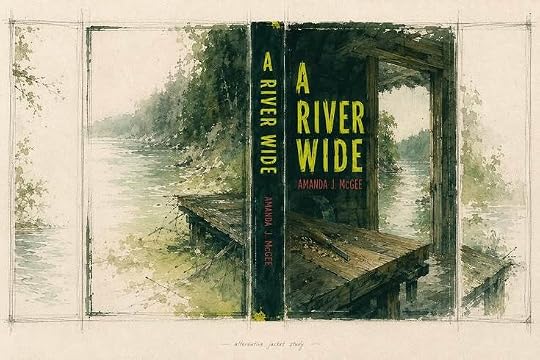
Mountains have deep, dark hearts, and those hearts are carved by water. Deep in the shadowed hollers of Appalachia, Rhia Blackburn has always kept her powers and her heart buried. Around here, the river whispers dark secrets, the earth remembers every cut, and survival is a skill women pass down in blood. But when her cousin Amey is kidnapped up the mountain, Rhia is forced to confront the terror of her home and her own troubled history. To save her, Rhia must trust her powers—and herself—because in Appalachia, family comes first and water always finds a way.
An Appalachian horror novella about family, grief, and the stubborn strength it takes to survive.

98 pages, ebook

Published September 7, 2026

Loading...
Loading...

About the author

Amanda J. McGee

7 books25 followers
Amanda J. McGee is a planner by day and a writer by night. When not writing, Amanda can be found reading books or hiking mountains, depending on the season. She lives in Southwest Virginia with the love of her life, her son, two fluffy cats, and a plethora of plants.

Her work includes the dark epic fantasy series The Creation Saga, poetry in Artemis Journal XXX and the Poetry in Place Project funded by the City of Roanoke in April of 2023, the horror novella “Viridian” published in 2020 in A Sinister Quartet from Mythic Delirium, and the forthcoming novella A River Wide from Interstellar Flight Press. You can find out more on her website at http://amandajmcgee.com.

Ratings & Reviews

What do you think?
Rate this book

Friends & Following

Create a free account to discover what your friends think of this book!

Community Reviews

5 stars
25 (15%)
4 stars
80 (50%)
3 stars
46 (29%)
2 stars
6 (3%)
1 star
0 (0%)
Displaying 1 - 30 of 141 reviews
Profile Image for Stitching Ghost.
1,666 reviews447 followers
Read
September 2, 2026
I had a pretty good time with this novella, I mean it's easy for me to have a good time when the pacing is so snappy. Sometimes I almost wished it took its time a little more but the whole story takes place over a fairly short period of time. It's the kind of story that could easily be a starter for something much longer/bigger.

The characters are perhaps a little on the cliché side but Rhia was easy enough to root for and I really got invested in her journey. The magic system was pretty cool and I enjoyed how McGee approached as it's really where her writing shone. The locale was also used fairly well but I wish we had gotten a little more from it, I'm greedy, what can I say?

There was something hurried about the prose in certain part and I thought it was pretty effective to convey the stress and messiness of the situation.

I received an eARC of this book, many thanks to the publisher and NetGalley for the opportunity to read this book early.
Profile Image for Teabag.jpg ♡.
55 reviews1 follower
July 8, 2026
“Mountains have deep, dark hearts, and those hearts are carved by water.”

Firstly, thank you to Interstellar Press and to the author Amanda for this ARC in exchange for an honest review.

First and foremost, any thing Appalachian involving witchcraft, I am sold from the get go.. but this? The combination of witchcraft, nature, familial love and deep emotional turmoil - chefs kiss.

From start to finish, that was truly beautiful - in such a short amount of words I managed to feel every single emotion; I was confused (thankfully, not for long), I was angry, I was upset (to the point of actual tears), I was enraged, I was vindicated, overjoyed and finally, at peace - Amanda has such a way with words and it’s inspiring and amazing to see and read.

I truly would absolutely recommend this to anyone - please get your self a copy cause it is truly a work of art.

⭐️⭐️⭐️⭐️⭐️
Profile Image for Cait.
116 reviews7 followers
August 1, 2026
*4.5 stars rounded up*
"A River Wide" captures the ideas of elemental magic, witchcraft, personal growth, family and sets it in a small Appalachian town following Rhia, Amey, and a few other lovely small town characters.

There is a lot of "telling" over "showing" in this story, but I think it really works well here. What really struck me was McGee's prose throughout the whole novella. There is delicateness and strength to how the elements are portrayed with so much personification and life, and the mundane is captured with a dreamlike flow. The witches aren't too proud or bold, they live with their gifts and in harmony with the world around them.

The magical realism and fantasy genre elements were more apparent than any bits of horror in my opinion, so I'll admit I did expect a little bit of a darker or gruesome story than what we got. It was overall easy to follow and wonderful to picture as I was reading.

I wish there was a bit more depth with the queer romance (and generally the rest of the characters) we're introduced to, I think these characters have a lot more to bloom in to. Rhia's moment of backstory and self introspection made me so emotional and I wish we had more to this story to spend more time with everyone.

Thank you to Amanda J. McGee, Interstellar Flight Press, and NetGalley for the e-ARC!
Profile Image for Hoarding Wyrm | Jenn.
189 reviews
July 12, 2026
Well, that was a pleasant surprise. Based on the blurb, I hadn’t expected witchcraft to be part of the story, but gods, am I glad it was. This novella packs a punch despite clocking in under 100 pages. In a very short span, you get mental health, suicide, alcoholism, queer identity, personal identity and self-worth, family traditions and values represented as themes, all wrapped in an atmosphere so thick you can feel it on your skin.

And the story opens on a critical event that doesn’t give you time to catch your breath. Time-pressure, action, and tension that holds from start to finish. I have a soft spot for Appalachian lore and history, so seeing it infused into the witchcraft here? Even better, as it was such a unique interpretation.

My only notes? Well, my usual novella problem: too short. And with that pace, the lack of context occasionally left me feeling like I’d missed some background. But overall? I’m genuinely eager to read more of this world.

A big thanks to Interstellar Flight Press and NetGalley for this ARC!
Profile Image for Francesca Forrest.
Author 23 books99 followers
September 15, 2026
I love-love-loved the water-witchy goodness of this story, Rhia's relationship with the creek and the river. It felt so good, so true. The creek, well, Rhia feels comfortable with the creek, comfortable enough to think things like this:
Maybe the deck will hold in the next flood anyway. If it doesn’t, me and Back Creek will be having words.

But things are a little different with the river...
I don’t talk to the river. The river doesn’t belong to me, and I don’t belong to it, and that’s intentional on my part, no matter what the river thinks about it. We’re in deep enough without me making bargains with an ancient body of water that stretches clear to Ohio.

If you suspect that Rhia may have to do some talking to the river by the story's end, well... you get an A-plus for suspecting things ;-)

And overall, the atmosphere it just **great**, and Rhia's voice is excellent. Lines like this crack me up:
Death’s hardly the time to go changing yourself. The opposite, really.
The story's got strong women, sisterly devotion, spirits, a light seasoning of romance, and great Appalachian vibes. An enchanted moonshine of a tale.
Profile Image for KDub.
450 reviews14 followers
Review of advance copy received from Publisher
September 4, 2026
A River Wide is a fast-paced horror/dark fantasy novella set in the Appalachian region of Virginia. The story centers around the FMC, Rhia, whose cousin, Amey, has been kidnapped. Rhia has to find Amey while navigating other relationships, secrets, small-town dynamics—oh, and being a water witch, too.

I really enjoyed the plotline overall. Rhia is a down-to-earth main character who deeply cares about her family. The witchy elements are subtle but unique, and presented in a way that felt believable. I loved the family focus, especially since the characters don’t fit the typical nuclear family mold. There’s some relatable mental health representation here, where bit by bit, we learn more about Rhia’s struggles as the story progresses.

It’s hard to critique such short stories, because my main complaints probably wouldn’t exist if this were a full-length novel. For example, I found that the side characters weren't as fully developed as I’d like, and I wanted more information about the magic system overall. Regardless, it’s a touching story, and I definitely enjoyed it.

Recommended for fans of dark, family-centered novellas with just a touch of romance.

Thank you to Interstellar Flight Press for the #gifted physical copy.
Profile Image for A Dreaming Bibliophile.
774 reviews9 followers
September 15, 2026
Thanks to NetGalley and Interstellar Flight Press for providing me with an eARC.

This was a nice novella but I think too much was going on for such a short book. To me, it felt like the story would have been the same without the magical elements, maybe a little less powerful but the underlying story would have been exactly the same. Also, because the readers were thrown right in the middle of the story climax in a sense, it took me a while to make sense of who the different characters were. Even then, some of them just felt like background characters even though they were not. I did like the author's note though about how it's something from her childhood in a sense. I appreciate that. I liked the setting, it worked perfectly well for the story, a bit of nature and a bit of mystery, perfect for elemental magic. This was a pretty quick read and I especially liked the river scene, from which the book gets its title.
Profile Image for kailin.
278 reviews11 followers
July 12, 2026
“there was too much to feel and not enough time to feel it.”

this novella hit on so many topics, from appalachia, witchcraft and murder to bonds of family, grief and hope. i really enjoyed it and would highly recommend it.

thank you to amanda j. mcgee, interstellar flight press and netgalley for this e-arc🖤
Profile Image for Demetri Papadimitropoulos.
1,038 reviews160 followers
Review of advance copy received from Publisher
August 13, 2026
Corpse Disposal Is Easy; Needing People Is Hard: Amanda J. McGee’s “A River Wide” and the Limits of Doing It Yourself
Rhia Blackburn can bury a body, brew a spell and repair a walnut table, but McGee’s Appalachian novella is most persuasive when competence stops solving the problem.
By Demetris Papadimitropoulos | August 13th, 2026


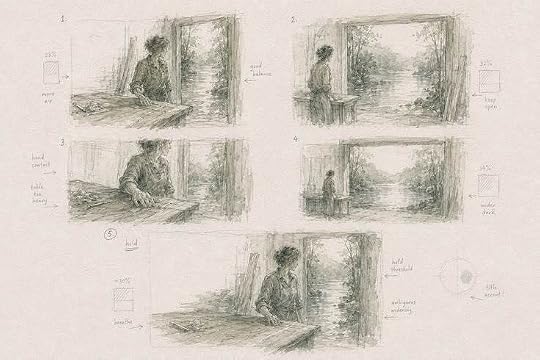
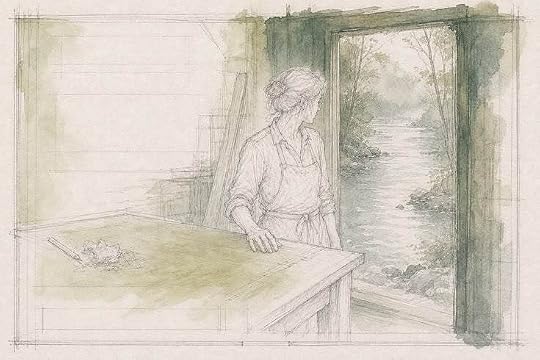
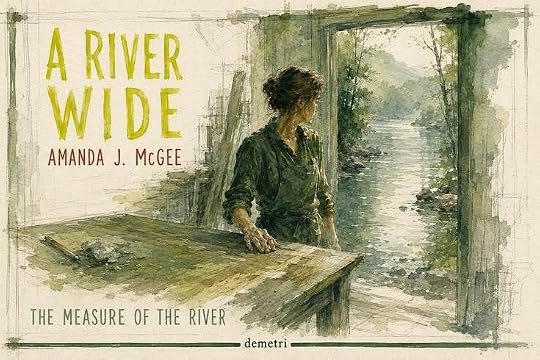
“The Measure of the River” – The workshop gives Rhia straight edges, joints, surfaces and problems that can be worked by hand; beyond its threshold, the painting lets those certainties loosen into water, open paper and a widening dark that refuses the courtesy of becoming measurable.

Difficult things in Amanda J. McGee’s “A River Wide” are often met with the wrong tool until someone discovers what the right one costs. Rhiannon Blackburn, called Rhia, knows how to garden, carve, mend, brew, bury, haul, hide and survive. She can coax weather, listen to water and make damaged wood hold again. She is the sort of woman fiction likes to call self-sufficient and life more often calls tired. Early in the novella, she restores an old walnut table for Owen, a man she is trying not to want. Water has warped the inheritance. Rhia keeps what can be kept, replaces what cannot, cuts a design into the old surface and gives the table a new working shape. Owen calls it art. Rhia worries she has overstepped.

Early on, that table tells us more than any spell about the kind of trouble McGee is interested in. “A River Wide” can be shelved readily enough as Appalachian horror: a water witch in rural Southwest Virginia finds a dead man in her yard, realizes her cousin-by-blood and sister-by-choice has vanished, and goes after the violent man who has taken her. There are ghosts, an abusive husband, a threatened burning, a gunshot wound and a drowning. Plenty to keep a plot busy. The harder question is what Rhia does when being useful stops being the same thing as being safe.

McGee gives her two bodies of water. Back Creek runs near the house and knows her. It floods, sulks, listens, helps. Rhia trusts its moods because she trusts its scale. Beyond it lies the river, older and less willing to be governed, a force she has deliberately kept at a distance because neither belongs to the other in any consoling sense. Rhia has arranged the rest of her life along similar lines. She likes work she can finish with her hands, magic she can meter out, relationships that do not require too much visible dependence. Back Creek is more than a source of power. It is the size of life she thinks she can safely inhabit.

Everything exceeds that size when the earth spits Randy Higgins into Rhia’s yard. He has been killed by Amey, whose earth magic erupted after Randy slaughtered one of her chickens on orders from Jack Higgins. Jack saw the death, and Amey is gone. Rhia does not call for help. She binds Randy’s blood, wraps his body, loads him into an old Ford and takes him to Gran so the dead man can be questioned. Then she buries him in the woods. Competence gets the job done; it also closes the circle around her. McGee understands the absurd bookkeeping of emergency: corpse disposal still involves leverage, mud, a ruined tarp and whether the truck feels like cooperating. The horror works better because Rhia cannot afford to behave as though horror has relieved her of logistics.


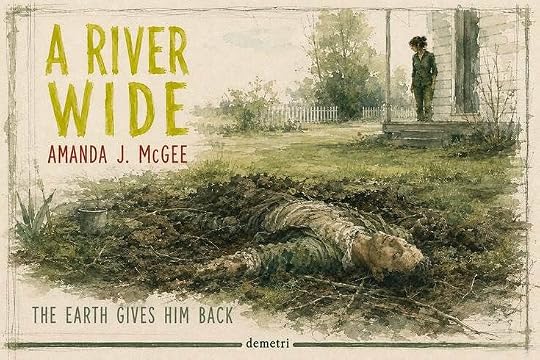
“The Earth Gives Him Back” – The horror here lies less in spectacle than in trespass: an ordinary yard has produced a body, domestic ground has ceased to obey its usual rules, and Rhia’s gift for getting things done begins to shade almost imperceptibly into the more dangerous instinct to handle everything alone.

The voice carrying all this is where the novella becomes unmistakably itself. Rhia narrates in a colloquial, regionally inflected first person that can turn from dread to irritation without cheapening either. Her language stays close to things that stain, warp, bruise, rot or need washing. Herbs must be ground. Chickens still need feeding. Old windows rattle. Magic occupies the same household world as a microwave, a market stall and a steel bowl in the sink. McGee denies witchcraft its own velvet rope. A mixing bowl, beeswax candle, creek water and inherited recipe book can share a kitchen without the prose changing clothes. The supernatural is another skilled practice, closer to carpentry than spectacle: attention first, then patience, then respect for materials that will not become whatever you wish.

Rhia’s first-person ease also creates one of the book’s smaller irritations. She is dry, profane, self-deprecating; catastrophe has a habit of arriving when she already has chores. The prose tightens around danger and opens into family history, magical explanation or local memory. Most of the time that looseness feels companionable. Sometimes Rhia keeps supplying her own footnotes, explaining the secrecy, fear or self-diminishment that the scene has already shown. McGee’s images can be subtler than Rhia’s commentary on them, especially once water has begun doing psychological work that the narration then patiently translates.

If Rhia talks herself down too often, her life keeps contradicting her. The woman who calls herself ordinary builds furniture, supports a household, divines across distance, converses with the dead and eventually manipulates water with lethal force. Archie, her dead grandfather, finally tells her what this running inventory has been saying for chapters: she has spent years making an argument for her own smallness. The scene is more explicit than it needs to be, but McGee does not stop there. Recognition will not be allowed to masquerade as cure.


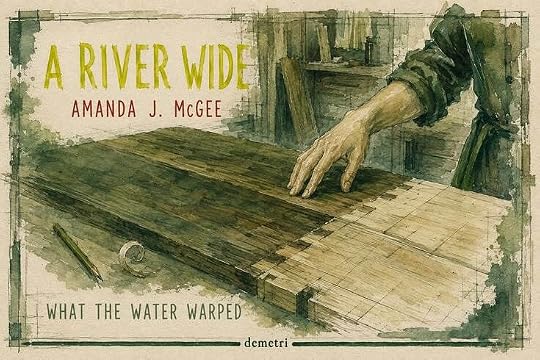
“What the Water Warped” – In “A River Wide,” the damaged walnut table becomes a quieter kind of inheritance: not something returned to innocence, but something made usable through visible alteration, with the joins left legible enough to honor both what survived and what had to change.

Plot first enlarges what Rhia does not know. Scrying reveals Amey in darkness with another captive but does not identify that person. Gerry later lets slip that Amey has been involved with Marie, Jack’s wife, and that other people knew more about Amey’s emotional life than Rhia did. That hurts for reasons the kidnapping cannot explain. Rhia has confused proximity with knowledge. She lives with Amey, loves her fiercely, calls her a sister, and still has not noticed the life developing beside her. Soon after, Back Creek no longer contains Rhia’s distress. Beneath it she feels the deeper river.

At that point the suspense stops being merely informational. Rhia does not know enough about Amey, and she does not know enough about herself. She withholds the truth from Gerry because Gerry would help. She keeps Owen outside the crisis because bringing him in would create obligation. Even her independence has a history of necessity: poverty, patched-together work, an old house enlarged over generations, a region where opportunity has often meant leaving. McGee does not romanticize self-reliance. She knows why Rhia learned it. Usefulness kept people fed, housed and moving; the trouble begins when Rhia treats that usefulness as a private monopoly.


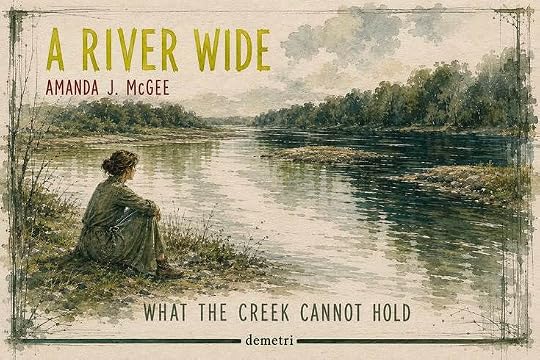
“What the Creek Cannot Hold” – Once Rhia learns that loving Amey has not meant fully knowing her, familiar water acquires unfamiliar dimensions, and the painting gives that private embarrassment a geography in which bank, reflection and distance can no longer quite agree on where the creek ends.

Perhaps the novella’s quietest accomplishment is its insistence that love is mostly work. Food appears. Somebody drives. Somebody stays awake. Somebody tends the sick, fixes the house, feeds the animals, sits beside the bed. Gerry’s anger after the rescue matters because Rhia has excluded her in the name of protection. Friendship, Gerry insists by implication, includes the right to be inconvenienced by another person’s danger. Owen matters less as romantic payoff than as the man willing to remain with Gran while Rhia goes after Amey. Amey tries to help Marie leave a violent marriage. Even the dead keep finding small jobs to do. McGee’s magic is most convincing when it joins this economy of tending rather than interrupting it.

All Rhia’s competence carries her to Jack’s mountain, and no farther. Jack has taken Amey and Marie because Amey threatens his control over his wife. He intends to burn her. Rhia finally accepts the river, using mist and water to enter a problem her familiar tools cannot solve. She frees the women, is beaten and shot, and drowns Jack. Fire threatened; water answered. The symmetry is satisfying, perhaps suspiciously so, until McGee leaves the mountain and lets the killing acquire a human aftertaste.

Down the mountain, Marie gives the book its messiest moral moment. Jack beat her, imprisoned her and understood that she loved Amey even after she tried to reject Amey and remain with him. His demand was not obedience alone. He wanted authorship over what she felt. Marie tells Rhia she may never forgive her for killing him. Then she asks how he died. Rhia says she drowned him. Marie thanks her. No interpretation improves those three sentences. Love for an abuser, terror of him, relief at his death and anger at the person who caused it are allowed to remain badly behaved. That is rarer than the book’s otherwise clean moral lines might suggest, and it leaves a bruise the rescue itself cannot quite account for.


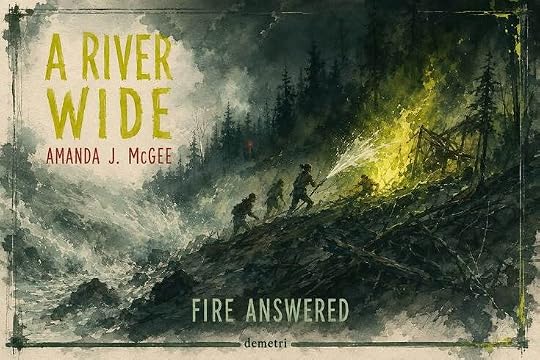
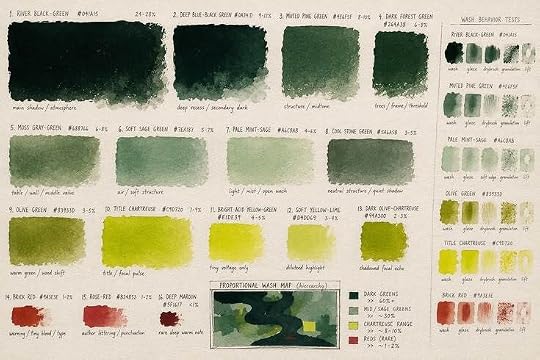
“Fire Answered” – The suite spends its brightest acidic color at the moment force becomes unavoidable, letting the flare of threatened fire and the pale violence of water meet without turning rescue into victory or pretending that necessary action leaves everyone morally dry.

If that scene opens the novella wider, it also shows how quickly McGee must close things afterward. Jack remains largely the man Rhia names on sight: violent, entitled, somewhat dim, clever enough to be dangerous. McGee understands coercion more fully than she develops him. Amey and Marie’s relationship carries enormous plot weight despite much of it occurring outside Rhia’s view. Owen is appealing, but the romantic future the ending asks us to imagine arrives faster than the romance does. The police, church and wider community stay at the edge, which keeps the story intimate but means Rhia’s preference for private justice is troubled more by feeling than by sustained consequence.

McGee’s compression is both engine and tax. Nine chronological chapters move briskly through discovery, concealment, divination, preparation, rescue and aftermath. Information arrives in useful increments: Randy, Jack, captivity, Marie, then the abuse in fuller form. The final third is less spacious. It must absorb Jack’s death, Marie’s ambivalence, Rhia’s gunshot wound, Gerry’s anger, Amey’s collapse, Gran’s irreversible condition, the funeral and the return of the dead. None of those beats is false. Several arrive while the previous one is still ringing. McGee’s speed keeps sentiment from congealing, but it also denies some scenes the awkward pause in which consequences stop being plot and become life.

Instead of ending when Jack dies, “A River Wide” takes Rhia to a hospital. That choice saves the novella from the neatest version of its own plot. Gran, who raised Rhia and Amey, is not coming back. The woman who has just discovered that she can call on terrifying amounts of water reaches a bedside where there is nothing useful to do. No spell, no plan, no amount of nerve will restore the person who taught her how to survive.

The hospital is where repair finally fails her. Rhia can hide a corpse, ask a forest for help, cross a mountain, survive violence, rescue Amey and kill a man. She cannot fix Gran. When she tells the dying woman that she found Amey and brought her home, the sentence closes the kidnapping plot without closing the loss. That is what prevents the ending from becoming mere reassurance. Doing more is no longer the same thing as loving better.


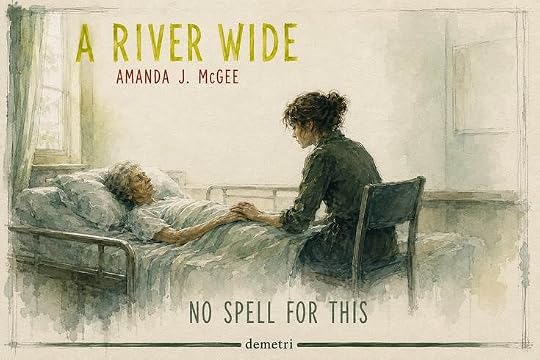
“No Spell for This” – After the book’s largest display of supernatural force, the palest painting in the sequence arrives at a bedside where almost every useful gesture has run out, leaving touch, open paper and institutional stillness to carry what magic cannot.

Regional detail helps explain why Rhia so instinctively treats capability as duty. Belfont carries the residue of coal extraction and disinvestment without becoming scenery arranged for an argument. Rhia’s patchwork livelihood, Amey’s nursing ambitions, unreliable cell service, economic caution and suspicion of formal help belong to a place where infrastructure and opportunity cannot be assumed. Amey and Marie, meanwhile, do not have to leave Appalachia to become legible as queer adults. Their danger comes from Jack’s coercive control, not from a schematic claim that queerness and the region cannot coexist. That refusal matters because it lets the place remain home even when home contains people worth fleeing.

On a nearby shelf, Linda H. Codega’s “Motheater” helps clarify what is particular about McGee’s scale: “A River Wide” is less interested in making extraction the explicit engine of its fantasy than in showing what old economic damage looks like inside one household. Alix E. Harrow’s “Starling House” is useful for another reason. Both books care about damaged places and compromised inheritances, but McGee’s most persuasive answer to that problem is not supernatural. It is sitting in Rhia’s workshop.

Past the drowning and the mist, the walnut table is still there. Rhia salvages something damaged by the very element that defines her. She does not erase the damage, and she does not preserve every warped piece out of reverence. She cuts, replaces, carves. The old table holds because she is willing to alter it. McGee arrives at her cleanest thought about inheritance with a piece of furniture rather than a declaration about roots. The past deserves neither obedience nor theatrical rejection. It is material. What matters is the workmanship.

On a 100-point scale, “A River Wide” earns 82/100, corresponding to 4/5 Goodreads stars. Rhia’s voice and practical magic make the novella easy to enter; the river design and the hospital reversal make it harder to dismiss once the chase is over. The thinness of several secondary relationships, Jack’s limited dimension and the narration’s occasional urge to explain its own imagery keep the book below exceptional territory. Its best move is simpler to name: after giving Rhia more power than she thought she had, McGee gives her something power cannot do.

Under Rhia’s old logic, wideness is the problem. A river is frightening because it will not become creek-sized, because its depths cannot all be sounded, because its currents cannot be arranged around the people she loves. By the end, the danger looks different. The world will exceed her. So will other people. Safety cannot depend on preventing that fact.

Like the walnut table, Rhia’s inheritance survives by changing shape. Gran and Archie remain part of her world without dictating it. Amey has a life Rhia cannot supervise into safety. Owen and Gerry can care for her only if she lets their care interfere with her plans. Even grief has to remain grief; turning it into another repair job would only be a more industrious form of denial.

Once the funeral gathers the living and the dead beneath the same trees, McGee allows a measure of comfort without putting Gran back where she was. Rhia has not learned to prevent loss. What she has learned is less glamorous and more useful: staying open to other people means accepting that some of what enters will hurt, and that hurt is not proof that openness was a mistake.

Still, the final image refuses mastery. The dead are near, the living are waiting, and the river remains wide. Rhia walks toward people she cannot completely know, save or control. The water has not become smaller. She has stopped asking it to.


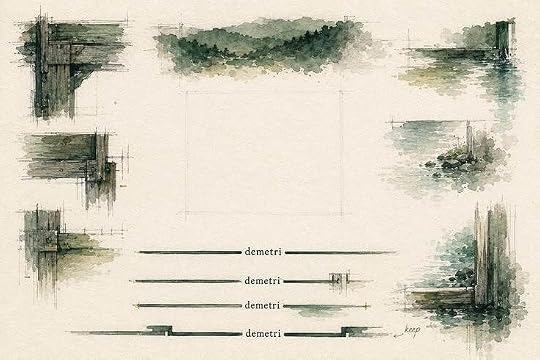
Compositional Thumbnail + Negative-Space Geometry Sheet


Cover-Derived Palette Proportion + Wash-Behavior Ledger


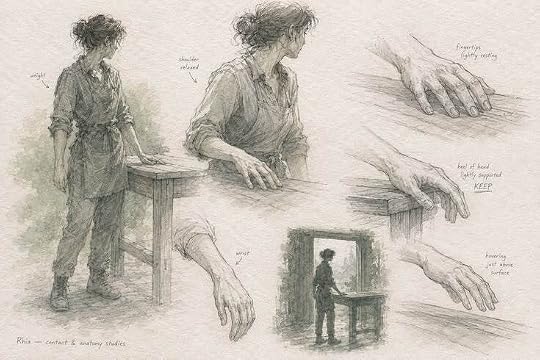
Rhia Anatomy + Hand/Table Contact Study


Border Architecture + Underscore Rail Closure Study


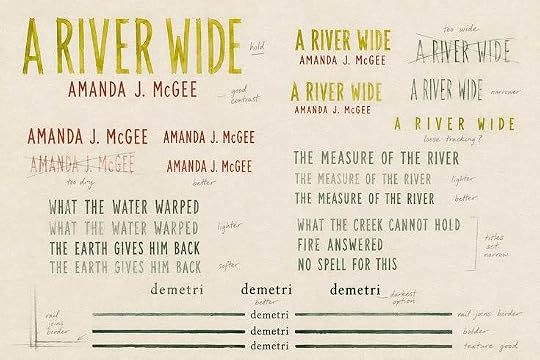
Hand-Lettering Specimen


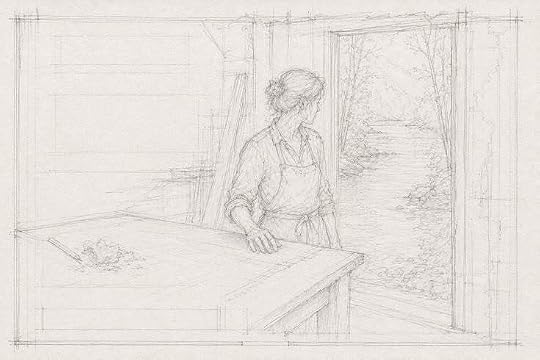
First Underdrawing Pencil Drawing


First Underdrawing Pencil Drawing with First Wash of Watercolor


Proposed Alternative Full Dust Jacket with Flaps

All watercolor illustrations by Demetris Papadimitropoulos.
Watercolors are done on 140lb vellum and then scanned into the computer using an Epson scanner. From there, they are finalized in Procreate. All art and opinions are my own.
Profile Image for Stress Reader.
311 reviews38 followers
Review of advance copy received from NetGalley
September 2, 2026
A River Wide ARC Review 


⭐⭐⭐⭐🌟 4.8 rounded up


"A beautifully dark tale of society's demonization of women through the lens of witch mythology and set under the Appalachian mountains..." - Lee Murray, Guest Editor at Interstellar Flight Press (this is what convinced me I needed to read this novella so I'm including it here)


📗 A River Wide is a beautifully atmospheric little horror story that punches well above its 98-page weight. Its greatest accomplishment isn't the mystery itself, but the way McGee makes water, witchcraft, Appalachia, family, grief, and survival feel like parts of the same ecosystem.


It combines family, Appalachian horror, witchcraft, mystery, family drama, grief, and romance into something that feels less like a conventional supernatural thriller and more like a dark Appalachian folktale—one where the landscape itself seems to remember, watch, and demand something from the people living within it. It's centered on family, grief, the strength it takes to survive, water, witchcraft, and a very localized sense of place. The result is atmospheric and emotionally resonant, although its novella length inevitably means some of its richest ideas and characters receive less room to develop than they might have in a novel.


Its biggest weakness is also its biggest structural constraint: I wanted more (as in a full length novel). More time with Rhia, more of the Blackburn family, more Appalachian life, more lore, more secondary-character development. But importantly, that hunger feels less like “the author failed to give me enough” and more like “the author created a world I didn't want to leave yet.”


For me, that's a pretty strong endorsement of a novella.


📓 Synopsis: 

When Rhia Blackburn's kidnapped cousin needs rescuing, the Appalachian witch must finally stop hiding her powers and confront the dark secrets of her home. With water-bound magic, ghosts, murder, and family ties all tangled together, Rhia has to decide just how far she'll go to protect the people she loves. 


🫵🏼 A River Wide is perfect for readers who enjoy:

• atmospheric folk horror

• Appalachian settings

• witchcraft 

• elemental/folk magic

• family-centered stories

• strong bonds between women

• emotionally driven mysteries

• ghosts, mysteries, grief, and lyrical prose

• speculative fiction short but thematically dense—the novella packs thriller, ghost story, romance, family drama, and coming-of-age elements into a very small space


🚫 You may not love A River Wide if you're looking for: 

• fast-paced, action-heavy horror

• extensive worldbuilding

• elaborate magic system

• extensive worldbuilding 

• straightforward genre categorization, its blending of horror, fantasy, mystery, a dash of romance, and literary/family drama 


❓ QOTD:  What do you think makes Appalachian settings so effective for horror and dark fantasy? Or, last, current, next?


❗AOTD: I think it's in part because they're so isolated with large areas of wilderness with pockets of tight-knit communities, and the mountains themselves are ancient (~480 million years old and the Blue Ridge Mountains, a province of the Appalachian Mountains, have some underlying rock that's 1.2 billion years old), that aides in the sense of wonder and mystery. Plus, it's an area a lot of the world hasn't seen or experienced firsthand, so there's a natural curiosity. 


Thank you to Amanda J McGee, Interstellar Flight Press, and @netgalley for the opportunity to read this gifted eARC. All thoughts and opinions expressed are my own.


📗 Plot 4.9

McGee gives A River Wide a compelling central engine: Rhia's need to find her kidnapped cousin forces her to confront both her supernatural abilities and the painful history she's spent years trying to bury. The mystery/thriller framework keeps the story moving, but the real emotional hook is why Rhia is willing to risk so much for her family.


What worked particularly well for me is that the plot doesn't treat the supernatural as merely a mechanism for solving a mystery. Rhia's magic, her relationship with her family, her grief, and her complicated relationship with her home are all intertwined and normalized (within their family). The story consequently feels emotionally motivated rather than simply event-driven.


It kind of amazes me that McGee was able to make me feel tense, melancholic, intrigued, and a soft punch to my emotions in ~ 98 pages. 


The novella's stated focus on family, grief, and the strength required to survive comes through strongly and effectively.


The tradeoff is that the novella's brevity occasionally makes developments feel more compressed than fully explored. I wish it had been just a smidge longer so we'd have had more time to explore certain things and let others breathe. We get enough that it felt satisfying for me. I would've loved to have more pages, preferably a full length book. [Please, Amanda, make this a full length novel because I have questions and need to know more 😅.]


💫 The horror is more psychological and eerie. I loved that. But if you're looking for a full on, traditional horror story (like Steven King), the introspectiveness and brevity of this may not work as well for you. 


➕ Loved

• emotional stakes

• strong sense of family, survival as strength, grief, and bits of burgeoning romance

• intriguing mystery

• family witchcraft 

• satisfying combination of genres

• strong sense of place

• Appalachian setting


➖ Didn't Love 

• some developments feel abbreviated - I'd have loved more time in the world and with the characters

• I'd have loved a bit longer denouement


📖 Themes, Metaphors, & Deeper Meaning 5

The most important idea is survival—not merely surviving danger, but surviving history. Family trauma, grief, gendered expectations, secrecy, and inherited knowledge all become intertwined with the story's supernatural elements.


Water is particularly effective as both literal setting and metaphor. Rivers move, erode, reshape, conceal, and reveal; that makes them an excellent metaphor for memory and inherited trauma.


The landscape similarly becomes more than scenery: Appalachia feels like something Rhia belongs to, something that has shaped her, and something she must negotiate with.


There's also a fascinating tension between power and control. Rhia's magic isn't simply about commanding nature; her relationship with water requires respect, understanding, and sometimes negotiation. That makes the magic reinforce the book's larger ideas rather than sitting separately from them.


The book also explores women's survival, family loyalty, grief, identity, and the consequences of suppressing one's own power. I loved that it examines society's demonization of women through mythology and the ways it does so. 


➕ Loved

• symbolism

• themes (particularly 'society's demonization of women through witch mythology')

• environmental imagery

• emotional depth

• intergenerational themes


✍🏼 Prose & Dialogue 4.5

McGee's prose is atmospheric, earthy, lyrical, and occasionally visceral. She has a particular talent for making the natural world feel simultaneously beautiful and threatening. Water, mountains, woods, hollows, and weather aren't simply described—they carry emotional weight.


There's also a wonderfully folkloric quality to the narration. The prose frequently feels like someone telling you an old Appalachian story around a fire, except the storyteller knows that the old stories are true.


That lyrical quality doesn't completely overwhelm the thriller elements, either. McGee knows when to tighten the language and let the tension take over.


Rhia's vivid narrative voice is one of the book's particular strengths. 


The dialogue is generally natural and character-oriented, although because this is a novella, not every secondary character gets enough page time to develop an unmistakably individual voice.


➕ Loved

• beautiful, at times eerie imagery

• strong narrative voice

• atmospheric language

• folkloric feel


💫 I appreciated the handful of occasions when characters use Appalachian vernacular. I found it grounding and befitting the novella. I imagine some people may not. 


⏳ Pacing 4.5

This is primarily a character-driven story wrapped around a plot-driven mystery.


The kidnapping and supernatural investigation provide momentum, but the emotional progression—Rhia confronting her past and relationship with her powers—is ultimately more important than simply getting from clue A to clue B.


For most of the novella, the pacing works extremely well because the short length gives the story a sense of urgency. You can feel Rhia's anxiety and stress, and the sense of urgency yet fear. 


➕ Loved

• the visceral sense of anxiety and fear

• doesn't waste pages or time

• maintains tension

• feels appropriately urgent


🗺️ Worldbuilding 5

For a 98-page novella, the worldbuilding is impressively atmospheric rather than encyclopedic. While the area it takes place in does exist, the specific town is an amalgamation of real towns in the area - an "every town" in Appalachia, if you will.  


McGee doesn't dump pages of Appalachian history or magical lore on the reader. Instead, she builds the world through place, family traditions, local knowledge, supernatural rules, and Rhia's relationship with the landscape.

The result feels lived-in, particularly because Appalachia isn't merely an aesthetic backdrop. The mountains, hollows, rivers, and small-town environment influence the characters and the story's mythology. 


➕ Loved

• strong sense of place

• atmospheric Appalachia

• intimate rather than exposition-heavy worldbuilding


🧙🏼‍♀️ Witches 5

It's essentially elemental/folk magic, but McGee avoids making it feel like a generic spellcasting system. Rhia's connection to water is particularly interesting because she doesn't simply control it. She has to work with it, understand it, and sometimes bargain with it - it's more of a collaboration. 


That distinction is important because it makes the magic feel almost animistic: nature has its own agency, and humans aren't necessarily at the top of the hierarchy.


The system isn't developed to the degree you'd expect in a full-length fantasy novel, but what is explained feels purposeful. More importantly, the magic reinforces the themes of respect, power, boundaries, and interconnectedness.


➕ Loved

• unusual elemental approach

• integration with Appalachian folklore

• magic that feels organic to the landscape


👥 Character Development 4.5

Rhia is where the character work is concentrated, and appropriately so. Her primary arc involves moving from suppression toward acceptance—of her abilities, her history, her relationships, and ultimately herself. Her flaws aren't decorative character traits; her fear, avoidance, and reluctance to embrace her power directly affect the story.


That's an important literary strength because the external conflict mirrors the internal one: Rhia needs to save someone else, but she first has to confront the parts of herself she's been trying to keep buried.


The limitation is again the format. Rhia has enough depth to feel like a real protagonist, but some secondary characters function more as pieces of the emotional architecture surrounding her than as fully realized independent characters. 


➕ Loved

• compelling protagonist

• believable emotional conflict

• meaningful internal arc

• strong family relationships.


➖ Loved

• secondary characters could use more dimensionality

• Rhia's development sometimes feels a bit compressed


🩷 Romance 5

This is *not* a romance, nor is it romance heavy. But it does have a minor thread of romance within. And it works well as a supporting emotional thread.


It contributes to Rhia's emotional landscape without hijacking the central mystery, which is exactly the right choice for this particular story. There's also something appealing about the way intimacy sits alongside the novella's larger questions about family, trust, vulnerability, and allowing someone else into a life built around secrecy.


That said, because the book is so short and the main plot is carrying considerable weight, the romance doesn't have the same opportunity for gradual development that a romance-centered novel would provide.

Does it feel believable? Yes.


Does it interrupt the plot? No—it remains subordinate to the central story.


➕ Loved

• subtlety

• emotional connection

• romance that doesn't overwhelm the horror


📚 Read if you enjoyed these comps


BIPOC Comp 

The Hacienda — Isabel Cañas

A River Wide is comparable to The Hacienda in its blend of supernatural horror, women's resilience, sinister secrets, and an environment that becomes almost a character itself. Both use the supernatural to explore what happens when women are forced to confront dangers that have been woven into the places and histories they call home. 


If you liked The Hacienda for its supernatural horror + women facing sinister forces + an environment that feels ALIVE, I think you'll enjoy A River Wide. Both turn place, history, and female resilience into something genuinely haunting.


1 Queer Comp

The River has Roots — Amal El-Mohtar

A River Wide and The River Has Roots both make water, magic, landscape, and familial bonds feel inseparable from the characters themselves. Both are also short, lyrical stories where love and sisterhood become sources of power in the face of forces that threaten to tear people apart.


If you liked The River Has Roots for its sisters + magical water + lyrical folklore + love-as-power, I think you'll enjoy A River Wide. They're both tiny books with BIG feelings about family, survival, and the magic embedded in the natural world.


Indie Comp

The Curse in their Veins — Ana Yudin

A River Wide is comparable to The Curse in Their Veins through its focus on witchcraft, sisters, inherited family darkness, and the struggle to break free from the past. Both use supernatural elements not merely for atmosphere, but as a way of examining what families pass down—and what their descendants can choose to change.


If you liked The Curse in Their Veins for its witchcraft + sisters + inherited darkness + breaking family cycles, I think you'll enjoy A River Wide. Both use witchy elements to dig beneath the surface of family history and ask what we're willing to do to protect the people we love. 


Non-Big Five Comp

2 Serpent's Wake: A Tale for the Bitten — LE Daniels 

A River Wide and Serpent's Wake both use fantastical imagery and folklore to tell deeply human stories about trauma, otherness, survival, and healing. The comparison is particularly apt because Serpent's Wake was specifically cited by A River Wide's editor as a point of reference for McGee's novella.


If you liked Serpent's Wake for its folkloric weirdness + trauma + healing + gorgeous, unconventional storytelling, I think you'll enjoy A River Wide. Both prove that speculative horror can be less about monsters and more about the wounds people carry—and the power it takes to survive them.


Big Five Comp 

The Once and Future Witches — Alix E Harrow 

A River Wide shares The Once and Future Witches's fascination with witchcraft as a source of female power and with complicated family bonds that must be confronted rather than simply inherited. Both ultimately ask what happens when women reclaim power that society—or their own history—has taught them to fear.


If you liked The Once and Future Witches for its witchcraft + sisterhood + female power + complicated family bonds, I think you'll enjoy A River Wide. Think a much shorter, darker, more intimate Appalachian cousin—with the same underlying belief that reclaiming your power can change everything.


Indirect Comp 

3 The Deep — Rivers Solomon, with Daveed Diggs, William Hutson, & Jonathan Snipes

A River Wide may seem completely different from The Deep, but both make water a living repository for trauma, memory, and survival. Beneath their very different settings, both ask how people can carry inherited pain without allowing that pain to determine their future.


If you liked The Deep for its water + inherited trauma + memory + survival, I think you'll enjoy A River Wide. Forget the radically different settings—the deeper connection is how both turn water into a vessel for the past and ask whether survival means carrying that past or finally confronting it.


38.4/8 = 4.8
Profile Image for The Reading Frog (Less online ATM).
115 reviews88 followers
Review of advance copy received from NetGalley
May 24, 2026
Thank you to Amanda J. McGee, Interstellar Flight Press & NetGalley for this free ARC in exchange for my honest review

Rating: 3.75/5⭐ Rounded up to 4 for GoodReads
CW: Explicit |
Moderate |
Mild |
CWs as stated by the author |
My chosen soundtrack(s): Witches Circle - Italian Witches Circle | All Rivers At Once - Sevdaliza

We live well out in the woods and mind our own business, but the funny thing about private property in rural America is that people shout a lot about the sanctity of it and then don’t respect it much. Most people don’t bother us, though, on account of them knowing that I, at least, am something strange.


Representation
╰┈➤ Mental health rep through MC,
╰┈➤ Latinx side character
╰┈➤ Queer unspecified sapphic background characters
╰┈➤ Minor WLW background dynamic
╰┈➤ Minor disability rep through elderly side character (mostly blind and a cane user)


Themes
(Sentient) nature, witches, murder, poverty, generational knowledge and collective memory, rural mountain village and its (lack of) community, isolation, (unconventional) family structures/relations, self-worth issues, fear of abandonment, mental health, estrangement, otherness, sibling bonds, family.


Tropes/What to expect
‎ ‎ ‎ ❥ Rural small mountain village/town
‎ ‎ ‎ ❥ Murder kickstarts the plot
‎ ‎ ‎ ❥ Race against the clock
‎ ‎ ‎ ❥ Witchey women


What I liked/loved
‎ ‎ ‎ ✧ I love how we start this book immediately in the thick of it. The earth spits out a dead man in front of Rhia's (our MC) feet, a family member is missing and has something to do with it, and we're sure that there was an eyewitness to whatever happened out here. It's instantly high-stakes with a deadline counting down to something horrible set to happen if Rhia doesn't immediately get to the bottom of this.
‎ ‎ ‎ ✧ Interesting setting. Though officially contemporary, this book doesn't date itself. It takes place in a struggling mountain village. There is no cell service or other advanced technology. The community is small, and their houses are spread out on this mountain, divided by acres of land and forests. This town/village comes with everything you would expect of such a place. There is a religious community close by, gossip spreads like wildfire, and everyone seems to know everything about one another.
‎ ‎ ‎ ✧ A simple yet well-thought-out magic system. This book features a family of elemental witches. Which you could see as witches with special connections to nature, who, at times, 'borrow' from nature to make their spells come to fruition. Nature in itself is sentient and is, in a way, able to communicate with these witches, which makes spellcasting a dialogue instead of a solitary action. Though not a complex system, it still felt believable and well-rounded, which isn't always easy to do in a novella. To me, this aspect is where this novella really shines.
‎ ‎ ‎ ✧ Family is the core of this book. There is an exploration of non-conventional family structures, regarding siblinghood and parental figures.
There’s family you grow with, and family you adopt.

‎ ‎ ‎ ✧ I love it when story themes are woven into the prose. In this case, we get lots of water-based imagery and metaphors, since Rhia is a water witch.
‎ ‎ ‎ ✧ I'm going to try to do this without spoilers, but towards the end of the book, there is a really charged, complex conversation happening between two characters surrounding guilt, not being able to forgive, yet also gratitude. It felt nuanced, convoluted (in a good way) and thus, interesting. It really hit me for some reason.
‎ ‎ ‎ ✧ Explores the question "How far are you willing to go for your family?"
‎ ‎ ‎ ✧ Exploration of grief.
‎ ‎ ‎ ✧ Exploration of mental health.
‎ ‎ ‎ ✧ There is a certain "I support women's rights and wrongs" or "Good for her" quality to this novella. It also feels quite deliberate that most characters significant to the plot are women, which is something I appreciate in writing.
‎ ‎ ‎ ✧ Though not as explicitly stated, it does highlight femicide, domestic abuse, and has some feminist undertones.
I wouldn’t have said was dumb enough to make himself a killer, but all men can be killers in the right circumstances, and he’s already closer to it than most.

‎ ‎ ‎ ✧ This specific quote 10/10:
“Failure is a piece of living,” I say.
“I don’t want to lose,” says the girl, and I feel that grief like it’s my own, because it is. I’ve always been trying to grip tight to things that can’t be held onto.


‎ ‎ ✧ I didn't expect this, but there was a comedic aspect to this. I have some annotations here and there of sentences that caught me off guard and made me laugh my ass off.


What I didn't like/felt lacklustre about
‎ ‎ ‎ ✦ This might be my lack of literary English skills showing, but some sentences didn't feel grammatically correct. This is, however, the ARC version of this novella and thus might not reflect its final publication.
‎ ‎ ‎ ✦ I hate to have this happen to me two times in a row, but unfortunately, this book didn't read as horror to me. I personally would categorise it more as a fantasy thriller. Which wouldn't be a problem if not for the difference between expectation and reality. This is more of a marketing complaint than anything else. It made me expect something that it wasn't able to give. Which brings me to my next point.
‎ ‎ ‎ ✦ For a book with the LGBTQIAP+ tag on NetGalley, I had expected it to have a little more of a presence in the story. The Queer rep in this one is very much a background thing.
‎ ‎ ‎ ✦ The ending was fine, cathartic to a certain degree, but I did feel myself longing for a more intense and conclusive ending. Specifically regarding
‎ ‎ ‎ ✦ This happens a lot with novellas, but I wish we'd gone more in-depth regarding the relationships between Rhia and her family members. It would've probably made me feel more connected to the characters. There were some moments here and there that were character-driven and focused on emotion. Those moments I did truly love. Regardless, I found myself wishing for just a little more.


Conclusion/Notes
Overall, 'A River Wide' is a solid debut exploring familial bonds and how far one is willing to go for the ones they love.

My issues are mainly with how it is advertised because I was expecting something other than what we've got. It's still a lovely read, just not necessarily horror or queer-centric as you might expect.

Regardless of my complaints, I did have a good time reading this one! The fantasy aspect was well-rounded and interesting, the setting wasn't standard, which added to the atmosphere, the exploration of (non-conventional) family structures was interesting, and I love that the characters we focus on are mostly women.

If any of this sounds intriguing to you, make sure to add it to your TBR and pick this one up once it releases in September!


⋆⁺₊⋆ ━━━━⊱༒︎ • ༒︎⊰━━━━ ⋆⁺₊⋆


Want to buddy read this book now or in the future? You can do so on Storygraph.

Follow me on Spotify for specific reading playlists like this one:
📚 Collapse Of Society | Though not fully fitting the theme, it really suits that rural, low-technology vibe.

StoryGraph | Instagram | TikTok | Spotify | Overview of all reading playlists |
Profile Image for RiahsReading.
835 reviews11 followers
July 26, 2026
“Rivers are dragons, make no mistake. They aren’t cruel on purpose, but their concerns aren’t your concerns, and you forget that to your peril.”

I received an eARC of A River Wide by Amanda J McGee in exchange for an honest review. Here are my thoughts!


💧 Rhia comes from a long line of Appalachian witches, her own magic connecting her to the rivers and creeks of her home. Their family has always kept their magic secret, but when Rhia’s cousin is kidnapped she’ll have to use every advantage she has to get her back.💧

A River Wide excelled at showing complicated and messy family dynamics and showcasing the power of community. I did also really enjoy the magical realism aspect and the Appalachian setting.

Where I think this story struggled a bit was with pacing and its main romance. There were times when Rhia focused on tasks that seemed really unnecessary given the dire situation, and I just didn’t care about her romance plot at all.

Overall A River Wide was a quick novella with what I felt like was a really satisfying ending - this one gets three stars for me. Let me know what you think when it’s release on September 7th!
Profile Image for Deb the Reading Bee.
355 reviews9 followers
Review of advance copy received from NetGalley
September 3, 2026
I liked that this horror novella immediately dropped us into the very central plot point of the story: Rhia cannot find her cousin Amey, but she found a dead body instead,

As Rhia explores where her sister could be, she starts getting clues from some of the townsfolk but also explores deeper using elemental witchcraft that runs in her family.

While we quickly learn that she struggles to accept and control her powers, which used to make her an outcast, she must do it for Amey.

Despite its short format, this book gives me a feeling of well-fleshed-out characters. As we are slowly introduced to their past struggles and mistakes, we see them fight strongly for each other and for acceptance, both from others and their own.

This is a dynamic mystery story in an urban fantasy setting with only minor horror elements, and it explores family bonds and found family, past and current trauma, substance abuse and self-harm, death and grief, queerness and bigotry, poverty, but also love. It was a perfectly paced story of an ideal length that kept my attention until the end.

I thank Interstellar Flight Press for granting me access to an advance reading copy of this book via NetGalley. All opinions are my own.
Profile Image for anne.
242 reviews1 follower
Review of advance copy received from Netgalley
August 24, 2026
| rating: 3.5★

in a few words ࿐
✧ appalachian magic
✧ small town shenanigans
✧ fmc's cousin disappears as a dead man shows up on fmc's doorstep

representation ࿐
✧ secondary sapphic dynamic
✧ visually impaired / practically blind secondary character
✧ secondary latina character

positives ࿐
✧ i found the whole setting to be pretty enchanting and the main character, rhia, to be a compelling narrator. the way we enter the story is a dead man (which rhia knows, because small town so they grew up together) showing up in front of her house and she is not as distraught by it as one would expect.
✧ this intriguing novella puts you immediately at the start of the problem without wasting the reader's time. it did this while still unveiling important details and lore about the characters throughout the short story. i appreciated how evenly it was paced like that.

negatives ࿐
✧ not even typos, i saw a pretty concerning amount of grammatically incorrect sentences for a 92 page novella. it got to a point where i started to question whether i didn't learn english properly as my second language.
✧ i either missed something or this relationship between rhia and owen evolved out of nowhere? one minute, he's a client for her furniture business, and the next, rhia is thinking of telling her cousin about them.

memorable quotes ࿐
✧ « The river changes her song for all sorts of reasons, or his song. Rivers don’t really have gender. It doesn’t matter, but the river is so big, so vast, that I want to make it seem smaller. I want it to be a person I can talk to , not a spirit as old as the hills. »


thank you to netgalley and interstellar flight press for giving me the opportunity to read this free e-arc in exchange for my honest review!

📅 publication date: 7 september 2026
68 reviews1 follower
Review of advance copy received from NetGalley
August 13, 2026
Thank you to NetGalley and the Author for this ARC in exchange for an honest review.

I normally take things like spelling, grammar, and plot errors into consideration when rating and reviewing a book. Given that this is the uncorrected proof and not the final published copy, I will withhold any judgment in good faith, trusting that any errors will be corrected before publication.

This novella follows Rhia, a young water witch, as she tries to untangles the mystery of a dead man found in her yard and her disappearance of sister/cousin, Amey. A River Wide is an Appalachian horror novella centred around grief, family, and finding your inner strength.

There is a queer side couple. Unfortunately, I found their relationship to be fairly shallow and felt it was more of a plot device than a genuinely developed relationship.

Novellas can be difficult to write, especially when the author has to juggle character development, plotlines, emotional arcs and more within a limited page count. I think, overall, McGee did a solid job with A River Wide. The pacing is strong, and the story really hooks you within the first chapter. There is minimal build-up, you are thrown straight into the thick of the mystery. However, I feel that this story would have fared better as a full length novel.

There is a lot going on, both plot-wise and with Rhia's character, that I feel the page count did not allow a full exploration of.

1. Rhia and Owen's relationship
The budding relationship between Rhia and Owen felt unnecessary to me. The story already has a lot going on, and I found that their relationship took up valuable space without adding anything to the overall narrative.

2. the lack of relationship depth

Shallow character relationships are a common issue in novellas. Rhia's relationship Gerry and Teddy, did not have enough time to establish depth. In the case of Teddy, his introduction seemed primarily for Rhia's emotional depth, and had little connection to the larger plot.

3. Rhia's character development

There are glimpses into Rhia's character, her struggles with mental health, her abandonment issues, her lack of self-confidence, the trauma of being unable to leave her home town, but I wanted more. Rhia faced a lot of internal struggles and I feel the limited page count did not allow for them to be fully explored. With a longer novel, I feel McGee could have developed Rhia's struggles and her overcoming them more effectively.

4. The aftermath

I also with we had seen more of the aftermath of everything that happened. It is implied that Randy and Jack are believed to have killed each other, but I wanted to see more of the fallout.

My biggest issue, however, is the way this novella is marketed as horror. Personally, I don't think A River Wide reads as a horror story. There are certainly elements of mystery, suspense, murder, and magic, but I never found it particularly frightening or horror-driven. I think fantasy or mystery would be a more accurate way to describe the book.

Overall, I think McGee accomplished a lot within a relatively small page count, and the novella is engaging and well-paced. However, I feel that this could have been a more developed story is given more space /pages. A River Wide had the foundation for something I could have really enjoyed as a full-length novel, but as a novella, too many of its characters, relationships, and themes felt underexplored.
This entire review has been hidden because of spoilers.
Profile Image for Nicole.
518 reviews67 followers
Review of advance copy received from NetGalley
September 3, 2026
A River Wide by Amanda J. McGee is the second advanced copy I have received from Interstellar Flight Press. So far, the press is two for two for me because both novellas are 5-star reads. Both Grief Eater by Emma Osborne and A River Wide are different kinds of stories for me. They are speculative fiction/horror with no romance. They are queer but not exclusively sapphic, although sapphic relationships are important to the plot. I find them both unique, and I wholeheartedly recommend them. However, I suggest heeding the content warnings.
I appreciate McGee's writing style. It is engaging from the start and easy to read. The author gives enough detail to set the scene, but not so much that it bogs down the pace. I appreciate the Appalachian setting in Virginia. The descriptions of the rural homestead are easy to imagine, as are the residents of the nearby small town. Aside from some of the characters being witches, the whole thing feels very realistic, and the conflict is believable. I also enjoy how McGee writes about the witches' connections to their elements.
The main characters are distinct and interesting. An emphasis on the importance of family and found family is a significant aspect of this plot-driven story. Death, grief, and environmental factors are also key.
The main characters show strength, vulnerability, and bravery in the face of fear. It was easy to form emotional connections. I was invested in the mystery and the outcome. I never lost interest.
This story is a bit dark but offers a hopeful and satisfying ending. It functions well as a standalone novella, but I wouldn't be upset if the author offered more in this world.
PS. I need this one and Grief Eater as shelf trophies.

Quoteworthy:
“Jesus Christ, Randy,” I say, then clamp a hand over my mouth. No witch should speak to the dead, except to say her goodbyes. It gives them ideas.

Amey always complains about all the sweets we have in the house. Says they’ll go to her figure, but that girl burns calories faster than the evangelists burn books, and she’s only about as big around as a toothpick anyway.

The creek, tense and sleeping, is cold with the coming fall.

...the corridors wrap around me like tentacles pulling me in.

"There’s no shame in fear. Only in what you let it make of you.”

I can’t tell you what it’s like for a river to speak, except to say it’s like your bones are giving a rattling hum. It’s the feeling you get when you’re holding tight to someone you love, praying to never let go. It’s like someone just tried on your skin, or maybe like someone just changed you into something that no longer fits in skin at all, and you’re rising and falling and splitting apart and coming together all at once.

The darkness of alone is not so different from the darkness of loss. With loss, you are missing those you love. Alone, you are missing yourself.

“Failure is a piece of living,” I say.

There’s nothing left to feel. I’ve gone through grief, and I’ve gone through guilt and anger, too. It’s too dark in this truck for hope just yet, so I wait.

There was too much to feel and not enough time to feel it.


#death #witches #elementalwitches #virginia #appalachia #deathofalovedone #grief #family #foundfamily #rural #bittersweet #hope #thesouth
I received a review copy from NetGalley. This is my honest opinion.
Profile Image for Bea.
12 reviews
Review of advance copy received from NetGalley
May 24, 2026
“The river doesn’t belong to me, and I don’t belong to it, and that’s intentional on my part, no matter what the river thinks about it.“

Ancient sentient rivers and elemental magic? Sign me up! A river wide follows Rhia, a young water witch who must untangle the mystery of her missing sister and the dead man found in her place.

The novella is well-paced with a great start; we’re thrown right into the meat of the story. The exposition is incorporated well, and I love that the girls’ gifts are not something they have total control over; there’s a great undercurrent (pun intended) of danger and self-sacrifice. The elements are certainly not benevolent powers. I love the modern witchy vibes; small details, like the cheap white vinyl on the old isolated house, work very well.

Rhia is a compelling protagonist, who manages to reject traditional ideals of femininity without stepping into NLOG territory, and her Gran is also wonderful.

Generally, the prose was strong. There is some repetition of words within a few sentences of each other (including a few incidences on the first page). I get the sense this was not an intentional choice, and it makes the prose seem somewhat unfinished; I hope that gets fixed in the final manuscript. All in all, it was very readable with some lovely watery imagery.

Unfortunately, some of the plot elements don’t work as well. I think this is because – like with so many novellas – there’s many themes barreling towards a conclusion, all at once. Without giving spoilers, I didn’t understand the necessity of the train plot point. Owen was one note, and while Gerry was complex for all her limited page time, her relationship with Rhia does not have time to display its depth. Teddy also only felt like he was introduced for emotional impact.

I wanted more of Rhia’s underlying resentment for Amey, more of the fallout from her disastrous college experience, more of the sacrifice that being tied to a decaying place demands. It’s such a shame this wasn’t longer, because there’s a lot of unfulfilled potential.

Some marketing points, which didn’t play into my rating but are nonetheless significant quibbles.

Firstly: why is this marketed as horror? There’s some mild peril, sure, and the elemental powers have some menace, but at no point is there a sense of dread. I was surprised when I reached the final page, because I was expecting an unsettling twist. This would do far better tagged as straight fantasy. And talking of straight …. I also agree with other readers that anyone going into this for queer rep will be very disappointed. The queer romance was shallow, and a plot device more than anything else. I don’t think we actually got any dialogue between the couple.

Thank you to the author, NetGalley and Interstellar Flight Press for the eARC.

PS: as a lover of antique furniture … if someone ‘restored’ my beloved heirloom table by altering key details without consulting me, I would be FURIOUS.
Profile Image for Blake.
20 reviews
September 9, 2026
Guys, I think I’m in love with Interstellar Flight Press.

Amanda J. McGee’s A RIVER WIDE is the second book I’ve picked up from IFP and, much like the first one I read, I loved it.

A RIVER WIDE is the first book I decided to read for my 75 Dedicated challenge, where I’ve combined a personalized version of 75 Hard and 75 Booked into one. I’m both extremely glad and terribly upset that I started my challenge with this because on one hand, McGee’s writing is so fucking good that it pulled me out of my reading slump. But, on the other… McGee’s writing is so fucking good that I fear it may put me into another one. Ask me about it later.

The story of A RIVER WIDE felt very near and dear to my soul. I, like Rhia, have always had a spiritual connection to the water. What really made this a unique read for me was not only the writing style, but the way McGee described the magic. The writing itself was absolutely gorgeous – I even went as far as describing it as stellar while in conversation with my best friend. McGee has a mind made for poetry, and her use of prose here felt very in tune with the story being told. I don’t know how else to describe it – McGee’s writing style just felt exactly like the on-page magic, and I think that in order to understand exactly what I mean, you have to read this for yourself. But seriously, I think the last time I was truly enamored with a magic system was when I first read Olivie Blake’s THE ATLAS SIX. The magic in A RIVER WIDE isn’t even all that complex – it’s just so effortlessly beautiful that I couldn’t help but fall in love with it. Off the top of my head, the closest thing I can think to compare it to is the magic in Maggie Stiefvater’s THE RAVEN CYCLE series, but specifically the kind of magic in Blue’s family. So, if you can imagine that and the art of poetry combined… well, you’ll have A RIVER WIDE.

While I was journaling for 75 Dedicated, I did come across one single qualm. I wrote, “I think that my only ‘gripe’ – if we can even call it that – is the length. I feel like this could have done well as a full-length novel, even if it still works as a novella. Making it longer maybe would’ve allowed for more pre-Amey’s disappearance, letting readers get to know her character a little better.” Which, to be fair, is all true! I imagine that McGee has reasons as to why she chose to write this in novella form, but I (rather selfishly) think that it could have been 150+ pages longer. Either way, I’ve chosen to rate this a solid 5/5 stars. McGee’s A RIVER WIDE has left me truly amazed, and I cannot wait to see what Amanda does next.

Thank you so much to Interstellar Flight Press, Holly Lyn Walrath (an editor over at IFP), and NetGalley for the opportunity to read this eARC.

P.S. I remember telling my best friend something about how I love the southernisms that are woven into the writing. Like, YES we’re in Appalachia, but there’s some southern influence on language. It feels so distinctly Appalachian. I loved it.
29 reviews
Review of advance copy received from NetGalley
August 29, 2026
Many thanks to the publisher, author and NetGalley for the ARC.

This is my first time reading a novella, so my thoughts and feedback would focus more on how I usually assess a full-length novel. A River Wide tells us a story of a missing person and how her cousin mustered her courage to unravel the truth and gather all her strength to save her. Although the main conflict of the story revolves around her cousin getting kidnapped and dealing with a corpse found lying on her yard, themes such as self-harm, navigation of one’s dilemma with self-esteem, isolation by choice, and grief over life decisions which could’ve, would’ve, and should’ve been made were also discussed in this book.

Truth be told, there is something satisfying about the way the story is delivered. My reading experience with this book is that despite its brevity, it feels complete and thoughtfully put together, with its narrative elements arranged in a way that gives the impression of careful craftsmanship. The fantasy, the storytelling, and the prose work together rather than competing for attention. Ultimately, it is a novella that succeeds through its clarity and composure: imaginative without becoming excessive, polished without feeling sterile, and simple without being lacking in substance. It is the kind of story whose neatness is part of its appeal, leaving the reader with the feeling that the author knew exactly what they wanted to say and delivered it with a steady, confident hand.

I also liked how the main character was intentionally designed by the author as a weird one and how it fits with the plot device in resolving this main problem. Furthermore, the story strikes a particularly satisfying balance between fantasy and emotional realism. What I appreciated most is that the fantasy elements are never overdone or allowed them to overwhelm the narrative. Instead, the fantasy is used with purpose as a plot device that moves the story forward, creates opportunities for the main character Rhia to confront what she is experiencing, and ultimately reinforces the central themes. It feels integrated into the story rather than added simply for the sake of making the premise more fantastical. This restraint makes the magical aspects all the more effective, because they feel meaningful to the narrative rather than excessive.

At the heart of the novella, however, is its exploration of grief, and this is where the story feels especially grounded. The portrayal of grief is realistic in the way it acknowledges that loss is rarely a straightforward or neatly resolved experience. The emotions feel complicated and human, allowing moments of sadness, longing, confusion, and acceptance to exist alongside one another. Rather than romanticizing grief or treating it as something that can simply be overcome, the novella gives it room to feel like an ongoing process. That emotional honesty gives the fantastical premise a surprisingly grounded quality.
Profile Image for A Reader's Plight.
60 reviews1 follower
Review of advance copy received from NetGalley
May 24, 2026
Review of A River Wide by Amanda J. McGee

Thank you very much to NetGalley and Interstellar Flight Press for the eARC copy of this book!

Ratings out of 5 stars.
- Overall Rating: ⭐⭐⭐
- Interest Rating: 📖📖📖📖
- Heartfelt Rating: 🖤🖤🖤🖤
- Tear Rating: 💧💧💧
- Tension Rating: 🪢🪢🪢
- Predictability Rating: 💭
- Writing Style Rating: 🖋🖋🖋

Favorite character?
-

Most memorable scene/moment?
-

Did the ending satisfy you?
- The ending felt like it wrapped up a little too quickly, but it did tie up all loose ends and was satisfying.

Would you read this book again?
- No, I would not read this book again. I think it was a good read and I enjoyed my time reading it, but it wasn't something that made me itch to read it again.

Additional Notes:
- My thoughts on this novella were simply that it was confusing or lacking in some aspects while being incredibly well done in others. I did enjoy reading it and I wouldn't hesitate to recommend that someone read it given how short it was and how good some of the scenes are. I'm sure that this is the perfect book for some others. For me personally, this book was middle-of-the-road.
- Definitely made me feel a lot of emotions at times.
- I came across this book on Threads and the author describes it as "a bit of Appalachian horror with witches, kidknapping, and murder," and while I do agree with that for the most part, I would not call this an Appalachian horror book and I'm not sure where the elements of that are (though I could be just be missing it entirely, maybe in one of the sections I found confusing).
- The beginning ~25% was a bit hard to follow for me at times, but I feel like the story was much easier to follow as it went on and I found myself enjoying the tenser scenes closer to the end of the book. There was where I got more attached to the characters and I felt like I was more invested in the story. There are still some elements I'm confused about to be honest, even after finishing the book.
- There were a few moments where I noticed the grammar was a bit weird, but it wasn't enough to pull me out of the story.
- Overall, a very good story centered around family and self-identity!
Profile Image for Jae Alistar.
321 reviews13 followers
Review of advance copy received from NetGalley
July 14, 2026
Some stories slowly unfold around you like quiet ripples. A River Wide crashes over you like a flash flood.

We are instantly thrown into the heart of the story from the very first page, and it never slows down. Every decision felt urgent, and every step further into the mountains made the tension feel heavier. The suspense never loosened its grip and was seamlessly balanced with relentless tension and deep emotions. It managed to make you feel like there really is "too much to feel and not enough time to feel it." We flow along a journey though every range of emotion; confusion, anger, sorrow, rage, a sense of justice served, and finally relief and acceptance.

McGee blends elemental magic with Appalachian folklore and landscape so seamlessly that it never feels out of place. Rhia's connection to water, alongside her family's other elemental gifts, gives the story a deeply witchy heartbeat without ever overshadowing its emotional core. The setting itself carries as much weight as the characters where everything is burrowed into the land itself. A place where old secrets cling to the earth, the woods seem to listen, and the river remembers everything.

The way this story explores family, grief, and the quiet resilience it takes to keep moving forward feels deeply rooted, like something shaped by the land itself. It captures both the beauty and brutality of Appalachia with an atmosphere that feels almost sentient, blending folklore, elemental magic, and emotional weight into something that completely pulled me under.

Thank you to NetGalley and Interstellar Flight Press for the opportunity to read this ARC!

Favorite Quotes:
"The river doesn’t belong to me, and I don’t belong to it, and that’s intentional on my part, no matter what the river thinks about it."

"I wouldn't have said [he] was dumb enough to make himself a killer, but all men can be killers in the right circumstances, and he's already closer to it than most."

"[She] ran and jumped and danced and laughed at the right times. That laugh was infectious. You heard it, and you fell in love."

"We don't need attention. There's a dead man needs to stay buried. And attention might push him toward action, and desperate men turn monster fast, even when they start out kind. [He’s] not kind…"

"All the living are afraid, and many of the dead. There's no shame in fear. Only in what you let it make of you."

"Mountains have deep, dark hearts, and those hearts are carved by water."

"Too much to feel and not enough time to feel it."

"What comes before makes you. But only you get to decide where you're going."
Profile Image for Tara.
25 reviews
October 31, 2026
I absolutely love the way Amanda J. McGee writes - the voices of the characters in this story, especially the narrator, are strong and real, and I loved the rhythm of every thought and word and piece of dialogue. I felt as if I'd grown up in that small town in southwest Virginia, as if I were part of the trees and the earth and the water, as if I were on the verge of letting the river in. The setting was so vibrant, every description laced with magic and a personal connection in a way that made the place feel alive. I had to read some sentences again and again, just to appreciate the sound and the shape of them. McGee is a truly incredible writer when it comes to character and prose. And the magical system! It was so cool, and so integrated with the nature of the setting, which is one of my favourite things.

I did struggle with some aspects of the plot. The book begins with the main character's sister vanishing, and I was enjoying the story of her trying to unravel what happened and how to get her back. I also liked the MC's personal struggle to believe in herself and believe that she was capable of saving her sister even though she doesn't see herself as a strong witch. However, the incident that pushed her into finally facing her fears and recognizing her own strength felt too big for the story; it overshadowed the problem of finding her sister, and disrupted (for me) the emotional pacing of the story. It was really difficult to move from the shock of it back into the rhythm of the original story - I wish the character growth had been more subtle. To me, it felt like it was forced by tragedy.

That being said, I still did like where the characters ended up. I did like the growth that came off that moment, and I loved the way the MC finally faced her fears, and came to trust herself, and became the person she was always meant to be. It's such a beautiful journey of self discovery, and it felt very relevant to me. And the ending was lovely and gentle; it made me cry, and it saved the story for me.

Finally, I will note that while this was labeled as a queer book and it does have queer characters, the primary romance is M/F. That took me by surprise!

Thank you Netgalley for the opportunity to read the ARC!

Content warnings:
- mentions of past alcoholism
- mentions of past suicidal ideation
- death of a loved one
- themes of domestic violence (bruising is described multiple times)
- infidelity
- light mention of animal harm
Profile Image for Melanie.
442 reviews
Review of advance copy received from NetGalley
May 25, 2026
🐓💧⛰️

This little story definitely has personality and gumption - and how could it not? It’s about Appalachian elemental witches! And it has a little mystery/missing person element as well that blends remarkably well with the supernatural component. And everything fits nicely under the overarching theme of family, undoubtedly the heart of this story which shines through in almost every aspect. The characters are immediately likeable and it’s easy to get onboard with the plot. And, again, elementals are ugh so cool every time and it helps to build a character’s personality just knowing what you know about each element’s traits.

It did take a minute for this to find it’s footing, I suspect this could’ve been attributed to presenting a lot all at once: atmosphere/environment building, character introduction and relationships, magic system explanation, and mystery set up. I realize this is pretty standard but a lot was posed as exposition (mostly at the beginning) which unfortunately pulled me out of the main story to the point where I got a little twisted around regarding what was going on with our missing person plot. I appreciate the attempt to match how people living in that area may converse (it was effective and contributed to the immersion) but it did clash a bit to go right from a more lyrical sentence to a more “matter of fact” storytelling/inner thought sentence.

I’m not convinced a side of romance was needed here, it just posed as another distractor for me - perhaps removal in favor of more interaction with Amey (to help really nail down the family theme) would’ve been more to my preferences. Also agree with other reviewers that I may reconsider classifying this as a primarily LGBTQIAP+ as it is quite minor within the story. Although I thought the main conflict was approached and resolved a bit quickly for my liking, the last two chapters posed great closure while leaning back onto the central theme of family. All in all, an enjoyable short story with direction, a good emotional pull, and a really satisfying supernatural system.

Thank you to the author, NetGalley and Interstellar Flight Press for the privilege of this ARC in exchange for an honest review!

⭐️3.25⭐️
Profile Image for Jamie Mcmahan.
83 reviews2 followers
July 31, 2026
I offer very sincere thanks to NetGalley for the privilege of reading this Advanced Reader Copy. I really loved this book. There are so many reasons why I enjoyed this story, from my proximity and love for Appalachia to my calling as an herbalist. I love the characters in this story. I want to know more. I would happily dive into more of this family, past or future. I want to know hear about Rhia and Owen finding love. I want to hear about Gran and Archie. I want to know about the girls’ mothers. I want to know details about all the elemental witches. I loved hearing even the tiniest bit about Rhia’s work with wood and plants. Overall, I just want more.

I love the author’s writing style, and the idiosyncrasies that are specific to the area. I love that I could tell from her choice of words and description of manners, that the author is from the south. It’s not something that can be faked. It’s just part of who you are. I loved the lyrical quality to the writing. I loved the way the author described Rhia’s work with wood, and the way she related it to the characteristics of the water power that was Rhia’s.

I really enjoyed the fact that the twists were not obvious even though the setting felt like a place I knew well. The villains were people I knew. I think that was the point, that those kind of bad guys were a dime a dozen, but that didn’t make them less bad or hateful. I think we all know people like Jack Higgins. That’s the point.

There were parts of the story that broke my heart. I just lost my mom two months ago and honestly, I’ve avoided books that might make me sad so there were parts of this story that made me cry, that had tears rolling down my face not just for the obvious devastatingly sad things, but for the less obvious ones too.
My life path has been similar to Rhia’s. I went away to college with big plans only to have it not go the way I anticipated. I spent a significant amount of time trying to figure out what my path was supposed to be and who I was when it didn’t go the way I wanted. In some ways I’m still figuring that out 30 years later.
The characters, the setting, the story all aspects of this were very relatable The writing reminded me of Rachel Ross or Rachel Gillig, and I would absolutely read more from this author.
Profile Image for Kaylyn K.
31 reviews2 followers
May 24, 2026
As Amanda McGee says in the acknowledgements, family truly is the heart of A River Wide, and that resonates with every page of this book. Rhia's family is her life and her reason, and you can tell, but other forces are at play in the story as well, such as the dead man the Earth spits out of her yard. Attempting to solve the mystery of this man's death and her cousin's sudden disappearance, Rhia has to turn to everyone in her corner, including her grandmother, the ghost of her grandfather, her cafe-owning best friend, and a man newly back in town whom she happens to have a crush on, and (as a water witch) the town's nearby river.

The quick-paced plot, mystery surrounding Amey's disappearance, and evocative language are only a few things I enjoyed about this novella, but I feel that it really fell short with regard to the characters. MeGee presents many narratively interesting characters, but for the most part, they are given about a page of small backstory before they are pushed aside in favor of Rhia attempting the rescue mission on her own. I think it is merely a downside of having such a plot-heavy story in such a short format, but I really would have loved to hear more about the characters themselves, particularly because they are so important to Rhia. There were even times that I felt the main character herself lacked depth, such as the mentions of her childhood friend's death, her abrupt departure from college, and her conflicted feelings towards her cousin.

Overall, I enjoyed the story and thought it was very good, though I do agree with some other reviewers' comments that the LGBTQ+ tag should be removed from the marketing of the book, as it is not necessarily relevant to the plot and is barely addressed.

Thank you to NetGalley and the author for the privilege of receiving a copy for early review!
Profile Image for Joyce.
42 reviews3 followers
Review of advance copy received from NetGalley
July 16, 2026
* Thank you to NetGalley, the author, and publisher for this ARC*

I think I just found one of my new favorite authors.

A River Wide feels less like a novella and more like stumbling across an old Appalachian folktale that was never meant to leave the mountains. The magic here doesn’t feel invented. It feels remembered. Like something you could catch on a breezy afternoon if you stopped trying so hard to explain the world and simply listened.

I was hooked from the very first page.

Amanda J. McGee writes with a reverence for the natural world that feels increasingly rare. Every river, every tree, every shifting wind seems alive with quiet intention. I would have happily stayed in this story for another 300 pages and then some.

What struck me most, though, was who this story chooses to follow. Rather than centering the people who built the town’s history, McGee gives voice to those left to carry it. Through her witches and the people forced to live beneath the weight of inherited violence, she paints a portrait of a community abandoned by time, opportunity, and compassion.

She understands something many writers miss, the greatest monsters are rarely supernatural. They’re often ordinary men shaped by generations of pain who pass that hurt to everyone around them. It’s a story that feels hauntingly familiar across countless forgotten towns in America, making the magic all the more necessary.

Amanda J. McGee is a master of quiet storytelling. She reminds us that witchcraft has always been about far more than spells. It’s resilience. It’s community. It’s women refusing to let the world strip away the parts of themselves that make them whole.

And maybe that’s why this story lingered with me…Because somewhere deep inside every woman is a little bit of magic, patiently waiting for her to remember it’s always been there.
Profile Image for Mariah.
408 reviews
Review of advance copy received from Publisher
July 25, 2026
The river will speak to you if you care to stay still and listen. This is a lovely horror novella that combines witchcraft and unique storytelling. The witchcraft factors were unexpected but helped to elevate the narrative. This story is in the same category as The River Has Roots and once again a river will make itself heard. Horror about grief is an interesting duality that forces you to walk with death while you breathe. This Appalachian gothic captures the hearts of those who feel lost in their grief and must fight the way ahead.
The witchcraft is not simply a supernatural element but incorporates real witchcraft and the ways the elements can influence our lives. The ways that humans can manipulate the elements to help guide them. The spells are not Hocus Pocus and that is exactly the charm I appreciated about this novel. This is real, gritty, and the emotions are fresh with the ripeness of grief. The story tells us to learn how to channel that energy in a broader context. But, following the story, the craft is leading them towards having their voices heard, even if it may end up bloody. The metaphor here is that the way forward is something ancestral and not through the lies from men.
A novella has less space to give us dialogue, character growth, and setting – yet McGee was able to construct that within eighty or so pages. The river comes alive and steals the spotlight. The scene setting was purposeful and created a strong vision of where this book falls into the universe. You can spell the river as well as you can hear it as the writing flies through the pages. Thank you Amanda J. McGee and Interstellar flight press for this advanced physical copy. 4.5 Rated up for goodreads!

For tarot readings, recommendations, and reviews, visit my blog https://brujerialibrary.wordpress.com/
Profile Image for Astrophel AKA Beeneedssleep.
394 reviews10 followers
September 6, 2026
Thank you to NetGalley and the Independent Book Publishers Association for an arc. All opinions are my own.

★ Rating: 3/5
Genre: Mystery
Are There Gay People in this?*: ✅

An interesting quick read

Full disclosure, my expectations were a bit off. I went into this expecting it to be horror, and it just isn't. It is a witchy small town mystery. I think a lot of people will love that, but personally I probably wouldn't have picked this up if I hadn't thought it was horror, so take this review with a grain of salt.

I think this was well written and had great vibes. The stuffy small town atmosphere coupled with the elemental magic worked really well. The magic system is pretty vague, but it's a novella so that makes sense. I wish Rhia would have had more interactions with the townsfolk while she was trying to figure out what happened to Amey, but I also understand that part of the point is that she is so isolated from this town she's lived in for years.

I was a little underwhelmed by the actual investigation part. It feels like Rhia spends more time eating and sleeping than actually locking in to find her missing sister. I also think the romance subplot was totally unnecessary and didn't add anything. In a story this short, I think the page space dedicated to Rhia's romance could have been better allocated.

Who I would recommend this to: If you want a witchy story that takes place in a small town and feels like it's right on the cusp between summer and fall vibes, I would give this a go.

* I count a book as including gay people if any of the main or secondary characters are implicitly or explicitly queer or trans. This does not necessarily mean the protagonist is queer or that there is a queer romance
Profile Image for Ryan Lawler.
Author 3 books20 followers
May 23, 2026
A River Wide by Amanda J. McGee is short fast-paced read that delivers a lot and packs a punch in just 100 pages. It explores witchcraft with modern Gothic-Appalachian stylings, and it uses that setting to tell a grim story that got a little darker than I was expecting but that also stuck the landing with a great ending.

The main character Rhia is a water witch, who comes from a long line of witches that are all attuned to different elements. She appreciates her heritage and can hear the river calling out to her, but she has always kept it at arms length because she just wants to live a normal life. When her sister Amey goes missing and a dead body turns up in her backyard, Rhia knows her best option is to embrace the call of the river, but will it be worth the cost?

In the Acknowledgments the author talks about Southwest Virginia as the inspiration for her story and this clearly shines through. When the story takes Rhia to different parts of the community, it really feels like a slice of Southwest Virginian / Appalachian life. The people, the one brunch place in town, the one bar in town, everyone knowing everyone’s business, it all feels so familiar and is one of my favourite parts of this story.

As I said earlier the plot is grim, and for those who appreciate content warnings there is death, violence and suicidal ideation. It does take a couple chapters for the plot to properly establish itself, and I found those early chapters to be a little clunky. But it doesn’t take long for this story to really get going and I think it does a great job of building towards a great conclusion.

I had no idea what to expect going in and I was really impressed with what McGee was able to deliver in such a short amount of pages.
Profile Image for Tara.
558 reviews
September 8, 2026
Thank you to Interstellar Press for the eARC for review! Another banger from ISP.

Tight little novella about protecting the ones you love (especially when the ones you love suddenly go missing and leave a corpse) and intrinsically living with the land.

Rhia may be a water witch, but when her sister goes missing, is that enough to save her from some probable horrible fate? Especially when the likely culprit is a good ol' boy with connections up-mountain and she's just one person, water witch or no.

This isn't your normal revenge/reconnaissance/rescue story - Rhia is both resolute and reluctant (all right, I'll stop with the alliteration now), and while she knows she has to go find her sister, she also knows she's hungry, she's tired, and she needs to prepare. Some other stories may have the hero running off to go do the thing immediately, and maybe some deux ex machina provides, but I liked the more realistic-ness here? I liked that she was scared, she pushed through anyway, but allowed herself to be scared because sometimes "allowing yourself" is as much a need as food and water and rest. She's aware she doesn't know what to do but has to do it anyway.

I also really liked how much depth this less-than-100-page novella had, in that we had a pretty full understanding of Rhia, and her connections to the people around her (including her also magically inclined grandmother and the hottie love interest that's there more than she expected) and to the community and to the land itself. A River Wide was also written in a way that made me slow down in reading because I could *hear* the narration, the phrasings and rhythm of the words really felt Appalachia (and like parts of my own family a little).

Definitely worth the read, and a quick one at that.
Displaying 1 - 30 of 141 reviews