

What do you think?

Memetic
A meme is an idea that starts with an individual, and then virally spreads to multiple persons and potentially entire societies. Richard Dawkins suggests a meme’s success comes from its effectiveness to the host, but history shows that destructive memes can spread just as rapidly through society. Memetic shows the progression of a weaponized meme that leads to the utter annihilation of the human race within 72 hours. The root of this apocalypse is a single image on the internet, a “meme” in the popular sense. A meme that changes everything. Collects the complete three-issue miniseries.
128 pages, Paperback
First published October 13, 2015
About the author
James Tynion IV
1,688 books2,201 followersPrior to his first professional work, Tynion was a student of Scott Snyder's at Sarah Lawrence College. A few years later, he worked as for Vertigo as Fables editor Shelly Bond's intern. In late 2011, with DC deciding to give Batman (written by Snyder) a back up feature, Tynion was brought in by request of Snyder to script the back ups he had plotted. Tynion would later do the same with the Batman Annual #1, which was also co-plotted by Snyder. Beginning in September 2012, with DC's 0 issue month for the New 52, Tynion will be writing Talon, with art by Guillem March. In early 2013 it was announced that he'd take over writing duties for Red Hood and the Outlaws in April.
Tynion is also currently one of the writers in a rotating team in the weekly Batman Eternal series.
Tynion is also currently one of the writers in a rotating team in the weekly Batman Eternal series.
Ratings & Reviews
Friends & Following
Create a free account to discover what your friends think of this book!
Community Reviews
Displaying 1 - 30 of 218 reviews

March 30, 2016

i decided to read this because i felt like i didn't know what was going on in the world of graphic novels anymore. back when i was working at the book factory all the time, even if i wasn't reading all the graphic novels, i was at least flipping through them after picking them up off the ground (thanks, lazies!) on my way to reshelve them, or getting first-looks at them when they came in. but now? i only know things from goodreads. which is helpful, but sometimes a girl needs to see for herself.
and once i saw this…

well, much like the characters in this book, i became hypnotized by his placid smile and tacit promise of very slow snuggles and i bought it and took it home with me.
at my own peril

and it's okay. i feel that, as a standalone graphic novel, it's a bit disappointing as far as where it ends. there's an expectation and an opportunity for follow-up, but this is all there's going to be, so it left me all tensed up with nowhere to go.
there's an afterword/conversation between the author and the illustrator specifically discussing the ending, where the author acknowledges that he anticipates people may feel 'pissed off' at what can be seen as a lack of closure or explanation, while the artist talks about how he finds the ending 'hopeful.'
the artist is clearly a crazy person. i understand what he's saying but they're the ravings of a stockholm-syndromed lunatic. as for me, i don't feel pissed - it ends in a way that is fine, but could also be a very interesting jumping-off point.
but, nope:

but i'm glad i read it, and i look forward to more explorations into the contemporary sequential art scene, and if there are sloths, well that's just gravy, innit?

 come to my blog!
October 6, 2025
And a Meme shall end the world...
- ancient Babylonian saying
Alright. So this was (for me) simply ok as a comic. Mainly because I thought it might be going somewhere, but ultimately didn't quite go anywhere interesting for me. Like it needed maybe one more issue before the final one or something?
At any rate, I felt not necessarily disappointed by the ending, just very ambivalent toward the ending.
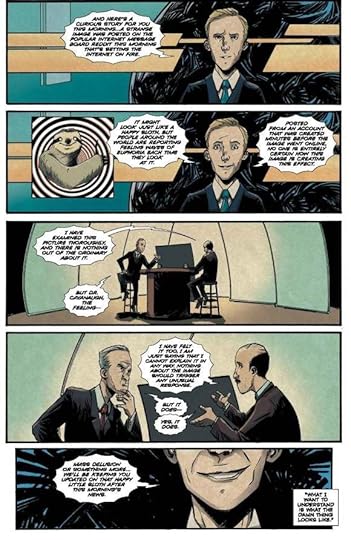
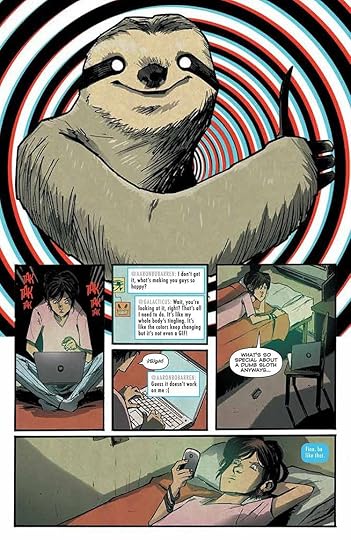
The skinny gist is that this meme of a happy sloth pops up and makes its rounds on the internet (2015 style), and people get a little jolt of euphoria when they look at it.
Then they start looking more.
And more.
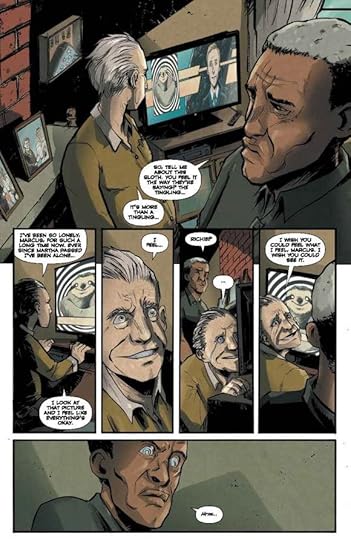
Things go downhill from there. We follow two characters, one guy who was a once high-ranking muckety-muck in the government and is now retired and losing his sight, and the other is a young college student who was born with both ear and eye problems that keep him from being able to understand what the big deal is with this damn sloth.
Ok, the idea of a meme bringing about the apocalypse sounds dumb at first. Until you remember that the word meme was coined by the biologist Richard Dawkins in his book, The Selfish Gene, as a way of describing how systems of behavior were passed from one generation to another. <--there's more to it than that, but this is a comic review for god's sake!
So if this meme of a sloth were created with some kind of code that unlocked a part of our brains that fundamentally changed us, AND made us want to share it, and then was passed around via the internet, television, and even good old-fashioned pictures & drawings, how quickly could it spread?
Quickly.
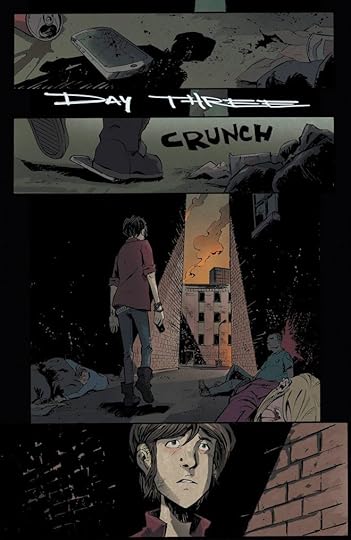
As in, the apocalypse happens in 3 days.
I wanted to like it more.
Mainly because I like Tynion and thought the idea was fairly original in its execution. But at the end of the day, it was just meh for me.
Still.
Cute sloth.
- ancient Babylonian saying
Alright. So this was (for me) simply ok as a comic. Mainly because I thought it might be going somewhere, but ultimately didn't quite go anywhere interesting for me. Like it needed maybe one more issue before the final one or something?
At any rate, I felt not necessarily disappointed by the ending, just very ambivalent toward the ending.
The skinny gist is that this meme of a happy sloth pops up and makes its rounds on the internet (2015 style), and people get a little jolt of euphoria when they look at it.
Then they start looking more.
And more.
Things go downhill from there. We follow two characters, one guy who was a once high-ranking muckety-muck in the government and is now retired and losing his sight, and the other is a young college student who was born with both ear and eye problems that keep him from being able to understand what the big deal is with this damn sloth.
Ok, the idea of a meme bringing about the apocalypse sounds dumb at first. Until you remember that the word meme was coined by the biologist Richard Dawkins in his book, The Selfish Gene, as a way of describing how systems of behavior were passed from one generation to another. <--there's more to it than that, but this is a comic review for god's sake!
So if this meme of a sloth were created with some kind of code that unlocked a part of our brains that fundamentally changed us, AND made us want to share it, and then was passed around via the internet, television, and even good old-fashioned pictures & drawings, how quickly could it spread?
Quickly.
As in, the apocalypse happens in 3 days.
I wanted to like it more.
Mainly because I like Tynion and thought the idea was fairly original in its execution. But at the end of the day, it was just meh for me.
Still.
Cute sloth.
November 8, 2025
So! Some meme of a happy looking sloth goes viral online. All who see it are overtaken by Euphoria and compelled to continue to stare at it and share it, which everyone does, until they all slowly become lifeless husks of themselves who only seek to harm others 12 hours later.
The story follows two people, a color blind and partially deaf boy, and a former colonel who is slowly loosing his sight due to a medical condition. Both of them are unaffected by the meme, as we see the colonel assemble a team to try and stop the outbreak and figure out what the hell is going on, we also watch the boy loose all his friend and try to find safety.
This was a very cool concept, and Tynion is one of my favourite writers, but the ending just felt as bit lazy to me. The antagonist was mid, and just a pawn for the aliens whose motives weren’t even explained. loose cartoony art like this isn’t really my cup of tea, but it works well enough for this short story. It’s not a bad book, but it’s my least favorite work by Tynion so far. Also it all feels too disturbingly similar to Uzumaki by Junji Ito.
The story follows two people, a color blind and partially deaf boy, and a former colonel who is slowly loosing his sight due to a medical condition. Both of them are unaffected by the meme, as we see the colonel assemble a team to try and stop the outbreak and figure out what the hell is going on, we also watch the boy loose all his friend and try to find safety.
This was a very cool concept, and Tynion is one of my favourite writers, but the ending just felt as bit lazy to me. The antagonist was mid, and just a pawn for the aliens whose motives weren’t even explained. loose cartoony art like this isn’t really my cup of tea, but it works well enough for this short story. It’s not a bad book, but it’s my least favorite work by Tynion so far. Also it all feels too disturbingly similar to Uzumaki by Junji Ito.

August 7, 2021
Found myself stuck waiting outside a thrift store changing room without a book in hand so I downloaded this for free from Amazon Prime Reading because I have long been intrigued by its cover. I swiped through the first third pretty quickly. Aside from being a rehash of Stephen King's Cell nothing special seemed to be happening, so it took me a couple days to get back to it.
As I continued reading it reminded me of The Girl with All the Gifts and the later volumes of I Am a Hero with all of its bleakity-bleak bleakness. Then I realized I spent more time thinking about other books rather than this one even as I read it, and well, that ain't good.
As I log this, I find that there are actually two sequel volumes: Cognetic and Eugenic. The completist in me has the urge to check them out, but I think I'll resist for once, especially since Tynion has been a hit-or-miss author for me. (Update: Oh, it seems they are thematic sequels, not directly continuing Memetic but offering up their own apocalyptic plot and new characters. That makes them even less interesting.)
As I continued reading it reminded me of The Girl with All the Gifts and the later volumes of I Am a Hero with all of its bleakity-bleak bleakness. Then I realized I spent more time thinking about other books rather than this one even as I read it, and well, that ain't good.
As I log this, I find that there are actually two sequel volumes: Cognetic and Eugenic. The completist in me has the urge to check them out, but I think I'll resist for once, especially since Tynion has been a hit-or-miss author for me. (Update: Oh, it seems they are thematic sequels, not directly continuing Memetic but offering up their own apocalyptic plot and new characters. That makes them even less interesting.)

June 7, 2025
I've officially reached that point where I have enjoyed every horror graphic novel I have read by James Tynion IV and that I look forward to reading anything else by him. Case in point: this early-in-his career 2015 three-issue gem called "Memetic". It starts off weird---an Internet meme of a happy sloth goes ridiculously viral within hours---and gets weirder---12 hours after viewing it, the person becomes a homicidal maniac---and goes beyond weird into extreme body horror territory. And there's aliens.
Not his best, but it's still a creepy little sci-fi/horror series that showed off Tynion's talent.
Not his best, but it's still a creepy little sci-fi/horror series that showed off Tynion's talent.

October 6, 2020
I couldnt tell if this was serious or sarcasm..it would go down one way they twist the other. The tone was too haphazard for me

February 14, 2025
Rounded up to a 4

September 1, 2022
This was the first of what would later loosely be called James Tynion's "Apocalypse trilogy," a story about an internet meme of a happy sloth that turns people who view it into mindless, screaming, violent zombies. As the screamers increase in number and chaos rules, a small band of military personnel try to track down the source of the infectious meme. Another bonkers story line with perfectly matching art by Eryk Donovan. Tynion has such a unique and twisted mind for storytelling, he mingles horror, sci-fi and weird fiction like no one else in comics. The ending was frustrating, but was what it was on purpose. 3.5/5*

February 14, 2017
Didn't get the tone. Is it sarcasm, or a twisted celebration (catharsis?) of our collective/individualistic obsessive paradoxes? Again, I feel that the concept of meme is wasted. Sci-fi wise, it's a nice premise that is used in a chilled teen/catastrophe movie narrative. The dystopian analyses and insights are nowhere to be seen.
May 8, 2018
Bullet Review:
Fantastic. This is EXACTLY my favorite type of book - the end of the world, no holds barred. Characters are great, the art is awesome, I even love the tone - a dismal "We cannot escape this" feeling.
But please: NO ONE decide to make another volume after this. The story needs to end right here.
Fantastic. This is EXACTLY my favorite type of book - the end of the world, no holds barred. Characters are great, the art is awesome, I even love the tone - a dismal "We cannot escape this" feeling.
But please: NO ONE decide to make another volume after this. The story needs to end right here.

March 15, 2019
The weakest out of their apocalypse trilogy (with Eugenic being the strongest, I think).
Why couldn't they let this end of the world breathe a little bit, instead of moving it along at breakneck speed, which made the whole thing feel preposterous, and made character decisions feel melodramatic and unbelievable.
Why couldn't they let this end of the world breathe a little bit, instead of moving it along at breakneck speed, which made the whole thing feel preposterous, and made character decisions feel melodramatic and unbelievable.
April 15, 2020
Here’s the continuation in the saga where I read more existential apocalyptic horror while we are in a pandemic. Woo. I did not know what the fuck was going on and I loved it. Reading the authors’ back and forth letter greatly entertained and helped me to understand the chaos.
I also may be bias and just expect greatness from Tynion. He always delivers great Queer content.
I also may be bias and just expect greatness from Tynion. He always delivers great Queer content.

May 2, 2023
Memetic collects issues 1-3 of the Boom Studios series written by James Tynion IV with art by Eryk Donovan.
A new meme of a cute sloth giving a thumbs up quickly spreads through social networking sites and all media. Viewers of the image report a feeling of immediate happiness and a lessening of stress, anxiety, and worry. Nobody can figure out what is causing this change of feeling from a simple image, but the world is instantly thrown in chaos when those who have viewed the image turn into brainless violent maniacs after twelve hours.
I found the first issue to be really interesting and then the book instantly loses steam with its twist at the end of the first issue with viewers of the meme becoming violent maniacs. There seems to be an underlying message of the danger of social media and the power of sharing knowledge on a global scale, but it becomes lost in an increasingly boring tale. Not enough time is given to flesh out the characters to make me care about them and the overly cartoony art doesn’t capture the feel of the book, especially in the last issue. I believe the book had a interesting premise, but ultimately Tynion just didn’t know what to do with it.
A new meme of a cute sloth giving a thumbs up quickly spreads through social networking sites and all media. Viewers of the image report a feeling of immediate happiness and a lessening of stress, anxiety, and worry. Nobody can figure out what is causing this change of feeling from a simple image, but the world is instantly thrown in chaos when those who have viewed the image turn into brainless violent maniacs after twelve hours.
I found the first issue to be really interesting and then the book instantly loses steam with its twist at the end of the first issue with viewers of the meme becoming violent maniacs. There seems to be an underlying message of the danger of social media and the power of sharing knowledge on a global scale, but it becomes lost in an increasingly boring tale. Not enough time is given to flesh out the characters to make me care about them and the overly cartoony art doesn’t capture the feel of the book, especially in the last issue. I believe the book had a interesting premise, but ultimately Tynion just didn’t know what to do with it.

February 9, 2025
This ended at the best part of the whole story. The characters and illustrations were meh. The storyline is all over the place and then just gives up.

August 12, 2015
Hmm...not quite sure how I felt after reading this, and I'm not exactly sure what to write about it, which is why I'm going to continue to write a rambling review.
The last issue ends with a conversation between the writer James Tynion IV and the artist Eryk Donovan, and it seems that, like the random-ass sloth meme in the series, they weren't necessarily trying to convey specific "messages" either. Tynion says, "That's all I wanted to do here. Write something that made you guys feel something palpable and strange. Something that made you look at the world a LITTLE differently." If I use this as a measuring stick, then I think that Tynion accomplished his goal.
There are well-recognizable elements from horror and apocalyptic works. At its core, Memetic is a zombie apocalypse comic, except the vector is a meme and aliens/angels (Wha...?) might be involved. Sometimes Memetic felt too trope-ish for me, but at other times, Tynion achieves a surprisingly fresh effect on the readers. I enjoyed that, as any good short story does, Memetic made me wonder about the future toward which humans were evolving, the effects of increasingly rapid technology-aided communication/networking, and the value of the individual/conforming.
The last issue ends with a conversation between the writer James Tynion IV and the artist Eryk Donovan, and it seems that, like the random-ass sloth meme in the series, they weren't necessarily trying to convey specific "messages" either. Tynion says, "That's all I wanted to do here. Write something that made you guys feel something palpable and strange. Something that made you look at the world a LITTLE differently." If I use this as a measuring stick, then I think that Tynion accomplished his goal.
There are well-recognizable elements from horror and apocalyptic works. At its core, Memetic is a zombie apocalypse comic, except the vector is a meme and aliens/angels (Wha...?) might be involved. Sometimes Memetic felt too trope-ish for me, but at other times, Tynion achieves a surprisingly fresh effect on the readers. I enjoyed that, as any good short story does, Memetic made me wonder about the future toward which humans were evolving, the effects of increasingly rapid technology-aided communication/networking, and the value of the individual/conforming.
Did Not Finish
November 9, 2019Not going to rate this, as I mostly skimmed. This probably appeals to millennials and a younger crowd, I mostly didn‘t care about the story idea. I caught glimpses of something zombie-like and an end-of-the-world scenario. I think this gained a GLAAD nomination due to gay representation? What I saw wasn‘t anything spectacular. Then again, this didn‘t grab me and I just skimmed...

November 14, 2019
Interesting idea, not unlike Stephen King's Cell, although here it's an Internet meme that brings about the end of the world, rather than a weird signal broadcast through peoples' phones. The art was interesting though a bit hard to really recommend. The characters could have used more development throughout. This is an idea that probably could have used a couple more issues to fully develop.

August 30, 2016
Well. Hey certainly went there, didn't they?

August 8, 2020
Literarly, that wasnt the end of the world.
Yeah i liked the point of view that the writer tried to say us. I have no problems with idea of this comic. But the storyline wasnt full, did it?
I feel like the last page was somehow lost.
Yeah i liked the point of view that the writer tried to say us. I have no problems with idea of this comic. But the storyline wasnt full, did it?
I feel like the last page was somehow lost.

January 2, 2019
I was somewhat intrigued by this, but I feel that there are so many things wrong with this. The characters feel underdeveloped, with unclear motivations. One would think that with this book having received a nomination for gay representation that this wouldn’t be the case, that there would be richly drawn out characters, but the end result (without giving specific spoilers) ends up somewhat problematic, implicitly reinforcing a narrative that marginalized people are willingly will sacrifice their identities to belong to the dominant culture. Furthermore, the horror reads as a flat allegory that isn’t doing deeper intellectual work.
As others have noted, the idea of weaponized memetics has such a strong potential for framing a unique apocalyptic narrative, but this idea feels like it was tossed aside to reuse horror tropes from films like Pontypool and Slither. Perhaps in an era of fake news and political gaslighting, a premise like this book is based on is inherently ridiculous. We are living through the real horror.
As others have noted, the idea of weaponized memetics has such a strong potential for framing a unique apocalyptic narrative, but this idea feels like it was tossed aside to reuse horror tropes from films like Pontypool and Slither. Perhaps in an era of fake news and political gaslighting, a premise like this book is based on is inherently ridiculous. We are living through the real horror.

July 1, 2017
I'll be honest, when I finished the story part of the collection, I absolutely hated this book. I didn't know anything about the book when I picked it up, and what had started out as an interesting concept ended in a place I really didn't want to go. Reading some of the afterword stuff, especially the conversation between the writer and artist, helped me to recontextualize my feelings and recognize that they had done what they set out to do. This is truly a horror story about the end of the world. And while I still don't agree with the decisions made by several of the main characters, I recognize that my visceral reaction to the story proves their point. I'm still not sure I would recommend this book to anyone (do not be fooled by the cover), but I can see what they were intending and I think they made their point. It's just not a point I wanted to see made; where they saw hope I saw despair.
March 3, 2022
Some appeared to have mixed feelings about this one, but I really liked it. I saw the cover long ago, and it looked so silly I thought this was some type of weird comedy book. Yeah, I did that thing about judging a cover by the book and so forth, which I try not to do. But regardless, this turned out to be a really dark horror book. It wasn't a totally original concept, as at its heart its a zombie story. But it's a very different type of zombie story, as in this case the outbreak is triggered by an internet meme. The story behind it all was sort of predictable, but managed to come across as surprising at the same time.
Overall this did exceed my expectations, which hasn't happened a lot with comics lately.
Overall this did exceed my expectations, which hasn't happened a lot with comics lately.

April 23, 2020
ATTENZIONE SPOILER
2.5 stelle o poco più.
Meh. La primissima e l'ultimissima parte funzionano bene, ma ciò che sta in mezzo vacilla. I personaggi sono piatti come fogli di carta e la trama è ridotta all'osso, stiracchiata su troppe pagine. Inoltre ho trovato l'interessante premessa un'occasione sprecata: hai un mene che sfrutta la psiche dell'essere umano per riprodursi e diffondersi, è un'idea davvero figa, perché banalizzarla? Il plot twistone è meh, i messaggi subliminali sparsi ovunque e l'alieno con la fissa per la coscienza collettiva fanno molto "Essi vivono incontra I am an hero" e sanno di già visto.
This entire review has been hidden because of spoilers.

October 16, 2022
A fun apocalypse, as fun as apocalypses can be, anyway. Which is pretty fun by my estimation.
Catpocalypse: Cats breed out of control, we're inundated by kittens. That's fun.
Pizzapocalypse: A mad scientist, probably working for the Papa John's guy, invents a machine that turns all food into pizza. Pretty fun.
And a little book I've been working on: Turdnado. What happens when a tornado sweeps through a feedlot AND a sewage treatment plant? A Turdnado, that's what. Not a fun apocalypse to experience, but fun to be outside of.
No one steal my idea, okay? I think this is my best shot of getting a film optioned by SyFy.
Catpocalypse: Cats breed out of control, we're inundated by kittens. That's fun.
Pizzapocalypse: A mad scientist, probably working for the Papa John's guy, invents a machine that turns all food into pizza. Pretty fun.
And a little book I've been working on: Turdnado. What happens when a tornado sweeps through a feedlot AND a sewage treatment plant? A Turdnado, that's what. Not a fun apocalypse to experience, but fun to be outside of.
No one steal my idea, okay? I think this is my best shot of getting a film optioned by SyFy.
November 22, 2015
I really wanted to like this book. It's got an interesting concept, was rife for some good social commentary, and had some wonderfully Lovecraftian elements. But the whole thing feels a bit rushed, and the characters were far too 1-dimensional. We only ever get introduced to them, never getting to know them, or make any sort of real emotional connection to them. So when events happen to them, there is no real feeling of consequence.

August 20, 2020
There are so many elements that I thought were really original, fascinating, and with great narrative potential. But they just don't come together in a compelling or rich way. I think this may be due to overly short length and high number of characters. This could have been absolutely great, but instead it is just meh at best.

October 4, 2021
What a depressing end of humanity. Nihilism, even with a pseudo-smiling sloth on the cover, is just a differing tarp over a dark pit that once you start your descent gives you ledges to stop. Glorifying hopelessness and the quest to join the lemmings plunging over the cliffside, strikes me akin to kicking puppies.

May 31, 2020
This story takes what happens to a brain on memes to an extreme (if absurd) conclusion. (To get the most out of the story, one needs to understand “meme” in the sense Richard Dawkins coined the term. Not just as a popular image one sees repeatedly on social media, but as any cultural artifact (image, idea, symbol, fashion, etc.) that behaves in a manner analogous to a gene – spreading, mutating, etc.)
In the story, a meme (featuring a sloth) goes viral. All is benign, at first. People are spending far too much time blankly staring at the meme because it engenders a euphoric feeling, but that doesn’t seem so bad (and -- quite frankly – it’s not much different from how people engage with social media and online games in real life.) Then, like a time-release bomb in the brain, something is triggered and people start bleeding from their eyes, screaming, and engaging in Zombie-like behavior. [Except, as befitting a story about memes, the mindless activity of these “zombies” is designed to perpetuate the meme -- rather than the eating of brains.]
The story plays out in two interwoven arcs. At the center of each arc is an individual who is – at least at first – immune to the meme by way of a “disability.” One story features a college kid who is color-blind, and the other a retired Colonel who is visually impaired so he can only see vague shapes (i.e. either glaucoma or cataracts.) The college kid’s story is the more human-interest piece, with him just trying to survive the apocalyptic world when he feels challenged enough by his usual world. The Colonel leads a team to try to defeat the meme by tracking its author.
In one sense, the perfect power of this meme and its ability to mutate to more effectively spread itself may feel ridiculous. However, without spoiling the story, I will say the author does offer a kind of explanation that may help quell the mental rejection. I’ll leave the reader to determine whether they think it helps or not. But, more importantly, I think it’s a story that knows it’s venturing into preposterous territory, and that’s kind of the point. We don’t necessarily see the freakish way we respond to memes and the online world, and so this story blows the problem up to absurd scale to make the reader more aware. [It’s also fun.]
I delighted in “Memetic.” I found the concept thought-provoking and the telling entertaining. It’s not just a concept, it offers a strong story. I’d highly recommend this graphic novel for those who find themselves aware of, and disconcerted by, how many people in their immediate environment are entranced by their phones.
In the story, a meme (featuring a sloth) goes viral. All is benign, at first. People are spending far too much time blankly staring at the meme because it engenders a euphoric feeling, but that doesn’t seem so bad (and -- quite frankly – it’s not much different from how people engage with social media and online games in real life.) Then, like a time-release bomb in the brain, something is triggered and people start bleeding from their eyes, screaming, and engaging in Zombie-like behavior. [Except, as befitting a story about memes, the mindless activity of these “zombies” is designed to perpetuate the meme -- rather than the eating of brains.]
The story plays out in two interwoven arcs. At the center of each arc is an individual who is – at least at first – immune to the meme by way of a “disability.” One story features a college kid who is color-blind, and the other a retired Colonel who is visually impaired so he can only see vague shapes (i.e. either glaucoma or cataracts.) The college kid’s story is the more human-interest piece, with him just trying to survive the apocalyptic world when he feels challenged enough by his usual world. The Colonel leads a team to try to defeat the meme by tracking its author.
In one sense, the perfect power of this meme and its ability to mutate to more effectively spread itself may feel ridiculous. However, without spoiling the story, I will say the author does offer a kind of explanation that may help quell the mental rejection. I’ll leave the reader to determine whether they think it helps or not. But, more importantly, I think it’s a story that knows it’s venturing into preposterous territory, and that’s kind of the point. We don’t necessarily see the freakish way we respond to memes and the online world, and so this story blows the problem up to absurd scale to make the reader more aware. [It’s also fun.]
I delighted in “Memetic.” I found the concept thought-provoking and the telling entertaining. It’s not just a concept, it offers a strong story. I’d highly recommend this graphic novel for those who find themselves aware of, and disconcerted by, how many people in their immediate environment are entranced by their phones.

July 15, 2020
Memes.
O que são?
O que comem?
Como se reproduzem?
Tudo isso e muito mais num gibi do Tynion IV e do Donovan.
Primeiro, apocalipse zumbi, basicamente isso, mas o que causa é um meme; uma imagem de uma preguiça feliz aparece na internet e todo mundo pira o cabeção na preguiça feliz. Todo mundo?
Quase, porque o meme é uma imagem precisa ser vista e depois reproduzida para ter o efeito - deixar todo mundo eufórico e zumbístico -, logo se os nossos heróis tem problema de visão - um guri surdo e daltônico e um veterano militar com catarata -, eles estão a salvo. Será?
Há duas narrativas; a primeira fala sobre o apocalipse a partir de um meme, uma ideia que já apareceu no Frequência Global do Warren Ellis - quem não leu, leia, é muito bom - e num livro do Stephen King - Celular, bem meia boca -, a imagem da preguiça feliz se multiplica absurdamente rápido e começa a transformar as pessoas em, bom, zumbis - ou algo muito semelhante -, no final rola mais uma loucurada - acho que pra fugir das comparações mais óbvias - envolvendo anjos, deuses antigos e o propósito final da humanidade como propagadora de informações - um discurso de vilão bem interessante -; porém, correndo por fora, há uma segunda narrativa sobre a vontade de pertencer, a informação não se reproduz sozinha, precisa de um canal - um livro, uma música, uma fala - para prosperar, então de um lado temos os zumbis disseminando o meme e convertendo as pessoas a sua causa, do outro lado temos os que não foram infectados e precisam resistir a essa vontade de fazer parte do que está acontecendo, desligar sua individualidade - ou ligar o aparelho de surdez - para se unir a essa euforia contagiante e libertadora.
Uma das coisas mais difíceis da vida é saber quando nós somos indivíduos - a particularidade pública - e quando somos um grupo - o anonimato da multidão. Devem existir dezenas de livros de psicologia muito mais corretos e interessantes do que qualquer coisa que eu possa dizer; porém eu acho - puro achismo - que eu devo assumir quem eu sou, o que eu gosto, a minha opinião, mesmo que não sejam populares.
Escolher o que eu acho importante, faz parte da vida e, na maioria das vezes, não é fácil, porém, necessário.
O que são?
O que comem?
Como se reproduzem?
Tudo isso e muito mais num gibi do Tynion IV e do Donovan.
Primeiro, apocalipse zumbi, basicamente isso, mas o que causa é um meme; uma imagem de uma preguiça feliz aparece na internet e todo mundo pira o cabeção na preguiça feliz. Todo mundo?
Quase, porque o meme é uma imagem precisa ser vista e depois reproduzida para ter o efeito - deixar todo mundo eufórico e zumbístico -, logo se os nossos heróis tem problema de visão - um guri surdo e daltônico e um veterano militar com catarata -, eles estão a salvo. Será?
Há duas narrativas; a primeira fala sobre o apocalipse a partir de um meme, uma ideia que já apareceu no Frequência Global do Warren Ellis - quem não leu, leia, é muito bom - e num livro do Stephen King - Celular, bem meia boca -, a imagem da preguiça feliz se multiplica absurdamente rápido e começa a transformar as pessoas em, bom, zumbis - ou algo muito semelhante -, no final rola mais uma loucurada - acho que pra fugir das comparações mais óbvias - envolvendo anjos, deuses antigos e o propósito final da humanidade como propagadora de informações - um discurso de vilão bem interessante -; porém, correndo por fora, há uma segunda narrativa sobre a vontade de pertencer, a informação não se reproduz sozinha, precisa de um canal - um livro, uma música, uma fala - para prosperar, então de um lado temos os zumbis disseminando o meme e convertendo as pessoas a sua causa, do outro lado temos os que não foram infectados e precisam resistir a essa vontade de fazer parte do que está acontecendo, desligar sua individualidade - ou ligar o aparelho de surdez - para se unir a essa euforia contagiante e libertadora.
Uma das coisas mais difíceis da vida é saber quando nós somos indivíduos - a particularidade pública - e quando somos um grupo - o anonimato da multidão. Devem existir dezenas de livros de psicologia muito mais corretos e interessantes do que qualquer coisa que eu possa dizer; porém eu acho - puro achismo - que eu devo assumir quem eu sou, o que eu gosto, a minha opinião, mesmo que não sejam populares.
Escolher o que eu acho importante, faz parte da vida e, na maioria das vezes, não é fácil, porém, necessário.

July 6, 2022
WHAT DO WE HAVE TO THINK ABOUT BEING EXPOSED TO THE SLOTH FOR 124 PAGES? ARE YOU TRYING TO MESS WITH US?!? 😵
Good times sloth. Posted on Reddit, then Facebook and Twitter, it's our, current, real world. Printed and hung on walls. People can't stop looking at their phones, at this image.
It's memetic warfare!
DROP BEATS NOT BOMBS tee
"Instantaneous, unlimited knowledge. Singularity."
from the afterword:
Eryk Donovan "In a way, apocalypse stories are a meme."
Drawings get sometimes weird. Overall, an average American mainstream comic book, so it screams (yes!) what it tries to tell, no subtleties at all, some plot holes, very sinplified version of what it could have been, unfortunately it's not much more than some book you read lazily on a summer afternoon.
The fact I got to read it for free thanks to Prime Reading is probably easing my rating towards 2 full stars out of 5 instead of dropping it more.
Good times sloth. Posted on Reddit, then Facebook and Twitter, it's our, current, real world. Printed and hung on walls. People can't stop looking at their phones, at this image.
It's memetic warfare!
DROP BEATS NOT BOMBS tee
"Instantaneous, unlimited knowledge. Singularity."
from the afterword:
Eryk Donovan "In a way, apocalypse stories are a meme."
Drawings get sometimes weird. Overall, an average American mainstream comic book, so it screams (yes!) what it tries to tell, no subtleties at all, some plot holes, very sinplified version of what it could have been, unfortunately it's not much more than some book you read lazily on a summer afternoon.
The fact I got to read it for free thanks to Prime Reading is probably easing my rating towards 2 full stars out of 5 instead of dropping it more.
Displaying 1 - 30 of 218 reviews