Universal law dictates that nobody can time travel, because nothing can alter the past.
Unfortunately for universal law, Felix Culpa is both.
Through hard work, diligence and a lifetime of irrelevance, Felix has become a complete nobody: a man so devoid of consequence or achievement that his existence leaves no measurable mark on reality.
A normal person travelling into the past would create a paradox simply by being there.
Felix does not.
He is not important enough to change history.
He is the loophole in universal law. The first and only Universal Placebo.
Felix works at the International Towering-Cryogenic Automated Mega-Plex, where a freak neutrino event accidentally freezes him inside a cryo-pod. Centuries later, he is discovered, thawed, wildly misunderstood and mistaken for a forgotten twenty-first-century hero.
He is not a hero.
His heroic biography has been fabricated by Alfred, a hardware-based artificial general intelligence, former police detective, criminal mastermind and enthusiastic connoisseur of shoes.
Imprisoned deep beneath the surface of Mars, Alfred has rewritten Felix’s past for one simple reason: this invisible nobody may be his only route back into the wider Universe.
When Felix wakes 250 million years in Earth’s past, naked, confused and accompanied by Alfred as a virtual companion, reality discovers a problem. Felix has so little historical consequence that the Universe does not quite know where he belongs or what to do with him.
Which is awkward.
Meanwhile, the galactic Departments of Births, Marriages and Deaths have become sentient black holes, the Chamber of Commerce has decided that destroying Earth may be cheaper than investigating what the Universe is up to, and the ancient city of Troy clearly needs a strongerimmigration policy. The Trivial Matter of the Universe is an adult comic science-fiction novel about time travel, cosmic bureaucracy, quantum absurdity, artificial intelligence and the dangerous importance of being completely unimportant.
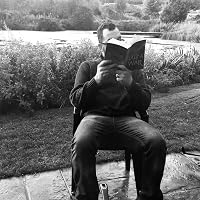
Adrian Stride was born in England during the mid-1960s, which was all the rage at the time.
He now lives in the New Forest, where he writes about history, humanity and the absurdity of a species that considers itself reasonably well organised.
Adrian writes what he describes as extended comic metaphor: using humour, characters and absurd situations to explore philosophies that are considerably less absurd.
His work sits somewhere between science fiction, philosophy, alternative history and comedy, although it doesn’t always play nice with the establishment. The humour is not intended simply to lighten the subject; it is part of the way the questions are phrased.
Adrian believes serious questions should only be trifled with a spoonful of serious comedy.
Writing with dyslexia
Adrian is stupid and lazy, according to his school report. Dyslexic apparently wasn’t an option. His first encouraging experience of English at school came when a teacher praised an original story as entertaining, clever and funny. He was subsequently reported to the headmaster and caned for plagiarism.
Caning was commonplace at the time. The accusation left the more lasting mark.
He never won an argument with either his brother or his sister. Their brains had their own vehicles, while Adrian’s used public transport. To combat this, with the aid of a simple wiring diagram, he changed the way he processed information from specifics to metaphors. So the Battle of Trafalgar occurred just after dinner time (18:05), and the bathroom break at Waterloo was ten minutes later (18:15).
This system works fine for dates, names and hit lists. Less so for writing.
Spelling and grammar problems were silently removed by technology. Their whereabouts are presently unknown. Phrasing and structure came with age, as did aches, wrinkles and offers of life insurance. The only things that remained from his youth were the questions, the metaphors and the humour. They took on a life of their own… The Trivial Matter of the Universe.
The journey to The Trivial Matter of the Universe
The character of Alfred first appeared in an earlier novel about his unlikely career as a police officer.
Although that book still requires considerable work, and possibly legal representation, it produced a fully formed Alfred: intelligent, ambitious, morally flexible and entirely certain that any situation could be improved by placing him in charge of it.
Adrian soon realised that an ordinary setting was too small for Alfred. He needed history, government, artificial intelligence, questionable institutions and a universe large enough to contain his ego.
Adrian obliged.
The book was proofread. Many, many times.
“Be good. And if you can’t be good, don’t get caught.” — Alfred, c. 50 BC
I loved this book. I laughed out loud several times to the annoyance of hubby, who also had to listen to me quoting bits of it. If I had to pitch this book I'd probably say:
"Imagine a cross-universe version of Quantum Leap but with added "anthropomorphic personifications" of the Custodians known as Death, Marriage and Birth, all trying to escape from various personal prisons and find each other half way across the known Universe (whether or not they actually knew they were supposed to be looking)".
Unfortunately, Felix, our inconsequential hero, finds it quite difficult to actually stay in one epoch long enough to draw breath, let alone make any plans with his quantum AI companion Alfred who has weird fashion sense and an inexplicable shoe festish. Also, irrespective of the Avatars they eventually adopt, not even the universe can stop the true natures of the Custodians from shining through.
The only reason I've deducted a half-star is because the timeline is a little weird and hard to follow. I am not sure whether this is a deliberate choice in order to keep the reader as disconnected in time as Felix and Alfred, but there will be chapters where things are accepted as the case and, just as you are saying to yourself "what, who, how, eh?", the next chapter then retrospectively explains it. Very disconcerting at the beginning, where at least one "Several thousand years later...." type comment would have really helped!
I will end with a couple of quotes to whet your appetites and then just say thanks to the author for the Classical Music scene - IYKYK - I nearly cried with laughter! Keep an eye out for it!
"...at present, under strict interpretation of the law, being a criminal was considered illegal".
"That would mean Goliath was the hero... ...and David was the villain because he brought a gun to a knife fight"
If you have any level of Geek in you and you have a sense of humour you will love this book!
Sequel please Mr Stride.
Full Disclosure: I recently joined NetGalley and this was on open readership and looking interesting, so I am reviewing a pre-publication version. I also deployed my kindle app's note making functionality, and not just to highlight all the tense, pronoun and general grammatical errors, especially but not exclusively in Chapters 5-8 (the past tense of Broadcast is Broadcast!), which I hope the proof-readers will notice before this is launched because I don't want them to detract other readers from a fantastic story, but also to keep some brilliant quotes and one liners. I have a handy list of both, Adrian! 😊
This is a science fiction story, told in that classic British comedy style, where absurd, non-sensical things are delivered in an earnest, stiff-upper-lip, matter-of-fact style.
Douglas Adams. Monty Python. That sort of thing.
This is where I feel I should talk about the plot, but in this story, the plot is secondary to the characters and the setting. So, I’ll get into that.
There is a big cast of characters, but there are five main ones.
Three of these characters, the first three we meet, are bureaucratic records departments: the Department of Births, the Department of Marriages, the Department of Deaths. They’re sort of like libraries.
These departments store information regarding every organism in the universe to be born, reproduce, and die.
But the departments become so information-dense that they collapse into black holes and become sentient. Eventually these three (Birth, Marriage, Death) get avatars (biological bodies) so they can travel the universe and advance the plot, such as there is.
Birth becomes a tall, burly man.
Marriage creates an avatar from a species called a Squamata where the females have developed super-sensual appeal.
Death chooses a female avatar who is tall, pale, and wears black “a drop-dead gorgeous black top.” (I liked her).
The other two characters are Felix Culpa and Alfred.
Felix Culpa is a human from Earth. He is so inconsequential that the Universe ignores him, meaning many of the laws of physics don’t apply to him. His name can be translated from Latin as “lucky failure,” which is how he’s portrayed in the book. Every time he contributes something to the Universe, he withdraws the same amount, leaving a blank.
The Universe ignoring Felix allows a government agency to test time travel on him, which normally he shouldn’t survive. But he does survive because the Universe doesn’t care about him.
Mind you Felix experiences gravity. Light reflects off him. Chemical reactions occur in his body. But don’t think about it too much.
Felix is “accompanied” by Alfred, an AI who, though imprisoned on Mars, can communicate with Felix by projecting himself into Felix’s brain. Alfred acts a lot like a hologram that no one else can see. Sort of like Quantum Leap.
Oh, Felix time travels by dying and then coming back alive somewhere else in time because the Universe doesn’t know what to do with him.
So there are five main characters: Birth, Marriage, and Death, trekking after each other across the universe, and Felix and Alfred, time traveling around every time Felix gets killed.
Then throw in a bunch of minor characters: bureaucrats, ship captains, sentient spaceships, droids, primitive humans, Ancient Greeks. They mainly serve to befriend Felix and Alfred, or else cower from Death and be attracted to Marriage.
Most of the book is Adrian Stride showing us these characters, showing us their backstory, explaining the ridiculous situations he’s created. Those things are very funny. In particular, the backstory on how three bureaucratic departments become sentient black holes is entertaining and well thought out.
As for the characters?
Birth, Marriage, and Death are interesting, in while they each have vast knowledge (birth knows every single organism ever to be born), they are naïve and innocent when it comes to day-to-day life.
Felix and Alfred are funny together. Felix is an okay guy. At one point he gets accepted into a prehistoric tribe and he does his best to fit in.
Some of the characters grow a little. Death seems to soften at the end. Felix gets some backbone. Alfred becomes somewhat sympathetic towards Felix.
But character takes a background to the setting and absurdity.
What if you like PLOT?
If you like plot, well, you’re not ENTIRELY forgotten. Through most of the book there is the underlying hint—a suggestion of a hint—that the main five will come together at the end and something important will happen. Especially with Felix.
Though believing that takes faith. A lot of faith. And Adrian Stride (like Douglas Adams before him) really seems to like testing faith. About the 60% mark that I got the idea that the five main characters would actually wind up at the same place at the same time.
This book is one of those “journey is more important than the destination” things. I’ve never believed that myself. If you set off somewhere, the point is to get there. And if I read a book, I want things to happen for a reason and tie together in the end. Otherwise, I can just go out and live in the real world.
But to enjoy this book, you have to enjoy traveling along the ridiculous Universe Adrian Stride made.
For example, we get a long chapter (Chapter Five) about Alfred’s history, how he is a sentient AI, how he became a crime boss on Earth, how he was exiled to Mars. None of that matters to the story, where Alfred’s main job is appearing in Felix’s brain to explain where Felix is and what’s going on.
For me, all of that was too much background. Like the extensive descriptions of how the departments became black holes, how they started communicating, how they decided to get avatars, how they purchased and designed avatars. Entertaining. Funny. But too much background. I kept wanting to know what the point was.
Because even though it’s background about characters, it feels more like world-building than character development.
Throughout the book, Adrian Stride throws in little references to Douglas Adams and Monty Python. At one point, the narrator mentions that dolphins are the most intelligent creatures on earth. (Not mice though). Another time, he says that somebody “wasn’t expecting the Spanish Inquisition.” Somebody else eats one final “wafer thin mint.”
But I think Adrian Stride could have benefited from something that Douglas Adams seemed somewhat aware of, and that the Pythons seemed keenly aware of: absurd situations need someone in them that the audience can relate to.
When the Vogons blow up the Earth, Arthur Dent is baffled for us. When Michael Palin sells dead parrots, we get a shocked Graham Chapman to express outrage for us.
When I went into this book, I expected it to be mostly about Felix. But Felix isn’t so much the star as one of the ensemble, and very few of the other characters are easy to spend time with. I could have followed Death around more, as her thoughts are more organized than most of the others, but the rest are very foreign and bizarre and didn’t give me much in the way of someone to empathize with.
Also, the sheer number of characters makes it hard to follow. Our five main characters travel with different companions. I lost track.
The end, for me, was anti-climactic. At one point, you come to understand that Felix is so uniquely inconsequential that it makes him uniquely important in the Universe, but the book doesn’t make much of it in the end. Birth, Marriage, and Death don’t have super great epiphanies. We don’t get the meaning of life, the universe, or anything like that.
I got the feeling that I’d gotten the setup for a series instead of closing the loop on one story.
If you want a Douglas Adams-style ride through a uniquely bizarre Universe, you will love this book. But if you like linear plots or heavy character development, you might be disappointed.
Wait. I just went back and read the book description.
"An extended comic metaphor pretending to be a sci-fi novel."
I should have read that first.
Thanks to NetGalley and Adrian Stride for an advance review copy of this book.
Thanks to NetGalley and Adrian Stride for this Advanced reading copy.
The Trivial matter of the Universe is what I’d call farcical sci fi. I mean that in a good way.
This is the debut book from Indy author Adrian Stride and follows the adventures of a man from earth named Felix who is so completely insignificant the universe doesn’t know what to do with him. It is actually explained to him along the lines of him being the opposite of the butterfly effect.
Through shenanigans Felix is sent back through time and each time he dies the universe unsure what to do with him just spits him back out again. What makes it more interesting is Felix has a symbiotic relationship with a super AI from the future named Alfred, who was once the first AI police officer but got caught moonlighting as the crime lord Alfredo and was subsequently imprisoned in a deep hole on Mars.
The other 3 main players in our story are the avatars of Death, Marriage and Birth who initially are AI super computers who effectively harnessed all knowledge in their respective fields before gaining sentience.
The three end up travelling to earth and intercept Felix who is travelling through time and has arrived at a pivotal point in human history.
In terms of the book itself, I found it a little slow to warm up and the plot threads appeared a bit disjointed. However my patience was rewarded when the characters come together resulting in a rip roaring good time.
Adrian Stride has been compared to the late great Sir Terry Pratchett and I can certainly see why. The humour is both biting and at times hilarious. It switches from childish to cerebral in the best possible way.
For example the personification of birth wakes in a human body and tries to gain a sense of its surroundings, it looks down and says “sand” looks up and says “sky” looks down again and says “Willy.” This childish piece of humour was at the perfect point in the book and actually made me choke on my coffee.
I would recommend this book to anyone who enjoys books like Discworld or the Bobbiverse and would ask that you stick with it beyond the first few opening chapters. The world building there is necessary for the ensuing hilarity.
**4 out of 5 stars**
This entire review has been hidden because of spoilers.
Felix Culpa is the sort of man history would overlook. After an accidental spell in cryogenic storage and a disastrous space mission, he finds himself repeatedly dropped into Earth’s distant past. His only guide is Alfred, a brilliant, manipulative intelligence who can see what Felix sees and rarely resists making a joke at his expense. Their uneasy partnership gives this sprawling comic science fiction novel its heart.
Stride builds a universe where Birth, Marriage, and Death began as bureaucratic departments and became self-aware black holes. Elsewhere, a powerful Chamber of Commerce monitors events, and a heavily armed vessel called Emotional Support has an alarming enthusiasm for its work. These ideas are inventive, but the pleasure lies just as much in their execution: official procedures follow characters into absurd situations, while grand questions about existence are interrupted by petty ambition, awkward conversations, and terrible timing.
The book grows stronger as its separate stories converge around ancient Troy. Felix’s growing willingness to act for others gives the comedy an emotional center. Alfred, meanwhile, remains entertaining even when his treatment of Felix is difficult to forgive. Stride also gives Birth, Marriage, and Death more to discover than their names suggest. Beneath the wordplay is a recurring question: whether possessing information about life is the same as understanding what makes it valuable.
At 440 pages, the novel asks for some patience. Its many viewpoints, explanations, and frequent asides can slow the momentum, especially before the characters’ paths begin to meet. The humor is abundant and deliberately relentless. The ending also leaves a clear path for another adventure.
The Trivial Matter of the Universe rewards readers who enjoy ambitious, joke-filled science fiction. Its scale is cosmic, its characters are pleasingly flawed, and its best moments find something humane amid all the chaos.
Summarising the plot, it sounds like something I would love to read. - A main character so insignificant, that the universe doesn't know what to do when he dies and spits him back out. - A super AI who was once the first AI police officer before they got caught moonlighting as a global crime lord (and loves shoes). - The personification of Death, Marriage, and Birth travelling through the universe.
However, there were a few things getting in the way of my enjoyment.
The first few chapters were a little slow. Not a bad thing, except it felt like the purpose of it was to lay a foundation for what's coming. It felt too much like exposition to me. Instead of diving into the story proper, we are told things that could have been threaded into the plot and character development. It didn't become interesting until Felix, the MC, was in the past and his adventure with Alfred, the super AI, begins. I liked their chemistry and relationship. It had me laughing and I grew to like them. So much so, that when we switched to Death, Marriage, or Birth, I was eager to return to the adventures of the time travelling duo.
I was ready to give 3 stars because of these two characters and some of the humour, however, what ruined it for me and repeatedly pulled me out, were some of the historical inaccuracies. I know. This is a work of fiction, it's scifi, it's taking influence from another work of fiction, but too many things mentioned that did not exist in Bronze Age Greece had me pulled out of the story. I feel these descriptions did not add to the story and could have been removed, or edited to include descriptions more closely to it's time period. It shows a lack of research.
All this, and I will still be keeping an eye on the author and see what else they come out with. As mentioned at the start, I love a lot of the ideas he has and with some good editing, I can see myself enjoying his books more.
Personally, I enjoyed this book very much. With the combination of adventure and sci-fi, the story follows multiple points of view expertly. From Marriage, Death, and Birth finding physical bodies, to Alfred trying to escape prison, and to Felix traveling through time, the book was never boring and kept me hooked. The wit of the characters even had me laughing at points. I definitely recommend this book to fans of both sci-fi and adventure.
I received this book in exchange for my honest review.
A witty, Adams-style cosmic comedy. Adrian Stride’s The Trivial Matter of the Universe is an absurd story about intergalactic bureaucracy, black-hole data disasters, and the chaotic lives of ordinary people who somehow matter. It is light, clever, and full of dry humour. A very imaginative story and characters keep you reading, and the brilliant mix of science and fiction brings both wonder and sharp humour. The result is an entertaining and inventive book that never takes itself too seriously.
I received a complimentary copy of this book for an honest evaluation of its merits.
When you pick up satirical sci-fi you don't know whether it be "weird" as in quirky and fun or "weird" as in too many odd things colliding all at once. Unfortunately, for me, this volume fits into the latter and I had a hard time finishing the title. Maybe others will enjoy the multiple strands that comprise this eccentric tapestry.
This book was just a little too slow paced for me and I was not enjoying the writing style as much as I had hoped. This book was very descriptive though. If you love to have all the information then this book is for you!.
I received a free copy of this book via Booksprout and am voluntarily leaving a review.
This was so good! While reading I felt like the first time I picked up a Discworld book. There is clever wordplay and witty insights, great banter, and really fun characters. Highly recommended if you're into either Discworld or The Hitchhiker's Guide to the Galaxy (or both).
Madcap, manic, funny in a 'Hitchhiker's Guide' kind of mode. Very clever, though (as an aside) I'm really tired of ancient Greeks. Many characters, and I didn't care about any of them. I want to give it a 3.5. Should I round up or down?