

What do you think?

In These Gilded, Ghostly Hearts
Stoker winner Gwendolyn Kiste holds up a dark, queer mirror to The Great Gatsby in In These Gilded, Ghostly Hearts, a haunting exploration of the obsession and control at the edges of an American classic.
In 1955, Daisy Buchanan is found dead in an abandoned West Egg mansion, but her daughter Mel knows she's really been gone for years. No one knows whether Daisy was murdered, or if it was a simpler, slower death: her yearslong spiral of alcohol, abuse, and helplessness. But when Mel enters the estate, she finds Daisy's ghost, somehow frozen at twenty-three, and a charming, bleeding phantom that used to be Jay Gatsby.
To free her mother, Mel must carve a path through family secrets and decaying revelers: deep into Gatsby’s starving house, as it gorges itself on unfulfilled love and grows stronger every night.
In 1955, Daisy Buchanan is found dead in an abandoned West Egg mansion, but her daughter Mel knows she's really been gone for years. No one knows whether Daisy was murdered, or if it was a simpler, slower death: her yearslong spiral of alcohol, abuse, and helplessness. But when Mel enters the estate, she finds Daisy's ghost, somehow frozen at twenty-three, and a charming, bleeding phantom that used to be Jay Gatsby.
To free her mother, Mel must carve a path through family secrets and decaying revelers: deep into Gatsby’s starving house, as it gorges itself on unfulfilled love and grows stronger every night.
174 pages, Kindle Edition
First published September 15, 2026
About the author
Gwendolyn Kiste
122 books924 followersGwendolyn Kiste is the four-time Bram Stoker Award-winning author of The Rust Maidens, Reluctant Immortals, The Haunting of Velkwood, Boneset & Feathers, and Pretty Marys All in a Row, among others. Her short fiction and nonfiction have appeared in outlets including Lit Hub, Nightmare, Best American Science Fiction and Fantasy, Vastarien, Tor Nightfire, Titan Books, and The Dark. She's a Lambda Literary Award winner, and her fiction has also received the This Is Horror award for Novel of the Year as well as nominations for the Shirley Jackson, Premios Kelvin, Ignotus, and Dragon awards.
Originally from Ohio, she now resides on an abandoned horse farm outside of Pittsburgh with her husband, their excitable calico cat, and not nearly enough ghosts. Find her online at gwendolynkiste.com
Originally from Ohio, she now resides on an abandoned horse farm outside of Pittsburgh with her husband, their excitable calico cat, and not nearly enough ghosts. Find her online at gwendolynkiste.com
Ratings & Reviews
Friends & Following
Create a free account to discover what your friends think of this book!
Community Reviews
Displaying 1 - 30 of 133 reviews

Read
March 5, 2026I blurbed this one!
"Clever, compelling, and creepy: In These Gilded, Ghostly Hearts is the sapphic sequel to The Great Gatsby we have all been waiting for as fervently as Gatsby waited for Daisy."
"Clever, compelling, and creepy: In These Gilded, Ghostly Hearts is the sapphic sequel to The Great Gatsby we have all been waiting for as fervently as Gatsby waited for Daisy."

Review of advance copy received from NetGalley
✨ In These Gilded, Ghostly Hearts ✨
I can appreciate the attempt at a queer Great Gatsby retelling, but this one just fell flat for me. It felt too short to fully explore the ideas it was reaching for, which left the story feeling underdeveloped and a bit too fast paced.
🖤 What to Expect
• Queer gothic horror
• Great Gatsby reimagining
• Haunted mansion
• Ghostly mother
_ _ _
⭐ Final Score: 2.5
📅 Pub Date: September 15, 2026
📝 Thank you to Creature Publishing and NetGalley for the advanced copy. All thoughts are my own.
I can appreciate the attempt at a queer Great Gatsby retelling, but this one just fell flat for me. It felt too short to fully explore the ideas it was reaching for, which left the story feeling underdeveloped and a bit too fast paced.
🖤 What to Expect
• Queer gothic horror
• Great Gatsby reimagining
• Haunted mansion
• Ghostly mother
_ _ _
⭐ Final Score: 2.5
📅 Pub Date: September 15, 2026
📝 Thank you to Creature Publishing and NetGalley for the advanced copy. All thoughts are my own.

May 4, 2026
⭐️⭐️⭐️⭐️ (4 very solid stars)
At the forefront of this novella is Daisy’s and Mel’s mother-daughter relationship. It’s complex, difficult but inevitably soo emotional too. And without spoiling, just let me say that this novella raised so many questions within me such as how much of our parents is in us? How much are we alike? How much of our past or the one of our parents define us and how do you learn to live with your past without wanting to erase certain points?
To put it mildly, this was veryyy emotional, even more so at the end. Especially because in the very end, it felt like I was reading a story which teaches me to learn how to let go, of the past, of people long gone and in a way even people who are still very much alive and mean so much to one but hinder us to move on in a way. And all of this, to get your own chance to live a life according to your own terms. Which is exactly why I would say this is so very emotional but also a really important read. Moreover, it was very well written and put together in a way that I wish it would’ve been longer and had even more detail. Though, I gotta admit, reading this almost made me nostalgic to read ‘The Great Gatsby’ again (haha).
Overall, I really really enjoyed reading this and I can recommend this a thousand times. It’s really sooo good!!
Ps: We all surely had a Jordan in our life, I know for sure I had one 🙂↕️
Thank you to Netgalley and the publisher for providing me with a free copy of this novella in exchange for an honest and voluntarily given review!
At the forefront of this novella is Daisy’s and Mel’s mother-daughter relationship. It’s complex, difficult but inevitably soo emotional too. And without spoiling, just let me say that this novella raised so many questions within me such as how much of our parents is in us? How much are we alike? How much of our past or the one of our parents define us and how do you learn to live with your past without wanting to erase certain points?
To put it mildly, this was veryyy emotional, even more so at the end. Especially because in the very end, it felt like I was reading a story which teaches me to learn how to let go, of the past, of people long gone and in a way even people who are still very much alive and mean so much to one but hinder us to move on in a way. And all of this, to get your own chance to live a life according to your own terms. Which is exactly why I would say this is so very emotional but also a really important read. Moreover, it was very well written and put together in a way that I wish it would’ve been longer and had even more detail. Though, I gotta admit, reading this almost made me nostalgic to read ‘The Great Gatsby’ again (haha).
Overall, I really really enjoyed reading this and I can recommend this a thousand times. It’s really sooo good!!
Ps: We all surely had a Jordan in our life, I know for sure I had one 🙂↕️
Thank you to Netgalley and the publisher for providing me with a free copy of this novella in exchange for an honest and voluntarily given review!

Review of advance copy received from Publisher
Review in the September 2026 issue of Booklist and on the blog: https://raforall.blogspot.com/2026/09... (link live on 9/10/26 at 7am central)
Three Words That Describe This Book: book about a book, immersive and visceral, reclaiming forgotten women (especially discarded daughters)
This one is a solid 4.5 stars.
More than a retelling, this is a horror novel that explores and probes its inspiration-- The Great Gatsby and creates something new. But it keeps the sensual, decadence and glamor of the original as well. It uses the source material to tell a new story. Similar to Reluctant Immortals but not as wide in scope-- both in the breadth of the story and length-- this is a novella that can be read in 2 sittings-- and you will want to do that.
Also I stand behind the word Visceral here but this book is not "gross" in a standard use of that word. The house-- Gatsby's West Egg mansion is a sentient haunted house, it can create corporeal ghosts out of its memories-- conjure them-- but it needs to feed off the living to gain strength. The more living breathing humans who visit from 3-4 am, the more it can feed and then do. So this book is sticking with the ectoplasm that oozes down the walls and sticks to the people. The ghosts it creates are in various states of building-- some are grotesquely missing major parts, some are rotting, some are just slightly, but very creepily off.
Let's back up a bit though. This book hinges on the appearance, very small, of Daisy's daughter Pamela in the source text (The Great Gatsby). Like Kiste does with all of her work-- she gives voice to the voiceless women in the world (whether they are of her creation or from other works of literature). In this case, she dedicated the book to "discarded daughters" and that is the focus here. Pamela, who prefers to go by Mel, is our protagonist and POV here. Kiste empowers her with her own story and her own happy ending.
Kiste also makes reference to the film version which readers may notice and if not, she tells you in the acknowledgements.
It is 1955 and Daisy has just died-- found dead at the West Egg Mansion of Gatsby, obviously long dead as readers of the course material know. Mel gives readers the view of Daisy after the novel. Washed up at 25 but living in the past to almost 60. Mel's life has not been easy and she grew up very poor knowing her family had once been rich. Once nice touch in Kiste's hands here is that over the course of the novel, Mel comes to learn more truth about her mother, Gatsby and more.
Mel is 35 but her whole life she has toiled and tried to earn her mother's love. Her mother seemed to only live in the past. Mel has a good job at a dry cleaner working with a woman who is her best friend but who she also has feelings for.
When she finds out her mom was with a famous spiritualist at West Egg when she died, this starts the horror action. Mel is drawn to participate in connecting with the ghosts who appear every night at West Egg to live an echo of the great parties from the heights of the novel. At the center of it all is Gatsby himself. But Mel goes with the spiritualist in an attempt to find the ghost of her mother. What she finds is a lot more than she bargained for, but it might be just what she needs to start living her life for herself for the first time ever.
Readers see immediately that the house holds a grotesque power of its own from the start. Mel feels it. The visceral things I mention above are key. The details are immersive. You are there both in 1955 with Mel (whether it is in NYC at her job and walking the streets o visiting the lesbian bar) AND at West Egg in the Gatsby pre cars 1920s and the abandoned decrypted house of 1955.
Fun thing here, Kiste makes Gatsby, his parties, and his death part of the world's history-- so Mel can go to the NYPL and look up news stories about it.
This is a story that probes the source material to move it into a future and tell Mel's story, but it also closes some loops in the original. It is also an immersive and imaginative sentient haunted house story. It is also a novel that gives the power and happy ending to discarded daughters and forgotten women everywhere.
I found the resolution a little too fairy tale-esaue and neat for horror, but I have read a lot of Kiste's work and love all of it. I know she doesn't usually do this so I know she had a reason.
Like all of her books and stories, this is impeccably written. The imagery is vivid, the characters come alive, the writing is beautiful (even when about gross things like a ghastly built body) and accessible. It is a joy to read and will linger with you long after.
I for one will never be able to look at The Great Gatsby the same way again. And that is a HUGE win. This is from a smaller press but totally worth a read by anyone who like Gwendolyn Kiste (raises my own hand).
For any readers who love to read original retellings of classics by today's horror authors but especially the way Helen Oyoyemi does it.
Also if you like this decadent and glamorous but still visceral horror of forgotten women getting their due, try Donyae Coles-- Midnight Rooms yes because a type of haunted house Gothic, but especially the upcoming (August) The Sunken, the Adored.
Three Words That Describe This Book: book about a book, immersive and visceral, reclaiming forgotten women (especially discarded daughters)
This one is a solid 4.5 stars.
More than a retelling, this is a horror novel that explores and probes its inspiration-- The Great Gatsby and creates something new. But it keeps the sensual, decadence and glamor of the original as well. It uses the source material to tell a new story. Similar to Reluctant Immortals but not as wide in scope-- both in the breadth of the story and length-- this is a novella that can be read in 2 sittings-- and you will want to do that.
Also I stand behind the word Visceral here but this book is not "gross" in a standard use of that word. The house-- Gatsby's West Egg mansion is a sentient haunted house, it can create corporeal ghosts out of its memories-- conjure them-- but it needs to feed off the living to gain strength. The more living breathing humans who visit from 3-4 am, the more it can feed and then do. So this book is sticking with the ectoplasm that oozes down the walls and sticks to the people. The ghosts it creates are in various states of building-- some are grotesquely missing major parts, some are rotting, some are just slightly, but very creepily off.
Let's back up a bit though. This book hinges on the appearance, very small, of Daisy's daughter Pamela in the source text (The Great Gatsby). Like Kiste does with all of her work-- she gives voice to the voiceless women in the world (whether they are of her creation or from other works of literature). In this case, she dedicated the book to "discarded daughters" and that is the focus here. Pamela, who prefers to go by Mel, is our protagonist and POV here. Kiste empowers her with her own story and her own happy ending.
Kiste also makes reference to the film version which readers may notice and if not, she tells you in the acknowledgements.
It is 1955 and Daisy has just died-- found dead at the West Egg Mansion of Gatsby, obviously long dead as readers of the course material know. Mel gives readers the view of Daisy after the novel. Washed up at 25 but living in the past to almost 60. Mel's life has not been easy and she grew up very poor knowing her family had once been rich. Once nice touch in Kiste's hands here is that over the course of the novel, Mel comes to learn more truth about her mother, Gatsby and more.
Mel is 35 but her whole life she has toiled and tried to earn her mother's love. Her mother seemed to only live in the past. Mel has a good job at a dry cleaner working with a woman who is her best friend but who she also has feelings for.
When she finds out her mom was with a famous spiritualist at West Egg when she died, this starts the horror action. Mel is drawn to participate in connecting with the ghosts who appear every night at West Egg to live an echo of the great parties from the heights of the novel. At the center of it all is Gatsby himself. But Mel goes with the spiritualist in an attempt to find the ghost of her mother. What she finds is a lot more than she bargained for, but it might be just what she needs to start living her life for herself for the first time ever.
Readers see immediately that the house holds a grotesque power of its own from the start. Mel feels it. The visceral things I mention above are key. The details are immersive. You are there both in 1955 with Mel (whether it is in NYC at her job and walking the streets o visiting the lesbian bar) AND at West Egg in the Gatsby pre cars 1920s and the abandoned decrypted house of 1955.
Fun thing here, Kiste makes Gatsby, his parties, and his death part of the world's history-- so Mel can go to the NYPL and look up news stories about it.
This is a story that probes the source material to move it into a future and tell Mel's story, but it also closes some loops in the original. It is also an immersive and imaginative sentient haunted house story. It is also a novel that gives the power and happy ending to discarded daughters and forgotten women everywhere.
I found the resolution a little too fairy tale-esaue and neat for horror, but I have read a lot of Kiste's work and love all of it. I know she doesn't usually do this so I know she had a reason.
Like all of her books and stories, this is impeccably written. The imagery is vivid, the characters come alive, the writing is beautiful (even when about gross things like a ghastly built body) and accessible. It is a joy to read and will linger with you long after.
I for one will never be able to look at The Great Gatsby the same way again. And that is a HUGE win. This is from a smaller press but totally worth a read by anyone who like Gwendolyn Kiste (raises my own hand).
For any readers who love to read original retellings of classics by today's horror authors but especially the way Helen Oyoyemi does it.
Also if you like this decadent and glamorous but still visceral horror of forgotten women getting their due, try Donyae Coles-- Midnight Rooms yes because a type of haunted house Gothic, but especially the upcoming (August) The Sunken, the Adored.

Review of advance copy received from NetGalley
Some Inheritances Are Better Tailored Than Preserved
In “In These Gilded, Ghostly Hearts,” Gwendolyn Kiste refits “The Great Gatsby” into a queer Gothic of hungry houses, aging women, filial obligation, and the dangerous fantasy that love should keep someone unchanged.
By Demetris Papadimitropoulos | September 4th, 2026
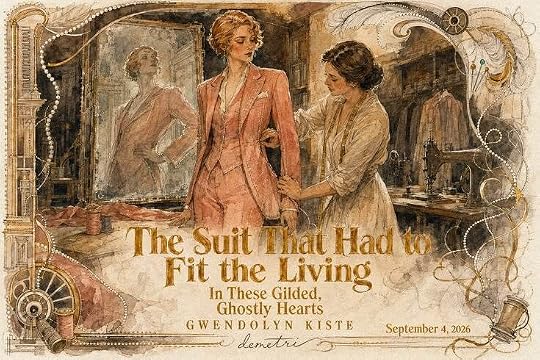
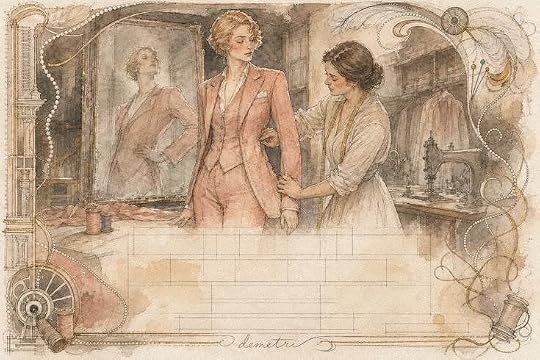
“The Suit That Had to Fit the Living” – Vera’s needle refits Gatsby’s pink suit for Mel, turning inheritance from a form to inhabit into material that can be changed for the living.
Dressed in a pink suit that has outlived its owner by three decades, Mel Buchanan discovers how seductive a bad fit can be. The suit belonged to Jay Gatsby, which is trouble enough. In Gwendolyn Kiste’s “In These Gilded, Ghostly Hearts,” objects cling to their former meanings almost as stubbornly as people do, and Gatsby’s suit carries the old promise of self-invention: perhaps a person can step into another shape and call it freedom. Mel nearly believes this. Vera, the woman she loves, answers with a needle. She takes the suit in at the seams. Beside the supernatural excess gathering on Long Island, the gesture looks almost comically modest. It is also the novella’s quiet counterspell. What is inherited need not be worshiped or destroyed. Sometimes it needs tailoring.
Everything begins with a death that should have been final. It is 1955, thirty-three years after Gatsby’s murder, and Pamela “Mel” Buchanan, daughter of Daisy and Tom, learns that Daisy has died inside Gatsby’s abandoned West Egg mansion. Mel has already survived the Depression, the collapse of Buchanan wealth, Tom’s violence and eventual suicide, Daisy’s long alcoholic decline, and a miserable marriage of her own. She now works at a Manhattan dry cleaner, where torn things arrive under bright lights and leave changed enough to be useful again. Gatsby’s house offers a grander repair service. It promises restoration: not a workable present, but the past returned intact.
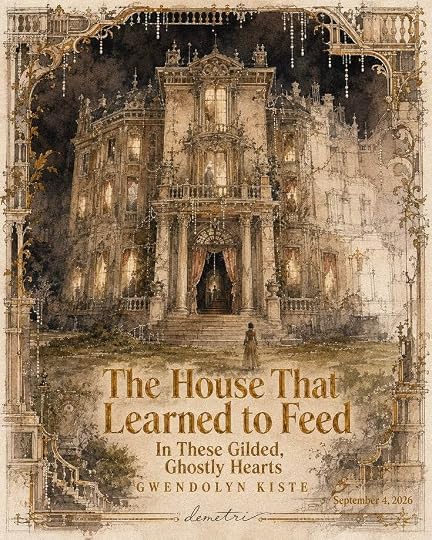
“The House That Learned to Feed” – Gatsby’s mansion becomes appetite made architectural, its repeated windows and misregistered grandeur reducing Mel to a small figure before inherited hunger.
Memory in this house has a metabolism. The walls secrete ectoplasm; at three each morning they rebuild Gatsby’s old revelers from whatever scraps of recollection remain. Some guests emerge nearly persuasive. Others arrive with missing parts, bad seams, mouths that never formed. Jay Gatsby himself persists with unusual clarity, still bleeding from the wound that killed him and still hoping with such exertion that hope begins to resemble unpaid labor. Daisy appears too, at first as the twenty-three-year-old Gatsby remembers. When Mel reaches for her, she cracks apart. The mansion manufactures memory, and quality control has been dead for years.
Elapsed time is Kiste’s first real intervention. Rather than replay Gatsby’s famous summer from another chair at the table, she lets it harden into family history. Nghi Vo’s “The Chosen and the Beautiful” brilliantly reenters that summer through Jordan Baker; Kiste gives everyone but Gatsby three decades in which to age, work, fail, move, harden, soften, and discover what happens when the party becomes anecdote. She can write consequences rather than corrections. Gatsby’s wish to repeat the past is no longer a romantic impossibility suspended inside one tragic season. It has had thirty-three years to become infrastructure, complete with upkeep charged to people who never consented to inherit it.
The mansion feeds on living visitors, and their energy gives its recollections weight, appetite, even hands. Younger versions of guests begin consuming their older selves. Bodies return with seams visible and pieces missing. Kiste keeps dragging abstraction into matter until the old Gatsby vocabulary turns physical: nostalgia leaks; idealization develops a body count; longing leaves stains on the wallpaper. Fitzgerald’s yearning has become a production system, and the defective merchandise still bites.
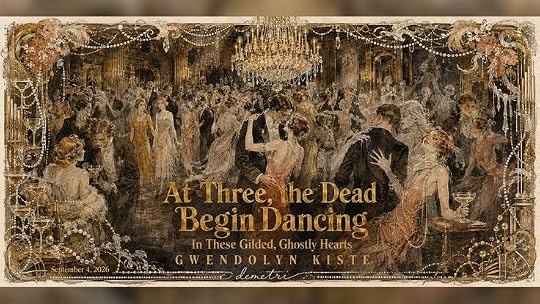
“At Three, the Dead Begin Dancing” – Gatsby’s party returns at three in the morning, glamour and predation occupying the same floor as the dead borrow substance from the living.
Return trips between Manhattan and West Egg give that system its rhythm. Mel enters the mansion, learns something, loses something, retreats, then goes back. Each circuit alters the terms. Gatsby repeats because he cannot change. Mel repeats until she can. Manhattan contains rent, work, Vera, blistered fingers, sewing machines and an unwritten life. West Egg contains inherited property, family mythology, staged glamour and the fantasy that nothing need ever finish. The geography gives Mel’s divided loyalties a commuter schedule.
Inside the house, knowledge has an address. One locked room yields another; Gatsby’s bedroom hides a false wall; behind it waits a stairway; above that, an attic. The farther Mel moves through the architecture, the farther she gets beneath Gatsby’s preferred version. Family truth has literally been stored upstairs, behind more attractive rooms. Lili, the glamorous assistant to the washed-up spiritualist Harrison Shipton, turns out to be his daughter, another woman drafted into a parent’s unfinished ambition. Daisy’s youthful apparitions are not Daisy. Even the deed changes the moral geometry: Gatsby left the mansion to Daisy, so Mel has inherited legal title to somebody else’s fixation.
Past the false wall, Gatsby’s private romance begins to look less like longing than inventory. He has filled a room with Daisies. Some are almost right; others leak, slump, or emerge badly assembled. When a copy deteriorates beyond his tolerance, he does not repair her. He replaces her. Mel later watches him slit the throat of one failing version, let the body collapse into a husk, and bury it beneath a silk flower among the graves of earlier attempts. Romantic idealization becomes serial disposal. Kiste takes Gatsby’s dream at its word and finds an assembly line: the beloved is safest when she remains reproducible.
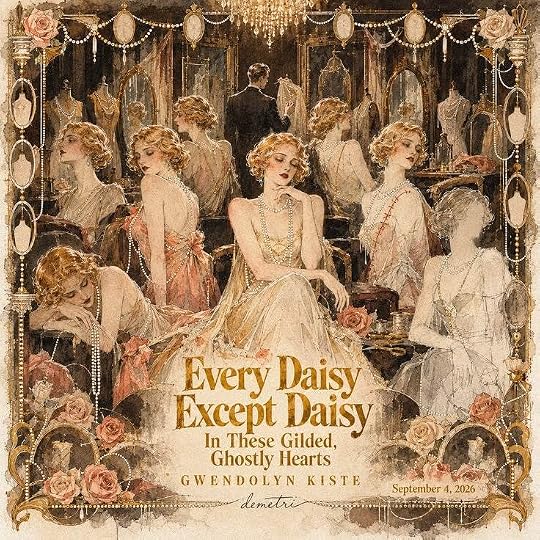
“Every Daisy Except Daisy” – Gatsby’s manufactured Daisies become an elegant inventory of idealization’s waste, each beautiful copy failing in a different seam.
At that point Gatsby could have collapsed into a straw villain in an excellent suit. He does not. He knows the copies fail. He is lonely inside the machinery he sustains and sometimes weary enough to wish he could disappear. His tenderness toward Mel is warped but recognizable, partly because she resembles Daisy and partly because the two of them occupy the same family disaster from opposite ends. The climax does not ask Mel to destroy Gatsby. It asks her to make him look.
Pamela has been practicing another kind of preservation all her life. As a child, after one rare afternoon when Daisy seemed happy, she silently promised that she would make her mother smile that way again. The promise becomes a private contract she never remembers signing: escorting Daisy home from bars, visiting after moving out, absorbing secrets she did not create, and finally treating death itself as one last chance to become the daughter who fixes everything. Childhood bargains have an embarrassing durability. They can govern an adult life long after the adults who inspired them have forgotten the terms. The haunting merely gives physical form to a question families manage every day without ectoplasm: when does care stop being love and become permission to disappear inside someone else’s need?
At the dry cleaner, Kiste gives Mel a world built on less glamorous rules. She takes wicked pleasure in becoming precisely the sort of daughter Tom Buchanan would have despised: blue-collar, divorced, in love with a woman, competent with a ledger and better with a seam. The Buchanans once possessed enormous houses and scant practical skill. Mel can mend a garment and earn a wage. Gatsby keeps by freezing. A tailor keeps by cutting, adjusting, patching and conceding that wear has already happened. Vera’s needle does not return the pink suit to 1922. It makes the old cloth answer to the body standing there now.
Daisy’s real ghost, when Mel finally reaches her, makes that difference brutal. She is not twenty-three. She is nearly sixty, gray-haired and carrying the face of the woman who actually survived those missing decades. Gatsby looks at her and refuses the evidence. She cannot be Daisy because she no longer resembles the image he maintained. Gatsby can resurrect Daisy indefinitely; what he cannot do is allow her a lifespan. His dream preserves the beloved by abolishing every version of her he did not personally witness. There is something colder than nostalgia in that refusal. It is love with no provision for another person’s time.
Images this good do not need much help, which makes Kiste’s most persistent weakness easier to name. Again and again, a scene completes the thought and Mel supplies the gloss. By the climax the house has demonstrated the cost of repetition, the copies have exposed the violence of idealization, and Daisy’s demands have shown how filial devotion can curdle into self-erasure. Yet the narration still pauses to tell us that Daisy does not want the kind of rescue Mel offers, that the past cannot be repeated or erased, that Gatsby and Daisy must be released. The conclusions are right. They are also plainer than the hauntings that produced them. There is a small irony in a book so suspicious of fixing people into one preferred form occasionally fixing its own meanings before the reader has finished trying them on.
More pressure falls on the secondary characters because of the novella’s brevity. Vera is warm, skilled, stubborn and brave, but she is also made to carry much of the book’s idea of a life ahead; Jordan, charismatic and evasive, bears much of the pull from behind. Lili’s refusal to continue Harrison’s ghostly ambition is moving, though so neatly parallel to Mel’s emancipation that one wishes their resemblance had acquired a few splinters. At 176 pages there is almost no dead air. There is also little room for these women to surprise the argument that recruited them. The neatness is not fatal, but it shows.
In Mel’s mouth, however, the book rarely sounds embalmed. Kiste makes no attempt at Fitzgeraldian ventriloquism. Her sentences are usually short to medium, quick on their feet and fond of bodily simile; Mel can register grief and ridiculousness before either has time to put on evening clothes. The body horror is splendidly indecorous: Jazz Age sheen keeps splitting open to reveal blood, ectoplasm and anatomy with assembly errors. Most effective is the textile vocabulary running beneath the gore. The house puts people together badly. Vera sews well. Kiste rarely needs a more elaborate theory of adaptation than that.
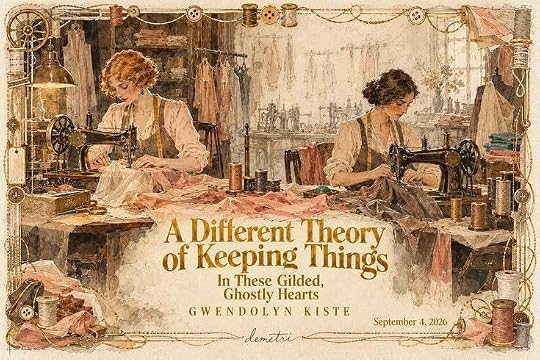
“A Different Theory of Keeping Things” – At the dry cleaner, Mel and Vera preserve by altering: worn cloth, old machines and shared labor make a future from what can still be repaired.
The 1955 setting denies Mel an easy escape into modern self-knowledge. When she and Vera finally kiss at the Bag, a lesbian bar, a vice-squad raid sends them running into the night. Their intimacy is not a wholesome present supplied to correct a decadent past; it is precarious, surveilled and dangerous in its own time. A freer emotional choice does not produce a freer society. That pressure keeps Vera from becoming merely the reward waiting outside the haunted house. A life with her remains a risk, just a risk that belongs to Mel rather than to her parents.
Revision has its best defense hanging in the dry cleaner. A canonical work can be embalmed in references or cut to a new shape; “In These Gilded, Ghostly Hearts” earns its place when it does the latter. The point is not simply to add queer lives to Gatsby’s world or move a neglected woman toward the center. It is to examine what his celebrated longing looks like when the daughter who inherited its wreckage receives the bill. The novella’s smartest changes do not correct Fitzgerald sentence by sentence. They expose costs his ending had no reason to itemize.
Once the book becomes certain of its lesson, some of its strangeness stiffens. I can understand wanting more ambiguity from the final movement, though its emotional decisiveness mostly works on me. The richest passages live in rooms of copies, hungry walls, badly sewn bodies and an old pink suit waiting for another wearer. Those objects can hold several meanings at once. The explanatory passages sometimes ask them to hold still.
Part of what Mel must finally abandon is the flattering idea that rescue always means staying. Daisy’s demand for love has no natural stopping point: to satisfy her mother completely, Mel would have to remain in the mansion, die there and become another ghost. Letting Daisy go is not indifference. It is the first refusal in Mel’s life that does not require her to stop loving the person she refuses. When she persuades Gatsby to recognize the elderly Daisy before him, the house begins releasing its copies. They do not receive the grand reunion Gatsby spent decades manufacturing. They receive a quieter mercy: an ending.
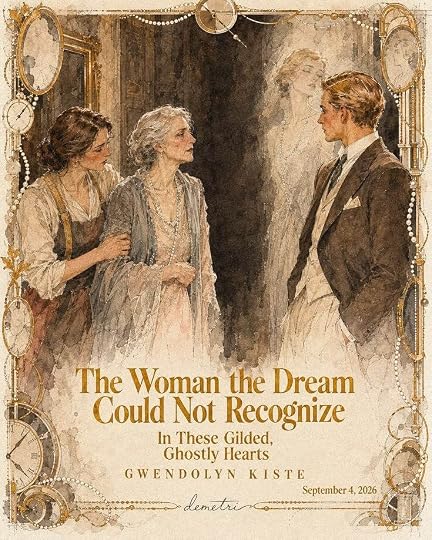
“The Woman the Dream Could Not Recognize” – The real Daisy stands before Gatsby with decades written into her face, while the younger image he can accept remains the less substantial ghost.
Outside the house, endings become choices, some more convincing than others. Nick Carraway, who has spent decades wishing he had intervened before Gatsby’s death, finally intervenes and dies taking a bullet meant for Mel. Harrison proves the existence of ghosts by becoming one. Lili refuses to make his obsession her inheritance. Jordan leaves for California and invites Mel to follow; Mel declines, recognizing that chasing Jordan would only convert an old longing into a new itinerary. The resolutions line up almost suspiciously well, but their direction feels earned. Freedom here is less glamorous than fantasy, less photogenic than a green light, and much more useful.
Uneven only at its edges, “In These Gilded, Ghostly Hearts” earns 85/100, or 4/5 Goodreads stars. Its best trick is to give Gatsby’s old longing bodies, rooms, seams and appetites. Its recurring misstep is almost the reverse: having built machinery this expressive, Kiste occasionally explains what it has already made impossible to miss.
Long after the mansion comes down, the pale green light remains across the water. Mel sells the property on the condition that Gatsby’s house be demolished and plans to spend part of the proceeds on new sewing machines. Monument becomes equipment; inheritance becomes work. It is a modest destination for a story built from legendary excess, and that modesty feels right. The old symbol does not need to be smashed. It only needs to lose jurisdiction. From the dock, the past is still bright enough to recognize and far enough away to refuse. Behind Mel waits Vera, a dry cleaner, a row of machines and the less glamorous work of making a life fit the person who has to live it.
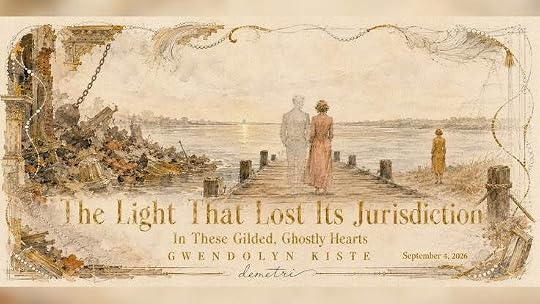
“The Light That Lost Its Jurisdiction” – After the mansion falls, Mel faces the surviving green light across the water; Nick fades, Vera remains, and the old symbol is reduced from destination to distance.
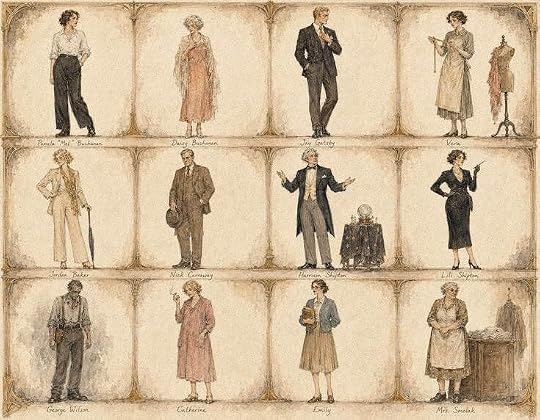
Full-Body All-Character Watercolor Study
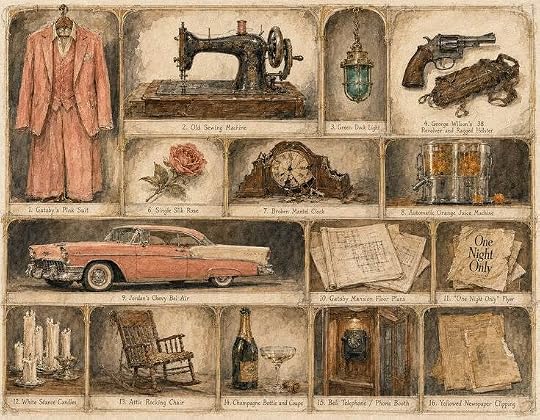
Important-Items Watercolor Study
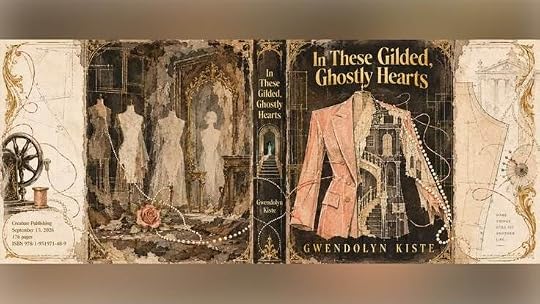
Alternate Full-Jacket Study
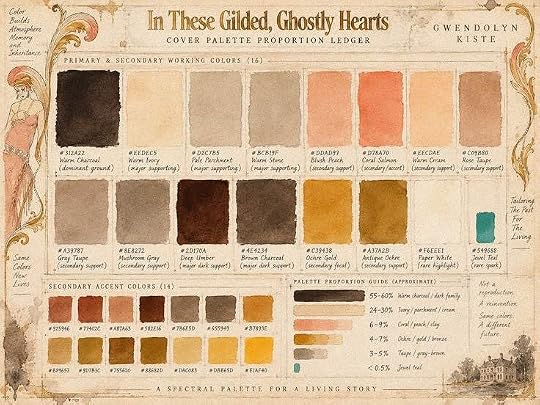
Cover-Palette Proportion Study
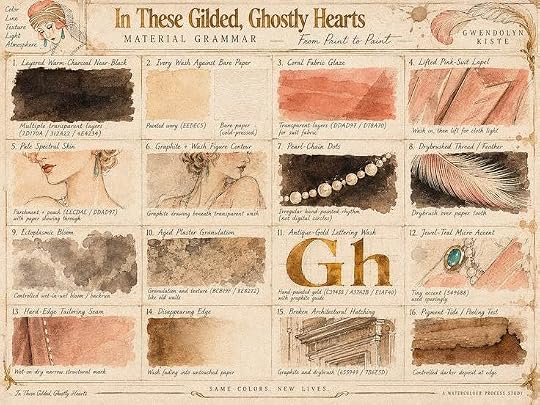
Watercolor Material Grammar Study
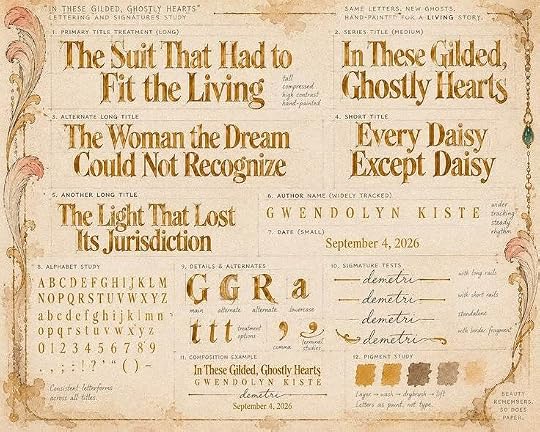
Series Typography + “demetri” Signature Study
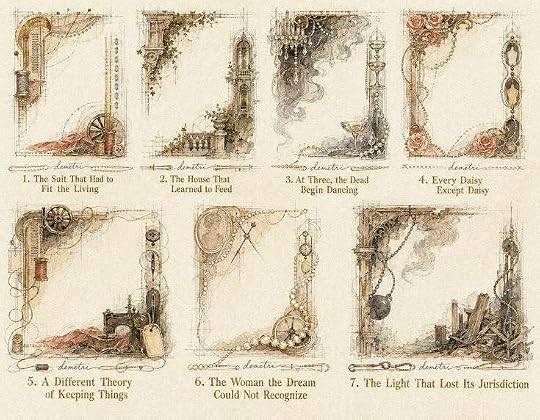
Border Architecture Study
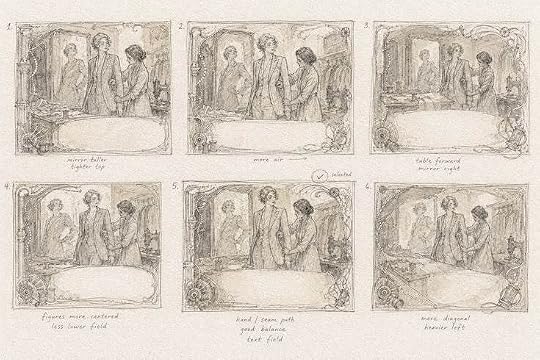
Emblematic Composition Thumbnail Study
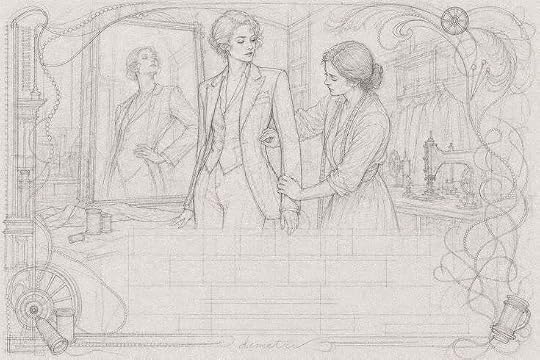
First Underdrawing
First-Wash Study
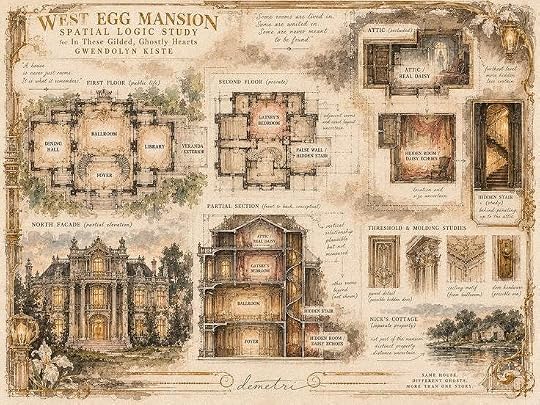
West Egg Mansion Spatial-Logic Study
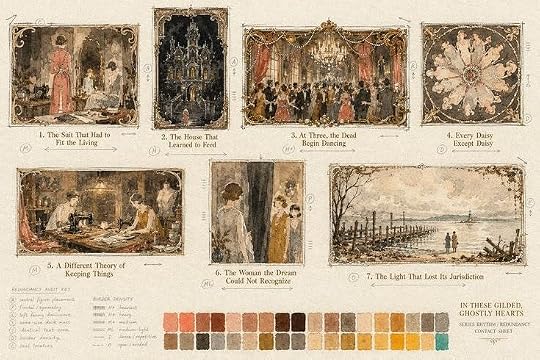
Series Rhythm / Redundancy Contact Sheet
All watercolor illustrations by Demetris Papadimitropoulos.
Watercolors are done on 140lb vellum and then scanned into the computer using an Epson scanner. From there, they are finalized in Procreate. No AI was used in writing this review — all art and opinions are my own.
In “In These Gilded, Ghostly Hearts,” Gwendolyn Kiste refits “The Great Gatsby” into a queer Gothic of hungry houses, aging women, filial obligation, and the dangerous fantasy that love should keep someone unchanged.
By Demetris Papadimitropoulos | September 4th, 2026
“The Suit That Had to Fit the Living” – Vera’s needle refits Gatsby’s pink suit for Mel, turning inheritance from a form to inhabit into material that can be changed for the living.
Dressed in a pink suit that has outlived its owner by three decades, Mel Buchanan discovers how seductive a bad fit can be. The suit belonged to Jay Gatsby, which is trouble enough. In Gwendolyn Kiste’s “In These Gilded, Ghostly Hearts,” objects cling to their former meanings almost as stubbornly as people do, and Gatsby’s suit carries the old promise of self-invention: perhaps a person can step into another shape and call it freedom. Mel nearly believes this. Vera, the woman she loves, answers with a needle. She takes the suit in at the seams. Beside the supernatural excess gathering on Long Island, the gesture looks almost comically modest. It is also the novella’s quiet counterspell. What is inherited need not be worshiped or destroyed. Sometimes it needs tailoring.
Everything begins with a death that should have been final. It is 1955, thirty-three years after Gatsby’s murder, and Pamela “Mel” Buchanan, daughter of Daisy and Tom, learns that Daisy has died inside Gatsby’s abandoned West Egg mansion. Mel has already survived the Depression, the collapse of Buchanan wealth, Tom’s violence and eventual suicide, Daisy’s long alcoholic decline, and a miserable marriage of her own. She now works at a Manhattan dry cleaner, where torn things arrive under bright lights and leave changed enough to be useful again. Gatsby’s house offers a grander repair service. It promises restoration: not a workable present, but the past returned intact.
“The House That Learned to Feed” – Gatsby’s mansion becomes appetite made architectural, its repeated windows and misregistered grandeur reducing Mel to a small figure before inherited hunger.
Memory in this house has a metabolism. The walls secrete ectoplasm; at three each morning they rebuild Gatsby’s old revelers from whatever scraps of recollection remain. Some guests emerge nearly persuasive. Others arrive with missing parts, bad seams, mouths that never formed. Jay Gatsby himself persists with unusual clarity, still bleeding from the wound that killed him and still hoping with such exertion that hope begins to resemble unpaid labor. Daisy appears too, at first as the twenty-three-year-old Gatsby remembers. When Mel reaches for her, she cracks apart. The mansion manufactures memory, and quality control has been dead for years.
Elapsed time is Kiste’s first real intervention. Rather than replay Gatsby’s famous summer from another chair at the table, she lets it harden into family history. Nghi Vo’s “The Chosen and the Beautiful” brilliantly reenters that summer through Jordan Baker; Kiste gives everyone but Gatsby three decades in which to age, work, fail, move, harden, soften, and discover what happens when the party becomes anecdote. She can write consequences rather than corrections. Gatsby’s wish to repeat the past is no longer a romantic impossibility suspended inside one tragic season. It has had thirty-three years to become infrastructure, complete with upkeep charged to people who never consented to inherit it.
The mansion feeds on living visitors, and their energy gives its recollections weight, appetite, even hands. Younger versions of guests begin consuming their older selves. Bodies return with seams visible and pieces missing. Kiste keeps dragging abstraction into matter until the old Gatsby vocabulary turns physical: nostalgia leaks; idealization develops a body count; longing leaves stains on the wallpaper. Fitzgerald’s yearning has become a production system, and the defective merchandise still bites.
“At Three, the Dead Begin Dancing” – Gatsby’s party returns at three in the morning, glamour and predation occupying the same floor as the dead borrow substance from the living.
Return trips between Manhattan and West Egg give that system its rhythm. Mel enters the mansion, learns something, loses something, retreats, then goes back. Each circuit alters the terms. Gatsby repeats because he cannot change. Mel repeats until she can. Manhattan contains rent, work, Vera, blistered fingers, sewing machines and an unwritten life. West Egg contains inherited property, family mythology, staged glamour and the fantasy that nothing need ever finish. The geography gives Mel’s divided loyalties a commuter schedule.
Inside the house, knowledge has an address. One locked room yields another; Gatsby’s bedroom hides a false wall; behind it waits a stairway; above that, an attic. The farther Mel moves through the architecture, the farther she gets beneath Gatsby’s preferred version. Family truth has literally been stored upstairs, behind more attractive rooms. Lili, the glamorous assistant to the washed-up spiritualist Harrison Shipton, turns out to be his daughter, another woman drafted into a parent’s unfinished ambition. Daisy’s youthful apparitions are not Daisy. Even the deed changes the moral geometry: Gatsby left the mansion to Daisy, so Mel has inherited legal title to somebody else’s fixation.
Past the false wall, Gatsby’s private romance begins to look less like longing than inventory. He has filled a room with Daisies. Some are almost right; others leak, slump, or emerge badly assembled. When a copy deteriorates beyond his tolerance, he does not repair her. He replaces her. Mel later watches him slit the throat of one failing version, let the body collapse into a husk, and bury it beneath a silk flower among the graves of earlier attempts. Romantic idealization becomes serial disposal. Kiste takes Gatsby’s dream at its word and finds an assembly line: the beloved is safest when she remains reproducible.
“Every Daisy Except Daisy” – Gatsby’s manufactured Daisies become an elegant inventory of idealization’s waste, each beautiful copy failing in a different seam.
At that point Gatsby could have collapsed into a straw villain in an excellent suit. He does not. He knows the copies fail. He is lonely inside the machinery he sustains and sometimes weary enough to wish he could disappear. His tenderness toward Mel is warped but recognizable, partly because she resembles Daisy and partly because the two of them occupy the same family disaster from opposite ends. The climax does not ask Mel to destroy Gatsby. It asks her to make him look.
Pamela has been practicing another kind of preservation all her life. As a child, after one rare afternoon when Daisy seemed happy, she silently promised that she would make her mother smile that way again. The promise becomes a private contract she never remembers signing: escorting Daisy home from bars, visiting after moving out, absorbing secrets she did not create, and finally treating death itself as one last chance to become the daughter who fixes everything. Childhood bargains have an embarrassing durability. They can govern an adult life long after the adults who inspired them have forgotten the terms. The haunting merely gives physical form to a question families manage every day without ectoplasm: when does care stop being love and become permission to disappear inside someone else’s need?
At the dry cleaner, Kiste gives Mel a world built on less glamorous rules. She takes wicked pleasure in becoming precisely the sort of daughter Tom Buchanan would have despised: blue-collar, divorced, in love with a woman, competent with a ledger and better with a seam. The Buchanans once possessed enormous houses and scant practical skill. Mel can mend a garment and earn a wage. Gatsby keeps by freezing. A tailor keeps by cutting, adjusting, patching and conceding that wear has already happened. Vera’s needle does not return the pink suit to 1922. It makes the old cloth answer to the body standing there now.
Daisy’s real ghost, when Mel finally reaches her, makes that difference brutal. She is not twenty-three. She is nearly sixty, gray-haired and carrying the face of the woman who actually survived those missing decades. Gatsby looks at her and refuses the evidence. She cannot be Daisy because she no longer resembles the image he maintained. Gatsby can resurrect Daisy indefinitely; what he cannot do is allow her a lifespan. His dream preserves the beloved by abolishing every version of her he did not personally witness. There is something colder than nostalgia in that refusal. It is love with no provision for another person’s time.
Images this good do not need much help, which makes Kiste’s most persistent weakness easier to name. Again and again, a scene completes the thought and Mel supplies the gloss. By the climax the house has demonstrated the cost of repetition, the copies have exposed the violence of idealization, and Daisy’s demands have shown how filial devotion can curdle into self-erasure. Yet the narration still pauses to tell us that Daisy does not want the kind of rescue Mel offers, that the past cannot be repeated or erased, that Gatsby and Daisy must be released. The conclusions are right. They are also plainer than the hauntings that produced them. There is a small irony in a book so suspicious of fixing people into one preferred form occasionally fixing its own meanings before the reader has finished trying them on.
More pressure falls on the secondary characters because of the novella’s brevity. Vera is warm, skilled, stubborn and brave, but she is also made to carry much of the book’s idea of a life ahead; Jordan, charismatic and evasive, bears much of the pull from behind. Lili’s refusal to continue Harrison’s ghostly ambition is moving, though so neatly parallel to Mel’s emancipation that one wishes their resemblance had acquired a few splinters. At 176 pages there is almost no dead air. There is also little room for these women to surprise the argument that recruited them. The neatness is not fatal, but it shows.
In Mel’s mouth, however, the book rarely sounds embalmed. Kiste makes no attempt at Fitzgeraldian ventriloquism. Her sentences are usually short to medium, quick on their feet and fond of bodily simile; Mel can register grief and ridiculousness before either has time to put on evening clothes. The body horror is splendidly indecorous: Jazz Age sheen keeps splitting open to reveal blood, ectoplasm and anatomy with assembly errors. Most effective is the textile vocabulary running beneath the gore. The house puts people together badly. Vera sews well. Kiste rarely needs a more elaborate theory of adaptation than that.
“A Different Theory of Keeping Things” – At the dry cleaner, Mel and Vera preserve by altering: worn cloth, old machines and shared labor make a future from what can still be repaired.
The 1955 setting denies Mel an easy escape into modern self-knowledge. When she and Vera finally kiss at the Bag, a lesbian bar, a vice-squad raid sends them running into the night. Their intimacy is not a wholesome present supplied to correct a decadent past; it is precarious, surveilled and dangerous in its own time. A freer emotional choice does not produce a freer society. That pressure keeps Vera from becoming merely the reward waiting outside the haunted house. A life with her remains a risk, just a risk that belongs to Mel rather than to her parents.
Revision has its best defense hanging in the dry cleaner. A canonical work can be embalmed in references or cut to a new shape; “In These Gilded, Ghostly Hearts” earns its place when it does the latter. The point is not simply to add queer lives to Gatsby’s world or move a neglected woman toward the center. It is to examine what his celebrated longing looks like when the daughter who inherited its wreckage receives the bill. The novella’s smartest changes do not correct Fitzgerald sentence by sentence. They expose costs his ending had no reason to itemize.
Once the book becomes certain of its lesson, some of its strangeness stiffens. I can understand wanting more ambiguity from the final movement, though its emotional decisiveness mostly works on me. The richest passages live in rooms of copies, hungry walls, badly sewn bodies and an old pink suit waiting for another wearer. Those objects can hold several meanings at once. The explanatory passages sometimes ask them to hold still.
Part of what Mel must finally abandon is the flattering idea that rescue always means staying. Daisy’s demand for love has no natural stopping point: to satisfy her mother completely, Mel would have to remain in the mansion, die there and become another ghost. Letting Daisy go is not indifference. It is the first refusal in Mel’s life that does not require her to stop loving the person she refuses. When she persuades Gatsby to recognize the elderly Daisy before him, the house begins releasing its copies. They do not receive the grand reunion Gatsby spent decades manufacturing. They receive a quieter mercy: an ending.
“The Woman the Dream Could Not Recognize” – The real Daisy stands before Gatsby with decades written into her face, while the younger image he can accept remains the less substantial ghost.
Outside the house, endings become choices, some more convincing than others. Nick Carraway, who has spent decades wishing he had intervened before Gatsby’s death, finally intervenes and dies taking a bullet meant for Mel. Harrison proves the existence of ghosts by becoming one. Lili refuses to make his obsession her inheritance. Jordan leaves for California and invites Mel to follow; Mel declines, recognizing that chasing Jordan would only convert an old longing into a new itinerary. The resolutions line up almost suspiciously well, but their direction feels earned. Freedom here is less glamorous than fantasy, less photogenic than a green light, and much more useful.
Uneven only at its edges, “In These Gilded, Ghostly Hearts” earns 85/100, or 4/5 Goodreads stars. Its best trick is to give Gatsby’s old longing bodies, rooms, seams and appetites. Its recurring misstep is almost the reverse: having built machinery this expressive, Kiste occasionally explains what it has already made impossible to miss.
Long after the mansion comes down, the pale green light remains across the water. Mel sells the property on the condition that Gatsby’s house be demolished and plans to spend part of the proceeds on new sewing machines. Monument becomes equipment; inheritance becomes work. It is a modest destination for a story built from legendary excess, and that modesty feels right. The old symbol does not need to be smashed. It only needs to lose jurisdiction. From the dock, the past is still bright enough to recognize and far enough away to refuse. Behind Mel waits Vera, a dry cleaner, a row of machines and the less glamorous work of making a life fit the person who has to live it.
“The Light That Lost Its Jurisdiction” – After the mansion falls, Mel faces the surviving green light across the water; Nick fades, Vera remains, and the old symbol is reduced from destination to distance.
Full-Body All-Character Watercolor Study
Important-Items Watercolor Study
Alternate Full-Jacket Study
Cover-Palette Proportion Study
Watercolor Material Grammar Study
Series Typography + “demetri” Signature Study
Border Architecture Study
Emblematic Composition Thumbnail Study
First Underdrawing
First-Wash Study
West Egg Mansion Spatial-Logic Study
Series Rhythm / Redundancy Contact Sheet
All watercolor illustrations by Demetris Papadimitropoulos.
Watercolors are done on 140lb vellum and then scanned into the computer using an Epson scanner. From there, they are finalized in Procreate. No AI was used in writing this review — all art and opinions are my own.

August 17, 2026
Oh I loved this one. It’s such a fitting time for Gatsby to enter the public domain and explore how little we’ve changed from rubbernecking the excess of glitz, celebrity, and tragedy. Gwendolyn Kiste really knows how to write a convincing ghost story, equal parts spectral and rotten. New characters slotted into the world convincingly and fully believable arcs from the returning cast of The Great Gatsby.
Thanks to Creature Publishing and Netgalley for eARC. Video review to come.
Thanks to Creature Publishing and Netgalley for eARC. Video review to come.
September 18, 2026
I clearly hoped more on the side of atmosphere and development.
Like, it wasn't bad. The style was bland, sure, but some ideas were good, such as making Gatsby obsessed with the ghost of an idealized woman. The theme of closure and breaking cycles is always one I appreciate.
But I felt like you clearly needed to appreciate the original to enjoy it. And why I am familiar with the characters and the plot of the original novel, I probably missed many things.
Daisy haunts the narrative, both literally and metaphorically. I clearly hoped for a deconstruction of her character, more complexity. An opportunity for her to tell her own side of the story. Sadly, it never came.
Like, it wasn't bad. The style was bland, sure, but some ideas were good, such as making Gatsby obsessed with the ghost of an idealized woman. The theme of closure and breaking cycles is always one I appreciate.
But I felt like you clearly needed to appreciate the original to enjoy it. And why I am familiar with the characters and the plot of the original novel, I probably missed many things.
Daisy haunts the narrative, both literally and metaphorically. I clearly hoped for a deconstruction of her character, more complexity. An opportunity for her to tell her own side of the story. Sadly, it never came.
September 18, 2026
Thank you NetGalley and Dreamscape Media for the ALC of In These Gilded, Ghostly Hearts!
I always thought the Great Gatsby was a bit of a horror novel, so getting a continuation of the story that includes body horror and ghosts (and sapphic yearning!!!) was absolutely wonderful! You get the feeling of being right back in West Egg at a Gatsby party and you get to re-interact with all the old favorite characters. It was wonderful and spooky and deeply unsettling.
I always thought the Great Gatsby was a bit of a horror novel, so getting a continuation of the story that includes body horror and ghosts (and sapphic yearning!!!) was absolutely wonderful! You get the feeling of being right back in West Egg at a Gatsby party and you get to re-interact with all the old favorite characters. It was wonderful and spooky and deeply unsettling.

Review of advance copy received from NetGalley
We've all got to reckon with the past one way or another.
3.4/5
I wasn't entirely sure what I was expecting from In These Gilded Ghostly Hearts, but I was immediately intrigued by the premise. Gwendolyn Kiste's writing is not, ultimately, a style that particularly grips me as a reader, although that's very much a matter of personal preference. This novella's great limitation may simply be that it is a novella: there is enough substance here that more time with the characters and their ideas would have enriched rather than diluted the story. What I did appreciate was the clear familiarity with Fitzgerald's The Great Gatsby underpinning the story. The overall premise is thoughtfully constructed and it is highly evident that Kiste has not simply borrowed the framework of a classic, but has read it critically and repeatedly enough to engage meaningfully with its architecture and subtext, making its re-engineering feel authentic.
The sections that most deeply invested me were the depictions of Mel navigating a time and place of LGBTQ intolerance. Kiste writes these moments with affecting reverence and rich historical callbacks that make every facet feel deeply considered. The intimacies, distances, hopes and heartaches echoed off the pages with resonating force. I found myself particularly wishing Mel's personal experiences and observations had occupied more of the book. There is something genuinely moving in the way these moments are rendered, and I think the story could have benefited enormously from giving them more room to develop. Especially considering that I was unsurprised by many of the plot developments. To be fair, that speaks to the story's organic construction — the pieces generally fall where they ought to — but in such a concise book, predictability began to flatten the impact of that progression. The plot persisted where I wished it had thickened. I think I would have been more invested had there been less reliance on visceral symbolic imagery and more room for nuance, notably in the places where the characters and their identities are at their most compelling.
Ultimately, In These Gilded Ghostly Hearts is a successful novella, and I certainly didn't dislike it. I simply wanted more from it — more Mel, more surprise, more nuance, and perhaps more space for an already interesting premise to become something richer. A hunger which, in its own way, might entitle me to a pink suit of my own.
Thank you to NetGalley and Creature Publishing for the advanced reader copy of this novella in exchange for an honest review. It is always a pleasure and privilege to be trusted with pre-publication work and I look forward to the next.
3.4/5
I wasn't entirely sure what I was expecting from In These Gilded Ghostly Hearts, but I was immediately intrigued by the premise. Gwendolyn Kiste's writing is not, ultimately, a style that particularly grips me as a reader, although that's very much a matter of personal preference. This novella's great limitation may simply be that it is a novella: there is enough substance here that more time with the characters and their ideas would have enriched rather than diluted the story. What I did appreciate was the clear familiarity with Fitzgerald's The Great Gatsby underpinning the story. The overall premise is thoughtfully constructed and it is highly evident that Kiste has not simply borrowed the framework of a classic, but has read it critically and repeatedly enough to engage meaningfully with its architecture and subtext, making its re-engineering feel authentic.
The sections that most deeply invested me were the depictions of Mel navigating a time and place of LGBTQ intolerance. Kiste writes these moments with affecting reverence and rich historical callbacks that make every facet feel deeply considered. The intimacies, distances, hopes and heartaches echoed off the pages with resonating force. I found myself particularly wishing Mel's personal experiences and observations had occupied more of the book. There is something genuinely moving in the way these moments are rendered, and I think the story could have benefited enormously from giving them more room to develop. Especially considering that I was unsurprised by many of the plot developments. To be fair, that speaks to the story's organic construction — the pieces generally fall where they ought to — but in such a concise book, predictability began to flatten the impact of that progression. The plot persisted where I wished it had thickened. I think I would have been more invested had there been less reliance on visceral symbolic imagery and more room for nuance, notably in the places where the characters and their identities are at their most compelling.
Ultimately, In These Gilded Ghostly Hearts is a successful novella, and I certainly didn't dislike it. I simply wanted more from it — more Mel, more surprise, more nuance, and perhaps more space for an already interesting premise to become something richer. A hunger which, in its own way, might entitle me to a pink suit of my own.
Thank you to NetGalley and Creature Publishing for the advanced reader copy of this novella in exchange for an honest review. It is always a pleasure and privilege to be trusted with pre-publication work and I look forward to the next.

September 1, 2026
In These Gilded, Ghostly Hearts is a sumptuously decadent haunted house story.
Set 30 years after the events of the Great Gatsby, Daisy Buchanan is found dead in the abandoned and crumbling mansion once owned by Gatsby himself. Now it is up to Pamela, Daisy’s daughter, to finally lay her mother to rest. If the secrets of the past will let her go, that is…
Kiste writes a sensitive and haunting sequel which will satisfy readers very familiar with The Great Gatsby, as well as readers who are new to his decadent world. With Easter eggs to book and film, this story has love and reverence for the source material poured into every word, and it showed.
The sapphic subplot adds an extra dimension to the plot that I absolutely loved: featuring forbidden love and police raids, the historical details added a horrific and threatening undertone to an otherwise beautiful love story. The haunted house elements are gothic and full of atmosphere and faded grandeur, the house a character in its own right. The ghosts themselves are ethereal and delicate, drowning in the vast nothingness that surrounds them. This is gothic prose done well.
It may be short, but this book packs a punch, and I found myself flying through it. If anything, I wanted more of everything! The story was over before I knew it, any loose ends satisfied. Like the house, I was hungry for more of these characters.
A unique concept, In The Gilded, Ghostly Hearts is a true testament to the gilded age. Full of sparkling champagne, music, and twenties flair, you won’t be sorry to step back into the world of Jay Gatsby, in the way that only Gwendolyn Kiste could deliver so perfectly.
Set 30 years after the events of the Great Gatsby, Daisy Buchanan is found dead in the abandoned and crumbling mansion once owned by Gatsby himself. Now it is up to Pamela, Daisy’s daughter, to finally lay her mother to rest. If the secrets of the past will let her go, that is…
Kiste writes a sensitive and haunting sequel which will satisfy readers very familiar with The Great Gatsby, as well as readers who are new to his decadent world. With Easter eggs to book and film, this story has love and reverence for the source material poured into every word, and it showed.
The sapphic subplot adds an extra dimension to the plot that I absolutely loved: featuring forbidden love and police raids, the historical details added a horrific and threatening undertone to an otherwise beautiful love story. The haunted house elements are gothic and full of atmosphere and faded grandeur, the house a character in its own right. The ghosts themselves are ethereal and delicate, drowning in the vast nothingness that surrounds them. This is gothic prose done well.
It may be short, but this book packs a punch, and I found myself flying through it. If anything, I wanted more of everything! The story was over before I knew it, any loose ends satisfied. Like the house, I was hungry for more of these characters.
A unique concept, In The Gilded, Ghostly Hearts is a true testament to the gilded age. Full of sparkling champagne, music, and twenties flair, you won’t be sorry to step back into the world of Jay Gatsby, in the way that only Gwendolyn Kiste could deliver so perfectly.

September 18, 2026
I was really eager to read this one because The Great Gatsby is one of my favorite books, and the idea of returning to that world with a ghostly twist sounded like it was written specifically for me. Unfortunately, I came away a little disappointed.
There were a few historical inaccuracies that pulled me out of the story, but my bigger issue was that there simply wasn’t enough of what I was promised. I wanted more. More Daisy. More Gatsby. More of that glittering, decadent world. And, most importantly, more of the haunting.
Perhaps some of this is simply a consequence of the book’s length, because the premise had so much potential. I wanted to feel that same strange, intoxicating magic that makes Gatsby so compelling. The wealth, the longing, the ghosts of the past, but I never quite found it here. It felt like I was standing just outside the party, looking through the window at a world I desperately wanted to enter.
That said, I really enjoyed the audiobook. The narrator did a fantastic job, and the overall production quality was excellent. A gorgeous premise with so much potential, but ultimately I was left wishing there had been more time to really inhabit this gilded, ghostly world.
Many thanks to NetGalley, Gwendolyn Kiste, and Dreamscape Media for the ALC. All opinions are my own.
There were a few historical inaccuracies that pulled me out of the story, but my bigger issue was that there simply wasn’t enough of what I was promised. I wanted more. More Daisy. More Gatsby. More of that glittering, decadent world. And, most importantly, more of the haunting.
Perhaps some of this is simply a consequence of the book’s length, because the premise had so much potential. I wanted to feel that same strange, intoxicating magic that makes Gatsby so compelling. The wealth, the longing, the ghosts of the past, but I never quite found it here. It felt like I was standing just outside the party, looking through the window at a world I desperately wanted to enter.
That said, I really enjoyed the audiobook. The narrator did a fantastic job, and the overall production quality was excellent. A gorgeous premise with so much potential, but ultimately I was left wishing there had been more time to really inhabit this gilded, ghostly world.
Many thanks to NetGalley, Gwendolyn Kiste, and Dreamscape Media for the ALC. All opinions are my own.

September 15, 2026
⭐️⭐️⭐️⭐️
In These Gilded, Ghostly Hearts by Gwendolyn Kiste.
Published by @creaturepublishing
OUT NOW!!!
This is a short novella under 200 pages.
Based on The Great Gatsby comes this Dark and queer story.
Daisy and Mel are mother and daughter.
Their story is complex, difficult and emotional.
Mel has to uncover secrets from the past to put her mother to rest.
Will she succeed or will the ghost of her mother will haunt the mansion forever??
Thank you @netgalley and @creaturepublishing
for this short but amazing read.
#netgalley #books #booksta #booktok
#bookshelf
In These Gilded, Ghostly Hearts by Gwendolyn Kiste.
Published by @creaturepublishing
OUT NOW!!!
This is a short novella under 200 pages.
Based on The Great Gatsby comes this Dark and queer story.
Daisy and Mel are mother and daughter.
Their story is complex, difficult and emotional.
Mel has to uncover secrets from the past to put her mother to rest.
Will she succeed or will the ghost of her mother will haunt the mansion forever??
Thank you @netgalley and @creaturepublishing
for this short but amazing read.
#netgalley #books #booksta #booktok
#bookshelf

July 21, 2026
Kiste’s writing can best be described as “haunting;” beautiful, unsettling, nostalgic, and melancholy, lending itself well to a ghost story. Her stories are less “in your face” horror with gore and blood and instead rely on atmosphere to create a general sense of unease commonly found in gothic horror. For some readers this will make it feel like the pacing is dragging as there’s no sense of urgency and not a lot of action because this isn’t that kind of book. This is a novella meant to be savored rather than rushed through. So, while it won’ be everyone’s cup of tea I think fans of slow burn horror and character driven story will enjoy In These Gilded Ghostly Hearts.

Review of advance copy received from NetGalley
Thank you to NetGalley, Creature Publishing, and the author for an eARC in exchange for my honest feedback.
While browsing the Horror category, I ran across In These Gilded, Ghostly Hearts. Immediately, I was struck by that gorgeous cover. Definitely one of my top covers of the year - I would love to know who the artist is because I need new art, immediately!
Then I see it’s a queer sequel to The Great Gatsby? A HORROR sequel at that? SAY LESS! Queer horror is truly one of my passions. I think they go hand in hand so well and queer horror writers are writing some of the most moving horror out there right now.
I laughed when I saw who the blurbs were from: I know a sapphic horror HATES to see Johanna van Veen coming!! If she didn’t write it, she’s probably giving a blurb for it.
Which I love, because I love van Veen’s work.
I’m expecting In These Gilded, Ghostly Hearts to be a haunted house horror focusing on queer identity with a gilded, Gatsby larger than life backdrop.
I expected queer identity to be at the very forefront of this tale, but it wasn’t.
Don’t get me wrong - there is definitely queerness in multiple characters that is explored! However, I would say this leans very heavily on haunted house and the mother-daughter dynamic between Mel and Daisy.
As someone who has had a complicated mother-daughter relationship with my own mother and became the mother of a daughter this year, this struck a really intense cord with me that I wasn’t anticipating.
In this novella, we get to see the repercussions of Daisy’s shallow, self-serving nature and how that translates to motherhood.
The stock market crash and the fallout with the Buchanan family fortune is also explored - which I think adds important historical context to a story that was written prior to the crash and ensuing Great Depression.
The exploration of ghosts and family secrets as both literal and metaphorical ghosts is very well done.
I could have sat down and analyzed the shit out of this story in a way that would make the AP Lit scholar in me shed a tear.
There’s a really poignant scene were Mel takes Gatsby’s pink suit and has it tailored for herself and she finally “goes out” as her true self that I will probably think about for a long time.
And, it turns out, the pink suit had a really significant meaning for the author. I think she absolutely nailed it with including that nod to her inspiration.
If I were an English teacher we would be discussing the pink suit extensively. Because no the pink suit is not just a suit that’s pink!!!!!!
The prose is so lyrical and full of one liners that had me like “write that down write that down!!” Finding the line between lyrical and purple prose is thin: but it is done well here.
I was also worried...
Were we going to get any ‘Old Sport’ action out of Gatsby?
I can confirm: the Old Sport count made it to 7.
Not nearly as many as The Great Gatsby itself, but still a respectable number.
Any Gatsby tale without Old Sport is not something I’m interested in reading tbh.
I was really pleasantly surprised by this one.
The lyrical prose is beautiful but also it gets pretty gory at some points! I knew it was classified as horror and the writer is a Stoker winner, but wow!
Everything about In These Gilded, Ghostly Hearts is just enough. The prose, the gore, the storyline. . .
I enjoyed the way the house was characterized because truly, The House plays such an important role in the original book. Seeing it quite literally come alive in this story was a nice touch.
While I anticipated more queer turmoil, I was actually glad that it went the direction that it did. It would have been very easy to turn this into a bury your gays situation and have the tragic ending, but I left this story feeling hopeful.
I feel like ultimately, this story was the inverse of The Great Gatsby: where Gatsby starts hopeful and ends with tragedy, Ghostly Hearts begins with tragedy and ends leaving the reader feeling hopeful for the future.
In These Gilded, Ghostly Hearts is not a catfish!
I haven’t read a lot of Gatsby retellings / related stories, but my bookstagram bestie is a Gatsby fanatic so I really need her to read and make a final judgement on this one.
Overall, I’m giving In These Gilded, Ghostly Hearts 4 stars!
I thought this was a unique spin on a classic that turns it into a true horror within the haunted house trope.
While I enjoyed it and think it’s an interesting entry to the Gatsby legacy, it didn’t like… change my life or anything.
I really resonated with parts of it and will definitely be eager to read more by this author.
While browsing the Horror category, I ran across In These Gilded, Ghostly Hearts. Immediately, I was struck by that gorgeous cover. Definitely one of my top covers of the year - I would love to know who the artist is because I need new art, immediately!
Then I see it’s a queer sequel to The Great Gatsby? A HORROR sequel at that? SAY LESS! Queer horror is truly one of my passions. I think they go hand in hand so well and queer horror writers are writing some of the most moving horror out there right now.
I laughed when I saw who the blurbs were from: I know a sapphic horror HATES to see Johanna van Veen coming!! If she didn’t write it, she’s probably giving a blurb for it.
Which I love, because I love van Veen’s work.
I’m expecting In These Gilded, Ghostly Hearts to be a haunted house horror focusing on queer identity with a gilded, Gatsby larger than life backdrop.
I expected queer identity to be at the very forefront of this tale, but it wasn’t.
Don’t get me wrong - there is definitely queerness in multiple characters that is explored! However, I would say this leans very heavily on haunted house and the mother-daughter dynamic between Mel and Daisy.
As someone who has had a complicated mother-daughter relationship with my own mother and became the mother of a daughter this year, this struck a really intense cord with me that I wasn’t anticipating.
In this novella, we get to see the repercussions of Daisy’s shallow, self-serving nature and how that translates to motherhood.
The stock market crash and the fallout with the Buchanan family fortune is also explored - which I think adds important historical context to a story that was written prior to the crash and ensuing Great Depression.
The exploration of ghosts and family secrets as both literal and metaphorical ghosts is very well done.
I could have sat down and analyzed the shit out of this story in a way that would make the AP Lit scholar in me shed a tear.
There’s a really poignant scene were Mel takes Gatsby’s pink suit and has it tailored for herself and she finally “goes out” as her true self that I will probably think about for a long time.
And, it turns out, the pink suit had a really significant meaning for the author. I think she absolutely nailed it with including that nod to her inspiration.
If I were an English teacher we would be discussing the pink suit extensively. Because no the pink suit is not just a suit that’s pink!!!!!!
The prose is so lyrical and full of one liners that had me like “write that down write that down!!” Finding the line between lyrical and purple prose is thin: but it is done well here.
I was also worried...
Were we going to get any ‘Old Sport’ action out of Gatsby?
I can confirm: the Old Sport count made it to 7.
Not nearly as many as The Great Gatsby itself, but still a respectable number.
Any Gatsby tale without Old Sport is not something I’m interested in reading tbh.
I was really pleasantly surprised by this one.
The lyrical prose is beautiful but also it gets pretty gory at some points! I knew it was classified as horror and the writer is a Stoker winner, but wow!
Everything about In These Gilded, Ghostly Hearts is just enough. The prose, the gore, the storyline. . .
I enjoyed the way the house was characterized because truly, The House plays such an important role in the original book. Seeing it quite literally come alive in this story was a nice touch.
While I anticipated more queer turmoil, I was actually glad that it went the direction that it did. It would have been very easy to turn this into a bury your gays situation and have the tragic ending, but I left this story feeling hopeful.
I feel like ultimately, this story was the inverse of The Great Gatsby: where Gatsby starts hopeful and ends with tragedy, Ghostly Hearts begins with tragedy and ends leaving the reader feeling hopeful for the future.
In These Gilded, Ghostly Hearts is not a catfish!
I haven’t read a lot of Gatsby retellings / related stories, but my bookstagram bestie is a Gatsby fanatic so I really need her to read and make a final judgement on this one.
Overall, I’m giving In These Gilded, Ghostly Hearts 4 stars!
I thought this was a unique spin on a classic that turns it into a true horror within the haunted house trope.
While I enjoyed it and think it’s an interesting entry to the Gatsby legacy, it didn’t like… change my life or anything.
I really resonated with parts of it and will definitely be eager to read more by this author.
September 15, 2026
The Great Gatsby is my favorite American classic, so I am always intrigued by queer reimaginings of it. Nghi Vo's The Chosen and the Beautiful set a high bar, but Gwendolyn Kiste's take now ranks alongside it for me. What impressed me most was not simply how much I enjoyed this book, but how completely Kiste understands and transforms the original without losing what made it so compelling in the first place.
The premise is ingenious: Gatsby's West Egg mansion is a sentient haunted house, feeding on the living and using their energy to conjure the people and parties it remembers. Kiste may even be suggesting that the house has always been haunted; that Gatsby's legendary parties became its heyday, providing an endless stream of revelers for it to feed upon. She even builds her mythology around a specific moment from Fitzgerald's novel: Daisy left Gatsby's party at four in the morning the one time she attended, and in Kiste's version, the hour between three and four becomes the witching hour, when the house is at its most powerful. Details from the original are not merely referenced; they are transformed into the architecture of the horror story.
At the center of the story is Pamela Buchanan—Mel—a character who appears only once, very briefly, in Fitzgerald's novel. Yet her presence gives us one of The Great Gatsby's most memorable moments, when Daisy says that she hopes her daughter will grow up to be "a beautiful little fool." It is a line that reveals that Daisy herself is no fool; she understands the world women inhabit and recognizes that ignorance might make navigating it easier. Kiste takes that briefly glimpsed little girl and asks what kind of woman she might become after growing up in the aftermath of her parents' choices. She gives Mel a voice, a history, desires, and the possibility of a life beyond their damage. I especially loved the way Jordan Baker is incorporated into that history, including the suggestion that a bisexual Jordan may have played a role in Mel's own queer awakening.
There are nods throughout to both Fitzgerald's novel and its first screen adaptation, but what delighted me was that they never felt like Easter eggs included so knowledgeable readers could recognize them. They serve the story Kiste is telling. Images, characters, and ideas from the original are reconsidered through horror, queerness, and the perspective of a daughter who inherited the wreckage left behind by people obsessed with lives they could never reclaim.
And that is perhaps where Kiste's haunted-house conceit works best. Gatsby was always a ghost story in everything but the supernatural: a novel populated by people haunted by who they were, who they wanted to be, and what they had lost. Here, that metaphor becomes literal. Gatsby is still clinging to the past, only now the house itself is clinging with him, endlessly rebuilding people and parties from memory and refusing to let what is dead remain dead.
What I love about The Great Gatsby's is how tightly constructed it is. Nothing feels extraneous; its images, characters, and recurring motifs continually circle back upon one another. I was surprised by how much this novella gave me that same satisfaction. It is concise and carefully plotted. Even its references to the source material have a purpose within the larger design.
I expected to enjoy this because I love Gatsby's, queer retellings, and haunted houses. I did not expect to love virtually every choice Kiste made. Rather than simply placing a queer horror story inside Fitzgerald's world, she interrogates one of American literature's most famous obsessions with the past and asks what happens to the people who inherit its ghosts. The result made me look at a novel I have loved for years from an entirely new angle—which may be the highest compliment I can give a retelling.
The premise is ingenious: Gatsby's West Egg mansion is a sentient haunted house, feeding on the living and using their energy to conjure the people and parties it remembers. Kiste may even be suggesting that the house has always been haunted; that Gatsby's legendary parties became its heyday, providing an endless stream of revelers for it to feed upon. She even builds her mythology around a specific moment from Fitzgerald's novel: Daisy left Gatsby's party at four in the morning the one time she attended, and in Kiste's version, the hour between three and four becomes the witching hour, when the house is at its most powerful. Details from the original are not merely referenced; they are transformed into the architecture of the horror story.
At the center of the story is Pamela Buchanan—Mel—a character who appears only once, very briefly, in Fitzgerald's novel. Yet her presence gives us one of The Great Gatsby's most memorable moments, when Daisy says that she hopes her daughter will grow up to be "a beautiful little fool." It is a line that reveals that Daisy herself is no fool; she understands the world women inhabit and recognizes that ignorance might make navigating it easier. Kiste takes that briefly glimpsed little girl and asks what kind of woman she might become after growing up in the aftermath of her parents' choices. She gives Mel a voice, a history, desires, and the possibility of a life beyond their damage. I especially loved the way Jordan Baker is incorporated into that history, including the suggestion that a bisexual Jordan may have played a role in Mel's own queer awakening.
There are nods throughout to both Fitzgerald's novel and its first screen adaptation, but what delighted me was that they never felt like Easter eggs included so knowledgeable readers could recognize them. They serve the story Kiste is telling. Images, characters, and ideas from the original are reconsidered through horror, queerness, and the perspective of a daughter who inherited the wreckage left behind by people obsessed with lives they could never reclaim.
And that is perhaps where Kiste's haunted-house conceit works best. Gatsby was always a ghost story in everything but the supernatural: a novel populated by people haunted by who they were, who they wanted to be, and what they had lost. Here, that metaphor becomes literal. Gatsby is still clinging to the past, only now the house itself is clinging with him, endlessly rebuilding people and parties from memory and refusing to let what is dead remain dead.
What I love about The Great Gatsby's is how tightly constructed it is. Nothing feels extraneous; its images, characters, and recurring motifs continually circle back upon one another. I was surprised by how much this novella gave me that same satisfaction. It is concise and carefully plotted. Even its references to the source material have a purpose within the larger design.
I expected to enjoy this because I love Gatsby's, queer retellings, and haunted houses. I did not expect to love virtually every choice Kiste made. Rather than simply placing a queer horror story inside Fitzgerald's world, she interrogates one of American literature's most famous obsessions with the past and asks what happens to the people who inherit its ghosts. The result made me look at a novel I have loved for years from an entirely new angle—which may be the highest compliment I can give a retelling.

Review of advance copy received from NetGalley
Title: These Gilded Ghostly Hearts
Author: Gwendolyn Kiste
Publisher: Creature Publishing
Rating: ⭐️⭐️⭐️⭐️⭐️
What happens when the flamboyance of the 1920s decays into the cold reality of 1955? In These Gilded Ghostly Hearts, Gwendolyn Kiste crafts a brilliant, heart-wrenching gothic horror sequel to The Great Gatsby that handles generational trauma and historical tragedy with absolute mastery.
The story follows Pamela Buchanan, the daughter of the infamous Daisy. Daisy is dead, found in the crumbling, ectoplasm-infused ruins of Gatsby’s old mansion. Trapped there by a predatory charlatan named Harrison, Daisy’s spirit is suddenly young again, locked in the past she spent thirty years longing for. It’s up to Pam, her "sister-figure" Jordan Baker, and Harrison to free her. But as Pam digs into West Egg’s history, she realizes the house itself harbors a sentient, gluttonous malice that isn't ready to let the Buchanan family go.
At its core, this is a story about loss: the loss of parents, the sting of unrequited love, and the heavy burden of family wreckage. Kiste brilliantly explores Pam’s internal struggles as a queer woman navigating the terrifying "Lavender Scare" of the 1950s. Pam’s quiet, aching love for her friend Vera acts as a beautiful counterweight to the literal ghosts of her parents' past.
Pamela's analysis of her mother is devastatingly sharp. Daisy is a character to be both pitied and despised—a spoiled socialite trapped by her times, whose emotional absence haunted Pam long before her physical death. For years, the only way to be close to Daisy was to be close to death.
Without giving away the explosive climax, the return of classic Gatsby characters shifts the narrative into a chaotic, breathless rhythm where the boundaries between the living and the dead entirely dissolve. The story delivers a profoundly satisfying, heart-wrenching resolution that forces Pam to decide whether she will succumb to her family's tragic legacy or finally break the cycle to face a loving future of her own making.
Kiste hits every single note perfectly. A masterclass in gothic horror and literary continuation.
Likes:
Fast pacing paired with a deeply flawed, fiercely relatable main character.
A brilliant, seamless integration of The Great Gatsby lore and themes.
Classic characters felt entirely natural to the spooky environment, not forced.
Dislikes:
Left me craving just a bit more backstory on the mysterious dynamic between Harrison and his assistant, Lili!
Many favorite quotes to come after official publication!
Thank you Creature Publishing for providing this book for review consideration via NetGalley. All opinions are my own.
Author: Gwendolyn Kiste
Publisher: Creature Publishing
Rating: ⭐️⭐️⭐️⭐️⭐️
What happens when the flamboyance of the 1920s decays into the cold reality of 1955? In These Gilded Ghostly Hearts, Gwendolyn Kiste crafts a brilliant, heart-wrenching gothic horror sequel to The Great Gatsby that handles generational trauma and historical tragedy with absolute mastery.
The story follows Pamela Buchanan, the daughter of the infamous Daisy. Daisy is dead, found in the crumbling, ectoplasm-infused ruins of Gatsby’s old mansion. Trapped there by a predatory charlatan named Harrison, Daisy’s spirit is suddenly young again, locked in the past she spent thirty years longing for. It’s up to Pam, her "sister-figure" Jordan Baker, and Harrison to free her. But as Pam digs into West Egg’s history, she realizes the house itself harbors a sentient, gluttonous malice that isn't ready to let the Buchanan family go.
At its core, this is a story about loss: the loss of parents, the sting of unrequited love, and the heavy burden of family wreckage. Kiste brilliantly explores Pam’s internal struggles as a queer woman navigating the terrifying "Lavender Scare" of the 1950s. Pam’s quiet, aching love for her friend Vera acts as a beautiful counterweight to the literal ghosts of her parents' past.
Pamela's analysis of her mother is devastatingly sharp. Daisy is a character to be both pitied and despised—a spoiled socialite trapped by her times, whose emotional absence haunted Pam long before her physical death. For years, the only way to be close to Daisy was to be close to death.
Without giving away the explosive climax, the return of classic Gatsby characters shifts the narrative into a chaotic, breathless rhythm where the boundaries between the living and the dead entirely dissolve. The story delivers a profoundly satisfying, heart-wrenching resolution that forces Pam to decide whether she will succumb to her family's tragic legacy or finally break the cycle to face a loving future of her own making.
Kiste hits every single note perfectly. A masterclass in gothic horror and literary continuation.
Likes:
Fast pacing paired with a deeply flawed, fiercely relatable main character.
A brilliant, seamless integration of The Great Gatsby lore and themes.
Classic characters felt entirely natural to the spooky environment, not forced.
Dislikes:
Left me craving just a bit more backstory on the mysterious dynamic between Harrison and his assistant, Lili!
Many favorite quotes to come after official publication!
Thank you Creature Publishing for providing this book for review consideration via NetGalley. All opinions are my own.

Review of advance copy received from NetGalley
I haven't read The Great Gatsby (yet) so I can't tell how close to the original story this sequel of sort is, but the author did a good job at giving me enough of the original story that I never felt lost.
If you're looking for a scary haunted mansion or an action pack novella, this isn't the book for you. This book is slow, very introspective, and all about Mel and her learning to let go of the past, of her mother, of family bagages.
Daisy wasn't a good mother by any stretch of the imagination so I understand why some people wouldn't understand Mel need to save her, but I get it. I know people who should let go of parents that aren't and have never been good for them or to them, but they can't. I witnessed the anguish and the desire to let go while being unable to "fail their duties" and I saw that in Mel in lot. Maybe my own experience colors my liking for the character but I really liked her and I was rooting for her all the way, knowing she would get there eventually and mentally nudging her forward.
I also enjoyed the other characters, they're all flawed (expect Nora. Nora deserved to be more fleshed out in my opinion because she was mostly just a plot device and she deserved better) and not all of them grow from the story. I think you'll enjoy them even more if you've read the original story.
And I really liked the atmosphere. I don't usually like historical , but I figured I could deal with 20th century and I did enjoy it. I liked how queer the story was and the hint of how difficult life could be for queer folks in the 50's but the book also doesn't dwell on it. It's a realistic background, not the main focus and I appreciated that in a story that was already emotionally heavy.
The writing is very lush, very old fashioned, clearly a well thought decision that fit the story. It can be a bit much at times, but it fits the vibe and I don't think the story would have worked in another writing style. It needed to be grandiose and over the top because Gatsby and his whole parties were.
I'm really glad I gave this book a try. This wasn't what I expected going in, because like I said the haunted mansion wasn't scary at all and I wouldn't really call this horror, but the story I got instead was worth my time. It was sad, hopeful, and touching in ways I wasn't expecting.
A copy of this book was provided to me by NetGalley. All opinions are my own.
If you're looking for a scary haunted mansion or an action pack novella, this isn't the book for you. This book is slow, very introspective, and all about Mel and her learning to let go of the past, of her mother, of family bagages.
Daisy wasn't a good mother by any stretch of the imagination so I understand why some people wouldn't understand Mel need to save her, but I get it. I know people who should let go of parents that aren't and have never been good for them or to them, but they can't. I witnessed the anguish and the desire to let go while being unable to "fail their duties" and I saw that in Mel in lot. Maybe my own experience colors my liking for the character but I really liked her and I was rooting for her all the way, knowing she would get there eventually and mentally nudging her forward.
I also enjoyed the other characters, they're all flawed (expect Nora. Nora deserved to be more fleshed out in my opinion because she was mostly just a plot device and she deserved better) and not all of them grow from the story. I think you'll enjoy them even more if you've read the original story.
And I really liked the atmosphere. I don't usually like historical , but I figured I could deal with 20th century and I did enjoy it. I liked how queer the story was and the hint of how difficult life could be for queer folks in the 50's but the book also doesn't dwell on it. It's a realistic background, not the main focus and I appreciated that in a story that was already emotionally heavy.
The writing is very lush, very old fashioned, clearly a well thought decision that fit the story. It can be a bit much at times, but it fits the vibe and I don't think the story would have worked in another writing style. It needed to be grandiose and over the top because Gatsby and his whole parties were.
I'm really glad I gave this book a try. This wasn't what I expected going in, because like I said the haunted mansion wasn't scary at all and I wouldn't really call this horror, but the story I got instead was worth my time. It was sad, hopeful, and touching in ways I wasn't expecting.
A copy of this book was provided to me by NetGalley. All opinions are my own.

Review of advance copy received from NetGalley
This is the retelling of the famous book "The Great Gatsby", which has always held an indescribable fascination, especially for what happens to him and the heartbreaking story of love and friendship.
This book is about Pamela/Mel Buchanan, Daisy's daughter, who tries to heal the wounds of a difficult past with a mother lost in her memories and her great love for Gatsby.
"The only way to be close to my mother was to be close to death."
I loved the ghostly part, the haunted house and the queer love. I love to meet old friends like Nick.
I hoped until the end that Mel would do the right thing, which isn't always easy, especially in the 1950s, where queer love was not accepted by society.
The haunted house is a dominant part of the novel; everything revolves around the house where Gatsby held his parties and where he met his death in the novel.
"Sometimes, the house forgets what it's doing. It can't always remember how to put the ghosts togheter again."
"But the house never forgets you." I gaze at him, at that perfect face. Something like an angel. Or maybe more like the second cousin of the devil. "You don't fade away like the others."
I loved the ghosts and the unique way of describing them, of bringing the past to life in such a "sticky" way that seems like the underlying theme of the novel: that it's difficult to detach ourself from the past and our own history.
It's not a scary book, but it's fascinating and at times disturbing. The author did a good job of conveying the melancholy of Gatsby and the 1920s, which, despite their opulence, concealed something akin to sadness, loneliness, and uncertainty beneath the veneer.
The author's writing is fluid and descriptive. I appreciated Mel's sensitivity, the way she handled her feelings while keeping them hidden and respecting the taboos of those years.
The writer also respected Nick—my favorite character from the original novel—I found him again, just like finding a friend after a long time.
I loved the metaphors she used to describe the places and the sensations, transporting me along with her in this truly captivating story.
Thank you so much to the writer and NetGalley for this incredible opportunity.
I can't wait for it to come out so I can buy it in paperback and add it to my library.
Rebecca
This book is about Pamela/Mel Buchanan, Daisy's daughter, who tries to heal the wounds of a difficult past with a mother lost in her memories and her great love for Gatsby.
"The only way to be close to my mother was to be close to death."
I loved the ghostly part, the haunted house and the queer love. I love to meet old friends like Nick.
I hoped until the end that Mel would do the right thing, which isn't always easy, especially in the 1950s, where queer love was not accepted by society.
The haunted house is a dominant part of the novel; everything revolves around the house where Gatsby held his parties and where he met his death in the novel.
"Sometimes, the house forgets what it's doing. It can't always remember how to put the ghosts togheter again."
"But the house never forgets you." I gaze at him, at that perfect face. Something like an angel. Or maybe more like the second cousin of the devil. "You don't fade away like the others."
I loved the ghosts and the unique way of describing them, of bringing the past to life in such a "sticky" way that seems like the underlying theme of the novel: that it's difficult to detach ourself from the past and our own history.
It's not a scary book, but it's fascinating and at times disturbing. The author did a good job of conveying the melancholy of Gatsby and the 1920s, which, despite their opulence, concealed something akin to sadness, loneliness, and uncertainty beneath the veneer.
The author's writing is fluid and descriptive. I appreciated Mel's sensitivity, the way she handled her feelings while keeping them hidden and respecting the taboos of those years.
The writer also respected Nick—my favorite character from the original novel—I found him again, just like finding a friend after a long time.
I loved the metaphors she used to describe the places and the sensations, transporting me along with her in this truly captivating story.
Thank you so much to the writer and NetGalley for this incredible opportunity.
I can't wait for it to come out so I can buy it in paperback and add it to my library.
Rebecca
September 15, 2026
Thank you to NetGalley and Dreamscape Media for providing me with access to this audiobook ARC in exchange for my honest review.
It’s kind of cool that I keep finding amazing retellings / story-continuations of The Great Gatsby, even though I am not a big fan of the original novel. I realize I’m in the minority, but while I appreciate The Great Gatsby as a work of literature, I don’t care for the story at all. Yet, I love Self-Made Boys by Anna-Marie McLemore and I love In These Gilded, Ghostly Hearts by Gwendolyn Kiste.
In These Gilded, Ghostly Hearts is a continuation of the original story - of a sort. It is told from the perspective of Mel, Daisy and Tom’s daughter, and begins when Mel learns that her mother Daisy has died, in a mansion long before owned by the famed Gatsby. As Mel seeks to learn how her mother died, Daisy’s brilliant and disastrous life in West Egg seems to have the answers. Mel reunites with friends and family from her mother’s past in an attempt to understand her own roots and solve mysteries from a lifetime ago.
Story: Short and direct. My only real critique is that I wish this were a longer story. I found it fascinating but almost too short to be as atmospheric as I wanted. Of course Gatsby’s house would be “haunted” given all the lies he told and how West Egg hid everything behind a gloss of wealth and alcohol. I appreciate the references to The Great Gatsby without making us relive the full story; this book assumes you know what happened in the original.
Narration: Stephanie Németh-Parker does a nice job, a better job with women’s voices than men’s in terms of differentiating. Nick and Jay sound a bit too similar. But there is a good use of accents and pacing. I like the distinction between inner monologue voice vs conversational voice.
Audiobook Flow: It’s short but sweet. Good chapter transitions. No extraneous noises or distractions.
Recommendation: 4 stars / 5 stars really just because I wanted more. Maybe it’s unfair to take a star away for brevity but this is a fascinating story and I wanted to explore more about how it all happened. Still, really enjoyable, creepy audiobook.
Great for fans of: Self-Made Boys, Every Exquisite Thing, and Looking for Love in All the Haunted Places
TW: parental death, difficult memories, family trauma, reference to suicide
It’s kind of cool that I keep finding amazing retellings / story-continuations of The Great Gatsby, even though I am not a big fan of the original novel. I realize I’m in the minority, but while I appreciate The Great Gatsby as a work of literature, I don’t care for the story at all. Yet, I love Self-Made Boys by Anna-Marie McLemore and I love In These Gilded, Ghostly Hearts by Gwendolyn Kiste.
In These Gilded, Ghostly Hearts is a continuation of the original story - of a sort. It is told from the perspective of Mel, Daisy and Tom’s daughter, and begins when Mel learns that her mother Daisy has died, in a mansion long before owned by the famed Gatsby. As Mel seeks to learn how her mother died, Daisy’s brilliant and disastrous life in West Egg seems to have the answers. Mel reunites with friends and family from her mother’s past in an attempt to understand her own roots and solve mysteries from a lifetime ago.
Story: Short and direct. My only real critique is that I wish this were a longer story. I found it fascinating but almost too short to be as atmospheric as I wanted. Of course Gatsby’s house would be “haunted” given all the lies he told and how West Egg hid everything behind a gloss of wealth and alcohol. I appreciate the references to The Great Gatsby without making us relive the full story; this book assumes you know what happened in the original.
Narration: Stephanie Németh-Parker does a nice job, a better job with women’s voices than men’s in terms of differentiating. Nick and Jay sound a bit too similar. But there is a good use of accents and pacing. I like the distinction between inner monologue voice vs conversational voice.
Audiobook Flow: It’s short but sweet. Good chapter transitions. No extraneous noises or distractions.
Recommendation: 4 stars / 5 stars really just because I wanted more. Maybe it’s unfair to take a star away for brevity but this is a fascinating story and I wanted to explore more about how it all happened. Still, really enjoyable, creepy audiobook.
Great for fans of: Self-Made Boys, Every Exquisite Thing, and Looking for Love in All the Haunted Places
TW: parental death, difficult memories, family trauma, reference to suicide
Review of advance copy received from NetGalley
While I did like the overall story, I found my enjoyment inconsistent. The first half was pretty slow, which is silly because of how short this book actually is. Then it picked up very quickly and finally it ended, though satisfyingly, way too soon.
I really liked The Great Gatsby back when I read it. And the movie was also very good. I’m not the story’s number one fan, but I like it well enough. And I’m also always a sucker for a good retelling, make it queer too and I’m automatically on board.
This novella is based off of the book but the character we’re following is Daisy Buchanan’s daughter. The year is 1955 and Pamela Buchanan has lost her mother recently, then she finds her ghost. I know. It’s actually very emotional. She also finds the spirit of the man Gatsby himself.
It’s a story of family, how alike them we are, unrequited love. Things most people have experienced, questioned themselves about, at least once in their life, but it’s got that prose that will have you feeling all the emotions alongside Mel. I really wish I enjoyed the first half of the book as much as I did the second.
Something I have to say is that I’m a firm believer in the fact that Nick harbored some type of feelings for Gatsby. I don’t know what kind of feelings, but there were feelings involved. And this book acknowledged that, thereby making me happy. Even in the way that they were mentioned, in correlation to Mel’s situation. Her and Jordan, and how they mirror Jay and Nick.
But the best part of this book was the relationship dynamics and all the talk of family. The mother-daughter relationship between Mel and Daisy and how important it is. How Mel felt and behaved has you feeling sad, emotional even. There’s something familiar about it all to me. Love, the kind that never comes to anything at that, loss. And I can’t praise the book enough for that.
The issue I had with this novella was mainly the pacing because the book itself was actually good. It went slow then very fast, almost too fast. I wish it was longer so that we had a bit more time to work through the pacing issues. Overall, I’d recommend it to everyone who has read the original classic this is based on, especially if you like your retellings with a queer twist to it. I’d recommend everyone read the og before going into this one because you’ll enjoy it a lot more I think. 4/5⭐️
Thank you to NetGalley for providing an ARC in exchange for an honest review.
I really liked The Great Gatsby back when I read it. And the movie was also very good. I’m not the story’s number one fan, but I like it well enough. And I’m also always a sucker for a good retelling, make it queer too and I’m automatically on board.
This novella is based off of the book but the character we’re following is Daisy Buchanan’s daughter. The year is 1955 and Pamela Buchanan has lost her mother recently, then she finds her ghost. I know. It’s actually very emotional. She also finds the spirit of the man Gatsby himself.
It’s a story of family, how alike them we are, unrequited love. Things most people have experienced, questioned themselves about, at least once in their life, but it’s got that prose that will have you feeling all the emotions alongside Mel. I really wish I enjoyed the first half of the book as much as I did the second.
Something I have to say is that I’m a firm believer in the fact that Nick harbored some type of feelings for Gatsby. I don’t know what kind of feelings, but there were feelings involved. And this book acknowledged that, thereby making me happy. Even in the way that they were mentioned, in correlation to Mel’s situation. Her and Jordan, and how they mirror Jay and Nick.
But the best part of this book was the relationship dynamics and all the talk of family. The mother-daughter relationship between Mel and Daisy and how important it is. How Mel felt and behaved has you feeling sad, emotional even. There’s something familiar about it all to me. Love, the kind that never comes to anything at that, loss. And I can’t praise the book enough for that.
The issue I had with this novella was mainly the pacing because the book itself was actually good. It went slow then very fast, almost too fast. I wish it was longer so that we had a bit more time to work through the pacing issues. Overall, I’d recommend it to everyone who has read the original classic this is based on, especially if you like your retellings with a queer twist to it. I’d recommend everyone read the og before going into this one because you’ll enjoy it a lot more I think. 4/5⭐️
Thank you to NetGalley for providing an ARC in exchange for an honest review.

Review of advance copy received from NetGalley
Rating: 3.5 / 5 Stars
Thank you to NetGalley and Creature Publishing for providing an ARC in exchange for an honest review.
The Bottom Line: In These Gilded, Ghostly Hearts is a genuinely great, atmosphere-rich haunted house story that occasionally gets bogged down by its own literary heritage.
Atmosphere & Narrative Style:
At its core, this is a fantastic ghost story. Gwendolyn Kiste brings a wonderfully eerie atmosphere to the table, delivering a solid haunted house narrative with real creepy potential. The book uses a first-person perspective, which initially felt a bit jarring for a speculative sequel to a classic, until I remembered that The Great Gatsby itself is narrated in the first person by Nick Carraway. In that sense, keeping to the original style makes complete narrative sense.
The Gatsby Connection:
Where the story ran into trouble for me was in the explicit Gatsby framing itself. On one level, you can argue that Fitzgerald’s original novel was already a ghost story about people trapped by the past and unable to move on, and this book simply takes that premise literally. However, the two elements often felt at odds with one another. Having not read The Great Gatsby in 20+ years, I found myself needing to look up minor character details (like Jordan Baker, who plays a major role here but whom I had entirely forgotten) and plot points just to keep up. Every time the story leaned heavily into explicit Gatsby lore, it left me feeling a bit lost rather than grounded.
Had this been a standalone haunted house/ghost story without the Gatsby ties, it would easily be a solid 4-star read for me. That said, reading the author's note and acknowledgments at the end made it abundantly clear just how much this story and these characters (and the pink suit!) meant to Kiste personally, and I can respect the heart and passion behind what she set out to create.
Final Verdict:
3.5 stars. Recommended for fans of atmospheric haunted house stories and spooky reimagining—especially those with a fresh memory of The Great Gatsby who can fully appreciate the deep-cut references. Despite my mixed feelings on the framing, Kiste's flair for creepy storytelling definitely impressed me, and I will be looking up more of her work in the future!
Thank you to NetGalley and Creature Publishing for providing an ARC in exchange for an honest review.
The Bottom Line: In These Gilded, Ghostly Hearts is a genuinely great, atmosphere-rich haunted house story that occasionally gets bogged down by its own literary heritage.
Atmosphere & Narrative Style:
At its core, this is a fantastic ghost story. Gwendolyn Kiste brings a wonderfully eerie atmosphere to the table, delivering a solid haunted house narrative with real creepy potential. The book uses a first-person perspective, which initially felt a bit jarring for a speculative sequel to a classic, until I remembered that The Great Gatsby itself is narrated in the first person by Nick Carraway. In that sense, keeping to the original style makes complete narrative sense.
The Gatsby Connection:
Where the story ran into trouble for me was in the explicit Gatsby framing itself. On one level, you can argue that Fitzgerald’s original novel was already a ghost story about people trapped by the past and unable to move on, and this book simply takes that premise literally. However, the two elements often felt at odds with one another. Having not read The Great Gatsby in 20+ years, I found myself needing to look up minor character details (like Jordan Baker, who plays a major role here but whom I had entirely forgotten) and plot points just to keep up. Every time the story leaned heavily into explicit Gatsby lore, it left me feeling a bit lost rather than grounded.
Had this been a standalone haunted house/ghost story without the Gatsby ties, it would easily be a solid 4-star read for me. That said, reading the author's note and acknowledgments at the end made it abundantly clear just how much this story and these characters (and the pink suit!) meant to Kiste personally, and I can respect the heart and passion behind what she set out to create.
Final Verdict:
3.5 stars. Recommended for fans of atmospheric haunted house stories and spooky reimagining—especially those with a fresh memory of The Great Gatsby who can fully appreciate the deep-cut references. Despite my mixed feelings on the framing, Kiste's flair for creepy storytelling definitely impressed me, and I will be looking up more of her work in the future!

Review of advance copy received from Netgalley
In a nutshell: An amazing sapphic retelling of Gatsby, following Pamela, the daughter of Daisy. This is a story of losing a parent, discovering family secrets, letting go of the past, navigating life in the 1950s as a queer person and of course haunted mansions.
What I loved: Immediately, I will start by saying that the way this book is written is beautiful. It definitely fits the theme and time period that it describes within each page. As someone who hasn't read Gatsby, it was easy to follow, and so I picked things up relatively quickly.
Pam's relationship with her mother was...not great. You can feel from the very start that her mother's priorities were very self-focused. That being said, I can understand why Pam just couldn't let her mother go and felt the need to "save her." I feel like it comes with that time period and the need to fulfill your role.
I loved the addition of Jordan and the relationship between her and Pam. Immediately, I thought there was definitely some romance there; perhaps in another life, it may have been the case. I loved how much care Jordan showed Pam every step of the way, not to mention how she embodied confidence and glamour in such an effortless way, whilst also keeping herself mysterious.
It was then a nice contrast to see Pam and Vera interacting, both craving a certain type of future and freedom but feeling the confines of the current world around them. I think the interpersonal relationships throughout this were my favorite, for sure!
Gatsby was just as I had imagined him to be, and with his entry into the story, we find ourselves shifting into the great world of the Gatsby parties. However, the parties are quite literally oozing, the guests starving, and it's Pam who needs to figure out what is going on with Gatsby and his haunted house of ghosts.
My least fav parts: I do feel like, perhaps, it could have been longer. Only because I would have loved to be able to dive into some of the characters more.
Memorable quote: "“Do you think it was hungry back when you went to Gatsby’s parties?”
“Oh, darling,” Jordan says with a sly grin, “that house was positively starving.”
What I loved: Immediately, I will start by saying that the way this book is written is beautiful. It definitely fits the theme and time period that it describes within each page. As someone who hasn't read Gatsby, it was easy to follow, and so I picked things up relatively quickly.
Pam's relationship with her mother was...not great. You can feel from the very start that her mother's priorities were very self-focused. That being said, I can understand why Pam just couldn't let her mother go and felt the need to "save her." I feel like it comes with that time period and the need to fulfill your role.
I loved the addition of Jordan and the relationship between her and Pam. Immediately, I thought there was definitely some romance there; perhaps in another life, it may have been the case. I loved how much care Jordan showed Pam every step of the way, not to mention how she embodied confidence and glamour in such an effortless way, whilst also keeping herself mysterious.
It was then a nice contrast to see Pam and Vera interacting, both craving a certain type of future and freedom but feeling the confines of the current world around them. I think the interpersonal relationships throughout this were my favorite, for sure!
Gatsby was just as I had imagined him to be, and with his entry into the story, we find ourselves shifting into the great world of the Gatsby parties. However, the parties are quite literally oozing, the guests starving, and it's Pam who needs to figure out what is going on with Gatsby and his haunted house of ghosts.
My least fav parts: I do feel like, perhaps, it could have been longer. Only because I would have loved to be able to dive into some of the characters more.
Memorable quote: "“Do you think it was hungry back when you went to Gatsby’s parties?”
“Oh, darling,” Jordan says with a sly grin, “that house was positively starving.”
Review of advance copy received from NetGalley
#reklam Netgalley tarafından kitabın elektronik sürümüne tarafıma ücretsiz erişim hakkı verilmiştir.
Thank you Netgalley, Creature Publishing and the author Gwendolyn Kiste for my free eARC of In These Gilded, Ghostly Hearts. Reviews are my own.
In These Gilded, Ghostly Hearts follows Pamela, Mel, the daughter of Daisy Buchanan from The Great Gatsby. Mel gets a call about her mother, and goes back to where it all began, Gatsby's Manor. Could she save her mother and give her the peace at last?
Well, this was a very different novel for sure. After reading The Great Gatsby, I hated Daisy, a lot. Her recklessness, her immaturity, her obsession with wealth, everything about Daisy, I truly hated. And also her husband, of course. He is also so irritating. I felt angry and sorry for Gatsby and thought only Nick was somewhat good character.
This novel captures the toxic obsession of Gatsby against Daisy. Even after his passing away, Gatsby is still searching for his beloved Daisy, who even did not show up for his funeral. Mel is trying to find a solution to put her mother Daisy at rest at last. For that, she has to cross the veil between living and de'd to rescue her mother from that infamous house caused all that misery. Mel is a likable and unique character, and I think the author did a very good job with her. The eerie atmosphere was not there a lot, so it is not a horror story but rather a sad story involving ghosts. The atmosphere had some gothic vibes and I liked the atmosphere. I did not like Daisy being shown as a less hate-able character than she is, even though Mel emphasizes her flaws, Gatsby is rather shown worse than he is.
Overall, this is a different novel with sadness and ghosts, not just supernatural but also as past pains that still hurt, and has an amazing cover! Recommended for everyone who needs a closure for The Great Gatsby!
Out September 15th.
#creaturepublishing #thegreatgatsby #inthesegildedghostlyhearts #1920s
Thank you Netgalley, Creature Publishing and the author Gwendolyn Kiste for my free eARC of In These Gilded, Ghostly Hearts. Reviews are my own.
In These Gilded, Ghostly Hearts follows Pamela, Mel, the daughter of Daisy Buchanan from The Great Gatsby. Mel gets a call about her mother, and goes back to where it all began, Gatsby's Manor. Could she save her mother and give her the peace at last?
Well, this was a very different novel for sure. After reading The Great Gatsby, I hated Daisy, a lot. Her recklessness, her immaturity, her obsession with wealth, everything about Daisy, I truly hated. And also her husband, of course. He is also so irritating. I felt angry and sorry for Gatsby and thought only Nick was somewhat good character.
This novel captures the toxic obsession of Gatsby against Daisy. Even after his passing away, Gatsby is still searching for his beloved Daisy, who even did not show up for his funeral. Mel is trying to find a solution to put her mother Daisy at rest at last. For that, she has to cross the veil between living and de'd to rescue her mother from that infamous house caused all that misery. Mel is a likable and unique character, and I think the author did a very good job with her. The eerie atmosphere was not there a lot, so it is not a horror story but rather a sad story involving ghosts. The atmosphere had some gothic vibes and I liked the atmosphere. I did not like Daisy being shown as a less hate-able character than she is, even though Mel emphasizes her flaws, Gatsby is rather shown worse than he is.
Overall, this is a different novel with sadness and ghosts, not just supernatural but also as past pains that still hurt, and has an amazing cover! Recommended for everyone who needs a closure for The Great Gatsby!
Out September 15th.
#creaturepublishing #thegreatgatsby #inthesegildedghostlyhearts #1920s

Review of advance copy received from Publisher
"𝘿𝙚𝙚𝙥 𝙞𝙣𝙩𝙤 𝙂𝙖𝙩𝙨𝙗𝙮'𝙨 𝙨𝙩𝙖𝙧𝙫𝙞𝙣𝙜 𝙝𝙤𝙪𝙨𝙚, 𝙖𝙨 𝙞𝙩 𝙜𝙤𝙧𝙜𝙚𝙨 𝙞𝙩𝙨𝙚𝙡𝙛 𝙤𝙣 𝙪𝙣𝙛𝙪𝙡𝙛𝙞𝙡𝙡𝙚𝙙 𝙡𝙤𝙫𝙚..."
I’m sorry, but WHO allowed Gwendolyn Kiste to drag The Great Gatsby into a dark, sapphic, gothic graveyard and absolutely DESTROY my emotional stability like this?!
─── THE MEAT ──────────────
In 1955, Daisy Buchanan is found dead in an abandoned West Egg mansion, but her daughter Mel knows she's really been gone for years. When Mel enters the decaying estate, she finds Daisy's ghost frozen at 23 - alongside a charming, bleeding phantom of Jay Gatsby. To free her mother, Mel must navigate family secrets inside a starving house that gorges itself on unfulfilled love.
─── THE VIBE ───────────────
Faded 1920s grandeur, sparkling champagne, and melancholy gothic horror. It replaces in-your-face gore with atmospheric unease, ethereal ghosts, and a sapphic subplot rich with historical detail and forbidden longing.
─── MY THOUGHTS ───────────
At the heart of this novella is a complex, deeply emotional mother-daughter relationship. RELATABLE.
It forced me to ask raw questions about how much our parents define us... how we can draw that line and cross it into our own definitions of life. It carries a STRONG reminder to let go of the past - even if it harbors people who have hindered our ability to move on. Introspective, delicious glamorous, and packed with reverence for the original!
─── THE SAVE ───────────────
If you love dark retellings, starving houses, and wicked family baggage, save these to your TBR right now:
The Butcher's Daughter by David Demchuk
└─ A gothic Mrs. Lovett retelling with a strong interwoven sapphic thread that's HEAVY on atmosphere.
It Came From Neverland by Cynthia Pelayo
└─ A dark, gothic Peter Pan reimagining that will make you rethink childhood nostalgia forever.
This House Will Feed by Maria Tureaud
└─ Because if you want a "good for her" meets hungry gothic estate that consumes, this is it.
I’m sorry, but WHO allowed Gwendolyn Kiste to drag The Great Gatsby into a dark, sapphic, gothic graveyard and absolutely DESTROY my emotional stability like this?!
─── THE MEAT ──────────────
In 1955, Daisy Buchanan is found dead in an abandoned West Egg mansion, but her daughter Mel knows she's really been gone for years. When Mel enters the decaying estate, she finds Daisy's ghost frozen at 23 - alongside a charming, bleeding phantom of Jay Gatsby. To free her mother, Mel must navigate family secrets inside a starving house that gorges itself on unfulfilled love.
─── THE VIBE ───────────────
Faded 1920s grandeur, sparkling champagne, and melancholy gothic horror. It replaces in-your-face gore with atmospheric unease, ethereal ghosts, and a sapphic subplot rich with historical detail and forbidden longing.
─── MY THOUGHTS ───────────
At the heart of this novella is a complex, deeply emotional mother-daughter relationship. RELATABLE.
It forced me to ask raw questions about how much our parents define us... how we can draw that line and cross it into our own definitions of life. It carries a STRONG reminder to let go of the past - even if it harbors people who have hindered our ability to move on. Introspective, delicious glamorous, and packed with reverence for the original!
─── THE SAVE ───────────────
If you love dark retellings, starving houses, and wicked family baggage, save these to your TBR right now:
The Butcher's Daughter by David Demchuk
└─ A gothic Mrs. Lovett retelling with a strong interwoven sapphic thread that's HEAVY on atmosphere.
It Came From Neverland by Cynthia Pelayo
└─ A dark, gothic Peter Pan reimagining that will make you rethink childhood nostalgia forever.
This House Will Feed by Maria Tureaud
└─ Because if you want a "good for her" meets hungry gothic estate that consumes, this is it.

September 18, 2026
⭐️⭐️⭐️⭐️
Turns out the green light wasn’t the creepiest thing lurking around West Egg.
In These Gilded, Ghostly Hearts takes the glittering excess of The Great Gatsby, lets it rot for a few decades, and then asks what happens to the people left behind to inherit all those beautiful, terrible choices.
And apparently the answer is: ghosts.
Lots of ghosts.
Following Daisy Buchanan’s daughter, Mel, this feels less like a traditional retelling and more like walking back into a familiar house years later and realizing something inside never moved on.
The atmosphere was easily what stood out most to me. Gatsby’s parties are no longer glamorous—they’re decaying echoes filled with people who don’t seem to realize the music stopped a long time ago. The whole mansion feels hungry, haunted, and deeply wrong in exactly the way I want from gothic horror.
I also really liked seeing this world through Mel’s perspective. Instead of romanticizing the obsession and excess of the original story, Kiste focuses on what gets passed down afterward: family secrets, grief, control, and the damage caused by people who spent their lives desperately clinging to versions of the past.
And making that story explicitly queer in 1950s New York adds another layer to Mel trying to figure out what kind of future she actually wants for herself.
My biggest complaint is honestly that I wanted MORE. It’s a short novella, and there were characters, relationships, and pieces of the haunting I would have happily spent much longer exploring.
But as a dark, queer return to West Egg?
Beautifully unsettling.
Turns out Gatsby’s greatest talent wasn’t throwing parties.
It was making sure nobody ever really left. 🥂👻
Thank you to Gwendolyn Kiste, NetGalley, and Creature Publishing for gifting this ARC. These are my 100% own honest thoughts.
Turns out the green light wasn’t the creepiest thing lurking around West Egg.
In These Gilded, Ghostly Hearts takes the glittering excess of The Great Gatsby, lets it rot for a few decades, and then asks what happens to the people left behind to inherit all those beautiful, terrible choices.
And apparently the answer is: ghosts.
Lots of ghosts.
Following Daisy Buchanan’s daughter, Mel, this feels less like a traditional retelling and more like walking back into a familiar house years later and realizing something inside never moved on.
The atmosphere was easily what stood out most to me. Gatsby’s parties are no longer glamorous—they’re decaying echoes filled with people who don’t seem to realize the music stopped a long time ago. The whole mansion feels hungry, haunted, and deeply wrong in exactly the way I want from gothic horror.
I also really liked seeing this world through Mel’s perspective. Instead of romanticizing the obsession and excess of the original story, Kiste focuses on what gets passed down afterward: family secrets, grief, control, and the damage caused by people who spent their lives desperately clinging to versions of the past.
And making that story explicitly queer in 1950s New York adds another layer to Mel trying to figure out what kind of future she actually wants for herself.
My biggest complaint is honestly that I wanted MORE. It’s a short novella, and there were characters, relationships, and pieces of the haunting I would have happily spent much longer exploring.
But as a dark, queer return to West Egg?
Beautifully unsettling.
Turns out Gatsby’s greatest talent wasn’t throwing parties.
It was making sure nobody ever really left. 🥂👻
Thank you to Gwendolyn Kiste, NetGalley, and Creature Publishing for gifting this ARC. These are my 100% own honest thoughts.

Review of advance copy received from NetGalley
In These Gilded, Ghostly Hearts by Gwendoline Kiste returns to the world of The Great Gatsby, examining how the events of the novel impacted Mel Buchannan, the daughter of Daisy and Thomas. After the sudden death of her mother, Daisy Buchannan, Mel is persuaded by her family friend (and long-time crush) Jordan Baker and a medium looking for fame to return to the site of her death. She finds herself attending the ghosts of Gatsby's parties in the West Egg each night, and trying to figure out why her mother's phantom is stuck there, frozen at the age of 23. Mel must figure out what is going on before it is too late, and move on from the past that haunts her so.
Personally, I found this book just didn't hit the mark. The characters felt a bit annoying and whiny at times, and just flat in general, and for such a short book, it definitely dragged at times. I normally enjoy Kiste's work, but this really was not it for me. I would have loved more interactions with Mel and some of the other characters, especially Gatsby and Vera, as I felt that they were really integral to the plot but weren't present for enough of the story.
If you're looking for other Gatsby retellings, I would recommend The Chosen and the Beautiful by Nghi Vo (Jordan Baker-centric, with a sinister magical twist done much better than in this work) and Self-made Boys by Anna-Marie McLemore (t4t Nick and Jay), which have (in my opinion) far more developed characters and plot. Overall I give this 3/5 stars. It was a slog for me to read, but I can see how some people would really enjoy it. Thank you to Creature Publishing for providing this book for review consideration via NetGalley. All opinions are my own.
Personally, I found this book just didn't hit the mark. The characters felt a bit annoying and whiny at times, and just flat in general, and for such a short book, it definitely dragged at times. I normally enjoy Kiste's work, but this really was not it for me. I would have loved more interactions with Mel and some of the other characters, especially Gatsby and Vera, as I felt that they were really integral to the plot but weren't present for enough of the story.
If you're looking for other Gatsby retellings, I would recommend The Chosen and the Beautiful by Nghi Vo (Jordan Baker-centric, with a sinister magical twist done much better than in this work) and Self-made Boys by Anna-Marie McLemore (t4t Nick and Jay), which have (in my opinion) far more developed characters and plot. Overall I give this 3/5 stars. It was a slog for me to read, but I can see how some people would really enjoy it. Thank you to Creature Publishing for providing this book for review consideration via NetGalley. All opinions are my own.

Review of advance copy received from NetGalley
2.5. this book seems to have everything it needs to succeed, but it disappointed me so much. the more i think about why, the more i’m convinced it’s because it lacks atmosphere. there’s just no tension built, no mystery, we are thrown into the action from the first chapter and things just happen out of a sudden and for no reason, and they feel scattered and often not even connected well. most of the characters’ motivations and actions seemed pretty shallow and didn’t make sense as well, and the romance was formulaic, not even developed in any way, and just painfully predictable.
i see the potential there, i like the idea of the past and the characters still haunting gatsby’s mansion as ghosts, but what i read felt like a series of random scenes. maybe this should have been longer and better developed, or maybe some scenes and plots needed to be cut, especially when they didn’t add much (like visiting myrtle’s sister). but like that, this just fell flat.
the writing also felt too lofty and overdone in some places, or maybe it was the problem of the narrator—just suddenly contemplating the meaning of life, or complaining that all her life people see in her only the similarity to her mother; things were said insistently instead of shown. the main character also felt pretentious sometimes, like she knew all about the people who died when she was a child, and could pass a judgment.
i’m also not sure if this was meant for readers who know the great gatsby, or for those who don’t. for the former, there was no mystery around the past events, for the latter, not enough was explained, in my opinion.
overall, it just didn’t work for me.
thank you to NetGalley and the publisher for giving me access to this ARC in exchange for an honest review!
i see the potential there, i like the idea of the past and the characters still haunting gatsby’s mansion as ghosts, but what i read felt like a series of random scenes. maybe this should have been longer and better developed, or maybe some scenes and plots needed to be cut, especially when they didn’t add much (like visiting myrtle’s sister). but like that, this just fell flat.
the writing also felt too lofty and overdone in some places, or maybe it was the problem of the narrator—just suddenly contemplating the meaning of life, or complaining that all her life people see in her only the similarity to her mother; things were said insistently instead of shown. the main character also felt pretentious sometimes, like she knew all about the people who died when she was a child, and could pass a judgment.
i’m also not sure if this was meant for readers who know the great gatsby, or for those who don’t. for the former, there was no mystery around the past events, for the latter, not enough was explained, in my opinion.
overall, it just didn’t work for me.
thank you to NetGalley and the publisher for giving me access to this ARC in exchange for an honest review!

Review of advance copy received from Author
I received an advanced copy of In These Gilded Ghostly Hearts from the author Gwendolyn Kiste, whose work I continue to admire with each new horror novel or story she puts out into the world. And I feel much the same about this new book, which is set in the world of The Great Gatsby.
Mel has had an estranged relationship with her mother Daisy Buchanan for years. Even when they lived together, Mel has always known that her mother was never really there, lost to abuse, alcohol, and the ghosts of her past. But when Daisy is found dead in an abandoned West Egg mansion in 1955, Mel follows her mother out to the estate, where she meets a would-be psychic promising that she will be able to communicate with her mother again. Instead, she encounters the charming Jay Gatsby, still the center of the swirling, dancing spirt memories of the massive parties he once through, still longing for the Daisy he once lost.
Kist writes her ghosts with a gilded edge, evoking the grandeur of Gatsby’s parties with a sense of crowded, lush vibrancy layered with the dripping, rot of those long since dead. This is a past that will not let go, the revelers still lost in the lust and greed of their festivities. Even the mansion itself is hungry, clinging to and feeding off of the desires of the living. All of which makes Mel’s attempt to free her mother from the house extremely dangerous.
Kiste’s supernatural story feels like a fitting continuation. The 1950s she presents is vastly different from the 1920s opulence in the original Gatsby, and yet, the tale circles many of the same themes regarding wealth, capitalism, and the great longing for what we can seem to have — be it success or love.
Mel has had an estranged relationship with her mother Daisy Buchanan for years. Even when they lived together, Mel has always known that her mother was never really there, lost to abuse, alcohol, and the ghosts of her past. But when Daisy is found dead in an abandoned West Egg mansion in 1955, Mel follows her mother out to the estate, where she meets a would-be psychic promising that she will be able to communicate with her mother again. Instead, she encounters the charming Jay Gatsby, still the center of the swirling, dancing spirt memories of the massive parties he once through, still longing for the Daisy he once lost.
Kist writes her ghosts with a gilded edge, evoking the grandeur of Gatsby’s parties with a sense of crowded, lush vibrancy layered with the dripping, rot of those long since dead. This is a past that will not let go, the revelers still lost in the lust and greed of their festivities. Even the mansion itself is hungry, clinging to and feeding off of the desires of the living. All of which makes Mel’s attempt to free her mother from the house extremely dangerous.
Kiste’s supernatural story feels like a fitting continuation. The 1950s she presents is vastly different from the 1920s opulence in the original Gatsby, and yet, the tale circles many of the same themes regarding wealth, capitalism, and the great longing for what we can seem to have — be it success or love.

Review of advance copy received from NetGalley
Synopsis: Daisy Buchanan has been found dead and her daughter wants to find out why. But the Buchanan family is haunted by the sins and regrets of its past and Mel must shoulder them to get to the truth. What Mel doesn’t expect is that the abandoned West Egg Mansion her mother was found in is haunted by spectres – especially the charming Gatsby.
Rep: Sapphic/Lesbian MC and sapphic LI.
CW/TW: Murder/Death/Violence/Loss/Grief/Gore – others may be present.
The Great Gatsby is well known so I was intrigued when I saw a sapphic ghost story that takes place years after Gatsby’s death – so OBVIOUSLY I had to pick it up! In These Gilded, Ghostly Hearts is very much reminiscent of its muse, dealing with the ghosts of feelings and regrets that people leave behind. The murder of Daisy Buchanan served to be an intriguing mystery and the abandoned mansion the perfect setting.
Though this is fairly slow paced and builds itself up bit by bit, I adored the way the mansion and its ghosts were depicted. The flickers of memories from Gatsby’s parties, flickers of people who came and went, flickers of those we know and love that aren’t quite right was all quite captivating. I just wanted more from the characters and their relationships. They fell flat and had little development over the course of the story which undermined the enjoyment. However, it was interesting to watch Mel’s journey to the truth behind her mother’s death and West Egg’s past.
Overall it was an emotional and heartfelt ghost story that had a slow and steady build.
*I received a Netgalley eARC in exchange for an honest review – thank you!*
Rep: Sapphic/Lesbian MC and sapphic LI.
CW/TW: Murder/Death/Violence/Loss/Grief/Gore – others may be present.
The Great Gatsby is well known so I was intrigued when I saw a sapphic ghost story that takes place years after Gatsby’s death – so OBVIOUSLY I had to pick it up! In These Gilded, Ghostly Hearts is very much reminiscent of its muse, dealing with the ghosts of feelings and regrets that people leave behind. The murder of Daisy Buchanan served to be an intriguing mystery and the abandoned mansion the perfect setting.
Though this is fairly slow paced and builds itself up bit by bit, I adored the way the mansion and its ghosts were depicted. The flickers of memories from Gatsby’s parties, flickers of people who came and went, flickers of those we know and love that aren’t quite right was all quite captivating. I just wanted more from the characters and their relationships. They fell flat and had little development over the course of the story which undermined the enjoyment. However, it was interesting to watch Mel’s journey to the truth behind her mother’s death and West Egg’s past.
Overall it was an emotional and heartfelt ghost story that had a slow and steady build.
*I received a Netgalley eARC in exchange for an honest review – thank you!*
Review of advance copy received from NetGalley
Thank you to the publisher, the author and NetGalley for an opportunity to read In These Gilded, Ghostly Hearts and share my thoughts about the book.
If I’m honest, I barely remembered what happened in The Great Gatsby, so I wasn’t sure if I would belong to the target audience of this book, but a queer horror with that pretty cover… How could I say no.
I don’t think that you have to be a big fan of The Great Gatsby because the story is the next gen retelling of the original Gatsby, focusing on the daughter of Daisy Buchanan after her mother is found dead in the West Egg Mansion that belonged to the infamous Jay Gatsby. As Mel tries to figure out what happened to her mother, we do a little bit of séance, see ghosts, try not to get destroyed by the haunted house or get lost in it and yearn. I always love some yearning.
It was short and quite easy to follow even with quite limited knowledge about the original story, although I think at least knowing what characters the story is talking about helps a lot. For me the pacing worked. It was maybe slightly slow-ish but the story was moving on and I found the characters quite likable. I didn’t necessarily feel like it was a horror story, but a somewhat sad exploration of obsession and maybe even finding peace and letting go with additional horror elements to spice things up.
I really enjoyed it. I usually like my books longer but in this case, I think it was a good length, too. It didn’t overstay its welcome but delivered a well written sequel with good characters and lesbians for us who love some women who love women. Overall, I think it’s quite a successful sequel type of retelling.
If I’m honest, I barely remembered what happened in The Great Gatsby, so I wasn’t sure if I would belong to the target audience of this book, but a queer horror with that pretty cover… How could I say no.
I don’t think that you have to be a big fan of The Great Gatsby because the story is the next gen retelling of the original Gatsby, focusing on the daughter of Daisy Buchanan after her mother is found dead in the West Egg Mansion that belonged to the infamous Jay Gatsby. As Mel tries to figure out what happened to her mother, we do a little bit of séance, see ghosts, try not to get destroyed by the haunted house or get lost in it and yearn. I always love some yearning.
It was short and quite easy to follow even with quite limited knowledge about the original story, although I think at least knowing what characters the story is talking about helps a lot. For me the pacing worked. It was maybe slightly slow-ish but the story was moving on and I found the characters quite likable. I didn’t necessarily feel like it was a horror story, but a somewhat sad exploration of obsession and maybe even finding peace and letting go with additional horror elements to spice things up.
I really enjoyed it. I usually like my books longer but in this case, I think it was a good length, too. It didn’t overstay its welcome but delivered a well written sequel with good characters and lesbians for us who love some women who love women. Overall, I think it’s quite a successful sequel type of retelling.
Displaying 1 - 30 of 133 reviews