Jump to ratings and reviews
Rate this book

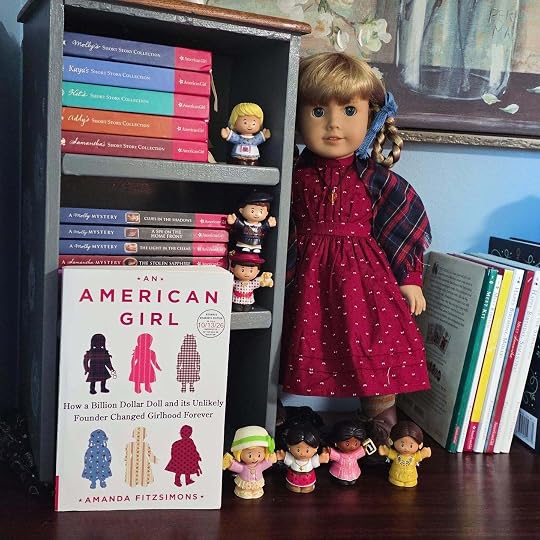
An American Girl: How a Billion Dollar Doll and its Unlikely Founder Changed Girlhood Forever

Rate this book
A deeply researched, invigorating love letter to the beloved American Girl brand, its unforgettable female founder Pleasant Rowland, and her then radical, now iconic line of eighteen-inch dolls that surprised and transfixed a nation.

Are you a Samantha? A Felicity? An Addy? Dive into the world of American Girl, the franchise that has captivated the world for generations.

For four decades and counting, American Girl has been a defining force in the lives of young girls, shaping their understanding of history, identity, and selfhood. But the story of its creation—and the visionary woman behind it—has never been fully told...until now. An American Girl is the fascinating tale of Pleasant Rowland, the trailblazing founder who disrupted the toy industry with her line of dolls defined by their high-quality craftsmanship and rich, educational backstories—and how this iconic brand from America’s heartland ended up shaping girlhood for generations.

Author Amanda FitzSimons takes readers inside Rowland’s meticulous creative process and the far-reaching, almost incalculable legacy of her creation. This book explores how American Girl became a cultural touchstone, navigating the crosscurrents of third-wave feminism, the rise of consumer culture, and contentious debates over historical accuracy and representation. It dissects the brand’s complicated relationship with race, class, and diversity, from the groundbreaking introduction of Addy Walker—the line’s first nonwhite doll—to the critiques of its aspirational price point.

An American Girl is a compelling, eminently readable love letter to the entrepreneurial genius of a brand that has maintained its grasp on public consciousness for nearly half a century. It is an essential read for anyone who has ever loved a doll and recognized the powerful ways in which they can transform our understanding of ourselves—as well as the world around us.

Audible Audio

First published October 13, 2026

Loading...
Loading...

About the author

Amanda FitzSimons

3 books11 followers

Ratings & Reviews

What do you think?
Rate this book

Friends & Following

Create a free account to discover what your friends think of this book!

Community Reviews

5 stars
120 (27%)
4 stars
196 (45%)
3 stars
88 (20%)
2 stars
23 (5%)
1 star
8 (1%)
Displaying 1 - 30 of 185 reviews
Profile Image for Miranda Reads.
2,362 reviews165k followers
Review of advance copy received from Publisher
September 10, 2026
description

"The story you are about to read is about how one woman broke every rule in the male-dominated toy industry ... and built an empire that would forever change the culture of girlhood in America."

You'd be hard-pressed to find any millennial who hasn't heard of American Girl.

As a child, I poured over the yearly magazines, learning as much as I could about these semi-fictional worlds. We never had money for an American Girl Doll - but gosh dang was I enamored by the whole shebang.

The beautifully made dolls with their seasonal outfits and multi-faceted accessories - from lunch boxes to furniture to treehouses! The surprisingly robust historical fiction stories that taught thousands of girls about their ancestors, and the ever-expanding worlds based on eras of American history.

They were a status symbol - and one that thousands of girls (and their mothers) coveted.

This book traces the brand back to its very origins - how it went from a glimmer of an idea in Pleasant Rowland's head to the multi-million dollar Mattel-owned company that it is today.

"Rowland's simultaneous, multi-pronged approach was riskier and it was a huge part of what ultimately made her company so successful."

For context, this year I've also read The Making of American Girl and while I definitely walked away with a greater understanding of the dolls, you could also tell that it had a very positive spin. It focused on the design origins and less on the business side of the brand.

This book focuses on the business side - providing context, comparison, and occasional snark towards American Girl and other powerhouses of the day (i.e. Barbie or Cabbage Patch).

I do think that some of the snide seemed unwarranted, often alleging that Pleasant Rowland was domineering or meticulous to an unreasonable degree. Which, to be fair, I've never worked for her so I don't know her professional style but I imagine that you aren't always your most genial self when launching a brand and maintaining a multimillion dollar company.

Swinging back to the meticulousness, her attention to the most minute details is what really sold me on the company. I picked up my first American Girl book fully expecting a "doll with accessories" sort of story and was blown away by the heart, soul, and attention to detail.

"Nothing felt like an afterthought - the dolls weren't based on the books, the books weren't based on the dolls."


One thing that I loved were all of the casual tidbits thrown in this book that only elevated my opinion of the company.

For example, I learned that Addy Walker originally came with a real dried drinking gourd and only after hand-scooping and drying thousands of them did Pleasant Rowland (owner of the brand) acquiesce to the impracticality of the endeavor and allow for a plastic replica to be made.

And that Samantha Parkington came with a real 1904 penny and that the company was purchasing the pennies for 30 cents each. And that the company literally bought so many pennies from collectors that the collectors ran out. They had to decide between going for the 1905 penny or a replica (with the replica being distinct enough from US currency in order to avoid counterfeit claims).

Granted, no company is perfect and this book does spend quite a bit of time with the Felicity Controversy, which honestly felt good to talk about. I know that when I read the stories for the first time, I was shocked by how Felicity and her family owned slaves...and she chose to free a horse.

And I do think the book was weighted a bit too heavy towards the beginnings of the company, the post-Pleasant era (when it was sold to Mattel) felt much sparser compared to the origin story sections. But I still learned quite a bit about how expanding and diversifying the brand allowed it to flourish for over forty years.

Overall, this was fascinatingly nuanced take on American Girl. I learned so much, but also have an awareness for the brand that I hadn't before. If you are curious about a complete history of the brand, then I'd highly recommend this book.

With thanks to the author and publisher for sending me a free copy in exchange for an honest review
Profile Image for Babbity Kate.
132 reviews218 followers
Review of advance copy received from NetGalley
August 9, 2026
This book was misrepresented in marketing. Which maybe isn't the author's fault, but that's the reality.

The summary promises “a deeply researched, invigorating love letter” to the brand, the founder, and the dolls. That’s not at all what An American Girl is trying to be. The book is a case against American Girl– against the intentions, execution, and impact. Which is a legitimate book to write, but hardly a love letter.

The book is also not “deeply researched,” though I do think that was the original intention. It seems that FitzSimons really wanted to write an intimate and thorough history of Pleasant Rowland as a businessperson. Unfortunately, as FitzSimons acknowledges in the introduction, she learned early on that she did not have the access necessary to write such a book. “I made efforts to reach out to both Rowland and Mattel,” she writes, leaving the reader to assume that these efforts were not successful. (In the ARC, FitzSimons said it more directly: “Rowland wouldn’t participate in this book.”)

Instead of pivoting the project to an outside perspective that doesn’t require access, it seems that FitzSimons forged ahead with the original outline, sans firsthand research. The author still weaves a personal narrative of Rowland’s perspective and emotions throughout the book. In the absence of direct quotes, FitzSimons settles for her own imaginings of Rowland, with whom, she admits, she developed a “parasocial relationship” (7). These imaginings are unflattering and tend to dwell on fantasies of Rowland upset or embarrassed.

There’s a pervasive misconception that negative somehow equals unbiased. Because FitzSimons is making a case against AG, I fear that some readers unfamiliar with the subject matter will assume that this means they’re getting the real unvarnished truth. But let’s be clear: a lot of this is just plain false. I have no idea where FitzSimons sourced information about the American Girl stories and product releases. I'm baffled by the sheer number of factual errors.

My review grew into a full 3,000 word essay, which you can find on my substack (no paywall). I go into detail on the more outlandish claims in the book.

But here's the note the essay ends with: I really do want to read a thoughtful, thorough history of Pleasant Company. While I loved the insights and photographs in the Mattel-created The Making of American Girl, there is an open gap for a book that casts a balanced, critical eye on American Girl. There’s a lot still to be uncovered, and some deep contradictions and issues to explore. I want to read that book– even if that book ends up arguing that Pleasant Rowland’s a monster.

An American Girl is not that book. AAG is written in bad faith. From the twisting of facts to the self-contradictory complaints, it has no integrity, no commitment to a point of view. It’s just plain mean. It’s mocking and cruel and, I’ll just say it, deeply sexist. It doesn’t argue that Pleasant Rowland is a monster, because it doesn’t argue anything. It just points and scoffs.

I’m disappointed that we’ll have to wait longer for the critical evaluation of Pleasant Company history that is so greatly needed.

------

Previous review of ARC copy:

Oh dear.

Based on the ARC copy I received, I'd rate this one star. To be blunt, I just don't see anything of value for the reader here. This is not because I disagree with the author's view of the American Girl brand, which she characterizes as fundamentally hypocritical, insincere, frivolous, and oppressive. (Although I do.) It is because the book doesn't bring any actual reporting or analysis to back up the emotionally-charged accusations.

Perhaps most importantly, this thing is riddled with factual errors. I didn't take initiative to fact-check every claim and detail. I simply highlighted each instance where the book said something I already knew to be untrue. That alone amounted to several errors each chapter. Small mistakes (a misspelled name, an incorrect date) are common in uncorrected proofs. Constant and substantial errors about the main topic are not. I'm left completely befuddled at where the author sourced information about the content of the American Girl books, as it doesn't appear to have been the books themselves. While I am less familiar with the timeline of doll collection releases, catalog editions, and the like, I still was often caught off guard by incorrect descriptions of items whose appearance is easy to look up with a quick image search.

There's precious little primary research or original analysis here-- nearly the entire thing is cobbled together from quotes and borrowed observations from other's scholarship. There's certainly nothing wrong quoting and referencing existing work, and usually this secondhand work is correctly attributed. Sometimes, though, it is not clearly labeled, and I was only aware that the work was not FitzSimmon's own because I was already so familiar with the topic. I imagine that a reader who hasn't already read the same sources that this book uses might assume that FitzSimmons collected particular quotations or stories through her own interviews, an assumption the book will not directly contradict.

For now, I'm throwing an extra star on top in good faith that the final copy will be substantially revised. This is a much earlier draft than I typically receive from Netgalley. Usually, the book is in a finished and readable state, just waiting on line edits. However, in this case, the copy I read (August of '26) appears to be an alpha draft. (In my opinion, this is not acceptable on the publisher's part, but isn't the fault of this specific book/author.) For that reason, I'm going to hold off on a substantial review until I can compare the finished version.
Profile Image for Mai T..
1,448 reviews976 followers
2026
June 25, 2026
Non-fiction November TBR

📱 Thank you to NetGalley and Atria Books
Profile Image for Katie.
493 reviews54 followers
September 21, 2026
If you're invested in analyzing American Girl — and you know I am — this is one you'll want to pick up.

The story of American Girl has been told before in various places, to varying degrees of detail.
Playing with America's Doll and Dolls of Our Lives and An American Girl Anthology all provide enough backstory so that they can get into the cultural analysis and/or personal essays they're really interested in providing. The Making of American Girl, a massive coffee table book from the brand itself, somehow gives an even more abbreviated version (but does offer unique visuals from their archives).

But in contrast to some of the more academic efforts above, FitzSimons is a journalist. She weaves in analysis and critique along the way, but she's setting out to tell the history and impact of the brand, and that is exactly what we get.

So naturally she too starts with the background of founder Pleasant Rowland add how she was inspired by Colonial Williamsburg and her frustration at buying presents for young nieces. But FitzSimons goes well beyond the perhaps-familiar beats to share a detailed account of American Girl, from Pleasant to Pleasant Company to Mattel, right up to this year (though arguably we get a speed run through everything after Kaya's release in 2002).

As a good journalist, she's transparent about her sources: No, Pleasant didn't choose to talk to her. No, the brand didn't choose to engage, either. (And perhaps that's for best, freeing FitzSimons from any possible appearance of obligation to the corporation.) But enough former employees and other connections were willing to share their stories that it hardly matters. We hear about business plans and philosophies, customer service anecdotes, and the inside baseball of the Colonial Williamsburg partnership. We also examine how AG fit into, responded to, and contributed to a variety of trends in the '80s and '90s and into the '00s: how we approach history, history education, feminism, consumerism, class, and race. And, of course, trends in toys and books and girlhood.

It all works together, of course, to try to answer why these stories, these toys had such a hold on us (and in some cases, still do). But FitzSimons also acknowledges that a lot has changed since 1986, and that there are many cases in recent years where's it's easy to wonder if American Girl has lost its way. This decade, the company has spent no little effort in capitalizing on the nostalgia of people like me, both by re-releasing some of the original dolls and outfits, and by creating characters ("historical," how dare) from the '80s and '90s whose stuff is a mirror of our childhoods. But it's hard to say whether the actual girls of today are being given enough substance that they'll hit a similar wave of nostalgia in another 20 years. FitzSimons doesn't prognosticate.

Overall, the portrait FitzSimons crafts is a fair accounting, not a hagiography. We see missteps and miscalculations as well as successes. But at heart, this was a scrappy little company that works very hard to get details right, to braid education into playtime, and above all, to focus on girls at the most in-between-y of ages. And that, I think, is why I keep coming back.

I received an Advanced Reader Copy provided by the publisher via Netgalley in exchange for an honest review.
Profile Image for Mikaela Lennberg (lennberglibrary).
160 reviews10 followers
Review of advance copy received from NetGalley
September 17, 2026
If you owned or played with American Girl dolls as a girl this is a fascinating read. I learned so much about the story and journey of the company and how much thought and research went into every doll and her accompanying books. Pleasant Rowland, the founder, is a determined woman that was on a mission to do it all independently and she did what a lot of people thought she never would. This book told the story in an interesting way that kept my attention. I learned a lot and felt like the title of how it “changed girlhood forever” was very well documented.
Profile Image for Olive Fellows (abookolive).
923 reviews6,529 followers
Want to Read
September 13, 2026
Being a child in the 90s/early 2000s, American Girl dolls were incredibly popular. I didn't grow up wealthy, so we couldn't afford for me to have one of my own (I needed boring things like braces instead), but I loved playing with them and learning their stories at my friends' houses.

As such, I had high hopes for the book Dolls of Our Lives, but I found it rather lackluster in its failure to focus on the history and business of these dolls - something this new book promises to do better. We'll see!

Click here to hear more about this book and my other anticipated releases of the upcoming quarter over on my Booktube channel, abookolive!

abookolive
Profile Image for Rebecca Brenner Graham.
Author 1 book39 followers
July 15, 2026
the kind of book that makes my days better by carrying it around with me. AN AMERICAN GIRL by Amanda FitzSimons is engagingly written, well researched, at times laugh-out-loud funny, and overall a model for this kind of book. full of millennial nostalgia, too!
Profile Image for Samantha.
2,978 reviews207 followers
October 24, 2026
Most of the nonfiction addressing the Pleasant Company and the American Girl dolls seems to be unable to help itself from engaging in a lot of bizarre editorializing. For whatever reason these dolls seem to inspire a lot of strange criticism, which seems odd given that the dolls and their accompanying books are among some of the best products created for kids.

Thus I very much appreciated this thorough and objective history of the company and its founder, which is largely research based and discusses controversy academically.

This isn’t a super long or dense read, but it’s very completist, and covers everything from Rowland’s early foray into the toy market to her attempts to single-handedly revamp a struggling town.

I’m a Samantha who of course chose the Samantha doll as her first item from the company way back when, and it’s been interesting to see how the business evolved. Not every endeavor made by Pleasant and her company has been a win, but the ethos of the product has always been a good one, and its success is one of the few instances in which you actually find yourself rooting for a large company to continue thriving.

*I received an ARC of this book in exchange for an honest review.*
Profile Image for Bethany.
856 reviews68 followers
September 30, 2026
This book tells the story of Pleasant Rowland, the founder of the American Girl Doll Company, and the journey of the company throughout the past four decades. Rowland created a line of high-quality dolls with educational backstories, and these dolls shaped the girlhood of an entire generation. From the original three dolls, to the enormous empire it became, this book shows how toys can shape our world.

Growing up in this generation of American Girl Doll-loving kids, the book was so nostalgic for me to read as I reflected back on my childhood and the love I had for these dolls (I had Molly and Kirsten!). The book was incredibly well-researched and thorough, and I found the background of this company and its development over the past forty years so interesting. I’d definitely recommend this book to any fans of the brand!

Thank you to Atria Books for my gifted copy!
Profile Image for Reading Rachel .
334 reviews56 followers
September 28, 2026
I grew up dreaming about having An American Girl doll like many little girls born in the late 80s. I never could decide which doll I wanted, Samantha, Felicity or maybe Molly. I studied my American Girl magazine with vigor. I made plans on how to earn money and even went through with a few 😁. I made lists about everything I wanted because I didn't want just the doll, I wanted all of her stuff too. If I remember correctly it was a little over 300 bucks for everything I wanted. Big big money, especially in 1994. I also of course read all of the books I could and I even re read a few this year 2026 for nostalgia purposes.
I loved this book and all of the history behind The American Girl dolls. I think if you love them as much as I do then this is a must read.
Profile Image for Kasee Baldwin.
334 reviews57 followers
Read
September 2, 2026
I really, really enjoyed this book, and read it in two singular airplane trips — I couldn’t put it down once I started.

I grew up on American Girl and the brand is deeply rooted in my adolescent experiences and identity. As an adult, I appreciate the opportunity to engage with both the reverential, nostalgia-filled aspects of it, but also in the criticism of the brand and its legacy where required. I think Amanda FitzSimons’ AN AMERICAN GIRL is a well-written, highly-researched, and thoughtful look at the brand and the history of its founder. It’s balanced and smart, funny and resonant. I loved its look at the brand’s impact on the culture and meaning of girlhood, and there was much in this reporting that I wanted to explore further.

Love love love this book. Highly recommend reading (and pairing it with the Dolls of our Lives podcast & book!)

Thank you to Atria Books and Netgalley for the e-ARC in exchange for my honest, unbiased review. AN AMERICAN GIRL is out 10/13/26.
Profile Image for Madeline Gautreaux.
159 reviews13 followers
August 16, 2026
What doll are you? How did you pick your doll? And did you know the history of your doll’s beginnings? All these questions to say, FitzSimons has written a book just for you.

Given that we’re coming up on the 40th anniversary of AG, FitzSimons tells us a history that many of us (especially those born in the very early 2000s) AG lovers may not know. In reflecting back on my experiences with AG as a girl, the story of Pleasant Company and AG that FitzSimons laid out absolutely deepened my appreciation for the world that Pleasant built for young girls.

This book addresses the good, bad, ugly, and nostalgia of American Girl in a way that is raw and moving. As a self-proclaimed Kit enthusiast, I just loved the way FitzSimons put together history, pop culture, and the genuine feeling of what getting your first doll or book in the collection felt like. I don’t think I had experienced it since 2010 when I got my first doll.

All this to say, if you love or have loved AG any time in your life, I really think this story is worth the time spend reading & reflecting on how one woman changed the trajectory of our youth one step at a time. And maybe, just maybe, it’ll help you realized why you chose the doll you did.

Thank you Atria & NetGalley for access to this arc; I am so thankful!
Profile Image for Regina Mulebya.
53 reviews1 follower
Review of advance copy received from NetGalley
October 2, 2026
*Thank you to NetGalley and to the publisher for an advance reader copy of this book in exchange for an honest review*

Non-fiction books are always hard for me to rate, but 3.5 stars feels like a good landing spot. This one was fascinating, informative, and just plain nostalgic. Pulling back the curtain on such a beloved brand felt as though I was being given an insider exclusive.

At first, I was a little let down when I heard that creator Pleasant Rowland herself (nor American Girl Company) was involved in the making of this book, especially knowing she’s still alive. The inner child in me wanted that firsthand account of what my 10-year-old dreams were made of! In hindsight though, this boded well for the narrative as the author didn’t need to protect the brand.

Part expose, part commemorative, FitzSimons offers readers a seasoned balance of salacious details with adorned reverence. She lends profound respect for the company, while also not pulling any punches on the (sometimes ugly) facts underneath the meticulously kept surface.

That said, I learned A LOT. I didn’t realize how controversial a figure Rowland was. Having already inherited a large fortune prior to starting the company, her business already exuded elitism prior to launching. American Girl gave “American Dream” vibes while being simultaneously clothed in considerable privilege. Pleasant, as an executive, was described as “beyond picky, tough to work with, difficult, and controlling”—ironically the exact opposite of her first name. I did however appreciate the author rightfully pointing out how people probably wouldn’t have harped on those qualities had Rowland been a male (interesting how being overbearingly particular and measured is seen as a negative for women, but somehow a strength for men--I digress!)

Ultimately, Rowland was a trailblazer who went against the societal “toy industry” norms, whether she was liked by folks in the business or not. Her unconventional way of advertising through a catalog instead of commercials was just one example of this. Though her approach and demeanor may have been seen as controversial, she was a woman on a mission: to create dolls in an effort not to rush girlhood (a term the book coins as “early childhood but before adolescence”)

Rowland adapted very feminist views in how she operated her business. She was the sole distributor of her collection--which meant she didn’t sell at the big name stores so she wouldn’t have to negotiate with them. This ultimately allowed her to have full creative freedom and control over her product- a concept seen as progressive for it’s time. Yet oddly eough, her products often promoted very misogynist views like “Learn to Cook in the Kitchen like Kit”. Rowland initially set out to make her company narrow and deep, but it later spiraled to shallow and wide.

Criticism aside, American Girl was extremely inventive for it’s time. They created an imaginative and alternative play reality for us as little girls but also facilitated learning outside of the classroom. Originally, Rowland distinguished her brand from Barbie and Cabbage Patch by limiting their creative licensing strictly to dolls and books in effort not to cheapen the product. She felt if AG was offered just as an educational toy, it was more upscale. The doll would appeal to children, while also satisfying the educational needs of parents. The issue with making a product “upscale” though is ACCESS. The dolls were problematic due to their affordability, with a steep price tag that could only attract the upper echelon.

For me, the most memorable chapter centered on the book “The Care and Keeping of You”, a book I fondly remember receiving as a pre-pubescent girl. Parents somehow trusted Pleasant Company with these very adult conversations solely because their brand was proven and established (some even giving their child this book in lieu of an actual real dialogue!) Parents loved it because Pleasant Company essentially did the “hard” part for you. The book was sex free, which played into more conservative parenting, but still willingly brought up uncomfortable topics that some liberal parents may not have been comfortable broaching. I mean who WASN’T raised by this book in lieu of real sex ed??? (as a former Catholic school girl, it was a rite of passage) How seemingly ironic that the company—who centered so much of their brand on not wanting kids to grow up fast—created a book on puberty.

So where’s the line drawn between teaching history vs pricey nostalgia? FitzSimons leaves that up to readers to decide. Of course, the brand is still selling their products, but Rowland is no longer involved with the company and is living a very private life. She remains largely away from the spotlight by choice, often declining requests for interviews. Ultimately, I would recommend this book to anyone who grew up with the dolls and felt this was a phenomenal way to celebrate the 40th anniversary of American girl!
———————————————————————————

Some facts I learned: (FYI spoilers below if you haven’t read the book!!!!!)

-In 1982, the USA accounted for half of the entire world’s toy sales, making a lucrative environment for AG to thrive in

-AG was initially made as an alternative counterculture option to Barbie, yet Rowland ended up selling the company to Mattel for a cool $700 million in 1998 (valued at $1.4 billion today) This felt especially hypocritical after spending so much of her tenure criticizing Mattel—who quickly changed the logo from a girl reading a book to a star after assuming ownership.

-The company wanted the books to be historic but not offensive or depressing—which unfortunately isn’t possible when discussing American history!! (staff was told to make “the slaves look happier” in the book drawings—major eye roll!!!!)

-The overall “white washing” of history (for example: Felicity’s books didn’t touch on slavery, even though it took place in 1700’s) not to mention the fact that AG was first created in 1986, yet didn’t release any dolls of color until 1993 when Addy Walker debuted (AND conveniently after Oprah called out Pleasant Company live on air!!) It wasn’t until another 4 years after THAT that the first Latina doll Josefina would be announced... a whooping 11 years after the dolls were first introduced. Not a good look for equity.

-From 1986 to 2011, female PhD history candidates rose from 30 to 50% and cited American Girl as “crucial” towards giving them an early push in the field
Profile Image for Ashley.
137 reviews1 follower
Review of advance copy received from NetGalley
October 2, 2026
I think Pleasant Rowland would really enjoy knowing that I tell people most of what I’ve retained about American history is because of the American Girl books.

Never have I ever been this invested in a nonfiction book!! American Girl was (and is?) my special interest—I spent a LOT of time researching AG when I first got internet access as a tween, and of course always loved the books. Every NYE without fail I’d check the website to see the new girl of the year (until they started releasing them early), and for some reason I still get their emails. Real ones know I got a group together to dress up as AG dolls for Halloween last year (it is important to note that I was Felicity. TRUST if I could include a picture I would). And yet!! I did not expect to find this company deep-dive to be this fascinating!!

Thank you to NetGalley bc I needed to read this immediately upon finding out it existed!!
Profile Image for Kate Rose.
382 reviews3 followers
September 5, 2026
It’s been a while since a nonfiction book I just haven’t wanted to put down, but this book was it for me! I really enjoyed the in depth narrative approach this book took— I really appreciate when people take the history of things like girls’ dolls seriously and treat it with such respect. I really loved the way the book interlays the cultural atmosphere of the American girl eras with the business decisions.
Profile Image for Ellie.
151 reviews13 followers
August 17, 2026
I absolutely adored learning more about the cultural phenomenon that is American Girl. Super impressed by FitzSimon's attention to detail and research. Growing up Asian, I've always had a disjointed relationship with these dolls. I owned a few, but never felt like the representation was good enough. This book put a lot of my frustrations into words and also gave me insight into the entire process that American Girl went into for their non-white characters. Truly fascinating all around. I'm going to try to find the photo of me and my friends at the American Girl Place restaurant because it definitely counts as a core memory!

Thank you so much to NetGalley and AtriaBooks for an advanced copy in exchange for an honest review.
Profile Image for Lauren.
83 reviews
October 22, 2026
Pleasant Rowland, they could never make me form a solid opinion of you
Profile Image for Stephanie Fitzgerald.
1,362 reviews
Review of advance copy received from NetGalley
October 2, 2026
As an avid reader of the original American Girl books, and an owner of several of the dolls, I was glad when Netgalley approved my request for this book. It was interesting, with details about the Pleasant Company’s origins that I had not known before, and background information about the how characters of the historical line came to be created. The “financial” parts were somewhat less interesting and made the book a bit difficult to push through and finish.

*I received a digital copy from Netgalley in exchange for an honest review. All opinions are strictly my own.*
Profile Image for Alanna Metz.
125 reviews1 follower
Review of advance copy received from NetGalley
July 20, 2026
I was given an advanced reader copy of this book by Atria Books for my honest review.

As a 90s baby, I LOVED American Girl. I read every book up until Kit, had an AG themed pajama birthday party with their slumber party kit, subscribed to the magazine, learned about puberty from "The Care and Keeping of You" and even went to American Girl Place in Chicago. I still have my Hallmark ornament (Josefina) but never did get a doll (I wanted Molly). Reading this book really brought memories back. The author describes things in such detail that I could suddenly remember them again. The catalogs, the books, Kirsten's trunk, and the DRESSES. I can even still remember some of the stories, such as Molly's ill fated Halloween costume.

I learned so much from this book. I had no idea the founders name was actually Pleasant. I understood why I never got a doll, but did get the sleepover kit. The doll was $80 then, and the sleepover kit $20 ($167 and $41 in 2026 money). I never knew it was sold to Mattel. I didn't realize it was only sold in catalogs. (I lived in a very rural area at the time. Still do. We still don't have an Apple store in the entire state. I just assumed there were stores American Girl was sold at, just not near me.) I didn't know the inspiration behind the books, such as Gettysburg. I could keep listing things, but page after page I was treated to a new fact I was unaware of.

Pleasant Rowland in particular I found fascinating. Rowland really cared about the presentation of everything, down the Addy's drinking gourd. The way she treated her employees was often harsh, but she also paid them very well. She had a great idea, and the book illustrates perfectly how she implemented it, down winning over girls and their mothers. She was great at marketing the dolls and their collections, without being only about the profits. There was many times in the book where she took an extremely expensive option to safeguard the way she saw her brand. (A seat on an airplane for a doll? Ruth Handler would NEVER)

It was a little sad to see where the company is now. The future for the dolls doesn't seem so bright, but there's always a possibilty of a turn around. The last few chapters really hammered home that the brand simply isn't the one I knew and loved in the 90s. It doesn't seem like there's a much care put into the Girls as there used to be, though they are much more inclusive now. I was particularly thrilled to see an Indigenous Girl, as that was truly a long time in the making. I do hope the Girls get more books, as I read they only get one book per doll now. The best part of the dolls was always the background they had. It's so much more fun to tuck Molly into that gorgeous bed of hers knowing she is listening to the radio for news of her father.

Thank you, Ms. FitzSimons, for the walk down memory lane. I appreciate your balanced look on the subject, showing the good and bad about the brand, its founder, and its current direction.

Profile Image for Liz.
174 reviews1 follower
September 5, 2026
An American Girl is a straight-to-the-veins shot of nostalgia for us millennial women. A thoroughly researched, unputdownable text that takes readers on a journey from Pleasant Company’s inspiration and founding to its present day decline.

As an avid American Girl fan throughout most of my elementary school years, I was immediately brought back in time while reading this absolute gem of a book. The descriptions of the catalogs (Remember those life-sized two-page spreads of the original dolls? I get the chills just thinking about it!), the passages pulled from the books (hearing that worm eating scene again definitely unlocked some repressed memories), and those ACCESSORIES?! Swoon! I might not have fully recognized or understood the level of artistry that went into their creation, but somehow, even at the tender age of nine, I knew what I held in my hands was a thing to be treasured. The unprompted reverence and respect that I afforded my American Girl collection as opposed to, say, my Beanie Baby collection, is clearly proof that young girls are superior judges of value.

As an adult who recently transitioned from teaching to the creative industry, I felt a strong kinship to Pleasant Rowland as I read her story. I am fascinated by the way her mind works and how she was able to build what eventually became an empire, especially with such an excruciatingly narrow target audience (American girls aged 7-12). She is by no means a perfect role model (in fact, it seems, she is quite far from it), but there is so much to be learned from her fierce commitment to to her vision (going so far as to encourage parents NOT to purchase her products until their daughters are ready), her meticulous attention to detail (insisting that Kirsten’s boots be sourced from her native Sweden) and world-building genius (this one speaks for itself). These are certainly qualities we should all aspire to emulate.

Needless to say, I will be pre-ordering this book for my own collection, as well as gifting a copy to each of my sisters. If you are of the age to have been caught up in the cultural phenomenon that is American Girl, this book is for you.

Thank you to NetGalley and the publisher for the free ARC in exchange for my honest review.
Profile Image for Katie Katieneedsabiggerbookshelf.
1,921 reviews315 followers
Review of advance copy received from Publisher
October 5, 2026
A deep dive into the world of American Girl!

Well American Girl being 40 doesn’t make me feel old or anything so there’s some good news there! LOL. I listened to this book on audio and I really loved listening to the story of my favorite childhood dolls! This talks about the good and the bad of the dolls and series. The wins, and the missteps. I loved my dolls growing up, but I also recognized that they were a privilege to own for sure. What I loved most about them though was the books. Shocking, I know, that I was obsessed with the books! I loved learning history through the stories of my dolls, and I remember devouring the books. When the first store opened on Michigan Ave, my Grandma and Great Aunt took me for a fun filled girls day, and I will forever hold those memories dear. While I don’t love how much they have changed toward less history, more money making, I also get it, but I really wish they had kept the show at the store. It was so well done and was my favorite part of that day, just in front of the tea with my favorite people and my doll. For those to be the parts that stood out when I was also being spoiled by my Grandma and Aunt says a lot about the entire experience of going to the American Girl store. I also did all the Felicity things when we visited Colonial Williamsburg and remember making a friend at our hotel over our love of our dolls. American Girl was my childhood, and I loved this deep dive into its history.

Thank you to @atriabooks and @librofm for my gifted copy of this book!
Profile Image for Caitlin Rydberg .
514 reviews3 followers
October 6, 2026
I was nine when I got my American Girl Doll. My parents gifted me Josefina, along with most of her outfits and accessories. By then, I had a subscription to the Magazine, had spent countless November evenings curating my Christmas list from the catalog, created plays on my family computer via American Girl Premiere, forced my sisters to do the Samantha play that came in a kit, read all the books (and I mean ALL the books), worn out my paper dolls, and consumed miscellaneous media. I later created fashion on the computer with the game Dress Designer, consumed Amelia's journal (and created ones with that CD-ROM), and obsessed over Dear America and Royal Diary books. The latter two, I found out, were created due to the American Girl popularity. I learned about growing up through The Care and Keeping of You. American Girl was my childhood, and I am dead set on creating that for my daughter.

Amanda FitzSimons saw the nostalgia and love and ran with it. A perfect history lesson for the girls who grew up to be women and who are spending their money to make sure the American girls of today don't lose those lessons.

Thanks to Netgalley for a chance to read this book in advance for my honest review.
Profile Image for Jillian.
451 reviews7 followers
October 6, 2026
Thank you to NetGalley, Atria Books & Amanda FitzSimons for the chance to read this book in exchange for my honest opinion.

I am an American Girl stan. I'm a 1980s girlie, I got Samantha in 1993, and I'm raising a 10 year old Molly girlie. We are NECK deep in the lore and LOVE of AG. This book holds nothing back. If you're a Mattel Apologist- ya might not like it. If you can't handle the concept of women that lead companies in ways that wouldn't earn the criticism if a man did it.. ya might not like it as well.

But as for me and my house, we love the lore. The successes, the misses, the detail- and all of the info provided in this book. I will say, we were left on a note in the spirit that the company is declining.. maybe fading away. Really? Is that how people see it? Again, we are neck deep into fandom.. maybe we're actually eyeball deep and blind to the despair?

Either way-- we'll be in Chicago next week for the debut of Samantha's Adult Novel and to visit the AG store/Mecca anyway! So for us-- AG is alive and well!
Profile Image for Deanna.
304 reviews
October 16, 2026
I ate this book UP! It scratched an itch I've had for a long time. Over the years I've tried to look up information on Pleasant Rowland and the American Girl brand, but there was never much out there about Rowland herself. It was fascinating to learn why she created the dolls, which dolls she had ideas for, and what the company culture was like as a whole.

My opinion? It was probably inevitable that Rowland would sell to Mattel, but I really miss the emphasis on the historical dolls, because those were so special to me. The pivots to the Disney Collection and Wellie Wishers are, I guess, what girls want now, but my frustration comes from pure nostalgia. If Rowland were around today, I don't think she'd be happy with the brand's direction.

Now for Christmas/Chanukah, I want Samantha, Kirsten, and Rebecca. I don't care that I'm going on 29. 🤣
Profile Image for Kaitlyn.
301 reviews1 follower
Review of advance copy received from NetGalley
October 3, 2026
Great trip down nostalgia lane! Lots of fun facts and loved learning about the history of the company. Admittedly I skipped the entire chapter about Rowland investing in Aurora, NY since it felt unnecessary to the story, as did a few other narratives. Some sections dragged but not enough for me to lose overall interest.

Also to keep in mind, this eARC had A LOT of errors - repeated sentences within the same chapter let alone paragraph, spelling/shorthand issues, and poorly worded asides. I’m assuming that these will all be fixed prior to publishing but not the best first impression imo.

Thank you NetGalley and Atria for this eARC!
Profile Image for haley ⊹.
376 reviews66 followers
October 18, 2026
as an american girl fan since I was a kid in 2002 and a returning adult collector as of last year, I was anxious to read this. overall, I can tell a lot of research was put into it, and I did enjoy reviewing many things that I already knew. like other readers on here pointed out, the tone felt a little too cynical at times, especially regarding certain characters (why is samantha catching so many strays 😭) but in other instances I appreciated the pros-and-cons that were presented for different characters. it wasn't a bad read but I do have some conflicting thoughts on some of the arguments it presented.
Profile Image for Megan Baker.
20 reviews1 follower
Read
October 24, 2026
"The story you are about to read is about how one woman broke every rule in the male-dominated toy industry ... and built an empire that would forever change the culture of girlhood in America."

Every millennial girl has heard of American Girl, so I enjoyed getting to learn the full history behind the iconic brand. This was an interesting look at how American Girl came to be, its founder, and the impact it had on a generation of girls.
Profile Image for Jacqueline Schottler.
87 reviews
October 15, 2026
Nostalgic overload! If you grew up with American Girl dolls, this one is such a trip down memory lane. I think the author did a really good job balancing the nostalgia of the dolls with the more modern social commentary around what they represent today. It’s an interesting look at how something that felt so simple and magical as a kid can carry a lot more cultural weight when you revisit it as an adult.
Profile Image for Zoe.
60 reviews5 followers
October 26, 2026
Thank you to Atria Books & NetGalley for this ARC!

American Girl shaped my girlhood in such an intricate way, like it did for so many others. I even got the magazine until I was arguably way too old for it, and I didn't care.

This isn't the first book I've read about AG, but I loved how nuanced it was. Nonfiction about companies rarely looks at its subject from every angle and thinks critically, even when the people behind it are fans themselves
Profile Image for Jessica Milliner.
214 reviews18 followers
June 30, 2026
I love reading American Girl books when I was little. I’ve never had the dolls. This book shows so much about the history of The American Girl. Inside it explains so much including books, dolls, magazines, and catalogs. It’s a pretty good read.
Displaying 1 - 30 of 185 reviews