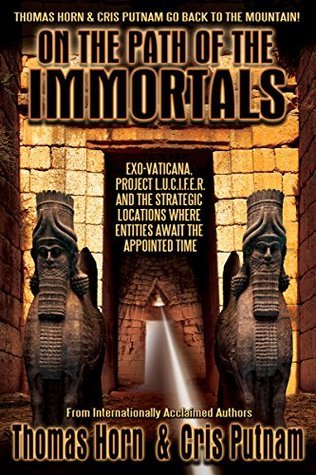
Following the release of their international best-seller, Exo-Vaticana, Thomas Horn and Cris Putnam were inundated with requests from around the world to be interviewed on radio, television, and in print media. What they discovered sent shockwaves through Christianity concerning the Vatican s advanced telescope, which sits on top of Mt. Graham in Arizona (USA) where the Jesuits admit they are monitoring something approaching the earth. After the author s initial report was published in Exo-Vaticana, the pope s top astronomer took to the airwaves and on the Vatican Observatory website to try and explain the role that he and other church astronomers are playing with regards to emerging ET Friendly theology, their association with the LUCIFER device at Mt. Graham, and their developing doctrines concerning extraterrestrial life and the impact it may have on planet Earth s religions; Christianity in particular. Now, armed with fresh information from the native peoples (that failed before a federal appeals court to stop the construction of the Vatican s observatory on one of their four holiest mountains), the authors set out with cameras and field investigators to unearth their most astonishing discovery yet. The mountain is said to be a portal, a gateway to another dimension. And, as the Vatican knows and the authors uncovered, it is not the only one.
NOW, FOR THE FIRST TIME, ON THE PATH OF THE IMMORTALS REVEALS... *Unveiled! What Mt. Graham really is, and why NASA and the Vatican are there *Disclosed! What the Bible says about gateways and the beings that wait behind them *Discovered! Scientific evidence of, and signals from, life beneath the surface of the earth *Found! The ancient stargates and their association with vortex manifestations *Revealed! The role of CERN s Large Hadron Collider and its search for a portal *Uncovered! Gobekli tepe, Baalbek, and the secrets of the coming immortals *Deciphered! The worldwide grid that ties them all together *Exposed! The occult s countdown calendar for the return of their gods *Unearthed! Giants, cryptids, and their mysterious connection with gates
In On the Path of the Immortals, internationally acclaimed, investigative authors Thomas Horn and Cris Putnam continue the greatest investigation of our time by exposing the facts kept hidden from the public by elitists and intellectuals who are planning mankind s assimilation under a coming savior, one whom the prophet Daniel foresaw as an alien god.
Thomas R. Horn (Also Published under the Name Thomas Horn ) is an internationally recognized lecturer, radio host and best selling author of several books including his newest books, Petrus Romanus: The Final Pope Is Here, Forbidden Gates and Apollyon Rising 2012. He is a well-known columnist whose articles have been referred to by writers of the L. A. Times Syndicate, MSNBC, Christianity Today, New Man Magazine, World Net Daily, News Max, White House Correspondents and dozens of newsmagazines and press agencies around the globe. He has been interviewed by US Congressmen and Senators on his findings as well as featured repeatedly in major media including top-ten talk shows, America's Morning News for The Washington Times, The 700 Club, The Harvest Show, Coast to Coast AM, Prophecy in the News, and the Southwest Radio Church to name a few. Thomas received the highest degree honorary doctorate bestowed in 2007 from legendary professor Dr. I.D.E. Thomas for his research into ancient history, and has been endorsed by such national leaders as Dr. James Kennedy.
What an intense book! It is the third book in a series concerned with the Catholic Churches ties to occult practices, the identity of "ancient aliens", Egyptian spiritualisms' connection to Washington DC architecture and city planning, end times prophesy, and much more.
All of these topics are examined from a Christian perspective. While I may not agree with all the theories proposed, I have to say the authors back up their claims with more evidence than anyone else that comes to mind. The book is not hyperbole, it is well researched, documented and presented.
One flaw (if I can call it that) is that the book is written as though the reader is well grounded in science, technology and theology. I consider myself a fairly well educated man, but portions of this book were so far beyond my ken as to be impossible for me to completely understand. I didn't have this problem with the first two books.
As a Christian, I found this book to be fascinating. Seeing the occult connections to so much of our everyday world can be intimidating and somewhat disconcerting. I found this information bolstered my faith rather than undermined it. (I peeked at the end of the Bible, God wins)
I enjoyed this book and learned quite a bit about what is going on around me. Knowledge is power and I feel my faith more empowered than I have in some time.
I highly recommend this book to those who want to try and make sense of the craziness in society and government today. Even if you don't agree with the premise, their arguement with make you think.
Again, this is a book you read on purpose, if you are into this stuff. I made a list (7 pages, on small note paper, double sided) of all the other things I want to look up... Now to go backwards and read Exo-Vaticana
I read Tom Horn’s book, Zenith 2016, and was really impressed, so I checked to see if the library had this book and it did so I checked it out. This one unfortunately was not as exciting. The topic revolves around the Nephalim in Genesis 6 and the authors are trying to determine who in fact were these fallen angels? There is also discussion about the giants that walked the earth at that time, the corresponding worldwide legends surrounding the flood, as well as topics surrounding interdimensional portals, UFO sightings, and how they may correlate to the spirit world. I think it’s important that Christians attempt to understand or explain such phenomena whether they agree and disagree and I commend the authors and their research for trying to decipher these issues. I personally think that most chapters in the book were a little dry so I couldn’t dive into it with as much excitement as I was hoping to.
Author and TV/radio personality Thomas R. Horn, serves as the Chief Executive Officer of SkyWatchTV. Co-author Cris Putnam (1965-2017) was an actor, as well as an author.
Cris Putnam explains, “Because all religious traditions and even materialist science acknowledge alternate realms, this book assumes that they exist, but critically evaluates them as well as various ideas about how they interface with the everyday world. After taking the reader along on our adventures in the American Southwest, we delve into earth mysteries, megalithic monuments, and places of power. We also explore alignments, ley lines, and the world grid. These concepts are evaluated in terms of various claims to dimensional portals and alternate realities. Such an investigation is multidisciplinary, requiring a range of topics---from hard science to religion and occultism.” (Pg. 17)
Thomas Horn recounts, “Who could have known that, in 2012 when Crus Putnam and I released our best-selling book, ‘Petrus Romanus: The Fina Pope Is Here,’ we would be inundated with invitations from around the world to be on radio, television, and in print media?... But it was a series of shows that we did with … Steve Quayle… that really set the world abuzz… illustrating to these authors that the world was more than casually interested not only in the final pope, but in the connection between Roe and its work on extraterrestrial intelligence, astrobiology, and the intriguing connection between those issues and why the indigenous people of Arizona… fought so diligently against the construction of telescopes atop [Mount Graham] … [which] is considered sacred … because it is what we might call a ‘stargate’… a portal through which the ‘Star People’ have come since the dawn of time. Once we understood this fact, our suspicions as to why the Vatican and NASA had chosen this mountain … went into hyperdrive.” (Pg. 29-30)
He continues, “Cris Putnam, headed to Arizona with a guide and film crew of his own… not only was he successful in chronicling the ancient and modern stories of portals and those who come through them, but… his crew filmed a luminous object zooming up behind them… The occurrence was followed by … an enormous, V-shaped craft passed overhead…” (Pg. 39)
They interviewed Don Jose Jr., “the third-generation medicine man … [and] retired Navajo academic… [and] a proficient Native American storyteller… told us that the oldest legends of the Anasazi… included stories of the Anasazi turning to sorcery, sacrifice, and cannibalism after they ‘lost their way’ and were driven insane by a reptilian creature…” (Pg. 48-50) He adds, “Nor only did Dr. Mose substantiate the age-old and globally recorded story of ‘those who come through portals’ and the impact they have had on biblical and global history… and not only did he weave Navajo Indian myths and legends seamlessly with our understanding of the six days of creation, the arrival of the Nephilim, and their connection to judgment by a global flood followed by the repopulating of… the world and a second incursion of giants, but … Dr. Mose went off script … to provide greater consistency between history and the way the bible itself recorded certain events.” (Pg. 53) But in about AD 1300, “the Anasazi suddenly disappeared.” (Pg. 56) “Archaeologists theorize that the Anasazi were just absorbed into the Navajo and Hopi tribes… The oral history knows they just disappeared. The question is: where, and why?” (Pg. 58)
He suggests, “one has to wonder what happened to the remains of the giants in America and whether the Smithsonian Institution actually participated in a cover-up (as some have alleged) in making a deliberate effort to hide the giants’ remains (which would inconvenience the theory of evolution which they celebrate)… Does the Smithsonian Institution have… [a] large warehouse somewhere with aisles of American giants’ remains locked away? It’s possible… Locations around the world … seem to connect to… the ‘second incursion’ of giants that came after the great Flood…” (Pg. 62)
Cris Putnam observes, “Although many Christians probably recoil at the thought that God created serpentine divine beings … Scripture does support the notion. It is also telling how the Watchers were described in explicitly RETILIAN terms by the ancient Hebrews… The plumed serpent gods of the Aztecs, Mayans, and Incans share the same basic description as the biblical flying serpentine humanoids.” (Pg. 122)
He also suggests, “It seems fair to argue that the Bible supports the possibility of travel to the spirit realms via altered states of consciousness… Dreams, visions, trances, and out-of-body travel are all supported as real ‘portals’ in Scripture, but the practice of inducing them via psychotropic substances, Eastern meditation techniques, or rituals is forbidden as sorcery.” (Pg. 143)
After mentioning Superstring Theory, Thomas Horn acknowledges, “If you think all this sounds like gobbledygook, then you’re not alone… I’ll admit that this whole theory muddles my poor brain, but I include it to make the ‘point’ that the world is massively more complicated and layered then we fallen humans can now perceive.” (Pg. 154-155) He adds, “Is it possible that Psalm 24 is actually referring to a dimensional gateway that Jesus Christ passes through to access … the earthly realm? Do the principalities of the ‘gates’… control access into our current ‘three-dimensional’ world? Might this be the impetus for an angelic war in heaven that results in Satan and the principalities, powers, and rulers of darkness being cast down to the earth?” (Pg. 157)
He proposes, “Exotic matter is required to create temporary artificial wormholes in more theoretical designs. However, the Creator’s divine essence is all the exotic matter needed to make the already thought plausible designs of theoretical physicist Kip Thorne into tangible realities.” (Pg. 162) Later, however, Cris Putnam states, “The Morris-Thorne traversable wormhole … is held open by a spherical shell of exotic matter… Unfortunately, ‘exotic’ entails hypothetical properties that violate the known laws of physics… Unfortunately, it is only theoretical…. The work is ongoing.” (Pg. 221)
They note, “Self-proclaimed ‘bastions of discernment’ have ridiculed the ‘return of the Nephilim’ idea popularized by our friend Chuck Missler… completely ignored by the skeptics is that ‘the return of the Nephilim’ has a compelling basis in the Greek Septuagint text of Isaiah.” (Pg. 198)
They suggest that the real motivation for the Iraq War was that “biblical sites in Babylon---which had been uncovered during Saddam Hussain’s reconstruction of that ancient city---possessed something the [Bush] administration went there to capture.” (Pg. 204)
They report that “When the Large Hadron Collider (LHC) first started up… director for research and scientific computing at CERN, Sergio, provoked a whirlwind of speculation with his enigmatic remark that the LHC might open a door to another dimension… ‘Out of this door might come something, or we might send something through it.’” (Pg. 218-219)
Thomas Horn asserts, “by placing a bronze Shiva sculpture … in front of its headquarters, CERN is indicating to those with ‘eyes to see’ that the collider’s true purpose is to open a portal to the underworld… which would serve as a doorway between worlds.” (Pg. 237)
This book will appeal to those Christians who like Horn and Putnam’s other books.
Gateways, wormholes, portals, stargates and hyperdimensions... if you've ever wondered what or where they are, or even if they exist, this book presents some theories and, perhaps, answers. Tom Horn, Chris Putnam and their assistants start their explorations in Arizona, where they discover the true purpose of the Vatican's Project LUCIFER telescope and why it is located on Mt. Graham. The large hadron collider in Switzerland (CERN) - and its purpose - is also discussed.
The book elucidates the connection between the sun, planets and ancient gods, and how those ancient gods remain relevant today, including their hidden significance in Washington, D.C. Freemasons are discussed, as well as George Washington and Benjamin Franklin's roles within this secret society. The dollar bill and its symbols indicate a new world order and a time when dark entities - fallen angels or immortals - will dwell among us. According to the author, they are awaiting their appointed time, and it is imminent.
Although it contains an abundance of esoteric knowledge, some of which may bore a few readers, there is a wealth of information to discover along the way. In any case, there is simply too much to cover in a review. I would recommend this book to anyone who seeks to understand the connection between the powers on earth and the powers we can't see, and how they quite possibly work together.
book #35 of 2022: On the Path of the Immortals: Exo-Vaticana, Project L.U.C.I.F.E.R., and the Strategic Locations Where Entities Await the Appointed Time (2015) by Christian authors Thomas Horn and Cris Putnam. I finished this book a few weeks ago and I’m still trying to wrap my head around it. as many of you probably know, I grew up in the church and was…summarily unimpressed, probably largely because at least our version of Protestantism was just swallow it whole: doubts and questions mean you are a heretic. my family would pretend they understood everything and other church members might admit they didn’t, but that was no matter: understanding wasn’t important, feeling it was: and heaven help you if you didn’t feel it! as a natural born stoic, this left me with very little to grasp onto. enter recent world events that seemed like they were fulfilling Revelations line-by-line. if you’ve been following my reading over the last couple of years, you’ll note that I’ve been reading well outside of my usual range of anthropology, evolutionary biology, ancient history, world literature, mythology from an anthropological lens, and philosophy. desperate times…as they say. so I’m casting my net to include…anything and everything, basically no matter how far fetched, things two years ago I would’ve scoffed at, like such books by such authors, to try to comprehend what I’m observing: the seeming inexplicable. bcs the educationally sanctioned narrative seems incomplete…at best, much more likely, it seems, very intentionally constructed to mislead bcs any halfway serious reading of ancient history brings up far more questions than answers: comparative mythology, on the other hand, is a lot more consistent.
so, this book…it’s a lot to take in: I desperately wish it had an index! the authors attempt, beyond delving into a different interpretation of the Bible (they ponder whether the supernaturals described in the Bible are aliens) and its apocalyptic prophecy, they seriously consider some comparative mythology, particularly Native American lore and architecture, but also Sumerian, Mesoamerican, Hindu, etc., something I haven’t really seen Christians deign to entertain in the past. this book helped me in the sense that i was planning (and am still planning) to revisit (I’ve read the Bible several times, but all of them were before I was 16 and with zero useful interpretation, in my opinion) the prophetic books of the Bible: Daniel, Isaiah, and of course Revelations, etc, as well as some Jewish books that didn’t make into the Christian Bible: Enoch, Jubilee, etc. (which I plan to get to, too). the authors did a lot of that reading and selected much of the content of interest re: the apocalypse, which is my current area of interest in this reading focus. they discussed the Nephilim: the giants that resulted from satan’s minions, fallen angels (the watchers, which Jordan Peele referred to as the viewers in his film, Nope), getting with human chics and the flood, which many civilizations have a history of, was, according to these authors, an attempt to destroy the Nephilim, who were apparently abominations in god’s sight, though the authors think one or more giants survive…particularly Nimrod, who then built the Tower of Babel, which the authors perceive as an attempt to access the extraterrestrial (ET) world - a plan god wasn’t keen on and famously developed multiple languages among them to destroy their construction attempt. this book talks about the feathered serpent gods of mesoAmerica who are apparently the same as watchers (fallen angels) and undeservedly accepted the praise that was due god himself (apparently America is the continent of the serpent: Babylon, anyone?). the books also discusses portals through which ETs travel, as well as stargates, which the authors think is why the US invaded Iraq: they think Saddam Hussein was trying to resurrect a stargate there; and black holes and quantum physics and and and. (the book never mention god’s status as an ET or other.) the book also discusses the occult worship of Osiris/Apollo and the Catholic church’s alleged involvement (the Jesuits) in satanism and in attempting to bring the Nephilim and fallen angels back to earth. the entire last chapter talks about how the US was built not on Christian, but on occult symbolism (see the comments for screenshots of most of the last chapter); the authors also believe the idea that god is in everything and in all of us is a new age expression of satanism.
sometimes this book felt like an array of loosely related tangents and sometimes it felt like clearly the best interpretation of the Bible, and ancient history and mythology, I’ve encountered. I’m not sure where the truth lies. I believe I’ll be rereading it, likely before the end of the year, probably alongside the relevant source material in the Bible and in the Jewish sacred texts and maybe beyond (I’m currently reading a book on Sumerian mythology).
note: remember, what you believe is just that. from what I can tell, there’s a lot of reason to suspect that the people running us all into ruin do believe this stuff - and this is why I’ve read anthropology, history, and mythology my whole life: the fact that someone believes or believed it makes it relevant, interesting, and worth my attention, in the same way politics is, regardless of my own beliefs or impressions: it could still impact you/the world.
Compelling arguments, logically reintroduced and completed
At first I found myself thinking, "what the heck did I buy?" I mean the topics these writers introduce are entertaining and interesting. But as I read more, and look at the empirical evidence, and then take another look at this crazy world that everyone I talk to no matter what belief system is held feels like something bigger than ourselves is happening, it does as crazy as it sounds, seem plausible at worst, and down right scary at best. If you are willing to keep an open mind and hear these guys out, you might come to the same realization as I. Good luck!
Well what can I say. There is always a waw factor at the end whenever I read Tom Horn. Paranormal these days is quickly becoming the norm. If you want to learn about Portals, Vortices, Stargates, Giants, Watchers, Nephilim, stuffs like these from a christian perspective, then Tom Horn is one of your best bet. Tom, I thoroughly enjoyed this one. Please keep up the good work!
A lot of information to take in. Most people may not understand some of it. The just is that there are gates to be opened that will cause hell. Let us hope God intervenes soon.
This was a let-down from the two previous books Petrus Romanus and Exo-Vaticana. Those books were better-researched, which kept this one from getting one star.
As Joe Friday (allegedly said), "Just tell us the facts, Ma'am." Horn and Putnam don't. There are entire chapters which are purely speculation, and they seem to enjoy denigrating any religion other than Christianity, even when the other religions' texts support their theses.
On page 138, they talk about how the Babylon Working supposedly released the Scarlet Woman of Revelation, during 1946 or early 1947. Then they deduce, because there was only one woman born in that time frame, that that woman was Hillary Clinton. Pu-hlease!
There are a few places which are overly dramatic. One of the authors received an email from a "curator" of a museum in Iraq, which had a link to a webpage that was only valid for 12 hours. Tom looked at this page and found all sorts of weird things AND DIDN'T EVEN CONSIDER DOWNLOADING THE IMAGES AS PROOF. Twelve hours later, the link was no longer valid, and he never heard from the curator again. Straight out of an episode of the X-Files! This episode came from pages 204ff; the Angel Scroll tale on pages 286f could have come out of another episode.
Now, for some secrets to CERN. The name of the organization changed between 1952 (when CERN was named) and 1954 (when the acronym should have been changed to OERN). Why didn't the founders change the name? The authors dig up a pagan god, whereas Heisenberg said that OERN just doesn't have the right sound to it. Since Heisenberg was part of CERN/OERN, I'd go with his explanation.
They also get some Biblical facts wrong; on page 246 they repeat the myth that Elijah was taken up by a whirlwind to Heaven (2 Kings 2:11) and never returned; however, in 2 Chronicles 21:12-15, we find out that he's alive on Earth. They also repeat the myth that the Bermuda Triangle is triangle-shaped. (It's not; it's lozenge-shaped.)
As a mathematician, I get a laugh out of people who think 9 is a magical number when you "reduce" number by adding their digits together. (The authors also confuse mathematics with numerology.) As far as mathematics goes, adding digits together and reducing them is related to 9 because 9 is 10-1. (If we had twelve fingers in all, our "magic number" would be 11, not 9.) And the fact that any multiple of 9 is another multiple of 9 leads to a lot of easy proofs of "mysterious" facts. 360 (the number of degrees in a complete circle) reduces to 9. 21600 (the number of minutes in a complete circle) reduces to 9, simply because 21600 is 360*60. And the authors say that 360 divided by any number reduces to 9, which it does, if you divide by 2, 3, 4, 5, 6, or 8, but if you divide it by 9, you get 40, which reduces to 4. Oops.
A bit short on facts, I'd definitely say. And that just scratches the surface.
I like a good conspiracy. But this is just a jumbled mess of really bad logic, reasoning, and analysis.
Repeatedly, the author tries to prove a point by asking a rediculous question instead of stating his position. For example, in Patterns, Portals, and 3 6 9, he wraps up and argument about there being a possible ocean benath the ocean like this: "Could it be that life is there now? Perhaps something substaining the hollow earth theory and offering that, innside this pale blue dot, there are animals, plants, and perhaps even some form of intelligent life?" What he does is goes from showing research that there may be more water under the crust, to asking whether there might be intelligent life there (nevermind it would be crushed by millions of tons of psi), to leaving the reader to say....oh...if there's life underneath, thats where the demonic entities are coming from. Just bad.
Bad writing. I don't have time to retype the ONE sentence on page 342 which goes on for 9 lines and is fillesd with Latin in itallucs, parenthesis, a hodgepodge of archaic references and a baffling insinuation that all these things are related.
there's a difference between good research and just baffling your audience.
This book is interesting regarding the different occult religions and how they have counterfeited Christianity. If you are familiar with the giants in the Bible, you will see how the authors fit the Immortals into the future return of these beings to set-up the New Word order. I don't agree with all the arguments in the book, nor do I discount everything that is said.
Some of it is conjecture and is based on the authors understanding of their research. The truth of the matter is that only God knows what His plans are.
I like these guys, but sometimes I think they need to read their own books when they finish writing them. Or their editor needs to be fired. There books have a lot of meat in them, but the presentation lacks something. They are too esoterical and arcane in their writing. They need to loosen up and write like they think. That being said, you can learn a lot from them, even though you may not buy everything they write about. Sometimes they are on the leading edge of things, and it takes a while to catch up to where they are. Not a fast read, but a meaty read.
Story line was kinda fantastical - almost too much so for even me. It chases all the standard thermos most notably the ancient astronaut and then the Roman gods. Book flowed nicely from chapter to chapter. Can't say that I agree with everything written between the covers but there was enough good stuff in it to allow me to finish it. I like the authors and some of their other works. If this is your interest you'll enjoy reading it.
Wonderfully insightful. I enjoyed every minute of this book. I learned a lot from this book. I so appreciate Chris Putnam and Tom Horn, they are blessed and brilliant investigators and authors.
To read that there is hidden meanings behind all of what is behind our government and church institutions is mind boggling. It's no wonder that we are seeing the problems with in our cities expand to even more of an issue.