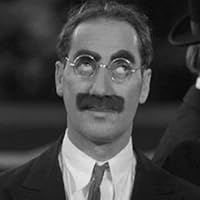
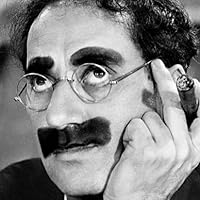
Born Julius Marx in 1890, the brilliant comic actor who would later be known as Groucho was the most verbal of the famed comedy team, the Marx Brothers, his broad slapstick portrayals elevated by ingenious wordplay and double entendre. In his spirited biography of this beloved American iconoclast, Lee Siegel views the life of Groucho through the lens of his work on stage, screen, and television. The author uncovers the roots of the performer’s outrageous intellectual acuity and hilarious insolence toward convention and authority in Groucho’s early upbringing and Marx family dynamics.
The first critical biography of Groucho Marx to approach his work analytically, this fascinating study draws unique connections between Groucho’s comedy and his life, concentrating primarily on the brothers’ classic films as a means of understanding and appreciating Julius the man. Unlike previous uncritical and mostly reverential biographies, Siegel’s “bio-commentary” makes a distinctive contribution to the field of Groucho studies by attempting to tell the story of his life in terms of his work, and vice versa.
Lee Siegel is a New York writer and cultural critic who has written for Harper's, The New Republic, The Nation, The Atlantic Monthly, The New Yorker, The New York Times, and many other publications. Siegel is a senior editor at The New Republic and lives in New York City with his wife and son.
In September 2006, Siegel was temporarily suspended from The New Republic, after an internal investigation determined he was participating in misleading comments in the magazine's "Talkback" section, in response to anonymous attackers on his blog at The New Republic's website. The comments were made through the device of a "sock puppet" dubbed "sprezzatura", who, as one reader noted, was a consistently vigorous defender of Siegel, and who specifically denied being Siegel when challenged by an anonymous detractor in "Talkback." In response to readers who had criticized Siegel's negative comments about TV talk show host Jon Stewart, 'sprezzatura' wrote, "Siegel is brave, brilliant, and wittier than Stewart will ever be. Take that, you bunch of immature, abusive sheep." The New Republic posted an apology and shut down Siegel's blog. In an interview with the New York Times Magazine, Siegel dismissed the incident as a "prank." He resumed writing for The New Republic in April 2007. Siegel's critique of Web culture, entitled Against the Machine: Being Human in the Age of the Electronic Mob, was published in January 2008.
I thought the years when it was cool to take a post-post modernist deconstructivist Foucauldian examination of the Marx Brothers were 1987-1993. Lee Siegel, who apparently missed that boat, decided time was an illusion and that 2016 was the perfect moment for him to tap his inner Camille Paglia.
This book claims that the Marx Brothers were not funny. It doesn't matter how much the Marx Brothers make you laugh, they're not funny, do you understand? You're laughing because the Marx Brothers are energetic, anarchistic self-loathing Jews who are humiliated by their immigrant father, not because they're funny. And Minnie Marx, their much loved and hated mother who drove them into show business, is the reason they Marx Brothers are so misogynistic against poor Margaret Dumont, which is of course not funny. After all, you never see the Marx Brothers insult and humiliate a man, do you? Of course not. That would be funny. But they never do it. [HINT: Yes, they do.]
In short, the book's central thesis, if post-modernist critique has a central thesis (it's been so long since I cared), is that the Marx Brothers, especially Groucho, make us laugh by not being funny. Are we clear about that? Not funny.
I'm 62 years old and have been a Marx Brothers fan for over 45 years. I've read most everything by them and about them and can recite entire movies. This author's big contribution is that Groucho had trouble with women. No kidding??!!
After reading a fascinating history and a challenging memoir, I turned to this book for some levity. Soon, I realized that it was not going to be as funny and light hearted as I'd hoped. It's a dense, complicated and philosophical little book, and, because of it's intensity, I was grateful for it's brevity. Groucho's brand of humor derived from his upbringing, family dynamic and early experiences in vaudeville to which he was introduced by his mother's brother. Throughout his life, like other comedians, he used 'self-negation as a path to freedom and power.' The author explains that Groucho, though he wanted to be a doctor, had to leave school early to make money for his family. He fantasized about a life filled with high culture and intellectual pursuits but in reality he never left his family's Yorkville apartment where everyone was gambling and philandering. My dad grew up in the area and told me that the Marx's lived closer to 5th Avenue and had more money, but it does not seem in this book that the Marx's were well off financially, far from it. Though the book is insightful and informative, it's not what could be characterized as funny. His family's outsider immigrant experience was not often a happy one. Humor at that time was pervasively misogynistic, ('take my wife, please') and often insulting to the female sex. He lampooned the rich, authority figures and anyone in a club who would have him as a member. It was not a rundown of the bits in his movies. It was a look at the complicated way Groucho dealt with life and a society who looked down on entertainers. In today's 'me-too' climate, the insights were appreciated but often not amusing. Fortunately, today we have comedians like Sara Silverman to balance the playing field. Groucho's mom was tough and his first sexual encounter left him scared for life. He and his brothers 'spent sixteen years on the harsh, wounding vaudeville circuit, treated as a second-class citizens, disdained and shunned in the small towns they played... for all his wealth and fame, he was still a mere entertainer.' 'Feelings of exclusion' marked Groucho's entire life... he and his brothers 'held a sharp sense of themselves as outsiders' and may be why they were so successful. Groucho had some unusual fans like playwright Thomas 'Waiting For Godot' Becket and was friends with the greatest poet of the twentieth century, T.S. Eliot. For a good philosophical study on Groucho, this is definitely the book.
I have been reading this series Jewish Lives published by Yale University Press, and this book is my favorite in the series so far. I have always been a big fan of comedians, but the author does an excellent job of analyzing Jewish comedy. According to Lee Siegel, Groucho's style of comedy goes back to being born in a large competitive Jewish family with struggling immigrant parents. Groucho's style was based on an unbridled insolence toward wealth and privilege. His famous quip, "I do not want to belong to any club that will accept me as a member, " reflects on his belief in his own autonomy. You see the same behavior later in movies like Rebel Without a Cause where the small and powerless defeat the powers that be with stinging words such as Marlon Brando's "what have you got?" when asked what he was rebelling against It was James Joyce who that words were a poor boy's arsenal. The Jewish comedians that followed such as Lenny Bruce and to some extend, Woody Allen, patterned their style on Groucho's mocking banter that often pushed the boundaries of candor. I think of the comedian Bill Hicks myself, whose comedic style was compared to Jesus' Sermon on the Mount. There is an anger there, and an anger towards society's foolishness that is barely restrained. Although the Marx brothers are an icon in the comedy field, their satire was often misogynistic and women were often the foil for their verbal bards. Although they made thirteen feature films, the brothers were never cast outside their comedic characters and were never allowed to play leading men. Groucho had the most successful career of the family as he went from vaudeville to stage and film as well as solo career in radio and TV. He was the host of a game show called You Bet Your Life. There are not very many comedians have made the impact on the arts to the extent that Groucho Marx has.
This book is mostly a psychological analysis of Grouch Marx. Lee Siegel's basic premise is that Marx Brothers humor is not humor. (quote from page 79: "The humor as I've noted, is often not humor.") Seigel brings a Freudian type analysis to the Marx brothers performances which I just did not find plausible.
Part of the appeal of Marx brothers comedy is the inconsistency in the plots. Siegel finds dark meanings in every show with important plot points tied to some trauma in Groucho's childhood. Yes, he wanted to be a doctor when he was in his early teens, but did leaving school to join the vaudeville circuit really break his heart? Siegel sees evidence of reacting to personal trauma in every blow that is struck. Compared to Three Stooges movies, the Marx brothers were mild. The physical comedy which included blows was expected. The Marx brothers violence is relatively mild and more comic than other movies of the era.
I remember Groucho's TV show, You Bet Your Life, which aired when I was a girl. Groucho was quick witted and entertaining. He was born to be an entertainer, not a doctor. I can not buy that his comedy was his way of lashing out at childhood hurts. Yes, this book is a new way of looking at Julius (Groucho) Marx, but I don't think it brings new insight into his life.
This is less a biography and more an (over-?) analysis of Groucho’s humor and character and its place in Jewish culture. Can sometimes get lost in the weeds but some clever insights
Groucho Marx: The Comedy of Existence was my book club's selection for June 2016. In all fairness, I expected a biography, and this book was nothing of the sort. I suspect the book club member who chose the book had a similar expectation.
This book would be more accurately described as a psychoanalytical interpretation of Groucho's comedy style, with references to philosophy, sociology, and classic literature. I felt as if I were transported back to college, for a 200-level psyche course.
The author plucked vignettes out of Groucho's life and, conveniently, retrofitted them into Freudian theory, oftentimes stretching wildly to make his point. For example, the author cites an incident where "Frenchie" (the Marx Brothers'father), attempts to discipline Harpo, threatening to break every bone in his body. Frenchie was unable to follow through. In relating the incident, Harpo is quoted as saying, “I couldn't have hurt more if my father had broken every bone in my body”. Siegel describes this as the hurt of seeing the father figure emasculated. Couldn't it have been the hurt of disappointing his father instead? The book is filled with similarly contrived examples and insupportable conclusions.
I'm not sure a Groucho fan would find this book appealing. Does it really help a person appreciate Groucho's comic genius by dissecting it into its Freudian parts? Or does comparing Marxian dialogue to Sophocles, Shakespeare, Twain, Melville, etc. elevate one's enjoyment?
So who would likely enjoy this book? Perhaps a serious (read that: VERY serious) student of Freudian psychology or an armchair psychologist. For ordinary people who simply enjoy a Marx Brothers romp, this book could be the ultimate buzz kill.
Had this not been a book club selection, I would not have persevered.
I did not enjoy this psychobiography of Groucho Marx and will not be finishing it. Lee Siegel is an insightful thinker about matters of popular culture, but his subject is unlikable and unsympathetic. Essentially Siegel's argument is that the Groucho we see on screen--misogynist, narcissistic, aggressive, and full of barely contained rage--is the *real* Groucho (sans four-letter words). (A recent 'Atlantic' profile of Donald Trump by Dan P. McAdams makes a similar argument that what you see is what he is.) Because Siegel's is mainly a Freudian analysis, Marx's overbearing mother and passive father bear much of the blame, a basic argument that seems overly simplistic especially as part of a series titled 'Jewish Lives.' There are many interesting anecdotes here, but always at the core is Groucho's angry personality. Enough already.
There were two good things about this book. One was learning a new Peasie Weasie. I'd known the one about the smelt and sister coming down the stairs; now I know the one about the humpback. Also, there were some good recommendations about other Marx Brothers biographies. Otherwise, a humorless, pedantic tome full of psychobabble.
This Isn't Your Typical Nightstand Biography Rather than yet another boring laundry-sniffing accounting session of a larger-than-life life (Hollywood scholars as Judgment Day angels, figuring out the weight and want of a Silver Screen soul), with stops along the Hollywood highlight-reel (the cocktail party anecdotes) and flashbacks to the the venom and vigor of vaudeville with its first juicy blooms of success (with pains taken to foreshadow the sterile pollen haze of future setbacks that despite the sneeze attacks make the sunset so pretty), not to mention the radio and television comebacks and, finally, death itself...yes, yes, rather than all of that...this rather enjoyable novella-sized biography takes the life of Groucho and superimposes it over the films and then takes the films and superimposes it over the life. Then holds it all up to the light.
I received a Kindle copy of this book courtesy of Net Galley and the publisher. It is with the understanding that I will publish a review on Net Galley, Amazon and Goodreads. In addition I have posted it on my blog, Facebook, Twitter, LinkedIn and Google Plus pages.
I requested this book because I have enjoyed a number of the Marx Brothers movies and was interested in learning more about Groucho in particular. This is the first book by Lee Siegel I have read (and will be the last).
This book is part biography and part psychoanalysis/babble on not just Groucho Marx, but on his brothers also (making the title very misleading). One of the strong points of the book is that it is short and a very quick read. It was unclear to me if the author was defending the brothers or criticizing them. Was I supposed to be offended or feel sorry for them? I was tempted on a few occasions to just stop reading (life is too short to spend reading dull books), but I continued due to the shortness of the book.
I suggest looking elsewhere if you want to learn more about Groucho Marx.
Writer Lee Siegel published Groucho Marx: The Comedy of Existence in 2015. Siegel’s biography of Groucho Marx is for Yale University Press and the Leon D. Black Foundation's Jewish Lives series. Julius Henry ‘Groucho’ Marx was born in 1890. Siegel writes, “The Marx brothers grew up in Yorkville, a neighborhood on Manhattan’s Upper East Side that was teeming with European and Cuban immigrants” (Siegel 1). Groucho Marx was always drawn to comedy about language. Siegel believes that growing up in a place with so many languages taught, “the Marx brothers experienced language as a fluid, shifting, arbitrary social phenomenon” (Siegel 1). Siegel writes, “Groucho’s insolent patter focused the talkie audience’s attention on the spoken language as never before” (Siegel 92). The book ends when Groucho Marx retires in 1972 (Siegel 138). Groucho Marx died in 1977. Siegel’s biography is ten chapters long. Each chapter is an essay on a different theme. One of the themes is the lifelong misogyny of Groucho Marx. The book explores the roots of this misogyny. Siegal’s book explores the topic of Jewish comedy. Since the death of Marx, he has become one of the symbols of Jewish comedy (Siegal 108). The book explores why Marx has become the symbol of Jewish comedy since his death (Siegal 108). The book explores Groucho Marx’s personality of his characters and his personality in real-life interact in his life (Siegal 58-59). I read the book on my Kindle. Siegel’s short biography of Groucho Marx is thoughtful.
It's been a while since I've read anything about any of the Marx Brothers and this one is the worst. It's all armchair psychology speculation. I think this author actually wanted to write a book on humor and comedy though he doesn't seem to understand very much about it, but he does know how to beat a dead horse, quote smarter people, and name drop comedians. Considering this book is part of a series it seems the author was contracted to write a book specifically about Groucho whom he doesn't even seem to like. Don't bother with this one. The best part about this book is that it quoted better books about the Marx Brothers so I can look for other things to read.
"[Irving] Thalberg was as feared as he was famously difficult to see, and he kept the nervous brothers waiting for hours. Finally they each lit a cigar and began to blow smoke under Thalberg's door, shouting 'Fire!' The next time they went to see him he ushered them into his office right away, but then kept them waiting for hours while he went down the hall to the office of Louis B. Mayer, the studio head. When Thalberg returned, he found the brothers sitting naked before a crackling fire in his fireplace, roasting potatoes."
I expected a compact overview of Groucho's life and career from this book. Instead it was a stream-of-consciousness, overthought analysis of the Marx Brothers disdain for their father, the nature of comedy, Jewish comedy, Jewish identity and god knows what else. Don't read it unless you have all their films from the 1930s memorized, which is possibly the only way it will make sense.
I enjoyed reading more details about the Marx Brothers' upbringing and Vaudeville days. But quite often, the author references media about other comedians that I'm not familiar with and not interested in, as I feel the Marx Brothers are in a far superior league, especially Groucho and Harpo. That took away from the overall experience I had with reading this book.
Mixed bag. It was eye opening, yet tedious. Marx humor is difficult to translate with only words since his humor is also very physical. It just wasn't that interesting and I never felt as if I understood much about who Marx was. The good - gave some good stories and insights as to Marx as related to Jewish humor and its history.
'I came to this town without a nickel in my pocket....now, I have a nickel in my pocket'. A series of fairly interesting critical essays about the Marx Bro's oeuvre that satiated my need for scholarly if not douchey, flowery prose.
A serious book on a great comedian. What delight we were given by Groucho and his family. And what serious matters were lampooned and jibed and insulted. A good book on a good subject -- humor and serious, Shakespeare and W. C. Fields.
More psychoanalytic than expected, and the analysis is mostly inflated. Sometimes people just overthink the genius of Groucho and his brothers. Still learned a lot, though. Now I have to watch all the movies again, of course.
I was under the assumption this was a biography but it’s more about Lee Siegel’s ideals and psychoanalytical work of the Marx brothers and Jewish humor as a whole.
What a strange book that has some thoughtful ideas about comedy, but purports to be a biography of Groucho and has very, very, very little about his life.
I'm not quite sure what to think about this book. Mr. Siegel's interpretations of Groucho Marx's performances are wholly unlike how I've been thinking of them my entire life I initially tried to reject what this book was positing: Groucho's characters are attempts to deconstruct reality, traditional comedy, and normative social structures. Here I just thought he was being funny. Yet, the more I think about Mr. Siegel's ideas, now that I'm semi-literate, the more I suspect he may be closer to the heart of the destructive comedy of the Marx Brothers, especially in the Zeppo years. One of the interesting aspects of the Marx Brothers movies Mr. Siegel points out is how disconnected the actions of the Brothers are from the rest of the characters in that movie world: why else would Margaret Dumont's character continue to sing at the end of Duck Soup while the Brothers are pelting her with vegetables? The Bros. are more like forces of disintegration, attacking pretensions, elitism, and everything else. That is obvious at the end of my favorite, Animal Crackers, as the movie basically stops (it doesn't really "end") with all the cast unconscious. That may seem to contradict the notion the Bros. are in their own world as they completely disrupt the world of the movie, but morally they are distinct from the rest of the movie, and their attempts to draw the others into their world seem successful for a time, but the other characters escape easily when the scene is over and things are back to normal for them (except for the end). Similarly, as with the earlier example, none of Groucho's remarks to Margaret Dumont seem to stick with her: they may sting when they hit her, but she easily shrugs them off and acts as if they never happened. Mr. Siegel posits a good deal of their boyhood and disappointing family experiences drove the Bros.' comedic destruction, as well as Groucho's paradoxical envy-loathing relationship to intellectuals and, again, elites of society (but also of the working man, as evidenced in the rather painful vignettes of Harpo vs. the Vendor in Duck Soup) in real life, as he becomes a published author and respected wit. For Mr. Siegel, the key joke behind Groucho and the Bros. is the "I would never join a club that would have me as a member" joke (slightly paraphrased for faulty memory at the moment). Since this book is a part of a Jewish Lives series, Mr. Siegel spends a good deal of time toward the end of the book extrapolating from that joke an entire Jewish self-deprecating ethos leading us to Woody Allen and his oeuvre. That section is fairly interesting, and seems very personal to Mr. Siegel, and thus comes off fairly well, even if he may be presuming a bit much about Groucho and Woody. If nothing else, this critical bio/work sketch offers a focused look at aspects of the (mostly) early Bros. movies that made me 1) want to watch them again, 2) look at them more intelligently and critically, and 3) wrestle with my own lifelong interpretations and see if the Bros. are truly Agents of Chaos after all.