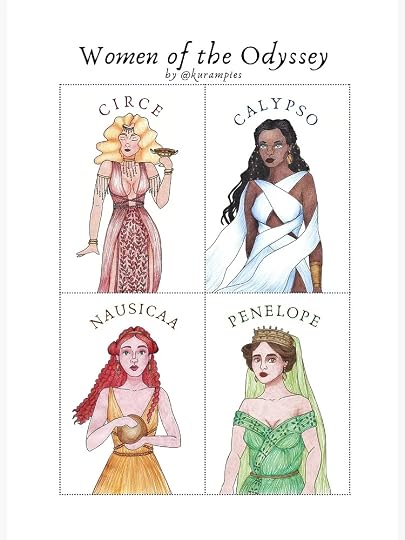
Homer’s Odyssey has become a foundational text of the Western literary canon. At first, its focus on the heroic journey of Odysseus appears to fit the mold of other ancient Greek epics—a deeply masculine story of a hero overcoming a host of obstacles to reach his goal. But unlike many other works of this era, The Odyssey is also populated by a large cast of strikingly modern, complex, and remarkable women who are integral to the story at every turn.
In Wives, Witches, and The Powerful Women of Homer’s Odyssey, Professor Jessica Blum-Sorensen helps you explore this classic work with fresh eyes, focusing not on the eponymous hero, but on the many women whose voices and motivations invite us to rethink traditional ideas of heroism. Across seven lectures, you’ll reexamine some of the foundational themes of the literary canon from a new perspective and discover why the deities, wives, maidens, witches, and monsters who populate Homer’s Odyssey are more than a match for its hero.
In examining these women, you’ll see how each one, however monstrous or alluring she might be, has the power and the will to help—or hinder—Odysseus on his arduous trek homeward. From cunning Circe to brave Nausicaa to faithful Penelope, you’ll meet women who reject traditional limitations, defy gendered expectations, and reshape our idea of the hero’s journey.
I’ve really enjoyed the Great Courses on Audible. They use a podcast-like format to take dives into specific topics. What I like about this series is that they’re less fluff, more research-based, and very structured, unlike most podcasts. (Most of the Great Courses are free for Audible members.)
Jessica, the author of this series, is a scholar and professor of classics. She takes the listener through a series of lectures discussing the various female characters in the Odyssey. I enjoyed learning about each of their roles and some history and additional research on them. It was really neat to learn what Greek life must have been like for women and how that shaped their roles in Homer’s work. This was a fun deep dive into the story of the Odyssey and the women that shaped Odysseus’ story. A perfect listen to prepare for the upcoming Odyssey film.
Definitely a must-read if you've tackled the behemoth of The Odyssey by Homer as Prof. Blum-Sorensen focuses on agency and some of the hard-to-see glimmers of the women characters that Homer (and the later male historians) have failed to shine a light on. [paraphrased] 'The premise of the Odyssey's story is a series of conflicts over women. The way Odysseus interacts with women, divine or human, will be crucial to his successes or failures. In the world of the Trojan War, women are the gatekeepers of conflict and peace.' Can't wait for Christopher Nolan's movie to come out next week - I wonder how his female characters are portrayed.
L1 - Homecoming & the Hero (29 min) L2 - The Daughters of Tyndareus: Helen & Clytemnestra (28 min) L3 - Athena: Guardian Goddess (29 min) L4 - Women in Charge: Nausciaa & Arete (28 min) L5 - Female Monsters: the Sirens, Scylla & Charybdis (28 min) L6 - Witch Craft: Calypso & Circe (28 min) L7 - The Good Wife: Penelope (34 min) - I think this was way too short!!!!
3⭐️- Although informative, this audiobook left quite a bit to be desired. 🏛️🎧 I was expecting a deeper exploration of the powerful women in The Odyssey, but it felt like much of the audiobook was spent simply recounting the events of the story rather than actually analysing the women, their roles and their power.
There were some interesting insights, but I wanted much more depth and critical discussion. It felt more like a recap of The Odyssey with some analysis sprinkled in, rather than the focused exploration I was hoping for.
Interesting, but ultimately a little underwhelming. 📚
I finished The Powerful Women of Homer’s Odyssey in one morning, almost by chance, because I wanted a short audiobook for my walk-run. What a wonderful discovery. For those of us who have loved The Odyssey for years, this is a very rewarding listen. Jessica Blum-Sorensen brings deep scholarly knowledge to a beautifully focused subject: the women of Homer’s poem. Athena, Helen, Clytemnestra, Nausicaa, Arete, Circe, Calypso, the Sirens, Scylla, Charybdis, and above all Penelope are not treated as secondary figures around Odysseus, but as essential forces in the poem’s structure, meaning, and emotional power. The result is a fresh but very grounded way of returning to one of the foundational works of Western literature. The course is narrow in focus, but that is also its strength. It does not try to summarize The Odyssey in a generic way. Instead, it illuminates one crucial dimension of the poem and reminds us how rich Homer’s storytelling remains. I especially appreciated the context around the Trojan War, Helen and Clytemnestra, and the mythic background that helps us understand why Odysseus’ homecoming matters so much. And, of course, the final emphasis on Penelope is exactly right: she is not simply “the faithful wife,” but one of the great minds of the poem. I also think this title may soon become much more searched for and appreciated because Christopher Nolan’s upcoming Odyssey film is likely to bring Homer to the center of popular attention again. Many readers and listeners will be returning to Homer, or discovering him for the first time, and this course will be a wonderful companion for that moment. I am grateful to Professor Blum-Sorensen for sharing her research with a wider audience in this format. Serious scholarly divulgation matters, and this is a perfect example of it. I am also grateful to Audible and The Great Courses for releasing this title and making it available to Audible members. For anyone already interested in Homer, Greek epic, Penelope, Circe, Athena, or the women of The Odyssey, this is an easy five-star recommendation.
This is a gem of a book for anyone who enjoys Homer. Sorensen gives the reader a lot of different looks at the many women who populate the Odyssey, helping us to see much more in these characters than Homer gives us by teaching us a lot about the times.
For the record, I have read the Odyssey several times and seen a couple of screen adaptations. Therefore, I was both shocked and embarrassed when Sorensen taught me something that in hindsight is so obvious and yet, I had never thought of it before. Odysseus's wife Penelope would have been a child when she married and gave birth to their son just before he left for the war. Therefore, she is still a woman in her thirties (probably no later than her mid-thirties) when her husband returns. I had always pictured her in her forties or fifties which really makes no sense if you know anything about Greek marriage customs at that time.
This book is packed with little insights like that and will greatly enrich my next reading of the epic poem.
A good, but brief, work on the women in Homer's Odyssey. I had only considered this perspective before through and Dorothy Parker poem about Penelope, but this was obviously much more in depth, gave a good history of many of the other characters, and discussed these women as just as powerful as Odysseus. A good work that is highly recommended for anyone into classical studies and feminist icons.
I enjoy books about powerful women and Greek and Roman Mythology is full of them. Focusing specifically on the women in Homer's Odyssey was very interesting. I already knew this, but Penelope was a badass for sure!