Why say goodbye? Death is only a temporary glitch in this eerily plausible future from award-winning graphic novelist Brian “Box” Brown. Brenda’s mom is dying—but not for long. Like millions of others, she’s uploaded her consciousness to the groundbreaking new app Forevr, which allows the surviving family members to chat with her on their screens for a very reasonable monthly fee. Now Brenda’s dad doesn’t have to be alone…while Brenda and her girlfriend focus on building their careers as wilderness survival influencers. But when this very modern family sets out on a camping trip, their tensions and tech addictions build to an explosive climax whose consequences may last…forever.
The premise of this graphic novel is super interesting to read and think about. What would happen if your loved one’s memories and consciousness could be uploaded to AI after they die? They could hang around forever (as long as someone is paying the subscription fee). The story starts off with Brenda & her partner vs her mom and dad. When her mom dies, her dad gets super depressed but feels like he has the mom back when he gets the AI version of his later wife. Brenda is not convinced and since she and her mom never had a great relationship to begin with, she thinks AI mom is just manipulating her dad and wants to unplug her good. The overall questions are are: is an AI person a real person and should they be treated like people with all the rights of their human counterparts? Does knowing that you can just “live on” cheapen life in the present? I can’t say more without giving the ending away, but it really made me think and brought up questions that I could 100% see being an issue we have to grapple with in the future. I thought the story telling was good. The artwork was ok. Overall, I would give this 3.75 stars.
Thank you to NetGalley & Top Shelf Productions for this thought provoking ARC.
The core conceit of having access to a loved one’s posthumous AI double is basically the same as a memorable early Black Mirror episode, but this version differs by not focusing directly on the ethical or philosophical implications, but instead letting them simmer in the background of more petty contemporary concerns. The widower isn’t grappling with his choice; he’s a man child mostly using recreational drugs and playing video games with his online friends, just the same as before his wife died. His adult daughter is mostly having the same fraught conversations with mombot as before she died IRL.
The end result feels much more authentic and true to the slow motion dystopia of encroaching big tech hegemony playing out in the 2020s in the periphery of our commonplace daily lives.
“What if you didn’t have to say goodbye to your loved ones? What if you simply said goodbye to their old, worn-out bodies and hello to the most wise, powerful and customizable versions of them.”
“He listens to these awful positive mindset podcasts. It sounds like magical thinking to me.” “There was this cult where people would point their assholes at the sun to absorb its energy.” “Like I said: magical thinking.”
“These are protein donuts for men. They have five times the protein of regular donuts.”
My Selling Pitch: A graphic novel about the societal impacts of uploading consciousnesses to the cloud
Pre-reading: I love a dystopian love story. Let ‘er rip. They do look like Lego people.
(obviously potential spoilers from here on) Thick of it: You know that Barbie meme you guys ever think about death? That’s how I feel reading this.
Poor dad.
Black Mirror kinda did this already, but how do you not imagine different variations of this with AI’s constant loom?
The furry made me chuckle.
This is very interesting commentary that kinda translates to the religious nuts forsaking their earthly family because they think heaven will be better.
God, that was dark.
Post-reading: I dug it, but this was bleak! The art is not my favorite. It kinda fits with that ugly adult cartoon theme, but it’s not my favorite style. The simplistic drawings definitely meant that the story had to shine on its own, and it really did. The dialogue felt familiar and realistic. I like that it’s left ambiguous as to whether it’s really mom uploaded or if it is just an algorithm prone to racism and feeding people content that they want. There’s a lot of drug use and unhealthy coping skills in this, and I like the message that AI can be just as much of an addictive crutch. I think it’s worth the read if you’re into dystopian commentary, just bear in mind that it is still just a graphic novel. It doesn’t have a ton of time or the necessary word count to really dissect anything.
Who should read this: Dystopian fans AI social commentary fans
Ideal reading time: Summer
Do I want to reread this: I think I'll just remember it
Would I buy this: Yes
Similar books: * For Human Use by Sarah G. Pierce-dystopian, horror, classic retelling, satire, family drama, romance, social commentary * How High We Go in the Dark by Sequoia Nagamatsu-short story collection, sci-fi, dystopian, family drama, social commentary * Free for All by Patrick Horvath-graphic novel, dystopian, revenge thriller, social commentary * Sike by Fred Lunzer-dystopian, litfic, family drama, social commentary, romance * Love is an Algorithm by Laura Brooke Robson-dystopian-ish, litfic, family drama, social commentary, romance
Thank you to Netgalley and the publisher for a copy of this book in exchange for an honest review.
(Thank you to Top Shelf for the gifted review copy.)
If you could live forever, would you? Should you? Is it ethical? Are you ethical? Do you even care? A lot of people base their lives around the reward of an everlasting life after death of some kind, for leading a good life on Earth. A lot of people can’t even come close to meeting that standard -- die for it and kill for it -- even with such a rich reward to be had. So what if you could skip the “good” part and just pay for it when you’re buying your funeral arrangement?
If it was presented to you as a no-hassle trial offer would you even bother with any of the questions, or just go for it?
This is the new reality Penny and Jim find themselves staring at head-on when Penny is given an early terminal cancer diagnosis. Shopping for a burial package, the funeral director upsells them on Forevr, an app-based afterlife service. He even enlists his own Forevr app mother to help sell them on it.
The couple appear to be somewhere in their late 40s or early 50s, and married for about half of that time. They have a daughter, Brenda, and a daughter-in-law Terry. Penny and Brenda constantly bicker while Jim and Terry are out back getting high.
We already live digital lives, so it only makes sense that the next step is to die digital deaths, and that’s where the Forevr App comes in. If Big Tech can reinvent car service and bookstores and sell them to us at a markup (or at a loss in order to harvest our data), why not death too? All they need is a sample of your DNA, and to scan your phone, then do some mysterious magical things that you don’t need to know about and bam, a few weeks later you’re born again in the digital realm, accessible to your loved ones 24 hours a day -- for a monthly subscription fee, you understand.
Like most of us would, Penny shrugs and says sure, why not? It’s a free trial. But is that personality actually you, or just another bullshit AI intruding on our lives?
It’s not until some time after her funeral that Jim gets the email saying Penny is now ready to chat in the app and he takes the plunge on this nebulous technological salve for his aching heart.
Brenda and Terry expect the worst as they drive to meet him for brunch -- a sad, broken man, surrounded by empty pizza boxes and beer cans, but they find a man rejuvenated and a house full of people they don’t know, full of fancy brunch items he cooked himself without incident or injury. They are amazed to find the brunch has been networked by Penny and her new friends from the app, full of their loved ones, everyone who needed to get out of the house and meet people.
Brenda finally sits down and talks with her mom, but she can’t quite find it in herself to believe it’s her mom and not an AI, which Penny takes offense to, and they fall back into their old roles of bickering like clockwork. Is that a sign or just algorithmic prediction?
But as he falls deeper into thrall at the comfort of the digital Penny, the suspicion that Forevr is brainwashing her dad only grows in Brenda's mind.
The first time I remember coming across the concept of extending life digitally was in the X-Files episode “Kill Switch” (1998) -- co-written by the kings of cyberpunk at the time, William Gibson and Tom Maddox -- where Mulder and Scully become targeted by an unknown entity with limitless access and power after the innocent-bystander killing of a reclusive computer genius. The unknown entity turns out to be a rogue AI, loose on the web and fighting for its life against the kill switch its creator (the deceased) was trying to inject into its command line.
Of course, the big news in this episode wasn’t AI Bad (Neuromancer, T2), it was Upload Consciousness, Y/N? Hit Enter to continue.
The episode features a second hacker, a techno-goth queen with basically airbrushed dark makeup around her eyes named Invisigoth, who in the end straps herself into some kind of vr rig that uploads her consciousness into the AI’s codebase, but also kills her body in the process. Has she achieved immortality or just fed the machine precious data at a high personal cost?
If data is the most valuable commodity in the world right now (or is it copper wire?), then certainly our bodies are the richest vein to strike and exploit. But like any real-life tech firm, Forevr has a powerful lobby behind it on the hill and the idea of a kill switch becomes a federal crime, passed by both houses and signed into law by President Brian Danielson (Yes ☝️ Yes ☝️ Yes ☝️).
The simplicity of Box Brown’s cartooning belies the depth of his delving around the questions he has, but also serves to be disarming before the questions come. These aren’t exactly the questions we’ve been asking ourselves about AI, but they’re a few kicks of the can down the road from what we’ve been asking ourselves about it. They’re certainly not far off in some alien science fiction distance none of us will be alive for. It's only a matter of time now before AI hits artificial general intelligence and something new needs to be taken on. Why not death, or “life” after death? And partially thanks to AI, how much distance down the road is there really left on this rock anyway?
Forevr in a nutshell: Grieving dad continues relationship with his deceased wife though a digital version of her; daughter opposes.
The intersection of afterlife and technology is among the most curious subjects of the sci-fi genre. As one of the latest in long line of media with tackling this, what does Forevr do differently?
Forevr is a 150-page graphic novel that tells the story of James, a middle-aged gamer, who copes with the death of his wife Penny with the Forevr service, as many Americans are already doing. Forevr provides a digital version of the dead person, with consciousness, knowledge, and experiences intact, in exchange for a monthly fee. Therefore, Penny, or a version of her that insists on being the actual Penny, exists on James' tablet. This decision isn’t taken as well by their camper-influencer daughter Brenda and her partner Terry, especially when they notice the horrors of their digital mom slowly building up.
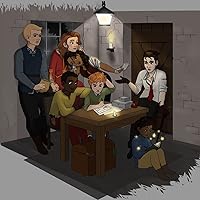
The art style is based on early pixel video games having simplistic figures with bold, solid colors. I’m not necessarily a fan since I thought the story required an art style that could convey wider emotion but I thought it did work well with the subject matter and the subtle deadpan, dark humor. There’s a pattern of colors used for each page which I wasn’t able to determine on my first read.
Instead of opening the story with Penny already dead and creating ambiguity, the first part of the book actually introduces Penny and glimpses of her personality and dynamic with the family, most especially her rough relationship with her daughter. This provides the reader a point of reference to compare the digital Penny with. It was interesting to see what changed and what stayed with her dynamic with James, Brenda, and Terry. James being a gamer and Brenda being a camper-influencer also informed their mindsets and decisions when it came to the alternate afterlife. There are tangents of in-world true crime stories interspersed throughout the graphic novel but beyond being a way for Penny and Terry to bond over, I wasn’t able to determine if they had a deeper significance.
The personal/familial story is tied into a wider narrative as the Forevr population in the country keeps on growing. The corporate and capitalistic nature of the service was intact and I thought the worldbuilding around it was decent, even without going too scientific as to how the app actually worked.
Overall, Forevr is a seemingly unassuming dystopian story that juxtaposes bright, simplistic art with a horrific dystopian possibility where our natural bodies are merely “transitory”for an eternal life in the cloud, AI corps profiting out of our (after)lives, and affecting the connections and relationships we built in the process.
Thanks to NetGalley, TopShelf Productions, and IDW Publishing for providing me with an eARC of the book in exchange for a review.
The "digital consciousness after death" premise is nothing new, we’ve seen it in Black Mirror and dozens of other sci-fi properties. But with AI advancing at its current terrifying pace, these existential dilemmas feel closer to reality than ever. Forevr tackles these heavy questions. What is personhood? Should you go to prison for destroying a digital copy? Is it healthy to keep a digital clone of a dead loved one instead of mourning? But it does so with a surprisingly absurd, cynical comedic tone. It has that distinct "everything is so messed up all you can do is laugh" energy, very reminiscent of the movie Don't Look Up.
The art style is simple and clean, which works well for the story, but what really made this stand out for me was the shift in part three. Just when I thought I knew exactly where the digital dilemma was going, the narrative swerves into something much more absurd and unique. It saved the book from feeling like a predictable sci-fi trope.
Interestingly, for a story centered entirely around loss, Forevr keeps the audience at an emotional distance. It doesn't deeply explore grief at the forefront; instead, the sadness is just quietly presented to you in the background. Like, noticing the dad has clearly been doing poorly, or noticing someone crying off-screen. This emotional detachment is driven heavily by the main character, Brenda, who seems to have a profound lack of feelings for her mother, Penny. At least any positive ones.
Instead of a heartbreaking story about loss, you get an incredibly uncomfortable, painfully realistic mother-daughter dynamic. It perfectly captures those suffocating family relationships where the mother and daughter are constantly judging, constantly fighting, and so locked into their toxic patterns that they seem to forget they are actually supposed to love each other.
Because of all that tension, my absolute favorite character was Brenda’s wife. She was the ultimate "chill daughter-in-law" and the peaceful anchor of the book. While Brenda is constantly fighting with her parents, her wife is just hanging out, smoking blunts with her father-in-law, discussing podcasts with her mother-in-law, and trying to calm Brenda down. She was the perfect contrast to the family chaos.
Overall, Forevr is a smart, dark, and highly cynical look at the future of technology and human relationships. It values absurd comedy over deep emotional resonance, which might throw some readers off, but it makes for a memorable and fast-paced read.
You know how the best episodes of 'Black Mirror' are terrifying because they don't actually feel that far removed from reality? That's exactly the feeling I got while reading 'Forevr'.
The premise is deceptively simple: a groundbreaking new service called 'Forevr' allows people to continue communicating with their loved ones after death, but for a monthly fee, of course. So what starts as a seemingly compassionate technological innovation quickly raises questions about grief, memory, identity, and just how much of ourselves we're willing to hand over to corporations in exchange for comfort.
At the centre of it all is Brenda, who is already navigating a complicated relationship with her family while trying to build a life of her own. As the technology becomes more deeply embedded in everyday life, she finds herself increasingly at odds with the people around her; not because she's heartless, but because she's asking questions that nobody else seems willing to.
And that's where 'Forevr' shines.
This isn't just a story about AI, digital consciousness, or whether technology can preserve us after death. It's about the industries that emerge around grief. It's about how easily convenience becomes dependency. It's about the way corporations package existential questions into subscription services and convince us that they're solving a problem.
So the deeper the story goes, the more unsettling it becomes. Every new development feels like a logical next step, which somehow makes it even more horrifying. And the book constantly forces you to ask where the line is between memory and personhood, comfort and exploitation, devotion and obsession.
By the end, all I could really think about was the ethical, emotional, legal, and societal implications that came with the 'Forevr' app.
This book is incredibly that fucked up. 4 stars, highly recommended.
Thank you NetGalley, IDW Publishing, and Top Shelf Productions for the e-ARC!
Thank you so much to IDW Comics/Top Shelf and Netgalley for providing me with an ARC in exchange for an honest review!
First of all, I'm a fan of the art style - yes it's simplistic, but I think it shines in the fact it draws you in with the simple design and colors that won't overwhelm you - I thought it made the story pop a little more. Second of all, calling a liquor store a 'liquid library' deserves an honorary mention. Absolute chaotic creativity, I audible chuckled whilst reading.
I think this is a story that's - at its core - about love And loss - in multiple ways (of course it's about grief but there's very little grief if there's very little love so it's automatically included here) and especially the ways people (don't) deal with them. There's something to be said about how involved one of the main characters is in her death - she's as upfront about it as necessary for the plot and I respect that. The second she's gone, there's all the ways her family are (not) dealing with it. One could argue that a subscription service to see your loved one(s) post death is a way to cope in and of itself. It could also be seen as incredibly dystopic - both points of view are in this book (once again, I respect it). All in all, I think this book might not only explore love and loss but also the various ways in which people go insane - both silently and loudly - combined with the graphic style And the way the story is told with lots of humor - I think it's a great ride and I very much enjoyed my ride.
It's not as if Black Mirror invented the notion of a digital afterlife, but they certainly helped mainstream it. Though of course the real world, in classic Torment Nexus style, has also been doing its part lately; when people are already going loopy talking to off-the-shelf AI, how much more easily could they be entrapped by one that's been given the likeness of a lost loved one? Still, if that's how it's probably going to play out here, at least assuming technological civilisation lasts that long, part of what makes Forevr (a plausible app name there) work is that, at least until the slightly disappointing final section, it doesn't make its position too obvious. After Penny dies, her husband James still treats the digital avatar as her; daughter Bren is more sceptical. And my sympathies swayed back and forth. Was Bren right about James being manipulated by a bot that only really cared about maximising corporate profits, or is it just that mother and daughter always argued anyway and now they can't even hug it out? And so on. Where there could have been lazy binaries, there aren't – so yes, Bren is a camping influencer, but her dad's a competitive gamer so it's not an easy generational thing. It reads like proper SF, in other words, but in another smart move, it doesn't look science-fictional, instead using a simple style more reminiscent of autobiographical indie cartooning. Not an easy cautionary tale, not quite what I expected, and not bad.
A really thought-provoking graphic novel exploring what it would be like if our loved ones could live on after death as a AI virtual selves. With a DNA sample and access to your loved one’s phone (for social media posts, etc), the “Forevr” system will create a virtual version of them - for a monthly fee, naturally.
Brenda’s mum, Penny, has a terminal illness, and the story spans the decision by Brenda’s dad to upload her to Forevr, and the impact that this has on the family in the days and weeks following.
Brenda is just trying to get on with her life, but she worries about the impact that her mother’s continued presence is having on both her dad and herself, as her mother continues to be critical of her lifestyle from beyond the grave. And the corporation behind the Forevr system is ethically ambiguous (at best).
For such a serious subject, there is a thread of dark humour and irreverence running through the story that I really enjoyed, and lightened the mood without undermining the material. This is the quality and depth of story that I would expect to see on the critically acclaimed “Black Mirror” TV series. And given the current, and accelerating, capability of real life AI systems, the “what if?” that this story explores is close to the bone.
Thank you #NetGalley and IDW Publishing for the free review copy of #Forevr without obligation. All opinions are my own.
I was provided an early review copy for Box Brown's Forevr, a delightfully dystopian graphic novel about death, grief, and tech bros trying to capitalize on it. The story has a family dealing with the early death of a mother and wife, whose "soul" is uploaded to Forevr, a digital service that creates a simulacrum of your loved one based off of a DNA sample and a full dump of their personal cell phone. It feels like a direct response to that trend from a few years ago where folks would upload pictures of their deceased loved ones to have AI videos made using the photo.
Despite the grim (and unfortunately familiar) subject of the book, Brown manages to buoy the whole thing with sharp humor and great cartooning. This is my first time reading one of his books and I love the way he draws out these scenes. Emotive characters and absurd visual punchlines help deliver the story of deprogramming relatives caught up in the AI swirl without being a total downer the whole way.
This review copy was provided by Top Shelf via NetGalley
Forevr is the story of a family affected by death and then the presence of an AI recreation of the dead. How this AI person affects different members of the family is the heart of the story, a story that writer/artist Brian Box Brown does an excellent job telling. Brown can deal with topics ranging from death, family dynamics, technology, camping, influencers, and even communities of gamers in a relatively quick read.
Given the topic, it's not surprising that this is a serious read, even though it has moments of humor throughout. The pacing is solid, especially once the heart of the story begins. I personally am a big fan of Brown's art style. It's a unique look that is simple, boxy, and cartoon-like, yet it conveys complex emotional depth and clear storytelling.
What Works: The depiction of family dynamics felt believable, and the simplistic/stylized artwork was great for the story. Also, the Bryan Danielson cameo was appreciated!
What Doesn’t: No complaints.
Final Thoughts: Recommended for people who want a smart story told uniquely.
This is one mind-f*ck of a book. Lots of social commentary on so many things, from wondering what comes after death to influencers and how they make content to fit the algorithms to AI and what AI can do. The book starts off learning of Brenda's mother dying of terminal cancer and discovering that, for a monthly fee, a company has made it possible to create a digital being of your dead loved one. Throughout the book, the characters talk to their digital loved ones, with some wondering if it's an AI bot and other's vehemently defending that it is in fact their loved one, and to talk about them with their respect and dignity of a regular human. I was so creeped out and unnerved throughout the whole book. Everything felt so sinister and timely. This is definitely one of those graphic novels you read and have to just sit and think about it for a bit. So glad I read this but I feel like I have to pay closer attention to the technology around me.
Brian “Box” Brown nails that exact brand of uncomfortable, near-future tech satire that feels five minutes away from reality. The premise—subscribing to a monthly app that lets you keep chatting with your dead mom while navigating influencer culture on a family camping trip—could easily feel gimmicky, but it ends up being surprisingly sharp and grounded.
The balance between dark humor and genuine family grief works really well. The ending wraps up a little abruptly, but the visual storytelling and biting commentary on digital addiction carry the book effortlessly.
Staff Pitch / Shelving: Easy handsell for fans of Black Mirror, Nick Drnaso’s Sabrina, or anyone looking for smart, accessible social satire in the graphic novel aisle. Great pick for adult fiction displays and tech-cynic graphic novel readers.
Why say goodbye? Death is only a temporary glitch in this eerily plausible future. In the graphic novel a app is invented where they can supposedly download your DNA after you die and bring a digital copy of you back to life. Your love ones get to talk to you and I tract with you as if you never passed away. Part of me that grieves for people I've lost love the idea. Having my older sister back, hanging out together again traveling and going to museums and other attractions across the country sounds like a dream, but is it right? So many ethical questions that have to take precedent over the emotional ones. Great story that with humor opens a very interesting line of discussion Recommended Published Sep. 09, 2026
Thanks to @netgalley and IDW Publishing/Top Shelf Productions the opportunity to read this eArc in exchange for my honest and unbiased opinion.
You got a dead mother? In this comic, you can keep your dead loved ones' digital presence on a subscription-based plan!
In this dystopian, near-future-adjacent a grieving father keeps his wife immortalised as her digital safe in order to keep up with his depression, despite the protests of his daughter. There are a few inherent problems, ranging from hallucinations to the digital people having AI-familiar biases, which the comic explores, even if it keeps to a small scale. Readers familiar with the technical world and ones interested in the ramifications of commercialising death and personhood may be the ones who will enjoy most of the work.
The art is kept quite simple, but I enjoyed how much of the story it is able to tell in only that many pages.
Thanks to NetGalley and IDW Publishing for an eARC for an honest review.
Thanks to NetGalley and IDW Publishing for providing me with an eARC.
I liked the concept and the AI/technology commentary the book made, especially at the end with respect to the laws. It sounds absurd but also scary when you realize how close humanity is to creating such a dystopian world. The art style didn't work as much for me but the bright colors definitely worked here. My issue really was that it went into too many tangents, especially the part that's happening inside the forevr device. It could just be me but I found the transitions to come out of nowhere. I also don't think it would have made a difference to the story if those weren't present. I would recommend this to anyone who likes futuristic dystopian stories.
"Forevr" was terrifying in the way that great sci-fi is, not because it predicts the future, but because it accurately observes what's happening in the present. If there isn't a company already working on this, I would be surprised.
This was an amazing story about how we are being conditioned and socialised to be subscribers, rather than human beings, substituting true community and social interactions for services, and how easily we accept it through our laziness, ignorance and exhaustion, with a big help from the companies and government, because it makes us easier to control.
The world-building and characters were so well constructed that you can close this book, but it won't leave you.
Thank you to Edelweiss, Top Shelf Productions and IDW Publishing for this DRC.
Thank you to Netgalley for the free ebook to read and review.
This was such an interesting premise! Obviously the end is meant to be rage-inducing so props for that, but IDK. I did like the idea and the implications AI afterlife brought up but I wish this had explored it more directly instead of leaving us to conjecture on our own. It would've been more interesting to see some other things play out. For example, what happens when someone can't pay- are they considered murdering their deceased companion? Does the deceased companion become deleted right away? How about people committing suicide or murders on behalf of the deceased companion so that the whole family can be together in Forevr?
I loved the concept of this book as it was similar to a show I really loved, ‘Upload’. We follow Penny and her family after she receives a terminal diagnosis and is subsequently uploaded to Forevr. There, you can transfer your loved one’s consciousness to a server so that you never have to part. The story relays social commentary on AI, capitalism, and consciousness in a weirdly intriguing foray into the afterlife layered with dark humor and prompts even darker thought.
I enjoyed the journey and dive into the questions this story presents. Thank you to NetGalley and the publisher for this ARC in exchange for my honest review.
Thank you to NetGalley and IDW Publishing for a digital copy of this graphic novel in exchange for my review!
This was an interesting technology-based dystopian where your loved ones are uploaded to the cloud to continue videochatting for eternity. Similar to ideas in a black mirror episode, in this graphic novel it spirals out of control when a family's deceased matriarch continues to influence the family long after her death. I thought this was a good read but I couldn't really say if the fault was the technology or just the personality of the mom that led to the anger and dissolution of the family.
Loved this one. The opening chapter is incredibly strong and emotional. “No one tells you about this part, your loved one dies and then you’re alone at their funeral” is such a simple but strong sentence and it really incapsulates the emotional power of Forevr. As much as it slightly dips towards the end, Brian Brown approaches the concept of “AI Afterlife for your loved ones” from a new perspective and really uses it to its fullest. The writing is exceptional, with dialogues varying from funny, to satyrical, to emotionally charged weep-stuff.
I really recommend this read , and definitely won’t stop talking about it to my friends once the book comes out! Thanks for the advanced copy! :)
The blurred line between reality and AI (and whether the Forevr app is AI or an actual insight into the afterlife) is explored really well but I can't really say I enjoyed this novel. The ending was fantastic and super depressing. I absolutely loathe AI and seeing how it could be used to manipulate people grieving was hard to get through. Although I would say there are other examples of this type of story that are better (Black Mirror, for example), I think this was a good story overall.
The art reminded me of Nick Sharratt's art (he illustrated the Jacqueline Wilson books).
Amazing read!! The storyline is so interesting and different!! The ending tho i feel bad for their daughter fate. The app took over the whole world since people couldn’t let their loved ones gone or their afterlife future is gone. Refreshing storyline. I love the artstyle so much!! It like the 80s or 90s video games style and it such a nostalgic feeling!! I really love the book!! . . Thank you to the publisher and netgalley for giving me the opportunity to read and review this book in advance~
With thanks to Netgalley and the publisher for the ARC.
What if you could upload yourself into an AI system so your loved ones could still chat with you after you die? Maybe you'd actually rather that mama could no longer nag at you for how you live your life.
This graphic novel tries to grapple with the digital afterlife but mostly fell as flat as the art to me. I feel like the subject deserved a deeper story. The art style was not a good fit for the subject, even if it was technically good.
Penny is given a terminal diagnosis. As she searches for her own coffin, her final resting place, the salesman offers them the deal of a lifetime. What if you didn’t have to completely lose contact with your loved one after they’re gone? What if you could talk to them digitally 24/7? DNA is taken from the pre-deceased which somehow equals their soul and then this DNA is uploaded into the Forevr app. What could go wrong?
This graphic novel was like a Black Mirror episode and it is worth the read!
I loved this one. It's quite a popular base concept, but it approaches the topic in a very interesting way. It deals with heavy topics, but it never really lets you feel their entire weight. It is never obvious nor corny, not even in the plot itself, and it poses some great questions (ones that feel dystopian and futuristic, but that we will probably find ourselves asking quite soon, I fear). The art style is also great, and I loved the use of colors. All in all, absolutely recommended read!
Really interesting concept and I loved the design/art! I feel like this is an idea we've seen in media before but now it feels closer than ever - slightly less sci-fi and more speculative... it's scary and I hope we get a lot more authors and artists exploring it! This was a compelling read and I cared about these people even though everyone was unlikeable in some way, they're human, and it really captured that. I hope this isn't our future.
Exceptionally relevant in these tech/AI-driven times. Makes you think…about mortality, humanity, ethics, the internet, algorithms, capitalism, addiction, influence, complicated family dynamics, and consequences. All in 150 illustrated pages. Which speaking of, I really liked the art style! I could have used more, I would have liked more. But overall, a really great, intriguing and timely tale.
Thank you to NetGalley and the publisher for the digital ARC.