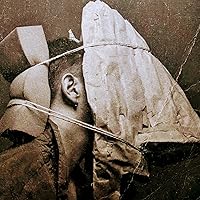
What a cool book. I was unaware of Evenson’s early history with magic realism, and so I was quite surprised when I started reading and encountered a very different style from that found in his more recent work. Hence, it’s possible that this collection will disappoint some Evenson fans, but I think it offers a fascinating timeline of his development as a writer from a very early age.
The stories are all set in the same fictitious universe, either in the town of Labaise or within striking distance of it. Recurring characters also populate this place, sometimes prominently while other times merely garnering a passing mention. The style, at least in the earlier stories, is more formal than what it becomes later on. It’s like Evenson whittled away at his sentence construction over time—truncating and condensing—until he reached the masterful minimum needed to deliver his ideas. Theme-wise, as I read further into the book, it became clear that Evenson’s ongoing preoccupations were built into his stories from the start. His characters struggle with issues and situations tied to power dynamics, identity, existential despair, futility, and, of course, death and dying. So often, the people in his stories are confused, befuddled, and/or unsettled by what is happening to them. His stories are almost allegorical in how they reflect aspects of the common, everyday human condition but in an over-the-top absurd way. It’s like you’re reading and thinking, ‘this is a totally ridiculous situation’, but then when you consider the ontological underpinning, you realize it’s not unlike something that happened to you last week. In this way, Evenson’s fiction delivers a universal element found at the black heart of true horror: the fear and dread of the unknown—be it a who, what, why, or where.
The book concludes with an afterword written by Evenson’s early mentor Leslie Norris, as well as Evenson’s own explanation of the publishing history of the collection and his notes on individual stories. All in all, probably a collection best suited for diehard Evenson fans, and as previously noted, even some of those readers may not be all in on this early work, but I also suspect others will find it as compelling as I did, especially as a contextual key to his oeuvre.
Note: this new Weird House Press edition is a hardcover special edition, not a paperback as indicated in the GR record. It should probably have a separate record from the 1997 collection published by Wordcraft of Oregon, as it includes additional stories and Evenson’s notes. I could fix that, but I have better things to do than patching one of the myriad holes in this sinking ship of enshittified media...