

What do you think?

The Country Schoolmaster: A Mystery in 88 Letters
Not yet published
Expected 22 Oct 26'I stood there holding the hundred-year-old letter with a feeling that was familiar from other archives, other bulging files of dog-eared paper. It was a blood-running-fast, itchy-palm, eyes-wide-open feeling of stumbling on something. A story . . .'
Rummaging around in the Archives one afternoon, Kate Grenville comes across an innocuous-looking file of letters about a schoolteacher in New South Wales. Intrigued, she keeps reading - and discovers a tale far more curious and complex than she ever could have imagined. Contradictory perspectives on Joseph Connor are everywhere, and many of them eerily sinister. Was he savagely beating the students in his care? Or was he the victim of a small-town vendetta? And what went so terribly wrong between him and his daughter?
Grenville simply has to know: was Connor a victim, or a villain? Part colonial cold case, part dance of a writer's imagination, The Country Schoolmaster is a book like no other. In it, the novelist comes to understand the seductive pleasure of story-making, but also its dangerous limitations.
Rummaging around in the Archives one afternoon, Kate Grenville comes across an innocuous-looking file of letters about a schoolteacher in New South Wales. Intrigued, she keeps reading - and discovers a tale far more curious and complex than she ever could have imagined. Contradictory perspectives on Joseph Connor are everywhere, and many of them eerily sinister. Was he savagely beating the students in his care? Or was he the victim of a small-town vendetta? And what went so terribly wrong between him and his daughter?
Grenville simply has to know: was Connor a victim, or a villain? Part colonial cold case, part dance of a writer's imagination, The Country Schoolmaster is a book like no other. In it, the novelist comes to understand the seductive pleasure of story-making, but also its dangerous limitations.
- GenresHistorical Fiction
259 pages, Kindle Edition
Expected publication October 22, 2026
About the author
Kate Grenville
43 books871 followersKate Grenville is one of Australia's best-known authors. She's published eight books of fiction and four books about the writing process. Her best-known works are the international best-seller The Secret River, The Idea of Perfection, The Lieutenant and Lilian's Story (details about all Kate Grenville's books are elsewhere on this site). Her novels have won many awards both in Australia and the UK, several have been made into major feature films, and all have been translated into European and Asian languages.
Ratings & Reviews
Friends & Following
Create a free account to discover what your friends think of this book!
Community Reviews
Displaying 1 - 8 of 8 reviews
Review of advance copy received from NetGalley
This was a fascinating book, which analyses archival records of a small rural school in Australia in the late 19th century, piecing together a narrative around the character of the schoolmaster. It's labelled as "General Fiction" on NetGalley, but it struck me not as fiction, but as a microhistory, similar in tone and approach to Natalie Zemon Davis' The Return of Martin Guerre: unpicking historical sources and social mores, reading between the lines, and telling a history whose insights contain much educated guesswork.
In A Room Made of Leaves Kate Grenville played a bit of a game with the reader, framing the story as long-lost historic documents found in a box beneath the eaves. Here, my impression is that she is not playing a game (or if she is, it is more subtle): that these documents relating to a school teacher in New South Wales, concerned about dead mice in the water tank and in dispute with his neighbours about allowing cattle in the playground, are real. The fictional element, the work of imagination, is in the way the author speculates about personalities, motivations and conflicts - of the schoolmaster and his family, colleagues and neighbours.
The Country Schoolmaster excels in the thoughtful, reflective way it discusses historical research: the trips to the archives, the moments of serendipity, the hunch that there is something worth pursuing in a particular document, the careful analysis of tone in a phrase or single word, doubts creeping in over interpretations and the tantalising gaps and silences. It also engages with the ethical quagmire of examining the lives of real people - their reputations, neighbourhood disputes, half-truths, toadying to their boss, work appraisals, house repairs, nepotism, family arguments - all exposed and vulnerable in records that could easily have lain there unread for another hundred years. (In the author's note at the end, Grenville says that she has changed the names of the historical people mentioned, which gives them some privacy and makes "it clear that this odd hybrid isn't history or biography." I wondered whether the vivid place name "Terrible Vale" was similarly fictionalized, but it turned out to be a real place in Australia.)
Kate Grenville questions: what if her interpretations simply, irrevocably, reflect her own family history and life experiences? And what is the emotional pull of these past records? Why do they resonate? As she puts it: "Why have I cared so much?" (Incidentally, this reminded me of the title of an article by Jill Lepore: "Historians Who Love Too Much: Reflections on Microhistory and Biography.")
The author's approach to the documents is one of curiosity and empathy. The analysis of the sources becomes a window into a past community and way of life. I felt there was sometimes too much emphasis on assessing the schoolmaster's moral character, his goodness: the author cares about whether he is kind and honest, whether it is safe or foolhardy to like him, almost as if she is a new pupil in his class who has heard gossip that he has a temper and is watchful of his every move. In a way this appears to be the mystery of the title: whether Joseph Connor was a good man. Yet surely there is an extent to which we are all muddling along, and might not stand up to such scrutiny afterwards, especially if most of what's left of our lives is some fragments of official paperwork? In fairness, there are several passages in which the author is careful to acknowledge all the everyday drudgery and administration work the schoolmaster did, and the planting of saplings. I was reminded, reading this book, of the famous passage in Middlemarch about the value of ordinary "hidden" lives. The schoolmaster was there, year after year, teaching seventy-odd children, helping keep the community going. There are touching asides too about what fragments of this past community are still there in the fabric of the place - reminders that it wasn't that long ago.
In the author's note, she says that "to avoid repetition and drawn-out exchanges, I've merged and streamlined a number of documents. When I've intervened in this way, I haven't invented anything and I've taken care not to alter the meaning or tone of the originals." Personally, I'd rather the documents had been left in an unpolished state - especially given that, as the author says, part of the reason for including the texts is to allow the reader to make their own interpretations. This is a minor quibble though. The Country Schoolmaster is a great read: original, thought-provoking and poignant.
Many thanks to the publisher and NetGalley for the advance copy.
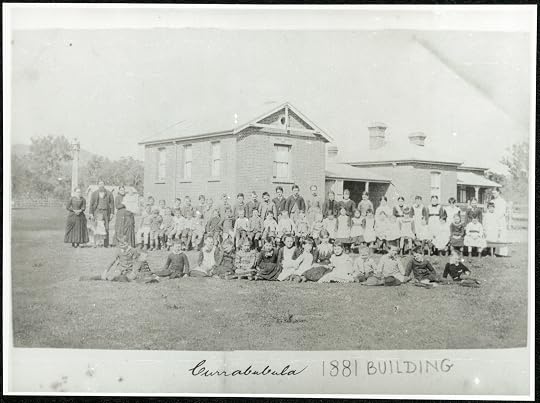
"The Currabubula Public School - 1881 building" photograph from New South Wales State Archives collections, NRS-15051-1-10-[553]-1
In A Room Made of Leaves Kate Grenville played a bit of a game with the reader, framing the story as long-lost historic documents found in a box beneath the eaves. Here, my impression is that she is not playing a game (or if she is, it is more subtle): that these documents relating to a school teacher in New South Wales, concerned about dead mice in the water tank and in dispute with his neighbours about allowing cattle in the playground, are real. The fictional element, the work of imagination, is in the way the author speculates about personalities, motivations and conflicts - of the schoolmaster and his family, colleagues and neighbours.
The Country Schoolmaster excels in the thoughtful, reflective way it discusses historical research: the trips to the archives, the moments of serendipity, the hunch that there is something worth pursuing in a particular document, the careful analysis of tone in a phrase or single word, doubts creeping in over interpretations and the tantalising gaps and silences. It also engages with the ethical quagmire of examining the lives of real people - their reputations, neighbourhood disputes, half-truths, toadying to their boss, work appraisals, house repairs, nepotism, family arguments - all exposed and vulnerable in records that could easily have lain there unread for another hundred years. (In the author's note at the end, Grenville says that she has changed the names of the historical people mentioned, which gives them some privacy and makes "it clear that this odd hybrid isn't history or biography." I wondered whether the vivid place name "Terrible Vale" was similarly fictionalized, but it turned out to be a real place in Australia.)
Kate Grenville questions: what if her interpretations simply, irrevocably, reflect her own family history and life experiences? And what is the emotional pull of these past records? Why do they resonate? As she puts it: "Why have I cared so much?" (Incidentally, this reminded me of the title of an article by Jill Lepore: "Historians Who Love Too Much: Reflections on Microhistory and Biography.")
The author's approach to the documents is one of curiosity and empathy. The analysis of the sources becomes a window into a past community and way of life. I felt there was sometimes too much emphasis on assessing the schoolmaster's moral character, his goodness: the author cares about whether he is kind and honest, whether it is safe or foolhardy to like him, almost as if she is a new pupil in his class who has heard gossip that he has a temper and is watchful of his every move. In a way this appears to be the mystery of the title: whether Joseph Connor was a good man. Yet surely there is an extent to which we are all muddling along, and might not stand up to such scrutiny afterwards, especially if most of what's left of our lives is some fragments of official paperwork? In fairness, there are several passages in which the author is careful to acknowledge all the everyday drudgery and administration work the schoolmaster did, and the planting of saplings. I was reminded, reading this book, of the famous passage in Middlemarch about the value of ordinary "hidden" lives. The schoolmaster was there, year after year, teaching seventy-odd children, helping keep the community going. There are touching asides too about what fragments of this past community are still there in the fabric of the place - reminders that it wasn't that long ago.
In the author's note, she says that "to avoid repetition and drawn-out exchanges, I've merged and streamlined a number of documents. When I've intervened in this way, I haven't invented anything and I've taken care not to alter the meaning or tone of the originals." Personally, I'd rather the documents had been left in an unpolished state - especially given that, as the author says, part of the reason for including the texts is to allow the reader to make their own interpretations. This is a minor quibble though. The Country Schoolmaster is a great read: original, thought-provoking and poignant.
Many thanks to the publisher and NetGalley for the advance copy.
"The Currabubula Public School - 1881 building" photograph from New South Wales State Archives collections, NRS-15051-1-10-[553]-1

Review of advance copy received from NetGalley
“Was Joseph Connor the villain he was accused of being? Or was he the innocent victim of some kind of small-town vendetta, collateral damage in a war that wasn’t his?”
The Country Schoolmaster is a mystery in 88 letters by award-winning bestselling Australian author, Kate Grenville. Whilst researching in the NSW State Archives for a book on her mother’s life, Grenville caught sight of an intriguing letter: a resident of her grandparents’ hometown, Currabubula, was writing to the Inspector of Schools in 1885 to complain about Joseph Connor, the sole teacher at the town’s one-room school.
Captivated, she photographed some of the documents relating to Connor, later returning to more thoroughly record the letters, reports and transcripts of hearings, as well as Teachers’ Files for Connor and his daughter.
Fascinating as it all was, there were too many gaps. “The obvious way to fill those gaps was to make things up. It would be easy enough to invent a plausible story to make sense of what was in the file. The trouble was, in shaping one story out of the slipperiness of the documents, I’d be sacrificing all the other possible stories that lay within them.”
She discovers a man poorly qualified to teach, who gained the position at a time when an Act had just been passed making schooling compulsory, and the Department of Public Instruction was desperate for teachers to go to small outback towns. It was good, clean work if you could get it, a secure, well-paid job.
Her first impression was of a hard-working teacher with up to seventy pupils, caught between a penny-pinching government department and the townspeople, but as she works through the documents in chronological order, she begins to wonder. “I was inclined to favour Joseph Connor then, thought of him as a straightforward, honest fellow doing his guileless best. Now a dozen little things have left a residue, like a grubby bathring, round my picture of him.”
With each document, she reads between the lines, makes educated guesses, and suggests various alternative explanations for behaviours, but she repeatedly reminds the reader that “The documents are real, but the rest is story.”
Over the thirteen years that Connor was schoolmaster at Currabubula, the complaints about him were many and varied: the substandard quality of his teaching; pupils forced to do housework for Ann Connor; their lunches stolen by the teacher’s children; livestock in the schoolyard leading to unsanitary conditions; pupils beaten; and overly strict enforcement of fee payment and attendance. There were, however, also some documents supporting the teacher.
Grenville speculates on how Connor got on the wrong side of some of the townspeople, what might have led to denunciations, accusations, nasty anonymous letters, four departmental enquiries, and two court cases. She noted the enquiries were interpreted and transcribed by the District Inspector and realised “the words on the page can’t be accepted at face value, the way I’ve been doing.” Also, that Connor’s method was to “discredit the witness rather than address her accusations”.
Ultimately, Grenville gives the reader an even-handed assessment of the documents, and a measured conjecture of the events that might have surrounded them. An utterly enthralling read.
This unbiased review is from an uncorrected proof copy provided by NetGalley and Canongate books.
The Country Schoolmaster is a mystery in 88 letters by award-winning bestselling Australian author, Kate Grenville. Whilst researching in the NSW State Archives for a book on her mother’s life, Grenville caught sight of an intriguing letter: a resident of her grandparents’ hometown, Currabubula, was writing to the Inspector of Schools in 1885 to complain about Joseph Connor, the sole teacher at the town’s one-room school.
Captivated, she photographed some of the documents relating to Connor, later returning to more thoroughly record the letters, reports and transcripts of hearings, as well as Teachers’ Files for Connor and his daughter.
Fascinating as it all was, there were too many gaps. “The obvious way to fill those gaps was to make things up. It would be easy enough to invent a plausible story to make sense of what was in the file. The trouble was, in shaping one story out of the slipperiness of the documents, I’d be sacrificing all the other possible stories that lay within them.”
She discovers a man poorly qualified to teach, who gained the position at a time when an Act had just been passed making schooling compulsory, and the Department of Public Instruction was desperate for teachers to go to small outback towns. It was good, clean work if you could get it, a secure, well-paid job.
Her first impression was of a hard-working teacher with up to seventy pupils, caught between a penny-pinching government department and the townspeople, but as she works through the documents in chronological order, she begins to wonder. “I was inclined to favour Joseph Connor then, thought of him as a straightforward, honest fellow doing his guileless best. Now a dozen little things have left a residue, like a grubby bathring, round my picture of him.”
With each document, she reads between the lines, makes educated guesses, and suggests various alternative explanations for behaviours, but she repeatedly reminds the reader that “The documents are real, but the rest is story.”
Over the thirteen years that Connor was schoolmaster at Currabubula, the complaints about him were many and varied: the substandard quality of his teaching; pupils forced to do housework for Ann Connor; their lunches stolen by the teacher’s children; livestock in the schoolyard leading to unsanitary conditions; pupils beaten; and overly strict enforcement of fee payment and attendance. There were, however, also some documents supporting the teacher.
Grenville speculates on how Connor got on the wrong side of some of the townspeople, what might have led to denunciations, accusations, nasty anonymous letters, four departmental enquiries, and two court cases. She noted the enquiries were interpreted and transcribed by the District Inspector and realised “the words on the page can’t be accepted at face value, the way I’ve been doing.” Also, that Connor’s method was to “discredit the witness rather than address her accusations”.
Ultimately, Grenville gives the reader an even-handed assessment of the documents, and a measured conjecture of the events that might have surrounded them. An utterly enthralling read.
This unbiased review is from an uncorrected proof copy provided by NetGalley and Canongate books.
Review of advance copy received from NetGalley
“Was Joseph Connor the villain he was accused of being? Or was he the innocent victim of some kind of small-town vendetta, collateral damage in a war that wasn’t his?”
The Country Schoolmaster is a mystery in 88 letters by award-winning bestselling Australian author, Kate Grenville. Whilst researching in the NSW State Archives for a book on her mother’s life, Grenville caught sight of an intriguing letter: a resident of her grandparents’ hometown, Currabubula, was writing to the Inspector of Schools in 1885 to complain about Joseph Connor, the sole teacher at the town’s one-room school.
Captivated, she photographed some of the documents relating to Connor, later returning to more thoroughly record the letters, reports and transcripts of hearings, as well as Teachers’ Files for Connor and his daughter.
Fascinating as it all was, there were too many gaps. “The obvious way to fill those gaps was to make things up. It would be easy enough to invent a plausible story to make sense of what was in the file. The trouble was, in shaping one story out of the slipperiness of the documents, I’d be sacrificing all the other possible stories that lay within them.”
She discovers a man poorly qualified to teach, who gained the position at a time when an Act had just been passed making schooling compulsory, and the Department of Public Instruction was desperate for teachers to go to small outback towns. It was good, clean work if you could get it, a secure, well-paid job.
Her first impression was of a hard-working teacher with up to seventy pupils, caught between a penny-pinching government department and the townspeople, but as she works through the documents in chronological order, she begins to wonder. “I was inclined to favour Joseph Connor then, thought of him as a straightforward, honest fellow doing his guileless best. Now a dozen little things have left a residue, like a grubby bathring, round my picture of him.”
With each document, she reads between the lines, makes educated guesses, and suggests various alternative explanations for behaviours, but she repeatedly reminds the reader that “The documents are real, but the rest is story.”
Over the thirteen years that Connor was schoolmaster at Currabubula, the complaints about him were many and varied: the substandard quality of his teaching; pupils forced to do housework for Ann Connor; their lunches stolen by the teacher’s children; livestock in the schoolyard leading to unsanitary conditions; pupils beaten; and overly strict enforcement of fee payment and attendance. There were, however, also some documents supporting the teacher.
Grenville speculates on how Connor got on the wrong side of some of the townspeople, what might have led to denunciations, accusations, nasty anonymous letters, four departmental enquiries, and two court cases. She noted the enquiries were interpreted and transcribed by the District Inspector and realised “the words on the page can’t be accepted at face value, the way I’ve been doing.” Also, that Connor’s method was to “discredit the witness rather than address her accusations”.
Ultimately, Grenville gives the reader an even-handed assessment of the documents, and a measured conjecture of the events that might have surrounded them. An utterly enthralling read.
This unbiased review is from an uncorrected proof copy provided by Black Inc.
The Country Schoolmaster is a mystery in 88 letters by award-winning bestselling Australian author, Kate Grenville. Whilst researching in the NSW State Archives for a book on her mother’s life, Grenville caught sight of an intriguing letter: a resident of her grandparents’ hometown, Currabubula, was writing to the Inspector of Schools in 1885 to complain about Joseph Connor, the sole teacher at the town’s one-room school.
Captivated, she photographed some of the documents relating to Connor, later returning to more thoroughly record the letters, reports and transcripts of hearings, as well as Teachers’ Files for Connor and his daughter.
Fascinating as it all was, there were too many gaps. “The obvious way to fill those gaps was to make things up. It would be easy enough to invent a plausible story to make sense of what was in the file. The trouble was, in shaping one story out of the slipperiness of the documents, I’d be sacrificing all the other possible stories that lay within them.”
She discovers a man poorly qualified to teach, who gained the position at a time when an Act had just been passed making schooling compulsory, and the Department of Public Instruction was desperate for teachers to go to small outback towns. It was good, clean work if you could get it, a secure, well-paid job.
Her first impression was of a hard-working teacher with up to seventy pupils, caught between a penny-pinching government department and the townspeople, but as she works through the documents in chronological order, she begins to wonder. “I was inclined to favour Joseph Connor then, thought of him as a straightforward, honest fellow doing his guileless best. Now a dozen little things have left a residue, like a grubby bathring, round my picture of him.”
With each document, she reads between the lines, makes educated guesses, and suggests various alternative explanations for behaviours, but she repeatedly reminds the reader that “The documents are real, but the rest is story.”
Over the thirteen years that Connor was schoolmaster at Currabubula, the complaints about him were many and varied: the substandard quality of his teaching; pupils forced to do housework for Ann Connor; their lunches stolen by the teacher’s children; livestock in the schoolyard leading to unsanitary conditions; pupils beaten; and overly strict enforcement of fee payment and attendance. There were, however, also some documents supporting the teacher.
Grenville speculates on how Connor got on the wrong side of some of the townspeople, what might have led to denunciations, accusations, nasty anonymous letters, four departmental enquiries, and two court cases. She noted the enquiries were interpreted and transcribed by the District Inspector and realised “the words on the page can’t be accepted at face value, the way I’ve been doing.” Also, that Connor’s method was to “discredit the witness rather than address her accusations”.
Ultimately, Grenville gives the reader an even-handed assessment of the documents, and a measured conjecture of the events that might have surrounded them. An utterly enthralling read.
This unbiased review is from an uncorrected proof copy provided by Black Inc.
Review of advance copy received from NetGalley
What a fascinating investigation into whether schoolmaster Joseph Connor beat his pupils at Currabubula Public School in the 1880s and 1890s. It’s fast-paced and it never wastes the reader’s time. I absolutely loved being able to read the letters and official documents and learn about the daily life in remote Australia at the time. It’s amazing to me that we can read these records and speculate, but we simply don’t know the inner workings of Connor’s mind and heart, nor do we know the inner workings of any of the other citizens of Currabubula. This underscores how hard it is to judge a situation properly, whether we are removed 100+ years from it or right in the middle of it. No matter how much information we gather about a situation, there will always be something we don’t know, a perspective that we haven’t considered. This is a book that celebrates being able to live with moral ambiguity and even abstaining from judgment, as the truth is we almost never have the full picture. Grenville herself alternates between seeing Connor with compassion and with suspicion. I particularly loved reading the records before reading Grenville’s observations about them as it allowed me to form my own, and I often saw myself disagreeing with her. This made the book feel interactive. I refrain from giving more information because one of the pleasures of the book is being surprised by the turn of events. Highly recommended.
Thank you to Netgalley and the publisher for the review copy.
Thank you to Netgalley and the publisher for the review copy.

Review of advance copy received from Netgalley
I received an ARC from NetGalley and was initially drawn to this epistolary mystery. Kate Grenville weaves together 88 genuine letters from 1885–86 concerning Joseph O’Connor, a country schoolmaster in Currabubula, New South Wales. The letters cover a variety of subjects but mainly raise questions about O’Connor’s character: was he cruel to the children in his care, or was he the victim of malicious letters and rumours from parents and townspeople?
Grenville discovered the letters in the New South Wales State Archives while researching a book about her mother’s life, and uses these letters and other historical records to piece together a presumed narrative, while also weaving in the history of the time.
I enjoy epistolary novels, which was what initially drew me to this book, but unfortunately this wasn’t a great fit for me. I didn’t find it a page-turner and, for me, it was quite slow and not particularly gripping. I think this book will appeal more to readers who enjoy examining historical evidence, archives and conflicting accounts, and who like taking their time over piecing together the past. For me, though, there wasn’t enough momentum or intrigue, and ultimately this book wasn’t a good fit for me.
Grenville discovered the letters in the New South Wales State Archives while researching a book about her mother’s life, and uses these letters and other historical records to piece together a presumed narrative, while also weaving in the history of the time.
I enjoy epistolary novels, which was what initially drew me to this book, but unfortunately this wasn’t a great fit for me. I didn’t find it a page-turner and, for me, it was quite slow and not particularly gripping. I think this book will appeal more to readers who enjoy examining historical evidence, archives and conflicting accounts, and who like taking their time over piecing together the past. For me, though, there wasn’t enough momentum or intrigue, and ultimately this book wasn’t a good fit for me.
Review of advance copy received from NetGalley
An extraordinary delve into the factual history of a schoolmaster of Currabubula Public School from his arrival in 1878 until his death in 1897. It is extremely interesting to read of the lives of Connor and his family, the working of the school, and general way of life of the people in the village and how they existed with the limited resources they had, and sought to improve them.
Alongside this is the intriguing mystery told though the letters and reports from the school. Anyone who has ancestors who were living in or near the area around that time, as I did, will find it fascinating.
Many thanks to Kate Grenville, Canongate and NetGalley for the opportunity to read an early copy.
Alongside this is the intriguing mystery told though the letters and reports from the school. Anyone who has ancestors who were living in or near the area around that time, as I did, will find it fascinating.
Many thanks to Kate Grenville, Canongate and NetGalley for the opportunity to read an early copy.

Review of advance copy received from NetGalley
I thought this novel would be a more conventional mystery, rather than an exploration of whether a schoolmaster was an evil man who beat students or the victim of a village vendetta. Just not my cup of tea, unfortunately.
August 28, 2026
This didn’t work for me. It felt more like an exercise for a creative writing class than a novel.
She finds some old documents in an archive and then imagines a story that fits around them. But she walks us through her thought process by saying if we assume something about this person the story does this but it could have done something different if we made a different assumption.
I didn’t find this process showed me anything I didn’t know and there wasn’t much else to redeem the book other than the flight of one of the minor character towards the end.
Thanks to NetGalley and Canongate books for the arc
She finds some old documents in an archive and then imagines a story that fits around them. But she walks us through her thought process by saying if we assume something about this person the story does this but it could have done something different if we made a different assumption.
I didn’t find this process showed me anything I didn’t know and there wasn’t much else to redeem the book other than the flight of one of the minor character towards the end.
Thanks to NetGalley and Canongate books for the arc
Displaying 1 - 8 of 8 reviews