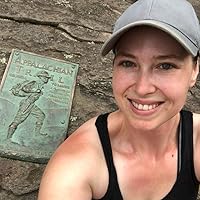
Katie Dozier’s love of poetry began in elementary school, when she memorized Frost in between climbing magnolia trees and kicking around a soccer ball. Born in Miami, Florida, her childhood led her to Kentucky, Michigan, Georgia, and Cocoa Beach—where she graduated high school and tried to become an opera singer.
While studying poetry at Florida State University, KHD became a professional poker player, and later attended culinary school. In addition to books about poker and a YA series, Katie is the author of Residency Review: A Memoir in Verse, All That Glitter (winner of The Poetry Box’s 2025 Editor’s Choice Award), and Watering Can (Alexandria Labs). She’s the co-author of Hot Pink Moon: A Crown of Haibun, and Did You See the Moon Honey (longlisted for the Haiku Foundation’s Distinguished Books Touchstone Award) with her husband, Timothy Green.
KHD is the creator of the top-rated podcast The Poetry Space_, the haiku editor for ONE ART: A Journal of Poetry, and creative editor at Rattle. She lives with her husband in The Woodlands, Texas, with their four children, a new magnolia tree, and too many books. Katie loves long conversations about short poems even more than macarons.
I follow Rattle, Tim Green, and Katie Dozier on Facebook. I recently purchased Residency Review in Kindle format after seeing Katie’s posts promoting it. There were poems in the book to admire but also work that, in my opinion, could have used more time, reflection, or editing. I initially debated between a two and three star rating, ultimately settling on two stars for the reasons explained below.
When it comes to reviews, I like to start with the positive: I greatly enjoyed much of Katie’s poetry about her daughter, Charlotte. To me, this is where the book shines. Katie honestly explores the challenges of parenting a neurodivergent child. She writes about her daughter with tenderness, worry, and pride, giving texture and dimension to this little girl and allowing readers to see Charlotte through her mother’s eyes.
I particularly liked the poem “Sad Panda.” On the surface, it is a sweet poem about a cute craft Charlotte made for her mother, a panda smeared with glue. However, the panda becomes a metaphor for Charlotte’s autism, and Katie progresses from amusement to seeing the panda as an embodiment of how the world sees her daughter. I found this poem particularly well-crafted and emotionally nuanced.
I also greatly enjoyed “Autism.” Charlotte is so endearing in this poem, even when the tantrums and “screams swoop in. Scrape [Katie] all over”—as well as “If” and “The Talker.”
While I connected with many of the poems about Charlotte, I struggled with most of the poems about Katie’s MFA experience.
1) Too much is left unsaid
In a book critiquing institutional silence, I felt Residency Review failed to provide enough context to ground the reader in the facts of the university’s failure. I understand the basic events that occurred between Katie and Star, but the actions or inactions of the university, as well as the alleged complacency or “groupthink” of others, remain vague.
It was unclear to me what Katie wanted from the university during her time there. The two emails she sent to the program director clarified that she felt unsafe, but the book does not explain what institutional remedy she hoped for. Did she want Star reassigned to a different workshop group? Did she want better supervision by Star’s mother? Did she want Star removed from the program? None of this is clear.
A level of irony was not lost on me—Katie accuses the university of silencing her while allowing very little of its response to be included. What is clear is that both Katie and Star deserved protection and anonymity within this complex situation. Katie does not elaborate on how the school responded or what accommodations, if any, were made for her.
Although two of Katie’s letters of complaint are published in the book, and these appear to be part of a longer email chain, little of the administration’s response is included. What Katie does publish made me wonder whether more was done to help her than the book implies.
The text presents a portion of the program director’s text message to Katie, stating that an effort would be made to keep the parties separate. A no-contact order was also created. I wondered whether Katie wanted additional disciplinary measures taken against Star or Star’s mother, but the book never makes those expectations clear.
Because so little of the university’s perspective is included, I was left unable to determine what the university did, what it failed to do, or whether its response was truly as dismissive as Katie suggests. Star, a woman with a significant disability, is protected under Title VI. An accusation of assault would most definitely be dealt with differently than one made against someone neurotypical.
2) The book’s assignment of blame is unclear
From my vantage point, although the university is positioned as the principal antagonist, the book does not provide enough evidence to make that characterization fully convincing.
The most immediate failure to intervene appears to belong to Gravity, Star’s mother, who does not stop Star when she behaves inappropriately toward other students, including Katie. However, Gravity is not explored as a character in a meaningful way. I wondered why Katie did not delve more deeply into Gravity, particularly given Katie’s own experience raising a neurodivergent child. It would have been interesting to see a parallel emerge between the two mothers.
Since reading the book, I have kept thinking about Gravity, wishing there were more about her. Katie writes about Charlotte screaming in restaurants while strangers look at both child and mother with judgment, assuming Charlotte is simply a brat. Might Gravity also live under the constant judgment of people who do not understand her daughter’s behavior? Might she also feel “scraped…all over” by her daughter’s outbursts? Might she be exhausted by loving and caring for a daughter whose internal world she cannot always reach?
Just as Katie hopes Charlotte will grow up in a world that is kind to her, one in which she can flourish, Gravity presumably also wants Star to be able to fulfill her poetry dreams and “populate the Pacific with blooms of poems.”
It bothered me that this tension was not explored. At times, the story seemed to pit the two daughters against each other, with Charlotte functioning as the sympathetic or “good” autistic person and Star as the threatening or “bad” one. The fact that Charlotte begins the story as a nonverbal child and gradually gains language, eventually gaining the ability to tell her mother she loves her, accentuates this contrast.
I felt immensely sad for Star, who is a human being with dreams and ambitions like anyone else, though she is also a person profoundly misunderstood by much of the world. Her disability may prevent her from fully expressing her own understanding of what happened between her and Katie. Yet the book gives her almost no interiority and treats her primarily as a source of danger—even insinuating she may be predatory.
Katie’s fear and experience deserve to be taken seriously. At the same time, the book could have confronted more fully the complicated questions of disability, intention, responsibility, supervision, and harm.
3) Prior knowledge is needed for comprehension
I think many of the poems, as well as the larger story the book tells, are unclear without prior knowledge of Katie’s life.
For example, if I did not follow Katie online and did not already know she has an autistic daughter who was, until recently, nonverbal, I would not have understood who the “she” was in the poem “Neurodivergent.” Elements of the residency would also have been unclear. I might have envisioned a sustained residential community rather than a brief low-residency gathering.
I would also have been confused by references to students pitching poems to Katie if I did not already know she is an editor at Rattle.
I believe a book should stand on its own. If it is intended to tell a cohesive story, the reader should be able to understand that story without first knowing the author’s biography, career, family life, or social-media presence. Trevor Noah’s Born a Crime, for example, remains a compelling and coherent narrative even for readers unfamiliar with his comedy or public persona.
4) Writing quality
While I found many of the poems about Charlotte well-written, much of the other writing felt clunky, clichéd, or lacking in nuance. For example, the book frequently relies on easy rhymes such as “night/light” and “around/down.”
Katie also uses clinical language too frequently for my taste. The word “trauma,” for example, appears in multiple poems. What I have learned about writing is to avoid relying on broad concepts when specific images, moments, or sensory details can communicate what those concepts mean to the speaker.
I also found the salad-bar poems ineffective, though they should have been among the book’s most devastating because they retell Katie’s violating experience with Star and form the emotional hinge of the collection.
Turning salad and the salad bar into extended metaphors for fear and trauma simply did not work for me. It felt trite to compare the aftermath of sexual violation to brown avocados, wilted lettuce, green tomatoes, or bruised Cosmic Crisp apples. I found myself uncomfortable and cringing through these poems, but not in the emotionally productive way the poems seemed to intend.
I also found the erasure poem based on a Title IX administrative document lacking in craft. Nothing especially illuminating seemed to emerge from the author’s engagement with the document’s language.
I thought about another poetry collection I recently read about sexual assault, Paul Tran’s All the Flowers Kneeling, which addresses many of the same themes but does so in a way I found much more emotionally evocative. Tran uses police report forms to bring personal voice into administrative language. The metaphors feel emotionally weighty.
5) The book often feels mean-spirited
I felt Katie was unfair in her treatment of other students and faculty members in the MFA program.
Katie interprets silence from nearly every student and faculty member, aside from her friend Morrow, as evidence of complicity. However, it is possible that Katie misinterpreted the “eyes of the college court flutter[ing]” around her or the faces turning away in the cafeteria. Perhaps many students did not know what had happened. Perhaps the professors she wrote about who looked away from her on the street had not been informed. If Katie’s case was handled confidentially, it seems possible that only Katie, her closest friends, Star, Star’s mother, and the relevant administrators knew the full situation.
The presumption of malintent without sufficient evidence troubled me. I also thought it was presumptuous to assume that every other student who experienced inappropriate contact with Star interpreted it as sexual violation. Without more context, everything remains nebulous.
I was also troubled by the way Katie treats other students’ writing with disdain. In the poem “My Attempt to Focus on the Material,” she complains that students write poorly, fail to include interesting details, and do not attempt meter or rhyme. There are several other poems in which Katie dismisses work she considers weak, even though the purpose of a workshop is often to bring unfinished or unpolished writing for feedback. She also pokes fun several times at the “famous” poets who teach at Pacific.
Katie has complained on social media that very few Pacific students have engaged with her or reached out regarding the book, but I cannot say I blame them. Had I been at Pacific during the residency and then read this book, I would likely have been offended by its assumptions about the motives of students and faculty, as well as by the suggestion that the author was morally and artistically superior to nearly everyone else in the program.
6) The ethics of the book
Because I genuinely liked several poems, I debated between two and three stars. Ultimately, I chose two because I found the ethics of the project questionable.
It bothered me that Katie named or made identifiable several individuals from the university, one especially so. She publishes enough information about the program director that readers could easily determine his identity and potentially contact or harass him through social media or email, which feels irresponsible to me. As a person with a significant social-media following, Katie should have been more cautious about villainizing real people while including their legal names or professional information. This left a bad taste in my mouth and made parts of the book feel motivated by vengeance.
I felt this especially strongly while reading “Groupthink,” which ends with Katie’s husband, the chief editor of Rattle, saying, “we can burn it all down.” That language made the project feel retaliatory to me.
As much as Katie insists she could lose opportunities by publishing this work, her position as an editor at a highly regarded and internationally prominent poetry magazine, along with her extensive social-media following, complicates the book’s presentation of her comparative powerlessness.
I was also put off by the difference between how Star is presented in Katie’s social media posts and how she appears in the book. From the posts and comment sections I saw, I came away with a substantially different impression of what had happened. Many commenters appeared to believe that the university had ignored or failed to report a crime committed by a person with full cognitive understanding. The book, however, reveals a much more complicated situation involving a person with a severe cognitive and behavioral disability.
I believe the response from some followers might have been different had that complexity been made clearer in the promotional framing.
Ultimately, Residency Review selects evidence that supports Katie’s interpretation while providing too little context or competing perspective for readers to evaluate the situation independently. The memoir criticizes institutional silence but often creates its own silences around the university’s response, Gravity’s role, Star’s disability, and the perspectives of the other students and faculty members it condemns.
Even though I genuinely enjoyed a handful of poems in the collection, the structural problems, uneven writing, and troubling ethical choices left me unsettled. These concerns inform my two-star rating and my regret at having purchased Residency Review.
TLDR: Katie Dozier will completely disregard any review that is not inherently flattering, including this one
Katie Dozier has a tendency to create unnecessary public drama with writers who disagree with her, so it's not surprising that you can't find any truly negative reviews of this collection. She uses AI to critique and rewrite works by other "inferior" writers, and she uses her platform at Rattle to pit other poets--and, most recently, entire magazines--against each other. She has already belittled people online for writing negative or anonymous reviews, calling them haters and implying a motive of misogyny. Those reviews were all scrubbed from the internet, except where she has screenshotted and shared them on her own social media pages to ridicule the people who wrote them. I write this preface to say: I doubt Katie Dozier cares what anyone actually thinks about her writing. She is an unreliable narrator who has, at best, an unethical and spiteful reputation in the greater literary community. Nevertheless, I bought this book out of curiosity. I heard from other writers that this book prominently featured Dozier's neurodivergent daughter, and as a disabled person, I figured that some of the poems would be written with ample tenderness. This assumption turned out to be woefully incorrect. Katie Dozier manipulates readers in this collection by leaving out crucial information. She obfuscates reality by using an abundance of clichés and platitudes. Perhaps worst of all, she uses disabled people as plastic, one-dimensional pieces in a game whose rules she has made up entirely. In the poem "Sad Panda," Dozier describes her elementary-aged daughter's art as a pitiful attempt worthy of only accute melancholy. When reading this poem on her podcast, she jokingly scolds the art teacher for letting such a "mess" even come home at all. It's unclear whether she is embarrassed, frustrated, unhappy, or simply self-absorbed. This is the same confusing tone plaguing basically the entire collection--you can't tell what Dozier wants from the school she attended, the educators/administration, the mother involved (as though renaming the mother/daughter to Gravity/Star wasn't cringe enough, Dozier chooses very pointedly to leave everyone else's names as they would appear in real life, including multiple instances where she has utilized private communication without consent), or the student body at large. About halfway through the collection, it becomes clear that Dozier believes everyone who interacts with her owes her something. She has this constant paranoid belief that every single person around her has some secret, pertinent information regarding Dozier's allegations, that maybe everyone in the whole world knows, or even saw what happened--yet nobody cares? As a reader, certainly, but also as someone who works in higher education, I find myself doubting this claim. Everyone owes her an apology, an explanation for something about which they have no prior knowledge? Is that a fair expectation for strangers? The speaker wants so badly for the people around her to pay attention to her, and yet she makes her discomfort clear. Again, I ask: what does she want in those moments? And what is the purpose of this collection? Both questions remain unanswered. However, my main concern lies with the assumed premise of advocacy. Dozier chooses carefully to draw parallels between her own daughter, Charlotte, and the "antagonist" Star--thereby creating a dichotomy of "good" neurodivergents and "bad" neurodivergents. This would be problematic enough, but because she focuses so intensely on mother/daughter bonds throughout this book, Dozier also begins drawing a quiet dichotomy between herself and Gravity--the "good" mom and the "bad" mom. Dozier paints herself as the sole hero in this story, the only person whose perspective is truly correct. Everyone else is flawed, everyone else is at fault--but never the writer, who finally compares herself to Carrie Bradshaw. Once I finished the book, I wondered: why wasn't Katie extending more grace to this family? She writes often about the challenges of raising a neurodivergent child, and yet she cannot seem to make a deeper, more meaningful connection between herself and Gravity. Does Dozier really not see that Gravity is also struggling with a child who lacks impulse control? Does she see the similarity and simply not want to address it? Dozier seems to lose sight of this fact: just like she wants people not to assume the intentions of her child throwing a fit in a restaurant, she should not automatically assign malicious intent to another neurodivergent person. The maternal façade is, at last, dropped. These are two mothers in the same boat, but only one is actively attempting to push the other overboard. Another reviewer used the term "mean-spirited" in describing this collection and I think that's the perfect phrase for what Dozier has done here. In her desperate attempt to label herself as an advocate for change, she has actually hurt her own child's chances for normalcy in the long-run. I am the neurodivergent child of a narcissistic mother. Her interpretation of my actions was always more important than my intention; her perspective always the "correct" one, and she was happy to talk and write about me without my consent. How she publicly described me as a child has left deep, constantly re-opening wounds on our adult relationship. I can guarantee that this will happen between Katie and Charlotte. Nobody wants to have every single mistake documented since birth, judged in (lazy) writing, handed out to family, friends, sold on the internet, marketed to strangers. When I read "Sad Panda," I feel emotionally overwhelmed by the idea that a mother is publicly commenting on her daughter's ability to do something, cementing her clumsy mistakes in the public eye. What if Charlotte was older, making much more socially inappropriate mistakes? Would Katie still be solidifying those actions in writing, gleefully passing out books praising her own mothering? Or would she expect others to have grace and understanding? What if Charlotte grew up to be Star? What would Katie Dozier do then? Between the banal writing (please stop rhyming "it" with "it"), the overwrought emotionality, and the severe ethical issues, I cannot recommend this book. Katie has made it clear that she is uninterested in any form of feedback that does not positively fuel her incredibly glassy ego, but I'm not writing this review for her. I'm writing this for the person who read this collection and thought "I could write a book about my neurodivergent child, too!" If a neurodivergent person can't tell their own story, then you don't have any right to make them a villain in yours.
E.T.A.: Katie has clarified on her social media pages that her desire was to feel safe in the school environment. This is a totally reasonable expectation, however it once again implies that there was any lack of care from the institution. Multiple people experienced an interaction similar to what Katie experienced; everyone else was able to uncenter themselves, act with compassion, and allow their reports to be handled delicately. This low-residency program meets for a handful of days each season, and there are extremely strict ADA laws in place which prevent schools from jetisoning neurodivergent students without a reasonable amount of time. Anyone who cares about accessibility knows there are very clear procedures for removing neurodivergent students from any school, any level. Katie did not allow this process to take place; she left before the school was able to do what she wanted. People have asked why the school "didn't do anything" and the answer is simple: they did, and no one else has taken up a personal vendetta against this student. I guess Katie is angry that they didn't do it fast enough, but that's not how things work. Everyone, even the student in question, deserves academic and medical confidentiality. Not just you.
Recipient of not one, but two scholarships, and a lover of poetry to her core, Katie Dozier enrolls in a low-residency MFA program “with enough hope to water/the whole garden—to populate Pacific/with the blooms of poems.”
But then her hopes begin to wither when she is sexually assaulted, not once, but three times by another student. “With/each passing day/[Dozier has] just/a bit less to say.”
This student isn’t the typical sexual predator many people may imagine. She is a disabled, nonverbal female classmate named “Star” who attends the university with the help of her aide, “Gravity.” Gravity is also Star’s mother.
Dozier masterfully interweaves poems about her relationship with her own nonverbal daughter as she exposes how the university fails to protect Dozier and the other students affected. These poems show us that Dozier knows firsthand what it's like to have a disabled daughter and to fight for a child no one understands. She writes about her experiences of people labeling her daughter, Charlotte, “a brat/ [and] not a perfect/little girl/lost/in her own/bamboo forest.
But Star is not Charlotte.
Through carefully crafted poems, we are immersed in Dozier’s conflicting emotions. We feel the abiding love she has for her daughter, Charlotte. We begin to grasp the system failures and the utter devastation of Dozier’s dreams. But we also know she has learned that “villains rarely wedge in, with spines out, on a shelf—/they buy milk and bread. Most of all, they buy themselves.”
Aware of Dozier’s empathy and sensitivity, we recognize how hard it must have been for Dozier to speak up—to say not only to the authorities, but to herself, that Star’s behavior cannot be excused. Like Gravity, she knows “a little of those/clouds, and the desperation/not to see them.” With courage, Dozier gives truth a voice when others cannot—not even Star’s mother: Star’s behavior is inappropriate and harmful to herself and others.
This lyrical memoir will burrow into your heart as it exposes what so many are afraid to bring to light. Bravo, Katie Dozier, for your bravery and refusal to be silenced.
I read this poetic memoir twice within 24 hours and am sure I will come back to it often. As a poet, disability advocate, and disabled person myself, I highly recommend “Residency Review” as a must-read memoir for administrators, advocates, and parents of disabled children. In fact, it is a must-read book for everyone grappling with the complexities of being human.
Truth unfolds in “Residency Review” as Dozier’s poetry blooms.
Dozier argues that love is action, community is action, and neither means anything if protection is offered only to the people easiest to sympathize with. The harm she describes is not lessened by the context, disability, or perceived capacity of the person who caused it, nor by the strength, competence, or composure of the person harmed.
What makes Residency Review so powerful is that Dozier refuses the comfort of black-and-white morality. She understands disability, motherhood, silence, and the complexity of wanting to give voice to someone who cannot speak for themselves without mistaking her own hopes and fears for their truth.
This book is layered with bravery. It asks what we owe each other as witnesses, friends, lovers, and members of a community. A key element is the bystander effect: what happens when people are too afraid to name harm. Silence is not neutral.
The poet, a mother of a neurodivergent child who has navigated her world in silence, finds herself lost as her own world is flipped by a sexual assault, yet pulls up her voice to break silence. It’s the silence of people and institutions to something they don’t want to admit or address, the silence of struggling to understand what just happened to you, and the silence of trying to be who you were for your loved ones. This collection is brave, crafted with skill, unsettling and moving in a gut-wrenching, beautiful way.
I admired Dozier's fluid, inventive use of language and form, and intend to study her work more closely. Additionally, I am stunned by the complexity of the multiple themes presented, how they weave around each poem and inform the whole. What resonates most deeply for me is the failure of an institution of higher education to perform to the level of its own standards. For the truth it reveals, Residency Review is a must-read for aspiring and other poets.
Residency Review is a stunning and brave work that I read in a single sitting. It combines poetry and documents in a powerful sequence that allows you to relate to the pain of institutional failure, and SA, as well as the joys and challenges of motherhood and art.
When Dozier shows the emails she wrote to advocate for action against SA allegations, it's striking because they are so well written. Surely someone who can communicate and advocate so calmly and effectively will affect change. But as Dozier discovers, when it comes to change, finding the perfect words and speaking truth is powerful, but often not enough. There's a certain pain but also clarity in grasping that: you can do everything you can, and it still isn't enough. Many have learned this the hard way. You can learn it by reading this.
And what's remarkable is this document is another attempt, to find even more perfect words that may help more people understand all this, to change the World for the better. Yes, she keeps trying because words are still the most powerful tool, even and ultimately because, they risk failure.
I felt deep solace and hope from reading this. I know it will help so many more who can't speak up yet, or those who don't understand why it's so hard to do so.
Impressive use of haibun and haiku forms to tell a very difficult story. The chimes of so many rhyming couplets reminds us of the hope in writing poetry—that it can true up the frayed ends of things. This memoir told though poems reminds us with its choice of mode that meaning is a made thing, that memories and tough recountings can be held up to the light in fragments.
An extremely brave and compelling collection. One can’t help but be moved by the poems (which are fantastic) and maddened at the inability of the school to protect its students from a serial predator. There is so much here to lift into the light, but the important piece is that this book is a must read and should be required reading for school personnel and students. Highly recommended.
I found Residency Review as beautiful as it is brave. I can’t decide what moved me most: Dozier's gentleness in the face of such emotional agony, her restraint in not lashing out against Gravity when I kept wondering how Gravity could do this to her child because it seemed beyond irresponsible to enable Star as she kept doing—it seemed cruel. It was painful to think that Dozier had to endure this. Beyond the trauma of the sexual assault itself, how could she not think of her own daughter, Charlotte, and what would happen to all the Charlottes who aren’t lucky enough to have a mother with Dozier's understanding and compassion and love.
I so admire the ways Dozier conveys such extreme emotional distress and upheaval with images that seem exactly right, from the cherry to the milky way (so brilliant) to the thirsty flowers. She shows how excruciating all of this was for her emotionally on so many levels without descending into sheer rage. And because this is a book of poems, let me say how much I admire the craft and the variety of form, from free verse to the haibun to the villanelle. “Craft Talk” and “Please Help Yourself” are terrific, especially the repetition of “nothing” in the second line.
Residency Review asks us to consider silence in the face of suffering or wrongdoing--the multiple costs of it, to the sufferer or to those who remain silent.
I made a Goodreads account for the very first time ever just so I could leave a review of this book. My friend gave it to me because it was recommended to her by someone who she went to school with. My friend initially had only positive things to say, but I found the book to be crass and frankly a bit off-putting. I read it in one sitting, then read it again and again over the course of several days. I do not have any idea who this author is, so I wanted to give her the B.o.t.D. when reading, but the book is really lacking in craft. Apparently she is the editor at a rather popular magazine, along with her husband (or maybe the husband is the editor, and she is the "along with" ... but who can really say) so I found it confusing that someone with such a wide reach would write such.........bland? banal?......poetry, given how many submissions she must see in any given day.
Then, after reading the book, I spoke with the person who recommended it to me and apparently she had changed her tune given some things that happened online. I don't really think that social media should impact a person's perception of a book that much, but when I went down the rabbit-hole, I was further put off. I also listened to several podcast episodes (sponsored by the same magazine that she edits, which is weird) where the author basically acts as an advertisement for herself and repeats her claim while offering no new insights.
She also, from what I can gather, considers herself a champion of haiku, but does not seem to understand the form on its base level. There is no such thing as "contemporary american haiku". There is haiku, and there is not haiku. It is okay to just say you are writing in slant.
"Residency Review" is a powerful, beautifully written, disturbing account of the author's experience at a top level institution where she'd gone to fulfill her dream of getting an MFA in poetry. Unfortunately, after several extremely distressing events that were met with silence she felt she had no choice but to leave instead. I believe the resulting book is an MFA in and of itself. It's deeply thoughtful, generous in nature and I believe it can help anyone become more empathetic and possibly more courageous.
(I actually bought the hardcover (which is beautiful) but it keeps taking me back to Kindle for review)
Residency Review is an exquisite book--beautifully written and accessible by general readers as well as by poets. Today that makes it, despite its many poems of hardship, a joy to read. It touches both the intellect and the emotions and leaves you thinking about what you have read.
I had the ebook version of this but turned around and bought the paperback version so I can keep it with my treasured poetry books of survivorship and bravery. Dozier explores a traumatic experience through an excellent collage of forms: haibun, poetry, blackout poems. Each piece is allowed to be what it needs to be and speaks what was hidden into the light. Even with the challenge of creating poetic art from a difficult personal topic, she does so with amazing skill, authenticity, and empathy.