From the author of A Ghost in the Throat, an unforgettable book - both history and ghost story - that will leave you gasping by its final page.
In the city of Cork, a derelict Victorian mental hospital is being converted into modern apartments. One passer by has always flinched as she passes the place. Had her birth occurred in another decade, she too might have lived within those walls. Now, she notices a FOR SALE. It is the first of many signs. Following them, she finds herself drawn into an irresistible river of forgotten voices, those of the women who knew this place insistent, vivid and true. They murmur from archives and old records; they whisper from stairwells and walls. Among them - and in one figure in particular -- she may find meaning, solace, rage; her own salvation, perhaps, or her own vanishing?
A work of sublime intensity and tenderness, Said the Dead breaks the boundaries between worlds -- past and present, imagined and real -- to make something lasting and an experience full of danger, full of love and full of truth.
Doireann Ní Ghríofa is a bilingual writer, devoted to exploring how the past makes itself felt within the present. A Ghost in the Throat finds an 18th century poet haunting a young mother, leading her through visions of blood, milk, lust, and murder. Written on the roof of a multi-storey car park in Ireland, it went on to be described as “powerful” (New York Times), “captivatingly original” (The Guardian), and a “masterpiece” (Sunday Business Post). A Ghost in the Throat won the James Tait Black Prize and was voted overall Book of the Year at the Irish Book Awards, while the US edition was a finalist for the National Book Critics Circle Award and a New York Times Notable Book of 2021. It is to appear in 15 further languages worldwide. Doireann is also the author of six critically-acclaimed books of poetry, each a deepening exploration of birth, death, desire, and domesticity. Awards for her writing include a Lannan Literary Fellowship (USA), the Ostana Prize (Italy), the James Tait Black Prize (Scotland), a Seamus Heaney Fellowship, and the Rooney Prize for Irish Literature, among others.
Absolutely sensational… there are streams of tears running down my cheeks as I write this. What a transformative and monumental book. Tentatively adding this to my favourites of all time. I miss it already.
In November 2025 I lived in Cork City thanks to a booksellers’ exchange programme. The bedroom of my apartment had a window overlooking Fitzgerald Park and the hill beyond the River Lee. Every morning, as I woke up, I wondered what that large red-brick building stretching out before me might be: I could see the collapsed roof, windows opening onto an empty sky, trees growing inside. Only a few weeks later did I discover that it was the Good Shepherd’s Convent, a former Magdalene laundry, purchased by Cork City Council and slated for conversion into student accommodation. I know it is a mistake to think this way, but somehow the derelict convent transformed itself in my mind into the asylum that Doireann Ní Ghríofa chose to write about in her new book, a place that seems to share the same past and the same future. And it was there that the author took me, on one of my last days in Cork, allowing me to look at it through a gate and through her voice.
Because of a mix-up in the mail, the Reader — both protagonist and narrative device of the book — begins to receive letters not addressed to her. Her stubborn search leads her to consult the old records of the local asylum, where she repeatedly encounters the name of Dr Lucia Strongman, the only woman physician. Through her, the voices of the patients are released and take possession of the book, passing through the reader with memories, pain, and healing. For this is a book about healing: the only cure made possible when the past returns and makes itself present again. It is a book written by someone who believes that ghosts can be glitches in time, presences we can still encounter in the places they once inhabited.
Said the Dead is a sublime book, permeated by its author’s sensitivity and extraordinary empathy. It is also a nocturnal book, of births and deaths, and, as in A Ghost in the Throat, these pages too are a “female text”: the eyes of its women look back at us from Victorian photographs, made hazy and fantastical by the slow decay of paper.
Doireann Ní Ghríofa's debut novel A Ghost in the Throat was published in 2020 by Tramp Press, founded by Lisa Coen and Sarah Davis-Goff in 2014 to “find, nurture and publish exceptional literary talent”.
It initially came to me attention via its shortlisting for the Republic of Consciousness Prize for innovative fiction from small presses, and went on to considerable literary prize success, but interestingly in a variety of categories - fiction; non-fiction; biography - the novel a distinctive blend of lyrical essay and autofiction, as the author told of her search for the woman, Eibhlín Dubh Ní Chonaill, behind an 18th century poem and lament, Caoineadh Airt Uí Laoghaire.
Said the Dead, the author's second work, is in a similarly hybrid vein and another book I hope and expect to see earn prize success.
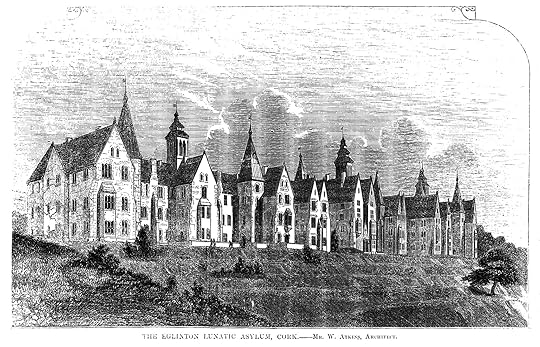
The novel is based around Our Lady's Hospital, Cork, which opened in 1852 as the Eglinton Lunatic Asylum, and became a mental and then a psychiatric hospital until it's closure in 1992.
The architect's drawing of the Eglington Lunatic Asylum:
It was subsequently converted to residential accomodation, and its seeing a For Sale sign (although the actual place is not named) that leads the author/narrator/subject to investigate further, aware of her own history, starting with a visit via her estate agent:
On a hill over the city, a derelict mental hospital had been partly converted into apartments, and now the hospital chapel was being advertised as a development opportunity too. She counted herself among the many who flinched as they passed that old institution. Had her birth occurred in another decade, she - whose distress had twice sent her clambering river railings seeking her ending - might have lived within those walls.
She called it a whim, the force that lifted the phone and made her thumb ask a favour: if the agent was arranging viewings of the chapel, might he allow her to pop in afterwards, just for a quick look? It all happened quite quickly then, the phone began to ring in her hand, and within fifteen minutes, she was watching him unlock the gate.
I hedge with the author/narrator/subject qualifier as the investigation into the asylum is conducted by a character referred to, in the third person, as the Reader. And another, unnamed narrator, provides their own commentary on her investigations, treating her obsession with the history of the mental hospital, as a form of psychiatry for the Reader.
The Reader soon exhausts her physical investigation into the part-refurbished part-derelict site but discovers a richer source in Cork's archives - detailed case notes (she focuses on the female side of the institution) of those incarcarated and treated there. Initially they are largely written by Dr William Scanlan, the Assistant Medical Officer, but then she spots another name:
What were they tor? Who were they for? Other doctors, she supposed, who might skim a patient's history before plotting treatments. Many entries were initialled W. S., matching the opening page: William Scanlan. Towards the end of November 1895, he was writing of a woman who said 'that she can stop the Sun from dancing, that her husband sold her to the clergy because he did not want her to be looking so well as she had too much money... She heard a man speaking to her during the night, while in bed. He said, "We'll meet again," but she does not know who he is? Later entries only shrugged 'No change since the last report, 'No change'. 'No change', 'No change'.
Years were lost to such repetition, while precious minutes were passing in the archive. Scanlan's signature was replaced by new squiggles - LS or GH or LFG or JF - but no one ever clarified whether the man in the night made good on his promise: 'We'll meet again.' Instead, one doctor observed that this patient fancies she is in a grand place and is very happy. LS! Three years later, the same hand found her 'elated and cheerful, fancies this is a lovely place and that she is wonderfully happy'. Even after a bout of influenza, she was 'still cheerful, although she now tells everyone that she is dead'. To this doctor, the patient appeared neat, clean and healthy, if 'very pale in complexion', and when the patient spoke from that blue page to address her doctor, ‘she says my name is Miss Justice.’
The Reader was taken aback. Was she looking at another woman?
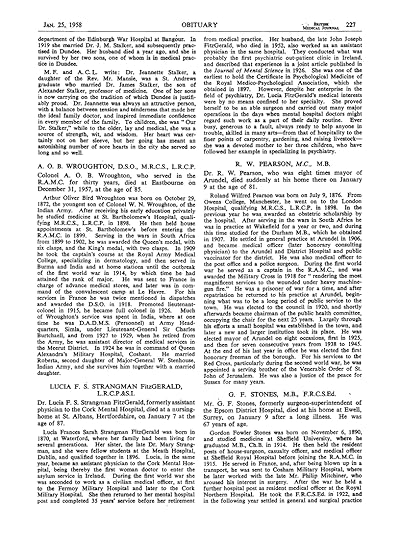
And examining the minutes of the institution's Board she soon discovers that they appointed, unusually for the time, a female doctor, Lucia Strangman.
The novel then consists of the Reader followng the history of the institution, and of Lucia, through the case notes, which she in part transcribes but in part brings to life in her fictionalised imaginings. We also see Lucia and her husband, another doctor at the institution, establishing the first psychiatric outpatient clinic in Ireland. And all the time the narrative voice concerns itself with the Reader's own present-day mental wellbeing.
Generally, the story told is of what comes across, particularly under Lucia's stewardship, as a caring institution, albeit one limited my the medical techniques of the time (indeed Lucia is required to act as a general surgeon as well as a psychiatrist) and prone to epidemics of TB and cholera. The main concern perhaps being the refrain of 'no change' and 'content' as many of the patients show no real improvement, or perhaps even desire to improve. But then the Reader comes across a letter from a relative of a patient, which makes her realise she is reading history through a one-sided lens:
Following polite enquiries about relatives and neighbours, Mary wrote of her stepsister, 'I saw Annie just once... she looks fairly well but her mental condition is no better, although she recognised me after a little while. She does not seem to feel the privation of these dismal walls. I know the outside world would seem foreign to her now. Have you got any idea of what kind of a place this is — well I must tell you, it is not a very good place and the treatment of the patients here is horrifying.'
The Reader's pencil rolled onto the archive floor. Her eye darted back to her question - 'Have you got any idea of what kind of a place this is' - No. She had been looking through the doctors' eyes for too long. If Lucia had written 'content here' about this stepsister, the Reader would have taken her words as fact. Scraping back her chair, she stumbled through the archive vestibule and locked herself into the bathroom.
She'd let the casebooks lull her into thinking of them as truth, and she was angry with herself for that, and angry that she couldn't put the doctors' books aside altogether in favour of letters composed by the patients themselves.
A coda to the novel provides an interpretation of the Reader's identity - or identities? - and most strikingly the identity of the psychiatrist-narrator.
Beautifully done. Perhaps my only hesitation the sheer volume of case studies, and the feeling the author wanted to do all the (anonymised) women she encountered in the archives justice, 4.5 stars.
'She read and read, because she had woken these voices, and to stop reading would silence them.'
Original, a novel no one could've written but this incredible author. Yet my fascination didn't always trump my impatience and at times I had to force myself ahead when I wished to be simply compelled.
Archives, names, and historical traces are incredibly powerful, but they are not yet a world.
I’m pretty bummed about not liking Doireann Ni Ghriofa’s Said the Dead more because I adored A Ghost in the Throat and loved her poetry collections. Here, she does a similar thing as in A Ghost in the Throat: archival pursuit, historical women, the narrator’s own life, motherhood, language, translation, hunger. However, instead of turning obsession into propulsion and openness, the book loses its poetic grip halfway through its woman-reading-archives plot. I don’t mind vibes and poetic fragments, but I’m supposed to feel something, and I simply can’t help drifting away. I still have the archive and the atmosphere, but the ghosts are no longer pulling me into the book.
UPDATE: I don’t know if my rating is accurate because I can’t stop thinking about the book now that its covers are closed and it’s back on my shelf. I think I wanted it to be like A Ghost in the Throat, which is unfair and like comparing two children. Possibly a 4… I loved learning about Lucia & her patients, but I didn’t always love the storytelling surrounding them. It’s a hard one to rate. Worth a read for the history alone.
This centres around the actual records female patients in Cork District Lunatic Asylum at the turn of the 20th century. It is a blend of fact and fiction. Despite an interesting premise the plot is difficult to follow. It is informative, written in an appealing style of prose, but lacks an edge that could have come from developing more of a fictional balance.
It will be to the liking of many, and it serves as a tribute to those who suffered such horrors. But I had hoped for something darker. Ultimately, it’s neither one thing nor another, not a historical account, and not a haunting novel based around actual records.
this was deeply deeply not for me, but it's going to really work for a lot of people.
i'll briefly talk about what it is, because it sounds super fascinating and it's why i picked it up. ní ghríofa takes a large old building in cork, which used to be a psychiatric hospital and only closed down in the 90s for ever. it's been abandoned and parts of it are now private apartments. the narrator in this book, who is the author but distanced, wanders through this place both physically (in the derelict parts) and also psychically. she reads over records of the women who stayed there. she immerses herself in their stories and tries to tell them, while also discussing what brought her there. it's clear she's struggled significantly with her own mental health and a prevailing concern appears to be that her own mental health would have likely seen her in similar places a hundred years ago.
this is an emotional creative exercise, using the bones of nonfiction. the author is writing using public records, reconstructing stories of the women who have been in this hospital, along with a pretty interesting story about one of the staff, lucia strangman -- a woman herself, who went to medical school, who become one of the first psychiatric fellows, who then went and opened her own clinic after.
i want to be upfront and say that some of this is very beautifully written, that it is obviously hugely emotionally impactful to the author, that it even feels like an interesting thing to do. it's a huge undertaking and it is compassionate. but, for me, i just didn't get on with the odd intersection between fact and fiction and the blurring of the lines. the distancing between the author and the "Reader" she creates to not use "I" over and over is a stylistic choice that i didn't like. the creativity she explores in diving into these womens lives and trying to bring them to life might be interesting but it made me very very aware of the distance, too. she's obviously trying to erode that but i just didn't find it convincing. if you're using these accounts and records to recreate these women, i ended up thinking that it wasn't enough of either. i didn't think it worked as a nonfiction and it's clearly not fiction although it's certainly creative. i didn't like the fundamental choice in the creation of this book so it made me feel odd and strange as i listened to it. i just didn't like it.
but it isn't bad. it's just not for me. a really interesting concept, for sure, but i think you know within the first part if you'll get on with this. i do recommend giving it a go because i think a lot of people will get on with this.
Said the Dead is one of those books that's nearly impossible to categorize. Is it fiction? Is it memoir? History? Fantasy? All of the above? The person telling the story (at times described using the first person and at times called simply "the Reader") comes across a former mental hospital being redeveloped into condos. Exploring some of the grounds and buildings, she feels a strange connection, which leads her to seek out the archives of the institution. There she comes across the unusual history of Lucia Strangman, one of the first female doctors to work with the mentally ill, and becomes obsessed with her case notes. The Reader becomes so immersed in the stories of the women who Lucia treated -- so often committed to the hospital not because they were truly ill but because they were at the mercy of men in their life or because they didn't fit in with the society of the time or simply due to extreme poverty -- that she often neglects her own life and family. The narrative is interspersed with haunting images of Lucia, her family, and some of her patients, and throughout there is a mysterious commentary to one side that suggests that as the Reader is somehow watching the lives of these patients unfold, someone is watching her. There is a dreamlike quality to the book, and there's never a clear sense of what is real and what is fiction, but overall there's an immense respect for the many women whose names and lives were utterly forgotten in time. As soon as I finished the book, I wanted to go back to the beginning and read it again, certain there was so much I missed.
Thank you to NetGalley and Farrar, Straus and Giroux for providing me with a digital ARC of this book in return for an honest review. This book will be published September 22, 2026.
I’ve genuinely never read anything like this before. It’s part memoir, part historical investigation, part ghost story, yet it doesnt fit into any one genre. The way Doireann Ní Ghríofa blends archival records, imagination and personal reflection creates something that feels completely unique.
What struck me most was how the novel explores the lives of women confined to a psychiatric institution through the eyes of a reader trying to piece together their stories. The book constantly questions what we can really know about people from the fragments they leave behind, and the result is both haunting and deeply moving. As the Reader becomes increasingly absorbed in the records, the line between history and imagination begins to blur, creating an unsettling but fascinating reading experience. At times I wasn’t entirely sure where reality ended and imagination began, but that felt like the point.
The last line in the book gave me goosebumps, a novel I will 100% be rereading.
Was hoping for so much more due to the interesting premise- but this was too poetic/lyrical and incoherent for me. The format was difficult to get into, and I wish there was less jumping around and back and forth.
The idea of ghosts in literature is an interesting one, although sometimes used as a technique to scare (I would check out Roald Dahl’s anthology) it can be a symbolic way for a character to get a glimpse into the past: to view our mistakes and losses. You can see this in Susan Hill’s The Woman in Black, Charles Dickens A Christmas Carol and Doireann Ní Ghríofa’s second novel, Said the Dead.
Doireann Ní Ghírofa is no stranger to writing about how the past can affect the present day, her debut A Ghost in the Throat was about birth and motherhood. Said the Dead does this as well but in a more expansive way.
The book’s main protagonist or known as the reader, is exploring a disused mental asylum in Cork which is going to be converted into flats. There she discovers a shard of glass with L written on it. Through research she discovers that the glass belonged to one of the first woman doctors Lucia.
As she researches more about Lucia, the ghosts of her patients start to appear until both living and dead worlds are combined.
Each patient represents the struggles women have gone through from the 1900s onwards. There’s victims of abuse, women with unwanted pregnancies , women who had relationships with other women, a woman who liked reading but was beaten for doing so : most victims of a patriarchal society which asks the question who the real mad people are. Lucia’s struggle to become a doctor also is included with the suffering of her patients.
Doireann Ní Ghírofa, as in her debut, likes to mix styles. Once again it’s here in Said the Dead. There’s a mixture of that gorgeous prose, poetry, research - Lucia and her patients did exist and mixed media. All which bring out the message even more.
Said the Dead does have one flaw, for me and that is the over abundance of patient descriptions. At times it does drag a narrative a bit but this definitely not a book to miss out on. Highly recommended.
Ní Ghríofa has completely blend the boundaries between fiction & non-fiction in this absolute favourite book of mine. It will send you down the rabbit hole to figure out how much of this is a memoir or shear imagination of author's mind.
The book is a perfect example of mosaic writing. Author has very smartly narrated the whole plot through a character simply known as "The Reader". By fluke she comes across an asylum which is currently in dire state & is up for sale. Slowly The Reader gets obsessed with finding out more about this asylum where abandoned women were institutionalized. She starts going through the medical records of hundreds of these women, which have been written by Dr. Lucia, who forms the anchor between these long forgotten women & the reader of today
letting the voices of the deceased fill her thoughts
Stories like that of Anna Martha (who is institutionalized as she is suffering from severe postpartum depression) or that of Dora (who is institutionalized coz she is fiercely independent woman & refuses to conform to societal norms) though set in 1850's still feel relevant to today's tome
The fragmented narrative about hospital records never feels dry. There are many many deeply personal stories in here which didn't overwhelm me but felt like prose poetry. This one reminded me so much of Han Kang's The White Book
Ní Ghríofa is a master storyteller. Both her works aim to undo the historical erasure of women & I love her for that. Don't miss this one
Utterly singular, you can’t help but tumble down the rabbit hole (as it were) with Ní Ghríofa. She’s brilliant. Had the pleasure of hearing her speak about this LIVE!! which has really coloured my experience. Would like to return to this in future as I feel I didn’t give it the devotion it needs - It’s tough to follow at times but rewards work!
Slow to start, and took awhile to accustom myself to the writing style. Once into it I enjoyed it. Ending ………leaves me hanging a little. As to where it leaves the “reader”.
I very rarely write reviews on here but I absolutely had to let it be known what a deeply moving and beautiful book this is. Having just finished I am crying my eyes out. Doireann is an absolute master of the craft. This is an absolute must read, I believe her to be the most exciting and talented Irish author of our generation, and I’m not exaggerating! Do yourself a favour and pick it up!
This is a hauntingly beautiful book which is very difficult to describe but completely compelling to read. The author wanders past what used to be the Cork lunatic asylum, soon to be turned into luxury flats. She finds herself drawn in body and soul and from going to see the site to she progresses to the archives where she buries herself in the files, immersing herself in the stories of all the women who passed through the gates. This is written as a kind of ghost story with fragments and refrains as the book progresses. I loved it. I read it in two days and was devastated when it was finished.
In een video op de website van de uitgever vertelt Ní Ghríofa dat ze gefascineerd raakte door de casusbeschrijvingen van een voormalige psychiatrische kliniek en dat ze met dit boek hoopte die fascinatie te delen. Waarom heeft ze er niet een historische roman van gemaakt, dacht ik. Dat is immersiever dan dit spel waarbij je in en uit de archieven en uit het verhaal wordt gehaald. Dat trucje van metafictie kennen we inmiddels toch wel? Tot het verhaal van the Reader meer gaat fascineren dan de verhalen van de vrouwen in de kliniek. Waarom laat ze huis en haard achter om in de archieven te graven? Klopt het dat er thema’s zijn die haar meer raken dan andere (rouw en gekte door zwangerschap of ‘excessive childbearing’) of is dat mijn eigen gevoeligheid? Dan ineens is er nog een Reader: ik, jij. Is dat wat te zijig, literatuur als geneesmiddel?
I can't find the words to talk about this book just yet but Doireann Ní Ghríofa is one of the most creative, masterful writers I have read. This book is phenomenal and will stay with me a long time.
I was intrigued by the premise of Said the Dead, but ultimately the execution of it fell short of my hopes/expectations for the novel. It’s an interesting read from an historical perspective as you gain an insight into the women who were patients at the asylum. However, the structure is jarring and lacks cohesion - often, names are mentioned, half a story is told and then the story moves on. I thought I’d enjoy the blend of fiction and non-fiction, past and present, but instead it felt clunky. I think had Ní Ghríofa leaned more into fiction this would have been a more enjoyable read for me.
When I first started reading this book, I chose to listen on audio because I thought this was going to be your standard non-fiction read; which I normally like to listen to as I do my weekly deep clean. Almost immediately I stopped listening and ordered the physical copy because the writing was too stunning to not be read. I am so glad I did as the physical book is enhanced by the inclusion of photographs, newspaper clippings, and letters I would have missed out on otherwise.
The most important thing to say here is that this book isn’t just non fiction - it’s a blend of non fiction, memoir, literary fiction, magical realism. I could go on and on. I really had to take it slow reading this as I related so painfully to The Reader that it knocked the breath out of me. To read a book that discusses time in the way that I’ve always felt and experienced it, but struggled to articulate, was affirming. I also loved how the story explored the ethics of archival research and whose voice gets to tell a story, and how our interaction with the past has the power to change the future.
Honestly, please read this because I don’t feel like any review is going to do it justice.