
What do you think?
Rate this book

142 pages, Paperback
First published August 31, 2015


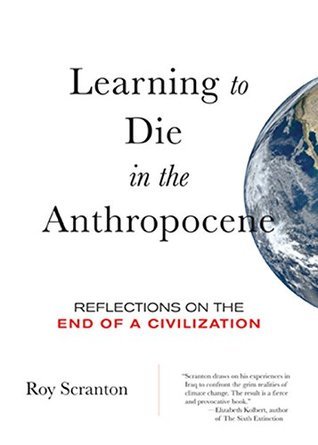
the crisis of global climate change, the crisis of capitalism, and the crisis of the humanities in the university today are all aspects of the same crisis, which is the suicidal burnout of our carbon-fueled global capitalist civilization. the odds of that civilization surviving are negligible. the odds of our species surviving are slim. the trouble we find ourselves in will likely prove too intractable for us to manage well, if we can manage it at all.expanded from a 2013 new york times essay, roy scranton's learning to die in the anthropocene is many things at once: an entreaty, a polemic, a history, a personal account, a documentation, a plea, and a chronicle of a death foretold. a former army private during the iraq war, scranton spends the early pages of his slim book drawing comparisons between the "shock of awe" of warfare witnessed and that of unmanageable climate change and the horrors to come. wending his way through a brief biography of human civilization, climate science, and the rapacious effects of the capitalist system, scranton, in the latter portion of his book, argues in favor of culture and more carefully attuning ourselves to the humanities. drawing on philosophy and texts of yore, he makes the case that our treatment of the humanities presages our fate as a civilization.
carbon-fueled capitalism is a zombie system, voracious but sterile. this aggressive human monoculture has proven astoundingly virulent but also toxic, cannibalistic, and self-destructive. it is unsustainable, both in itself and as a response to catastrophic climate change.scranton doesn't argue for any of the usual quick fixes (carbon trading, sequestration, binding agreements to reduce carbon consumption, techno-miracles, geoengineering, or the like), but instead accepts the fact that we've failed to prevent climate change despite having had decades in which to heed the warnings. declaring capitalist civilization already dead, scranton sees our best hope of survivability and adaptation in preserving and nurturing our cultural heritage. seas are surely rising, temperatures destined to climb ever higher, and the unmitigated effects of our over-consumption are re-shaping the planet's climate and our ability to thrive as we've grown accustomed to doing. learning to die in the anthropocene, rather than offering an existential salve to our coming calamities, seeks to reframe the future in a context that offers promise in the form of shifting paradigms and a reorienting of priorities understood. brief but unyielding, scranton's beautifully written book challenges, incites, and, best of all, offers a metaphorical arability in a landscape otherwise scorched by apathy and indifference.
the study of the humanities is nothing less than the patient nurturing of the roots and heirloom varietals of human symbolic life.
If being human is to mean anything at all in the Anthropocene, if we are going to refuse to let ourselves sink into the futility of life without memory, then we must not lose our few thousand years of hard-won knowledge, accumulated at great cost and against great odds. We must not abandon the memory of the dead.This is a book about holding on, and waking up, and preserving human cultural heritage. The book is somber, but not bleak. It's not about giving up all hope, really, but it's something much more subtle, like forsaking how we currently live while at the same time remembering and cherishing the history of humanity. It's complicated; I don't know how to do this.
*******
As we struggle, awash in social vibrations of fear and aggression, to face the catastrophic self-destruction of global civilization, the only way to keep alive our long tradition of humanistic inquiry is to learn to die.
--
We must practice suspending stress-semantic chains of social excitation* through critical thought, contemplation, philosophical debate, and posing impertinent questions. We must suspend our attachment to the continual press of the present by keeping alive the past, cultivating the info-garden of the archive, reading, interpreting, sorting, nurturing, and, most important, reworking our stock of remembrance. We must keep renovating and innovating perceptual, affective, and conceptual fields through recombination, remixing, translation, transformation, and play. We must inculcate ruminative frequencies in the human animal by teaching slowness, attention to detail, argumentative rigor, careful reading, and meditative reflection. We must keep up our communion with the dead, for they are us, as we are the dead of future generations.


