"Why are we fighting this war? Because evil must be resisted, and sooner or later there comes a time when men of principle have to make a stand. Because war is good for business and it's better to die on our feet than live on our knees. Because they started it. But at this stage in the proceedings," he added, with a slightly lop-sided grin, "mostly from force of habit."
A soldier with a gift for archery. A woman who kills without care. Two brothers, both unbeatable generals, now fighting for opposing armies. No-one in the vast and once glorious United Empire remains untouched by the rift between East and West, and the war has been fought for as long as anyone can remember. Some still survive who know how it was started, but no-one knows how it will end.
This serial novel from the World Fantasy Award winning K. J. Parker is the story of a war on a grand scale, told through the eyes of its soldiers, politicians, victims and heroes. The first three parts of The Two of Swords will arrive in April 2015, with further installments to be released monthly.
This is the first installment in the Two of Swords serialization.
According to the biographical notes in some of Parker's books, Parker has previously worked in law, journalism, and numismatics, and now writes and makes things out of wood and metal. It is also claimed that Parker is married to a solicitor and now lives in southern England. According to an autobiographical note, Parker was raised in rural Vermont, a lifestyle which influenced Parker's work.
Prvo što mi pada na pamet u vezi ove novele da je konfuzna. Upoznamo par likova na pocetku koji posle ne igraju nikakvu ulogu (pretpostavljam za sada), dodemo do glavnog lika koji veci deo price provede u hodanju i pitanjima šta se dešava i tu je kraj. Nemam pojma manje više ništa o svetu, sem da dve sile vode rat i da životi nisu vredni ni pišljiva boba. E sad nije fer prema ovome da sudim na osnovu samo jedne knjige pošto je predvideno da se cita citava sezona al kao što rekoh za mene je ovo bilo konfuzno i skoro da mi se ne cita dalje ali visoke ocene govore da vredi i da ne treba odustajati tako da cu nastaviti.
First thing first: one of my GR friends recommends reading at least 3 parts of this series in order to form a proper opinion about it. So I followed his advice and I strongly recommend you do the same. Being issued as separate chapters from what seems to develop as a huge opera, you have to read indeed 3 or 4 parts before make up your mind about it.
OK, so, until now, I’ve read 4 installments and I can tell that is becoming more and more interesting and intricate. The perspective about the war between Eastern and Western Empires, which separated 90 years back, is being told from different point of views. With each part/chapter, a new character is brought in and the story is being told from his/her PoV, which is kind of baffling. But the more you immerse yourself into the story, the more you’ll get to understand the reason.
On short, it is a story about war, people involved, relationships, loyalties and betrayals. Besides being admirably well shaped, the characters are not what they appear to be at first glance (all of them have a hidden agenda), fact which adds even more mystery to the story. Have no idea where it’s going or how it’ll end, but the journey is worth taking, from my PoV.
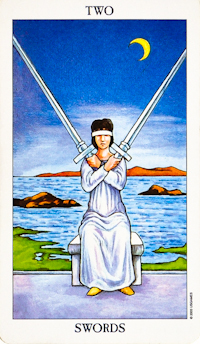
Another thing: being curious about the title (taking into consideration that up till the 4th part there is no sword in the story whatsoever), I made a little research and found myself amazed by the following: This is a Tarot card named “The two of swords” whose description explains soooo perfectly the setup of the story, so my guess is that’s the reason for choosing this title:
“The Two of Swords depicts a young, blindfolded woman who holds a sword in each hand. She sits before a sea filled with rocks and crags that present obstacles to ships which need clear passage. The blindfold shows that the woman in this card is confused about her situation and that she can see neither the problem nor the solution clearly. The swords she holds are perfectly balanced, showing a balanced and stable mind, and that both sides of the situation need to be addressed. The crossed swords are also symbolic of the need for a truce and the Suit of Swords indicates that the problem at hand needs to be resolved using logic and intellect. The waxing moon to the right of the woman shows a new beginning arising out of the solutions found for this problem.”
Worth to mention also that a pack of cards is an accustomed companion of our heroes.
It’s not the classic fantasy story (the magic part is missing entirely, at least so far) but it compensates with the puzzle like style, the cliffhangers at the end of each part, with unexpected situations and incredibly witty characters.
Short resume of this first part: the youngsters from a village are taken to war. Two of them, Teucer and Musen, found themselves in an awkward situation after some events on the road. Willingly or not, they have to take the same path in order to survive. Things precipitate and an unexpected thing happened, which, eventually, separate the two…
(The story here is told from Teucer’s POV.)
-------- Being monthly installments, I can't tell yet if it's going to be a very good one or not. It's like reading separate chapters. I'm on third part right now and it's being told from a third POV, meaning a third character, with no regard to the previous two ones.
The story goes like this: there is a war between East and West. People are taken from villages and sent to battle. Two of them, Teucer and Musen, take a different path after some events (I don't want to spoil so I won't go into details).
So, first part is told from Teucer's POV, second one from Musen's and third, which I'm currently reading, from another character which has a role in the second part...
Will see how it'll go with the forth, maybe after that I'll be able to form an opinion. So far, it is kinda catchy, even if only being curious what the development will be, because at the end of each part, the character is left in the air :D
I’ve made it no secret over the years that I’m a big fan of K.J. Parker, purveyor of quirky and highly intelligent fantasy, formerly a mysterious entity whose real name or even gender was unknown but recently revealed (to my unending surprise) as comedic fantasy author Tom Holt. If you haven’t read Parker yet, stop here and go read Sharps now.
I finished this and #2 and currently reading #3 and the one thing I would say for now is read the first three before you have an opinion as they are successively told from another pov and illuminate (and obscure and hint at much more) what came before
This is my first KJ Parker/Tom Holt book - I figured that a novella, or series of novellas, would be a good launching point. I have several of his paperbacks, having picked them up over time based on recommendations, but never actually dug into them - if Orbit had made audio for any of his books, I probably would have some time ago.
That said, this novella was...underwhelming. The worldbuilding was nice - you got a really good feel for the land, really felt like this was actually a smaller area in a time of war, really felt for the soldiers and the main characters traveling.
However, the writing itself was...uninspiring. The prose was professional, but was a lot more underwhelming than I'd come to expect based on reviews. It was businesslike, straightforward, to the point. The dialogue did it's job but was nothing special. The story moved along at a rapid clip, yet still felt sluggish, despite a lot happening in only 80 some odd pages.
Overall, I can't put my finger on what I didn't enjoy about this serial, but I felt overwhelmingly "meh" about it the entire time. At about the 75% mark, I was more than ready to give this 2 stars, but things picked up at the end, and I was left feeling a little more optimistic about it. I am on the fence currently about continuing this serial series - I might, I might not. Who knows. Enough was laid down to keep me interested.
Given that this story is a serial, I am going to post my impressions about each installment in this space.
Part One:
The story Parker tells caught me completely off guard. I expected big battles and deeds of courage, as opposed to the misfortunes and hardships that riddle the pages. I have read that war during the middle ages was very unkind to the common soldier and even worse to peasants and poor folk, and it looks like Parker subscribes to this perspective, too. In the context of the genre, it totally sucks to be anyone other than the Hero when countries war against each other.
I dig Parker's style, which is far more breezy than I expected. People talk in vague terms--"Why do I have to wear this thing?"--and grouse about creature comforts amidst momentous events. Everyone is human, fallible and quite mortal. Many people get killed off, but without the fanfare or shock that other writers suggest in their work.
As a first impression (haven't read KJP before this), I rate this high.
Part Two:
And now, for another character's perspective.
Parker stated in an interview that he wants to describe a big war from different viewpoints in this work, rather than focusing on a select few. So Part Two kicks off from someone else's perspective, and wouldn't you know it, this person was one of the characters from the first part. It's like the camera moves from one character to another and now here's our main guy.
The story here is all over the place, though the main thrust appears to be desperation at the tale end of a failed attempt to establish a foothold in enemy territory. You get your usual looting of corpses and black market trade, and Parker keeps it interesting by maintaining a brisk narrative pace. He also introduces something called the Craft, and though allegiance to this ethos appears to be very important to some of the characters, I'm not exactly clear on what that means.
Park Three:
My favorite part so far, thanks entirely to the character upon whom Parker focuses in this installment. She reminds me of Milady from Dumas, only with a stronger does of practical cruelty. Parker takes some time to mention some gender iniquities in this society, and I wonder if this topic will return in later parts.
Parts Four through Six:
I am hooked on the serial and excited for the next part. Hard to believe that I will be reading this until March of next year. I love the connections that Parker is developing in the story, and I am stunned by some of the details, like the decor in the Emperor's throne room, or Senza's reaction upon receiving tea just as he likes it in the same scene. The romance between Forza and his wife intrigues me, and I want to know more about the history, even though I suspect that I will not (which I don't mind, it's good to be left with a sense of mystery).
We are nearly at the halfway point, in terms of number of installments, and this is turning out to be a fantastic read--one of those books that I am so happy to live with as I go about my day.
Parts Seven through Eight:
I have no idea where this is going anymore--and I love this uncertainty! Just as I thought that I had grasped the fundamental politics of the big war, Parker throws everything into another direction entire with a few reveals about the lodge and craftsmen and their opaque machinations. By the end of part eight, a character suggests that something extraordinary is afoot, and only select people get to know. Does that include readers? Of course not! At least, not for now...
I have tried to get into digital serials on a few occasions, and this is the first time an author has me completely on the hook. The moment a new installment of Two of Swords appears, it becomes my magnetic north, and I thieve every moment I can to dive back into the story.
For a stretch, I found myself thinking, "Ah man, six more parts until this is done"; now, I am so happy that Parker has that many more installments to carve out his story.
The story format is basically a modern version serialized story on magazines, published by online selling.
I cannot say much with the content itself. It is the first part of a not-fully-published-yet story. So far I perceive it as a low-fantasy, the author's specialty under this pen name.
Farmboys. Oh right! Gritty, cynical and centered on war. A single chapter with a single viewpoint is too little to form an opinion, but it seems interesting, I like military stuff, skilled wordlbuilding, clever dialogues and a little gallows humor. The chapter end was probably meant to build suspense, instead it was confusing for a couple of dialogues but ok. I think the first installment should have been a little longer, a couple of chapters at least.
Parker/Holt casts his net very wide in this serial novel about war, allowing (so far; I'm currently reading part 4 and will very likely read all) each major character their own chapter(s?) and viewpoint.
Part 1 is master bowman Teucer's chapter, a simple peasant who is conscripted by the army of the West in the Empire. Most of Parker's novels have dealt with the countries outside the Empire and I am quite looking forward to look behind the curtain (having read everything everything of his except the Fencer Trilogy). The other main character is his neighbour, but not his friend (!) Musen, who is the central character in the next part.
The style is typical KJ Parker at his best with all the accuracy and top-notch research we are accustomed to. Very much recommended.
NOTE: These are not novellas (as advertised) as much as longer chapters of a serial novel. So far 14 volumes have been announced - meaning at least £14 total. That's a lot (read: way too much) even for a novel by one of my favourite writers.
K.J. Parker is one of those authors that I really, really want to read but other than his short back in Warriors anthology, I had manged to get around to -I even have the Kindle version of Sharps.
So these serials are not only fun but will finally get me reading Parker. Only downside, not sure how I'll work them in around my other books. Gonna have to try reading a couple books are once, like you folks.
I make no secret about being a big fan of K.J. Parker, who I think writes a lot of extremely interesting stories, with depressingly believable characters. Things tend to end badly for those characters; one of the key themes of Parker’s work is entropy; everything gradually falls apart, typically due to the actions of characters working with the best (or at least most reasonable) intentions. This tendency toward systemic collapse always makes for slightly depressing reading, but on the other hand, it’s usually tightly wound with a dry wit that exposes the essential humanity of the characters whilst eliciting the odd chuckle.
I’m happy to say that Two of Swords continues this trend. This first part introduces us to several farm boys, conscripted into a war They have a certain baffled innocence as a group which is rather charming, and the initial focus, on a lad who has some skill at archery, works as a means of drawing the reader into the world. Our viewpoint into the larger scale of things is as confused, disoriented and uninformed as we are – as he makes a bit of progress toward understanding, so do we. It’s always good to see world building done well, and Parker manages it through the little details – mentions of wider political situations in incidental dialogue; economic progress revealed through fashion...there’s all sorts of small clues to the world the characters inhabit scattered around the text, ready for readers to pick up, like ravens.
The characters are very well captured; Parker gives us a sense of confusion and drudgery most strongly, but there’s a whole gamut of emotions here. The gentle friendship of the protagonist and the village over-achiever, for example, is put into place so quickly you don’t notice, and forms the bedrock of the first half of the text, as they begin to move into the wider world together. The same is true of the sort of casual dislike f the protagonist for one of the other boys, something only becoming obvious as they move out of their comfort zone and into...well, a war zone.
The actual narrative is very tightly written. You could read it as a standalone short story, and it would work. There’s a definite character arc here for the protagonist, which eventually ends up going in some very unexpected directions. Suffice to say, the journey builds the character up nicely, and I’m not entirely sure what the destination will be. Parker doesn’t pull any punches either, in line with their usual style. There’s a lot of plot events packed into the eighty pages or so of text, and several of them are game-changers within the narrative, taking it off the expected path and throwing it somewhere entirely unexpected. Then once the reader is used to the new situation, they’re torn back out of it again. These narrative shifts are typical of Parker’s work, but they don’t lose their impact here.
In the end then, is this worth picking up? As a standalone short story, it isn’t too bad at all; interesting characters, a fast moving plot, and a believable and not over-drawn setting. As the start of a broader narrative, it shares those virtues, with a promise to build on them in the next segment (which has an entirely different protagonist). In either case then, yes, it’s definitely worth your time and money, and absolutely worth reading.
I plan to read all of K.J. Parker's novels this year. I had planned to read them in chronological order, starting with the Fencer trilogy, but I got caught up with my ebook novella reading project, and figured The Two of Swords would be a good place to start. What can I say? Starting on the first of twenty-three novellas sounded less daunting than starting the first in a 1500+ page trilogy.
Of course, reading this novel in its parts is less than ideal, since it will likely take a few entries to get a sense of what the story is about. I've seen other reviews that suggest holding off on judging it until you're three entries into it, but if the author is going to release them one-by-one, I'm going to rate them one-by-one. True enough, Part One is mostly exposition, though Parker starts to lay down the approach of his story. In short, this book is going to be about war, told from a variety of different viewpoints.
Part One focuses on war from the perspective of the soldiers. We're in a Medieval fantasy world, where the soldiers are conscripted from the surrounding villages in a kingdom. The army is made up of the young men, and the point-of-view character for this part is Teucer, a skilled archer. Parker tells his tale of leaving home, joining the army, going to battle, fighting, and then returning home, all in an effort to show what the war means to the common man. He's accompanied by Musen, another recruit from his village, and the two of them together share this journey. In true Parker form, though, the journey they take is far from what you would expect from a Medieval fantasy war story.
Readers of Parker's fiction will recognize his ascerbic, wry style that borders on irreverence. They will also recognize the somber undercurrent of his narrative, as Parker doesn't shy away from the cruel reality of his stories. What we find in Part One is the constrained chaos of being in an army, crossed with the real dangers of being in that same army. In other words, it's very much a K.J. Parker story.
This isn't the strongest start to the series, but it's engaging enough to keep me going. I understand each part of the series is going to focus on another viewpoint into the war, and I'm curious to see if it will be a parallel story, or a continuing one. I'm in for the long haul, though, so I'll let you know what I find.
I can't rate this serial segment as I would a novella because it isn't one. It's essentially one-eighth of a novel, so I'll leave a rating until the end, or until a collected edition comes out.
My understanding of The Two of Swords is that it is somewhat experimental, and each segment will focus on an individual character who is part of a larger tapestry of war. (Edit: Here Parker talks about the structure and intentions of the serial.)
I'm not real big on war stories, but this was interesting as it followed young Teucer in a series of events that would be pretty cataclysmic for anyone. Thematically and plot-wise it seemed to be heading in a particular direction, but toward the end it turned off somewhere else and now, probably much like Teucer himself, I have no idea what's going on or what might happen next.
I've got to say it... my goodness, is this segment bloke-heavy. There were literally thousands of men--a mere handful with speaking parts, of course--and six women, none with anything significant to contribute to the story. I can see why this was done, but still. I do want to see what a female character of Parker's is like, since is the first work of theirs I've read.
(Parker's identity is now known, but I'm attached to referring to them gender-neutrally for some reason.)
Anyhow, this was an intriguing beginning and it's far better than either of the other two e-serials I've read even at this early stage. I'll definitely keep on with this.
Really interested to see where this one goes. Few authors are able to hook me into a story as immediately as Parker and this one is no different. With the serialised format drawing on the author's strengths with short fiction (see the also excellent Academic Exercises) it remains to be seen if it can also string together a narrative that will be intriguing from month to month, when there has been time for the details to go fuzzy in the mind. If you're a seasoned Parker fan, there is nothing really groundbreaking here (though part 2 does wonder into some interesting territory) and as of yet I haven't got a great sense of the direction for the series, but it doesn't stop it from being a perfect slice of fiction from one of the masters of modern Fantasy.
My one complaint is that the ending just sort of... ends. There is no real hook into the next part. I suspect this will be more the case with later parts and it's probably why they released parts 1-3 straight away.
So, K.J. Parker of the Engineer trilogy fame is writing a serial, or should I say TOM HOLT. Well, whoever you are, the story is off to a good start. I guess a rose by any other name…could write an awesome fantasy story.
The story starts off with Teucer, a farm boy who has just done something amazing. Teucer doesn’t gets to celebrate for about fifteen minutes before he learns he being set off to war.
Not the war you’re used to in fantasy, but a more realistic war in which characters wonder, “Wait, who’s in charge” and “Are we going the right way?”
I’m definitely in for the rest of this experiment in serial fiction.
So, a question for the Orbit, the publisher, or the author. Was using the same cover for all of the episodes a matter of saving money, or did you think readers would be confused by different covers? Is the cover so basic, because you really don’t know what it’s about yet?
Feel a little silly giving this 5 stars as it's not terribly suspenseful or eventful in terms of plot. I don't even want to say anything about what does happen given how little does, but Teucer's a very likable character and I enjoyed the read thoroughly even if it wasn't especially exciting.
Very pleased to read that Parker's approaching this serial as a series of linked novellas. Having read two of his standalones now, and his collection, Academic Exercises, I think the novella form suits his writing very well, and hopefully it will make it the serial release schedule more bearable. I'm the sort of reader who usually won't even start a series unless it's complete or each volume stands on it's own. Glad they released the first 3 at once though, since volume one leaves a bit too much unexplained.
First part of a serialised novel - and to date I have seen up to 22 parts listed. This one introduces us to Teucer, who is an excellent archer and has the misfortune to be conscripted to the war just after he makes a perfect score of ten arrows in the inner gold from ten shots. The levies stumble around the countryside with little guidance or leadership from the 'proper' army...
Hard to say how this is going to develop - the blurb says that the war will be seen through the eyes of several people so presumably the next chapter will deal with another character and we'll catch up with Teucer eventually. He ends this section in an interesting position, having possibly less idea of what is going on than when he started.
The story starts out seeming to be a strategic battle between 2 brothers and the armies they are in. Both hold strategic positions and influence in their respective armies....
and then....
The story changes to be about a bunch of farm kids getting conscripted.
and then...
It ends up focusing on 2 of those kids, Teucer & Musen, as they wander around trying to get away from it all
Well written. Enough of a cliffhanger/mystery to entice people to read part 2.
Biggest annoyance was I wanted to read more about the 2 brothers. I hope they play a bigger role in future installments.
This is a serialized novel. It may well turn out to be a great story. However, solely evaluating this first installment, there's not enough content in it to be excited about. I just found it to be okay. I thought that the serial format would necessarily incorporate intrigue and suspense in each segment but that is not the case here. Thus, I'm not spurred to immediately move on to the next installment.
Primera novella de una serie de 8 con lo que se formará una novela. 71 páginas siguiendo a unos tíos que acaban de ser reclutados para la guerra, pero a los que nadie cuenta nada de nada y se pierden al ir al frente. Muy buen empiece a esta serie/libro. Y ya se pueden comprar las tres primeras partes.
I'm not usually a fan of military fantasy/fiction but this sounded interesting. I've picked up the second part and will probably wait until I've read a couple ( they are short) before I make up my mind about it.