Jump to ratings and reviews
Rate this book

The Great Eskimo Vocabulary Hoax and Other Irreverent Essays on the Study of Language

Rate this book
How reliable are all those stories about the number of Eskimo words for snow? How can lamps, flags, and parrots be libelous? How might Star Trek's Commander Spock react to Noam Chomsky's theories of language? These and many other odd questions are typical topics in this collection of essays that present an occasionally zany, often wry, but always fascinating look at language and the people who study it.

Geoffrey K. Pullum's writings began as columns in Natural Language and Linguistic Theory in 1983. For six years, in almost every issue, under the banner "TOPIC. . .COMMENT," he published a captivating mélange of commentary, criticism, satire, whimsy, and fiction. Those columns are reproduced here—almost exactly as his friends and colleagues originally warned him not to publish them—along with new material including a foreword by James D. McCawley, a prologue, and a new introduction to each of these clever pieces. Whether making a sneak attack on some sacred cow, delivering a tongue-in-cheek protest against current standards, or supplying a caustic review of some recent development, Pullum remains in touch with serious concerns about language and society. At the same time, he reminds the reader not to take linguistics too seriously all of the time.

Pullum will take you on an excursion into the wild and untamed fringes of linguistics. Among the unusual encounters in store are a conversation between Star Trek's Commander Spock and three real earth linguists, the strange tale of the author's imprisonment for embezzling funds from the Campaign for Typographical Freedom, a harrowing account of a day in the research life of four unhappy grammarians, and the true story of how a monograph on syntax was suppressed because the examples were judged to be libelous. You will also find a volley of humorous broadsides aimed at dishonest attributional practices, meddlesome copy editors, mathematical incompetence, and "cracker-barrel philosophy of science." These learned and witty pieces will delight anyone who is fascinated by the quirks of language and linguists.

236 pages, Paperback

First published July 1, 1991

5 people are currently reading
625 people want to read

About the author

Geoffrey K. Pullum

17 books11 followers
Geoffrey K. Pullum is a British-American linguist and regular contributor to Language Log. He has taught at the University of Washington; Stanford University; University of California, Santa Cruz; and University of Edinburgh.

Ratings & Reviews

What do you think?
Rate this book

Friends & Following

Create a free account to discover what your friends think of this book!

Community Reviews

5 stars
27 (24%)
4 stars
42 (38%)
3 stars
28 (25%)
2 stars
10 (9%)
1 star
2 (1%)
Displaying 1 - 19 of 19 reviews
Profile Image for Cecily.
1,325 reviews5,355 followers
February 17, 2021
Review of title chapter/essay

We’ve all heard the old chestnut about Eskimos having [big number] of words for snow. Apart from the outdated word for Inuit and Yupik people, it’s initially charming and makes intuitive sense. The trouble is, it’s bunk, as is the case with many widely-circulated ideas about language: false etymologies (especially involving initialisms: posh, tip, fuck etc), along with “untranslatable words” (always accompanied by translations) and the converse, “language X has no word for Y”.

In the title essay, Prof Pullum explains how a fairly innocuous, but poorly-explained comment by Franz Boas in 1911 got picked up and exaggerated with almost every telling, aided by the exoticism associated with “Eskimos”.


Image: Snowflake (Source.)

Linguistic truth

The original point was mildly interesting, but not remotely startling. The Eskimo language Boas was studying used four root words for types of snow, whereas English uses phrases for them, rather than a single specific word: snow on the ground, falling snow, drifting snow, and a snow drift. In contrast, English has lots of water-related words that each use a different root: lake, river, brook, pond, dew etc.

In 1927, C.W. Schultz-Lorentzen's Dictionary of the West Greenlandic Eskimo Language, halved the number of root words for snow: one for snow in the air and the other for snow on the ground. All the other words are composites derived from those, much like other languages, including English.

Linguistic lies

The numbers became inflated when Benjamin Lee Whorf wrote an article in MIT’s Technology Review in 1940. His degree had been in chemical engineering, and Pullum describes him derisively as a “Connecticut fire prevention inspector and weekend language-fancier”. Whorf upped Boas’ four root words to seven, and as the myth gained traction in subsequent years, people were claiming fifty, a hundred, and more.


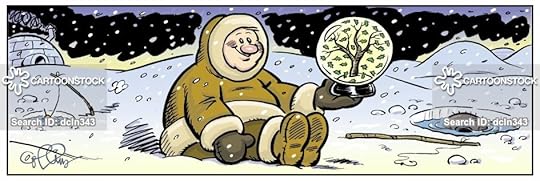
Image: Cartoon of Inuit person with a sun/leaf globe (Source.)

Logic

English is, obviously, not limited to phrases to describe snow; it also has specific words such as slush, sleet, blizzard, avalanche, and flurry.

Even if there were a large number of roots for different snow types in some Arctic language, this would not, objectively, be intellectually interesting.
There is specialist vocabulary for every group: horsebreeders, botanists, and interior decorators.

Except that, as Pullum then points out, people who live in a permanently snowy environment might not be that interested in it:
A kind of constantly assumed background, like sand on the beach. And even beach bums have only one word for sand

More fundamentally, the terms of the “Eskimos have X words for snow” are a huge debate in their own right: “Eskimo” covers many Arctic languages in different continents, and how do you define “word” and even “snow”? And this is where the big numbers are not entirely misleading: the Eskimo languages typically have far more inflectional endings, so there are more possible permutations, but whether or not they’re separate words is more contentious.

The tragedy is not that so many people got the facts wildly wrong; it is that in the mentally lazy and anti-intellectual world we live in today, hardly anyone cares enough to think about trying to determine what the facts are.


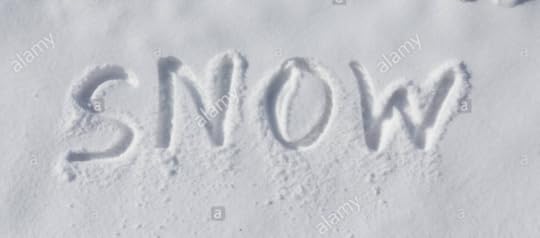
Image: “Snow” in snow (Source.)

Sources

I’m sure I’ve got a copy of this and that I’ve read the whole book. I’ve certainly read Prof Pullum (and a few others) on the subject of snow words several times over more than a decade on Language Log (though in the last couple of years, it’s mainly Victor Mair’s Chinese Language Log) and elsewhere, as well as his articles on other linguistic topics.

Anyway, the title article is widely available online, including HERE. It’s only a few pages long, and you don’t need to be an academic linguist to enjoy it and learn from it.

The idea of language constraining how we think is sometimes referred to as the Sapir-Whorf hypothesis. In its “strong” form, it’s largely dismissed as linguistic determinism, but the weaker form, linguistic relativity, is more supported. See HERE.

If you enjoy Pullum’s pugnacious style of demolishing popular linguistic myths and their proponents, read his views of Strunk and White’s The Elements of Style. The title sets the tone: 50 Years of Stupid Grammar Advice.

You can find links to many of his articles and essays on his website, HERE.

The Cambridge Grammar of the English Language, which he wrote with Rodney Huddleston, is an excellent source of clear explanations of grammar, punctuation, and orthography. It's especially good for authoritative answers on zombie rules and pedantic but erroneous peeves such as singular "they" and split infinitives. (I have yet to review it.)
Profile Image for Manny.
Author 48 books16.2k followers
June 13, 2012
Everyone who works with linguistics knows and admires Geoff Pullum, and the title piece, which you can read online here, is pure gold. You don't need to be a linguist yourself to find it very amusing. A few quotes to try and persuade you to check it out:
It is in the scholarly community that we ought to find a certain immunity, or at least resistance, to uncritical acceptance of myths, fables and misinformation. But sadly, the academic profession shows a strong tendency to create stable and self-sustaining but completely false legends of its own, and hang on to them grimly, transmitting them from article to article and from textbook to textbook like software viruses spreading between students' Macintoshes.
... the truth is that the Eskimos do not have lots of different words for snow, and no one who knows anything about Eskimo (or more accurately, about the Inuit and Yupik families of related languages spoken from Siberia to Greenland) have ever said they do.
"A silly, infuriatingly unscholarly piece, designed to mislead" is what one irate but anonymous senior scholar called this chapter when it was first published in NLLT. But this is not correct; rather, what I have written here is a silly, misleadingly scholarly piece, designed to infuriate. There is a huge difference.
Profile Image for Miglė.
Author 21 books487 followers
Read
April 24, 2019
Very humorous, witty writing style. But, except for the titular essay about Eskimo words for snow, doesn't say too much if you're not too familiar with the questions and debates in linguistics in the eighties.
Would love to pass this book on to someone who is interested and more knowleadgeble in this domain.
Profile Image for Nat.
730 reviews87 followers
September 11, 2007
This is a collection of Pullum's lighthearted editorial comments that appeared in the journal Natural Language and Linguistic Theory in the 1980s. I got it to read the title essay, on the frequently misunderstood number and significance of Eskimo snow words. That essay is polemical and funny, but I recommend supplementing it with the original Laura Martin paper (which you can get on Jstor) that Pullum's essay is based on.

The final section of the book, "Professional Fantasies", is pretty entertaining. Pullum considers what linguistics would be like if there were some equivalent of the Academy Awards for linguists, with categories like "The James McCawley prize in profound erudition", "Withering Invective", "Most Startling Volte Face", etc; an epistelary piece imagines what it would be like for different divisions of a university to argue that linguistics should belong to their division (this rumination is provoked by a massive $20 million donation to Stanford to fund the Center for the Study of Language and Information); a list of facts about linguistics books, which inclues a the top ten books titled "Semantics" (with no subtitle), a list of "extraordinarily ignorant claims about languages in books by linguists", etc.
Profile Image for Daniel Morgan.
723 reviews26 followers
January 6, 2018
I'm not entirely sure how this book came into my possession. I found it sandwiched between a history of 20th century Britain and a guide to community interpreting, yet the used bookstore label clearly indicated that Daniel of the Past thought this would be an interesting book.

Daniel of the Past was right. The premise of the book is that Dr. Pullum was volun-forced to fill the last few pages of every issue of the journal Natural Language and Linguistics Theory with various musings, satires, and humorous commentaries about linguistics research and linguistics research articles. These marginalia were then collected into the present volume. At first glance, this looks like something you would toss - and I almost did after the unintelligible-to-me Chapter Two. However, this book is (generally) not as dry or out-of-date as its subject and publication year would suggest. Aside from a few chapters that assume strong linguistics knowledge (which I do not have), most of this book is accessible to a general audience. And this book is both brilliant and hilarious! I especially enjoyed Chapter 8: Stalking the Perfect Journal, Chapter 11: Seven Deadly Sins in Journal Publishing, Chapter 19: The Great Eskimo Vocabulary Hoax, and Chapter 20: No Trips to Stockholm.

While I enjoyed the book, I'm not sure I would recommend it - it is 26 years old, lampooning research that is 30 - 50 years old, about a rather niche field. However, if it catches your eye, just skip Chapter 2 and give it a shot - you might enjoy it.
Profile Image for Maureen.
204 reviews4 followers
June 8, 2009
This book was cited by Trask as an engaging series of short essays on language and linguistics, including a detailed background of the myth that Eskimos have twelve or fifty or two hundred words for "snow". That story was indeed interesting (the author condemned it more as sloppy research than prejudice) but the rest of the stories were just inside jokes about the linguistics publishing community and made absolutely no sense to me.
Profile Image for Patricia.
132 reviews20 followers
May 20, 2007
Some of the stuff went over my head because I don't have a degree in linguistics, but his writing style is humorous and the essay about words for snow is interesting.
Profile Image for Hope Squires.
Author 1 book2 followers
January 6, 2018
I enjoyed this but would have enjoyed it more had I read it closer to my grad school days when sociolinguistics was less in the recesses of my brain. I wouldn't recommend it for someone who hasn't had at least some linguistics study, but if you studied linguistics in college/grad school and still love the topic, then go ahead and pick this one up. It's a fun read, and the final essay offers up a good reminder that not that much changes from one decade to the next: "these are troubling times for those who believe in satire and protest. But don't get me going on politics." (Note: it took me so long to finish this book because I would pick it up in between other books to read an essay as a palate cleanser, not because it was boring or easy to put down.)
372 reviews
Read
December 17, 2024
""
This entire review has been hidden because of spoilers.
Profile Image for Max Nova.
421 reviews246 followers
December 18, 2016
"The Great Eskimo Vocabulary Hoax" is a compilation of tongue-in-cheek essays written by linguist Geoffrey Pullum that were published in the journal "Natural Language and Linguistic Theory" in the 1980's. I was loaned this book by a friend when I started talking about the information content of non-verbal thought, blind people, and the color green. This book didn't help me make any progress on that question, but it did give me a few other questions to think about - primarily in the philosophy of science. There's not much meat on this bone, but the meat there is is delicious.

I found some of the essays a bit too "inside baseball" for a non-linguist such as myself. But I could appreciate many of the delightful wordplays and turns of phrase that one might expect from a linguist satirist. I also love the idea of a scientific journal publishing a less-formal common that pokes fun at the inconsistencies in the field.

My favorite essay in the whole collection is "Chomsky on the Enterprise" which is a fabulous showdown of Chomsky and Spock. But the essays that really made this book worth reading were the ones that discussed the philosophy of science and the role of politics/faction in research.

Full review and quotes at http://books.max-nova.com/great-eskimo-vocabulary-hoax/
Profile Image for Elizabeth S.
1,887 reviews78 followers
August 18, 2012
Some essays were worth 4 stars, some 3 stars, and some 2 stars. Giving the book as a whole 3 stars.

Favorite essays: "The Great Eskimo Vocabulary Hoax" (of course), "Stalking the Perfect Journal," and "A Guest of the State"

Other reviewers have said that many of the jokes are inside linguistics jokes. That is somewhat true. I am not a linguist by any means. But as a computer scientist I have touched the edge of linguistics enough to know who Noam Chomsky is and what a non-context grammar is. Even without this knowledge, many of the essays would still have been just as laugh-out-loud fun for me. The first section of essays is the most inside-linguistics heavy. I enjoyed the ones after that much more.
Profile Image for Andrea.
1,194 reviews35 followers
January 9, 2012
I was hoping for something interesting, but accessible to the non-linguist. This book was neither. While I'm sure this book is fascinating for linguists, I found it very dense and hard to read. Granted, I know very little about linguistics as a discipline, but I do read some pretty challenging, cognitively-complex material and I still couldn’t get through an entire essay in this collection. After an hour or so of skimming and reading the start of a number of essays, I give up on this one. Also – very disappointed as this is a rather discouraging start to my 2012 reading year.
Profile Image for Katja.
239 reviews44 followers
February 5, 2011
A collection of Geoffrey Pullum's essays from the "Topic... Comment" column of Natural Language and Linguistic Theory (1983-89). Unless you are a big fan of Pullum's humour, ... but even then there is Language Log. Definitely worth reading is the essay on the Great Eskimo Hoax (can be found online) so that everyone finally knows that ``C. W. Schultz-Lorentzen's dictionary of the West Greenlandic Eskimo Language (1927) gives just two possibly relevant roots: 'quanik', meaning 'snow in the air' or 'snowflake', and 'qput', meaning 'snow on the ground'.''
Profile Image for Apostate.
135 reviews7 followers
August 11, 2016
I enjoyed this a lot, but chose to read it for the title essay debunking the Inuit snow vocabulary myth - I have even had PROFESSORS tell this as gospel truth, rather than some philological game of telephone. And, as Steven Pinker said (paraphrasing here), even if it was true - who cares? They LIVE in snow & ice, it would be reasonable they would have terms for it other cultures would not.
Profile Image for Mette.
477 reviews25 followers
January 22, 2016
I've never read anything on linguistics before - seems like it's right up my alley! But hey I do love me some grammar so go figure. Loved these somewhat provocative essays! Especially the spock and the Eskimo one.
Profile Image for Matt.
248 reviews11 followers
Read
November 24, 2009
Wow, I am utterly NOT the audience for this book. I took some lit crit in college and still was in WAY over my head.
Profile Image for Jane.
1,940 reviews22 followers
April 16, 2011
If you have any interest in linguistics and you are willing to skip sections that you cannot understand, this is the book for you.
Displaying 1 - 19 of 19 reviews

Can't find what you're looking for?

Get help and learn more about the design.