Neron, odurzony władzą, wielbiony jest za wygląd i błyskotliwy umysł, jednak budzi strach z powodu nieprzewidywalnego temperamentu. Jego imperium rozciąga się od leśnych ostępów Brytanii po pustynie Partii, lecz wrogowie zawsze czają się gdzieś blisko – dowódcy legionów, senatorowie, lud, który oklaskuje go w cyrku, ale przeklina na ulicach.
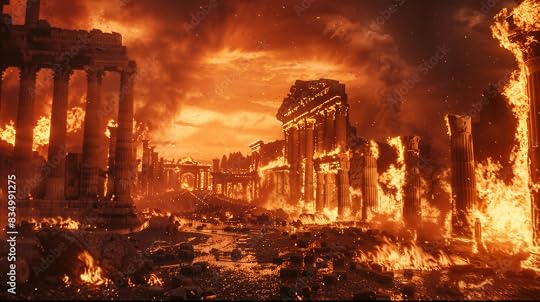
Władzy się z nikim nie dzieli, tylko się ją przejmuje. Usunął już niejednego wroga, w tym także swoją matkę Agrypinę. Tymczasem teraz na północy zagraża mu Boudika, królowa plemienia Icenów, która wszczęła rewoltę przeciwko Rzymowi. A nieco bliżej Gajusz Juliusz Windeks, wyższy urzędnik rzymski, który jawnie potępił zepsucie Nerona i stanął na czele galijskiego powstania przeciwko cesarzowi.
I was born in the normal way in 1971, and vaguely remember half-pennies and sixpences. I have written for as long as I can remember: poetry, short stories and novels. It’s what I always wanted to do and read English at London University with writing in mind. I taught English for seven years and was Head of English at St. Gregory’s RC High School in London by the end of that period. I have enormous respect for those who still labour at the chalk-face. In truth, I can’t find it in me to miss the grind of paperwork and initiatives. I do miss the camaraderie of the smokers’ room, as well as the lessons where their faces lit up as they understood what I was wittering on about.
My mother is Irish and from an early age she told me history as an exciting series of stories – with dates. My great-grandfather was a Seannachie, so I suppose story-telling is in the genes somewhere. My father flew in Bomber Command in WWII, then taught maths and science. Perhaps crucially, he also loved poetry and cracking good tales. Though it seems a dated idea now, I began teaching when boys were told only girls were good at English, despite the great names that must spring to mind after that statement. My father loved working with wood and equations, but he also recited ‘Vitai Lampada’ with a gleam in his eye and that matters, frankly.
I’ve always loved historical fiction as a genre and cut my teeth on Hornblower and Tai-Pan, Flashman, Sharpe and Jack Aubrey. I still remember the sheer joy of reading my first Patrick O’Brian book and discovering there were nineteen more in the series. I love just about anything by David Gemmell, or Peter F. Hamilton or Wilbur Smith. I suppose the one thing that links all those is the love of a good tale.
That’s about it for the moment. If you’d like to get in touch with me leave a comment in the forum or you can tweet me @Conn_Iggulden. I’ll leave it there for the moment. If you’ve read my books, you know an awful lot about the way I think already. There’s no point overdoing it.
The final book in the Nero trilogy ends as you’d expect, with Nero’s death, aged 30 having become emperor at age 16. This book starts with Nero fully in the role of emperor with able assistance from his two closest advisors, Burro, the head of his Praetorian Guard and Seneca the stoic philosopher. His mother, who’d manoeuvred him into this position is now gone, and almost forgotten. The story shows two halves to his reign. An early promising phase where he heeds the advice he receives, and the later phase where he throws away the checks and balances he had allowed himself to be constrained by, and follows his own reckless passions. Most of this book concerns his slow but steady descent into a type of narcissistic madness, bad temper and unpredictability. I usually check through some documented history to see how true or likely any historical fiction I read is. I like that the author includes an epilogue where he explains where he’s played with some historical facts, just slightly, to smooth the storyline. The author has indeed captured many of the apparently bizarre, cruel and ridiculous events in Nero’s reign. If anything, the author backs off from one or two of the more notorious reported events in Nero’s later phase, noting in the epilogue that Roman historians were possibly just too suspiciously damning of Nero for it to all be completely true! Such as the supposed taking of a castrated slave as a wife as he looked like one of his previous wives, told to us by Roman historians but not included in the story presented here…
What I’m really looking for is the creation of characters that I find consistent with recorded events. I thought he did this pretty well. It’s noted from the time that Nero’s love for theatre, music and poetry led him to trying to display his own skills in public - often for hours on end, with even important Roman senators not allowed to leave. At a later stage in his reign he went to Greece to take part in the Olympics (brought forward by a year to accommodate Nero’s schedule!). The Olympics then included the arts as well as sports. Nero received more than 1800 awards there, for his artistic performances, as well as ‘winning’ a chariot race in which he crashed. Indulging a powerful man with underserved awards is an activity which appears to be timeless.
Nero almost appears to lose interest in the demanding role of managing the empire and it’s this, together with his treasury draining spending sprees on palaces for himself in Rome, that eventually fuel the revolt against him by rivals, enemies and legions throughout the empire.
There were a couple of aspects that I wasn’t sure about in the story. Firstly, Nero’s genuine passion for the arts is well documented but I’m not sure it’s explained here why the character presented in the novels became quite so addicted, even to the exclusion of his day job, unless it was to indulge his clearly narcissistic nature. Secondly, it’s interesting that Nero’s cruel persecution of the new Christian sect in Rome is featured. Romans were happy for conquered peoples to maintain their own religions - as long as they acknowledged the supremacy of Roman gods and possibly the emperor himself as a god. Not something Christians could manage, with the one god, and the reason Nero and the Roman establishment were especially hostile to them. It was effectively treason. I found that side fascinating in the novel but I wasn’t convinced by the storyline that then suggested some of Nero’s advisors became sympathetic to the sect, even members.
A poignant ending to the novel noted in contemporary histories. The only person recorded as giving some respect to Nero, after his suicide by placing his ashes in the family tomb, was a freedwoman named Acte. She was also his first mistress, when he first became emperor, which suggests, just possibly, that the blackening of his reputation by Roman historians might indeed have been a bit one sided if she retained some affection or respect for him. A fine series by the author, giving these famously ruthless characters in the early Roman Empire some depth of character to sit alongside their larger than life reputations. 4.5*.
And so ends the life of Nero, Emperor of Rome from 54 to 68 CE, as well as this outstanding trilogy by Conn Iggulden. All three books were completely engaging and very well written, and I found I learned a lot from reading them. In this final book, we see Nero at the height of his power, brutally eliminating all possible rivals or enemies to hold on to a throne he never really seemed to have wanted. His interests were in theater, music, poetry, and he loved to put on spectacular performances -- especially when they allowed him to entertain and pacify disgruntled citizens while also killing off potential enemies. I recommend the entire trilogy to anyone who enjoys good historical fiction or reading about ancient civilizations.
🔥 Inferno by Conn Iggulden — the final instalment in the Nero Trilogy — brings Nero’s turbulent journey to its inevitable and tragic end.
Set in 60 AD, the novel follows Nero as he begins to rule more independently after the death of Agrippina. Rome is still at the height of its power, but beneath that grandeur, the foundations are beginning to crack. Boudicca’s rebellion, the earthquake at Pompeii, the Great Fire of Rome, the growing presence of the Christian sect, and an increasingly empty imperial treasury all add to the sense that something is going terribly wrong.
And while the empire desperately needs its emperor, Nero is becoming more and more consumed by his artistic ambitions, vanity, and personal desires. An empire that once seemed unstoppable slowly begins to burn from within.
🔥 Once again, Iggulden proves why he is such a compelling writer of Roman historical fiction. What I particularly enjoyed was his ability to make ancient Rome feel incredibly immediate. His descriptions and attention to historical detail often made me feel as though I was standing in the streets of Rome, watching these events unfold rather than simply reading about them. His research really shines through.
🔥 I also loved the way Iggulden builds the story around political intrigue, natural disasters, personal ambitions, and human passions. Rather than telling Nero’s story entirely through the emperor himself, we experience much of his reign through the eyes of characters such as Burrus, Seneca, Serenus, Octavia, Poppaea, Petronius and Epicharis.
That approach worked surprisingly well for me. These characters give the story a more intimate perspective and allow us to see the consequences of Nero’s rule from different sides.
Although there was one downside to this.
🔥 I sometimes found myself more invested in the minor characters than in Nero himself. And just when I had become attached to some of them, Iggulden would remind me how brutal this period was — by killing them off, having them murdered, or driving them towards suicide. 😅
Nero himself is probably the aspect I appreciated most. Iggulden portrays him as spiteful, petty, childish, selfish, vain, and deeply broken, without turning him into an exaggerated caricature. I was particularly glad that the author didn't try to sympathise with Nero or sensationalise some of the more notorious stories surrounding his reign. The author's note at the end also provides some interesting context about what he chose to include and leave out.
🔥 My biggest criticism, however, is that the book sometimes feels as though it shifts too far away from Nero's own story. I enjoyed the perspectives of the supporting characters, but there were moments when I wanted the narrative to stay more firmly centred on Nero and his gradual descent.
Still, Inferno is a strong and fitting conclusion to the trilogy. It may not be Iggulden's finest work for me, but it gave me a satisfying final chapter to one of Rome's most infamous emperors.
If you enjoy historical fiction set in Ancient Rome, particularly the works of Simon Scarrow, Ben Kane or S. J. A. Turney, I think you'll find plenty to enjoy here.
*4.4 starving lions, staring hungrily at bound and chained Christian prisoners, out of 5*
This final book in the trilogy covers a truly absurd amount of ground. Some details get skimmed over and a few changes are made that I personally wouldn’t have chosen, but overall it does a very solid job of capturing the scale, mess, and general spectacular rot of the final third of Nero’s reign.
We get poetry, betrayal, assassins, miscarriages, constipation, blood, secrets, affairs, infernos, sycophants, Christians, beheadings, tragedy, lutes, volcanoes, hot baths, loyal eunuchs, and more blood. Really, just the whole Roman imperial experience, if by “experience” you mean “a series of increasingly unhinged disasters.” Basically, all the fun and mayhem you could shake a well-used xylospongium stick at.
A lot of versions of Nero turn him into a fat, weak, pouty, blundering idiot in a crown. This trilogy does something better: it makes him a layered, self-important, emotionally unstable, occasionally self-aware disaster of a man with far too much power and almost no business having it. Sometimes he seems reflective, regretful, and even capable of doing the right thing. Then, almost immediately, he becomes an overgrown child with a god complex and starts setting his own life on fire, which is, admittedly, very readable.
The great fire of Rome in 64AD is described in vivid, breathtaking detail, which was awesome. Boudica's rebellion is featured (talk about tragic). The story and plight of the early days of Christianity's beginnings and early rising in Rome was super interesting, too. There's just a whole lot happening in a short span of time.
The Nero POV chapters are especially fun because you can watch him live inside a completely fake reality and slowly realize — far too late, of course — that he has spent his life wasting brilliant mentors, friends, allies, and resources on vanity and delusion. It’s tragic, but in the most Roman way possible.
And hovering over everything like the world’s most dangerous family ghost is Agrippina. This trilogy made me appreciate her even more, and honestly makes me want to go read everything ever written about her.
If you like epic stories, historical fiction, or ancient Rome being a nonstop disaster, read this trilogy.
This may have been my favorite of the three Nero books by Inguldden. I enjoyed learning more about ancient Rome and honestly, it wasn’t all that different than our modern day governments. Nero, in this book, seems like he should have never been pushed into being emperor. He mostly wanted to create songs, poetry, and plays. He cared little for running the empire and fed a huge ego. It was his ego that ended him by the completion of his reign. However, Inguldden creates a compelling character that you want to keep reading about and had me researching facts about Rome. Historical, yes but the novel keeps it interesting, emotional, and very human and the reader wants to know more. I recommend this whole series.
This is the third part of this trilogy. Iggulden has done his usual great job of researching his storyline. He keeps things interesting and not at all dry, like reading a history textbook from school. I do like his after thoughts explanations of what actually took place and what is conjecture. Definitely recommended
Inferno, the final book in the Nero trilogy did not disappoint. Conn Iggulden’s has written a fantastic description of the final years of Nero’s reign as Emperor of Rome. Initially he focuses on ruling his empire in a reasonable manner surrounding himself with trusted friends and military. However, he slowly begins to exhibit his true spoilt and narcissistic personality. He is more taken with poetry, performing arts and chariot racing! He loves to spend outrageous sums money on totally transforming Pompeii and Herculaneum following an earthquake and then Rome itself following a fire that destroyed half the city. He spent millions of sesterces restoring these cities just to boost his self importance. He slowly destroyed all his family, friends and advisors. He became vain, spiteful, selfish and childish while Rome was slowly becoming bankrupt due to his outrageous spending on his projects to enhance his self importance. Eventually the senate and the legions had enough and turned on him. Lending to him fleeing Rome and suicide!!
I was glad that the author finished the trilogy in time for me to read it after reading the first two books. I also have read almost all of Conn Iggulden's books as he's one of my favorite authors.
For some reason I felt like this book was "hurried" so it was't quite what I expected. I can't really state what it was but I felt it wasn't his best work. I guess that's all.
Mr. Iggulden is a fantastic writer of historical fiction. What I like most about his characters is that he paints them in a better light than other writers and source writers. For instance, Nero has been proclaimed a cruel ruler for all these years. Some say the cruelest of all. Mr. Iggulden, based on research, let me see Nero's better side.
Nero loved performing in the theater. He loved playing the lyre. He loved the arts more than governing. After Rome burned, he used rather flamboyant color and style to rebuild what was lost. It was not a good time to build for himself a grand mansion. Nero made other poor judgments that eventually cost him his life by his own hand.
His first wife was barren, so he had her killed. He married Poppaea who died birthing a son. While Poppaea labored, it was clear that mother and son would die. Nero ordered what we call a C-section be done to save the son. Both mother and son died. There would be no heir. What Nero did to both wives was cruel, and it weighed on his mind.
A Christian sect was building in Rome in Nero's time. Nero had the Christians killed. I do not see that in a horrible light. Just think about the gods the Romans had worshipped for centuries. Then a religion in the making poses a very real change in the governing of the people. I am forever thankful that Christianity took hold and grew, but how would a Caesar view a King?
I give my opinion of the four letter word Mr. Iggulden used four times in the book. The etymology ( I hope the etymology is about words and not insects.) of the word goes back to the fourteenth century. Why use it at all? It does not add anything to the story. I have advised the author in this regard at earlier times. He does not listen to me! Not one whit! I would like to know what invectives were used in the first century.
Thank you, Mr. Iggulden, for a good read. If only you were a cowboy....
Inferno by Conn Iggulden (Book 3 of the Nero Trilogy) was my favorite book of the entire series and an easy 5-star read. Iggulden brings the final years of Nero to life with all the drama, intrigue, and tragedy that made the Julio-Claudian era one of the most fascinating periods in Roman history. While Nero is often remembered simply as a monster, Iggulden paints a more complicated picture: a volatile and increasingly dangerous ruler whose love of music, theater, poetry & chariot racing feels completely genuine. Stay with me… In an odd way, Nero sorta reminded me of a psycho Michael Scott—both crave applause, admiration, & validation from an audience they desperately want to love them. The difference, of course, is that Michael Scott runs a paper company while Nero rules the Roman Empire and kills Christians. What is amusing in a sitcom becomes terrifying when combined with absolute power.
The novel also does an excellent job weaving early Christianity into the story. Historical figures such as Peter and Paul the Apostle appear naturally within the narrative, providing a fascinating glimpse into the small but growing Christian movement in Rome during Nero’s reign. I especially enjoyed seeing Matthew—still referred to as Levi by some characters—depicted as recording his account of Jesus. These scenes help ground the story in a world that was changing far beyond the intrigues of the imperial court. Although, I don’t think the historical record has Matthew in Rome. Luke was there…so why not others?
Pompeii earthquake, Boudicca, roses, Rome burning & lyre’s being played…
For me, Inferno was everything I want from historical fiction: compelling characters, real historical figures, strong pacing, and enough historical detail to send me down rabbit holes afterward. A superb conclusion to a trilogy and my favorite volume of the three.
A fascinating and fantastic trilogy. For any interested in Nero, and wanting a Nero generally more complex and psychologically grounded than the caricature found in some ancient accounts, this is for you.
His belief and focus is clear in humanising a Nero that is heavily debated. He even goes to the extent of not adding the accounts that claim Nero dressed and announced to the Senate that Sporus, his eunuch, as his past wife. I wouldn’t saw I completely agree with the level of sanity given to Nero in the series. While he does balance it well, I think he was a bit more insane as it takes a level of insanity to do what he did to Christians (which is VERY WELL documented in this series), & the killing of Poppaea & episode with Sporus has more grounding in reality than he gives credence.
I know he acknowledges the extreme bias of Suetonius and Cassius Dio who record those things which is true, and he follows Tacitus almost religiously, but I would also take into account the early Christians recordings which tend to agree more with the insanity side of Suetonius and Cassius Dio.
But I love his take and thoughts, it could very well be the most accurate account of Nero physiologically, especially considering his insane upbringing.
Rome: A.D, 60 - 68. It was a rough few years for empire and emperor Nero. Much of this book seems scarily attuned to our current age, 2026. While his empire convulsed around him, while his people were repulsed by his ruthless treatment of his perceived enemies, and while many went hungry, Nero kept his focus on spectacle and self-glorification. Things seemed calm at first, but when it rains it pours. In far away Britannia a woman known as Boudicea, gathered an army and led a bloody uprising against the Roman overlords. There was a devastating earthquake in Pompeii and Herculaneum. Nero's wife, Octavia gave birth, but it was a girl child, so that did not end well for mother or child. His second wife, Poppaea died in childbirth, as did the unborn boy child. A growing new religious cult calling themselves Christians held secret services throughout the city. Nero had hundreds of them burned in a profane public ceremony. Then Rome went up in flames. Assassination plots abounded involving some of his oldest friends and advisers. First time reading an Iggulden novel. I look forward to more.
The audio version is outstanding. Finished it in 2 days. The series is great but Inferno is particularly good since it focuses on that part of the Nero story we are most familiar with. The fire. The paranoia. The murders. Not terribly accurate but I don't expect Conn Iggulden's books to be completely accurate. Burrus as a Christian martyr sent me running to Google to confim the religious inclinations of the famous Preatorian Prefect and the writer. One yes. One no. The author is not a historian, he is a fine writer who knows some history. A "what if" guy with the ability to engage. Nero is a bad guy. A victim of lousy parenting it seems. A megalomaniac of the highest order. Whether or not it ends well depends on your point of view. I am sorry it ended but mayhem has to stop somewhere, I guess. I have read most of what Conn Iggulden has written. I eagerly await more. He is much younger than me. I credit Conn ,Simon Scarrow , Ben Kane and Bernard Cornwell (older than me) with increasing my longevity.
The final book in the Nero trilogy, absolutely brilliant, I loved it. So well written and informative, all I previously knew was that Nero fiddled while Rome burned, there is so much more to it than that, and watching the lovely Christopher Biggins playing a very petulant Nero in I, Claudius. I actually found him rather a sad character even though he was a very selfish, self absorbed person, who seemed to see his close friends as disposable, an artist and performer first and emperor second. I always read the author’s notes at the end of the book, mainly because they are so informative and I highly recommend reading them at the end of this book. I really do think that this Nero Trilogy is up there with Robert Graves I, Claudius and I have downloaded it to read soon. Thank you Conn Iggulden for writing this Trilogy, I have enjoyed it immensely,so much that I read it in 4.5 days with a lot of night reading.
Непогано, хоча мені не вистачило надламу в характері Нерона, як це хотів описати автор (згідно його ж слів у післямові). Антагонізація поступова, але можна було зробити й краще. Кінцівка теж доволі… anticlimactic. Наче автор сам утомився від свого твору і хотів чимскоріш закінчити.
Дуже вдячна за історичні пояснення наприкінці кожної книги, що дозволяють побачити працю автора над історичними джерелами й те, як він змінював деякі факти й події задля кращого сприйняття читачем. Для мене це завжди цікаві інсайти.
Ну і сподобалося розуміння автором того факту, що історію пишуть переможці, й тому все, що ми знаємо про Нерона, написано здебільшого його ворогами, тож кожне їхнє слово варто піддавати сумнівам та звіряти з іншими джерелами. Автор постарався відобразити Нерона настільки людяно, наскільки це було можливо, спираючись на історичні відомості про його життя і правління.
Хороша трилогія, раджу всім, хто цікавиться історичними романами чи імперією Риму.
Inferno is Conn Iggulden's third and final book about the life and times of Emperor Nero. In this book we see what happens to Nero from killing his mother to his own death. Also we see w the at happens to all the people who surrounded him. Whether is his long time tutor an advisor,Seneca. His imperial guard, Burrus, his long time friends Serenus Pretronius or Otho. Then you see what happens to his three wives and first love Nero was also a poet, singer, actor, charioteer and emperor. This book does a good job of highlighting the other historical events that happened during his reign. If you enjoyed the other two books by Conn about Nero, you will appreciate this one too If this is your first book about Nero by Conn, it stand alone too I give it a two thumbs up as a historical novel about Nero and I recommend reading Conn's historical notes at the end of the novel to get a full perspective of his sources and what we know about the history of that time.
The story of an ancient narcissist A slavegirl breaks a valuable vase belonging to her master Senator Pedanius. In defense of her daughter, her mother kills him. Elsewhere in the great city, thirty slaves ready the emperor for the day. By law, all 400 of Pedanius’ slaves must be killed for the crime of one. Nero enforces the ruling. He is divorcing his wife to marry mistress Poppaea. Two decisions unpopular with the plebs. They are chanting her name in the streets, with torches. Nero doubles down; Octavia is banished to Pandateria. Poppaea is a schemer, but we grieve with her when baby Claudia dies. The king of the Iceni is dead, and the queen’s daughters are screaming. We see the battle for Britannia through Suetonius’ eyes and through Boudicca’s (whom Iggulden names Ymma). But it’s the Great Fire which is exciting. The Fire is deliberately caused by the Christians, in order to fulfil their prophecy of the End Days. Nero personally sets the scapegoats alight in the arena. We meet St Paul and St Peter, and to give us more footage of the Christians, Iggulden makes prefect Burrus a convert. This Nero is the wanna-be musician, surrounding himself with sycophants who’ll clap for him, but with more power now, he’s become more of a tyrant. Nero’s insistence on the sycophancy goes to extremes; he doesn’t seem to require sincerity. He watches his audience eagerly, in case they register a flicker of inattention to his performances. Vespasian nods off and gets sent to Judaea. And yet there are moments of strong leadership, before narcissism triumphs. He rises to the occasion of the Great Fire, devoting his own wealth to the relief. Multiple point of view characters make it interesting and pacey. The writing is gorgeous, and filled with intimate details of ancient Roman life.
I really enjoyed this take. It flowed well and accounted for potential biases. I appreciate the way Nero’s character was unpacked. It didn’t feel forced or rushed. It built like a tower of blocks and came crashing down. I will say I feel other character depictions lacked a certain level of depth but it wasn’t jarring/super noteworthy (I also recognize this wasn’t their story).
I always appreciate a historical note at the end. It could have been more detailed (as could other parts of the book) but it was still solid nonetheless.
Conn Iggulden is one of the best (and most prolific) historical fiction writers in the game. His Conqueror and Emperor series were two that cemented my own mid-life reading renaissance. He's great.
And his Nero Trilogy is right there with his best stuff. I was initially a little dismayed by how much Caligula and Claudius were in this NERO tale... through books one and two, this was more Agrippina's story then it was Nero's. But this is an incredible take on a wild period of Imperial Roman history.
52 book club 2026 #51 Includes a map. Really enjoyed this trilogy as haven’t delved into Roman history very deeply previously.I was struck by the scheming and brutality surrounding the emperors and in society generally.The persecution of Christian’s and their torture as the religion was starting to emerge is shudderingly awful.I’m interested in getting to some of the other series this author has produced,maybe the War of the Roses next.
This trilogy was so well written and researched. While Nero's end is somewhat anti-climatic, his rise to power and actions while there were equal parts terrifying and fascinating. Iggulden is a natural story-teller who tries to be as true to the historical record as possible. As much as I enjoyed the Cicero trilogy written by Robert HArris, I enjoyed this one so much more. I look forward to checking out Conn's other series and titles.
When I tell you I dropped everything to read this the moment my library had it available!!! I'm so glad I did. If you know the story of Nero, there's no surprises here but the way this author writes the characters is so endearing that you can't help but feel bad for Nero. Definitely a victim of bad parenting imo. That being said, this was a great conclusion to an amazing trilogy!
Really great ending to this trilogy. As much as Nero is the villain, he is also painted with some complexity, with a plunging, cringe-worthy downfall. Similar to the Plantagenets of the middle ages in England, this family line of Augustus down through Nero is truly deplorable...murderous, traitorous, neglectful, extravagant, corrupt, petty, narcissistic, you name it.
So described the author himself about one of Rome’s most infamous emperors. Spoiled, selfish, deluded, extravagant. Tragic story altogether with many who suffered as a result of his impetuousness and ambition.
Fascinating story. Iggulden delivers the goods in yet another stunning novel of Ancient Rome.
Nero's reign was brutal as he murdered those who crossed him. It took me a long time to finish because it was so violent. The epilogue is very helpful for those who want to which facts are recorded by historians, The trilogy was fascinating.
I am puzzled by this book. Iggulden decided to indulge the fiddling whilst Rome burned legend, but the story of Sporus is largely ignored. I listened to the trilogy on audiobook and its narration by Lydia Leonard was great.
This entire review has been hidden because of spoilers.
A wonderful end to a brilliant series. Nero has been presented throughout as what history indicates he was; a complex, tormented character. Probably the best series this author has written (and he has written some great ones.)