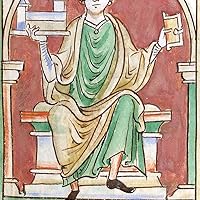
A biography of Henry II (ruled 1154-1189), the first Plantagenet monarch of England and founder of a dynasty that lasted until the death of Richard III in 1485. Henry married Eleanor of Aquitaine and with her duchy and his own Normandy, Anjou, and Maine controlled rather more of France than the French king. He had effective control of Scotland and made the first English efforts to conquer Scotland. His barons began the conquest of Wales. He was, in many ways, the most influential monarch in Europe in his time. In England, he invented the system of writs and the common law that are the basis of our own law to this day. He asserted, largely successfully, the rights of the monarchy against both the baron and the church. His famous quarrel with Thomas Becket, his Archbishop of Canterbury, is the stuff of legend. This is his story, excellently told.
Wilfred Lewis Warren was a historian who specialised in Norman and Angevin England. Born in 1929, he was educated at the High School, Newcastle-under-Lyme, and at Exeter College, Oxford, where he was an Open Scholar in History. He received his D Phil in 1955 for a thesis on Simon Sudbury, Bishop of London and Archbishop of Canterbury, 1361-81. He taught at Queen's University, Belfast from 1955 until his retirement in 1993.
Henry II's reign was complex. He inherited Anjou from his father, a claim to England and Normandy from his mother that as a teenager he had to fight for, he gained the south-west of France through marriage to Eleanor of Aquitaine, control over Brittany through some Feudal shenanigans, obliged to intervene in Ireland to restrain some over ambition Norman-Welsh lords, quarrelled with Thomas Becket, Kings of France, his sons and his barons. Henry's life was a gallop across countries, jurisdictions and customs in a struggle to assert authority.
His rule was somewhat enigmatic as for all the radical newnesss of the authority he asserted both geographically and within the traditional bounds of his inheritance he claimed to be a conservative, seeking merely to restore the royal authority as it had existed under his maternal grandfather Henry I.
Warren deals with the variety and complexity by dividing up the life thematically. Clear chapters on distinct topics (law, government, relations with the church), plenty of maps showing castles controlling key wine growing areas along the Loire, family trees and the occasional diagram make this an easy book to work with. As a student many, many years ago I read the bits I needed, ignored the rest until my austerity policy of reading the books I own before buying new ones led me to blow the dust off it and break its spine.
The sources keep us at arms length even from a relatively well documented figure like Henry II. On the one hand the relatively detailed accounts can tell us how much he was spending on building his own and demolishing others' castles or that a mercenary foot soldier was paid a penny a day in his service but the person remains remote. The chroniclers, authors and letter writers record anecdotes but these may be the medieval equivalent of urban legends, or tales improved in the telling. The occasional eye witnesses were either not people who were close to him, or they were those with their own particular biases.
Despite this the anecdotes Warren cites of Henry pulling Thomas Becket's coat off him to give to a poor man, laughing at being reminded of his tanner cousins of Falaise, laughing off a treason accusation when the accused told him that they would have said worse things if they hadn't have run out of wine, or chewing straw in his fury give a flavour of the man.
The book is Warren's attempt to extrapolate Henry II's policy from his actions. In hindsight this seems a misguided effort, one could more naturally argue that the King's actions were largely reactive in nature trying to make the best of changing events - like the victory of Strongbow & his men in Ireland, even for that matter his stated policy ambition of restoring the kingdom of England to the condition it had been in during the reign of his grandfather: Henry I, of more use maybe to examine the people immediate around the King who he turned to for advice or who acted as his agents and lieutenants. But this is at once fairly standard for a biography of a medieval ruler but particularly ambitious in the case of Henry who ruled over territories with distinct political cultures. Much of the book has an English focus with chapters on the governance of England, English Common Law and relations with the English Church, while Henry's activities knew no political boundaries. Money raised in England through effective utilisation of resources (including rights of wardship over widows and orphans) hired mercenaries from Wales and Flanders to fight in Southern France for instance. His quarrel with Becket affected his dealings with the King of France. The neat chapters of Warren's book perhaps give a misleading calm to his rule when many decisions which came to have far reaching consequences emerged out of the need to deal urgently with developing situations.
Warren does argue that that experience and maturity led to a change towards greater flexibility on Henry II's part. But equally one might point to the change in his advisers as they died or moved on. Warren looks to the importance of Henry I as a role model. But the influence of his parents and the political cultures they had been familiar with in Anjou and Germany is something that is not explored. This is the problem with Henry II, he is complex figure. A rounded view of his reign requires expertise in many areas.
The biography was originally published in 1973 and had a three page addendum added in 1990, this makes clear that one of Warren's weaknesses is that as his book is a dialogue with earlier historians, F.W. Maitland and Bishop William Stubbs feature from time to time, that the lack of a thorough study of the English Church in this period meant that his original assessment of Becket as a "theological dinosaur" was unreasonably harsh. But despite its age this remains a wide ranging yet readable study and with its careful explanations of the growth of Feudal power bases and the operation of a simple government with its Exchequer cloth and audits of Sheriffs, a good stepping stone back into the past.
Post script In comparison with his earlier book King John you can see the development of Warren's thinking for instance on the question of Laudabiliter . By this book Warren has shifted from seeing Henry II to having Archbishop Theobald as inspiring the Papal Bull.
This entire review has been hidden because of spoilers.
His greatest achievement, indeed, was not that he created a vast dominion, nor even that he held on to it and largely tamed it, but that he introduced to it the art of government.
Huge effort to capture the essence of a tireless soul whose struggled to standardize and thus modernize the English realm. Perhaps growing up during such instability forged his resolve. His famous mother Matilda escaping the clutches of King Stephen, a winter walk for posterity. Despite there being precious little that we can instantly identify as being English in the chauvinistic sense, Henry worked to anchor relations with the Scots, Welsh and Irish. reigned in the barons and addressed the church. Under Henry's tutelage, many steps were taken along the road to Common Law. His friends and family appeared as ambitious as he was, often with disastrous or at least minatory consequences. In fact he dropped dead after refusing to fight one of his sons Richard who had again chafed at reality and bared his sword. This is an exhaustive look at policy and posterity. There isn't an abundance of personality within.
This is the most comprehensive and detailed biography I have ever read in my life. It is also the most academic work I think I've ever seen.
The reign of Henry II, King of England, Count of Anjou, Count of Maine, Duke of Normandy, Duke of Aquitaine, Duke of Gascony, Count of Nantes, Lord of Ireland etc is told from hundreds of contemporary sources and historians, and interpreted in such an astute and articulate manner that even the minor details of forest law being administered by sheriffs are explained. No stone is left unturned, every scrap of every document from the era is examined and discussed. Warren ruminates on what may have been the state of affairs from periods where the records are lost, based on changes in practices and customs a generation later.
This is not a book for casual reading, this is a book to explain the entirety of the reign of one of England's greatest kings in obsessive detail. The book cites Pipe Rolls, letters from the Pope, court documents from relatively minor and isolated shires, and manages to cover every detail with sufficient context and uses it to support the author's conclusions about Henry's reign.
This was hard for me to read. Given my literary proclivities I feel that statement hopefully conveys just how insanely dense and thorough this book is. Seriously, do not read unless you need to know every detail of the King's life.
In the introduction, Warren notes that it took him over 10 years to write this book. At 700 pages, tiny single spaced font, and thousands of citations, I am amazed how quickly he got it done.
Henry II Wilferd Lewis Warren (W.L. Warren) Read it in old Hard Cover at 693 (including bibliongraphy+index+etc.)
Succession is messy business. The story of Henry II of England and the founding of the Angevin commonwealth is no different. It was a long road for Henry II to realize his inheritance and the story begins with Henry I of England. At this time in history, the power and crown of England is owned by the Dukes of Normandy who must pay homage (for Normandy) to the French Crown but an equal in England, a division across the channel. Henry I who lost the guarantee of stability on succession with the White Ship tragedy spent his final days trying to find a suitable successor. He re-married but failed to produce another male inheritor from that marriage and it is said legitimized his oldest daughter and any offspring she had with Geoffrey Plantagenet of Anjou. This marriage would produce three sons, the oldest being Henry II. On the death bed of Henry I however some things get a bit jumbled and his grandson was but an infant so when Henry I passed the kingdoms nobility selected Stephen, Henry's well landed and liked nephew as king, ushering what would be known as the Anarchy in England.
We've made it through the prologue…as you can see, things get complicated quick.
This is Henry II's journey to realize his inheritance and mold it into an Empire that would be nearly unrivaled in the west. His father had helped guarantee his sons claim to Normandy by conquest from Stephen and when Geoffrey died Henry finally had enough power, stability, and resources to pursue his claim in England. With 19 years of civil war, the nobility and just about everyone was looking for peace. With the death of Stephens heir apparent peace was garnered. A dual kingship with Henry II as his heir. With the death of Stephen in 1154 Henry is crowned at the age twenty-one in/on Dec. 7th 1154, his inheritance finally consolidated. Henry would prove to be a dominate and surprisingly affective King/Duke/Count. Raising up in his father's very ample and able court during the conquest of Normandy in his name surely helped to give him the purview of a successful rule. He arranged a favorable and controversial marriage that garnered him even more territory (Aquitaine) and despite a failed invasion of Toulouse wrangled in Brittany, appeased Ireland, calmed the Welsh, and solidified Scotland. Despite his famous quarrel with Beckett (which Warren demonstrated and convinced me that the result, cause, and end were all instigated by Beckett himself and his delusions), Henry actually navigated the quagmire the Church quite well and in his benefit or making concessions in the name of stability. In the end, the marriage with Eleanor of Aquitaine would produce eight children in which four sons would achieve maturity (Henry, Geoffrey, Richard, and John) and this is what would prove to be Henry's biggest challenge. Much like their ancestors the youth were impatient and easily influenced, the sons of Henry were no different. A great plot was hatched with aid from the French King (looking to degrade his vassals power which was woefully out of control). A war began with Henry besought on all sides by his enemies and within, his faith in his most trusted friends and family shaken. Henry firmly on the defensive went about his realm with spectacular elasticity repulsing his enemies and refusing the investment of his major supporters. This fluid dynamic to his warfare kept him from overreaching and lent its strengths to his pockets of supporters and the strategy he best was suited for. The plot was a failure, and although Henry would accept his family back into the fold, they would again, and again prove a source of great consternation and destabilizing factor to him and his kingdom that would eventually plague him to his deathbed. Henry died on July 6th 1189, his Kingdom once again torn asunder by the son who had been bent to believe that Henry wished to defraud him his inheritance, Richard I the famed Crusading King of England.
It is said that Henry had a great mural painted in which:�there was an eagle painted, and four young ones of the eagle perched upon it, one on each wing and a third upon its back tearing at the parent with talons and beaks, and the fourth, no smaller than the others, sitting upon its neck and awaiting the moment to peck out its parent's eyes. When some of the King's close friends asked him the meaning of the picture, he said, 'The four young ones of the eagle are my four sons, who will not cease persecuting me even unto death. And the youngest, whom I now embrace with such tender affection, will someday afflict me more grievously and perilously than all the others.'
An extraordinary man who was not ambitious or looking for prestige except in the acquisition he believed was due to him in right, to pass down to his dynasty. In this Henry was successful and while his dreams of a family federation were shattered by those who would have seen to inherit it all, the common wealth of the Angevins/Plantagenets would remain a force in Europe for generations eventually culminating in what would be the 100 years' war and the endless power struggle by the French to regain these lands and by the Angevins to control or prevent their loss.
A fantastic bit of high middle.
Warren was born in 1929 and left us a little prematurely in 1994 at 65. Within these 65 years Warren received Wolfson Literary Prize for History in 1973 for his work on this tomb. Additionally, Warren wrote the biography for King John (Henry II's youngest son) and a general 'The Governance of Norman and Angevin England, 1086-1272'.
Warren's approach in Henry II breaks what has been the traditional mold for the English Monarch Series in structure but definitely overcompensates in knowledge, maps, genealogical tables, and probably has the best prologue/introduction/setup to the events prior to Henry II's contributions that I have read yet. Naturally, it's thick and encompassing so be prepared for a deep read. This is highly recommended for anyone with an interest in the time period and not afraid to get into the knity-gritty including economics, church and state, etc. of the period.
As more times passes, Simon Schama's TV programme and books of the early noughties "A History of Britain"are becoming more and more important to me. One of the many brilliantly told stories in the programme (and books) is the tale of Henry II and family and, fired by that story, when seeing a copy of this book in the mid-noughties in Old Foyles bookshop in London (before it smartened itself up) i had to have it.
As the preface tells us, the book is mostly in three parts; how Henry rose to power, his influence on the method of law and its reform in England, and his dealings with the Church in England. Woven into this is the condition of the territories he inherited and/or annexed, why and how the law in England needed change, how it was done and how much he had to do with it, and of course the Thomas Becket saga. Almost mythical figures inhabit this story, Richard the Lionheart, Eleanor of Aquitane, Bad King John and Becket who perhaps still exist in the public consciousness even today, hopefully there's still a pub named for Becket in Northampton, next to the Railway Station, itself built on the site of Northampton Castle, a place very important to the Becket story.
The chapters on the law have a lot of detail, maybe that chapter isn't for the general reader. I love my history, have had a bit to do with the law but i found that chapter hard.
As Professor Warren says, there is very little evidence for his inner thoughts, and only one description of his appearance and that's not that detailed. The image i have of this man is a man of tremendous energy, certainly a tyrant and not a man to cross, he maybe wouldn't get on so well these days but it seems he was a very very impressive medieval monarch, quite the "Great Man" of english history.
The book spends a lot of time in England, perhaps because it's a book in the "English Monarch" series but another reason is given in that there are very few sources covering the continental dominions.
And finally, my copy, being a 1977 paperback edition of a 1973 original has, on the back cover, a testimony from Michael Ratcliffe of The Times who suggests this book will stand as the definitive account for the next fifty years. And we now are fifty years on. I've just done a search on a few bookshop websites for books about Henry II and this book still shows up with excellent ratings and reviews.
I would exclaim, "INCREDIBLE!" if it weren't for the innumerable citations; and trust me: this is a compliment. AWESOME PIECE OF WORK. This will also prove to be a helpful reference book if I ever choose, or need to use it as such; and as I don't think I'll ever write a biography of Henry II myself, I suppose I could use it to back up my claim that Henry of Anjou was the Mozart of politics. I knew the man was kick-ass ... Now I'm just in awe :)
01/24 page 206 33.0% "If only all rulers were as just as Henry II ..." 03/02 page 292 46.0% "By far this is the most comprehensive biography I've ever read. The bibliography spans 32 pages. Incredible. I am LOVING this." 03/08 page 352 56.0% "mort d'ancestor"
03/19 page 518 82.0% " Becket ranks (in my opinion) as the most cantankerous, uncompromising historical figure EVERRRRR; so WHAT if he's been canonized as a saint. He annoys me; although I have developed a shred of sympathy for him."
Warren has written a truly comprehensive account of the great British monarch and his world. Portions of the biography are also truly enjoyable. Large sections of the book, however, are far too detailed for someone with only a lay interest in the subject. This is definitely not a work of popular history.
One of the things that I have come to appreciate through this project is how certain biographies can dominate the study of English monarchs. Though this is not true for all of them, for some monarchs one work ends up becoming the go-to source for students and scholars seeking to learn about the king. It’s probably more than a coincidence, too, that these books tend more often than not to be the volumes on the subject for the English Monarchs series. Whether it’s Frank Barlow’s book on Edward the Confessor or David Douglas’s on William the Conqueror, the depth of their examination and the quality of their scholarship ensured that they defined our understanding of that monarch for decades after they were first published.
King Henry II is one of the most fascinating rulers of the Middle Ages. A man of deep passion and great ability he ruled not only England for over thirty years but he was also the master of half of France. Henry's lordship over half of France was a situation that did not please the two French kings that Henry had to deal with in the course of his reign: King Louis VII and his son Philip II.
The book begins with the disaster of the White Ship that killed Prince William, King Henry I's son and heir. The premature death of the King's son sent all of England into chaos as King Henry's surviving daughter, Empress Matilda, and her usurper, King Stephan, battled for the throne. Henry sees action at a very young age, yet, he never allows himself to be governed by it. Henry was a king who also appreciated diplomacy, he could both fight and talk.
The book is divided into several sections. The first of these deals with Henry's political career. A career that includes his unusual rise to the throne, his political marriage, his struggles with the church and the King of France, and the rebellion of his sons. The author uses the rest of the sections to take a closure look at the various aspects of King Henry's reign.
Henry II is most remembered amongst political scientists and the legal profession for establishing a system of courts under what would be called the Common Law. King Henry was able to achieve this by pretending to be carrying on the old classical traditions of Anglo-Saxon England despite the fact he was doing something completely different. Warren was also described to the reader that this evolving judiciary was very fluid and times very confusing because of the personality of the King himself.
"Clearly the curia regis existed wherever a delegate of King Henry acted in his name. It also, of course, existed wherever King Henry himself happened to be. This could be anywhere for the king and his household were continually on the move. In the thirty-four years of his reign Henry II spent Christmas at twenty-four different places. He crossed the English Channel at least twenty-eight times and the Irish Sea twice." (p.302)
Although King Henry II considered it his personal duty to do justice by his subjects, they were still his subjects and the government was his personal entity. Warren is quick to point out that this should not diminish the achievement of this King and his reign, for King Henry did try to do right by his subjects and his reign left a positive legacy.
"Royal power under Henry II could be discriminatory, violent, arbitrary, wilful, and selfish--for monarchy was still personal, and it was Janus-faced. Nonetheless, its weakness should not be allowed to obscure its virtues; and in the long run its customary impartiality, its respect for legal principle, its equation of right and law, and its sense of justice, were more important in moulding the traditions of English government than its lapses into tyranny." (p.395)
One of Warren's theories to how positive the government structure left by King Henry II was viewed, was in the rebellion against King Henry's son King John that led to the Magna Carta. King Henry was a king who knew that kingship came with responsibilities, and the Magna Carta was made to remind King John of what his father should have taught him.
"Magna Carta was to condemn the defects of royal government by the high standards which that government had itself inculcated; and it was Henry II who taught his subjects the remedy against the abuse of power--the rule of law. This was his greatest paradox." (p. 396)
One of the issues that I completely agree with Warren on is the King Henry/Thomas Becket rivalry. Despite Hollywood claims to the contrary, Thomas Becket was the jerk and King Henry was the just ruler. King Henry II, the ruler of the kingdom, wanted to be able to enforce laws on all of his subjects, including members of the clergy. So if a member of the clergy--which according to Warren consists on one sixth of the kingdom--commits a crime he has to be held accountable. However, Becket did not feel the same way. Becket wanted the clergy to be above the King's law yet have clergy be able to hold the secular royal officials to the church is law.
"That relations rapidly deteriorated was initially not Henry's fault but Becket's." (p.453)
Becket was so drunk on his own power it is hard at times to take him seriously. Warren points to issues and arguments where Becket even tends to make up or exaggerate facts in order to support his case! He is hardly the person I would want as a leader for he was so bull headed he could not be asked in good faith to negotiate to a reasonable compromise. King Henry II should be recognized as a hero who saved England from a total theocracy. If Becket had his way the King of England would be an agent of the Archbishop of Canterbury, instead of the other way around. Unfortunately King Henry ranting in anger would make some overly anxious knights go on to slay the Archbishop and make him a martyr. Although Becket's personal reputation was strengthened by death his cause justly died.
I also found Warren's theory that King Philip II of France is in some ways Henry's true successor to be interesting. King Philip mimicked Henry's court and, like Henry, did his best to give good government to his subjects. Henry's lessons were appreciated by his enemy in ways his sons could never pick up on.
I highly recommend this book. W.L. Warren does a great job explaining the life and times of one of England's most famous and enlightened rulers, King Henry II.
A comprehensive, readable and sympathetic biography of Henry II.
Warren looks at the issues Henry inherited, the reforms he pushed, and how he dealt with such problems as the Church (the longest part of the book), the other lands in the British Isles, his kingdom in France, and his troublesome family. Warren covers how Henry matured over time, his attempts to unify different lands in his realm, his interest in expanding the reach of the law, and his failed attempts to distribute his kingdom among his sons. Warren’s coverage of Becket is critical; he comes off as power-hungry and disingenuous, and Warren avoids using the affair to define Henry’s entire reign. Richard comes off as a little naive, and Warren covers how Henry won his family struggles until he just became too tired and ill.
The narrative is well-organized and flows well, the writing is lively and engaging for the most part, and Warren does a good job conveying Henry’s intelligence, energy, practicality, temper, and gift as an administrator. The level of detail can get somewhat tedious, depending on what interests the reader. There is surprisingly little coverage of Eleanor of Aquitaine, who doesn’t seem that significant in this version of the story. There is more coverage of England than Henry’s lands on the continent. The coverage of Henry and his sons may strike some readers as inadequate, almost like Warren found the subject too boring. Also, Warren's negative portrait of Henry the Young King seems overly simplistic.
Still, a well-researched, well-written and insightful work.
Quite simply one of the best royal biographies I have ever read (and I've read a few). Very well researched, well written, very detailed. It's up there with Hollister's biography on Henry I.
Henry II, King of England approximately a century after the conquest by the Normans, was one of Medieval England’s most consequential monarchs. He controlled a great swathe of territory stretching from the Pyrenees to the Scottish borders. His reign saw consolidation of English power and the first forays into Ireland. At the same time he was a more powerful magnate in France than the King of France himself. But the sweep of his lands is perhaps secondary in his achievements to bringing stability to England after more than a decade of civil war, increasing the power of the King’s administration and expanding the writ of the King’s justice at the expense of the barons. A consequential monarch then for W.L. Warren to be writing about in his book Henry II. This is an overview of Henry’s reign in terms of the narrative of events and also thematically on government and religion.
Warren sees Henry II as exceptionally important in all sorts of ways but particularly as a strong king, and an innovator in governance, administration, and Justice. Warren does occasionally overstate the case, for example he states that at the beginning of the reign (p362) “It was more likely that the realm of England would, as Germany did after a civil war, disintegrate into principalities.” This was a totally different situation, and never very comparable and even with the Anarchy Warren does not make a good case for it. The German Emperors had very little territory held directly with the main nobles holding as much, the English kings held immense amounts of territory (even if not as much as after the conquest) and far more than any individual magnate. Moreover the German magnates often held concentrated territorial holdings in a way that was not the case in England where feudal baronies were spread in packets over multiple counties. Moreover England had a history, and therefore acceptance, of centralisation that Germany never did, making a strong king once the civil war was over more likely than not.
This is a series of books about English Monarchs so it is not surprising that the focus should be on England. However, that does present a book on a King like Henry II with something of an internal inconsistency that is never resolved. Henry II himself spends more time in France than in England. The narrative element of the book reflects this and is all about him dashing hither and thither across France, fighting the French King and subjecting unruly Angevan barons. Conversely the thematic elements of the book are tilted the other way; Church, Administration, Governance and Justice are all almost entirely focused on England, although not exclusively so. This does make the book feel a bit unbalanced and that there are big gaps in what would have mattered to Henry II that we don't learn about - though of course that would make an already pretty big book much bigger.
The other element we don't get so much is on the personal life of Henry. This is presumably down to a lack of sources; we have lots of administrative minutia and chronicles but no diaries, love letters or other information to provide the personal touch. Personal is of course public for a monarch so there is plenty of information about what happened in his marriage, his fights with his sons etc. There is however perhaps less on personal relations - except where it directly is an element of state policy e.g. being lenient to the fecklessness of Henry the young king or rebelliousness of Richard.
This is a detailed academic book - as shown by the thematic half so it wont be everyone. It is decent and clear if not inspired writing. So not a book for someone new to the middle ages wanting an introduction but if you want an authoritative history of Henry II then Warren delivers the goods.
I have to admit, Henry Plantagenet, King of England, Duke of Normandy, Count of Anjou and Maine, Duke (by Marriage) of Aquitaine and Lord of Ireland is a personal favorite of mine as one of the great kings of England. His tale is extraordinary, as by marriage and inheritance he became the most powerful monarch in Western Europe, as (in theory) he was master of the British isles, having received the homage of the King of Scotland, most of the Welsh Princes as well as the kings of Ireland. Added to this was his control over most of Western France, which he inherited, gained by marriage, or pressed by force of arms.
Henry II should never have been king of England though, in fact he should never have been born. During the reign of his grandfather, henry I, Henry's son and heir died in the disaster of the White ship, when numerous barons lost their heir's when the ship tried to set sail from Normandy to England in the teeth of a storm. The death of Henry I's heir, caused a drastic change, as Henry's daughter, the Empress Matilda (she had married the Emperor of Germany) was recalled to England, a marriage was formed with Geoffrey, Count of Anjou and then henry I had his barons recognize her as his heir, not once, but three times. Civil war broke out though upon henry's death as other family members pressed the claim of Stephen of Blois to the throne (a cousin) and for the next 15 years a long protracted civil war was waged. Henry II eventually won out upon his majority, and he would spend the better part of his reign establishing and strengthen royal control, to maintain the dignity and power of the throne 'as it was during the time of his grandfather', while dealing with rebellious barons, The French and eventually his own sons whose desires for lands and power grew faster then Henry was willing to sate them. Henry's life ended ind efeat as his son Richard, allied with the French King Philip defeated him in battle and he died shortly there after.
W L Warren rights a fantastic biography of the Henry II. While acknowledging that no private letters of henry exist so we will never truly know the man, what we can gleam from his actions gives us an exciting tale indeed, masterfully brought to life by the author. The book is divided into 4 sections, Politics and warfare up to 1182,starting with the disaster of the white ship and then looking at the struggles of Matilda to start with, then the bulk of Henry's reign, then looking at his relations first primarily with France and then with the other parts of Britain. We then look at how the vast possessions of Henry's realm were governed, the great reforms he brought in to government and law (Henry II is widely regarded for establishing the basis of English Common Law) . The third section looks at Henry's relationship with the Church and then finally we look at the last section of Henry's reign, including the second revolt of his sons and the final one involving his Son Richard and Philip of France. The book may be old (Over 20 years now) it is still the definitive guide to this, one of the greatest Kings of England..
Henry II was born in France in 1133. His parents were Empress Matilda, daughter of King Henry I, and Geoffrey Plantagenet, Duke of Anjou. He was said to have been a fairly good looking guy, with red hair, and had bowed legs from riding horses. He was also said to have a temper, yelling and throwing spoiled toddler fits. He also refused to speak, which reminds me a lot of my seven year old when she throws her fits. Henry was educated by very capable tutors and also sent to religious school. He tried to invade England at one point with his household and a few mercenaries, but was unsuccessful in his little foray. In 1149, he again got involved in civil war as though it was his business, and got sent right back to Normandy after another failure. He eventually married Eleanor of Aquitaine, and took control of the English throne in 1154. He implemented a full scale reconstruction of the government, got up several military campaigns, held a very expansive court, implemented a lot of changes to the laws, and had a unstable relationship with the Church. One of the main issues that dominated his rain was the issue of Thomas Becket, whom he argued with, and who was ultimately killed in an obscene way by four knights. In his later life, he suffered greatly from a bleeding ulcer, which I might chalk up to karma. He eventually died, after falling into a coma with a fever.
I have read about Eleanor of Aquitaine and about Becket (both in nonfiction and fiction books), and somehow I never put it together that Henry II was the culprit in her life and the ending of Becket's. I learned a lot about Henry II from this book, and found it very entertaining as well. I also learned that I am not a fan of this particular monarch in the least, though he did make some good improvements during his reign. It also wasn't extremely long, so I was able to complete it quite quickly. If you are looking for a book to give you a good overview of Henry II's life and times, this is one that you should try out.
Henry II, despite his stated conservative aims of restoring the crown's rights to be as they were in the days of his grandfather Henry I managed to lay the groundwork and begin work on serious legal and administrative reform in England. From his earliest known actions at 14 to the final months of his life. Henry spent his reign moving across all of his domains to enforce his authority, from Scotland, to Aquitaine and even Ireland. How Henry dealt with problems included little compromise in his early reign, with the later part of his reign far more amendable to ambiguity and flexibility
This book covers Henry's reign in four sections. Politics, which is a narrative of Henry's political career and a survey into Anglo-Norman relations in Britain. The Government of England, covering both his administration and the law in England. Henry and the Church, following how the English Church was constructed and Henry's relations and troubles with his Archbishops like his equally stubborn former Chancellor, Thomas Becket. Finally The Angevin Commonwealth, detailing his plan for his domains after his death and the struggle with his sons to achieve it.
The book is about as comprehensive as it gets when it comes to a medieval biography. There is very little left out. The addition of letters and other primary sources in the book as well as frequent maps made the book all the more engaging. It's not an easy read especially if you aren't so concerned with the more administration and ecclesiastical issues faced by Henry but it's well worth it if you have any interest in the king.
It should be noted at the outset that this is not a popular biography intended for the general public but rather a scholarly work written to meet academic standards. Accordingly, while all the dramatic moments of Henry's reign are fully set forth - the struggle to build an empire through the acquisition of both French territories, including Aquitaine from his marriage to Eleanor, as well as the English throne; the incredible military victories in the Great War; and the fatal quarrel with Becket - a great deal of the book is given over to less glamorous aspects of Henry's reign, such as its relation to the Church and the establishment of a centralized government based on an equitable legal system, that sometimes can make for dry reading.
A great-grandson of William the Conqueror, Henry II was one of the greatest English kings. He brilliantly continued the work of his grandfather Henry I in transforming the country from a chaotic amalgamation of squabbling feudal fiefdoms into the united kingdom that still exists today. His tragedy, like that of Lear, was in having children who were not worthy of him. The final days of his reign, when he was hunted down by Richard, are worthy of Shakespearean treatment.
Exhaustive, thoroughly researched and very scholarly; not for the casual reader. The first part of the book is an overview of Henry II’s reign; the rest delves more deeply into various aspects of the challenges he faced. It should have deserved four stars, but author Warren pays far too much attention to some of those challenges, and too little to others. For example, he goes into intricate detail about coinage, debts, and other money matters; but gives short shrift to the court system.
Readers who like to learn about the personalities of historical people will be disappointed. All we learn about the nature of the king’s eldest son, also named Henry, who died before his father did, is that he was incredibly handsome but had a very poor character. The future kings Richard I and John appear mostly in the final chapter. As for the women in Henry’s life, the author all but completely ignores them: he dismisses Eleanor of Aquitaine as being "a figure of legend and romance, but not of history", and his mistress Rosamund, apparently the love of his life, is relegated to only a few fleeting mentions.
Henry II comes alive in this well written, comprehensive biography. I've always been a fan of Henry II and Eleanor and this book covered Henry's reign, his relationship with the church, his troubled family dynamics, his quest to stabilize and maintain his domain on the continent and his advances in law and good government. There is very little here about Eleanor, and the author points out that, although she was a consequential person, there is very little in the official record about her, which is too bad. The book as many maps, pictures, illustrations and genealogical tables, which I really appreciated. Really well done!!
A genuinely interesting topic, and Warren researched & analysed it thoroughly, but the writing was so ponderously, heavily academic, that reading it was a tough slog. For serious history buffs only, with an interest in this topic. My interest is as part of trying to get a feel for the Plantagenet's overall, as part of growing my knowledge of English history from William the Conqueror to Henry VIII, which is where I originally started it.
A very technical read but also well written. First 160 pages is an overview of Henry II's reign. The next 440 pages are an in depth look at each part of Henry II's empire. Well done.
The very last line of reading stated, "He was no god-like Achilles, either in valour or wrath; but in cunning and ingenuity, in fortitude and courage, he stands not far below the subtle-souled Odysseus."
Henry of Anjou, Henry II, had the ability to be anywhere and everywhere in the blink of an eye at any point in his realm. He could gather forces, go to war, make peace, and administer government when there weren't many precedents. He brought about changes in government to be a better administrator and to bring order to a chaotic and unorganized system. He despised disorganization and hate the site of blood... despite having been born and spend his early years with his parents involved in a civil war over succession to his grandfather, Henry I. It would be through negotiation with King Stephen that he would attain his rightful inheritance.
Henry would see the Angevin realm at its peak. It would stretch from England to Aquitaine, the latter he would get through his marriage with Eleanor, through Wales and even to Ireland. He seemed to do the impossible and the improbable... something none of his children (and heirs) would be able to attain.
He was a man with his strengths and weaknesses. This book delves into all of it in great detail from multiple sources ranging from governing England and Normandy to his relationship with Scotland, Wales, and Ireland to those of his relations with the Church. He was tireless and resilient until the end.
After 40 years Warren's Henry II is still THE standard work on Henry II. This is not a work of popular history and does not read easily as a novel but is rather a fully scholarly work written to be accessible to a broader audience. As a colossus of medieval Europe, there is plenty from the reign of Henry II to enjoy; rebellions, wars, betrayals and intrigue, governance, diplomacy, medieval law & politics, a major clash with the catholic church, plus an unparalleled cast of characters including Eleanor of Aquitaine, Thomas Beckett, Richard the Lionheart & John.
I highly recommend this book if you want to learn about this period of English and French history and have the perseverance to push through large quantities of information given to support Warren's assertions/interpretations. If you are looking for an entertaining history lesson that is more a summary of the times (rather than an in-depth study of the whos, hows and whys) you'll want to find another book.
This was a lot of book...and mostly it was stupifyingly boring. It was much more of a technical, in-depth look at Henry's reign and how he achieved things than I expected. More like a textbook. An economics textbook. It wasn't chronological; I got lost! The chapter about Thomas Becket was interesting though; much more to that story than I realized! I learned a lot, mostly useless information such as what pipe rolls and adwowsons are. Trust me, no one outside the medieval scholars cares. And the footnotes were often in Latin!!! No fair!!!
This classic biography provides a fascinating and authoritative look into the life of one of medieval England's most infamous rulers. Warren expertly illuminates the entirety of Henry's life and reign, including his tumultuous relationships with his queen, his sons, and Archbishop Becket. Part of the English Monarchs Series.
Not only is this an excellent biography of Henry II, it's also an excellent overview of the late 11th and 12th centuries. Warren brings in discussions of kingship, taxes, castles and plenty more to the biography, making it all the richer. Another great volume in the series.