What do you think?
Rate this book


382 pages, Kindle Edition
First published January 1, 2015
Uranium: In a 2015 investigative report, the New York Times reported that as Russia’s atomic energy agency assumed control of a multinational uranium mining conglomerate, “a flow of cash made its way to the Clinton Foundation” from investors with a stake in the deal. The sale of the company “gave the Russians control of one-fifth of all uranium production capacity in the United States.” The paper noted that the Clinton-led State Department was one of the U.S. agencies that signed off on the transaction.There is much more both in the book and Sirota's excellent overview and unfortunately, it gets worse. The chapter on the Clintons' involvement with Haiti in the aftermath of the tragic earthquake of 2010 was sickening and, alas, has also been thoroughly investigated and corroborated . One of the most striking aspects of the Clinton Foundation projects is how often they involve developing countries with colonial-style extraction economies--and how often Bill Clinton and his pals had cozy dealings with kleptocratic oligarchs and dictators eager to cash in on their countries' resources.
Lobbying: A 2015 analysis by Vox found that “at least 181 companies, individuals, and foreign governments that have given to the Clinton Foundation also lobbied the State Department when Hillary Clinton ran the place.” IBT reported that Bill Clinton was paid more than $2.5 million by firms that were lobbying Hillary Clinton’s department.
Colombia: A 2015 IBT investigative report found that as a Clinton Foundation-linked project accepted contributions from a Colombian oil firm and its founder, Hillary Clinton did not respond to calls for her State Department to use its power to combat alleged labor abuses at the company. Clinton also switched her position to support the U.S.-Colombia Free Trade Agreement, actively pushing Congress to ratify a pact she had previously pledged to oppose.
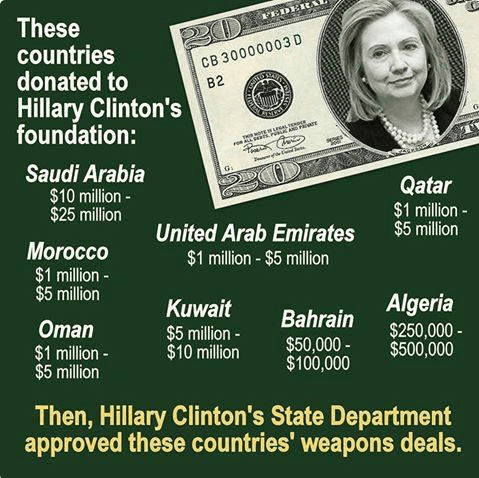
Morocco: In May of 2015, Politico, ABC News and Yahoo reported that Morocco’s state-owned phosphate company OCP donated $1 million to the Clinton Foundation for a conference in Marrakech. The Politico story said “Hillary Clinton’s relationship with Morocco’s government was pivotal” in brokering the meeting and noted that “not long after stepping down in 2013, Clinton joined her family foundation’s board, and that same year OCP donated between $1 million and $5 million to the philanthropy.” Politico also noted that prior to the donations, “as protests raged on Moroccan streets, Hillary Clinton in a joint 2011 appearance with Morocco’s foreign minister praised the king for introducing constitutional reforms and said his country was ‘well-positioned to lead in this area because it is on the road to achieving democratic change.’” Additionally, Politico reported, in 2012 “even as the State Department continued to include Morocco in human rights reports and to flag concerns about government corruption, Clinton launched an ongoing U.S.-Morocco strategic dialogue, praising the country as “a leader and a model.”
Algeria: A 2015 Washington Post investigation found that the Clinton Foundation accepted $500,000 from the Algerian government at a time when that country “was spending heavily to lobby the State Department on human rights issues.” The Post reported that Clinton Foundation “officials acknowledged they should have sought approval in 2010 from the State Department ethics office, as required by the agreement for new government donors, before accepting” the money, which was earmarked for Haiti earthquake relief.
More than half the people outside the government who met with Hillary Clinton while she was secretary of state gave money - either personally or through companies or groups - to the Clinton Foundation. It's an extraordinary proportion indicating her possible ethics challenges if elected president.Those who argue that there is no evidence of a quid pro quo miss the point that access is a form of privileged treatment, which in this case appears to have been bought. In the words of Supreme Court Justice John Paul Stevens in his dissenting opinion in Citizens United v Federal Election Commission:
At least 85 of 154 people from private interests who met or had phone conversations scheduled with Clinton while she led the State Department donated to her family charity or pledged commitments to its international programs, according to a review of State Department calendars released so far to The Associated Press. Combined, the 85 donors contributed as much as $156 million. At least 40 donated more than $100,000 each, and 20 gave more than $1 million.
Corruption can take many forms. Bribery may be the paradigm case. But the difference between selling a vote and selling access is a matter of degree, not kind. And selling access is not qualitatively different from giving special preference to those who spent money on one’s behalf. Corruption operates along a spectrum, and the majority’s apparent belief that quid pro quo arrangements can be neatly demarcated from other improper influences does not accord with the theory or reality of politics.Sadly, Justice Stevens was in the minority and an already bad situation with money in politics was made far worse. And as for the Clintons? The big money fundraising never stops.