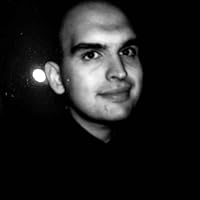
Eugene Thacker is an American philosopher, poet and author. He is Professor of Media Studies at The New School in New York City. His writing is often associated with the philosophy of nihilism and pessimism. Thacker's books include In the Dust of This Planet and Infinite Resignation.
Eu gosto muito do Thacker, e acho essa série "Horror of Philosophy" nada menos que excelente; uma investigação das relações entre filosofia e o gênero horror. Não exatamente para extrair uma filosofia do horror mas, antes, para encontrar o horror na filosofia, tratando inclusive textos literários como peças potencialmente filosóficas. Acho essa inversão diabólica muito esperta, e é o tipo de coisa que me faz sorrir.
No terceiro volume - Tentacles longer than night - Thacker discute tropos da tradição do horror cósmico - coisa que muito me interessa, porque eu talvez esteja escrevendo um conto ~cthulhunesco~ para o Halloween. (Dscp, galera.)
De Poe a Miéville, passando, é claro, por Lovecraft e toda a tchurma clássica do Weird Fiction, esse livro é um prato cheio para fãs do gênero. O tom não chega a ser acadêmico e, apesar de excessivamente fragmentário em certas passagens, permanece interessante ao longo de toda a leitura. Pesquei algumas referências ótimas. :)
Not a philosophy of horror, but a horror of philosophy
From the beginning of the book, the author already establishes an important distinction to his project: This is not a book about the philosophy of horror, but a book about the horror of philosophy. Through the book, the author shows a vast domain about the literature from all kinds of philosophy and all kinds of horror stories (books, movies, and others), which he does not use simplistically to establish show-off connections, but in order to create his own philosophy about the horror of philosophy, that which it can't comprehend, the wholly otherness to thought. An amazingly interesting book that works to move contemporary philosophy forward into interesting new directions.
At this point I feel like Thacker is repeating himself. The motifs from the first two volumes make their appearance again in this final volume in which Thacker promises to read horror fiction as if they were serious works of philosophy. As with the previous two volumes, the wealth of references supplied by Thacker make for a dizzying if not an encyclopaedic reading experience. In the grand scheme of things Thacker does succeed in drawing out and making explicit the specific philosophical problems posed by, to give but a few examples, Dante's Inferno, Lautréamont's Maldoror or Ligotti's Conspiracy Against the Human Race. Other times it is less of a specific problem than an certain spirit of unhumanism, for example, in the fictional verse of H.P Lovecraft. How does thought think the paradoxical extinction of thought, or the limit of thought? There are four stages, as outlined by Thacker in section 4 under the heading Black Matheme. At least for me this typography are the main takeaway of this whole volume. (1) The unhuman exists for the human, and can be integrated within the ambit of anthropocentric or terrestrial rationality (2) The unhuman is revealed to be not only autonomous but as mischeviously employing human rationality and human agency for its own ends, nonetheless some semblance of intentionality and intelligence (categories of human understanding) are still attributed to the unhuman forces (3) Everything human is exposed as an instantiation of the unhuman, in other words, in unhuman within us stages an escape (4) The final stage in which all representational apparatuses (language, sensibility and understanding) collapse into aphophantic catastrophism (“nameless,”“formless,” “lifeless")
It feels somewhat disjointed, starting off with in-depth examinations of Dante’s Inferno and Lautreamont’s Maldoror (neither of which are horror to me). But he hits his marks when he dives into more familiar Thacker subjects like cosmic horror and the uncanny vs. the marvelous. He makes a pretty convincing case that there is useful information to be gleaned from critiquing horror texts as philosophical treatises.
A beloved college teacher of mine once told me about a roommate he had in grad school who used to watch professional wrestling on TV and minutely analyze the drama he saw unfolding before his eyes: the delineation of good and evil personified in the two fighters' behavior, the fickle crowd's ever-changing attitude, and much more, while all his roommates told him to just relax and enjoy the fights. This anecdote/memory of long ago came to mind as I decided to stop reading Eugene Thacker's Tentacles Longer Than Night, in his Horror of Philosophy series. Professor Thacker likes horror movies, likes watching them and clearly would like to talk about them, and so they've become the basis of his Horror of Philosophy series.
Since I don't like seeing horror movies, or even reading horror stories, reading about them is not an attractive activity, and I finally gave it up. It took me a long time to recognize this, though.
Essentially, I realized the horror of philosophy that gives the series of film discussions its overall title is that nothing means anything, and the more you think and think about anything, the clearer this meaninglessness becomes. Everyone who reads pretty much knows that in one way or another anyway, which makes Professor Thacker's project not only subtly self-indulgent but also unnecessary. Let him look at and contemplate and write about horror as much as he wishes -- happily I now know I don't need to read it.
"Cosmic horror – at least in Lovecraft’s version – is therefore against both anthropomorphism and anthropocentrism. It would seem that this would leave one option open, that of an antagonism against the human tout court, a position generally regarded as misanthropic. In the mis-anthropos, the human is either regarded as an accident, an error, or as generally insignificant. It seems that this would leave only a residue that is simply not-human, or better, unhuman. Now, many tales of supernatural horror not only turn against the human, but they invert anthropomorphism and anthro-pocentrism, resulting in the misanthropic vision of a malefic and malevolent world. But even this is, in many ways, the ultimate anthropic conceit – the world is against us, but at least it cares enough to take notice. In this inversion, the human attempts to have its cake and to eat it too, tentacles and all. But supernatural horror must move beyond even this misanthropism, into the blank horror of the unhuman, into a region we can only call indifference, or what Lovecraft himself referred to as “indifferentism”: Contrary to what you may assume, I am not a pessimist but an indifferentist – that is, I don’t make the mistake of thinking that the resultant of the natural forces surrounding and governing organic life will have any connexion with the wishes or tastes of any part of that organic life-process. Pessimists are just as illogical as optimists… both schools retain in a vestigial way the primitive concept of a conscious teleology – of a cosmos which gives a damn one way or the other… [the indifferentist] simply knows that this quality has nothing to do with the case; that the interplay of forces which govern climate, behavior, biological growth and decay, and so on, is too purely universal, cosmic, and eternal a phenomenon to have any relationship to the immediate wishing-phenomena of one minute organic species on our transient and insignificant planet… The real philosopher knows that, other evidence being equal, favourableness or unfavourableness to mankind means absolutely nothing as an index of likelihood…108 In spite of what we may think, Lovecraft’s rather awkward term “indifferentism” does not so much indicate a personal predilection towards apathy, boredom, or a general grumpiness. Instead, Lovecraft proposes a diffuse, enigmatic antagonism, an anti-humanism that sets out the parameters for what we might call the “anthropic schema.” The anthropic schema is made up of three variants on the human-centric view: anthropomorphism, anthropocentrism, and misanthropy. Here the world is neither anthropic nor misanthropic, but simply indifferent, an indifference registered by the human in the utter apophatic blackness of incomprehensibility."
This is the third installment of a series of books titled ( Horror of philosophy) comprising "In the dust of this planet", "Starry speculative corpse" and this one subject to my review.
In the three books, philosopher Eugene Thacker dissect the many ways in which the horror genre as literary fiction converges with philosophy or vice versa, or what he summed up in his very ingenious way of putting it ( the philosophy of horror vs the horror of philosophy).
In the three books, the author, with a language and prose that oscillates between the academically austere and the highly poetic musicality (he's also a poet), presented the idea that the themes of the horror genre (mainly the fear of the unknown) are an artistic incarnations of that which philosophy couldn't have answers to or as he had put it "the failures of philosophy". Philosophy's major flaw- actually all human thought and disciplines for that matter- was conflating the map with the territory and dealing with everything as an anthropocentric projection. However, in a world where every bit of data translates into more and more ignorance, or even worse, a cementation of the inhumanity and complete otherness of this world not just as a concept in our minds but a material reality that dont give an effin about our thoughts and desires, how it can never be understood through anthropomorphic lenses/means for the simple fact that its not a "world for us". Its this complete alienating otherness of this world that declared the total failure of philosophy and which gave birth to concerns and anxieties that the horror genre is nothing but an artistic manifestation of.
In addition to that, Thacker developed in the three books a very strong case for and concise critique of philosophical pessimism.
So, if you're into horror and philosophy, or if you really wanna be mind blown by the amount of references ( philosophers, weird medieval theology books, horror novels and mangas, strange and eccentric authors, very weird music and obscure movies or even if you're into out of the box ways of philosophising) then this book is totally for you. I consider Thacker as an unorthodox/anti academic philosopher in the likes of Nietzsche, Bataille and Weil
What is True is Unknowable and What is Known is Untrue
We seek to understand what cannot be understood with our current tools of understanding, viz., logic, reason and common sense. We impose our subjective classifications and taxonomies upon nature itself and delight ourselves with what we are pleased to call knowledge of the world. In addition to being subjective, our classification systems are often idiosyncratic, relative and ephemeral, this is why they so often fail us. Evidence that our world is created by our subjective impositions can be seen in the fragility of human memory, the unreliability of eyewitness testimony and all too often rewriting and revising of history. A physicist I know once told me that it was amazing how much we learn when we change our perspective; that we come see things as we have never seen them before and finally know what is true. I thought, but did not say, that this further shows that all we really do is impose a new or alternative subjectivity onto observed existence rather than arrive at the 'truth' of existence or any form of objectivity or objective knowledge. We build and create, we then look upon the material and intellectual results of our labors as objective reality when they are still just the result of our subjective impositions upon whatever this thing called reality is. We declare objective that which accords with rational communal assent but this just to substitute community levels subjectivity for individual level subjectivity. The attachment to a false objectivity is also shown in the way we suffer with ideological pathologists and smug idealism. The world we observe is not an objective truth that we acknowledge through our observations. Rather, the world we observe is the product of our subjective impositions but by observing the results of our subjective impositions we take the observations to be of an objective reality or truth. For example, what we call a species in nature is just our subjective imposition upon the unplanned outcomes of the evolutionary process. Species is just an idea useful to us for classifying what we find. The species are not there in nature waiting to be found. We invent the species by generalizing about what we find. They are labels of convenience, nothing more but still useful in organizing our knowledge thus showing the subjective nature of our so-called objective knowledge.
Objectivity of any kind carries with it the stench of theism. We then build monuments to the permanence of this so called objective and true reality, just ask Ozymandias. Please do not mistake this for the subjectification of the empirical. The point here is that the empirical itself is subjective and the subjective is a necessary condition of having any kind of experience. This is why we cannot know the social world, it is a subjective creation, there is no objective world to know, there is no science of the social, it is a subjective position. We strive for unity and completeness; that which falls outside of our subjective anthropocentric ordering of existence is classed as alien, but all this is inadequate to grasp that which cannot be grasped. The problem isn’t the limits of thought, the problem is that thought is the limit. Existence qua existence is indifferent to the human perspective and has no need to respect our imposed antinomies and consistencies. The only such unity or oneness is to be found in nothingness. Does this seem alien?
There is a place of being in the primordial darkness of un-being, un-manifestation and unknowing. I have found that what is true is unknowable and what is known is untrue. I have discovered the narrow dark place but not based on a narrow band of awareness rather, from an enhanced awareness of experience. I have found that I am, all of us really are, victimized by Fate, tyrannized by Evolution and cursed by Genetics. Is not this horror enough of the non-fiction variety? This is the new frontier of the horror genre, non-fiction. It comes as a stark realization in confrontation with our Being that the greatest achievement of heightened human awareness is to realize the curse that is heightened human awareness (Zapffe Paradox). This just is the horror of philosophy. My questions have become: How empty is the void? How black are the shadows? How deep is the depth of despair? What answers could there be for a pretend person who very well might be an undiagnosed high functioning schizophrenic? A person who is inadequate in a world that is intolerable; a world that is uncertain save for the madness where I am taught to seek praise from the foolish. Just a pretend person grappling with barley understood feelings and emotions through a process of philosophy, poetry and art trying to come to terms with being and existence. Searching for expression in the kingdom of blackest shadows and deepest torment. Grouping in the darkness for the creation of a new kind of self-understanding. All is vague and imprecise in my awareness. I am only semi-conscious in the world in which I find myself where complete receptivity and awareness is not possible, this is life in an unlived world. I apologize to the reader who has had the misfortune of reading this far, I do not want to push anyone else over the edge into the corruption of consciousness, the one into which I have already fallen.
We live only in the meantime yet demand timeless meaning. If we believe that there is meaning to existence we will proceed to live life looking for such meaning. This creates a circular process. We look for meaning because we have already decided it must exist. This demonstrates that delusion serves as the path out of ignorance, but the reality is that this path, or any path, is an illusion. Few understand that our current existence is just irrelevant, it is nothing but an ephemeral phenomenon in the continuing entropy of space-time. Darkness and emptiness are just the consequences of a better understanding of existence. Oblivion will always displace meaning. With this, I now understand that I have not lost anything of value because I never had anything of value. I am existence without Being.
El último libro en la serie de El Horror de La Filosofía, éste recorre varias historias y autores del horror leídos como obras de filosofía. En este tomo se tocan temas tan diversos como lo inhumano, lo sublime, la insignificancia del hombre en el cosmos, lo divino, lo monstruoso, el miedo a lo desconocido, etc. todo desde el análisis de obras como La Llamada de Cthulhu o En Las Montañas de La Locura de Lovecraft, Los Cantos de Maldoror del Conde de Lautréamont, La Conspiraciòn Contra la Raza Humana de Ligotti, Uzumaki de Junji Ito y otras muchas obras y autores.
No es el libro que más me ha gustado de la trilogía, pero sí creo que tiene muchos temas interesantes, en lo personal el análisis de Maldoror fue el que más me interesó.
¡Vaya forma de cerrar esta trilogía! Los tentáculos se ciernen sobre nosotros para reflexionar sobre el Infierno de Dante y Los cantos de Maldoror del Conde de Lautréamont, pasando por Blackwood, Lovecraft, Ligotti y un sin fin de libros y películas (busca el corto "Outer Space" de Peter Tscherkassky y el libro _Vampyrotheutis Infernalis_ de Vilém Flusser). Sólo tengo dos quejas: la primera, que mencioné en el Vol. 2, es que no me gustaron varias decisiones editoriales como el tipo de fuente y su tamaño (sobre todo en las citas) y el acomodo del texto. Y en cuanto a Thacker, a quien admiro, me decepcionó un poco que sólo utilizara a Todorov para definir lo fantástico.
Blew through this one a lot faster than the second installment. Excellent finish to the series, in my opinion.
Thacker uses this book to explore what it would be like to treat works of fiction as philosophical texts. As such, he discusses Dante’s Inferno in a section where he branches into political philosophy. He spends a good amount of time analyzing the galactic views of H. P. Lovecraft. He also goes after vitalist philosophies through an extended meditation on what sounds like a wild ride called “Maldoror.”
I also really enjoyed the final section titled “As If…” where he hints and speculates on the possibilities of sort of non-philosophy he advocates for throughout the series.
“Tentacles Longer Than Night” (Vol 3) explores horror as philosophy, focusing primarily on Dante’s Inferno, Lautreamont’s Maldoror, and the weird, cosmic horror of Lovecraft and Junji Ito. Unfortunately, this volume repeats much of what was covered previously, and didn’t grab me until it got to the weird essay--one of the strongest in all three volumes.
These books are not for everyone. Thacker himself claims to write books for no one to read. (I can relate, brother.) But if you’re interested in negative or dark philosophy, and you can find them, these Horror of Philosophy Volumes might serve as companions through the long, dark night of the soul.
As an ecstatic pessimist, and jubilant nihilist, I am a big fan of Thacker. His writing, like that of Lovecraft, Liggotti, and Schopenhaeur, resonates with me at a visceral level. All three cut through the optimistic fallacies that obfuscate and strangle whatever real meaning might be found in the world. His is a philosophy consistent with the inescapable truths that 1) one day the sun will expand and incinerate the earth and 2) despite that bit of local warming the universe will die a heat death going cold and dark forever. The Big Empty.
As much as I've enjoyed this series—Thacker is a nimble, playful thinker and a philosophical polymath—his seeming reluctance to deliver on his thesis makes for a somewhat frustrating read. There's the get on with it already that comes front-loaded with the Lords of Reiteration* and then there's the get on with it already which arises when the leitmotif is buried under six hundred and sixty-six horseloads of graveyard clay.
It took a while into this series for it to really win me over, but eventually it did. A must for anyone like me who is going through an attempt to smash as much of the received wisdom anthropocentric hegemony that is they have imbibed...and of course for horror fans too.
A thought provoking end to a fascinating series, Tentacles Longer Than Night opened me up to a number of ideas that will occupy me for a long time. I can’t recommend these three books strongly enough.
Very good. I found the philosophical excursions more relatable in this book than in Volume 2, though the best parts deal with literary texts and authors. The exploration of Lovecraft as author, amateur science journalist, and literary critic is especially worthwhile.
I really loved this series! This book was a touch weaker as I chapter about the body politic didn’t really resonate with me. But still this trilogy was such a delightful and thought provoking read.
A satisfying entry and the mostvreadable.of the three volumes. Thacker does not dumb anything down in his musings, and it challenges as well as entertains.
I don't have a lot more to say about this volume that I didn't say for the first, but I will say that the switch (in a way) toward philosophy gave an interesting argument and that this continues to be a pretty high-quality series. Hopefully I can get my hands on the middle volume soon.
This is thought-provoking and wide-ranging study of the limits of thought and its relation to horror in literature. Especially insightful were the discussions of Lautréamont and Junji Ito's Uzumaki.