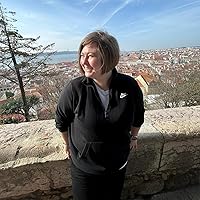
Erin Kaste was born and raised in Minneapolis, Minnesota, where she got in trouble at school for writing instead of doing the rest of her work. She began violin lessons at the age of four, went on to earn a degree in violin performance from the Eastman School of Music, and became a professional musician. After a brief public school teaching stint, she settled in Memphis, Tennessee, where she is currently a member of the Memphis Symphony Orchestra as well as their personnel manager. Away from writing and music, she loves running, hiking in the mountains, road trips, and channeling her grandmother as she raises African violets and Christmas cacti. She shares a home with her wife, their two teenagers, two dogs, and two cats.
Thanks you to NetGalley and the publisher for the ARC!
I’m not sure if it is because it is the ARC but there definitely needs to be content warnings because this deals with some heavy things and it is a little graphic.
I loved both MCs and love that we delved into Sam’s past. I think having only her POV helped the reader get into her psyche as well.
I just wanted more with this. More pages, more showing rather than telling and more wrap up at the end. I genuinely loved the story and character and it was written well. I just wanted MORE. A lot happens in the last 15% of the books and then it kind of just ends.
I received an ARC copy of this book from the Publisher via Netgalley and voluntarily leaving my review.
Sam is writer who has mental health issues that she needs to be on medication but it’s affects her writing. She also dealing with a horrible mother and ex who isn’t helping. Sam finds friendship with Lisa who is a teacher going through a divorce as they grow closer so does their feelings that turns into more. Sam and Lisa have great chemistry I like how organic they came to be it’ll been nice to know more about Lisa since this was more about Sam point of view. I like how the author took care on issues of mental health and learning to accept yourself.
A Second Draft, a Second Chance, and Several Very Bad Ideas In Erin Kaste’s “Life, Love, and Other Messes,” love arrives somewhere between a medication holiday, an impossible neighbor crush, and one writer’s overdue revision of herself By Demetris Papadimitropoulos | August 7th, 2026
Difficult people are easy to adore in fiction when their difficulty arrives tastefully arranged: one defensive joke, one regrettable text, one flaw waiting for a kiss and a breakthrough. Erin Kaste’s “Life, Love, and Other Messes” lets Sam Travis be more genuinely exhausting. She is jealous, obsessive, volatile, generous, funny, intermittently perceptive and spectacularly blind at exactly the wrong moments. She is also a prolific novelist who can restructure a murder plot on deadline while leaving one sentence about herself untouched: the unstable version of her mind is the version that makes her an artist.
Everything keeps circling that bargain. The medication that steadies Sam’s moods and keeps her neurological episodes at bay also seems to dam the torrent of words on which she has built a career. Off it, she writes through the night, forgets meals and produces pages in an ecstatic rush. On it, composition slows; ideas remain in her head as though somebody has narrowed the door between thought and fingers. Catherine, her therapist and psychiatric nurse practitioner, would prefer that deadlines not become occasions for pharmacological roulette. Sam agrees. A second draft is due Thursday.
Most of the book’s romantic machinery enters almost sheepishly beside this problem. Lisa Sutherland is Sam’s married neighbor, a preschool teacher with the best lawn on the block and a friendliness Sam has been admiring with very little discretion. Then the marriage fails. Lisa admits that the heterosexual life she built after being outed years earlier has never made her less gay, and the formerly impossible crush becomes possible. Her arc is a return to a truth she once buried, not a sudden discovery supplied for Sam’s convenience. More alarming for Sam, being together turns out to require very little drama: Ollie walks, takeout, lesson plans, work at opposite ends of the same room.
Ease is what Sam distrusts. Her girlfriend of five years, Veronica, supposedly moved to St. Louis for a lucrative job, only for Sam to find her still living locally and involved with a mutual friend. The fiction involved packed boxes, a supposed new apartment, weeks of preparation and one memorably miserable tofu lunch. Perhaps Sam really is the sort of person from whom a woman must stage an interstate escape. Kaste refuses the comforting correction that Veronica alone was the problem. Sam has spent years clinging, exploding, pushing women away and wanting them back. Veronica’s deception is grotesque. Sam’s fear does not come from nowhere.
To Sam, intensity has long had the status of evidence. Words arriving faster than she can type must be her truest creativity. Jealousy must be vigilance. Panic must mean something dangerous is happening. Leaving first can masquerade as prudence. What she has to learn is less flattering than “love yourself”: a defense may once have kept you alive and later become the thing making your life smaller. The book is strongest when it lets that realization arrive behaviorally, in a finished chapter or an evening that ends without somebody storming out, rather than having anyone pronounce it for her.
Red marks already govern Sam’s professional life. Her editor cuts pages, questions excess and sends scenes back for another pass; Sam can rearrange a mystery without treating the first draft as sacred. Her own history proves harder to edit. A 1999 flashback shows a professor recognizing the sheer compulsiveness of her writing and giving her the word hypergraphia. The later 1991 sections return to church, family and sexual violence, supplying the childhood knowledge beneath some of her adult alarms. An old interpretation acquires another sentence, then another. What changes is not the record but Sam’s insistence that the earliest version must remain the final one.
In Helen, Sam’s mother, that method meets its hardest case. Helen is controlling, religiously rigid, dismissive of Sam’s teaching and writing, and stubbornly unwilling to accept her sexuality. Later, however, twelve-year-old Sam is cornered again by Jackson Hardeman, the pastor’s son who assaulted her, and Helen appears with the gun Sam has stolen for protection. She fires beside Jackson’s head and orders him away from her daughter. Nothing about that afternoon clears Helen’s later account. It only makes a clean verdict impossible. A mother can injure a child for years and still, on one terrible afternoon, stand between that child and danger.
Punctuality is the weakness of some of these memories. The 1999 and 1991 passages do useful work because they make us revise judgments already forming: first about Sam’s writing, then about the family’s official story. We encounter behavior, acquire history, then learn that the history has another layer. But sometimes Sam develops a question in the present and the past arrives carrying an answer. Memory begins to resemble a filing cabinet with unusually good labels. Kaste opens interpretive space, then occasionally hurries in to alphabetize it.
As Sam tells it, life rarely has time to become solemn before something embarrassing wanders through. She notices breasts, frozen lasagna, church manners, bad dates, the condition of other people’s lawns and whatever Ollie has decided to chase. Her sentences tend to be short or middling, with fragments and quick self-corrections; anxiety stretches them, embarrassment cuts them off. The vocabulary is plainspoken. What makes it hers is the mind forever revising itself mid-thought, often getting a joke in just before discomfort can. One opportunity goes unused: medicated and unmedicated Sam feel far more different in the plot than they do in the sentences. After a few chapters, the effect is somebody talking from the passenger seat, possibly while you reconsider letting her drive.
Pages are Sam’s livelihood and, occasionally, Kaste’s problem. Sam’s editor keeps sending back some version of the same complaint: do you really need all of this? Kaste could borrow the red pen more often. A scene establishes Sam’s fear. Sam explains the fear. Catherine or Lisa then helps explain the explanation. Word count is not quite the problem; distrust is. The book sometimes seems unwilling to believe that a scene has communicated unless somebody subsequently puts a caption beneath it. Hypergraphia makes the abundance apt. Aptness does not make every sentence necessary.
A stranger virtue of that excess is time. Sam and Lisa are allowed hours in which nothing goes wrong. They work in the same room. Lisa prepares lessons; Sam writes. They eat, tease, grade papers, walk Ollie. This sounds almost comically undramatic beside the neurological episodes, betrayals and family history, but those hours alter Sam’s assumptions more effectively than several speeches do. Creativity can survive another person’s presence. Desire can survive boredom. The ordinary begins to look suspiciously like evidence.
Doing paperwork together turns out to be more persuasive than several of the novel’s revelations. Lisa does not solve Sam’s writing problem; Sam notices that pages are accumulating while Lisa sits nearby preparing preschool lessons. Lisa cannot retroactively clean up Sam’s romantic history; she simply behaves differently from the people Sam has already converted into prophecy. Sam’s new manuscript is called “Run To You,” almost suspiciously apt for a woman whose first instinct in love is backward. The title would be too neat if the change existed only there. It does not. Sam is learning, by unglamorous increments, to remain.
In the middle, however, Kaste makes us rehearse that lesson a few times too often. Sam approaches Lisa, gets frightened by how much the relationship matters, catastrophizes, receives reassurance, settles, then finds another reason to expect departure. Psychological fidelity explains the recurrence, but after several rounds the reader knows the choreography. Anxiety may circle. A novel still has to decide how many laps deserve to be shown.
Money in a collection plate eventually turns the pressure outward. At Sam’s childhood church, Pastor Hardeman solicits donations for a ministry dedicated to changing gay people. Sam interrupts him. Years of swallowed fury come out in public, and Helen responds by refusing contact with her daughter. The scene might easily have become a victory lap, but its aftermath saves it. Sam goes home shaken and ashamed, unsure whether courage is supposed to feel this bad. Speaking plainly has not liberated her. It has simply made the next silence louder.
If Lisa had behaved badly at this point, Sam would know what to do. Lisa’s offense is that she continues to be kind. Sam ends the relationship under the charitable fiction that Lisa deserves somebody easier, converting abandonment into a favor she can perform first. She understands the maneuver almost immediately. Lisa, inconveniently, has still been dumped. The joke has bite because knowledge is no substitute for repair: identifying the trap after you have sprung it does not release the other person.
Too much of Sam’s adult life eventually acquires a corresponding drawer in the past. There is the head injury, neurological abnormality, psychiatric treatment, religious shame, sexual violence, maternal criticism, romantic chaos and Veronica’s deception. Then Lisa discloses that, as a child, she watched her father kill her mother. The scene is horrific, but the book has already earned Lisa’s steadiness without it. Giving her catastrophe on that scale feels less like complication than credentialing, as if ordinary suffering could not sufficiently explain why she knows how to stay calm around Sam. She was already allowed to be wise without having survived the worst room in the house.
Reading Meg Mason’s “Sorrow and Bliss” beside Kaste would sharpen the distinction between explanation and absolution. Mason is darker and much more compressed, but both books refuse the easy arithmetic in which a diagnosis either excuses everything or explains nothing. Lily King’s “Writers & Lovers” offers a different point of contact: creative work there, as here, is not an attractive extracurricular but one of the terms by which a woman decides whether her life still belongs to her. Kaste is doing something warmer and more conventionally romantic, though not always something simpler.
On the question of art and illness, in fact, the book takes its best risk. Sam genuinely experiences treatment as loss. The medication makes daily life safer and writing harder, and Kaste does not insult her by pretending that trade-off feels trivial. Nor does the novel endorse the old romance in which damage is secretly the artist’s best equipment. Late in the story, Sam finishes “Run To You” while remaining medicated. The pages come differently. They come anyway. That modest fact does more intellectual work than a declaration about wellness ever could.
Parental reconciliation would have been the tidier final proof that Sam has changed. Kaste denies her one. Helen stops speaking to Sam after the church confrontation, then suffers a catastrophic fall before either woman can repair the breach. There is no deathbed apology and no last-minute softening of doctrine. Helen dies, and Sam is left with a relationship that has acquired finality without clarity. The missing scene is one of the book’s best decisions.
Once the machines are turned off, Sam cannot supply the words a daughter is supposed to say. She can remember gratitude and injury, protection and rejection, what Helen gave her and what she withheld. Later, Sam’s father tries to take his share of the blame and cannot quite decide how much belonged to Helen. Neither he nor Sam wants to make her the explanation for everything. Neither can pretend her hands are clean. For once, nobody improves the dead for the comfort of the living.
Under all this is a quarrel over authorship, though not the literary kind. Helen has spent years telling Sam what a successful daughter should look like. The church offers another version. Medicine gives names to what happens in her brain. Ex-girlfriends have their verdicts. Sam, meanwhile, can invent motives for fictional killers more readily than she can challenge the motive she has assigned to herself. Repetition has sounded like proof because she has been the one repeating it.
Lisa matters most when she stops interpreting and simply remains present. She does not need to be Sam’s corrected manuscript, therapist by other means or reward for improved behavior. Her better scenes are smaller: paperwork at the same table, food brought over, a dog between them, a hand held during a funeral. There, the romance makes its case without arguing it. Another person can know Sam and still have somewhere else to be tomorrow – then come back.
Of the book’s many messes, its own is excess: too much explanation, several late calamities more dramatic than necessary, too little confidence that its quieter evidence has already made the case. Those quiet moments are also why the novel survives its own overstatement: Lisa bent over lesson plans while Sam writes, a manuscript completed without a medication holiday, Sam discovering beside her mother’s body that grief does not oblige her to lie about the dead. I land at 79/100, or 3/5 stars. The book narrowly misses the next tier because its strongest idea is better controlled than the novel containing it.
Sam begins with a Thursday deadline and the conviction that words matter most when they arrive in floods. By the end, after Helen’s funeral, three words are moving through her mind whenever she looks at Lisa, and for once she does not force them onto the page or into the room ahead of schedule. Lisa has been thinking them too. They wait. For a writer who has spent years mistaking abundance for truth, that delay may be the clearest revision of all: language no longer has to outrun the life meant to hold it.
I was drawn in by the brief for this book so what I thought was a read about a budding romance between a writer and her recently divorced neighbour turned into something much more complex and could be quite triggering for people.
It is an interesting read with a focus on Sam’s mental health and living with this day to day showing her internal struggles. We do get a brief backstory around what trigged her and this is explored. This is handled very well and you understand how this has affected not only her previous relationship with her ex partner and friends, but also her current relationship with her family and somebody that she is aiming to start a relationship with.
For me there was such a focus on Sam’s mental health that the romance and development of her relationship with Lisa felt sidelined where I actually would have like a deeper view into their dynamic as I felt I knew very little about Lisa.
This it is wrote with such sensitivity and understand which I highly praise. There is a lot of plot points to follow and unpick in regards to Sam’s mental health which by the end seemed very rushed to provide a satisfactory ending so again I felt the character development was lost especially from her family.
It’s a good and very different read from what I expected but I did find the subject matter at times quite heavy but it’s not a criticism of the book. Thanks to NetGalley and Bold Stokes Books for giving me an opportunity to read this prior to release.
Thank you to NetGalley, the publisher, and the author for the opportunity to read and review this book in advance. All opinions are my own.
*Life, Love, and Other Messes* tackles mental health with a great deal of compassion and authenticity. What I appreciated most was that the central conflict wasn't driven by unnecessary relationship drama. Instead, the story focuses on the protagonist's internal struggles and the ways those challenges affect both her life and the people she cares about. It felt like a thoughtful and realistic portrayal of living with mental health challenges rather than using them simply as a plot device.
My biggest criticism is that I never felt I got to know Lisa as well as I wanted to. While I enjoyed the romance, I would've loved to see more of their connection develop on the page so that the emotional payoff felt even stronger. The ending also wrapped up more quickly than I expected, leaving me wishing for a little more time with the characters.
Overall, this was an enjoyable and heartfelt read with a nuanced approach to mental health. While I found myself wanting a bit more depth in the romance and a less abrupt conclusion, I still came away glad I read it and would happily recommend it to readers looking for a character-driven contemporary romance.
Really in to the first couple of chapters but then a bit impatient for the story to get going. The first quarter is not a particularly uplifting read. There is nothing wrong with it but it certainly didn't lift my spirits. The relationship is actually quite organic which I think is why I was so distracted by the setting of the first more physical scene. Maybe it's my age but I kept thinking "your empty house is just beside you!!" I find it slightly odd that there are quite a few mentions of off page intimacy between the mains where presumably all goes well yet the one with a bit of on page description was done like it was. All that said, there was something appealing about this book that reflected real lives are messy. It is not a feel good book and there are some tough subjects and some bits that I think could have done with a bit more clarity from the writer. The end was a bit.... cut off but not unfinished.
Sam Travis is a writer whose writing is dulled when she’s on her medicine. Unfortunately, she really needs to be on her medicine. Even though she sometimes isn’t for the sake of the writing. She’s got a horrible mother and a horrible ex who pretends to move to another city rather than being an adult and breaking up with her. She also has an attractive married neighbor who is separating from her husband soon after the beginning of the novel.
There is a romance in this book, and don’t get me wrong, there’s absolutely nothing wrong with the romance, but really, Sam’s mental health is the true story, and it is a fascinating tale. If you’re coming into the book for the romance, I will only say that it might have used a little bit more fleshing out. But again, it didn’t bother me, as I felt it wasn’t the main point of the story.
would like to thank netgalley and the publisher for letting me read this book
sam is a writer and when she is off her meds she writes constantly but those meds control things but empty her head of the words....
lisa is married and whenever sam sees her when she out walking her dog lisa is always smiling....
there lives are about to connect when sam finds out lisa is getting divorced and needs a friend sam is happy to assist with anything that lisa needs
but sam has dark days and at times comes off her meds
i have to say this wasnt an easy book to read with all the background stuff that we had to get through before the actual storyline kicked in...and that bought another whole heap of trauma but the storyline was actually really really good...
families though eh...
will be keeping an eye out for more of this authors books though
Based on the blurb, I expected a romance, but this is really queer fiction with a light romance subplot.
Samantha is a prolific author finally managing her mental health and a rare form of epilepsy with medication. The catch? The meds give her severe writer's block. As she struggles to reignite her creativity, Sam is also navigating realistic mental health spirals, an overbearing and homophobic mother, a crush on her cute neighbour, and her dramatic dog, Ollie—all while processing her ex-girlfriend moving away.
From awkward run-ins with her ex to temporarily going off her meds to hit deadlines, Sam's journey is full of tough trade-offs. It’s a grounded, emotional, and ultimately hopeful read about finding your footing when your mental health is failing but you're trying your best to shut out the negative spirals.
An interesting book, this is a romance that doesn't fall into the usual tropes. The focus is much more on Sam and her mental health, the traumas she is still recovering from, the homophobia she has experienced and still gets from her mother. Lisa comes into her life with a gentle empathy, she has her own trauma wounds, I really would have welcomed more from her POV. The focus is very much on Sam and it is well written, a good blend of plot, characters and Sam has a dog which always helps. I would have given it 3.5 stars but the book lost half a star for not giving any content warning, there is a graphic sexual assault and a horrifically graphic domestic violence murder that is casually dropped in, that was even more jarring.
With thanks to Netgalley and the publisher for an ARC in exchange for an honest review.
First book by this author, and it was a pretty good read, but it should have came with trigger warnings.
First off, if you're looking for romance, this book is not for you. This focuses more on Sam's mental health and it's in her POV the entire book. Sam is a writer who needs to be on medicine, but it affects her writing. She has a horrible mother and even worse ex, but the next door neighbor Sam finds intriguing. The relationship moves forward smoothly and felt real. I only wish we got more backstory on Lisa. We just know she is getting divorced from her husband, but otherwise you don't learn much.
The mental health was written and handled well. It was an interesting read.
I received an ARC from Netgalley in exchange for an honest review.
I was expecting a light romcom but it was much more than that.
Life, Love, and Other Messes tackles mental health with compassion. The story focuses on the FMCs internal struggles and the ways those challenges affect both her life and the people around her. It was a thoughtful and realistic depiction of living with a mental health challenge.
Overall, this was a pleasant read with a complex approach to mental health. However, I did find myself wanting more depth in the romance and less conclusion. I was happy to have read it and would happily recommend it to readers looking for a character-driven contemporary romance.
Thank you to NetGalley and the publisher for the ARC!
I read this as an ARC through NetGalley! I was expecting a light romcom for some reason but it was so much deeper than that. I thought the author did a great job describing mental health issues. There were a lot of really intense topics that came up over the course of the story but they were all handled with care. So glad I read this one, it will stick with me!