

What do you think?
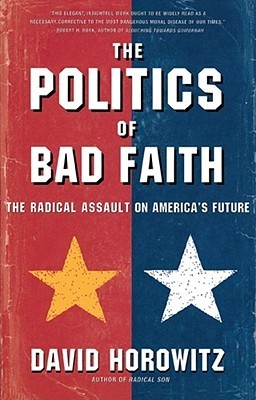
The POLITICS OF BAD FAITH: The Radical Assault on America's Future
In this intellectual companion piece to his acclaimed autobiography, Radical Son, David Horowitz argues that, even in this supposedly post-ideological, post-Cold War era, the historic themes of that conflict still drive our politics and animate our cultural debates. With keen political insight and a masterly grasp of history, he examines how the political Left, including those who describe themselves as liberals, has refused to learn from the past -- particularly from the checkered records of progressive movements for social justice.
This important work is a cohesive and searing document for all who refuse to bury their heads in the sand while American institutions and beliefs are corrupted by the politics of bad faith masquerading under the guise of social justice.
This important work is a cohesive and searing document for all who refuse to bury their heads in the sand while American institutions and beliefs are corrupted by the politics of bad faith masquerading under the guise of social justice.
224 pages, Paperback
First published January 1, 1998
About the author
David Horowitz
191 books341 followersDavid Joel Horowitz was an American conservative writer and activist. He was a founder and president of the David Horowitz Freedom Center (DHFC); editor of the Center's website FrontPage Magazine; and director of Discover the Networks, a website that tracks individuals and groups on the political left. Horowitz also founded the organization Students for Academic Freedom.
Horowitz wrote several books with author Peter Collier, including four on prominent 20th-century American families. He and Collier have collaborated on books about cultural criticism. Horowitz worked as a columnist for Salon.
From 1956 to 1975, Horowitz was an outspoken adherent of the New Left. He later rejected progressive ideas and became a defender of neoconservatism. Horowitz recounted his ideological journey in a series of retrospective books, culminating with his 1996 memoir Radical Son: A Generational Odyssey.
Horowitz wrote several books with author Peter Collier, including four on prominent 20th-century American families. He and Collier have collaborated on books about cultural criticism. Horowitz worked as a columnist for Salon.
From 1956 to 1975, Horowitz was an outspoken adherent of the New Left. He later rejected progressive ideas and became a defender of neoconservatism. Horowitz recounted his ideological journey in a series of retrospective books, culminating with his 1996 memoir Radical Son: A Generational Odyssey.
Ratings & Reviews
Friends & Following
Create a free account to discover what your friends think of this book!
Community Reviews
Displaying 1 - 14 of 14 reviews

March 5, 2018
Excellent report on the failures of communism and why an avowed communist turned to free markets and free people.

August 2, 2021
The POLITICS OF BAD FAITH: The Radical Assault on America's Future by David Horowitz Is an intellectual companion piece to his acclaimed autobiography, Radical Son. the author argues that, even in this supposedly post-ideological, post-Cold War era, the historic themes of that conflict still drive our politics and animate our cultural debates. With keen political insight and a masterly grasp of history, he examines how the political Left, including those who describe themselves as liberals, has refused to learn from the past -- particularly from the checkered records of progressive movements for social justice. Many of us raised with traditional values are shocked and disgusted to see fellow Americans attempting to destroy America from within despite all of the good America has done for the world and that she has been a beacon of hope unlike any other nation in the world. This important work is a cohesive and searing document for all who refuse to bury their heads in the sand while American institutions and beliefs are corrupted by the politics of bad faith masquerading under the guise of social justice.

October 1, 2022
This is seriously one of the best books ever written on political philosophy. It is highly recommended. It just might be the best Horowitz book, too!
======================================
This is my 8th or 9th reading so far? I love this book this much. As I grow older, I stopped reading. Now, I reread.
======================================
I am amazed at how cogent Horowitz's articles, how well written, an artifact of a time past, and a work of art by themselves. The essay, "The Road to Nowhere," might be the greatest political article I have read in my life. I have reminisced on times in my life where I had messed up, where I have erred and where I could have done better. That article gave me solace. My errors at most hurt someone else beside me. The errors intellectuals have committed have put underground more than 100 million people, and lay to waste the lives of billions more. The political left is the greatest danger the history of mankind has ever seen, and it surpassed anything, in terms of sheer numbers, that comes second.
All the articles here are well crafted and beautiful. From the first review of Hobsbawm's age of extreme, till the epidemic of AIDS. The latter, I have always thought to be the weakest link in this book, but I have come to appreciate it more and more as I mature.
I wished I had sat down with the author while he was alive. I wish I could have told him that I understood him, that I sympathize with him. I have been harassed by people in proportions far less exceeding than what he has seen. But like is compared to like. I appreciate the fact that he stood up and never sat down. He is a hero of our times. I just wish he was appreciated more.
=========================================
I lost count of how many times I have read this book. It is my safe haven. I love it. In this reading, I focused more on The Road to Nowhere, my favorite chapter, and probably one of the best essays written in the 21st century.
======================================
This is my 8th or 9th reading so far? I love this book this much. As I grow older, I stopped reading. Now, I reread.
======================================
I am amazed at how cogent Horowitz's articles, how well written, an artifact of a time past, and a work of art by themselves. The essay, "The Road to Nowhere," might be the greatest political article I have read in my life. I have reminisced on times in my life where I had messed up, where I have erred and where I could have done better. That article gave me solace. My errors at most hurt someone else beside me. The errors intellectuals have committed have put underground more than 100 million people, and lay to waste the lives of billions more. The political left is the greatest danger the history of mankind has ever seen, and it surpassed anything, in terms of sheer numbers, that comes second.
All the articles here are well crafted and beautiful. From the first review of Hobsbawm's age of extreme, till the epidemic of AIDS. The latter, I have always thought to be the weakest link in this book, but I have come to appreciate it more and more as I mature.
I wished I had sat down with the author while he was alive. I wish I could have told him that I understood him, that I sympathize with him. I have been harassed by people in proportions far less exceeding than what he has seen. But like is compared to like. I appreciate the fact that he stood up and never sat down. He is a hero of our times. I just wish he was appreciated more.
=========================================
I lost count of how many times I have read this book. It is my safe haven. I love it. In this reading, I focused more on The Road to Nowhere, my favorite chapter, and probably one of the best essays written in the 21st century.

February 2, 2015
I purchased this book to educated myself about the radical left wing and their methods, styles, and propaganda. I absolutely recommend this book, as well as, David Horowitz and his other works.

June 27, 2007
It's David Horowitz -- I mean c'mon.

March 29, 2012
This is a hard polemic to like and an easy one to admire. Among other things, it affirms David Horowitz as a deep thinker to whom I had previously been unfair. Before reading this book, I could have told you that Horowitz was the proprietor of a politically incorrect and pugnaciously conservative web site. I also recognized that he was well-known in some circles for having changed his stripes. Knowing those things, I still had reservations about cracking open my father's much-highlighted copy of this 190-page broadside. Would a nonfiction book about the fatal shortcomings of the worldview variously labeled Marxist, socialist, Leftist, or progressive have anything other than archival value more than a generation after it was first published?
It turns out that the answer to that question is a resounding yes. Some chapters in this effort are stronger than others: Horowitz admits that the long letters he wrote to two friends after renouncing Communism were both failures, and my guess is that those letters -- reprinted here --seemed pedantic even to the people who shared his vocabulary without having committed what they thought was his apostasy.
On the other hand, I know much more about radical and utopian thinking after having read that chapter than I did before, and you will, too. Horowitz never flinches in treating the French and Russian revolutions as the catastrophes they were. He also explores the little-known religious roots of radicalism and looks compassionately at the disproprotionate Jewish leadership of radical movements while debunking the progressive notion of "planetary patriotism" as something utterly alien to actual human experience. If you're big on the Kabbala, "social justice," Rousseau, or Soviet achievements, you'll find large parts of this book astringent.
Horowitz has no patience for people who claim that socialism would work "if it had ever been tried," but what makes this book different from other conservative screeds is his top-shelf, insider's explanation for exactly why Stalinism is not just a "possible" interpretation of Marxism, but the prevailing one. Socialism, in short, is always and everywhere a monstrous, dehumanizing fantasy, and Horowitz shows precisely how it even managed to turn AIDS into "a radical holocaust."
"The Politics of Bad Faith" has a lot of the same punch that Whittaker Chambers' Witness does, but Chambers thought when he became a man of the Right that he was on the losing side, and Horowitz has the fall of the Berlin Wall and the collapse of the Soviet Empire to look back on, even while explaining why Leftism mutated rather than admit defeat. The passion here comes with end notes, which is another way of saying that what Horowitz has written is equal parts light and heat, best read in chapter-length doses with breaks for something lighter in between. This won't appeal to everybody, but it's important, interesting, and -- from a moral and philsophical point of view -- darn near irrefutable.
If the arguments of "progressive" Facebook friends make you tired, take heart. Horowitz wrote this in 1998, but it's like a banana clip, a thinking cap, and a personal training voucher signed by James Madison and Chuck Norris. I'm glad I finally read it.
It turns out that the answer to that question is a resounding yes. Some chapters in this effort are stronger than others: Horowitz admits that the long letters he wrote to two friends after renouncing Communism were both failures, and my guess is that those letters -- reprinted here --seemed pedantic even to the people who shared his vocabulary without having committed what they thought was his apostasy.
On the other hand, I know much more about radical and utopian thinking after having read that chapter than I did before, and you will, too. Horowitz never flinches in treating the French and Russian revolutions as the catastrophes they were. He also explores the little-known religious roots of radicalism and looks compassionately at the disproprotionate Jewish leadership of radical movements while debunking the progressive notion of "planetary patriotism" as something utterly alien to actual human experience. If you're big on the Kabbala, "social justice," Rousseau, or Soviet achievements, you'll find large parts of this book astringent.
Horowitz has no patience for people who claim that socialism would work "if it had ever been tried," but what makes this book different from other conservative screeds is his top-shelf, insider's explanation for exactly why Stalinism is not just a "possible" interpretation of Marxism, but the prevailing one. Socialism, in short, is always and everywhere a monstrous, dehumanizing fantasy, and Horowitz shows precisely how it even managed to turn AIDS into "a radical holocaust."
"The Politics of Bad Faith" has a lot of the same punch that Whittaker Chambers' Witness does, but Chambers thought when he became a man of the Right that he was on the losing side, and Horowitz has the fall of the Berlin Wall and the collapse of the Soviet Empire to look back on, even while explaining why Leftism mutated rather than admit defeat. The passion here comes with end notes, which is another way of saying that what Horowitz has written is equal parts light and heat, best read in chapter-length doses with breaks for something lighter in between. This won't appeal to everybody, but it's important, interesting, and -- from a moral and philsophical point of view -- darn near irrefutable.
If the arguments of "progressive" Facebook friends make you tired, take heart. Horowitz wrote this in 1998, but it's like a banana clip, a thinking cap, and a personal training voucher signed by James Madison and Chuck Norris. I'm glad I finally read it.

September 27, 2017
Interesting to listen to the other side, as he's one of the more articulate conservatives. Unfortunately, he chooses to ignore the social claims of the left - about universal education and healthcare, and minority and women's rights, in particular. His beef is with the universalist New Left, with some ideal form of academic leftism, so we must forgive his flights of fancy when he conflates all leftist thought into Marxist internationalism. In fact, though I am not a leftie, there are some valuable social lessons - which the US is forced to acknowledge now with ACA being bitterly fought in Congress.
So there is a lot to argue with in his quarrel with what he thinks is the left. I think he's right, as most conservatives are, when he denounces the leftist hijacking of American academia. I think he's wrong in thinking that that kind of leftism has much in common with the social democratic principles of the German and North-European left, such as affordable healthcare, universal access to education etc. But then I'm not a conservative, not even in his narrow sense. I believe conserving traditional values is a silly stance when some are unjust and others outdated.
He is most humane when discussing his personal affects - Betty van Patter's murder, his feeling that his youthful fight for the left robbed him of his Jewish heritage etc. I will read more of his stuff, but I find his recent stances overly simplistic and sometimes downright disgusting, and his unwavering support for Trump quite troubling.
So there is a lot to argue with in his quarrel with what he thinks is the left. I think he's right, as most conservatives are, when he denounces the leftist hijacking of American academia. I think he's wrong in thinking that that kind of leftism has much in common with the social democratic principles of the German and North-European left, such as affordable healthcare, universal access to education etc. But then I'm not a conservative, not even in his narrow sense. I believe conserving traditional values is a silly stance when some are unjust and others outdated.
He is most humane when discussing his personal affects - Betty van Patter's murder, his feeling that his youthful fight for the left robbed him of his Jewish heritage etc. I will read more of his stuff, but I find his recent stances overly simplistic and sometimes downright disgusting, and his unwavering support for Trump quite troubling.

May 5, 2020
Always insightful to hear from defectors. The letters received and responded to at the beginning of the book were most revealing. The chapter on homosexual politics will infuriate you, one way or another.

May 7, 2020
Devastating critique of left-wing politics and the Marxist, radical program of the last 200 years. Cogent and well argued.

May 7, 2021
This book was similar to dark agenda
March 14, 2010
By adopting an impossible standard, it is easy to find fault with any institution or social system…. The idea of socialist equality, for example, may or may not be admirable. But if social equality cannot be realized in practice, or if the attempt to realize it necessarily creates a totalitarian state, then the idea of such quality can have significance except as an incitement to destructive agendas.
Santayana identified with patriotism “reverence for the sources of our being.”
The dramatic tension of the American narrative remains what it has always been: a tension between democracy understood as limits to government, the liberal polity of a diverse citizenry, and democracy understood as radicals understand it, the righteousness of a guardian state.
An Idea that was more important that reality itself. [how things should be, rather than how they are:]
What the Left cannot face is the prospect that an understanding of this century of revolutionary grief should lead, finally, to conservative conclusions: to reconciliation to the finite parameters of the human condition—the unavoidable conflicts and inevitable insufficiencies that make up ordinary social unhappiness. In other word, acceptance of who and what we are.
Conservative: I would mean by that respect for the accumulated wisdom of human traditions; regard for the ordinary realities of human lives; distrust of optimism based on human reason; caution I the face of tragedies past.
It is the unity of interest and the equality of condition that are the all-consuming goals of the modern Left. To suppress human nature and human difference is, in essence, the Left’s utopian ambition—an ambition that requires the totalitarian state.
Our progressive mission had imbued us with the greatest racism of all – a racism that was universal, that never allowed us to see people as they really were, but only as our political prejudices required.
When Marxism has been put into practice by real historical actors, it has invariably taken a Stalinist form, producing the worst tyrannies and oppressions that mankind has ever known. Is there a reason for this? Given the weight of this history, you should ask rather: how could there not be?
The leftist counterrevolution against liberal democracy has meant permanent war against the culture of individual rights and political pluralism, against the private property foundations of the liberal state. To have been on the left is to have been at war with the only democratic and free societies the world has ever known. It has been a war conducted in the name of ideals that cannot be implemented and a future that cannot work, and has brought misery and oppression to uncountable millions.
The collapse of Communism has disintegrated the Marxist idea and fragmented the culture of the international Left. The result is a proliferation of post-Marxian theories and identity politics that no longer base themselves on economic class but on the particularist identities of gender, ethnicity and race. The class struggle has been replaced by status conflict; the universalist idea, by quasi-fascist doctrines of racial solidarity, group rights and antiliberal political agendas.
Modern conservatism begins with the recognition that the progressive agenda and its progressive paradigm are bankrupt. They have been definitely refuted by the catastrophes of socialism in the Twentieth Century. The utopian quest for social justice and its redistributionist goals are implicated in those catastrophes as root causes of the totalitarian fate. To propose a “solution” that is utopian – in plain English, impossible—is to propose a solution that requires absolute coercion. Who wills the end wills the means.
Santayana identified with patriotism “reverence for the sources of our being.”
The dramatic tension of the American narrative remains what it has always been: a tension between democracy understood as limits to government, the liberal polity of a diverse citizenry, and democracy understood as radicals understand it, the righteousness of a guardian state.
An Idea that was more important that reality itself. [how things should be, rather than how they are:]
What the Left cannot face is the prospect that an understanding of this century of revolutionary grief should lead, finally, to conservative conclusions: to reconciliation to the finite parameters of the human condition—the unavoidable conflicts and inevitable insufficiencies that make up ordinary social unhappiness. In other word, acceptance of who and what we are.
Conservative: I would mean by that respect for the accumulated wisdom of human traditions; regard for the ordinary realities of human lives; distrust of optimism based on human reason; caution I the face of tragedies past.
It is the unity of interest and the equality of condition that are the all-consuming goals of the modern Left. To suppress human nature and human difference is, in essence, the Left’s utopian ambition—an ambition that requires the totalitarian state.
Our progressive mission had imbued us with the greatest racism of all – a racism that was universal, that never allowed us to see people as they really were, but only as our political prejudices required.
When Marxism has been put into practice by real historical actors, it has invariably taken a Stalinist form, producing the worst tyrannies and oppressions that mankind has ever known. Is there a reason for this? Given the weight of this history, you should ask rather: how could there not be?
The leftist counterrevolution against liberal democracy has meant permanent war against the culture of individual rights and political pluralism, against the private property foundations of the liberal state. To have been on the left is to have been at war with the only democratic and free societies the world has ever known. It has been a war conducted in the name of ideals that cannot be implemented and a future that cannot work, and has brought misery and oppression to uncountable millions.
The collapse of Communism has disintegrated the Marxist idea and fragmented the culture of the international Left. The result is a proliferation of post-Marxian theories and identity politics that no longer base themselves on economic class but on the particularist identities of gender, ethnicity and race. The class struggle has been replaced by status conflict; the universalist idea, by quasi-fascist doctrines of racial solidarity, group rights and antiliberal political agendas.
Modern conservatism begins with the recognition that the progressive agenda and its progressive paradigm are bankrupt. They have been definitely refuted by the catastrophes of socialism in the Twentieth Century. The utopian quest for social justice and its redistributionist goals are implicated in those catastrophes as root causes of the totalitarian fate. To propose a “solution” that is utopian – in plain English, impossible—is to propose a solution that requires absolute coercion. Who wills the end wills the means.

March 7, 2012
David accuses the Left of bad faith. By this, he means that even though socialism failed in Russia, the Left refuses to admit that this failure is evidence that there is something wrong with its ideal of social justice. David points out that even after the failure of Communism, Western universities still do not teach the works of those economists that predicted it would fail: Ludwig von Mises and Friedrich Hayek. If the Left were intellectually honest, it would admit that not just a particular implementation of socialism, but the socialist utopian vision itself does not work, cannot be made to work, is based upon a false understanding of human nature, and is destructive in intent. Instead, the Left pretends that its current progressive agenda has little in common with Communism. The unapologetic Left sees the Soviet failure as a betrayal of the socialist ideal by the politicians who were in charge of implementing it. I am reminded of Hitler in the bunker, blaming his army and his people for betraying him and losing the war.

July 19, 2007
I think that this book's critique of what is wrong with the political left is very insightful, so this book is worth reading. At the risk of radically oversimplifying it, he argues that with the collapse of Marxism as a viable political theory, the left no longer really has any idea of what they are fighting for. But they still do know what they are against: capitalism, individualism, and bourgeois democracy. So they have effectively become nihilists, dedicated to tearing down the existing social order without any real vision of what they want to replace it with.[return][return]For its critique of the left I'd give this book 4 stars. But I happen to disagree with some of Horowitz's solutions to this so I'm rating it at only 3 1/2

December 19, 2011
According to Brother Horowitz, the communists of the Cold War have just become the liberals and progressives of today. America is under attack from these sorts who never give up their failed ideology. Socialism can never win but for some reason liberals won't accept it. The book is powerfully and eloquently written, and Horowitz makes some good points, but it's all a little too Rush Limbaugh/Glen Beck conservatism on crack for me.
One part that is especially thought provoking is his argument about higher education training an army of liberals. He says that the majority of college professors are raging liberals and they are trying to convert the students to their bad faith.
One part that is especially thought provoking is his argument about higher education training an army of liberals. He says that the majority of college professors are raging liberals and they are trying to convert the students to their bad faith.
Displaying 1 - 14 of 14 reviews