This is a book about one of the deadliest places in the world
El Salvador and Honduras have had the highest homicide rates in the world over the past ten years, with Guatemala close behind. Every day more than 1,000 people—men, women, and children—flee these three countries for North America. Óscar Martínez, author of The Beast, named one of the best books of the year by the Economist, Mother Jones, and the Financial Times, fleshes out these stark figures with true stories, producing a jarringly beautiful and immersive account of life in deadly locations.
Martínez travels to Nicaraguan fishing towns, southern Mexican brothels where Central American women are trafficked, isolated Guatemalan jungle villages, and crime-ridden Salvadoran slums. With his precise and empathetic reporting, he explores the underbelly of these troubled places. He goes undercover to drink with narcos, accompanies police patrols, rides in trafficking boats and hides out with a gang informer. The result is an unforgettable portrait of a region of fear and a subtle analysis of the North American roots and reach of the crisis, helping to explain why this history of violence should matter to all of us.
Óscar Martínez writes for ElFaro.net, the first online newspaper in Latin America. The original edition of his book Los migrantes que no importan was published in 2010 by Icaria and El Faro, with a second edition by Mexico’s sur+ Ediciones in 2012. Martínez is currently writing chronicles and articles for El Faro’s project, Sala Negra, investigating gang violence in Latin America. In 2008, Martínez won the Fernando Benítez National Journalism Prize in Mexico, and in 2009, he was awarded the Human Rights Prize at the José Simeón Cañas Central American University in El Salvador.
When I first started practicing law, I was assisting a senior attorney in his defense of a gang member. I asked, with bold and ignorant naiveté, “what gang?”
“MS 13” he replied simply, no doubt expecting that to be sufficient.
“What’s that?” I asked, dripping green from my shiny new suit.
The older lawyer (now a judge) looked at me with an ironic smile and said, “I’ll tell you what, when you get home, Google it.”
I did and my wife immediately demanded that I get a new job. The defendant, a quiet man with a disarming smile, had allegedly ordered a rival gang member killed and was facing federal time (the victim had been beaten to death about two miles away from a restaurant my wife and I had once visited).
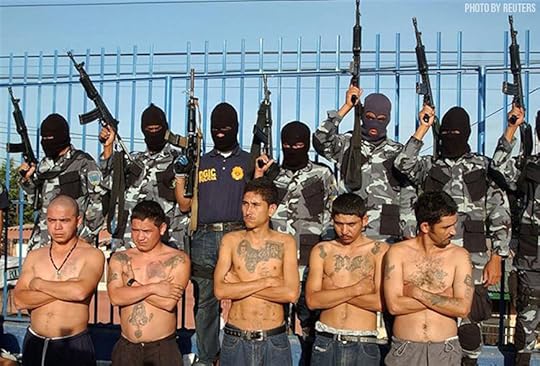
Author Oscar Martinez journalistically describes MS 13 and how it affects every level of El Salvadoran society. Martinez also illuminates the state of Copan, the passageway that connects Guatemala to Honduras, called the Corridor of Death. Here, a man without a gun is not considered a man. Criminal and terrorist organizations network with drug cartels and Guatemalan warlords like bankers and realtors at an after hours chamber of commerce cocktail hour. The lines between police, military, prison and gang are blurred from Texas to Ecuador. Women are bought and sold like chattel.
South and Central America is a flat rock that Martinez lifts to uncover all the corruption that crawls beneath.
Guns, drugs and violence – and this is NOT a Warren Zevon song. My wife and I had a great time last year in Costa Rica; I may reconsider going back down there. But on the other hand, Martinez presents clear evidence that these gangs go back and forth across our borders easier than the law abiding folks who must stand in line to be searched and have our shaving cream confiscated.
A History of Violence is depressingly hypnotic. Martinez delivers his message in a machine gun staccato of dry facts that beats the reader over the head like a hit man on a contract. Erudite and scholarly, this is a good book, but not for the faint of heart.
This book is a collection of articles composed by Martinez over several years of reporting on organized crime and their tentacles in narcotrafficking, corruption, immigration, the prison system, and human trafficking in Central America.
The book is loosely structured around the dealings of two allied gangs, MS and Los Zetas, and their dominance in the Central American culture, and everyday dealings. Martinez recounts the rise of the Mara Salvatrucha (MS) in California prisons in the 1980s, and the subsequent deportation of the members back to their home countries (primarily El Salvador, Guatemala, and Honduras). This deportation alongside the rise of narcotrafficking out of Colombia created a violent alchemy in this tenuous and key geographical bridge region.
Martinez strives to tell the stories of the people impacted, both "civilians" and victims, law enforcement and prison guards, and gang members. In a recent interview*, Martinez states:
“One of my obsessions is to explain the root of the violence,” he says, which is a sorry tale that goes back decades – and strongly implicates the US."
The content is violent, yet important. Martinez asks Americans to read this book to better understand the history, as well as the context of immigration, gang violence, and narcotrafficking. The translation and structure of the book are a little clunky, and some more annotations from Martinez would have eased this.
This book is very informative and gives the reader a wide perspective of the lives people live in countries the existence of which gets forgotten on my side of the ocean. If you've ever wondered what life in El Salvador, Guatemala and Honduras is like, this is the book for you, but beware - it's bloodier and more nightmarish than you can even imagine. In fact, this is a life which can arguably be called worse than the one in war-torn countries like Afghanistan, Iraq and Syria. The proof for this statement is the fact that in Central America we can find the cities with the highest murder rate and also the deadliest gang in the world - Mara Salvatrucha.
Considering the careless and sheltered life some Europeans and Americans live, A History of Violence is an eye-opener for some facts we intentionally don't want to learn anything about and dismiss because they do not concern us. Therefore, I think that people should think about reading this book or another one on the same topic.
Aside from this, though, the rest is a downfall. I can openly say that I admire Oscar Martinez's will to stay in that part of the world and document these events while many others would flee screaming.
However, in all truth, Oscar Martinez is not a gifted writer. Very far from it, actually. At the very beginning he describes his audience and it's clear that this book is meant for American readers, which I think is downright stupid, because no author should ever limit in such a way the people he or she wants to reach and dismiss all others. Aside from that, it's obvious that A History of Violence was written in the course of a couple of years and it's painfully obvious that the author didn't read it. He continues to repeat himself, explains the same things over and over again, mentions the same people for the first time again and again. We are explained who Chepe Furia is and how many years in prison he got about 20 times, in 5 different chapters Los Zetas are introduced as an organization we don't know anything about, then as one we do know about, all of a sudden, as if we could forget them in a matter of 8 pages, Martinez explains who they are from the beginning. He does the same thing with his explanations about the sentences for human trafficking, repeating himself in a very unpleasant manner: "a robber would get, say, 10 years, but a human trafficker, a person who sells humans would get 4!!!" Two chapters later: "a pick-pocket would get 10 years, but someone who sells people, a human trafficker, would get 4!!!"
The entire book is written in such a sloppy manner, with the author constantly repeating himself and also failing to choose whether he wants his book to be written in the form of a realistic account of events, or that of a Latin cop drama. He starts chapters as one would start a soap opera, then goes to normal storytelling, then moves back to overly sentimentalist sentences the purpose of which is to get the reader's sympathy as a cheap tear-jerker. No.
A History of Violence, Óscar Martínez, 2016, English translation by John B. Washington and Daniela Ugaz, 257 pages, Dewey 303.6, ISBN 9781784781682
This is about the continuing criminal violence in El Salvador, Honduras, and Guatemala, that followed the 1980-1992 political violence (El Salvador 1979-1992; Guatemala 1960-1996; Nicaragua 1979-1990).
This book is in 3 parts: p. xxi: 14 articles from 2011 to 2015:
EMPTINESS: the absence or disinterest of the state. pp. 1-92, chapters 1-5. MADNESS: what is festering in the emptiness. pp. 93-188, chapters 6-10. FLEEING: the only option for many desperate people. pp. 189-257, chapters 11-14.
People /outside/ Latin America ask, "What's your solution?" to the dangerous migrations north. It's a deceptive question: there's no answer. Journalism can only do as the sea does against the coast: constant lapping of the waves. p. xvii. 1,000 people a day leave Guatemala, Honduras, and El Salvador, headed to North America. p. xviii. A day laborer in Los Angeles can earn in a day the monthly minimum wage in El Salvador. p. xix. (Current minimum wages in El Salvador: https://elsalvadorinfo.net/minimum-wa... for businesses subject to them--not including the "informal" sector, mostly agriculture.) "What's the solution?" is up to Americans. The crisis will be solved when people understand, and worsens when they don't. p. xxi. [If only understanding were all it took. "We" people can be indifferent to what happens to "those" people. ]
The criminal gangs in El Salvador came from southern California. p. xx. George H.W. Bush deported 4,000 southern California gang members. p. xx. George W. Bush deported more dangerous ones. pp. 8, 11-26. There are now 60,000 of them just in El Salvador. p. xx. Politicians didn't understand circular migration. They spat into the sky. p. xxi.
Trafficking sex slaves, stolen goods, weapons, and archaeological artifacts, murder for hire, robbery, kidnapping, extortion, and money laundering, are complementary businesses. p. 57.
EMPTINESS: THE ABSENCE OR DISINTEREST OF THE STATE
When the authorities leave or don't do their jobs, thugs fill the power vacuum. p. 1. A judge repeatedly released a gang boss the police had arrested and charged. The mayor had "never heard of" the crime boss--knew only the president of the neighborhood association, who had business contracts with the city. p. 14. Three major barons with 40 years of large-scale drug trafficking, extradited to the U.S. in 2014, had clean records in Guatemala. p. 158. "The government has decided to hand the area over to the drug lords." p. 29. In western Honduras, a man without a gun isn't considered a man. p. 33. The lords who rule the border aren't alone. Behind them are the men in suits who govern the country. p. 35. Politicians, municipal or national, are cheap insurance. Finance a campaign and/or stuff a ballot box; any future problem, fix it with a phone call to your political friend. pp. 37-38. 300 tons of cocaine a year cross Honduras's borders. pp. 40-41.
Prison: "All sorts of people come in here. You get to know what's going on better than if you're on the outside." p. 46.
In the 1980s, the CIA involved the Salvadoran, Guatemalan, and Honduran militaries in drug trafficking, to fund the Nicaraguan Contras: up to $2 million per week, sold in Los Angeles. Government complacency attracted Colombian trafficking families to Guatemala in the 1990s. pp. 47-48.
In March 2008, two Guatemalan drug families invited Mexican crime organization Los Zetas to come and kill a Guatemalan drug lord who had been stealing from other drug families. The hired assassins did the job. And stayed. Raping and shooting. By 2011, they had taken over a large part of Guatemala's organized crime. pp. 53-59, 147.
The north Guatemalan state of Alta Verapaz was so abandoned that even the state-owned runway was left to Los Zetas. p. 56.
The Guatemalan government evicts subsistence farmers from their land in the border state of Petén, claiming they are narcotraffickers. The government does nothing about the real narcos with their runways and mansions by the border. pp. 61-79.
Cocaine production in the Andes has been steady at 850 metric tons per year. About 90 percent of it passes through Central America on its way north. pp. 88, 145. A kilo of cocaine is worth $6,000 in southern Nicaragua, $11,000 in El Salvador, $12,000 in Guatemala, $15,000 in southern Mexico, $20,000 just south of the U.S. border, more in the U.S. (The yearly product is worth $17,000,000,000 just south of the U.S. border.) p. 92. It costs a $10,000 bribe to police to get a full semitrailer of narcotics across a national border. p. 91. There are 20 million drug consumers in the United States. (Spending an average $765 per year per user on 38.25 grams of Andean cocaine, at Mexicali, Mexico, prices.)
MADNESS: WHAT IS FESTERING IN THE EMPTINESS pp. 93-188, chapters 6-10.
The longer you wait to solve a problem, the worse the problem becomes. When you let a problem fester, the solution doesn't stay the same. p. 103.
Officials aren't sure if arresting drug barons helps. If they're arrested, murders increase, including of police. p. 143, 149-150.
Talking with other cops about a narcotics investigation can get a cop killed. Honest cops don't linger in the border area. p. 149. The state is the intruder. p. 153. The author wanted to go to the drug kingpin's town. "The only help I was offered came from a detective: 'I can collect your body afterwards.'" p. 156.
There are only two ways to stop a drug lord. Either the gringos come in and extradite him, or the drug lord does something stupid. p. 156. In either case, there's an infinitely self-perpetuating tag team ready to take his place. p. 154. The gringos want only to claim they're "working on it." p. 160. Guatemala must do as she's told, or suffer the enmity of the United States. p. 164. In Guatemala, for every $10 supposedly spent on security, $4 goes to fighting the drug war: money that could have been used for education, health, many other things. p. 165. There is no tolerance for either fleas or elephants if the United States says so. But there is tolerance for a whole range of fauna that is in no risk of extinction. When the elephants are extradited, fleas proliferate. The business continues. p. 162.
FLEEING: THE ONLY OPTION FOR MANY DESPERATE PEOPLE. pp. 189-257, chapters 11-14.
About 250,000 Central Americans per year, trying to reach the U.S., are detained by Mexican immigration authorities. p. 248.
No serious coyote will charge less than $7,000 to send an El Salvadoran to the U.S. (as of 2014). p. 248. A serious coyote pays off Los Zetas. A serious coyote doesn't travel with his migrants. He coordinates with a series of other coyotes. A serious coyote doesn't use freight trains or trucks, but buses and shared taxis. A serious coyote pays off Los Zetas.
Mexican gang Los Zetas is in with the military and police. An officer will detain you, see if you've paid Los Zetas. If so, on you go. If not, the officer takes you to Los Zetas, who kill you. pp. 204-205.
About 10,000 people per year are kidnapped in Mexico, most by Los Zetas. Kidnappers can profit $50 million per year (average $5,000 per victim). p. 253. Los Zetas beat their victims until they give family members' phone numbers. They extort money, wired to the Zetas. They keep and continue to abuse and sell the victims. pp. 224-225.
Police and government officials are paid by, and are VIP clients of, brothels offering trafficked women. The women are beaten to submission. The owners sell the women's newborn children. p. 219.
One woman was released when her family paid the ransom. She reported the kidnappers to Mexican immigration officials, who handed her back over to the traffickers. They burned her to death. p. 226. In a world of weak states and desperate victims, only one in 30 trafficking cases is even reported. p. 220. When criminals are arrested, a friendly judge may order them released. p. 228. If El Salvador convicts a trafficker of selling a human being, the penalty is 4 years (parole in 2 years). p. 221.
When people learn I was born and raised in Guatemala, I have come to expect one of two reactions. First, wide eyes and a “Wow, that must have been crazy.” Second, though far less frequently, maybe a story about visiting the colonial city of Antigua or of volunteering at an orphanage near Lake Lake Atitlán once. And that’s about it.
Even though Central America is very close to us geographically, and though our histories are bound up together, for various reasons most people in the United States know very little about the three countries in the so-called “Northern Triangle” of Honduras, El Salvador, and Guatemala.
I’ll be honest: it’s kind of understandable. To the extent that any of us follow international news, the headlines and stories coming out of Central America are for the most part bleak. There are places in the region people like us simply don’t go, and therefore, lots of stuff people like us simply don’t understand.
Amazingly timely reminder of the continuing damage of US intervention in Central America. An essential read to understand contemporary drivers to Central American mass migration.
Hard to read but important to understand. Before you emit an opinion about Central America, immigration, or any other sociopolitical facet related to the region, it is important to understand the dynamics of many who suffer. Martinez paints the bloody reality that many people face right outside their door, inflicted by parasites that are sucking the life out of their own countrymen.
"A pickpocket who steals a cell phone can be sentenced to between six and ten years. A man who sells another man to Los Zetas, only four." This sobering sentence from the penultimate paragraph of Martinez's book is a great summation of this work. At its depressing nadir, it is a tract of despair, however, within that despair, Martinez gives voice to some of the most voiceless vulnerable people in the world.
"A History of Violence" is a deeply readable collection of essays by the journalist Oscar Martinez, which documents how Guatemala and El Salvador have become the most murderous places on earth, with a homicide rate that has increased after civil war tore through the regions. It is a book aimed at Western (particularly US) audiences, with the injunction upon those societies to attempt to understand what it happening. Why are so many Guatemalans and Central Americans so desperate to flee to the US? Well, it is partially because of US policy.
Gangs like Barrio 18 and Mara Salvatrucha were born in California, where "with the logic of an ape", they were merely flushed south to feed and proliferate throughout Central America. This is an area that has become a way station for drugs from Colombia on their way north to the US, and it has been ravaged in the aftermath of CIA meddling in its democratic affairs. Trapped between these rocks and hard places, the area has exploded in to homicidal violence.
Martinez tells us the story of the hitman who "took people for walks" and dumped their bodies in wells. This man turned coat, helped ensure that other killers and rapists were convicted, and then was abandoned by the State. He was assassinated in revenge on the day he registered himself as the father of his second daughter. Martinez doesn't romanticise, El Nino was a gangster, a killer par excellence. However, his words show why so many end up in the position of having to take people for walks.
We are shown the internal power struggles of prisons, where "civilian" non-gang members have become gangs in reaction to the overflow of gangsters in the prisons, where people must sleep standing upright - they are that crowded. Then we hear of the migrant trail and the narcos of Mexico who massacre migrants who won't pay for safe passage, through to the ill-researched and poorly understood phenomenon of sex-trafficking by these narcos.
The stories told here are harrowing, gritty and detailed. They are filled with pathos, but also with a humanity and understanding of the human spirit in situations that horrible beyond comprehension. Read it, it's worth understanding this little corner of the earth where people are dying everyday caught between the anvil of the narcos and the hammer of the United States.
This is a review of the English translation of Martinez's book.
If I had known this was a translation I never would have purchased it. Whoever did the translation here did not do their job. It's a shame, because an otherwise well-researched and valuable book has been rendered unintelligible--so much so that while reading, without knowing this was a translation, I felt my suspicions aroused and leafed to the front of the book to see, and--sure enough!--it was a translation. If a translation is doing it's job right, in my opinion, the reader shouldn't be able to tell, just by reading, that it's a translation.
Here's an example of one of the passages that made me finally quit:
"...people told me it was a shocking place. A place you may never get out of alive if you dare show up unannounced. But really, there's just little to see. City Hall, though, is a palace, a monumental palace. It stands tall...I'd been told I couldn't simply swing in like a disoriented tourist. That, with some luck, I'd be merely expelled from El Paraiso."
Here's what I did with this in literally two minutes...
"people had told me it was a frightful place, the sort of place you might never leave alive if you enter unprepared. But, as it turns out, the stories are exaggerated. It's not much to speak of, with the exception of City Hall, which is like a monumental palace...I'd been told I couldn't just swing in like a tourist, blind and unprepared. If I did, I'd be expelled from El Paraiso..and that was if I was lucky."
Now, not having access to the original Spanish, I don't know if my translation is 100% accurate to what the author was trying to say, but I think I've made my point. The use of prepositions like "but" "however" etc. in situations where they don't fit at all is rampant in this translation. Imagine the sentence "he was the most feared gangster in the city. However, he was a brutal killer." It makes you stop--it breaks the flow of the reading. Clearly something else, like "in addition" or "on top of that" would work better than "however." The translators don't seem to make these kinds of subtle distinctions and the result is a highly confusing read.
Reading can truly educate you, who knew? For me, looking more into life in Central and certain parts of South America makes me realize (again!) how many people in the world have to deal with the most terrible sh*t. I mean, seriously, El Salvador and Guatemala, probably Mexico and Nicaragua, too, can feel like living in a war zone without official war. Narco Gangs run and with that terrorize everything, and with a striking number of police, court and political officials being either accordingly bribed or threatened, this is simply life. You can try and stay away from the gangs but sometimes members just move into your apartment complex and threaten to massacre every one else, or they burn the bus you are on to send out a message to other gangs about territories or payments due. Getting involved or not isn't always about choice.
Martínez rightfully states in his introduction that especially Americans (and especially Americans who are against illegal immigration) should take a good look into this situation with this book because Americans contributed and contribute to the situation, but most of all how can you fault someone for trying to get out of there by any means necessary? Especially after your paths crossed a gang's path.
I wasn't always a fan of the writing in here, I think the translation is a bit choppy in places and creates not the best flow. Reading sometimes dragged, especially in the beginning I had a hard time but I'm glad I stuck it out. Also, this was written originally as single articles for an online publication site and it feels like it: in the beginning I was very overwhelmed with all the gang member name dropping and facts that were crammed into short, newspaper like paragraphs. Ihen I was happy when certain aspects got explained again but later the repetition got a bit tiresome, and some of that repetition is coming from the way it was originally published, not as a cohesive text but separate essays. I also would have appreciated a final conclusive chapter that wraps things up a bit more, a final statement from Martínez on the state of things if you will. That being said, some articles were really good, "Men Who Sell Women" or "El Niño Hollywood's Death Foretold" were rather engaging chapter, I gained insights into the immigrant trail (good coyotes and bad coyotes), the prison situation and of course drug trafficking and the gang culture that I didn't have before.
The way "Our Bottomless Well" (about gang murder victims hidden in a well) was written I really enjoyed, it had a lovely quote in it that helps to sum up the situation: "That's who we are as a country, a man with a pick and a shovel trying to dig up our dead, and yet unable to dig deep enough to save them". That chapter was haunting in its meanings. I felt for the few people dedicated to improving and saving the country and the limitations they face while doing so.
A few words on the level of violence that is described in this book. It is not gratuitous or anything but it was utterly shocking to me to learn the gruesome level of brutality these gangs often use. I am a Horror movie watcher and I know that several things described in here would be rejected to be part of a movie, it would be too much, too over the top. And I actually think it is good that Martínez did not gloss over these extremes, I think it hammers the point home of how depraved the situation really is.
While reading Part I, I initially struggled to connect with it despite recognizing its importance and the difficult topic it addresses. However, as I delved into Part II and III, I had a stronger connection and found the story more engaging. The narrative then focused on the innocent individuals caught up in the midst of chaos, which resonated with me more strongly. In contrast, Part I centered around the perpetrators of violence who later served as informants, making it harder for me to empathize with them despite the tragic endings.
Overall, this book is both important and heartbreaking. It sheds light on a range of disturbing realities, including trauma, violence, rape, murder, and human trafficking.
It's truly remarkable how people survive and overcome such immense adversity. My hope is that our world may find peace, and that individuals everywhere can begin to heal from these gruesome realities they face. My only wish is that the book had ended on a more hopeful note. However, the harsh reality depicted throughout the pages makes it difficult to find hope in a world riddled with chaos, violence, and corruption, where individuals are subject to mass murder, massacres, rape, and kidnapping every day.
Heavy, vivid reportage from a journo who refuses to be held at arm's length. From western Nicaragua, through El Salvador, Honduras and Guatemala, up to the Rio Grande and Mexico's northern border, Martinez embeds within police forces, coyotes (traffickers), migrants, contract killers and gang members. Los Zetas, most notoriously.
Martinez explains the plight of the working Central American family repeatedly exploited or forced to relocate. He refuses to condemn the gang members but starkly avoids glorification. 'Guatemala Is Spelled With a Z' marks a particularly revealing chapter in a conceptually ingenious book. Undoubtedly, it needs a second edition to deal with the controversial phenomenon of Bukele's mass gang arrests and megaprisons in El Salvador today.
Would highly recommend for anyone interested in forced displacement, the migrant trail, Central American law enforcement and corruption, US extradition, trafficking, and the complex fabric of gang culture.
UPDATE - Martinez and his brother just won the Gabo Award (the most prestigious in Latin American journalism) for their feature 'El exilio nos alcanza'. It chronicles the forced exile of journalist colleagues, human rights defenders and others who voiced criticism of Bukele's repressive government. Looks like I got my answer.
I found this book a bit boring at times, surprising for an exposé on gang violence in Central America. He’s a brave journalist for sure but his storytelling is often scattered and he resorts a little too often to “dramatic” repetition which feels cheesy and unnecessary. It’s also an eye opening book that makes you grateful to live in mostly lawful country. I really liked his other book, the Beast, and I hope he’s still alive and well and unearthing more stories.
An absolutely brutal read that gives detailed accounts of corruption and violence in Central America, painting a bleak picture of the powerful dark side of these countries. It's personal and surprisingly easy to read, despite its heavy and dark content. Some of the accounts were so horrific, it made my skin crawl. The absolute power of evil groups in these countries and the complete lack of justice is hard to come to terms with.
As a collection of articles, it could feel disjointed but certainly very informative.
This is required reading for anyone that has formed an opinion of the group of migrants that recently traveled to the US border that Trump has made such a fuss over. This is especially so if you've idiotically referred or thought of them, generally, as "invaders." If you don't want to dedicate much time to informing yourself, read chapters 13 and 14. Ask if the people in these stories are "invading" the US and ask what you would do in the same scenario. My only complaint is the repetitiveness of some portions of the book as a whole. I somewhat understand it since it is a collection of articles Martinez published at different times that have been put together for this collection, but to make it a smoother read it would have been nice if someone had edited them a bit to take out some of the cumulative sections. Certain paragraphs I feel like I read 6 or 7 times. I learned quite a bit about the region, the people, and the criminality that pervades just about every minute of the day in El Salvador, Honduras and Guatemala. Martinez notes early on people ask him sometimes what is the solution to these problems. He doesn't offer any and posits the point of his book is to inform, which I agree, has great value...but for someone with such inside knowledge, it would have been nice to hear some concluding thoughts on how he felt things could get better. Instead, we are bombarded with opinions from uninformed people on the issue (including the US President), while an expert like Martinez (at least in this book) holds back.
I was first assigned this book for an assignment in my college-leveled history course. When I first attempted to read the book, I loved the story-telling, the research, the general of the format. Due to time constraints, I never finished it. I picked it up again two years later, intent on finishing the book.
This book is a collection of various writings focused on the experiences of the victims, villains, and heroes in Central America. As well as stories that reflect these blurred lines.
The stories are not all in time-line order and some stories are repeated, or reiterated throughout the book. This is NOT a mistake. Often when outsiders observe Latin America there is a tendency to minimize and reduce the experiences of Latine individuals in to bite-sized and easy to filter stories. Óscar Martínez’s work is organized in a way that guides readers through the complexity of Latin American history and Latine experiences. To finish the book and target the repetitive stories as weaknesses of the story-telling reflects that the reader did not understand the attempts of the author to reveal that “Everything that is happening to us is tangled up with the United States,” (pg. XXI). The style of writing and editing of stories works to tie together the messy impact and the almost impossible to identify invisible string the ties United States politics to Latin American struggle.
This book is a great read for those who seek to understand the impact of American politics on the lives on Latine individuals living in Central America.
A brave and informative look into the underreported stories of Central America. I have an immense respect for the author, Óscar Martínez, who has put himself in great danger on multiple occasions to get these stories straight from the source, whether they be victims of trafficking, gang members, or city officials. The writing itself is incisive and clear, evoking emotion without sacrificing its journalistic neutrality.
That being said, the book is essentially a collection of longform journalism pieces which are not obviously cohesive. In fact, the structure of the book does not make much sense, with the exception of the final (and strongest) section, "Fleeing". In addition, because these articles were clearly written for varying purposes outside of coming together for this book, there was quite a bit of repetition between chapters, explaining on multiple occasions who people were, what purpose a place served as, the history of certain gangs, etc. But all in all, I came into the book not knowing much about Central America, and left with a breadth (albeit surface) knowledge of the problems that the area faces. It serves as a great introduction to those interested in drug trafficking and gang violence, as well as fostering understanding of why immigrants flee from these countries to "illegally" live in the United States.
Notable chapters: -A Nobody in the Land of Narcos -Our Bottomless Well -The Men Who Pull Out Nails -The Tamed Coyotes -Men Who Sell Women
Cuando leí la nota preliminar de este libro me emocioné muchísimo. En ella, Óscar Martínez verdaderamente dijo: Gringo, léete esto porque Centroamérica está hecha mierda, en gran medida, a causa de tu intervencionismo. Me encantó porque entre más aprendo de los problemas sociales latinoamericanos, más encuentro la mano estadounidense en sus orígenes. Quizás por las altas expectativas que me dejó esta nota preliminar me decepcionó un poco que no se profundizara mucho en las raíces históricas de los fenómenos que se describen. El libro recopila artículos publicados a lo largo de varios años cuyo propósito es servir de testimonio y denuncia, por lo cual son principalmente descriptivos, y no abundan demasiado en explorar antecedentes. Aún así, aprendí acerca de varias problemáticas sociales centroamericanas, como que en El Salvador hay sólo un investigador forense, a pesar de que es uno de los países con más homicidios en el mundo; y que en las cárceles de este país están apiñadas tres veces más personas de las que humanamente caben. Considero que es un libro muy relevante para cualquiera que viva en América, porque como este libro evidencia, las políticas públicas de cualquier país de la región afectan a los otros, y necesitamos sociedades que estén educadas acerca de sus problemas para que las cosas cambien.
Horrifying portrait of a truly unjust society and a reality more brutal than any piece of fiction could portray.
Very well researched and written, I wish that more Americans would read this so as to understand the impact their country’s drug consumption has on this bloody region as well as the desperate reality of migrants trying to seek out a better life in the ‘land of opportunity’.
Excellent book! Oscar Martinez scores another win. I only wished he had added one more chapter to wrap up these excellent articles. He alludes to the United States role in the violence and crime plaguing Central America at the beginning of the book, but he also needed to express this idea directly and thoroughly at the end of the book.
A hit and miss collection of articles about the gangs, migrants, prisons, and police in El Salvador, Guatemala, and Honduras.
It's a mixed bag of feelings as well. Desperately poor people who turn to MS or Barrio-18, human smuggling, drug trafficking, what have you. Some clearly do it for economic advancement, but those who rise to the top appear to largely be violent sociopaths.
Our Bottomless Well is the best chapter, detailing the futility and Kafkaesque attempts over several years to dig to the bottom of a well where who knows how many bodies have been deposited.
The most pointless are those about random gangsters who eventually get what they know they have coming, either from a rival gang over territory, or from their own for turning state's witness. The latter, the book shows, has little benefit (almost no protection and sometimes almost no food).
So far as the analysis of the human condition goes, I can follow the logic of killing for money or power, but the tale of gang-raping an 8-year old. WTF? Humanity has long since left those men, and if they get tortured and killed, well, can't say I feel bad for them.
Apparently it's about $7K to get from El Salvador to the US, and multiple coyotes act as logistics coordinators along the way. You may get sold, like as in selling a human, for a grand or less so that you can either be raped, held for ransom, or used as a mule, but 10s of thousands make the trip anyway.
It's a mixed bag for the American responsibility in all this. Yes, fighting proxy wars in the 80s did not help these people, and yes, the demand for cocaine amidst the Wall St and Hollywood class drives the drug business in Central America, as the heroin-based products come from Mexico or China, and pot is legal in so many states here now. However, the U.S. did not roll out the red carpet for Los Zetas, as so many Central American politicians did; the U.S. did force so many cops to work for the cartels; the U.S. did not tell all the pretty girls to not date a guy unless he has a new truck (all but impossible via legal means in much of this triangle of countries.)
What's the solution? How do you stop migrants coming across the border and thus harming the socioeconomic prospects of native born Americans without a silver spoon? How do you stop the demand for cocaine here? How do you revive trust in the state and create a vibrant economy in Central America so that fewer people will want to leave, and so that fewer people will be kidnapped, raped, enslaved, and murdered?
As the last 35 years have shown, solutions are few and far between.
¿Cómo sobrevivir a una masacre anunciada?, ¿cómo hacer para no sucumbir ante una burocracia que entorpece la búsqueda de los cadáveres?, ¿cómo charlar con un asesino confeso que, si no fuera por él, sería imposible identificar a los otros asesinos?, ¿cómo escuchar a la mujer que fue vendida cuando trataba de salir su país para intentar salir de la pobreza?, ¿cómo vivir después de conocer los detalles de una violación que nunca debió ocurrir? Las crónicas que componen este libro son desgarradoras. Como si cada una de ellas sumara una capa a la miserabilidad humana.
En este libro encontramos una narración voraz, incisiva y brutal sobre las vidas de cientxs de centroamericanxs atravesadas por la violencia estructural devenida en cotidianidad. Ahí donde pareciera que, en el mejor de los casos, los asesinatos, violaciones, masacres –y la impunidad que los posibilita– son parte de un registro del agravio a investigar; en el peor escenario, una historia “más”. Y precisamente el trabajo de Oscar Martínez nos recuerda que cada crónica no es “simplemente” una historia más en Centroamérica. Ésta es una historia con múltiples responsables. Este libro va con dedicatoria precisamente para lxs estadounidenses. Esxs que no comprenden (o no quieren comprender) lo que pasa a su alrededor: “este libro cuenta la vida de gente que a usted le sirve el café cada mañana (…), gente que poda su jardín y repara sus tuberías”. Si bien este libro se enfoca en procesos del siglo XXI, las condiciones de esa violencia son previas: “también somos el resultado de que algunos gobiernos estadounidenses hayan decidido dirimir la Guerra Fría en este pedacito del mundo”.
Pese a que pareciera que la historia de la violencia en Centroamérica no tiene fin, espero (como el autor) que logremos comprender que la historia del futuro aún no está escrita. Incluso sabiendo lo que sabemos, quiero imaginar que estas crónicas desgarradoras algún día serán narradas en pasado.
I am lucky to have the things I have, due to nothing more than the fluke of my being born a bit farther north than where this book takes place.
I honestly cannot believe some of the things I read in this book. This was not the first time I have heard or read the stories of why people are fleeing to the US from Central America. However the way in which author writes about all of the players in this awful game makes you feel at first like you're reading one of those nifty crime novels but in fact you quickly realize the weight and oppression of las maras, who have rendered to the people the false choice of joining them or living in abject poverty...or worse. It left me deeply unsettled. It is one thing to say "the drug cartels are corrupt, and they corrupt." It is another thing entirely to read about how they manipulate the police, representatives, businessmen, mayors, prosecutors, judges, and heads of state. Narcos is fun to watch, but A History of Violence is a gut punch of the reality of living under the cartels.
The ultimate 3 chapters left me shaking my head in disbelief and anger. Reading about what the poor in Central America and México are up against in terms of economic opportunity, basic fairness and human rights (never mind living conditions and social services) don't leave you wondering why someone would take their children on the back of a cargo train through Veracruz then to the US border by bus to come here and clean your office. And as standard practice, it's best to have your family wire you a couple hundred USD to bribe Los Zetas along the way. Unreal.
This is the book I wanted Marnham's 'So far from God' to be. Martinez's access to sources is astounding, and he writes as someone intimately familiar with the context of his research.
I read this in Placencia and Rio Dulce, and finished it on my way to Guatemala City from which I will travel to El Salvador. I'm glad that I read this book, which has made me appreciate the lived experience of many of the people around me in Guatemala. The chapter on the campesinos in the north of the country and the struggle of being forced off their land either by narcotraffickers or by multinational corporations growing palms for vegetable oil was a harsh reminder of the nefarious side to global supply chains. Other chapters on the state of Salvadoran prisons and the trafficking of women were horrifying.
I appreciate that, with the campesinos and the chapter that reported the evacuation of a block of civilians because of gang threats, Martinez was able to shed some light onto how living alongside gangs impacts communities.
This book was put together from a collection of articles, so some repetition is probably inevitable. It did become a bit grating and at points made me feel like I wanted more detail, rather than to go over the same ground again - I would like to read more of Martinez's work and hopefully won't encounter that again.
This entire review has been hidden because of spoilers.
The author included unimportant details such as a soccer match or the type of restaurant he ate at. Multiples times, he repeated the same fact in the same chapter. The writing style was somewhat plain though easy to read. That said, the author provided a good report on many aspects of violence in Central America and Mexico. People have been decapitated with a chainsaw out of revenge. During prison massacres, some inmates have been dismembered, torn and ripped apart, with the pieces flushed down the toilet and drains. Murdered people have been thrown into the bottom of wells. People have stowed away on the sides of trains for hours at a time. People leave their homes because they have no faith that the police can protect them from gang members that have threatened to massacre them. Women have been lured and forced into the sex trade where they're serially raped, beaten, forced to take drugs, branded like cattle with tattoos, sold and bought like merchandise, tricked to get cosmetic surgery. People are horrifically killed if they try to escape the safe houses they are imprisoned in. Amazingly, human traffickers receive just four year prison terms.
A very grisly and immersive set of essays on gangs and violence in Central America. The essays are all mostly independent, seemingly picked from previously published works by the author, and loosely organized around certain themes (absence of the state; the irrationality of actions; impact on average people).
It can be a bit difficult to follow some of the essays, as there isn't much context given about anything, in terms of local history or politics, and instead are jammed full of the details of this or that criminal case. Other essays are much better in that they touch upon multiple aspects of Central American society -- police, neighborhoods, elites, economic life -- and give a better overall picture of the situation and the context.
This book is a compilation of articles previously published in an online journal. Martínez's detail and thorough, risky journalism sheds light on just how deep corruption runs in El Salvador, Guatemala, and Honduras. I would like to read more about the lives of everyday people in these countries. This book focuses on the police, the gangs, and the drug networks. It is a complex subject and Martínez draws lines between incidents going on now and U.S. policy decades ago. He grounds each article in the precise geography of that particular city/ town/ region and its unique political role/predicament.