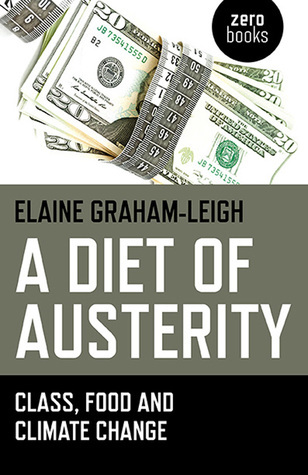
Received wisdom is increasingly that we all have to eat less to save the planet, but received wisdom is wrong. A Diet of Austerity argues that, just as the poor are blamed for the economic crisis, Malthusian conceptions about food and ecology are being used to hold the working class responsible for climate change and global hunger. Challenging existing dogmas about overconsumption and personal responsibility, it shows that what we need to stop climate change is system change.
Elaine Graham-Leigh is an activist, historian and qualified accountant (because even radical movements need someone doing the books). She is the author of The Southern French Nobility and the Albigensian Crusade (Boydell and Brewer 2005), A Diet of Austerity, Class, Food and Climate Change (Zero Books 2015), Marx and the Climate Crisis, (Counterfire 2020) and The Caduca (The Conrad Press 2021). She speaks and writes regularly on a range of political issues and her science fiction stories have appeared in zines including Jupiter SF, The Harrow, Bewildering Stories and Theaker’s Quarterly Fiction. Her website is www.redpuffin.net. She lives in north London.
The first chapters of this little book are well done. Graham-Leigh intelligently lays out how questions of class, morality, and diet are conflated in the modern British mind, and how untruthful and unhelpful much of the received wisdom regarding obesity, consumption and waste really is. This section is a bit repetitive but the author knows her material and presents it clearly. Her arguments against austerity in this section are forthright and convincing and echo much of what I've read elsewhere regarding the future of food and how best to make use of our natural resources in a changing ecology. I think she could easily have written an entire book-length manuscript on just this subject and I'd probably be giving it four stars. But...
...the final chapters. Ugh! So much verbiage to so little effect. Redundant, sketchy on data, maddeningly vague and poorly argued. Capitalism here becomes a monumental bogeyman that's never justified by the previous text (where Graham-Leigh notes that many different systems of social organization have suffered ecological disaster and famine) and even this old socialist had to roll her eyes in disgust at the special pleading and philosophical juggling needed to make some of these arguments even slightly coherent. A disappointing conclusion to an otherwise interesting book.
generally really good, but very weak final chapter on post-capitalism which jarred with the otherwise excellent discussions in rest of the book. full review to follow on blog.