Jump to ratings and reviews
Rate this book

The Way It Haunted Him

Rate this book
A terrifying and powerful dark academia novel about Jewish folklore, grief, and other things locked in the archives. Perfect for fans of T. Kingfisher, Tori Bovalino and Sunyi Dean.
"It's real. You'll see."
Michael Stein arrives at the Schechter Institute for Judaic Studies battered and broken after the death of his boyfriend seven months prior. Blaming himself for the accident that killed him, Michael has come to the Institute to complete his boyfriend's dissertation as part of his effort at repentance. While Michael's own past leads him to condemn superstition as a way to mask prejudice and old-fashioned beliefs, his boyfriend's research argues that the folktales told in the Jewish communities of Eastern Europe were based in truth, and that demons and other creatures walked the earth, wreaking havoc on peoples' lives.
Instead of the Institute's infamous archivist, Michael is met by his grandson, Jacob Schechter, who has taken over the archive after his grandfather's death. A firm believer in the existence of the supernatural, Jacob explains that the archive plays host to a coterie of household demons. Michael insists that he is a skeptic, but strange and frightening occurrences plague his research, causing Michael to question both his sanity and his view of the world.
 
To cope with his guilt, grief, and the terrifying shadows following him, Michael must reckon with the events leading up to his boyfriend's death—and his role in it—by trusting the enigmatic Jacob to help uncover the truth. As untangling the mysteries of the past bring Jacob and Michael closer together, their respective secrets threaten to tear them apart. Because Michael is not the only one with darkness on his conscience, and if he and Jacob discover the truth of each other, only one of them may survive the fallout.

8 pages, Audiobook

First published June 9, 2026

Loading...
Loading...

About the author

Laura R. Samotin

5 books197 followers
LAURA R. SAMOTIN and her spouse live with two enormously large felines. When she’s not pursuing her academic research on military tactics, power politics, and leadership, she relishes her role as a full-time cat servant.

Ratings & Reviews

What do you think?
Rate this book

Friends & Following

Create a free account to discover what your friends think of this book!

Community Reviews

5 stars
44 (30%)
4 stars
37 (26%)
3 stars
35 (24%)
2 stars
18 (12%)
1 star
8 (5%)
Displaying 1 - 30 of 107 reviews
Profile Image for Zana.
974 reviews403 followers
Did Not Finish
April 15, 2026
DNF @ 95%

If you love insta lust AND insta romance, this is it!!

But seriously though, this should've been labeled as a dark romance so readers could adjust their expectations accordingly. (Is this a spoiler?) It would've saved me from requesting the arc and wasting my time on a book that could've just been a library borrow.

Nothing in this story made any sense. The premise started off with Michael wanting to finish his dead boyfriend's dissertation and publish it. That made no sense at all; Michael wasn't even an academic. Then when he arrived at the institute, he immediately hooked up with Jacob, the guy in charge. That was literally the inciting incident. Then Jacob just let him into the archive while Michael had blood all over the front of his shirt. Make it make sense.

Oh, and I'm still trying to figure out if Jacob used Michael's blood as lube. (Yes, this was all in the first 15% of the novel.)

The only character I liked was the damn cat. The therapist was a close second because she was dropping truth bombs like no other. This really helped alleviate Michael's 24/7 foolishness to some extent. (And helped distract my mind from thinking about Jacob wearing socks in the bath.)

Honestly, this was a lot more Gothic dark romance than dark academia imo. So, if you're into Gothic dark romances with a mlm pairing, this might be for you. It didn't work out for me because while the summary hinted at a romance, I wasn't expecting a full-blown capital R Romance to the point where it fulfilled the requirements of the romance genre. (I skimmed the last 5% to confirm.)

Thank you to Titan Books and NetGalley for this arc.
Profile Image for The Reading Frog.
92 reviews24 followers
Review of advance copy received from NetGalley
June 21, 2026
Thank you to the author, publisher & NetGalley for this free ARC in exchange for my honest review

Rating: 1.5/5 ⭐
CW: Explicit |
Moderate |
Mild |
CWs as described by the author
My chosen soundtrack: New Ways - Daughter


(...) he wasn’t likely to accuse Michael of having utterly lost his mind.
And maybe that was what Michael was truly afraid of: someone looking at him and telling him that, yes, he could trust his own senses and his own mind. No, he wasn’t crazy. Yes, this was real.


Representation
╰┈➤ Bi/Pan MC, Michael
╰┈➤ Queer unspecified MC, Jacob
╰┈➤ MLM dynamics, Michael & Nate (past), Michael & Jacob
╰┈➤ Demisexual MC, Michael (Though I disagree with this self-proclaimed label describing Michael's sexuality)
╰┈➤ Mental health rep, MC seems to deal with
╰┈➤ Jewish characters and folklore


Themes
Guilt, grief, obsession, demonology, Jewish folklore, mysticism, self-worth issues, repentance/punishment, problematic coping mechanisms, blame/responsibility, self-hatred and destruction, detrimental effects of being a people-pleaser, escapism, abuse, and not allowing oneself to heal.

Tropes
‎ ‎ ‎ ❥ A character haunts the narrative
‎ ‎ ‎ ❥ Dark academia

What I liked
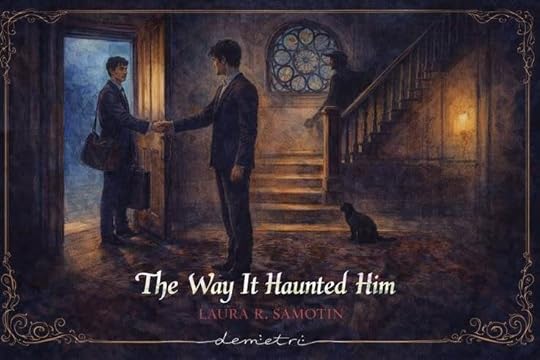
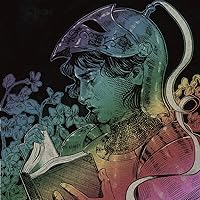
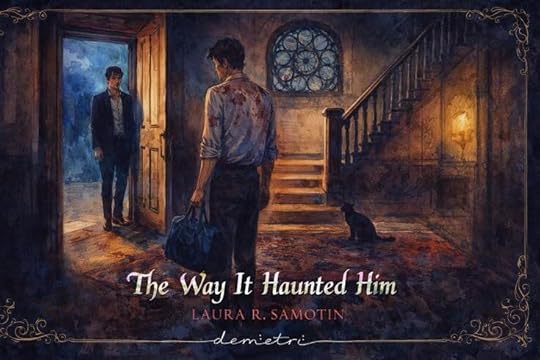
‎ ‎ ‎ ✧ The cover is beautiful.
‎ ‎ ‎ ✧ "Michael Stein wasn't a good person." was a good opening line.
‎ ‎ ‎ ✧ I did appreciate that Michael wasn't a perfect victim, but I have a lot of issues with how this story represented certain mental health issues and abuse. I never mind discourse in books about heavy subjects. I do, however, mind when they aren't properly addressed or perpetuate harmful ideas. More on that in the next segment.
‎ ‎ ‎ ✧ I did enjoy, to a certain degree, that Michael is , but I do think that there could have been a better way to execute it.
‎ ‎ ‎ ✧ I did like the concept of
‎ ‎ ‎ ✧ I enjoyed learning about Jewish folklore.


What I didn't like/felt lackluster about
‎ ‎ ‎ ✦ I'm starting this segment with an apology for potentially being ranty. Apparently, I had a lot to say about this one.
‎ ‎ ‎ ✦ I was able to predict one plot twist/reveal in the first 7% and the other one at 30%, which could've been okay, but it just felt like it dragged on and on. Once the reveals were finally there, I didn't feel hyped about it at all.
‎ ‎ ‎ ✦ Some aspects were quite repetitive.
‎ ‎ ‎ ✦ Wasn't really a horror in my opinion, but it is marketed as such.
‎ ‎ ‎ ✦ Michael is a self-proclaimed demisexual; he mentions in that same announcement that he falls fast and hard for people. I'm demi and correct me if I'm wrong, but that view doesn't feel in line with demi-sexuality, at least to me. It weirded me out as well that Michael was instantly attracted to Jacob and had sex with him the first day they met, which very much is in contrast with the common definition of demisexuality. Aside from describing physical traits that Michael finds attractive in the other MC, there isn't much more substance there. Making me unable to really feel or root for this couple. Jacob does have a hand in Michael's change of opinion about, which could be a reason for their bond, but I personally did not enjoy their romantic dynamic.
‎ ‎ ‎ ✦ I felt very uncomfortable with Jacob's and Michael's first sexual interaction. I guess Jacob does explain his behaviour later on. But it just made me feel weird. I feel like there are some dubious consent issues there due to Michael using sex as self-harm, as well as being under the influence of drugs during their interaction. There was a reason for Jacob during it, but it felt like a weird choice to me. That same result could have been attained without turning it into a weird, non-negotiated kink-esque situation. I just really dislike how Jacob treated Michael, especially when he later mentions how it was clear to him that Michael had been . He was also aware that he was grieving his dead boyfriend. All these aspects make it feel very icky to me.
‎ ‎ ‎ ✦ After the first 14%, I made this note:
This has the potential to romanticize whatever this is, and I really hope that won't be the case.

I love how we have explored complex emotions, trauma responses, and (harmful) coping mechanisms so far, but whatever message this book decides to deliver will highly impact whether I enjoy this book.

Since this could become unethical very fast if these aspects are not addressed as problematic.
Unfortunately, it turns out that I did feel like the aspects I've mentioned weren't handled correctly.
‎ ‎ ‎ ✦ There are many aspects of Michael's trauma and mental health that I could've appreciated if not for the way they fell off towards the end. Many of them were set up as potentially amazing character arcs, only for them to end up at the wrong conclusion. Going into major spoiler territory here, which I normally don't want to do for a book that is yet to be released. I do, however, think I need to spoil some stuff to clarify my issues with it.
‎ ‎ ‎ ‎ ‎ ‎ ‎ ‎ ‎ ‎ ‎ ‎ ‎ ‎ ‎ ✦ Throughout the whole book Micheal goes on and on about how he doesn't want to hurt or kill people, how he feels horrified by . But in the end, without a believable character arc, he is suddenly fine with . That last chapter really felt jarring to me.
‎ ‎ ‎ ‎ ‎ ‎ ‎ ‎ ‎ ‎ ‎ ‎ ‎ ‎ ‎ ✦ The way Michael's destructive tendencies were resolved felt abrupt and, in my opinion, harmful. This book follows the 'love fixes all' concept. Through Michael's relationship with Jacob, he seems to get better. He even lists it himself as the reason for no longer needing therapy. He dismisses his psychologist's very valid concerns and her suspicion that he is being loved bombed. He, however, concludes that he is healed. As someone who deals with my own mental health issues, I really dislike the message that when one finds love, all their problems will magically disappear. I'm on his therapist's side with this one.
‎ ‎ ‎ ‎ ‎ ‎ ‎ ‎ ‎ ‎ ‎ ‎ ‎ ‎ ‎ ✦ There is this whole arc of Michael realizing he shouldn't live for the whims of his partner, or disregard himself for them, but in the end, he seems to do so for Jacob. He also realizes that he is a victim of Michael was definitely not ready for a romantic relationship; he has way more healing to do.
‎ ‎ ‎ ✦ Keeping all this in mind, , I feel unsure if we can believe Jacob when he tells Michael that everything he felt wasn't meddled with, wasn't influenced. Because Jacob is literally ? What's to say he hasn't lied to Michael? Idk, I feel like there is way too much wiggle room for multiple interpretations. The author doesn't explicitly regard their dynamics as problematic, and if she intended to showcase their dynamic as toxic and something to be condemned, she failed to do so with this reader.
‎ ‎ ‎ ✦ Disclaimer, I am unfamiliar with Jewish folklore and thus might not get the full naunce of it. That being said, I felt very weirded out by the multiple mentions of Israel. Plus, including the plot point of a certain character () having served as a protector of Israel. As well as the term "ancient history" being used to describe the relationship to Israel. I will have to do more research on the author to see what their political stance is, since for me, that is really important. I don't want to promote something that I don't agree with.

POST RESEARCH UPDATE (Apr 10, 2026): The reasons for the allegations can be found here: Authors On Palestine | Airtable

ANOTHER UPDATE (Jun 21, 2026): Check out @Incunabula_and_intercourse's comments under this review for a more knowledgeable analysis of the texts on Israel in this book.


Conclusion/Notes
This novel had the potential to do something great, but unfortunately left me disappointed. I would've probably DNF'd this one if it weren't an ARC.

I did really enjoy learning about Jewish culture and folklore, but was really disappointed by the portrayal of mental illness and abusive relationships. I have so many thoughts that I could write down, but honestly, I'm tired.

Maybe I'm totally offbeat with this review, maybe I interpreted these characters and this story wrong. If so, feel free to change my mind. For now, these are my honest opinions, regardless of what was intended. And unfortunately, I find this book to be perpetuating harmful ideas about abuse victims and mental health.

I don't want to promote something that conflicts heavily with my own viewpoint, and thus cannot recommend this book in good faith.
Profile Image for bri.
466 reviews1,420 followers
Read
March 25, 2026
I've been SO excited to read this queer, Jewish, dark academia ever since its announcement, and I'm glad to say the vibes were sublime. In THE WAY IT HAUNTED HIM, Laura Samotin twists the strengths of her debut into the realm of dark academia, tinted with a shade of erotic horror.

THE WAY IT HAUNTED HIM treads a similar path to THE SINS ON THEIR BONES—following a queer, demisexual, Jewish MC on a journey of healing from trauma and complicated guilt-laden grief, in a story adorned with Jewish mysticism. But this time, instead of being an exiled king trying to take back his country, our main character is a translator trying to finish his boyfriend’s PhD work.

But despite their similarities, Samotin’s sophomore novel carries its own weight; its character-driven frame creates a lovely sense of intimacy, able to dive deep into the nooks and crannies of its container. I flipped through this book as quick as a breeze, lost in the compelling dynamics between the main characters and wrapped in the haunting and heavy beauty of the story’s setting.

There were many things to love in this book: a haunted synagogue-turned-archive (that I wish was real because I would never leave), a toilet demon cat (she’s really the star of the show), brilliant explorations and uses of niche elements of Jewish mysticism, relationships between physical and mental wounds, well-written character arcs. I was driven up a wall by the fact that the MC kept talking about using gloves for ultra-delicate materials, but I’ll forgive.

Overall, I really loved this book. The way Samotin threads Judaism into her books will never fail to touch my heart. I think fans of EVOCATION and THESE VIOLENT DELIGHTS might find something to love here.

Thank you to the publisher for sending me a copy of this book! Disclaimer: I am friends with the author. All opinions are my own.

CW: blood, injury detail, grief, death, drug use, suicidal ideation, hospitalization, emesis, hallucination, panic attack, insects, murder, abusive relationship
Profile Image for ❁lilith❁.
232 reviews41 followers
Review of advance copy received from NetGalley
June 5, 2026
Thanks to Netgalley and the publisher for this eARC.
____________

This was a nice story to read, despite the subject material which can get a bit heavy. Definite warnings for abuse and everything that comes with that, but I think it was handled respectfully and realistically. I think it could be quite healing for some to see that journey of understanding and acceptance that none of what happened was their fault and that there are opportunities for better things in life, even if this particularly story also comes with demons attached.
It was cool to look into the Jewish folklore and history that this book delves into. The characters are quite likeable, and it's a small cast so there is plenty of time to sit with them and see them develop.
I did call the plot twist really early on, but it was still interesting to see it play out at the end. Quite a quick and satisfying read, with some important themes.

PUBLICATION DATE: 09 JUNE 2026
Profile Image for Esmay Rosalyne.
1,633 reviews
Review of advance copy received from Publisher
June 4, 2026
This review was originally published on Grimdark Magazine

The Way It Haunted Him was my first time reading Laura R. Samotin, and it sure as hell will not be my last because this queer, demon-infested dark academia horrormance was exactly my type of emotional rollercoaster. I am fully aware that this book will not work for everyone, but unfortunately for me, I am just an absolute sucker for morally messy stories about grief, obsession, trauma, and broken people making increasingly questionable life choices in the name of love.

Normally, I am not a huge fan of books that immediately throw you into the deep end with zero explanation, but somehow The Way It Haunted Him had me hooked immediately. From page one, Michael is already midway through an emotional breakdown, and I loved how Samotin just grabs you by the throat and drags you down with him. He is drowning in guilt and grief over his boyfriend’s death, convinced that he is a sinner responsible for what happened, and that air of mystery and intrigue had me desperately turning the pages on the hunt for the truth because the details are frustratingly vague and answers are nowhere to be found.

Now, I can absolutely see some readers wanting to claw their way out of Michael’s brain, because he is repetitive, angsty, frustratingly oblivious to some of the very obvious weirdness happening around him, and if self-loathing was an Olympic sport, he’d absolutely win the gold medal. But honestly, that is exactly the kind of broken, unreliable narrator that I love. So much of his story is buried beneath trauma and PTSD, and for a huge chunk of The Way it Haunted Him, we are stumbling around in the dark alongside him as there are so many things he is hiding even from himself. His thought patterns can be exhausting, but they felt painfully real to me because trauma is not neat, grief is not pretty, and sometimes your brain just keeps chewing on the same wound until it bleeds again.

All of that does admittedly result in a plot that is quite slow-burn and a pacing that is honestly glacial for a good portion of the story, and yet I was never bored for a second because the tension just kept building and building on so many levels. The twisted, oppressive gothic atmosphere really reminded me of S.T. Gibson’s An Education in Malice, and I just loved how Schechter Institute felt so claustrophobic and unsettling in all the best ways. The dark academia aspect was maybe not as strong as I expected, but I did really appreciate the incorporation of Jewish folklore through Michael’s research into demonic entities, especially because it was deeply woven into the characters, the relationships, and the emotional core of the story instead of just being some nice windowdressing.

Though speaking of those relationships, the romance aspect of The Way it Haunted Him honestly put me through it in the best and worst ways. There is no denying that the dynamic between Michael and Jacob, the archivist’s brooding, enigmatic grandson, is an aggressively suspicious case of insta-love, which felt especially weird and unconvincing to me with Michael identifying as demisexual. But somehow, Samotin managed to make me stop caring because the vibes were vibing and I just got so invested in these disaster men and their mountain of issues. Their bond is built on obsession, loneliness, secrets, and approximately zero healthy coping skills, and I just loved how every interaction between them felt soaked in hurt and yearning.

The ending maybe felt a little rushed compared to the deliciously slow, agonising burn of everything that came before it, and some twists were so obvious that I started wondering if they were even meant to be shocking reveals in the first place, but I still devoured this book in a single day like a woman possessed and left it feeling completely drained and utterly satisfied all at once. If you like your horror queer, obsessive, emotionally messy, slightly unhinged, and crawling with demons both real and imagined, then The Way It Haunted Him is absolutely worth picking up.

Thank you to Titan Books for providing me with an eARC in exchange for an honest review, all opinions are my own. The Way It Haunted Him is scheduled for release on June 9, 2026.
Profile Image for Ally.
375 reviews502 followers
March 24, 2026
Got a review copy through Edelweiss, 4.5/5

Yet again, Laura R. Samotin proves herself to be a master of angst, anguish and heart. This is a story about literal monsters that lurk in the dark, and the monsters we make of ourselves, it’s about guilt and forgiveness, and it’s about a very good cat who’s a fiend for people food, but at its heart it’s a love story, and one that will haunt ME for quite a while.

I do feel like this was perhaps a bit mismarketed, if anyone is going into this expecting toxic dark academia, they may be a bit disappointed. The heart of this book is its love story and the supernatural elements, and while /I/ loved it, it’s NOT gonna be for everyone and something something managing expectations.
Profile Image for artemis.
436 reviews2 followers
Review of advance copy received from Netgalley
May 2, 2026
Thank you to Titan Books and NetGalley for providing me with an excerpt in exchange for my honest review.

The Way It Haunted Him follows Michael, someone who seven months previous had lost his long-term boyfriend in an accident and he sets out to finish his research as a final grace towards him. From the moment we meet Michael, he is shameful, guilty and feels inexplicably bad about himself; so much so he has developed somewhat of a sex addiction and is in the depths of a prescription drug addiction and self-harm. This is something that makes Michael interesting and intriguing right off the bat—someone who is deeply flawed and struggling with grief. When he arrives at Schechter Institute, he meets Jacob, the grandson and they research the archive that resides there. The premise of this is promising, there is a heavy hand in Jewish culture bred into this book, and you yourself, learn about the folklore that exists.

Everything about this, really should've grabbed me by the reigns—and it did for a good moment. The most disappointing matter was how Michael's characterization was handled during the duration of this book. It takes place between 2-3 months and inbetween this, we meet Michael in a self-destructive state and by the end, he is on the complete opposite end that all of his self-destructive behaviour has been mostly ignored.

I prefer to not go into heavy-handed spoilers for books I receive as an arc but unfortunately I don't believe I can get my honest, entire review without it. Michael is in a state where he is not ready for any type of romantic relationship, purely because of how he handling his grief and using his addictions to take place of any emotion he needs to have to heal. For example, here are a few lines from the book:

"Sometimes Michael thought he wanted to die, but he didn't have the courage to kill himself (...)"

"(...) reminding himself that he was a vessel for other people's pleasure and nothing more than that. This was his penance."

"Michael googled until he found the magic combination of words to say to psychiatrists to get prescriptions for Xanax, Ativan, Valium, Klonopin, Versed (...) while he spent most of his time in a dull haze"

Not mentioned in these quotes but he also self-harms via his unhealed scar. By the end of this book, Michael has not truly faced his addictions; instead by the third act, they are never mentioned ever again. His self-harm is mentioned once, but not him facing it. He avoids his addictions, his self-destructive behaviour and personally, I think this is a sure fire way to ruin what has been set up for most of this book. His shame, guilt and more is more or less dismantled within two scenes, both with the love interest. By the end, Michael tells his therapist he no longers needs this—this being in stories with mentally ill people, especially those dealing with grief will never not be harmful.

Secondly, the love interest: Jacob. I liked his character as we first meet him, I like how he wants Michael to have a safe place. Unfortunately, with Michael's fall of his character, this too falls. The romance is unnecessary in a story like this, especially when even Michael's therapist mentions it is very eerily akin to love-bombing. Love solves it all. For what happens towards the end with Jacob's being, it could have been a very interesting relationship between the two but not with how Michael was. Especially since there is one scene of Jacob handing Michael a drink of wine and his first thought was he hadn't drank alcohol in a long time but it wouldn't hurt to add another addiction into the mix. Especially since Michael has a unhealthy viewing of sex and his own relationship with romantic partners due to his previous relationship.

The romance unfortunately is hard to root for, hard to love or like when there are so many elements that are perfect for disaster and this is including an element that happens at the very end.

All in all, this was a very disappointing read. Originally I would've given this a higher rating but there are 3 mentions to Israel in this, there is a character who has "protected" Israel. Considering I myself, am not a zionist, I do not see Israel the right to a state nor do they have an "ancient" history as this book claims; this was extremely and utterly disappointing.
This entire review has been hidden because of spoilers.
Profile Image for Azhar.
436 reviews41 followers
January 26, 2026
more so a 2.5 stars. i just don’t know how to express my thoughts about it. it’s not that bad of a book but i’m left feeling very meh after reading.

michael’s carrying a secret and by the 80% mark when it does comes out, i do feel for him but i’d spent a majority of the book disliking his character and his choices including hooking up with jacob in the first chapter while he’s there to finish off his dead boyfriend’s dissertation. jacob’s character is also unremarkable.

i enjoyed the academia sections of the book, learning a little about jewish mythology and folklore was interesting but it doesn’t dive nearly as deep into it as i would have liked. veronica schanoes does it so much better in her “burning girls” collection.

thanking netgalley and publishers for the ARC
Profile Image for Timmy.
88 reviews1 follower
June 17, 2026
2.5. It was supposed to be a 3.5 at least, but the whole “therapy is not good, love is what you need” thing towards the end is not something I condone and makes me drop this a full star, which is a shame as this is otherwise a charming story about grief, surviving abuse, and filled with Jewish folklore.

What I liked: the setting, the slow, cozy feeling of the author’s writing, the way abuse was discussed *up until the last few chapters*. The characters, too. The amazing and natural inclusion of Jewish folklore! There is so much to love about Laura R. Samotin’s books and were it not for the dismissal of therapy, I would very much recommend this.

What I didn’t like as much: The insta-love thing. It’s a me thing, and it suits some people much better, especially as this is a fairly short book and honestly the rest of the story makes this a very little thing and would not have turned me away from the book at all.
Additional spoilery info that affected my rating below:


Thank you to the publisher and to NetGalley for sending me an advanced copy in exchange for an honest review!
Profile Image for Ella.
18 reviews
February 6, 2026
“Welcome to the Schechter Institute… May you find truth here.”

I immediately gravitated towards this book, from the title to the cover, to the topics contained in this book.

It’s not often books are written about Jewish mythology in such a way. The complexity of Michael and Jacob’s characters are evident and how mythology is encompassed in the book is well thought out.

I don’t often feel like I learn large sums of information in fiction books (not to say I don’t learn, but it’s usually words, not more about culture, religion, and superstition). However, I learned throughout this book and furthered my own understanding of Jewish folklore, demons, and superstition.

In the later half of the book, the understanding Jacob has of Michael and Nate’s relationship was a poignant reminder that abuse shows up in many ways, and sometimes it just takes one person to help someone understand it. I do suggest everyone take the time to read the trigger warnings for this book (and reach out for support should they need it). Not everyone’s experiences and understandings of abuse are the same but I felt it was written tactfully by the author. Mental health was a large portion of this book, with Michael trying to understand the aftermath of Nate’s death. The use of metaphor of Michael’s physical wounds to mirror his mental ones was well written.

Although a slower paced novel I felt it worked in this instance, it created a sort of intimacy with the readers. I felt that when what Michael had done was revealed (70% through the book) it was later in the book than I would have hoped but not too far that we couldn’t see the story afterwards. Moreover, I enjoyed the academia setting.

The last 20% of the book was very fast paced and did feel somewhat odd to me as the ending. While I understand how it fits with the book it almost felt like a new novel and that the characters had changed especially Michael’s insistence he would never hurt someone else purposefully being reversed.

Nonetheless it was a good book and I look forward to reading more by the author, I enjoy her writing style.

A sincere thank you to the publisher, author, and Netgalley for a copy of this as an ARC in exchange for an honest review.
Profile Image for Bookshire Cat.
622 reviews63 followers
May 12, 2026
Don't read this book if you expect squeaky clean romance MCs and a healthy relationship. This is horror-ish, gothic, dark romance that is so morally gray it's almost black. Check the trigger warnings in other reviews on GR as they are many and the coping mechanisms the MC uses are best not replicated.

I had a great time with this story although I was able to guess all the plot twists quite early (for my standards at least). I liked the atmosphere, the MCs and the supporting non-human characters. I also enjoyed how it played with cute romance tropes (e.g. one MC teaching the other how to cook) in this rather creepy setting. The unreliable narrator device could have been perhaps subtler and there was also a lot of repetitive patterns in the narrator's head - I know it was kinda the point as he has PTSD and anxiety but readers would have gotten the idea even with a bit less repetition.

I should note that I know next to nothing about Jewish folklore so I can only judge the vibes it gave to the story, which were immaculate.

I received the ARC through Netgalley and I'm leaving a voluntary review.
Profile Image for Trisha.
526 reviews86 followers
May 26, 2026
Thank you Titan for the ARC!

One thing about Laura is that she's going to give you an absolutely broken MMC with puppy eyes. And then she's going to break him some more.

If you're looking for a MM standalone and love your MMCs to be broken and questionably put back together, insta-lust, and a touch of Jewish folklore, you'll have a great time with this!

This was a super fast read that's very character focused more so than plot focused. I'm not sure I'd classify this as dark academia in the "normal" sense of the genre, especially because the plot is more centered around relationships and not the academic side of it. But it definitely does add a very interesting layer to the story!

Honestly I think this could have been better served as a duology--I really wanted Michael to struggle with accepting his new reality longer than he did and really give the "twist" of it all to settle in. Another 300 pages could have definitely let the "academic" side of the plot take more of a center stage too, and given us much more in terms of the folklore of it all.

Overall, I really enjoyed this and would definitely recommend it!
Profile Image for Sophie.
204 reviews6 followers
March 9, 2026
This was a bit of a strange one. I didn’t love it, but I also didn’t hate it. I sit very much in the middle, unsure how I feel about it.

A lot of emphasis is placed on the secret Michael is carrying that supposedly makes him an evil person. I don’t think it’s meant to be subtle and you can see where the story is going, but I just felt quite unbothered by it. The repetition of dangling the reveal started to get a bit annoying fairly quickly.

I’m also not really sure how I feel about the ending. It felt a bit rushed and took a turn that didn’t feel entirely natural. It seemed like Michael ended up back at square one and not much was really accomplished, which I struggled to get on board with.

I did enjoy learning about the different folklore elements, and the setting itself was very atmospheric.

Thank you to the publisher and NetGalley for the ARC in exchange for an honest review.
Profile Image for Kayla Borden (boocwurm).
170 reviews47 followers
Did Not Finish
May 30, 2026
The writing style of this was immediately not my favorite, so I struggled to get into the story to start. But my end point was the abrupt sex scene where essentially a stranger fingers the MC’s wound. It was way too much, too fast, and I’m questioning, why?????
Profile Image for Lisa.
301 reviews12 followers
Review of advance copy received from Netgalley
February 8, 2026
“Monsters weren't real. They were made up by people who wanted to hide the fact that they were monsters themselves, or too powerless to stop the monsters around them.”

I can’t count the number of times I picked this book up, put it down after a chapter, then picked it back up again almost immediately. It was addictive and immensely readable, but the heavy themes packed an emotional punch that made me pause for breathers.

The Way it Haunted Him haunted me with its no-holds-barred portrayal of grief and guilt. The hopelessness of the characters shone through, in every heartbreaking line. It’s a gritty, atmospheric story that will stick with me for a long time.

The characters’ secrets were both fairly evident early on, but I don’t think that detracts from the story. It’s not the revelation of the secrets that’s the important thing, it’s how the characters deal with that revelation. And wow, that’s a whole big thing that we can’t discuss because of spoilers.

To a smaller extent, The Way it Haunted Him is also a story about Jewish mythology and folklore. The academic sections were extremely interesting and well done. I look forward to more from this author, having also read and loved The Cursed Crowns duology, particularly the first novel.

I really enjoy Laura R. Samotin’s writing style. I get immersed in her descriptions and atmosphere she creates. There were a few instances in this book where sentences were a little confusing, and a few mistakes that could be caught with more editing before the final book is published.

Ummm, the ending? Not what I expected. But damn, did it make sense. Now I see why the book is labelled horror. You got me.


Thank you to NetGalley and Titan Books for providing the ARC of this book. This review is my honest and voluntary opinion.
******

Got an arc! So excited.

***

Dark academia you say?
Profile Image for Karen Rós.
498 reviews18 followers
Review of advance copy received from NetGalley
June 5, 2026
I received an ARC from netgalley in exchange for an honest review.

I need to first off say that I'm not very well versed in dark academia and its tropes and conventions, so I might be way off base in some ways. I think I've only read one dark academia novel before this, and that was an unpublished manuscript I hope didn't get picked up for publication because I hated everything about it with every fibre of my being.

this, though, I liked for the most part, until maybe the 90-95% mark (spoilers ahead) at which point I became really confused about what was going on.

Michael was a grieving, lonely, self-loathing, abuse survivor. Jacob could probably be described in much the same way. he also immediately has vampire vibes, so I'm (despite my general wariness of vampire books) excited for it to be revealed that Jacob is a vampire or some other kind of immortal, bloodsucking or no. Within a few hours of their first meeting they fuck in a way that is clear for both of them is, for the lack of a better word, toxic - it's intentional, and they're into it, and I'm into it, because I like fucked up characters making fucked up choices.

then what follows appears to be a slow romance during which Jacob and Michael genuinely fall in love and try to support each other and be kind to each other, and also Michael's mind starts unwinding - he starts healing from his boyfriend's death (and starts getting to a point where he can acknowledge that a) his boyfriend abused him and b) that he killed him). When Michael learns that Jacob is a sheyd (a Jewish demon) who's more than 5000 years old and who's been summoned to earth countless of times to be a slave to humans, to kill and murder and harm, and that he's currently bound to the archive and tired, and wants to be free, and doesn't want to harm anyone... and Michael, despite his shock of learning Jacob is a sheyd, decides he's all in, he loves him, he wants to help him, etc.

well. then my expectation becomes: the rest of the book is about them finding a way to unbind Jacob, so that they can live happily ever after, or something like it. I'm then VERY surprised to see that when they do find a way to break the binding, it means draining life forces - and even killing people in the process - so the two start making plans to invite researchers to the archive with the explicit intention to drain their life forces (kill them) in order to undo Jacob's binding. a long term plan, with contingenies for the dead bodies etc. now, I don't mind a dark ending! that is not my problem with this ending. my problem is that Jacob's character has at this point been established as someone who no longer wants to kill people. Michael's character has been established as someone who needed to recognise that he did a monstrous thing and be okay with that, so he can move on. he realises that because he doesn't hold Jacob's actions against him - actions performed under duress for the most part - he also can't hold his own actions against himself, i.e. killing his boyfriend after said boyfriend beat the crap out of Michael and nearly killed him. Michael and Jacob have not been established as characters who are okay with murder. so why do both of them suddenly think it's okay to set up a whole serial killer plan?? this feels incongruous.

so to be clear: I'm OK with the dark ending and the seerial killer plan, but I do feel like both Jacob and Michael should've been set up as characters who would actually be ok with that before that reveal. this was out of left field. I get that they have a codependent relationship going on, that it's not healthy, all things considered, but that unhealthy codependent relationship was built on kindness and grace and love (after that initial hookup). there were simply some things missing from the romance arc that properly laid the groundwork for the dark ending.

it basically felt like the romance and the healing arc was clawing its way out of the gothic dark horror-like setup it was in, to suddenly just veer back for no reason. I keep snagging on it. it doesn't make sense.

and this is why I said at the start that I'm not very knowledgeable about dark academia books - is this normal? I don't know. I'm confused. am I expecting something that goes against dark academia conventions? am *I* the problem?

ALL THAT SAID, I did still enjoy most of the book - the setting was delicius, Shiri the toilet demon cat was perfect, the mazzekin demons were fun. I loved seeing the bits of research Michael was going through.
Profile Image for Becky Spratford.
Author 4 books884 followers
Review of advance copy received from Publisher
March 24, 2026
Reading for review in a future issue of Booklist

Three Words That Describe This Book: Jewish Folklore, Horroromance, slow burn

"May you find truth here." a quote from the Schechter Institute itself but also the phrase that describes this book in one sentence. And as you can feel from the phrasing, this is ominous. The books reflect that. What is the truth? When you know the truth, it is not always neat and pretty. Truth carries horrors as well. All of it.

Michael has travelled to a most comprehensive Jewish archive in America to complete the research on his recently deceased boyfriend Noah. But from the start, Michael has made it clear that he holds scars from their relationship-- psychical and mental. He is the sole narrator and he makes it clear to readers that he has secrets that make him look bad. [I will say the author overdid it on that part. Too many pages about his guilt and telling the reader how "bad" he is. some editing on those pages and pages of guilt and then beefing up the end stuff after the twist is revealed (see below) would have made this book got from very good to excellent.]

After trying for months, Noah could not get an appointment at the institute-- the best place in the world to do his research on Mazzekin-- the minor demons/sprits known to cause mischief in Jewish folklore. The founder had died, but after Noah dies and Michael has healed from the attack [accident] that killed Noah and resulted in his own severe injuries, Michael gets an invite from Jacaob, the grandson of the founder. He is finally able to open again and Michael will be the first researcher.

They fall for each other, but of course, there is more than meets the eye here. And don;t forget about the Jewish folk horror parts of this book.

This book though is a great example of the difference between Paranormal Romance and Horroromance. The ending is very horror, sinister, and unsettling-- in al the right horror ways. And the romance between Michael and Jacob was very satisfying-- and there were multiple sex scenes.

The slow burn of the pacing was appropriate for the story and Michael our narrator. Michael is a researcher and a translator, he needs time to use sources to come to his conclusions about everything. That being said, when it clicks for him, it clicks and he knows his truth.

The details matter in that slow burn pacing and in the research, even the first sex scene has a few key details that are revealed to be significant. Things that happen are there for a reason and I appreciate that as a reader.

I do think the end was a bit rushed though. The revelations were not shocking to me as a reader, but the implications needed a bit more time to be explored. The ending itself-- the last action that happens was satisfying though. I would read more by this author for sure.

The author has a trigger warning statement at the start of the book. She lets you know where to go for more. This is needed. There is heavy stuff here.

As a Jewish person, I really loved reading a book that used my religions folklore and history to tell a Horror story without it having to have anything to do with the Holocaust. We are more than the people who were the victims of the Nazis.

To that end, this a a VERY grownup read for people who loved the Jewish mythology of Angels and Demons in one of my favorite books-- the YA title-- When The angels Left the Old Country by Sacha Lamb. Mix that up with the academic research and queer romance of A Game in Yellow by Hailey Piper and that is your readalike.

There is some grief horror here, but not as much as the description would lead you to believe. Those two titles are the best way to describe what you will find here.

Look this is not disparaging, but I do think Colleen Hoover fans would like this. It would satisfy a lot of itches. They need to know it is a gay romance though.
Profile Image for Elle Cheshire.
561 reviews40 followers
Review of advance copy received from Publisher
May 14, 2026
The Way It Haunted Him is a dark academia romance with Jewish mythology. It looks at grief, guilt, abuse, forgiveness, acceptance, love.

I haven’t read many books centring Jewish folklore before so I was very eager to read this one. I enjoyed how the mythology ran through the story and was a key part of Michael’s emotional journey. And the folklore itself was just interesting. I liked the superstitions, the little demons and their playful natures and learning about invocation bowls. It was also fun to see the contrast of Michael, a modern day man who doesn’t believe in magic versus the enigmatic Jacob and his absolute certainty.

I enjoyed Jacob and Michael’s dynamic though it’s insta-love. For a short book, there was lots to pack in so it worked for the story and for Michael’s personality. Their interactions were weighted and flourished over the course of the story.

Michael’s relationship with Nate was clear to the reader from the beginning. Michael’s grief is twisted up because it’s so heavily layered with guilt and underneath that the knowledge that Nate was his abuser. How are you supposed to process all that when you can’t even tell anyone the truth? Or believe your own mind? All experiences are different but the author handled it well. Mental health and healing are the core of this story. Michael’s emotional journey was the heart that drove this book and I liked how Jacob supported him. He pushed when he needed to and let go at other times. What started as Michael punishing himself for what he did, evolves into the very thing he needed to forgive himself.

The dark academia aspect was enjoyable, giving us time to soak in some history and Jewish folklore and feel Michael and Jacobs love of their work. The isolated atmosphere served to draw the two characters ever closer together. Their lives becoming entwined with each quiet moment of trust and shared intimacy.

I did guess the reveals early on but that didn’t detract from my reading experience. I still enjoyed the build up and how the truth came to light and what would happen in the aftermath.

Overall, an enjoyable read that delivered the emotional romantic journey I was hoping for along with a backdrop of rich lore. I do wish it had been a little more unpredictable or twisty and I’m conflicted on the ending considering Michael’s past choices.


Thank you so much Titan for the proof copy. All thoughts are my own
Profile Image for Magdalena (magdal21).
663 reviews79 followers
June 12, 2026
If you’re a fan of Laura Samotin’s previous duology, you’ll enjoy this one too. It’s more gothic and creepy, but it follows a similar framework and explores many of the same themes. Because of that, readers already familiar with Laura’s work might find this book a little predictable at times, and I can definitely see that argument. The emotional beats feel very much in line with what she’s written before. Still, that didn’t bother me much because the story isn’t really about shocking twists. It’s about following characters through pain, watching them struggle, and seeing how they eventually find a way forward.

This is a very character driven novel with a relatively simple but well executed plot. There are a few reveals along the way, but they’re more about gradually uncovering the full story than delivering shocking surprises out of nowhere. The main character, Michael, is grieving the loss of his boyfriend, a death he blames himself for. As a result, he decides to complete his boyfriend’s PhD research, which leads him to a Jewish archive filled with mystical texts, where he meets the mysterious archivist Jacob. As always, Laura Samotin’s portrayal of overwhelming grief is incredibly effective and deeply resonant. I really doubt there’s anyone in the fantasy genre doing that kind of emotional work better right now. That said, if themes of intense loss, depression, and emotional suffering are difficult for you, it’s worth approaching this book with caution.

I also have to praise the way Laura weaves Judaism and Jewish folklore into the narrative. I’m not Jewish myself, but I’m from an “old country” where Jewish communities were an important part of local history for generations. Seeing those traditions and stories presented in such a creative and positive way was fascinating.

Overall, this felt like a book written with existing Laura Samotin fans in mind, and I had a great time with it. I can’t wait to read whatever she writes next.
Profile Image for August ✡.
656 reviews
June 16, 2026
I wish this was a bit longer!
Some little problems (that others pointed out on their reviews) could have been ironed out with the additional pages. Just a bit more time to work out old trauma more convincingly (like how well it was on tSoTB) and to establish the relationship.
Mostly what took me by surprise was this fast the two jumped into a sexual relationship. I was sure at first it was a dream or illusion. Others might not mind, but it really took me out of the story and I still find it a bit too fast and not called for.

Also I found the mention of a the mc identifying as demisexual to be very out of place. I don’t think that’s how it works. Because he gets attached very dramatically to certain people, being codependent and highly clingy in all aspect of his life.
While demisexuality is developing sexually attraction only after establishing a strong connection with someone. I would say that there wasn’t any change in his sexual attraction over time. He just got attached very quickly and his life started to revolve around the love interest.
He does sound a bit inexperienced in the relationship department.

The therapist was probably so worried! I didn’t like the way Michael ended their sessions… maybe if we’d have seen/ known about actual work they did together to get to that point. But from her view, he just repeated his old behavior pattern and got lost into an all consuming relationship again- nothing new under the sun.

Maybe that’s why I connected less to the mc compared to their previous duology.

But in general readers have been mean as usual… This in my opinion should have a higher rating than the current average (3.67/5 stars).

This is definitely Samotin’s usual brand of writing, character and relationship.

I loved the premise and backdrop, I could take even more in depth explanation about myths, folklores and stories.
And I actually got introduced to incantation bowls from ancient Mesopotamia?! Didn’t know they used them in more modern East Europe communities… But they do get mentioned in The Golem of Brooklyn. It took me a few minutes to try to pin point where I have recently read that specific plot. And I thought in tGoB it was in ancient Near East?
Well, that’s my sign to finally book a ceramics lesson.
This entire review has been hidden because of spoilers.
Profile Image for Tayla.
87 reviews1 follower
Review of advance copy received from NetGalley
April 2, 2026
This story follows Michael Stein as he attempts to complete his deceased boyfriends research into demonic entities. Michael is consumed by grief and guilt regarding his boyfriend’s passing which fuels his determination with the research. This work causes him to end up at the Schecter Institute run by the mysterious Jacob Schecter, the previous archivists grandson. As he explores the archive and its contents with the help of Jacob he must also face his own demons…

I believe this was a solid read with an interesting premise and decent execution. Unfortunately, I just don’t think it was personally something I found that engaging or enjoyable. However, I believe a lot of that had to do with my inability to deeply connect with Michael. I of course had no issue emphasizing with his situation and what he was going through, but I did not feel any real connection to this character. I do think this would be a different experience for someone who has experienced loss. But this unfortunately hindered a lot of my enjoyment personally for this read and while I don’t think it was bad by any means, I don’t think it was my cup of tea.

With that being said, there were some interesting aspects of this one that I did enjoy. For example, the dark, moody, and isolated environment that allows for the two characters to have many interactions with one another without interruption was something I liked. I also liked the mystery aspect and putting the pieces of what happened in the past together as the story progresses.

While this was not something I found particularly special or something I was able to connect with personally, I believe it was a solid read that many others will find enjoyable!!

Thank you so much to NetGalley and Titan Book for the eARC in exchange for an honest review. This book will be published in June 2026 for anyone interested in reading this one!!
Profile Image for Gabby.
619 reviews92 followers
March 2, 2026
Laura R. Samotin weaves a tale on grief, humanity and self-acceptance. Michael is a victim of abuse, yet for much of the novel finds it hard to recognise this — seeing himself as the villain, that if only he was better, or did something different it would all be okay and he’d be happy. I think Samotin explored abuse well, particularly when it came to how Michael was gaslighted for years and how that has impacted his self esteem.

I liked the inclusion of Jewish mythology and folklore. A lot of it I am unfamiliar with, so it was interesting to learn something new.

Jacob was an interesting character and I had my own speculations on what was going on with him, to which I was mostly correct.

I’m not entirely sure how I feel about Michael and Jacob’s relationship. It was very much rushed, which you come to understand from Jacob’s perspective later, and with Michael looking for a distraction/a way to punish himself…

I did like that Jacob helped Michael to see the layers of abuse that he lived through.

However, I feel like I may be team Michael’s therapist and his friend when it comes to the ending of the book…

This was a good read and I liked it. I just wish there was a little more plot and a little more exploration of the characters.

Thank you Titan Books for the e-arc
Profile Image for Krystelle.
1,356 reviews51 followers
March 15, 2026
Thank you to NetGalley and the publisher for this ARC!

On paper, this book was everything that I could have hoped for. I love a good folkloric horror, and I think that Jewish folk horror is definitely a neglected genre. I wish that I could find a book that really leant into the horror elements, and I was left with cold feet from that in a serious sort of way.

I think the romance element just didn’t work for me at all. I found it to be a bit trite, and while I see what it was trying to do, it all just kind of fell a bit flat. I do think that there was some potential there but I just don’t think it got off the ground.

I really loved it when this book leaned more into the horror aspects but I felt like it didn’t lea into them as much as it could have. In addition, Michael having the secret that he keeps until very far in the book felt a bit too much like a dangling piece throughout. It left me feeling like it was just trotted out a bit too long.

I feel like some elements had promise, especially early on, but I just didn’t think it managed to hit the right spot in the end, which I was really disappointed by.
Profile Image for Sandra.
166 reviews6 followers
March 21, 2026
Blaming himself for his boyfriend's death, Michael Stein decides to take his place at the Schechter Institute for Judaic Studies to finish his boyfriend's dissertation. Instead of the older archivist, Michael instead meets his grandson, Jacob Schechter. And not only is Jacob very attractive but he's also a believer in the existence of the supernatural, all the things Michael doesn't believe in.

It's hard to say too much and not give things away but it's sprinkled throughout that Michael is quite obviously a victim of abuse by his previous partner, even if he does not seem to recognize this himself. Although this story is by no means a slow burn it was nice seeing Jacob slowly gain Michael's trust and see how a healthy relationship can be.

Michael also has to deal with never being a believer in the supernatural and yet witnessing multiple things he cannot explain during his short time at the institute. Thinking he's losing his mind due to many years of being gaslit by the man he loves.

The crux of the story is that both of these men are carry secrets, the story does reach this conclusion rather slowly. Once everything is on the table the story moves rather quickly, I do wish we had a little more of the story of the after these two were complete honest with each other.

I love how Laura writes a soft, sad character that I just want to wrap in a blanket but can also have a very dark twist. I would also die for Shiri.

Thank you Netgalley and Titan Book for the ARC in exchange for an honest review.
Profile Image for Jasey.
46 reviews4 followers
April 13, 2026
This was a disappointing read. I could see the twist miles away, I feel like it wanted to be edgier than it actually ended up being. The Therapist is the only character that I agreed with lol. I had so much hope for this one, but it was a let down. 1,5/5 stars for me.

Thank you NetGalley for the e-arc!
Profile Image for Demetri Papadimitropoulos.
699 reviews93 followers
Review of advance copy received from NetGalley
April 8, 2026
No One Should Be This Attractive While Explaining Your Trauma to You
In “The Way It Haunted Him,” Laura R. Samotin gives us a dangerously beautiful archivist, a haunted house with opinions, and a love story built like a snare.
By Demetris Papadimitropoulos | April 7th, 2026


At the Institute’s threshold, welcome already carries the shape of enclosure, and the house seems to know it before either man does.

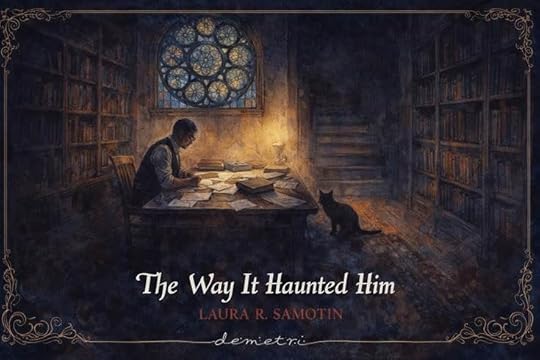
The real intoxicant in Laura R. Samotin’s “The Way It Haunted Him” is not demonology. It is the relief of having your life translated for you. Michael Stein reaches the Schechter Institute for Judaic Studies bleeding through his shirt, half-medicated, and so committed to self-punishment that pain has become his last reliable theology. What waits for him there is older and meaner than any archive should be allowed to get. More perilously, it has a face. Jacob Schechter – archivist, insomniac, rose-scented problem – can look at Michael’s ruined life and tell him what it means.

In a lesser novel, this setup would settle for handsome mildew: old building, old texts, old wounds, one man in a doorway so beautiful he ought to come with documentation. Samotin wants a wound, not a mood. Michael says he has come to finish the research of his dead boyfriend Nate, whose work on Jewish demonology and Eastern European folklore he hopes to complete as an act of penance, though even he seems unsure whether this is devotion, punishment, or just another superstition of his own making. Jacob, grandson of the late Eleazer Schechter and now keeper of the Institute, first appears to be the usual inducement to poor judgment – host, scholar, and local authority on whatever has been scampering over the shelves after dark. His first power is not supernatural at all. Before he works any magic, he does something more dangerous: he explains Michael to himself.

Grief is only part of the damage. Michael’s deeper wound is what happens when someone has spent years learning not to trust his own memory, fear, desire, or version of events. “The Way It Haunted Him” starts as a queer dark-academic grief novel and turns, more usefully and more cruelly, into a book about coercive control, self-distrust, and the narcotic force of finally having the past made legible. Nate, in Michael’s mind, begins as beloved dead and reason for endless self-accusation. As the novel tightens, another shape emerges. Michael’s flinching, his endless apologies, his terror of his own perceptions, his automatic certainty that he is at fault – these are not simply aftershocks of bereavement. They are the long echo of abuse. Samotin catches the injury at its source. Abuse here does not merely bruise the body or flatten self-worth. It teaches a person to outsource reality – first to the man hurting him, then to the man explaining the hurt.

That is why the haunting earns its keep. The mazzekin in the Institute – petty household demons with a talent for sabotage, nuisance, and appalling timing – are not there merely to provide occult upholstery. Papers move. Lights burst. Gloves appear to hold themselves upright. A window disappears. A bath fills with blood. A cat turns out to be not entirely a cat, which feels only fair. Each disturbance asks the same question in a fresh costume: will Michael believe what he sees, or will he once again decide that his own mind is the least reliable thing in the room? The house keeps converting self-doubt into event. Jacob insists that it is full of things Michael has trained himself not to believe. Beneath that insistence sits the book’s harder question: what if disbelief has become another name for survival?


Under the rose window’s cool authority, scholarship becomes seduction, and order begins its slow turn into private coercion.

Samotin writes in sentences that sound simple until they have already cut you. The prose is plain enough to be believed and sharp enough to draw blood. Her syntax often moves in medium-long coils, accumulating sensation, recoil, memory, and self-accusation in a single motion, which suits Michael’s mind exactly. He does not think cleanly. He loops, revises, punishes, starts over. The syntax circles with him, repeating the same accusation in altered forms until it begins to sound like liturgy. Samotin is especially good with bodily detail – blood under fingernails, cold air on skin, the indignities of panic, the drag of a wound that keeps being reopened, the awkward mechanics of sex when one is not fully at home in one’s own body. She can move from pasta, cat hair, and scribbled notes to occult trouble without sounding as though she has changed books halfway through. Her one recurring weakness is a tendency, now and then, to name a feeling the scene has already pinned to the wall. Michael’s returns to self-condemnation occasionally arrive one beat too explicit. Even that slackness belongs to the novel’s psychology. He handles guilt like prayer beads – constantly, automatically, and for comfort.

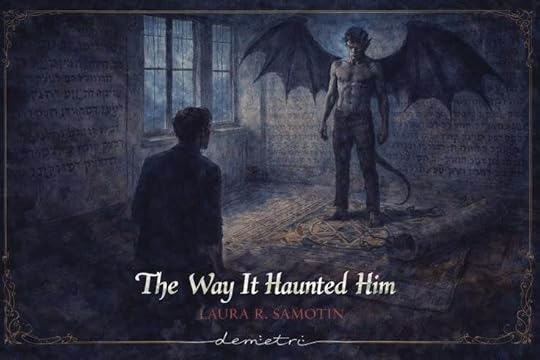
Under all that heat, the structure clicks shut with unnerving neatness. Each room offers a worse answer than the last. The archive begins as scenery and ends as machinery. The fourth floor is where the whole house changes species: the upper rooms are inscribed like an incantation bowl, the building itself transformed into a structure of containment, with Jacob standing where the trapped demon would be drawn. The Institute stops being haunted and becomes the haunting. Knowledge is stored here by imprisoning its source. Once that formal move arrives, the book’s images suddenly pull in the same direction. Thresholds matter. Rooms become arguments. Hospitality curdles into system. By the close, when Michael becomes the next smiling man at the door, the novel sends a chill backward through every earlier courtesy.


On the top floor the house gives up its secret at last, and confession arrives not as spectacle but as architecture, inscription, and grief.

What Samotin does better than most of her peers is refuse to separate care from control. Jacob binds Michael, withholds from him, and initially intends to use him. He also comforts him, bathes him, cleans his wounds, feeds him, teaches him to distrust his self-hatred, and sees through the lies Michael has accepted about his past. He is used, and the use arrives wrapped in understanding. Samotin understands that a snare lined with blankets is still a snare. The trap comforts as it closes. The book does not solve that contradiction. It leans on it until it starts to hum. That is why the relationship feels erotically alive. Jacob is not seductive merely because he is demonic. He is seductive because he offers Michael a sealed private logic in which every bruise suddenly comes with a caption. In the Institute, nothing is random anymore. No sound is meaningless, no symptom without theory, no fear without ritual. It asks only that you stay.


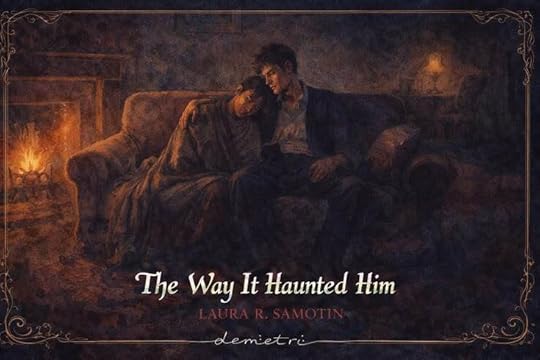
What looks like rescue by the fire is also the novel’s most perilous hinge – comfort settling over grief so gently it can pass for safety.

This is the novel’s central achievement, and also the place where it takes its largest artistic risk. It wants the reader to feel the relief of enclosure, not simply diagnose it. It wants us to understand why a closed system might seduce someone whose inner life has been wrecked by contradiction, shame, and gaslighting. In that sense, the book is doing something more interesting than staging a gothic romance with infernal accessories. It is asking what kind of love feels possible once someone offers you total explanation. It is asking what happens when self-trust returns, but returns inside the wrong house. Michael does become steadier. He does become less numb, less self-loathing, less willing to accept the story he has told himself about Nate. Yet that newfound coherence does not make him morally freer. It simply makes him more available to a different order.


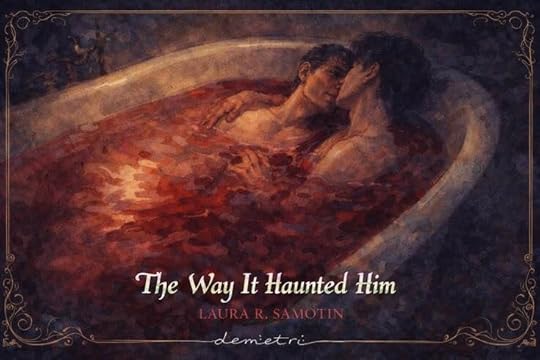
Here desire and revelation mingle until the scene stops asking whether the liquid is blood and starts asking what belief is willing to accept.

You can see the seam in the last turn. Samotin earns Michael’s attachment – his relief, his dependence, his growing preference for the Institute’s closed logic over the outer world’s blunter accounts of him. She earns, too, the revelation that Jacob is a sheyd: ancient, weaponized, bound into the house by Eleazer, and initially prepared to harvest Michael’s life in order to break free. What she earns a little less fully, though not disastrously less, is the final conversion of intimacy into system. By the close, Michael is not merely staying with Jacob. He is helping build a future in which new researchers will pay for knowledge with their vitality. Samotin earns the turn, then closes the door a shade too fast. Jacob, meanwhile, can at times feel almost too perfectly tuned to Michael’s wounds – lover, interpreter, occult authority, domestic partner, demon on a leash, and owner of cheekbones so sharp they should probably be regulated. Yet he is not hollow for it. This is not emptiness. It is over-seasoning. The novel’s problem is not lack of conviction, but an excess of concentration in its final movement.

The book’s contemporary bite lies in how lightly it handles current ways of naming harm. It never turns itself into a pamphlet, but it brushes against the language of coercive control, therapy, and consent under asymmetrical power, then asks what happens when those frameworks – however humane, sensible, and earnest – sound flatter than the dangerous explanation. Outside the house, every account of Michael’s life is partial: therapist, parents, friends, police, all offering versions of reality that are decent and plausible and somehow less complete than Jacob’s. Its coldest idea is not that love can imprison. Fiction has known that for centuries. It is that the narcotic pleasure of no longer having to wonder what anything means can feel safer than freedom. A complete explanation, however perilous, can be harder to refuse than an exit.

That is also why the book may divide readers. Some will find its last movement thrillingly perverse, a rigorous refusal of tidy healing and a shrewd account of how desire and coercion can fuse. Others will find that same ending a moral short circuit, too swift in its conversion of injury into appetite, too willing to let Michael’s hard-won clarity slide into complicity. Both responses are defensible. Samotin is not asking for consensus. She is asking how much interpretive certainty the reader, like Michael, is willing to buy if the terms are seductive enough.

I admired the book’s willingness to wound exactly where it meant to – its architectural cruelty, its psychological exactness, the way its ending makes welcome sound almost carnivorous. I also felt the drag of reiterated emphasis and a final movement that reaches its cozy damnation a beat before the last moral seam fully seals. I land at 88/100 – 4 Goodreads stars – for a novel more ambitious than tidy, more exacting than ornamental, and far nastier and smarter than its genre packaging prepares you for.


By the end, the threshold repeats itself with colder manners: hospitality intact, innocence gone, and the welcome sharpened into appetite.

What lingers is not the attic, or the bath, or the cat. It is the doorway. Michael arrives shattered, desperate for someone to tell him what his life has been. Another being – let us not get precious about species for the moment – does exactly that. By the close, Michael is the one opening the door for the next scholar, all courtesy and welcome, ready to serve truth with the bill tucked under the plate. The mechanism is intact. Only the smile now shows its teeth.


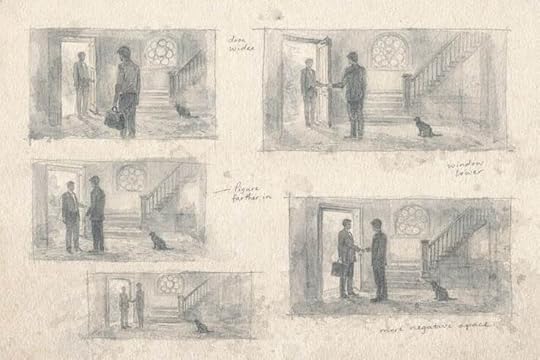
These rough compositional trials show the painting’s first question taking shape – where to place the door, the watcher, and the trap disguised as invitation.


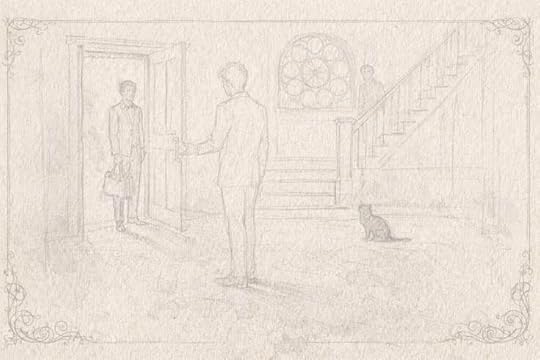
Before color claims the room, the pencil skeleton reveals the painting’s true design: two figures, one threshold, and a house already choosing sides.


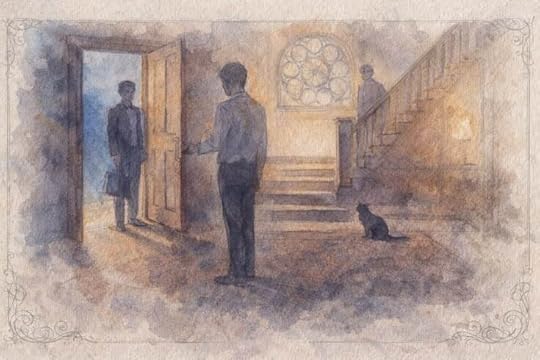
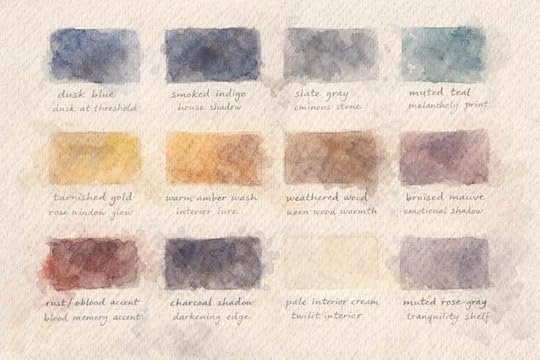
The earliest washes let mood arrive before detail, with dusk blue and interior gold beginning to divide the page into allure and warning.


This palette study makes the review’s visual logic explicit: bruised blues, tarnished golds, rusted reds, and the hush of a house that never quite means refuge.

All watercolor illustrations by Demetris Papadimitropoulos.
Profile Image for Maddie.
23 reviews1 follower
June 6, 2026
This book is categorized as horror but confusingly reads as a bad, smutty romance novel. I was excited about the premise but ended up being very disappointed. Absolutely not for me. 👎🏻
Profile Image for Nico.
45 reviews
March 16, 2026
I've never known much about Jewish folk tales or mythologies so it was cool to read a book with fantasy elements based in those stories. I can't speak to whether any of it was done well or not, but it was interesting for a non-Jew.
The actual plot and character motivations were unfortunately not as compelling. I kept feeling like all of the conflicts were really contrived and weren't actually problems, and almost every conflict gets solved within a few pages anyways, so there are never any real stakes. Like, the MC is upset because he hasn't asked his (dead) ex's family for permission to publish his research posthumously, and he feels like if he publishes it then the whole scholarly community will think he's a plagiarist. Why can't he just write an introduction explaining things and give credit to the ex? Most people would think that's a really touching gesture. This problem feels fake to me, and then it turns out to not even matter later.
I find the main character to be a bit grating as well. He's so self-hating it just wraps back around to self-obsession, which I am sure is the point based on his backstory and arc and whatever but it's annoying to read. And then everyone constantly assures him he's such a good person? He's fine, he isn't evil and bad, but he's not that great. He also has a weird thing near the beginning where he keeps insisting he's a translator, NOT a scholar, as if there is a huge and enormous zero-overlap distance between these professions. And then it turns out that he's done all kinds of research and academic writing and I'm genuinely not sure what he thinks a scholar does.
I don't really have an opinion about the love interest. Several times the book makes a point of mentioning that this guy eats a single strand of spaghetti which really stuck with me because it seems more difficult to pick out a single strand than to just take a small bite.


minor spoilers below
I think the main guy should have felt way crazier about learning that demons and shit exist as this is kind of irrefutable proof for him that Judaism is correct and God is real. He's shocked about the demons for sure but he doesn't have a moment where he considers the real implications of that. Like even if he was a staunchly faithful Jew who never doubted once in his life he should still have some crazy feelings about it! There's a difference between blind faith and Knowing full stop.
Profile Image for Nat.
170 reviews14 followers
Review of advance copy received from Netgalley
March 16, 2026
ARC provided by Netgalley in exchange of an honest review.

2.5 Stars*

The Way It Haunted Him is a dark academia centered around grief and Jewish folklore. As a reader of Samotin's previous duology I was very excited to see more of both of these themes explored through her writing. I found her other work exploring and healing from abusive relationships particularly well written. That's why this book is a bit disappointing. Everything in this book felt like it was done by her before, but more effectively. The biggest problem I had with this book is how underdeveloped it felt. It had all the makings of something excellent with the trauma of the characters, their relationship, and the folklore introduced. But unfortunately none of this was delved into with enough detail for any of it to have proper impact. Samotin's writing is still very strong and this is by no means a bad book, it just feels like a draft and not a finished project.
Displaying 1 - 30 of 107 reviews