Long's work begs to be read aloud in order to savor the rich language and rhythm she instills in each poem. She explores the beauty of specific bridges while employing them as a metaphor for crossings to death (a sister's suicide), eros, and art. Part elegy, the book also explores living, remembering, and celebrating.
Priscilla Long is author of The Writer’s Portable Mentor (University of New Mexico Press), Cartographies of Home: Poems (MoonPath), Dancing with the Muse in Old Age (Coffeetown), Holy Magic: Poems (MoonPath) Minding the Muse: A Handbook for Painters, Composers, Writers, and Other Creators (Coffeetown), a book of essays titled Fire and Stone: Where Do We Come From? What Are We? Where Are We Going? (University of Georgia Press), Crossing Over: Poems (University of New Mexico Press), and Where the Sun Never Shines: A History of America’s Bloody Coal Industry (Paragon House).
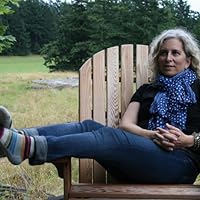
Priscilla is a Seattle-based writer of poetry, essays, creative nonfictions, fictions, science, and history. Her awards include a National Magazine Award. Her rigorous and extremely popular classes are always full for the good reason that her writers routinely become more skilled and get more published. Her scholarly history book is Where the Sun Never Shines: A History of America's Bloody Coal Industry (Paragon House). Author's website: www.PriscillaLong.com. Photo by Anne Herman
A brilliantly beautiful book of poems that felt like a deeply human and Northwest response to Hart Crane's classic "To Brooklyn Bridge." Instead of paying homage to the wonders of industry and how it towers over humankind (as Crane's work does), this book is closer to the Earth, where bridges connect us to others, to the worlds of life and death, to our most persistent memories. Highly recommended.
There is an immense sadness in this volume of poems by Priscilla Long. That sadness is anchored in the death of her sister, Susanne. Of the 50 poems in Crossing Over, six are centered on the sister. To this reader, the most poignant of the sister poems is Visitations (p. 38) that ends with these lines:
The dead have nothing new to say. They do not age, but their deaths are aging. We seldom cry for them now. Still, on odd, solitary evenings they come to call. They visit, but they have lost the art of conversation. They repeat themselves. They have nothing new to say.
As only a virtuoso can, the poet evokes much more than she shows, more than she tells as in Light at Arles (p. 55): A sun-drenched afternoon painted in a peacock century. The bare room: bed, basin, board: a poor man's coat hung on nails; two chairs for smoke and talk.
Here, we wait for the door to open and Vincent to enter, but that is not to be: Soon Munch will carve his scream. The century will die in its pictures.
The meditative core of much of the poetry in this book lies in the self-aware transience that the poet exploits to speak to us in a very personal yet profound way. The Body Poem (p.13) lets us see a purpose, a reason, perhaps, for writing—we all wish for, in some way, a portion of immortality. To achieve this moment, the poet marries the sadness of death to the knowledge that the work lives on:
After death the writer's body inhabits the body of work. The eye remains, the hand everywhere in notebooks The heart in beat and rasp of poem.
Voice, breast, breath, the intricate vulva devolving into throb, blood hot, or not. The naked foot dancing, leaping, all in the body of work.
There is much in this book about destruction and creation, about destruction as creation; it is, after all, a book about bridges and the people who build and use them. But this book is also a lamentation on human weakness and human stupidity. In the most successful sestina I have read in a long time, the poet evokes our failure to be the stewards of the land as we become, in fact, merchants of death. I'll quote just a few stanzas from the sestina, Nile Valley landslide (p. 23):
They wake to cracks, rocks dropped, rains of gravel, the fall of mountain sand, seabottom, dirt of the ages. Then a basalt boulder rolls into the river, roaring like an animal. … The Naches River, dirt – choked, runs like a spooked animal, flows around basalt. Trout gasp on high rock. The mountain rides it slow fall into the ancient river. … Now comes October, the fall of the great fall of basalt. We Homo sapiens, brainless animal, quarried the old rock of the river- bank, sold the landslide toe, dirt once pillar to mountain rock.
And so the great rocks fall and the dirt marries basalt, and the river rages like a wounded animal.
Crossing Over is a complex work by a complex thinker. Often the poems present themselves in a simple way only to show, deeper in, that they mask jewels we can claim only by reading and re-reading. This is the gift of poetry—not quick, not easy, neither facile nor superficial. And Priscilla Long has done it well. I recommend this book to all poets, to all lovers of poets, to lovers of poetry.
Priscilla Long is a poet and prose writer of immense talent and Crossing Over is an important work that covers life, death, loss, the natural world, war, and even an argument between two beloved Seattle bridges. Whether she is writing about her sister’s suicide, Seattle rain, or the afterlife of her books when she is gone–each poem offers solace, wisdom, and chance to slow down.
A wonderful collection of poems which, with a focus on the bridges we traverse, make something "ordinary," sacred. These poems also bridge life and death, and in doing so make something sacred, ordinary, not in the sense of being blasé, but in the sanctification of all of life and aliveness.
As would be expected, Priscilla's book of poems is wonderful. She knows how to craft words better than most, and her poetry never disappoints. I highly recommend this book.