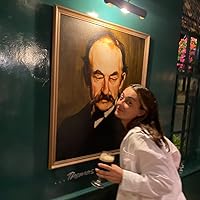
English-born American Christopher William Bradshaw Isherwood was a novelist, playwright, screenwriter, autobiographer, and diarist who portrayed Berlin in the early 1930s in his best known works, such as Goodbye to Berlin (1939), the basis for the musical Cabaret (1966).
After Isherwood wrote joke answers on his second-year exams, Cambridge University in 1925 asked him to leave. He briefly attended medical school and progressed with his first two novels, All the Conspirators (1928) and The Memorial (1932). In 1930, he moved to Berlin, where he taught English, dabbled in Communism, and enthusiastically explored his homosexuality. His experiences provided the material for Mister Norris Changes Trains (1935) and Goodbye to Berlin (1938), still his most famous book.
In Berlin in 1932, he also began an important relationship with Heinz Neddermeyer, a young German with whom he fled the Nazis in 1933. England refused entry to Neddermeyer on his second visit in 1934, and the pair moved restlessly about Europe until the Gestapo arrested Neddermeyer in May 1937 and then finally separated them.
In 1938, Isherwood sailed with Auden to China to write Journey to a War (1939), about the Sino-Japanese conflict. They returned to England and Isherwood went on to Hollywood to look for movie-writing work. He also became a disciple of the Ramakrishna monk, Swami Prabhavananda, head of the Vedanta Society of Southern California. He decided not to take monastic vows, but he remained a Hindu for the rest of his life, serving, praying, and lecturing in the temple every week and writing a biography, Ramakrishna and His Disciples (1965).
In 1945, Isherwood published Prater Violet, fictionalizing his first movie writing job in London in 1933-1934. In Hollywood, he spent the start of the 1950s fighting his way free of a destructive five-year affair with an attractive and undisciplined American photographer, William Caskey. Caskey took the photographs for Isherwood’s travel book about South America, The Condor and The Cows (1947). Isherwood’s sixth novel, The World in the Evening (1954), written mostly during this period, was less successful than earlier ones.
In 1953, he fell in love with Don Bachardy, an eighteen-year-old college student born and raised in Los Angeles. They were to remain together until Isherwood’s death. In 1961, Isherwood and completed the final revisions to his new novel Down There on a Visit (1962). Their relationship nearly ended in 1963, and Isherwood moved out of their Santa Monica house. This dark period underpins Isherwood’s masterpiece A Single Man (1964).
Isherwood wrote another novel, A Meeting by the River (1967), about two brothers, but he gave up writing fiction and turned entirely to autobiography. In Kathleen and Frank (1971), he drew on the letters and diaries of his parents. In Christopher and His Kind (1976), he returned to the 1930s to tell, as a publicly avowed homosexual, the real story of his life in Berlin and his wanderings with Heinz Neddermeyer. The book made him a hero of gay liberation and a national celebrity all over again but now in his true, political and personal identity.
the very last page touched me, but everything else… this read like someone who had seen a movie or read a book and then explained the plot to me. i think it’s really interesting that they based a musical on this little book with this little information. i really wanna see the show tho! especially because i think sally in the show is a whole lot different.
It reminded me of Holly Golightly, and I enjoyed seeing the author himself as the narrator, though I didn’t quite fall in love with her character. A glimpse of what was to come in his later work.
This was a lot cuter than I expected. Shocking that this led to Cabaret. Sally is so unserious, love that girl. Chris is such a passive participant. He's funny, he DGAF that the war is falling into place around him.
"And soon we were on Fritz's favourite topic: he pronounced it Larv."
"The green finger-nails seemed not to belong to them at all; to have settled on them by chance -- like hard, birght ugly little beetles."
"But she regarded Sally as my property, and it shocked her to see me standing so tamely to one side. I am sure, however, that if I hadn't known about the affair, and if Sally had really been deceiving me, Frl Schroeder would have assisted at the conspiracy with the greatest relish. Meanwhile, Klaus and I were a little shy of each other. When we happened to meet on the stairs, we bowed coldly like enemies."
" 'The blasted cheek,' exclaimed Sally, gulping the Worcester sauce and licking her upper lip, 'of his saying I adored him! ... The worst of it is, I did!' "
" 'I think,' said Sally, 'it must be marvellous to be a novelist. You're frightfully dreamy and unpractical and unbusinesslike, and people imagine they can fairly swindle you as much as they want--and then you sit down and write a book about them which fairly shows what swine they all are, and it's the most terrific success and you make pots of money.' 'I expect the trouble with me is that I'm not quite dreamy enough...' "
"They dipped their pens excessively in violet ink, made nervous inhibited circular movements with their elbows before starting to write, and were very curt and Gruff."
This entire review has been hidden because of spoilers.
the most perfect way to write about sally bowles. the informal manner of the book makes it ever more personal and really reels one into the charming and amusing nature of sally herself. her naivety and rashness was so electric- no wonder you inspired what would become of your story.
having watched- and absolutely adored- the musical, it’s very interesting to see the way in which they presented her energy in contrast to post war germany. her untapped wit and energy in comparison to the gloomy, scrappy and distressing germany which the nazi’s pounced on.
anyways, it’s beautiful to think of the untapped energy and potential that filled that sphere of life while it was growing into one of the most harrowing and terrifying places in the world. sally bowles, i hope with all my heart that you were able to find solace and peace with the life you lived.
I was hooked on the story when Isherwood starting describing Sally through his hands. This is a very good novella which has a feeling (like the musical Cabaret) that everything is alright but you feel in a sentence or two that the outside world is boiling. Btw no mention of Cabaret here. It's Chris, Sally, Fr Schroeder and some supporting characters that appear here and there. Isherwood used this as a practice ground for Goodbye To Berlin but the lonely outsider, the out of place Brit who is looking for a story comes across really well and truthful.
Well, wasn't this an absolutely wonderful story. I believe Truman Capote read this book which became the inspiration for Breakfast at Tiffany's? After a while, reading Sally's lines, all I could hear in my head was Holly Golightly.
A rather fun book to read. It was interesting to see Christopher Isherwood even inserted his own name as one of the characters.
Saw this republished as a single volume in the new penguin series.
I was confused and thought this is something different from the novella in Goodbye to Berlin. So for the first 40 pages of the book I went “wow this is just like the other one. He really hasn’t changed it much huh?”
Excellent wish I'd read it before. Obviously I was drawn to it by the film Cabaret but it's not the same. It's a short story about Sally Bowles and her time in Germany. I would recommend it.
Succinct version of his other book but perhaps the more personal one - its better when you know more about the author. Almost captures her but still feels that something is missing.