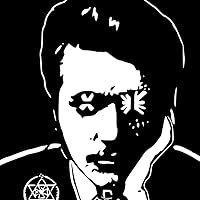
I’d argue that Alan Watts, dead now more than 50 years, is only now reaching the zenith of his influence.
A certain section of YouTube and Instagram is awash with his lectures, often superimposed over surrealistic animations and set to trippy lo-fi music. On SoundCloud, you can find DJs who play at the Burning Man festival who have set his lectures to twinkly-dancey beats. (Google “Bubbles and Bass Sunset/ Burning Man 2017.”)
A few years ago, an 18-year-old student told me Alan Watts was “his favorite philosopher.”
This is not so surprising: few philosophers can turn a phrase like Watts could. And this makes him the perfect philosopher for the TikTok age—bite-size philosophy in 10 seconds. And I do not mean this as a gripey insult to Watts or his fans. I myself have been awakened from an algorithm-induced stupor by a 10-second cold plunge of Watts’ words set to music. It was like a rousing slap in the face!
Here are just a few themes or ideas from these lectures that I would like to remember or return to someday:
The myth of cosmos as created artifact (Western) vs myth of cosmos as organism (Eastern). Watts argues that the former myth has caused our alienation from the universe, made us feel separate from it. We feel as if our “I” resides in the space right behind our eyes, that this “I” is trapped in the meat sack puppet of our bodies, and that everything external to us is no-I. (We believe ourselves to be “centers of awareness locked up in bags of skin.”) We feel, as Housman wrote, “a stranger and afraid In a world I never made.” We ask, as children, “who made me?”—which implies that we are artifacts made by some creator external to ourselves. Instead, the Chinese child might ask, “How did I grow?” Because the Eastern view of cosmos as organism reminds us that we are part of the universe, not alien to it. Watts uses the metaphor of apples and apple trees to illustrate the idea that the universe creates humans in the same way an apple tree produces apples. Just as it is natural for an apple tree to “apple,” it is natural for the universe to “people.” This metaphor challenges the Western notion of the cosmos as a machine built by an external creator, suggesting instead that humans are a spontaneous expression of the universe itself. Watts suggests that this second, Eastern myth could go some way towards relieving our sense of alienation from the universe, helping us to feel more snug and secure in the cosmos.
The illusion of ego. Again, we Westerners feel our ego, our “I,” to be both very real and very small: located very specifically right behind our eyes, we feel “ourselves” to be a vague entity piloting our bodies and looking out the “windshields” of our eyeballs. But Eastern wisdom reminds us this is just an illusion. Any notion of who “I” am or what “I” am doing relies on, for its very intelligibility, notions of “not-I.” The notion that I am talking or walking relies on notions of who I am talking to, or the field of space in which I am moving, and moving in relation to what things. I cannot talk to nobody, and I cannot move in a vacuum. So Watts reminds us that our “I” actually exists in a field of being—similar to (IIUC) Heidegger’s field of being he called “Dasein.” There are no independent organisms but organism-environments.
The humor of God: "If you suggest the Lord is joking, most people in our culture are offended because they have a moronic conception of God as a person totally devoid of humor. But the Lord is highly capable of joking, because joking is one of the most constructive things you can do.”
Zen aesthetic criteria: the “controlled accident,” the perfect harmony between order and randomness, man and nature.
Being perfectly HUMAN: "But in this we mustn’t take ourselves too ridiculously. I mean, naturally all human beings have in them a certain clinging, so you can’t let go totally, you wouldn’t be human if you did. You can’t be just a leaf on the wind, or just a ball in a mountain stream, to use a Zen poetic phrase. Because if you were that you wouldn’t be human, just as I pointed out that a person with no emotions, who has completely controlled his emotions, is a ‘stone Buddha.’ So a person who would be completely ‘let go,’ would also be some kind of inanimate object. So Zen very definitely emphasizes being human, being perfectly human as its ideal. And so to be perfectly human one must have not a state of absolute detachment, but a state of detachment which contains a little bit of resistance, a certain clinging still. They say in India…of a man who is liberated in this world, that he has to cultivate a few mild bad habits in order to stay in the body, because if he was absolutely perfect, he would disappear from manifestation. And so the great Yogi, maybe he smokes a cigarette or has a bad temper occasionally, something that keeps him human, and that little thing is very important—it’s like the salt in the stew, it grounds him.”
The Hindu idea of “Lila,” God’s play. The godhead becomes so absorbed in “playing” at creation that it forgets itself—just as we, as humans, forget that our individual selves (Atman) are fundamentally one with the ultimate reality (Brahman). This playful forgetting is not a tragedy but a divine game, reminding us of our deep connection to the cosmos.
Yezer Hara, the “element of irreducible rascality”: "But these people didn’t go around pretending that they were specially good. They didn’t dupe themselves. They were people who understood what human nature is—that in every one of us there is an element of irreducible rascality. In Jewish theology this is called the yetzer hara. The element of irreducible rascality, which was created by God because God has one, too. And this goes back, you see, again into the heart of Chinese philosophy: that human nature is considered to be basically good. And even the rascally elements of it are good. They’re the sort of salt in the human stew. There has to be this little thing, the human passions, and that the natural contentiousness and greed (or whatever that we have) is an essential element in our makeup, and that when people lose sight of that, they go mad. Nothing, for example, is more dangerous than a saint. You’ve got to say: a self-conscious saint who thinks that he is right, and who endeavors to live an absolutely pure life and to eliminate all selfish thoughts. Somebody who undertakes that task is going to be a menace to all around, because he loses his humor, he loses his real humility—which is knowing that, after all, since we are humans, we have certain needs. We need to eat, we need sex, we need this, that, and the other. And this sort of has a quality of humor to it. And so this is why, in Zen art, the sages are always drawn to look a little bit like bums. You know that Bùdài—or Hotei, as he’s called—what’s called the laughing Buddha, the fat Buddha, with an immense belly, and carrying around an enormous bag of rubbish into which he indiscriminately puts anything he finds around and then gives it away to children. This is the sort of type which the Chinese call the old rogue. And the old rogue, as a type of this poet, sage, monk, and scholar, you see, is greatly admired. He is the nonviolent brigand, the rolling stone, the free man—or in our words, the joker. The joker, you see, is the card that can play any role in the pack.”