

What do you think?

The Art of Risk: The New Science of Courage, Caution, and Chance
Are risk-takers born or made? Why are some more willing to go out on a limb (so to speak) than others? How do we weigh the value of opportunities large or small that may have the potential to change the course of our lives?
These are just a few of the questions that author Kayt Sukel tackles, applying the latest research in neuroscience and psychology to compelling real-world situations. Building on a portfolio of work that has appeared in such publications as Scientific American , Atlantic Monthly , The Washington Post , and more, Sukel offers an in-depth look at risk-taking and its role in the many facets of life that resonates on a personal level. Smart, progressive, and truly enlightening, The Art of Risk blends riveting case studies and hard-hitting science to explore risk-taking and how it impacts decision-making in work, play, love, and life, providing insight in understanding individual behavior and furthering personal success.
These are just a few of the questions that author Kayt Sukel tackles, applying the latest research in neuroscience and psychology to compelling real-world situations. Building on a portfolio of work that has appeared in such publications as Scientific American , Atlantic Monthly , The Washington Post , and more, Sukel offers an in-depth look at risk-taking and its role in the many facets of life that resonates on a personal level. Smart, progressive, and truly enlightening, The Art of Risk blends riveting case studies and hard-hitting science to explore risk-taking and how it impacts decision-making in work, play, love, and life, providing insight in understanding individual behavior and furthering personal success.
288 pages, Hardcover
First published February 2, 2016
About the author
Kayt Sukel
4 books105 followersA passionate traveler and science writer, Kayt Sukel has no problem tackling interesting (and often taboo) subjects spanning love, sex, neuroscience, travel, technology, and politics. Her work has appeared in the Atlantic Monthly, the New Scientist, USA Today, Pacific Standard, the Washington Post, ISLANDS, Parenting, the Bark, American Baby, National Geographic Traveler, and the AARP Bulletin. She is a partner at the award-winning family travel website Travel Savvy Mom, and is also a frequent contributor to the Dana Foundation’s many science publications. She has written stories about out-of-body experiences, fMRI orgasms, computer models of schizophrenia, the stigma of single motherhood and why one should travel to exotic lands with young children.
Her first book, DIRTY MINDS: HOW OUR BRAINS INFLUENCE LOVE, SEX AND RELATIONSHIPS (retitled as THIS IS YOUR BRAIN ON SEX: THE SCIENCE BEHIND THE SEARCH FOR LOVE in paperback), is an irreverent and funny tome that takes on the age-old question, “What is love?” from a neurobiological perspective. Called “a fun and insightful read,” by Scientific American Mind and “a serious, informative and highly entertaining survey of the neurobiology of sexual attraction,” by the Washington Post, DIRTY MINDS/THIS IS YOUR BRAIN ON SEX offers a new take on that crazy little thing called love.
Her new book, THE ART OF RISK: THE NEW SCIENCE OF COURAGE, CAUTION & CHANCE, an investigation into the science of risk-taking, will be published in February 2016. Advance praise calls it "an engrossing look at a fascinating issue by one of the most fearless science writers in the business" and "a road map for understanding boldness."
Kayt lives outside Houston, Texas (and is surprised as you are about it), and frequently overshares on Twitter as @kaytsukel.
Her first book, DIRTY MINDS: HOW OUR BRAINS INFLUENCE LOVE, SEX AND RELATIONSHIPS (retitled as THIS IS YOUR BRAIN ON SEX: THE SCIENCE BEHIND THE SEARCH FOR LOVE in paperback), is an irreverent and funny tome that takes on the age-old question, “What is love?” from a neurobiological perspective. Called “a fun and insightful read,” by Scientific American Mind and “a serious, informative and highly entertaining survey of the neurobiology of sexual attraction,” by the Washington Post, DIRTY MINDS/THIS IS YOUR BRAIN ON SEX offers a new take on that crazy little thing called love.
Her new book, THE ART OF RISK: THE NEW SCIENCE OF COURAGE, CAUTION & CHANCE, an investigation into the science of risk-taking, will be published in February 2016. Advance praise calls it "an engrossing look at a fascinating issue by one of the most fearless science writers in the business" and "a road map for understanding boldness."
Kayt lives outside Houston, Texas (and is surprised as you are about it), and frequently overshares on Twitter as @kaytsukel.
Ratings & Reviews
Friends & Following
Create a free account to discover what your friends think of this book!
Community Reviews
Displaying 1 - 29 of 29 reviews

April 18, 2016
The Art of Risk is a nonfiction book that takes a body of research and organizes the findings into a palatable read for the average person. The topic is addressed scientifically but not pretentiously, as the author takes us through a combination of her personal experience and interviews with current experts in the field of risk taking. The final chapter in the book is filled with advice on how to be a better risk taker. After all, good risks leads to success and bad risks can lead to demise - but in order to get anywhere we all have to take risks. It only makes sense to be smart about it.
If you like books similar to Malcolm Gladwell's Outliers, David and Goliath, or Blink, I think you'll enjoy this one.
If you like books similar to Malcolm Gladwell's Outliers, David and Goliath, or Blink, I think you'll enjoy this one.

January 4, 2022
"We pay homage to heroes, rule-breakers, and thrill-seekers each and every day. These are the men and women who inspire us with tales of derring-do—they make our lives better by challenging the status quo, rushing into burning buildings, shaping new boundaries, creating new technologies, climbing the most dangerous peaks, and doing the (seemingly) impossible. They are favored protagonists in novels and movies—and, in real life, the faces prominently featured on our favorite magazines. These are the people who make us believe that anything—anything!—is possible. And even the most risk-averse among us aspire to their success..."
The Art of Risk was an interesting book. This one is on the reading list of Dr. Michael Gervais's Course "Finding Your Best," which I am currently taking (and loving).
According to her website, author Kayt Sukel is "a passionate traveler and science writer, she has no problem tackling interesting (and often taboo) subjects spanning love, sex, neuroscience, travel and politics. Her work has appeared in the Atlantic Monthly, the New Scientist, USA Today, Pacific Standard, the Washington Post, ISLANDS, Parenting, the Bark, American Baby, National Geographic Traveler, and the AARP Bulletin. She is a partner at the award-winning family travel website Travel Savvy Mom, and is also a frequent contributor to the Dana Foundation’s many science publications. She has written stories about out-of-body experiences, fMRI orgasms, computer models of schizophrenia, the stigma of single motherhood and why one should travel to exotic lands with young children."
Kayt Sukel:
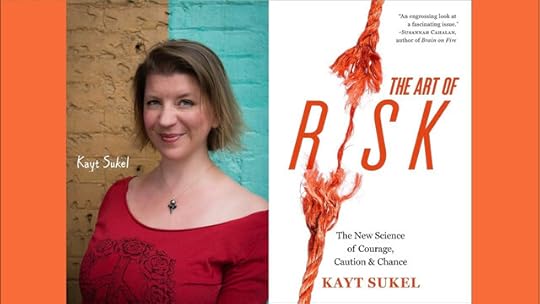
Sukel gets the book off to a decent start, with a well-written first chapter. She tells the reader a bit about her personal life, mentioning that she has typically been a life-long risk-taker.
She writes with an easy and engaging style, and the book is very readable.
She drops this interesting quote early on, talking about gambling odds:
Taking risks is essential for advancing yourself, and reaching your full potential, Sukel writes:
Being familiar with risk, and how best to deal with it is a common thread among those in high-performance situations, environments, or jobs:
The scope of the book is quite broad, and multi-disciplinary. Sukel covers much of the newer research in topics related, and tangentially related to risk. Some of the topics covered here include:
• Possible genetic roles to risk-taking: the MAOA gene, AKA the "warrior gene."
• Sex differences and risk.
• Testosterone's role in risk; stock market traders; the 2d 4d digit ratio.
• Mastery; deliberate practice.
• Risk-taking in adolescence.
• The role of evolution in risk-taking.
• The effects of stress on the brain.
• The role of mistakes in success.
• The importance of training in high-stress, high-performance environments.
*********************
The Art of Risk was a decent read.
I would recommend it to anyone interested.
4 stars.
The Art of Risk was an interesting book. This one is on the reading list of Dr. Michael Gervais's Course "Finding Your Best," which I am currently taking (and loving).
According to her website, author Kayt Sukel is "a passionate traveler and science writer, she has no problem tackling interesting (and often taboo) subjects spanning love, sex, neuroscience, travel and politics. Her work has appeared in the Atlantic Monthly, the New Scientist, USA Today, Pacific Standard, the Washington Post, ISLANDS, Parenting, the Bark, American Baby, National Geographic Traveler, and the AARP Bulletin. She is a partner at the award-winning family travel website Travel Savvy Mom, and is also a frequent contributor to the Dana Foundation’s many science publications. She has written stories about out-of-body experiences, fMRI orgasms, computer models of schizophrenia, the stigma of single motherhood and why one should travel to exotic lands with young children."
Kayt Sukel:
Sukel gets the book off to a decent start, with a well-written first chapter. She tells the reader a bit about her personal life, mentioning that she has typically been a life-long risk-taker.
She writes with an easy and engaging style, and the book is very readable.
She drops this interesting quote early on, talking about gambling odds:
“Blackjack usually has the best odds, with a return over 99 percent of money bet with best statistical play. With rules most favorable to the player, returns can exceed 99.5 percent,” he tells me, absentmindedly smoothing his salt-and-pepper mustache with his fingers. He can also (and does) easily rattle of the particular probabilities he calculated for craps (84 to 99.4 percent), poker slots (95 percent), and keno (60 to 65 percent). Still, he concedes that, no matter what game you play, the house always wins. “With good odds, you can play longer and win more often, but one always loses over the long haul,” he explains with a sigh. “That’s the bad part.”
Taking risks is essential for advancing yourself, and reaching your full potential, Sukel writes:
"If you don’t take a risk, you won’t get that extra hit of dopamine to help push those learning signals. If you never get off the easy climbing course and push yourself a bit, you’ll never improve your skills. If you don’t get up the gumption to talk to that hot chick at the bar, she’s never going to have your babies. If you stay at your boring corporate gig, you may miss out on an amazing new professional opportunity.
“When you’re in a situation with risk, the learning signals in your brain are stronger,” Frank says—and his laboratory work certainly backs up that statement. “The way in which people get better at things, at anything, is to take some risks and constantly change the level of expectation.”
Being familiar with risk, and how best to deal with it is a common thread among those in high-performance situations, environments, or jobs:
"A calculation of risk, followed by an informed series of adjustments in response to any setbacks. Successful recovery in the face of adversity, whether it be due to your own missteps or not, can be helped along by careful preparation, focusing on small wins, controlling what you can, being aware of your own strengths and weaknesses, and then letting go of past mistakes. Put those things together, and you’re in a place where your mesocortical limbic circuitry is well synchronized with the world around you. Where you have the ability (and the right neurobiological prompts) to take a step back and put “catastrophic events” in the proper context for review. And that provides the kind of context that can help you learn, grow, and, yes, adjust accordingly, so you are better able to deal with risks the next time around..."
The scope of the book is quite broad, and multi-disciplinary. Sukel covers much of the newer research in topics related, and tangentially related to risk. Some of the topics covered here include:
• Possible genetic roles to risk-taking: the MAOA gene, AKA the "warrior gene."
• Sex differences and risk.
• Testosterone's role in risk; stock market traders; the 2d 4d digit ratio.
• Mastery; deliberate practice.
• Risk-taking in adolescence.
• The role of evolution in risk-taking.
• The effects of stress on the brain.
• The role of mistakes in success.
• The importance of training in high-stress, high-performance environments.
*********************
The Art of Risk was a decent read.
I would recommend it to anyone interested.
4 stars.

February 2, 2016
I am the most risk-averse person I know. I don't gamble, I ride my bike only if I can avoid busy streets, I avoid the stock market, I hesitate trying anything new and different, and so on. One of the biggest risks I've taken in recent years was deciding to become self-employed, and even that came after many hours of deliberation and with all kinds of safety nets built in (already was making an income on the side while working full time and a husband with a good job that would cover the bills and benefits and didn't have to worry about college expenses).
But when I saw that Kayt wrote this book (full disclosure; I know Kayt but this review is totally unbiased), I wanted to read it. I have been on a self-help kick lately and I was hoping that this would provide some feedback into why I'm so risk averse and prefer a life without added drama or adventure or adrenaline.
Honestly, it took me until the very end of the book to figure that out. The book focused on why people take risks moreso than why they don't, but by the end I realized that she ended up explaining why my risk taking is so low -- and also began to think of areas where I do take risks that I never think about. It's just that I don't think of those things as risks -- singing in front of strangers or walking down the street are just things I do, you know?
Like I said, I read a lot of books like this and when there is a lot of science jargon, my eyes tend to glaze over and my brain shuts down. Yes, that happened at times while reading this book -- this is why I'm not a scientist -- but overall, the writing was smooth and engaging, which is unlike a lot of the books I've read. I liked the personal stories and experiences and tried to not think too deeply about watching brain surgery.
So why am I risk averse? It probably comes down to a lot of things -- my gene pool, my upbringing, my life experiences, and quite possibly my unusual high resistance to peer pressure and social influences (even as a teenager, I wasn't a "go along with the crowd" kind of kid).
I came away from this book with a new understanding of myself and a lot of food for thought -- which is exactly what I expect for this type of book.
But when I saw that Kayt wrote this book (full disclosure; I know Kayt but this review is totally unbiased), I wanted to read it. I have been on a self-help kick lately and I was hoping that this would provide some feedback into why I'm so risk averse and prefer a life without added drama or adventure or adrenaline.
Honestly, it took me until the very end of the book to figure that out. The book focused on why people take risks moreso than why they don't, but by the end I realized that she ended up explaining why my risk taking is so low -- and also began to think of areas where I do take risks that I never think about. It's just that I don't think of those things as risks -- singing in front of strangers or walking down the street are just things I do, you know?
Like I said, I read a lot of books like this and when there is a lot of science jargon, my eyes tend to glaze over and my brain shuts down. Yes, that happened at times while reading this book -- this is why I'm not a scientist -- but overall, the writing was smooth and engaging, which is unlike a lot of the books I've read. I liked the personal stories and experiences and tried to not think too deeply about watching brain surgery.
So why am I risk averse? It probably comes down to a lot of things -- my gene pool, my upbringing, my life experiences, and quite possibly my unusual high resistance to peer pressure and social influences (even as a teenager, I wasn't a "go along with the crowd" kind of kid).
I came away from this book with a new understanding of myself and a lot of food for thought -- which is exactly what I expect for this type of book.

April 26, 2016
Risks are unavoidable. The risks we take as kids and teens train our brains to respond to threats in those precious milliseconds. But we face new risks and important decisions many times as adults. The author distills lessons learned from the information about the most important variables involved in assessing risks.
Reading academic research can be boring. It is not a thrilling page turner nor a fantasy world of Harry Potter. Let's face it, pouring over statistical data and inferences from research papers is no fun. In The Art of Risk Kayt Sukel compresses information from research done at various universities across the US and Europe as she evaluates each aspect of the decision making process. Narrating that with real world examples and interviews with people who take risk to earn their bread, the author makes understanding the subject matter easy.
~ http://bookreviews.infoversant.com/th...
Reading academic research can be boring. It is not a thrilling page turner nor a fantasy world of Harry Potter. Let's face it, pouring over statistical data and inferences from research papers is no fun. In The Art of Risk Kayt Sukel compresses information from research done at various universities across the US and Europe as she evaluates each aspect of the decision making process. Narrating that with real world examples and interviews with people who take risk to earn their bread, the author makes understanding the subject matter easy.
~ http://bookreviews.infoversant.com/th...
March 31, 2016
I was excited to read a book that spoke about risk-taking through an empirical lens. Unfortunately, it felt like a waste of time as I was reading it.
Most of the studies discussed were ones that captured insights that're neither novel nor entirely insightful in 2016.
Granted, there were a few good points, but only that. A few good points, constructed into a 200+ pages book.
Maybe I came in with too much expectation. Maybe I put too much weight on the "new" in the title.
Most of the studies discussed were ones that captured insights that're neither novel nor entirely insightful in 2016.
Granted, there were a few good points, but only that. A few good points, constructed into a 200+ pages book.
Maybe I came in with too much expectation. Maybe I put too much weight on the "new" in the title.

July 30, 2023
Very good and Heavy read. I got a new insight about how our brain works regarding risk and what effecting it in wider area
January 12, 2026
"Sticking with the status quo can make it hard to learn and improve at anything. The way in which people get better at things, at anything, is to take soem risks and constantly change the level of expectation. When faced with a decision, the brain computes the probabilities of potential outcomes by gathering information from both the current environment and our past experiences about each choice, and then weighing each alternative with a subjective value based on our needs, wants, beliefs, and goals. By taking all these variables into account, we can make sensible choices that will help us further our goals. To be a good decision-maker, cut to the core of a problem and break down complex situations into the most basic things. Focus on the things you should be focused on while you make those decisions. Adults can learn from opening themselves up to unbridled possibility such as tenns who have the kind of motivation to allow them to try, no matter what obstacles they face. Teens risk, learn, and grow, and believe that they can do anything. By better understanding the interaction of your innate predispostiion to risk-taking and the way you navigate your environment, you hold the power to take charge and make risk work to your best advantage. Partake in deliberate practice in which you practice at the edge of your performance ability. This means you are going to continually fail, but get right back up and try again. Deliberate practice is the model for getting really good at something, workig to the point where you can eventually gain expertise. Working right around the edge really helps you learn and progress. Practice also makes your brian work more efficiently. Before you decide to take a risk in a particular arena, it pays to practice, to learn, to gain all that vital experience, so that your intuition and unconscious processing systems are workig for you, rather than against you. it is important to appreciate the subtle power of affect and feeling on our decisions. It has the power to influence our decisions in ways we are not always aware of. Affect can also help us better assess risk in some situations. Over time, we learn from our past emotional experiences so we can call up some affect, or the essence of emotion, to inform our decisions without elevating the heart rate. This makes the decision-making process much more efficient, both physiologically and cognitively. Once you fail or get negative feedback as you are trying to reach a goal, you are more likely to persist with your goal when you perceive that you have control and can avoid future setbacks or negative feedback. When you have control, and you know what you have to do, that negative feedback can drive you to persist more and to work harder to achieve your goal. There will always be risk in any decision. There will always be factors that are unknown and outside our control. The best we can do is risk enough over time, and gain the requisite knowledge, so we understand just what those factors are and whether we are personally willing to deal with the potential consequences. We can make risk work for us, but doing so requires knowledge, focus, and awareness.
Lessons:
1. Reset Your Defintion of Risk
Risk-taking is part of normal decision-making. Successful risk-taking is simply about being willing to explore alternatives. When you do that, you learn from your experiences. You learn to adapt your behavior so you know how to weigh the risks against the consequences. And, over time, by taking some risks--in the context of a logn-term goal--you learn how to make better decisions. Risk-taking is also necessary because it serves as an integral part of the brain's learning system. It is there to push on boundaries and help us learn and adapt. Sticking with the status quo does us no favors. Risk taking offers us potential to make the right changes to successfully go after the things we want most and need in life.
2. Know What You Can't Change
Knowing what you can't change--who you are and how you innately respond to risk--leads to better, smarter choices when you consider a risky decision. It can help you learn when to let go and when to press on. It can also help put risk in proper context, so you can leverage it to achieve your long-term goals.
3. Know What You Can Change
Consider the environmental factors that we encounter and what we can alter as needed. Functional risk-taking is about reasoned risks and an adjusted temporal horizon. A successful risk-taker is taking risks that help him move toward a long-term goal. Successful risk-takers are planners by nature. They visualize success and focus on the big picture. They understand that any big move is only a series of smaller steps. They take their time, prepare, and take only the risks that help them reach their larger, long-term goals. If it is something you decide to pursue, practice deliberately. Learn how to adapt your mind and body to the situation at hand. Practice enough so that you can build thekind of intutition you can count on. Practice so that you can develop decision-making heuretics and habits that will help you learn, grow, and ultimately, choose wisely. When faced with a risk, take a step back and, as objectively as possible, consider how your social connections may be driving your focus. Utilize cognitive strategies to engage the slow-thinking system to balance out the faster one when you are overwhelmed by stress or emotion. This will lead to better decisions all around. When faced with failure, recover by regulating your emotional response to it, place errors in the proper context, and learn what you can from those mistakes to better reach your ultimate goal.
4. Take the Leap
Risk-taking is about challenging yourself a bit so you can accrue wisdom and help your brain become a better, more efficient prediction machine. It is about keeping your brain sharp and being prepared to deal with whatever life throws at you. It is about recognizing the importance of context, running collected data through both your fast and slow systems, and coming up with the best decision with the information at hand. By knowing yourself and what you want most from life, as well as knowing how your environment can influence you as you try to reach those goals, you have the power to take charge of risk and follow it to more success."
Lessons:
1. Reset Your Defintion of Risk
Risk-taking is part of normal decision-making. Successful risk-taking is simply about being willing to explore alternatives. When you do that, you learn from your experiences. You learn to adapt your behavior so you know how to weigh the risks against the consequences. And, over time, by taking some risks--in the context of a logn-term goal--you learn how to make better decisions. Risk-taking is also necessary because it serves as an integral part of the brain's learning system. It is there to push on boundaries and help us learn and adapt. Sticking with the status quo does us no favors. Risk taking offers us potential to make the right changes to successfully go after the things we want most and need in life.
2. Know What You Can't Change
Knowing what you can't change--who you are and how you innately respond to risk--leads to better, smarter choices when you consider a risky decision. It can help you learn when to let go and when to press on. It can also help put risk in proper context, so you can leverage it to achieve your long-term goals.
3. Know What You Can Change
Consider the environmental factors that we encounter and what we can alter as needed. Functional risk-taking is about reasoned risks and an adjusted temporal horizon. A successful risk-taker is taking risks that help him move toward a long-term goal. Successful risk-takers are planners by nature. They visualize success and focus on the big picture. They understand that any big move is only a series of smaller steps. They take their time, prepare, and take only the risks that help them reach their larger, long-term goals. If it is something you decide to pursue, practice deliberately. Learn how to adapt your mind and body to the situation at hand. Practice enough so that you can build thekind of intutition you can count on. Practice so that you can develop decision-making heuretics and habits that will help you learn, grow, and ultimately, choose wisely. When faced with a risk, take a step back and, as objectively as possible, consider how your social connections may be driving your focus. Utilize cognitive strategies to engage the slow-thinking system to balance out the faster one when you are overwhelmed by stress or emotion. This will lead to better decisions all around. When faced with failure, recover by regulating your emotional response to it, place errors in the proper context, and learn what you can from those mistakes to better reach your ultimate goal.
4. Take the Leap
Risk-taking is about challenging yourself a bit so you can accrue wisdom and help your brain become a better, more efficient prediction machine. It is about keeping your brain sharp and being prepared to deal with whatever life throws at you. It is about recognizing the importance of context, running collected data through both your fast and slow systems, and coming up with the best decision with the information at hand. By knowing yourself and what you want most from life, as well as knowing how your environment can influence you as you try to reach those goals, you have the power to take charge of risk and follow it to more success."

May 3, 2016
I can't stop thinking about this book since I read it. Every time I make a choice or feel fear about doing something new, I re-evaluate my own fears based on what I read within. It applies in so many situations. From when I write editors (I'm a writer, too) to whether or not my family will pick up and travel for six months.
I was also glad the book included a look into gender differences and how we define risk.
A really wonderful read. I'll be referencing it in a book of my own.
I was also glad the book included a look into gender differences and how we define risk.
A really wonderful read. I'll be referencing it in a book of my own.
June 23, 2025
The Art of Risk is a nicely organized book. The writer blends her personal experience, scientific research, and his interviews from individuals working in risk heavy occupations. While doing so, she keeps the book engaging for the most part, easily digestible and mostly concise.
The book starts with the definition of risk and underlines that while it has a negative conation why it is necessary. Next chapter switches to the biology wrt risk. It introduces the mesocortical limbic circuit and different parts that factor in the decision making process. This system is made up of 3 parts:
Basal Ganglia: The brains inner portion that focuses on food, sex and social behaviours. This part plays the role of pushing the gas in the risk taking process. It is also known as the fast-thinking portion.
Prefrontal Cortex: The brains executive control center. This portion acts as the break in the brain for balancing the risk taking actions. It is also known as the slow-thinking portion.
Limbic System: Manages the emotion and memory.
Regarding the biological portion the book mentions some genes that are specifically associated with risk taking. However, it concludes that since thousands of genes interact in the brain, it is not possible to evaluate a persons risk appetite only judging by a single gene.
Regarding the age and risk association, adults seem to be more risk averse while teens are more risk savvy. That’s because teens are required to try, error and retry to gain experience and transition into adulthood. They also don’t have the somatic responses developed. Those responses are automatic in adults brain based on their previous experience. For example, a teen would be taking 200-300 ms more when asked if eating a bug is good or not, compared to instant answer of an adult. Because teens brain is actually considering the question, not defaulting to a no.
As for the genders, women seems to be more risk averse except for the social context where they are more courageous brining up unpopular issues and again the conclusion is that the behavior between men / women is not so clear cut.
Groupthink also seems to be an important factor when individuals are judging risk. “Even as adults, we put a lot of stock in what our friends family and co-workers have to say about what’s risky and what’s not.”
Another concept that is analyzed wrt risk taking is the effect of stress. In the presence of stress, people are tending to default to their default behavior. The soldier who is keeping his calm under fire or thinking about bandaging himself once he is hit is the perfect example for how far the training can go here. Since, he practiced this situations in his training so many times instead of freaking out he can act calmly thanks to the way those learnt defaults.
All in all, having a well-balanced brain and having a nice intuition of proper calculation of the risks goes for a long way. Thus, self-awareness is important to know what one can and can not change. Leading into smarter decisions.
Examples used are: pro poker players, firefighters, teenagers, BASE jumpers, community advocates (soldiers wife), entrepreneurs, Special forces operations and a brain surgeon.
The book starts with the definition of risk and underlines that while it has a negative conation why it is necessary. Next chapter switches to the biology wrt risk. It introduces the mesocortical limbic circuit and different parts that factor in the decision making process. This system is made up of 3 parts:
Basal Ganglia: The brains inner portion that focuses on food, sex and social behaviours. This part plays the role of pushing the gas in the risk taking process. It is also known as the fast-thinking portion.
Prefrontal Cortex: The brains executive control center. This portion acts as the break in the brain for balancing the risk taking actions. It is also known as the slow-thinking portion.
Limbic System: Manages the emotion and memory.
Regarding the biological portion the book mentions some genes that are specifically associated with risk taking. However, it concludes that since thousands of genes interact in the brain, it is not possible to evaluate a persons risk appetite only judging by a single gene.
Regarding the age and risk association, adults seem to be more risk averse while teens are more risk savvy. That’s because teens are required to try, error and retry to gain experience and transition into adulthood. They also don’t have the somatic responses developed. Those responses are automatic in adults brain based on their previous experience. For example, a teen would be taking 200-300 ms more when asked if eating a bug is good or not, compared to instant answer of an adult. Because teens brain is actually considering the question, not defaulting to a no.
As for the genders, women seems to be more risk averse except for the social context where they are more courageous brining up unpopular issues and again the conclusion is that the behavior between men / women is not so clear cut.
Groupthink also seems to be an important factor when individuals are judging risk. “Even as adults, we put a lot of stock in what our friends family and co-workers have to say about what’s risky and what’s not.”
Another concept that is analyzed wrt risk taking is the effect of stress. In the presence of stress, people are tending to default to their default behavior. The soldier who is keeping his calm under fire or thinking about bandaging himself once he is hit is the perfect example for how far the training can go here. Since, he practiced this situations in his training so many times instead of freaking out he can act calmly thanks to the way those learnt defaults.
All in all, having a well-balanced brain and having a nice intuition of proper calculation of the risks goes for a long way. Thus, self-awareness is important to know what one can and can not change. Leading into smarter decisions.
Examples used are: pro poker players, firefighters, teenagers, BASE jumpers, community advocates (soldiers wife), entrepreneurs, Special forces operations and a brain surgeon.
This entire review has been hidden because of spoilers.

June 13, 2017
Even though you might be a milquetoast husband and father or a suburban housewife everyone still engages in risky behavior every day. It might not be mountain climbing or BASE Jumping or Scuba diving, but it still has inherent risks.
With that, this book was well done. It covers the science of decision making and tries to find out how different factors contribute to our overall perceptions and assessments of risk. Different brain modules and structures all chip in to give you gut feelings, intuition and other such aids in your life. It discusses why teenagers are bad with risk assessment and other such things.
It made for quite an interesting read.
With that, this book was well done. It covers the science of decision making and tries to find out how different factors contribute to our overall perceptions and assessments of risk. Different brain modules and structures all chip in to give you gut feelings, intuition and other such aids in your life. It discusses why teenagers are bad with risk assessment and other such things.
It made for quite an interesting read.

January 13, 2021
While the author fulfills her goal of exploring the many factors that go into our decisions to take risks, the meandering style of the prose made this book feel much longer than it actually was. Sukel gives the reader the latest research on the areas of the brain involved in risk assessment, the hormones that influence our decisions as well as the societal context in which we choose to take them. She also gives you several life stories, including her own, with unnecessary levels of detail. I can see how this style of science-life story balance could appeal to some readers, as a way to humanize the science but it just didn’t work for me.
October 9, 2022
Quick read and very comprehensive approach to stress, risk, and how together they affect our lives for the better. I loved how the author was able to take very complex concepts of neural anatomy and write about them in an understandable format - like a conversation over dinner. Not to mention all of the research and real-life anecdotes she put into it! I always appreciate the facts, the data, and the supporting content from people in the know.
November 9, 2023
The book should likely have been called "The Art and Science of Risk". Excellent book with science-backed research and interpersonal anecdotes throughout. Sukel makes a compelling case that risk is, to a large extent, endemic in our lives, and not confined to base jumpers, or sheer rock climbers. What she had not prepared this reader for, was the heart palpitations experienced while reading about a marathon brain surgery. Highly recommended.

August 10, 2019
Overall, it was interesting. However there were moments where I felt that the author was including personal aspects of her life that I felt was irrelevant.
Sometimes, the book could come off as a bit preachy as well.
Conclusion: the topic is interesting and there is a good balance of interviews, personal experiences and the science aspect that is very well researched.
Sometimes, the book could come off as a bit preachy as well.
Conclusion: the topic is interesting and there is a good balance of interviews, personal experiences and the science aspect that is very well researched.

May 14, 2017
Velmi hezká publikace, která přináší zajímavá fakta z oblasti psychologie a neurovědy, jež jsou pak aplikované v rámci praktického života na skutečných případech. Nenaučí vás sice úplně, jak riskovat, ale za to se naučíte mnoho o tom, jak se o to alespoň pokusit.
March 30, 2019
Very insightful!
As an avid reader, I relish books that keep my interest while imparting something of value. I not only enjoyed this book I came away with a different perspective on what true risk is and how to confront it in positive ways.
As an avid reader, I relish books that keep my interest while imparting something of value. I not only enjoyed this book I came away with a different perspective on what true risk is and how to confront it in positive ways.
December 26, 2019
Risk management is an important dimension of my day to day job as a project manager in the IT business.
This book has given me new insights on how to look at risks with great support of brain scientific facts and nice stories of different kinds of people and how they handle risks.
This book has given me new insights on how to look at risks with great support of brain scientific facts and nice stories of different kinds of people and how they handle risks.

June 11, 2026
So much of the book feels like common sense dressed up with neuroscience.
The book often takes ideas that are already intuitive and adds neuroscience explanations without providing much additional practical insight.
The book often takes ideas that are already intuitive and adds neuroscience explanations without providing much additional practical insight.

June 3, 2021
Check the complete review on my blog.
https://awildsadia.wordpress.com/2020...
https://awildsadia.wordpress.com/2020...
July 3, 2025
Decent book:
1. Prepare
2. Regulate
3. Reflect
Rest is a part of life. Basically
1. Prepare
2. Regulate
3. Reflect
Rest is a part of life. Basically
This entire review has been hidden because of spoilers.

December 23, 2016
I liked how Sukel defined risk from the beginning. It's not about throwing caution to the wind, but really about pushing beyond our comfort zone. About 3/4 of the book focuses on the science behind risk. I know for some folks that can be a lot, but I found it refreshing.
Sukel uses the science to show us how our brain reacts to risk taking, but goes on to talk about how e can still nurture our risk taking capabilities. She also dives into common misconceptions around people who take risks e.g. women, base jumpers, and neurosurgeons.
While there are some reviewers may not like her personal narrative, I thought it warmed the text, especially given how much science is in it, and helped readers connect to the author. I also appreciated how she balanced her personal narrative with a diverse set of stories. Some were interview based while others were told in first person.
I'd highly recommend this book for those looking to get a better understanding of what it means to take a risk in their lives and livelihoods.
Sukel uses the science to show us how our brain reacts to risk taking, but goes on to talk about how e can still nurture our risk taking capabilities. She also dives into common misconceptions around people who take risks e.g. women, base jumpers, and neurosurgeons.
While there are some reviewers may not like her personal narrative, I thought it warmed the text, especially given how much science is in it, and helped readers connect to the author. I also appreciated how she balanced her personal narrative with a diverse set of stories. Some were interview based while others were told in first person.
I'd highly recommend this book for those looking to get a better understanding of what it means to take a risk in their lives and livelihoods.

March 12, 2016
One of the biggest takeaways this book left me with was the need to go out, explore, and take more risks, because everything is cyclic and the only way to be a better risk taker by nature is to be willing to endure new experiences, make the necessary mistakes, and learn from them so that the adopted wisdom can better prepare us for future scenarios. Knowledge is half the battle, and since risk is ubiquitous and unavoidable, it is crucial to become a smarter risk taker.
Most of the studies and anecdotes were interesting, and the overall book was a quick and easy read. Unfortunately, most of the concepts presented in this book were not as novel to me as I'd expected, but the read was still a great reminder for some of the things I should be focusing on in my life.
Most of the studies and anecdotes were interesting, and the overall book was a quick and easy read. Unfortunately, most of the concepts presented in this book were not as novel to me as I'd expected, but the read was still a great reminder for some of the things I should be focusing on in my life.

April 12, 2016
Science writing that explores the brain and body mechanics behind risk-taking. Written in a way that is fairly accessible, and weaves lots of personal anecdotes from interesting risk-taking characters (mad entrepreneurs, a brain surgeon, a firefighter). Occasionally got a little bit dense for me, but this book comes at a time when I'm weighing some big decisions and this helped me to frame those decisions as calculated risks.
May 6, 2020
Mostly a story book about some people who are taking risks. Very little info about how to evaluate or use risk to improve my life. She did say that all of life is a risk. Also a lot of people that are doing what I call risky behaviors are really extraordinary preparers for the event they are trying to perform.
February 22, 2016
**obtained through giveaway** This book felt like it was written for simpletons. The first chapter was a joke and I'm surprised I got past it. The perspective of this book is quite amusing and I would have preferred a more rigorous scientific approach. I'm glad I didn't pay. Sorry.
March 1, 2016
***I had an advance copy of this book***
I enjoyed this book tremendously. I thought it had a great way of explaining the brain science to lay people--as well as actionable advice on how to better understand risk in life. I'd highly recommend it.
I enjoyed this book tremendously. I thought it had a great way of explaining the brain science to lay people--as well as actionable advice on how to better understand risk in life. I'd highly recommend it.


August 1, 2016
This book focuses on recent studies of the mind and uses that information to help you step out of your fear-zone.
Displaying 1 - 29 of 29 reviews