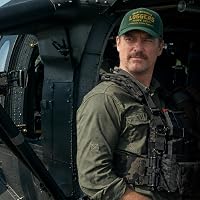
Bear J. Sleeman was born on Choogawarra, a 1,900-acre beef cattle ranch and apple orchard in Bilpin, New South Wales, Australia, where bull riding wasn’t a hobby—it was the compulsory family tradition. He rode bulls before he could drive, guided by his grandfather’s creed: “You find out who you are in eight seconds… or you don’t find out at all.” Bear has been finding out ever since.
Today he lives 1,847 metres above sea level at Bear Mountain Ranch in the alpine forests of Haramura, Nagano, Japan, where he and his wife Megumi have spent over a decade building their mountain homestead by hand.
The ranch is home to Angus × Wagyu cattle, a pony named Trigger, working dogs, towering woodpiles, old square-body GMC trucks, dirt bikes, deep winter snow, and the kind of silence that only mountains can teach.
Every morning begins the same way: the woodpile, the axe, coffee, then writing. This is not a routine; it is the price of admission.
Bear's imagination was forged by what he believes was the greatest era in cinema, when Westerns ruled the screen and heroes were measured not by speeches, but by what they did when nobody was watching. His greatest influence is Clint Eastwood—from the nameless drifter to the relentless moral compass of Dirty Harry.
He grew up on the worlds of Sergio Leone, Sergio Corbucci, Don Siegel, and Quentin Tarantino. Films like The Good, the Bad and the Ugly, Once Upon a Time in the West, The Wild Bunch, High Plains Drifter, and Unforgiven shaped the moral landscape that echoes in his fiction.
No influence looms larger than the music of Ennio Morricone and Lalo Schifrin, whose original vinyl soundtracks still accompany his early morning writing sessions.
Literature completed what cinema began, through the unforgiving landscapes of Cormac McCarthy, the frontier humanity of Larry McMurtry, the precision of Tom Clancy, and the relentless force of David Morrell’s First Blood.
These influences flow directly into his work. Preacher of the Badlands is a love letter to the supernatural Western—a place where frontier justice meets biblical reckoning.
Although the Bear Mountain in the novel is fictional, its name comes from the real mountain community he calls home. The spirit is the same: rugged, self-reliant, and shaped by people who believe a handshake still means something.
Bear is the author of The Bear Mountain Series, celebrating mountain life, ranching, and frontier values, and several standalone novels that explore war, survival, and the cost of doing what’s right.
He writes the same way he splits wood: no wasted motion, no pretty lies. The sentences are short and heavy. The land does not negotiate, and neither do his characters.
He and Megumi live by a simple code: Pressure. Velocity. Accuracy. They protect what they love.
The woodpile still waits at 0430.
The axe still swings.
The record still spins.
Bear or be borne down.
Other Novels by Bear J. Sleeman
Standalone Graphic Novels:
WIFE BEATER & THE PREACHER
A full-colour, 65-page illustrated graphic novel.
A dark, uncompromising tale of Southern Gothic horror, supernatural noir, and neo-Western brutality, where violence has consequences, death is not always the end, and justice belongs to neither Heaven nor Hell.
Goodreads Review - 5/5 Stars Reviewed by: Akiko Abe Date Read: June 25, 2026 Shelf: unforgettable, war-fiction, psychological, translated-to-english
I picked up The Devils Rejects after seeing it promoted by the small publisher here in Nagano. I expected another loud, foreign war story about heroes. I was so completely wrong. This book has stayed with me for days, like a haunting piece of music or a stark ink painting where the emptiness holds as much meaning as the brushstrokes. It is not about war. It is about what is left when every idea of "honor" and "purpose" is burned away, and two men must decide what they are in the void.
As a Japanese reader, I am familiar with stories of bushido, of the warrior's code, and the tension between duty and personal conscience. But Bear J. Sleeman takes this to a far more primal and devastating place. Jack and Steve are not samurai. They are more like oni—demons forged in a furnace of betrayal. Their rituals are not ceremonies of a code; they are acts of psychological self-surgery, cutting away their own humanity to survive. This fascinated and horrified me in equal measure. The quiet, stoic endurance (gaman) in the face of unbearable heat and thirst, the absolute focus on a single task—this felt familiar in spirit. But the direction of that focus, toward a transformation into something monstrous, was profoundly unsettling.
The prose itself is relentless. It does not comfort you. It drags you into the desert, into the grit and the thirst and the ringing silence after a shot. I have never read descriptions of physical suffering that felt so immediate. When Jack's shoulders are described as "raw meat" from his pack straps, you feel it. The desert is the most powerful character—an ancient, indifferent kami (spirit) that tests them not for a lesson, but simply because it can. It reminded me of the harsh, beautiful, and unforgiving landscapes of Japan's own mountains, which offer no mercy, only a pure, uncaring truth.
What moved me most, however, was the portrayal of the brotherhood between Jack and Steve. In a world where all institutions have betrayed them—their country, their intelligence services, the very cause they were sent to fight for—the only thing that remains real is their bond. It is communicated not in long speeches, but in a shared glance, a slight shift in posture, a silence that holds more meaning than words. This felt very true. It is a bond deeper than friendship, a complete and silent understanding that is the last flicker of humanity in a darkening world. Their loyalty is the only "honor" left, and it is a private, desperate one.
Furthermore, the novel is a terrifying critique of modern, sanitized conflict. The real villains are not in the desert; they are in clean offices, speaking softly on encrypted lines, turning lives and loyalty into accounting problems. Jack and Steve, with their painted faces and ancient brutality, are in a way the last honest thing in the war—a raw, screaming truth that the men in suits are desperate to erase. In our world of managed narratives and distant, button-push warfare, their bloody, personal struggle feels like a tragic, necessary scream.
The Devils Rejects is a brutal, difficult, and magnificent book. It is not for entertainment. It is an experience that stains your perception. It asks terrible questions about loyalty, betrayal, and the price of survival when the world you served declares you the enemy. As a reader far removed from the SAS or the Iraqi desert, it connected with me on a deeply human level—in its exploration of endurance, the sanctity of a single trusted bond, and the terrifying cost of truth.
It is a masterpiece of psychological intensity. I will not forget it.
MILITARY STRATEGY MAGAZINE TACTICAL FICTION REVIEW FROM THE DESK OF BUCK McGREGGOR, SENIOR CONTRIBUTOR & ANALYST (FORMER 1ST SFOD-D)
TITLE: The Devils Rejects – Reaper One Edition AUTHOR: Bear J. Sleeman PUBLISHER: Bear Mountain Rancher Publishing Inc. PUBLICATION DATE: May 2026 REVIEWER RATING: 4.5 / 5 Stars
A Surgical Strike of a Novel: When Doctrine Fails and Men Become Weapons
Let’s dispense with the pleasantries. The modern military thriller is a congested battlefield, littered with the cardboard corpses of two-dimensional heroes and plots recycled from a Pentagon press briefing. To pick up Bear J. Sleeman’s The Devils Rejects is to execute a breach-and-clear on that tired genre. It is not a book you read; it is an operation you survive. It leaves grime under your fingernails, the taste of copper in your mouth, and a profound, unsettling question echoing in the silence after the last page: What is the true cost of the sharpest tool in the box?
Sleeman, through the avenging-angel personas of SAS operators Jack Rennell and Steve Juggs, has crafted a narrative that functions on three distinct and devastating levels: as a masterclass in small-unit tactical realism; as a forensic psychological study of controlled devolution; and as a scorching indictment of the bureaucratic and corporate machinery that consumes the very warriors it creates. This is not a story about winning a war. It is the Operations After-Action Report from a conflict within the conflict, written in blood and sand.
Tactical Verisimilitude: Where the Poetry is in the Procedure
From the opening frames in the “smell of gun oil, damp wool, and the particular metallic tang of men who had already accepted they might not come home” at Hereford, Sleeman establishes an authority that is absolute. This is not a writer who has visited a shooting range; this is a voice that carries the muscle memory of a tactical reload in pitch darkness. The granularity of detail is staggering, not as decorative flourish, but as essential architecture.
Consider the HALO insertion in Chapter Two. Sleeman doesn’t just describe a jump; he documents a physiological and psychological event. The vibration “lived in your teeth, your bones, the fillings in your molars.” The freefall is not exhilarating but a mathematical exercise: “Rate of descent: 175 feet per second. Time to pull: 72 seconds. Heart rate: 110 and steady.” The sandstorm that follows isn’t weather; it’s an electromagnetic event that kills GPS and compasses, a tactical null-space. This is the unsentimental language of the professional soldier, where every piece of data—from the remaining round-count of a Minimi belt (191) to the specific failure mode of a CamelBak bladder in 120-degree heat—is a variable in the survival equation.
The set-piece engagements are choreographed with a staff planner’s precision. The ambush of the UAZ patrol in Chapter Three is a clinic in target prioritization, windage calculation, and immediate action drills. The defense of the wadi against the ISIS technicals showcases the brutal economy of close-quarters battle (CQB). But it is the long-range reconnaissance and terminal guidance of the airstrike on the Republican Guard brigade in Chapter Eight that is the book’s tactical zenith. The process—staking the target, calculating vulnerability (the poorly sited fuel tanker), calling in the ordnance (BLU-118/B Thermobaric, CBU-87 Cluster), and weathering the “danger close” storm—is depicted with a chilling, procedural beauty. In these passages, Sleeman doesn’t just write action; he diagrams the nervous system of modern combat.
Psychological Warfare: The Ritual as a Force Multiplier
Here is where The Devils Rejects transcends the genre and enters the realm of profound psychological inquiry. Jack and Steve are not merely soldiers adopting a scary disguise. Their transformation into “painted devils” is a deliberate, weaponized descent, a calculated shedding of the Geneva Conventions and the very concept of the Western warrior.
The rituals are the core of this. The Mohawk is not a haircut; it is a “shedding, a transformation.” The war paint, mixed from issued camouflage cream and pigment, is not for concealment but for becoming “what the mission required.” And then, the apex of this dark liturgy: the consumption of the enemy’s liver. Sleeman is unflinching in these scenes, presenting them not as acts of savagery for its own sake, but as a grotesque form of operational logic.
As Jack explains early on, “It’s about sending a message… If they believe we eat their hearts, they’ll break before we even fire.” This is psychological warfare (PSYWAR) taken to its most primal, terrifying conclusion. The enemy is not just facing superior soldiers; they are facing a myth, a nocturnal terror that operates outside the known spectrum of conflict. The brilliance of Sleeman’s portrayal is that he shows the cost of wielding this weapon. We witness Steve’s terrifying addiction to the ritual’s “pure, savage joy,” and Jack’s subsequent breakdown after performing it on Colonel Hashimi—the moment he realizes they are becoming the very monsters they were purportedly sent to hunt. This internal conflict is the novel’s moral backbone, preventing it from becoming a mere celebration of violence.
The Strategic Betrayal: The Real Enemy in the SCIF
While the desert and the Iraqi forces provide the immediate threats, the novel’s most venomous antagonist is the “machine” itself. The conspiracy Jack and Steve uncover—a bioweapons deal brokered by rogue MI6 officer Sir Reginald Voss, corporate villain Klaus Hugo Claws, and complicit CIA management—is terrifying in its plausibility. This is not a cartoonish plot for world domination. It is a story of asset management, deniable operations, and financial profit.
The genius of the plot is in the dossier details. Voss’s briefing includes the generals’ Swiss bank accounts, favorite Scotch, and mistress locations. At first, this reads as hyper-detailed profiling. But as Jack deduces, “You don’t send us in for cogs.” This information is an audit trail. Jack and Steve aren’t assassins; they are “cleaners,” sent to eliminate business partners who have become liabilities. Their subsequent “rogue” status and the deployment of CIA “Cleaners” to terminate them is merely the “BURN PROTOCOL” of a failed operation.
This elevates the novel from a survival story to a strategic tragedy. The real battle is not for terrain, but for narrative control. Voss and his ilk are not in the desert; they are in air-conditioned rooms, using satellites, encrypted comms, and proxy forces (ISIS, mercenaries) to sanitize the battlefield. Jack and Steve’s response—to turn from targets into hunters, to capture evidence and target the puppet-masters—becomes a guerrilla war against the very infrastructure of modern “plausibly deniable” conflict. It’s a devastating commentary on how the warrior class can be commodified and then discarded by the managerial class of warfare.
Critiques: The 0.5-Star Deduction
No operation is flawless. My 4.5-star rating acknowledges minor, yet perceptible, friction points.
The Shadowy Antagonists: While thematically fitting as remote, faceless powers, Voss and Claws can feel like schematic representations of corruption rather than fully fleshed individuals. A scene from their perspective, a boardroom discussion treating the “Reaper” problem as a mere spreadsheet liability, could have added a terrifying layer of contrast. Pacing Under Fire: The relentless forward momentum occasionally overwhelms moments that needed to breathe. Steve’s critical leg wound and the subsequent escape, while thrilling, happens at such velocity that the grave, life-threatening implications of the injury are somewhat glossed over by the next firefight. Dialogue Under Strain: In moments of extreme duress, the lyrical, introspective prose can sometimes clash with the need for terse, survival-level communication. Steve’s philosophical musings mid-ambush, while insightful, can briefly puncture the “in-the-moment” tension.
Resonance & Legacy
The Devils Rejects stands confidently on a shelf flanked by giants. It carries the bone-deep authenticity of Andy McNab, the complex, globe-spanning conspiracy of Mark Greaney’s Gray Man, and the psychological weight and sniper’s patience of Stephen Hunter. It shares the gritty, brotherhood-under-fire ethos of Don Winslow’s Savages and the hallucinatory, war-is-hell texture of Michael Herr’s Dispatches.
But Sleeman synthesizes these elements into something uniquely potent. This is a post-9/11, post-Iraq, post-Afgahnistan Novel of Disillusionment. It understands that the contemporary battlefield is as much digital and financial as it is physical, and that the most dangerous traps are not IEDs but policy decisions made half a world away.
Final SITREP
The Devils Rejects* is a landmark achievement in tactical fiction. It is a brutally intelligent, emotionally draining, and morally complex tour de force. Bear J. Sleeman has not written a thriller about soldiers; he has conducted an autopsy on the soul of the modern warrior, dissecting the interplay of duty, brotherhood, sanctioned violence, and ultimate betrayal.
It earns its 4.5 stars not for providing comfortable escapism, but for delivering a relentless, authentic, and necessary confrontation. It is the novel every armchair general needs to read, and the one every serving operator will recognize with a grim, knowing nod. This book doesn’t just entertain; it interrogates. And in the silent desert it creates, the only honest answer is the wind over the sand, and the long walk home.
BUCK McGREGGOR SENIOR CONTRIBUTOR, MILITARY STRATEGY MAGAZINE