America and other parts of the world are on fire right now. Massive protests against the police, racial inequality, and the state involving rioting, looting, and fires have gripped America in a way I've never seen in my life time. In my region alone, major cities and small towns have seen their fair share of rowdy protests and looting. These acts are forcing America to contend with a history of exploitation and violence soaked in the blood of black and brown people, poor people, Native people, working people, women, children, trans people, immigrants, and so on.
It is hard to imagine how the government will rein in this popular fury and festive joy other than with 1.) a massive campaign of pacification and pathetic reforms carried out by a broad coalition of liberals, conservatives, and activists or 2.) very heavy-handed repression from the state and vigilantes. Let us hope they cannot rein in it.
We've already seen elements of both pacification and repression at play, from calls by liberal and conservative politicians, police chiefs, and activists to stop the most meaningful and powerful elements of the uprising that riot and loot to the beating, maiming, teargassing, and killing carried out by the police and National Guard. Within the last few days, police in the Bay Area have killed Sean Monterrosa, while the National Guard in Louisville has killed David McAtee. Groups of mostly white people are cleaning up and hiding the damage of black and underclass rage carried out against businesses, while mobs of white vigilantes are starting to patrol the streets to protect property and enforce law and order from outside of the law.
If the state harming and killing black people and poor people weren't bad enough, sadly, some people seem to be buying the calls from politicians and police, in which they say they care and there are serious problems with policing in America, but that the most severe protesting needs to stop. Where were these politicians and police two weeks ago? Five years ago? 20 or 50 or 500 years ago?
History tells us where they were: they were harming, exploiting, and killing black people and other people to gain power and wealth. The violence and cruelty was necessary to make the America America, to make the rich and powerful rich and powerful. The violence it took is almost unimaginable, and it was carried out and protected by those with badges and uniforms. The police and the state cannot solve this problem, they can only make it worse. They are not our friends or allies. When the police walk hand in hand with protesters, kneel at their feet, cry, or say they care, inside many of them must be thinking, “I can't believe they're buying this.” If they actually cared they would quit their jobs.
Hopefully, the rebellion will continue to spread in intensity across America and the rest of the world. There is a very real potential to expand the struggle to strikes and occupations (the homeless encampment in Minneapolis's Sheraton hotel is an excellent example); to a shift in resource distribution not based in profit but in need and desire; to blockading major streets, highways, railways, bridges, tunnels, and other important infrastructure; and to the targeting of places that repress and confine immigrants. There are unknown possibilities beyond this as well.
If and when things die down, there is the very real possibility that the state will pour unlimited resources into finding and repressing those who participated in the uprising, whether physically or verbally. In the excitement, many protesters are not masking their identity as well as they should, and the police will take advantage of this. The state will not help, it will only make things worse.
The exploitation and violence meted out by America against its own people has been laid bare. The furor against it is palpable and contagious. Politicians on both sides of the aisle will offer solutions—but short of the radical transformation of the world—all other proposals will only pacify the situation, continuing the atrocities of the last centuries in different, perhaps milder or more severe forms.
In an attempt to have moments away from the protests and intensity of media reports, I've been reading No Wall Too High. At first part of me thought it best not to write a review right now. I do not wish to take attention away from conversations around abolishing the police and prisons of the world, nor do I want to take attention away from the protesters who insist on that course of action. But No Wall is a story of resisting confinement. Xu Hongci and I live on opposite sides of the same coin, the coin of the state, which proclaims the will of both communist and capitalist governments. They all must go.
This review is for everyone out their right now struggling against the police and the cruel hierarchy of this world that values some life above others and disregards the rest. It's for everyone past, present, and future who struggles either in isolation, collectively, or en masse against the constraints that keep this sick world functioning. Now is not the time to calm ourselves, but to press on. We can do better, much better, than this world. (A)
* * *
For years I've told myself I need to read about Communist China, but have stalled since most histories and memoirs are labeled either Maoist or capitalist propaganda. Not knowing many details, it's hard to pick a place to begin. So it was with skepticism I started Xu Hongci autobiography, No Wall Too High. Though I'm sure there are some biases in No Wall, the book serves not only as a powerful story against confinement and states of any sort (communist, capitalist, democratic, authoritarian, etc), but also a good overview of the politics of its time. It's hard to imagine how certain details could be taken out of context or exaggerated.
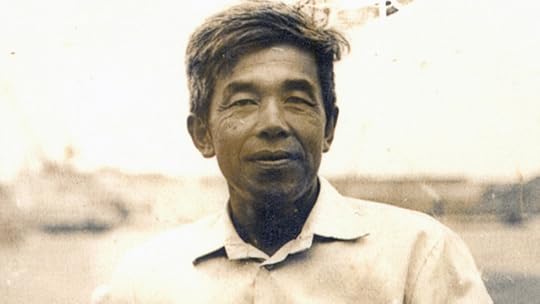
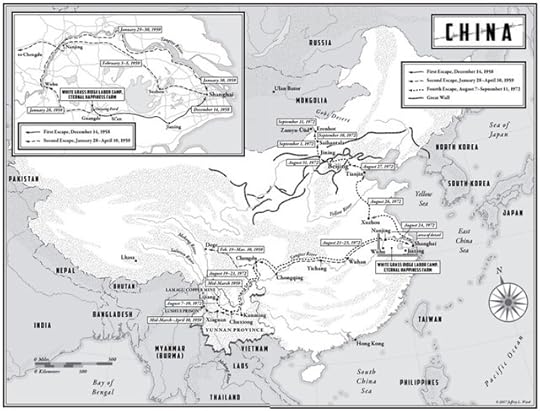
Xu appears to have been an enthusiastic but critical member of the Communist Party who was sentenced to years of hard labor in China's reeducation camps. Xu's repeated escape attempts, which are chronicled in the No Wall, earned him the title of China's Papillion, and his autobiography is on par with Henri Charrière's.
No Wall is significant for a number of reasons alone: a horrific window into Mao's gulags (laogai), an overview of political currents in China from the 1930-1950s (which I greatly appreciate), and a look into the life of a middle class boy growing up during that same time. Xu himself does a good job of giving a basic timeline of events, but Erling Hoh, the translator who stumbled upon Xu's unpublished book buried in a Chinese library, provides many (much appreciated) annotations of names, events, and articles referenced. Erling also prefaces certain chapters to provide historical context, which I also appreciated. Taken as a whole, this book is amazing.
The following is rough overview of Xu's life and the events leading to his imprisonment. If you are already interested in the book, read no further. But note that this book contains graphic descriptions of the violence the government of China committed against prisoners. And at the risk of ruining this review, my distro (aboulder.com) is carrying nice hardback copies of No Wall Too High starting at $5 (the price I paid for them).
* * *
Xu Hongci was born in 1933 two years into the Japanese occupation of Manchuria. Though his family were middle class members of China's emerging industrialists, war and occupation put them under constant financial uncertainty. Those below them suffered even greater. Xu was almost twelve years old by the time the Japanese military left China.
In 1956, the people of Hungary rose up against the Soviet-back communist government. Strikes and protests soon turned into hit and run attacks against Soviet tanks sent to squash the rebellion. The Hungarian uprising was one of the first large scale rejections of Soviet authority during its time. Communist rulers throughout the world feared it would spread opposition to them from below.
The following year, Mao called on the people of China to engage in a period of reflection and criticism against his government. Mao declared, “let a hundred flowers bloom and a hundred schools of thought contend”. Keep in mind, by now the communists had already killed several hundred thousand people. Dubbed the Rectification campaign (zhengfeng), Mao hoped that by letting people vent and complain he could prevent a Hungary type situation.
During this time, local officers of the communist party asked students like Xu to publish broadsheets (dazibao, 'sincere advice') declaring their take on the current situation in China. The communists thought this was good press since the posting of dazibao showed their ability to tolerate dissent, as well as people's willingness to followed their dictates.
Xu and a handful of other students obliged, posting a critique of the government and the administration of his school. They called for the expansion of curriculum (less curtailed to the ideological constraints of the government and the Soviet Union), elections where people could nominate their own candidates, the removal of restraints placed on students and faculty, and an increase in pay for the latter. Xu also took part in mingfang ('airing of views'), meetings arranged by the communists so people could express frustration.
But Mao's plan backfired, and the complaints grew so many that the zhengfeng risked creating another Hungarian uprising. Mao decided to end the period of critique and use people's grievances against the government as proof they were counterrevolutionaries (Rightists), sending 550,000-3,000,000 people to labor camps to undergo reeducation.
Locally, the Communist Party chapter and college administration (which was under the control of the CP) were appalled at how far Xu's critique had gone. Keep in mind, these critiques were pretty standard liberal complaints, nothing too crazy like the complete denouncement of the school or government or the overturning of either. Xu was hauled before a communist-lead meeting (douzhenghui, 'struggle meeting') where he was expected to denounce himself, apologize, and be shamed by loyal members of the party. But Xu would not repent, and instead was treated to struggle meeting after struggle meeting filled with angry boos and denouncements.
Local papers ran stories denouncing Xu as a dangerous Rightist, while the communist party published dazibao of their own slandering Xu and falsely signing the names of classmates to it. Eventually, Xu was sentenced to an unspecified amount of time in the re-education camps.
There, 19 hours of work a day tilling wasteland, a meager portion of rice, and other cruelties awaited Xu. Diseases like dysentery tore through the camps adding to the misery, while a diet of only starch added to constant feelings of hunger. Humiliations, beatings, and disgustingly ingenious forms of corporal and psychological punishments were used as well to try and break Xu and other dissenters.
Shortly after arriving, Xu began his fourteen year mission to escape. I will leave these details to the readers. Overall the story is masterfully told, translated, and annotated. A hidden gem against incarceration and restraint.