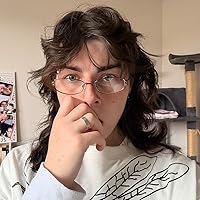
Max Easton is the author of a trilogy of Sydney-based novels that include The Magpie Wing (2021, longlisted for the Miles Franklin Literary Award), Paradise Estate (2023) and Now, Autonomy (2026). He runs Barely Human, a zine and tape label exploring underground music's ties to subculture and counterculture, and has played in several Sydney punk bands including BB & the Blips, Romance and The Baby. His fiction and cultural criticism has appeared in Sydney Review of Books, The Lifted Brow, Meanjin and HEAT.
I really didn’t enjoy this one - while it touched on all the expected modern issues, at best it would read as pessimistic and incisive with regard to left wing stereotypes, but I think it was supposed to be optimistic? Every character seemed like an absolute drainer so I aptly felt physically drained reading this
While the characters are more radical, the weariness is palpable which doesn't make for as-riveting a story as the first two installations. Works best when Helen and Sunny introspect about the present and the future. Still a remarkable depiction of the state of Sydney, and Australia writ-large.
Now, Autonomy by Max Easton is an incisive and vividly contemporary novel about people trying to build meaningful lives in a city that increasingly seems hostile to the communities and ideals they value. Set in Sydney and moving through underground music scenes, political protest, DIY activism, and experiments in autonomous living, the novel captures the frustrations and possibilities of people searching for something beyond conventional measures of success.
One of the book's strongest qualities is its attention to the lives of its characters and the subcultures that shape them. Helen, Pat, Sunny, and Sio are navigating precarious work, relationships, creative ambitions, and political commitments while trying to maintain some sense of community. Their experiences give the novel an engaging human dimension, while the broader questions surrounding activism, capitalism, generational change, and political solidarity add considerable depth.
Readers interested in contemporary literary fiction, Australian fiction, underground music and punk culture, political fiction, working-class stories, social movements, and character-driven narratives should find Now, Autonomy especially compelling. Easton's long-running engagement with Sydney's subcultures gives the novel a distinctive sense of place, while its examination of disillusionment, solidarity, and the possibility of collective action makes it a particularly timely work.
I knew people just like Sunny when I was going through my theatre degree, and there is something fundamentally frustrating about them that I think Easton captures here, which I think did a bit of a disservice to my own personal enjoyment of the book. I think almost every character being such a downer, and the only character who seems to be at least trying to solve their problems being so attached to Sunny kind of took me out of it.
I think the big end message here fell kind of flat, I'm a big believer in social spaces, in the need and want for community centers where people can be safe and learn and create with others. I am *not* a big believer in those social spaces being renamed venues for shitty DIY punk bands, not primarily. I don't think a couple of people squatting in a house to, again, turn it into a venue as "praxis" is effective to even the idea of making small changes in the world. I don't think Easton really unpacks that, they kind of gesture at it when Helen or Pat are being miserable about the state of the world (A feeling I get!) but it's still weird that after the blunt-faced summary of current (As of now) events Easton decides that a collective multinational *record label* named the CCP is some grand statement, nor that it really represents the kinds of positive fulfillment that the characters are looking for. Publishing Pat's book is, there's something to that, but not much else.
Max Easton is a fantastic storyteller, but this wasn't the right one to conclude an otherwise great trilogy. I struggled to differentiate any of the beige characters from one another; their motivations felt indistinguishable from one another. The cast dynamic that was so successful in The Magpie Wing and Paradise Estate was completely missing here and fell flat comparison. Perhaps that is this point but I did not care much to reflect. I don't agree that this novel holds a mirror up to sardonicism in leftist subcultures, it just illustrates it.
a self aggrandising portrait of everything wrong with leftist counter cultural movements in Australia that had me scoffing - though I don’t think that was its intent 😭
Disappointing end to a brilliant trilogy. What felt fresh in "The Magpie Wing" felt stale in "Now, Autonomy". A lot of emphasis on music & squatting history. A bit slow in the middle where it seemed to take forever for anything to actually happen.