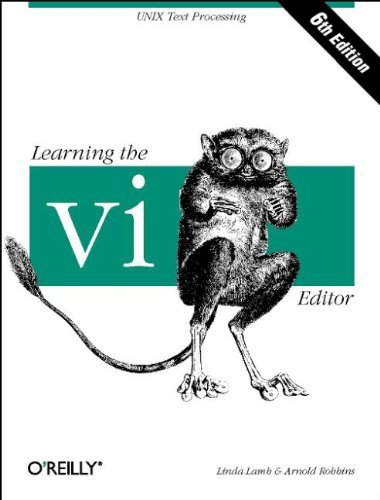
I can finally use Vi without making a fool of myself!
Vi is easily the least user-friendly application still in widespread use. Learn it well enough to feel confident when it pops up on the screen is something that requires a fair bit of devoted practice. It requires muscle memory.
The edition of this book that I read dates to the early 1990's - I don't believe Vim even existed then. Despite being so old, it was adequately suited to my needs: learning the basic commands of Vi which will be available on every POSIX-compatible system in the universe.
The book follows a logical path to learning the basics of the editor: first you learning how to open and close Vi, then how to move around, and finally, how to edit files and save them. There are plenty of troubleshooting tips, though most of these seemed like fairly unlikely things to encounter in modern times (oddball terminal settings and such).
There are well chosen exercises for most of the commands, and these will get you started. However, to really commit them to memory, I highly recommend that you put them into practice while attempting to edit a much larger document. In fact, I highly recommend my own method: I created a tutorial text file which guided an imaginary student through all of the Vi commands - with exercises and test areas for each. I even created a maze to help ingrain the h,j,k,l navigation commands. Doing this forced me to learn each command to a degree that I would not have had I just read this book and followed along with the provided exercises. Plus, using Vi to create the tutorial text file meant that I was not only learning but also using the commands. It's one thing to learn that 'A' takes you to the end of the line and puts you into insert mode. But it's entirely another to instantly fall in love with the command because you're tired of typing "llll...lllli" to do the same thing!
You'll actually exhaust Vi's repertoire of commands in the first fifty pages of this book. The rest of the book is concerned with commands for the "ex" line editor (for which Vi is merely a "visual" wrapper) and various tricks involving invocations of the Unix shell from ex. Vi is extremely lightweight (which is why it's so ubiquitous) and it becomes very clear in the last 2/3rds of Learning the vi editor that most of Vi's power actually comes from "outside" the editor itself in the standard set of Unix tools available from the command line.
The appendices are exceptionally helpful. Appendix A is a command Quick Reference. B lists all of the standard environment options (several of which you will absolutely change if you plan to do any programming in an unconfigured Vi). Appendix C has all of the ex commands, which is good to have because I imagine only a very, very serious Vi user will have memorized more than a fraction of these. Appendix D lists more troubleshooting and again, I think many of these problems may be outdated - however, if you're using Vi precisely because you're on an old or strange or minimalistic system, these may be exactly the sort of problems you'd run into!
I do recommend this book to learn Vi. It's a valuable skill if you find yourself in a Unix terminal on a semi-regular basis. Beyond the book, though, you'll almost certainly have to devote some time to working with Vi until you've achieved confidence with the editor. Make a tutorial. Challenge a friend or loved one to try to learn Vi from it. Happy editing!