Succesul și echilibrul în viață depind, mai mult decât am vrea să recunoaștem, de abilitatea de a naviga acele conversații dificile pe care majoritatea oamenilor preferă să le evite. De la negocierea unui salariu binemeritat până la gestionarea unui conflict tensionat în familie, felul în care comunici îți dictează viitorul.
În „Nu te mulțumi cu puțin”, Attia Qureshi și John Richardson distilează decenii de experiență academică la MIT și Harvard într-un set de instrumente strategice, verificate în cele mai dure condiții de negociere din lumea reală.
Metodele lor au fost folosite în situații de criză precum:
● Attia Qureshi a utilizat aceste principii în zone de conflict din Columbia, unde a lucrat pentru Departamentul de Stat al SUA, reușind imposibilul: a convins cooperative de fermieri aflați sub controlul cartelurilor să renunțe la producția de coca în favoarea agriculturii legale.
● John Richardson și-a rafinat măiestria pe Wall Street, gestionând negocieri cu mize de sute de milioane de dolari în litigii federale de fraudă și oferind consultanță strategică pentru liderii de la Goldman Sachs, Credit Suisse sau Ericsson.
Această carte transformă negocierea dintr-o confruntare stresantă într-o practică a clarității. Vei învăța cum să construiești, cu exemple concrete și exerciții practice, încredere acolo unde există suspiciune, cum să îți stăpânești emoțiile sub presiune și, cel mai important, cum să obții tot ce-ți dorești de la persoana din fața ta.
Attia Qureshi is a negotiation and influence expert, former MIT faculty member, adjunct professor at the University of Michigan, and the founder of Attia Qureshi Consulting — where she has spent two decades helping leaders, teams, and organizations negotiate better outcomes in every room they walk into.
Her work spans Fortune 500 boardrooms, university classrooms, and conflict zones around the world, where she has negotiated on behalf of the U.S. State Department in some of the most complex environments imaginable. She brings the same framework — principled, interest-based, and relentlessly human — to every context.
Her book, Never Settle: Persuasion and Negotiation Skills to Get What You Want, published May 12, 2026. Daniel Pink calls it a book that will "train you how to move through the world."
She lives in northern Michigan with her son and her husband, a seventh generation cherry and apple farmer. She tries — and mostly fails — to negotiate with the weather.
I have a hypothesis that many of the skills mental health clinicians miss can be found in books about business psychology. Chris Voss’s Never Split the Difference became a seminal text for me when I worked on a mental health crisis line. I read Never Settle to revisit and build on these skills.
I was reminded that the skills of a manipulator are almost indistinguishable from those of a good person. Kindness and warmth are effective ways of getting people to like and trust you. What you do with that trust is where your morality lies. The techniques discussed in Never Settle can also be found in Niccolò Machiavelli’s The Prince and Robert Greene’s more contemporary The 48 Laws of Power.
Richardson and Qureshi largely cover the same ground: reciprocity, emotional regulation, flattery, knowing yourself, understanding your negotiating partner’s interests, giving them options that you have chosen, anchoring and being able to say ‘no’ respectfully. These are all important skills, whether you want to be a good person or a con artist. The skills are much the same; how they are applied is another matter.
I found Qureshi the weaker author. Her example of escaping Colombia and the potential threat from the drug cartels did not quite fit the narrative she was developing about how to say no. In this example, she does not actually say ‘no’; she finds a way around the person rather than directly addressing what he has said. Her examples from her own life often seemed disconnected from the principles she was trying to explain. I suspect she had less life experience to draw upon than Richardson. She clearly understood the theory and could explain it, but I did not find that she consistently connected it to practice in a meaningful way.
Both Qureshi and Richardson come across as academic, placing too much emphasis on theory at the expense of practical experience. This is where Chris Voss and Never Split the Difference remain my go-to resource for negotiation strategies and skills. Qureshi and Richardson draw heavily on Voss, and Never Settle served its purpose for me by revisiting these skills and reminding me of their value.
My main takeaway is that these techniques are tools. They can be used to build trust, resolve disagreements and help people find a way forward, but they can also be used to manipulate others. The difference lies not necessarily in the skill itself, but in the intentions and ethics of the person using it.
The Practiced Sentence at the Edge of Wanting Attia Qureshi and John Richardson’s “Never Settle” turns negotiation into a rehearsal for the awkward, human moment when desire has to speak. By Demetris Papadimitropoulos | May 7th, 2026
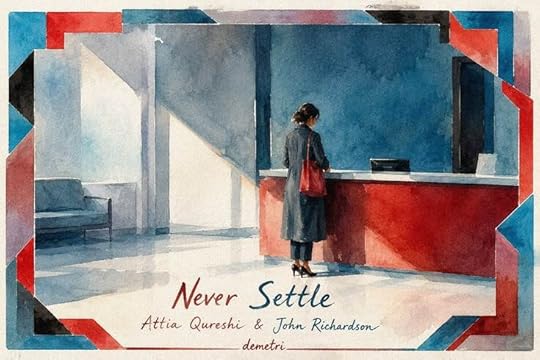
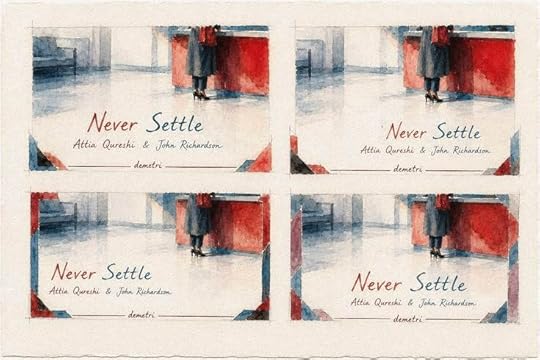
A solitary figure waits at the reception desk in a field of blue light and red pressure, holding the quiet courage of asking clearly for what one wants.
People rarely settle because they cannot imagine a better sentence. They settle because the sentence that would change the terms feels suddenly expensive. The room warms; the stomach tightens. The better number sounds greedy. The clear no sounds cruel. Correcting a mispronounced name suddenly seems too fussy, as if dignity had asked for a receipt.
Silence begins to pass itself off as tact, then good breeding, then wisdom. Attia Qureshi and John Richardson’s “Never Settle” is sharpest when it understands this hidden cost of negotiation: not ignorance, exactly, but embarrassment. Its true subject is the awkward second before wanting becomes visible.
That is both more modest and more interesting than the title’s motivational jawline. “Never Settle” sounds like a book about winning, perhaps even about becoming the sort of person who treats life as one long reimbursable contest. The book underneath the signboard is warmer, less predatory, and more observant. Qureshi and Richardson do want readers to get more: more money, more clarity, more time, more fairness, cleaner terms, firmer boundaries. But their real subject is not swagger. It is rehearsal. Negotiation, in their telling, is a performance skill, closer to boxing, firefighting, music, chess, or improv than to a locked drawer of tricks. No one becomes steadier in a difficult conversation by admiring theory from across the room. You practice when the stakes are low, fail safely, keep a record, try again, and eventually arrive at the table where the stakes have teeth with some muscle memory.
The book quickly shrinks negotiation from grand arena to ordinary room. Negotiation is not a special occasion. It is present when you ask for a raise, handle a rescinded job offer, negotiate remote work, ask a neighbor for an easement, choose a child’s name, push back on a deadline, or say no without becoming either a doormat or a tiny domestic dictator. Drawing from “Getting to Yes” by Roger Fisher, William Ury, and Bruce Patton, the tactical listening associated with “Never Split the Difference” by Chris Voss and Tahl Raz, behavioral psychology, and the crowded anecdotal pantry of the classroom, Qureshi and Richardson make a claim not of invention but of transfer: how to get old wisdom into the mouth at the moment one would rather swallow it.
The choreography is plain; the sequence is where the intelligence lives. Begin with rapport: the sandwich, the lemonade, the name. Then emotion. Then interests, first yours and then theirs. Then options, criteria, alternatives, no, and practice. The order is the argument. “Never Settle” does not begin with leverage. It begins by asking the reader to notice another person before asking something of them. Only later does it turn to money, benchmarks, fallback plans, and refusal. The path to getting more is not to become more forceful first. It is to become more awake to the person across the table.
The early chapter on reciprocity gives us the book in a glass of lemonade. Richardson explains how hostage negotiators use small acts, such as food or water, to build obligation and trust. Qureshi then brings the principle home, almost comically, in a story about a combative neighbor, a long-standing driveway and well easement, and the eventual need for a new gas-line easement. At first, the neighbor is a figure of dread. He complains about property rights. She retreats indoors to avoid him. Her mother, blessedly allergic to whining, tells her to stop complaining and take him a cold drink.
A glass of lemonade does not solve the problem. It does something better: it changes the weather. The eventual baskets of cherries, flowers, conversation with the neighbor’s wife, and successful easement request take years, not minutes. The scene works because it does not make reciprocity sound like a vending machine – insert beverage, receive utility access. It shows a low-grade feud softening into neighborly détente, with self-command as the first concession. Before Qureshi negotiates with Jared, she has to negotiate with the version of herself that wants him to remain the villain next door.
That distinction matters because “Never Settle” keeps walking a moral wire between kindness and leverage. It teaches readers to use names, gifts, choices, emotional labels, shared interests, and alternatives. These tools can be generous, and they can be manipulative. The authors know this and return often to intention, harm, transparency, and whether the other person would feel tricked if the method were named aloud. Those caveats are not ornamental bookkeeping. They keep the book from becoming salesmanship with better shoes. Still, the tension never fully disappears. A gift may be a gift; it may also be a lever with a ribbon on it. The moral test is whether influence leaves the other person freer, clearer, and better served – or merely better handled.
The prose wears work boots, and occasionally tracks mud across the seminar-room carpet. It is unvarnished, durable, and meant to get the reader from concept to action. Sentences tend to be medium-length, conversational, and classroom-clear, with field dust on them. Its gait is dependable: story, principle, drill, reminder. Richardson often writes in seminar-room comedy: the big brother behind him with the hockey stick, the daughter who out-negotiates him into a BLACKPINK trip, the friend who notices he has vacuumed his room and therefore must be in love. Qureshi’s sections carry more emotional sequence: discomfort, self-scrutiny, analysis, action, revision. Her stories about name pronunciation, professional dismissal, a failed textile start-up, a rescinded job offer, moving to Traverse City, and tense work in Colombia keep the book from becoming all toolkit and no weather.
The diction keeps its jacket off: direct enough to move from idea to drill without ceremony. The book would rather hand you a practice exercise than invite you to admire the upholstery. Its abstractions – interests, positions, criteria, options, alternatives, BATNA, ZOPA – are usually handed a chair, a counter, a kitchen, an inbox. The imagery sticks because it behaves like a tool, not a garnish. Food and drink recur: sandwiches, lemonade, cherries, apples, coffee, beer, pie. Training images recur too: boxing drills, firefighting academy, music practice, chess, mountain climbing, weightlifting. The metaphors earn their keep: fear as a barking dog, criteria as the big brother with the hockey stick, alternatives as the thing that lets the shoulders drop. The prose is not a scalpel; more like a well-used pocketknife. At times it strolls when it might stride. But some of the generous overexplaining has pedagogical purpose. Repetition is the training design as well as the flaw. One does not learn to say no by encountering the idea once, nodding gravely, and returning to one’s regularly scheduled agreeable little collapse.
The chapters with the most blood pressure are the ones where technique meets the body’s veto. The chapter on emotion matters because it refuses the fantasy that good negotiators are rational machines with calendars. Fear freezes; anger burns; happiness makes people stop too early; rejection hurts enough to keep people from trying again. Qureshi’s account of Lucia, a student whose job offer is rescinded after a negotiation over start date and advancement questions, is one of the book’s strongest pressure tests. The initial shock has to be named, sat with, and reduced before strategy can be trusted with the keyboard. Lucia can then diagnose the miscommunication, write directly but diplomatically to the hiring manager, and reopen the door. Negotiation skill here is not the absence of panic. It is the recovery from panic before panic writes the next email.
“Say Their Name” opens a trapdoor beneath what could have been a simple tip. Qureshi’s account of learning to simplify the public pronunciation of her own name because being called by name mattered more than hearing it pronounced perfectly is small, exact, and unexpectedly bruising. It could have been a chapter about remembering baristas and airline agents. Instead, it becomes an argument about recognition: to use a person’s name is to tell them, briefly but unmistakably, that they have emerged from the service blur. Tactically, yes, the chapter works. Qureshi’s airline rerouting story with Regina is attention with luggage tags. But beneath the tactic lies the hurt little dignity that makes the chapter linger. People are more likely to help when they feel seen, and people are often starving for evidence that they are not merely a function in someone else’s inconvenience.
When the book reaches interests, options, criteria, and alternatives, it enters heavily toured ground and still keeps the footing sure. Positions are what people say they want; interests are why they want them. Creative options emerge when both sides stop fighting over the first visible demand and start asking what needs, fears, values, and constraints sit underneath it. The Peru-Ecuador dispute over Tiwintza gives this section a wider stage: two nations trapped by symbolic claims over the same territory, and a solution that lets each side claim what mattered most in different ways. Ecuador can own the site; Peru can contain it. The story is almost too neat, but it makes the point beautifully. Not every conflict is a pie to slice thinner. Some conflicts contain unpriced rooms.
Money improves the book. That sounds rude, but it is true. The chapters on criteria and alternatives are chillier, more accountantly, and possibly the ones most likely to earn their keep by Monday. Criteria allow a person to argue about fairness without making the exchange a contest of chins. Market standards, comparables, contracts, salary data, used-car guides, and manufacturer specifications all move the question from “because I say so” to “because here is a standard we can both recognize.” It is much easier to be brave with a number when the number has witnesses. The advice on alternatives is equally practical: the best way to say no is to know what you will do afterward. Nerve, it turns out, loves a backup plan.
By the time “Never Settle” reaches refusal, it has become more interesting than its own promise. If many negotiation books court yes, this one understands that a better yes often depends on a no practiced before the room gets hot. It distinguishes the hard no from the gracious no, the final no from the not-yet, the boundary from the invitation to improve the offer. It also understands that agreeableness can create havoc by saying yes too often. Overcommitment is not kindness once it produces resentment, missed deadlines, broken promises, and exhaustion. Agreeable insolvency is still insolvency. The book’s no is not a door slammed for effect. It is a hinge that finally works.
The drone in Colombia becomes the practicum under pressure. Qureshi is working with farmers being encouraged to move from coca to other crops, facing skepticism, gendered dismissal, imperfect Spanish, heat, danger, and a disruptive figure with a drone. A lesser book would overplay the triumph. This one comes close, but the scene earns its force because the prior chapters have trained us to recognize the moves: build rapport, learn names, surface shared interests, manage fear, refuse disruption, give the group a structure. Names are no longer small. Interest-mapping is no longer academic. Saying no is no longer a slogan. The drone leaves; the farmers gather at the easel. The scattered exercises suddenly look less like homework and more like preparation for a room that matters.
What “Never Settle” does best is turn social discomfort into reps. It takes habits often mistaken for fixed traits – conflict avoidance, fear of rejection, discomfort with money, anxiety around refusal, eagerness to be liked, trouble asking – and reframes them as trainable moments. Readers who freeze at counters, tables, inboxes, meetings, and kitchen islands may actually use it. “Ask for More” by Alexandra Carter is one useful neighboring title, especially in its faith in questions, but Qureshi and Richardson are more overtly invested in drills. They want repetitions until the frightening move becomes merely difficult, then familiar, then ready in the hand.
The cost is technique optimism: the hope that a sufficiently trained sentence can repair almost any room. Because the method is so transferable, the book sometimes makes transfer look easier than it is. A spouse, a cartel-adjacent cooperative, a hotel clerk, a hostile neighbor, a boss, a recruiter, a sibling inheritance fight, and a geopolitical border dispute can all be illuminated by negotiation principles, but they are not the same kind of problem. Differences in money, safety, race, gender, institutional power, caregiving burden, and physical danger do not vanish because one has labeled an emotion or prepared a benchmark. The authors are not naïve about this; some of Qureshi’s strongest stories arise precisely from those pressures. Still, the book occasionally asks the well-trained individual to carry burdens created by unequal rooms. Better skill helps. It does not abolish the room.
Some chapters prove a point, circle it, give it a name tag, and send it around the room again. The neuroscience and evolutionary material sometimes functions more as accessible scaffolding than as searching inquiry. The packaging promises getting exactly what one wants, while the best pages teach something more adult: wanting must be clarified, tested, shared carefully, sometimes revised, and sometimes refused. But this mismatch is revealing. The book underneath the packaging is wiser than the packaging. It knows that never settling is not the same as always winning. It may mean not accepting the first offer, not letting fear set the terms, not mistaking anger for clarity, not using niceness to excuse self-erasure, and not calling a bad deal peace just because the room has gone quiet.
Its real subject is older than office weather: two people wanting, fearing, misreading, and deciding what must be said next. It speaks to hybrid-work tension, salary negotiation, boundary fatigue, and the exhausted diplomacy of modern professional life, but it does not need to chase the moment to matter. The essential scene is durable: someone wants something, fears something, misunderstands something, and must decide whether to posture, retreat, attack, charm, listen, trade, invent, or walk away. “Never Settle” is not a landmark of theory, and it is not a sleek literary object. But it is companionable, memorable, ethically watchful when it needs to be, and ready for the next unpleasant email. Its rare virtue is Tuesday usefulness: advice that may actually alter the next counteroffer, apology, deadline, or no.
I land at 84/100, which translates to 4/5 Goodreads stars under the stated rubric. That score reflects a book I admire more for its use than its elegance, more for its behavioral intelligence than its originality, and more for its humane accumulation of small moves than for any single startling argument.
The title talks tough, but the truer instruction is quieter: do not let fear do the negotiating for you. The book’s best image is not the triumphant closer with the perfect deal. It is the person standing at the edge of an awkward conversation, feeling the old flinch rise, and reaching anyway for the practiced sentence.
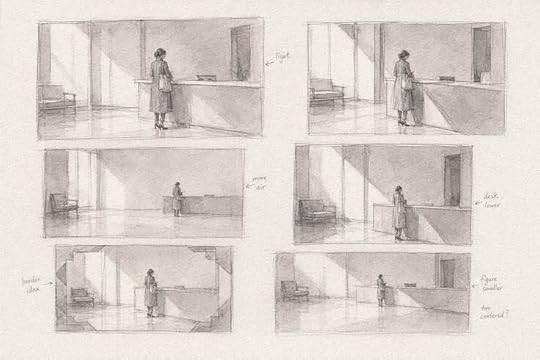
Early thumbnail studies test where solitude, desk, light, and negative space should sit before the final reception-lobby image finds its balance.
The faint graphite underdrawing reveals the bones of the composition: one figure, one desk, a few architectural planes, and a great deal of unsaid air.
Figure studies refine how self-possession looks in the body before color arrives: shoulders composed, weight held, gesture restrained.
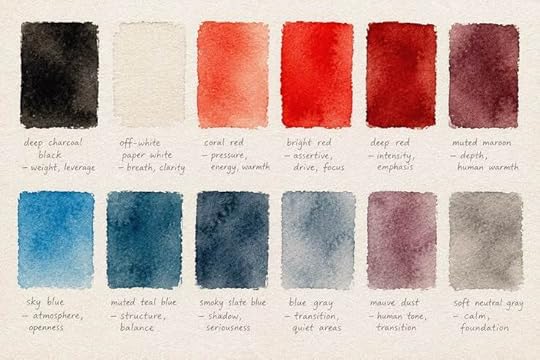
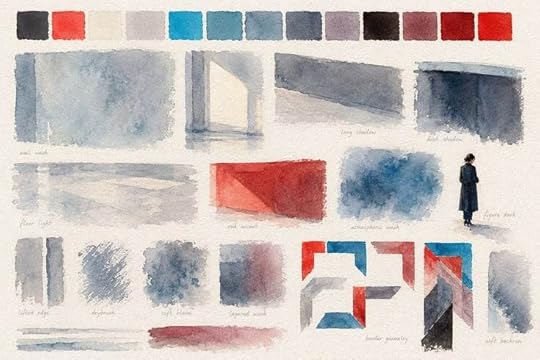
The working palette sheet shows the discipline behind the final image: blue as atmosphere, red as pressure, black as weight, and off-white as breath.
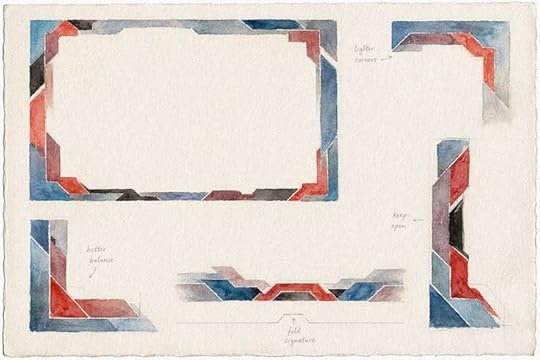
Border studies explore how stepped red and blue forms can suggest offers, counteroffers, thresholds, and structured exchange without overwhelming the quiet central scene.
The first-wash stage lets the image begin to breathe, with pencil structure still visible beneath transparent blue atmosphere, red pressure points, and early shadow.
Lettering studies test how title, author names, and signature can belong inside the watercolor rather than sit on top of it.
Texture tests reveal the hand, the paper, and the watercolor behavior behind the final image: blooms, drybrush, lifted light, layered wash, and quiet surface tension.
All watercolor illustrations by Demetris Papadimitropoulos.
A fun, practical guide to negotiation full of interesting insights about our own behaviors and framing. Other negotiation texts that I’ve read make me think about the psychology of the person who I am negotiating with, but this one taught me a lot about how I am wired as a negotiator. I’ve used the lessons learned from this book in a business context, but found it to be much more applicable to conversations, relational interactions, and day to day life than other books that I have read in this genre. Never Settle is genuinely fun, interesting, and applicable to every day life.
I’m going to start with this: I struggle with non-fiction. I really struggle with self-help or career advice under the guise of a “good read.” I tend to find them self-important aggrandizements to the author and less about something we as readers should take away or implement in life. If I want a monologue about ideas with no room for nuance, which I rarely do, this is a great genre.
However, there are occasional bright spots. This is Water was an incredible piece that challenged my perspective on life itself and crawled so deep into my back brain that I couldn’t help but apply its themes to my life.
Now, I will not go so far as to say Qureshi and Richardson reach the achievement of Wallace, but they did do something superb. The prose in these types of books often tends to be sorely lacking any creativity, but not here. I found the storytelling and narrative voice of the book not only engaging, but through the experiences the writers share, trustworthy as well. Again, reading these types of books, I often have the voice in the back of my head asking “what qualifies this person as a valuable voice on this topic?” Qureshi and Richardson’s shared history and their individual resumes really quieted that query for me.
So enough comparison, how was the book?! It was really enjoyable. I never felt that it was preachy or like it was speaking down to the reader from on high. The stories were interesting and entertaining and taught you just as much though parable as it did through principle. And there were some great lessons in here. Things I could apply to my everyday work and relationships, things I know I should try harder to implement, and things I will revisit and continue to practice because it doesn’t come naturally to me. Like I did with Wallace, I found myself thinking about the lessons I learned as I went about my day, encountered opportunities to negotiate, and improve my skills.
I do think this is worth your time regardless of your genre preference because these themes are so universal and so practical to brush up on and improve. Congratulations to the writers who managed to get this cranky guy to go out of his comfort zone and actually enjoy himself! To everyone else, give it a go. I thought it was worth it.
I came to Never Settle as someone who's read most of the canon — Getting to Yes, Never Split the Difference, Influence. What sets this book apart is the practice layer. Each chapter pairs a story (some funny, some hard, all real from MIT classrooms, Fortune 500 trainings, the State Department) with an exercise you can actually run that week. Small, low-stakes, designed for real life.
The chapters that landed hardest for me: Chapter 2 on emotions, because it gave me a vocabulary I didn't have; Chapter 5 on figuring out what the other person actually wants, because the diagnostic questioning approach is so different from how most of us are trained to listen; and Chapter 9 on saying no, because I learned how rarely I actually do.
What makes the book worth its price isn't the framework alone — it's the Appendix Prep Sheet at the back. One page, every element of negotiation, used before any conversation that matters. I've used it for a salary discussion, a contractor negotiation, and a conversation with my family about our next vacation.
Never Settle takes the 7 Elements framework I learned years ago and finally gives me a way to practice it. The exercises are small enough to actually do. I tried "learn their name" with my barista the next morning and noticed the difference by Friday.
If you want a book that gives you something to do, not just something to read, this is it.
A refreshingly practical and genuinely useful book. I first picked it up at a time when I was feeling stuck at work and needed a reminder that there are different ways to look at a situation, approach a conversation, and communicate what you want. It was exactly the perspective shift I needed, and I found myself reaching for the book every night for inspiration going into the next work day.
What I appreciated most was how straightforward the advice is. Rather than overcomplicating negotiation, the book breaks down fundamental communication skills into simple, actionable techniques that you can put to use immediately.
The anecdotal stories are actually relatable and make the lessons feel relevant to everyday life. I found myself recognizing situations I’d experienced and thinking about people in my own life who could benefit from these reminders.
I’ve since recommended and gifted this book to colleagues, friends, and family members. It provides inspiration around communication, navigating difficult conversations, or overcoming challenges. It’s one of those books that reminds you that sometimes a different approach or a few simple communication skills can make all the difference. An easy, worthwhile read with lessons that genuinely stick.
Never Settle is a sharp, practical guide to navigating the conversations that shape our lives and careers. Ant it's not about “winning” negotiations. It’s about understanding people, reading situations better, and making more intentional choices in moments that matter so that you get better outcomes for yourself and everyone involved.
The examples the personal stories and examples the authors give make it easy to see yourself in the scenarios, which make the tips so much easier to apply in every day life. No waiting for big business deals or career negotiations to put these exercises to work. The authors give you exercises you can start using immediately.
It's now my go-to book for all things negotiations and conflict resolution. It's so useful.
Negotiating anything can be an intimidating and stressful process. Attia and John have done a great job making the process feel more digestible and manageable with personal narratives and excercises woven into this book. The end result is that something that feels scary at the beginning of this book feels completely within my grasp. There are so many tools to add to your relationship and self-awareness tool kit that I walked away with.
Can’t recommend this book enough - not just for professionals, but for anyone interacting with humans on a daily basis. This book helps you understand your own and others needs in a way that feels productive and clarifying.
Never Settle: Persuasion and Negotiation Skills to Get What You Want by Attia Qureshi and John Richardson is a great book to learn and hone your negotiation skills. I am really not a very good negotiator and often joke if I negotiate we will not get we want and have to do more than we signed up for. This practical book was very insightful and I appreciated the exercises, great examples, and heartfelt stories. Truly we should all read Never Settle. I recommend.
I was gifted the books and not required to write a positive review.
The personal stories used as case studies were interesting and informative to read; however, the exercises throughout the book felt like something you would do in a class, and then forget afterwards. That said, there were good baseline themes about determining what you want, learning to understand what others want and navigating both the similarities and differences to get to what you want.
Simon Element provided me with a complementary copy of this book, the review and opinion are my own.
Never Settle was a fantastic read. The wording was strong, centered in the science and art of negotiation, but practical and supportive of daily living challenges as well as complex mediations. As a healthcare professional and mom of three strong willed children, I navigate the territory of relationally centered mediation daily. The advice in this book provided simple skills to access and a guidewire to navigating challenges without losing center or focus on what really matters.
I really enjoyed this book. It helps you to learn how to negotiate better , and the practice drills really make it stick. It’s approachable enough for total beginners but still useful if you already feel comfortable at the table. I’d hand it to anyone who freezes up when they have to ask for something.
I got an early copy of this book and it’s great for people who want to become better negotiators - the examples are great and it provides fun, easy exercises to build skills. It’s a quick read that I highly recommend!
This is the most insightful book I’ve read in years: it’s full of wisdom, it’s practical, and I leverage its advice in every difficult conversation that I face. So grateful to Attia Qureshi and John Richardson for writing this invaluable book!
I wish I had the book much earlier in my career - and I don’t work in a field where negotiation is considered a top skill set. But the framing and perspective is helpful for anyone and the storytelling is remarkably touching!
Chapter 2 on Emotions alone is worth the book. I've read a lot on negotiation and never seen anyone treat emotions as something you work with deliberately instead of trying to get rid of. The emotion wheel is on my desk now.
Came in skeptical... I've read Getting to Yes, Never Split the Difference, and felt I had the canon covered. Never Settle isn't a replacement for either; it's the practice book that pairs with both. The exercises are the difference.
Bought this for work negotiations. Ended up using it on a contractor, my teenage daughter, and a difficult family member in the same week. The stories have helped make the content stick: Tasha and Devon, Drone Man... but the exercises are what changed how I show up.
O carte pe care greu o mai lași din mâini. Sfaturi simple, practice, ușor de aplicat și cu exemple care te ajută să le pui în practică în viața cotidiană. Recomand această carte, am învățat lucruri utile care le voi folosi în relația cu partenerul de viață, subalternii, șefii și prietenii.
Never Settle was one of my favorite reads. Plenty of business and/or negotiation books give you theory but Never Settle truly teaches you the art of negotiation and how to win. Awesome stuff! Would highly recommend it to anyone.
I got an early copy of this book and it’s great for people who want to become better negotiators - the examples are great and it provides fun, easy exercises to build skills. It’s a quick read that I highly recommend!