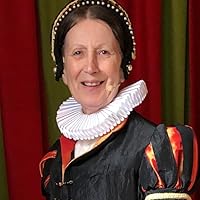
Tony Riches is a full-time author from Pembrokeshire, West Wales, an area full of inspiration for his writing.
Best known for his Tudor Trilogy, Tony's other international best sellers include 'Mary - Tudor Princess, 'Brandon - Tudor Knight' and 'Katherine - Tudor Duchess'.
In his spare time Tony enjoys sailing and sea kayaking. Visit Tony's website at www.tonyriches.com, Tony Riches Author on Facebook and follow him on Twitter @tonyriches.
I always enjoy this authors books and this one is no different. Not much has been written about Queen Anna and the author does a reasonable job of giving her a voice that seldom people listened to. She was forced to marry at the age of 14 and led a very lonely life. Denied love and even respect from her husband, the worst blow was having no involvement in her children's lives. This was not by her choice but was the custom of Scottish nobility at the time. Queen Anna suffered several miscarriages and out of 7 children only 3 survived past infancy. Through this plus her own health issues she never lost her will to give up or fight for what she believed in. I look forward to reading the other two books in this trilogy.
Having enjoyed reading several of the books by Tony Riches about eminent women of the Tudor court, I looked forward to discovering more about Anne of Denmark the wife of James VI of Scotland and first Stuart King of England. In an expertly researched story, we become intimately acquainted with Anna’s life from her marriage at 14 when she travelled from her home to Scotland. At 16 she is criticised for not having given birth to an heir, but her husband prefers the company of young men. However, he knows his duty and soon Anna begins the first of many pregnancies. Sadly, she lost several babies but finally Henry survives as the much-loved heir to both thrones. Anna’s love for her children, Henry, Elizabeth and Charles replace romantic love in her life, despite the fact that each child was first brought up by strangers, according to the custom of the Scottish royal family.
We are given detailed descriptions of many of the Masques arranged and performed in by Anna in her ornate costumes. Written by Ben Jonson and with wonderful sets created by Inigo Jones they impress most people, but only sometimes King James. Anna is no wilting violet. She stands up for herself, makes alliances with important men and defends her friends. She and James built a partnership against the odds although later in life when she became an invalid they lived separately.
I felt very sorry for Anna’s loss of many babies and her suffering later in life but her loyal Danish Lady-in-Waiting, Annie Kaas, kept her company throughout her married life. Anna was proactive in planning new buildings, encouraging the arts at court and nurturing her children. A fascinating account of an interesting historical figure.
Some historical figures are so closely associated with the people around them that their own stories are in danger of becoming little more than a footnote. Anna of Denmark is often remembered principally as the wife of James VI of Scotland and I of England, yet hers was a remarkable life in its own right. In 'Queen Anna (Stuart Queens Trilogy)', Tony Riches places this fascinating woman firmly at the centre of the narrative, creating an intimate and compelling portrait of a young Danish princess who must learn what it truly means to wear a crown.
Anna is only fourteen when marriage takes her away from everything familiar. Leaving behind her family, her language and the Danish court she understands, she enters a country with very different customs, fierce religious divisions and a political landscape she knows little about. Riches captures her uncertainty beautifully. Anna may be a queen, surrounded by all the wealth and ceremony that comes with such a title, but she quickly discovers that this does not necessarily give her the freedom to make her own choices.
It is watching Anna grow into her role that makes this novel so absorbing. She is not presented as a young woman who immediately understands how to manoeuvre her way through court politics. She makes mistakes, places her trust in people perhaps too readily and becomes frustrated when her wishes are ignored. Experience teaches her when to speak, when to hold her tongue and, most importantly, how much can be achieved by understanding the people around her. By allowing Anna to learn these lessons gradually, Riches creates a character whose development feels wonderfully believable.
Her marriage to James is equally fascinating. There is affection between them, but theirs is also a royal union carrying enormous expectations. Their relationship changes considerably as the years pass. At times, there is genuine warmth between them, while at others the distance between them feels almost impossible to bridge. Their differing views on religion, politics and royal duty inevitably cause tension, but there are also moments when they understand each other remarkably well. It makes their marriage every bit as complicated as the political life surrounding them.
Motherhood gives the novel much of its emotional heart. Royal children are never simply sons and daughters; they represent succession, alliances and the future of a dynasty. Anna struggles with a system that places tradition and duty above the ordinary relationship between a mother and her children, and her frustration is incredibly moving. Some of the quieter moments surrounding her family carry far greater emotional weight than the grand political events taking place around them. Riches never loses sight of the fact that behind the queen is a mother who loves her children fiercely and wants something that should be very simple — the chance to know them and be part of their lives.
Religion also plays an important role throughout the story. Anna arrives in a Scotland where faith is inseparable from politics and reputation, and she soon discovers just how dangerous suspicion can become. The sections concerning accusations of witchcraft are particularly thought-provoking. Rather than using them simply to add drama, Riches explores the fear surrounding such accusations and the terrible consequences that can follow when suspicion is accepted as proof. Anna's response to what she witnesses also reveals a great deal about the woman she is becoming.
The Danish, Scottish and English courts are brought vividly to life through the smaller details of royal existence as well as the significant events taking place beyond palace walls. Clothing, food, journeys, ceremonies, household arrangements and entertainments all help create an authentic sense of time and place. The depth of research is evident, but it never feels as though Riches is simply presenting historical facts to the reader. Major events are incorporated without being allowed to take over Anna's story. The history is always present, but it is experienced through the people living it.
Anna's love of art, architecture, fashion, music and court entertainment is another fascinating aspect of the novel. These interests could easily have been treated as little more than royal extravagance, but Riches demonstrates how important they become to the identity Anna creates for herself. Her patronage offers another way to make her presence felt, and there is something immensely satisfying about watching her discover that there are many different ways for a queen to leave her mark.
No matter how many years pass, Anna's connection to Denmark remains an important part of the story. Her memories of childhood and, especially, the lessons taught by her mother stay with her. Anna's understanding of those lessons changes as she grows older, with things she heard as a girl taking on an entirely different meaning once she has experienced marriage, motherhood and royal life for herself. It creates a lovely sense of continuity and ensures that the Danish princess introduced at the beginning is never entirely lost beneath the crowns she later wears.
The supporting characters are equally memorable, with Annie Kaas being particularly delightful. Her friendship with Anna brings warmth and humour to the narrative while also giving the queen someone with whom she can simply be herself. In a court where friendship and ambition can so easily become entangled, that loyalty becomes increasingly precious. The other women surrounding Anna are also wonderfully portrayed, each bringing something different to her life and helping to create a royal household filled with real personalities rather than names lifted from the pages of history.
The pacing deserves particular praise. Covering several decades of a person's life is never easy, yet the passing years feel natural. Relationships change, earlier experiences continue to matter and Anna grows older without the narrative ever feeling as though it is simply moving from one historical event to the next. Riches also resists the temptation to make his protagonist perfect. She can be stubborn, impulsive and occasionally too trusting, but these flaws make her far more believable and ensure she remains a woman shaped by her own time.
There is a quiet sadness running beneath much of the splendour. Palaces, jewels, beautiful clothes and royal titles cannot protect Anna from disappointment, loneliness or grief. It is often the smallest moments that carry the greatest emotional weight, and Riches handles them with a wonderful restraint that makes them all the more affecting.
'Queen Anna' is a beautifully written and deeply absorbing portrayal of a woman who deserves to be remembered as far more than the wife of James VI and I. Riches gives Anna intelligence, humour, vulnerability and determination while never forgetting the restrictions placed upon women of her rank and time. The uncertain young princess who arrives at the beginning gradually grows into a queen who understands how to make her presence felt, and following that transformation makes for compelling reading.
Richly researched, wonderfully paced and full of heart, 'Queen Anna (Stuart Queens Trilogy)' is historical fiction at its finest. Tony Riches brings Anna of Denmark vividly to life, giving this often-overlooked queen the opportunity to stand at the centre of her own story. A beautifully realised and deeply moving novel.
I’ve been taught a thorough history of England during Tudor times through the author’s Tudor Trilogy (Owen, Jasper, Henry) as well as Mary, Tudor Princess; Katherine, Tudor Duchess; and other characters populating the Tudor world (Raleigh, Warwick). Here, the author begins his exploration of the Stuart world, beginning with Anna of Denmark, wife of James I, king of England, Scotland and Wales, and the son of Mary Queen of Scots. The author tells us that Anna’s story began when the author researched Walter Raleigh’s herb garden at the Tower of London. Anna was a believer in the power of Raleigh’s herbal potions. Anna is the daughter of Queen Dowager Sophie and sister to King Christian, who will reign over Denmark for almost 60 years. Her marriage to King James of Scotland is arranged when she is very young. When she reluctantly leaves her family to sail for Scotland, her ship is met by savage storms at sea, which force her to return to Denmark. When she finally reaches Scotland, after several attempts, she finds the country very strange, with its customs and a difficult native language. For several years, while she comes of age, she works to fit into the court, with its politics and paranoia, and tries to understand her husband, who has a deadly obsession with witchcraft. James believes he will be Elizabeth I’s successor, and the long wait until she dies is filled with tension. When James becomes King of England, Scotland and Wales, Anna once again finds herself in a glittering and dangerous court, where she must maneuver to hold her place as a strong queen, exerting some influence on her husband’s reign. Anna becomes a strong character as she grows up, having to develop mettle in the face of the King’s male favorites. She has thirteen children. Many die young, and particularly tragic is the death of Henry, Duke of Wales, who was trained to follow in his father’s footsteps, leaving only Charles, the ‘spare,’ to assume the throne after James. Her role in the court’s politics, partially through many masques created and designed by the renowned Inigo Jones and Ben Jonson, and starring Anna herself, dared to make political and personal statements. I was particularly impressed by her commissioned building of Denmark House, also known as the Danish Pavilion, in 1706, which became her residence. I had to find pictures of it, because of the author’s grand descriptions! She dies at the young age of forty-four, in time to see her daughter Elizabeth begin her life as the ancestress of the Hanoverian dynasty through her thirteen children, but six years before her son Charles assumed the throne. I always enjoy this author’s books because of their depth of characters and his rich and sparkling backdrop of life at court with the food, the dress, the manners, the games. The food is tempting and the dress alluring. He has also successfully managed to represent the army of ladies who attend a queen by picking a few on whom to concentrate. His detail and depth of knowledge of court intrigue, both Scottish and English, is richly satisfying to anyone with an interest in this era. Another book by Tony Riches is highly recommended.
Tony Riches lets his far-reaching research lead the story in Queen Anna, and what a fascinating story it is. Born a Danish princess, Anna came to Scotland to marry James VI and became Queen of England when he inherited the English throne in 1603. She had to navigate life with a husband of brilliant intellect, who loved passionately but with sometimes dubious outcomes, and tolerate, and in some cases embrace, his succession of favourites, including Robert Carr and George Villiers. On top of all those anxieties, she navigated the very real pressure to provide the Stuart dynasty with an heir and a spare or two.
Through all of this, Riches’ Queen Anna rides calmly through chaotic times. She covertly converts to Catholicism, establishes her own circle of influence and patronage, and makes her mark on the art, music, fashion, and etiquette of the English court. Her patronage of the court masque brought her into collaboration with Inigo Jones and Ben Johnson, and her influence can be seen in the architecture and culture of the Jacobean age. Yet she remains one of England’s least-known queens.
I also wonder that if Anna had not died so young (a mere forty-four) when her son, Prince Charles, was only eighteen years old, what the outcome of English history might have been if she’d lived another twenty years. She took an interest in her children: would Charles have benefitted from her pragmatic guidance and perhaps not fallen under the influence of Buckingham, like his father? Could the English Civil War have been avoided? It’s a moot point, but an interesting one, especially when considering her character illuminated in this book. Through assiduous research and clear, informative biographical writing, Tony Riches places Anna firmly in history’s spotlight and gives her the recognition she deserves. I’m looking forward to the next in the series, about her daughter-in-law, Henrietta Maria.
Tony Riches’ Queen Anna’ had me enthralled from the first page. I knew little about James I’s Queen, Anne of Denmark before. After reading Tony’s meticulously researched and very moving story, I feel I know her much better. James crossed the North Sea to being back his bride from her home in Denmark in what seemed a romantic beginning. After surviving fierce storms at sea, Anna arrived to find the Scottish court an equally dangerous place, where gossip was rife and favourites vied for power. Anna was determined to do her duty, which was to produce an heir. In Scotland, tradition dictated that all royal babies were separated from their mothers at birth and brought up in the care of noble families. Although ultimately unsuccessful, Anna fought hard and was prepared to challenge the rules for her children. She once rode to Stirling while heavily pregnant in an effort to reclaim her son, Henry. Before reading this book I did not know that she and James had so many children, or that so many did not survive. Tony’s well-crafted telling of Anna’s story had me weeping with her for her lost babies. I shared her grief at the sudden death of her teenage son Henry, a boy who showed such promise. Once James took the throne in England after Queen Elizabeth I died, Anna made her mark in the arts, through music and through her famous masques. She often appeared in flamboyant costumes created from Queen Elizabeth’s gowns. Anna hired Inigo Jones, who also designed a stunning new Banqueting House, as her set and costume designer, effectively launching the career of the visionary architect. Anna had to be strong to survive in a hostile world. She and James drifted apart amid rumours about his male favourites and reputed lovers. Yet, despite all, she carved out a life of her own. Tony brings Anna’s world to life vividly, revealing a queen who deserves more recognition.
I so enjoyed this book - particularly fascinating as I know next to nothing about the Stuart era, so I learned much.
Tony Riches portrays Anna as a woman who knew her own mind but was intelligent enough to know when to insist on what she wanted and when to keep quiet. She felt like something of an 'old soul', even when she was younger; she was probably the best wife the inconstant James could have had. I felt as though she understood her situation and decided, calmly, to make the best of it. She never knew true romantic love, but she made up for this with her children, her interests, her friendships.
Of course the book is intricately researched, and I loved the detail about the masques that so absorbed Anna, about the customs of the time. The novel flows beautifully all the way through, never too much information (I never had the feeling that Riches was writing from his research notes!), and it flows so well - it's a very 'easy read'.
I felt so, so sorry for Anna when she lost her children - Robert, Mary, Sophia and of course, Henry. In an interview with the author that I read the other day, Riches describes Henry as the 'best king we never had', and that, coupled with what I read about him, made me wonder how we might have fared as a country, had there been a Henry IX. Anna's failing health was very sad, too - if only she'd taken her doctor's advice early on, and kept away from the wine.
I highly recommend this book for all historical fiction lovers, especially if you're not already versed in the period - and I'm very much looking forward to the next book, about Henrietta, wife of Charles I. Actually, I can't wait.