Inna Shevchenko est née en 1990 en Ukraine. Au moment de la Révolution orange, elle découvre l'engagement politique et rejoint le mouvement féministe Femen. Plusieurs fois arrêtée, battue et menacée de prison sous lanoukovitch, elle fuit son pays pour trouver refuge à Paris. Caroline Fourest l'accompagne dès le premier jour de son exil. Elle s'engage avec elle, face à Civitas, pour sauver Amina en Tunisie... Mais parfois aussi contre elle. Ce livre raconte à la fois l'odyssée d'une frondeuse tourmentée, tentée par le nihilisme, qui exige en tout la liberté mais s'impose une vie de soldate. Et les doutes de l'auteure. Leur romance, leurs disputes, jusqu'à ce livre de rupture. Haletant, personnel mais pudique, sur la force douloureuse de l'engagement. Inna est le roman vrai, passionnant, documenté, lyrique mais jamais naïf d'une rencontre multiple : celle de deux personnalités fortes qui se battent depuis des années pour leurs convictions.
Caroline Fourest est une essayiste et journaliste française, militante féministe et engagée en faveur de l'égalité, de la laïcité et des droits de l'homme. Elle est diplômée en histoire et en sociologie de l'EHESS, et est également titulaire d'un DESS de communication politique et sociale, obtenu à la Sorbonne. Elle y a étudié la communication de crise (réactions aux boycotts et aux rumeurs), à laquelle elle a consacré un livre : Face au boycott. Rédactrice en chef de la revue ProChoix, elle donne des cours à l'Institut d'études politiques de Paris. Elle est également chroniqueuse au Monde et à France Inter.
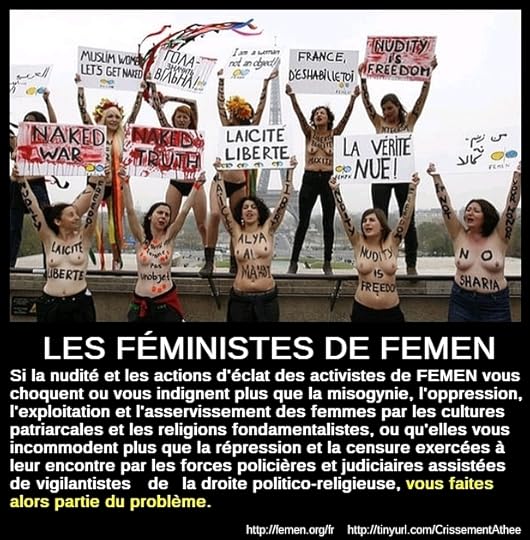
M'a permis de m'ouvrir l'esprit au sujet des femen qui pour moi ternissaient l'image du féminisme, beaucoup d'informations intéressantes sur le mouvement et la leader Inna Shevchenko.
There is much to like in this book, especially for someone like me. In the Femen, I find an antidote to the two kinds of "feminism" that have made me feel tired and outcast for over a decade now; reading this book makes me feel less alone.
On the one hand, seeing women take the to the streets, risking arrest, imprisonment, deportation, the loss of a home country and, in the Civitas action, a beating by fascists, is a really nice alternative to the bullshit "feminist theory" that I was subjected to all through grad school by people, some men and some women, who suggested that I was not a real feminist, or even a real women, because I hadn't read enough Irigiray. So, you know, fuck that. Conditions in the academy in the US for tenured professors do not stand up to those for prostitutes in the Ukraine, and a little reminder of this every now and then would not go amiss. The more-feminist-than-thou members of this site (oh noes! I've read less than 50% books by women, and now I feel so BAD about it, though I'm still way better than YOU!) could learn a thing or two from the Femen as well.
On the other hand, we've got the psuedo-engaged bobos from an american "left" gone completely off the rails, whose new thing is to run around telling me I'm a bigot for daring to suggest that religion might be bad for women, bad for gay people, bad for science, bad for a free society. Who don't understand the difference between respecting someone's rights and respecting someone's opinion. Who refuse to concede that some opinions are better than others, that some are stupid, that some are wrong, that some are dangerous and damaging and who, if you say these things to them, public shame you. Seriously. Bigot was the word used, twice, in front of an audience. So, you know, fuck that, too. Because apparently it's really really REALLY important to respect everyone's opinion EXCEPT mine. This book is a nice change from that, as well.
Given these options, I think I'll go with the Femen, bare breasts or no bare breasts. Indeed, there was a where-have-you-been-all-my-life feeling to reading this book.
There are a few annoying things as well, as with any book. I am not a huge fan of the author's constant instrusions. She discusses this early on, saying that while many journalists say you need to keep your distance from a subject, she thinks you should get close, get involved even. I think that she is probably right, or at least, she's not wrong about this. It's just that I wish she would spend a whole lot less time describing her involvement, which takes the form of a skit of pseudo-humilty rife with name-dropping. After she was beaten by the civitas guys (which, ok, I am too big a pussy to risk anything even approaching that, so good on her) there is the disclaimer, oh, don't worry about me, I'm only there to film, I'm only there in support. Expcet that of course because I am so famous and they recognized me, and then of course everyone was talking about me on twitter, and then Manuel Valls called me (we're friends from this other thing I did, did I tell you?) and he phoned the president, and then the PRESIDENT called me, so totally not my fault it just happened, and he asked if I was ok and I said, just don't you worry about me M. le Président, just you keep on fighting for gay rights, which would all be a lot more humble if it, you know, ACTUALLY took place back stage instead of forming the material for several pages all about Caroline Fourest and how modest she is.
On the whole I lean towards four stars, with that last star docked for star fucking and narcissistic tendencies.
UPDATE: Ugh, make that two stars. There is WAAAAAAAAAAY too much Carolie Fourest in this book.
Très différent de ses autres bouquins, sans notes de bas de page, sans grande révélation inattendue. Juste une histoire racontée, assez touchante. Pas du tout ce que j'attendais, mais bien.