'Even in the stillness of that dead-cold weather, I had heard no sound of little battering hands upon the window-glass...' A phantom child roams the Northumberland moors, while a host of fairytale characters gone to seed gather in the dark, dark woods in these two surprising tales of the uncanny from the great Victorian novelist. Introducing Little Black 80 books for Penguin's 80th birthday. Little Black Classics celebrate the huge range and diversity of Penguin Classics, with books from around the world and across many centuries. They take us from a balloon ride over Victorian London to a garden of blossom in Japan, from Tierra del Fuego to 16th-century California and the Russian steppe. Here are stories lyrical and savage; poems epic and intimate; essays satirical and inspirational; and ideas that have shaped the lives of millions. Elizabeth Gaskell (1810-1865). Gaskell's works available in Penguin Classics are Cranford , Cranford and Cousin Phillis , Gothic Tales , Mary Barton , North and South , Ruth , Sylvia's Lovers , The Life of Charlotte Brontë and Wives and Daughters.
Elizabeth Cleghorn Gaskell, née Stevenson (29 September 1810 – 12 November 1865), often referred to simply as Mrs. Gaskell, was an English novelist and short story writer during the Victorian era. Her novels offer a detailed portrait of the lives of many strata of society, including the very poor, and as such are of interest to social historians as well as lovers of literature.
Bravo, Miss Gaskell. What an intriguing, and very Victorian, ghost tale. I love the descriptions of the massive old house and the cliche of the locked East Wing.
The great, old rambling house was a famous place for little Miss Rosamond. She made expeditions all over it, with me at her heels; all, except the east wing, which was never opened, and whither we never thought of going.
I think every manor house must have had one wing that was locked, don't you?. I'd like to research and find the first instance in literature, so I could tip my hat respectfully to the man/woman who invented the device.
I never give away the plot of a good short-story...so go read this one for yourself and have a lovely tour of Furnivall Manor House.
This is exactly why I bought this collection: to find authors I may not have normally come across. I love Gaskell’s style of writing, and I will most certainly be reading more of her work in the future. These two stories are everything I adore in Victorian literature; they are gothic and fear evoking, but they are also approached from a realism angle. I think this is great because it creates a sense of the paranormal in a plain boring world.
Indeed, The Old Nurses Story is an elderly lady narrating her haunting experience with her former mistress to the said mistress’ children. She really takes her time with the tale and creates a large amount of suspense, as she reels the listeners in with her story. The house she is staying is haunted, and the residents deny the paranormal presence that is clearly evident. No doubt a denial brought out by a sense of guilt and a lack of admittance that something like this could actually occur in Victorian England.
“‘She won’t let me open the door for my little girl to come in; and she’ll die if she is out on the Fells all night. Cruel, naughty Hester,’ she said, slapping me; but she might have struck harder, for I had seen a look of ghastly terror on Dorothy’s face, which made my very blood run cold.”
It’s a perfect little horror story. One that drags children out of their beds in the night as they practically recreate the death of the ghost that roams the snowy darkness. In the process they try to save her, but almost join her in her perpetual agony in the cold night. The tale is a scary thing to tell children, so I’m not entirely sure why the Old Nurse is doing so. Surely, she would want to let the minds of the children rest on happier things before bed? Nonetheless I enjoyed, even if those children probably hated it.
I think this is a great edition in the collection. However, the second story lacked the captivating feel of the first; thus, my rating reflects only the first tale. I think it’s time to buy the full collection of Gaskell’s Gothic tales.
Penguin Little Black Classic- 39
The Little Black Classic Collection by penguin looks like it contains lots of hidden gems. I couldn’t help it; they looked so good that I went and bought them all. I shall post a short review after reading each one. No doubt it will take me several months to get through all of them! Hopefully I will find some classic authors, from across the ages, that I may not have come across had I not bought this collection.
What a great story to read while sitting on my couch, looking out my picture window at the snow on the ground. Of course we only have a few inches left from the other day but it was enough to provide atmosphere. This book contains everything I think of when I think spooky, not outright scary but spooky. An old house, two old women, tragedy in the past, secrets, strange sounds and a young child in peril. But from what? One cold snow covered night it all comes to a head and at last all secrets are exposed. Just a wonderfully gothic story and I loved every minute of it.
The Victorian writer Elizabeth Gaskell was invariably known as “Mrs Gaskell” (the name she was published under) until the mid 20th century. We remember her now mostly for her novels. Her first novel Mary Barton in 1848, and especially North and South in 1855 have become classics. Other novels of hers too are noted for their realistic and socially conscious portrayals of inequality and industrial conflict, as well as the author’s keen interest in moral and social issues. They contain detailed depictions of Victorian society, especially the lives of the poor and working classes. Unusually for the time, Elizabeth Gaskell showed great empathy when portraying working‑class characters. It is not surprising then, that she came to the notice of the great Charles Dickens.
However, as well as these solid novels, full of social realism, she also wrote some light, humorous works such as Cranford—and quite a few supernatural tales! Charles Dickens was equally enthusiastic about all her early works, as their concerns were close to his heart. He published her stories in his own magazine “Household Words”, and her first novels also had their first airing as serials there.
In 1852, Charles Dickens asked Elizabeth Gaskell to write a supernatural story for his first Extra Christmas Number of “Household Words”. She came up with The Old Nurse’s Story, which he said was: “a very fine ghost story indeed. Nobly told and wonderfully managed.”. In her subsequent ghost stories and shorter fiction, Elizabeth Gaskell continued to blend gothic atmosphere with moral reflection, and it is the realism which makes this supernatural story so poignant. One critic has said that
“Her supernatural stories are superior examples of the sentimental ghost tale so typical of the Victorian period, while her Gothic stories combine a taste for the macabre with a deeply felt sympathy for the extremes of female experience.”
Certainly the fact that this story is centred around a vulnerable child would have made it particularly appealing to her female readers. The “possession” is not supernatural in this case! We have words such as “my bright and pretty pet” as well as “I would carry my darling back to my father’s house[…]” Two female characters both display possessive instincts towards their respective wards, . The role of the child in this story, and thus in Victorian society, is carefully explored.
We also see Elizabeth Gaskell challenge social mores. Her narrator is not a middle or upper class man as we might expect, but a working class woman in a menial position. The story features an intolerant tyrant; the head of a family with unparalleled rights to dictate the actions of others. He is male of course, and his authority is compounded because he is an aristocrat. Therefore he has total rights over both his employees, his ward, and other family members—regardless of any emotional closeness.
Thus the wider relationships demonstrate the absolute dominance of the male at this time. Dorothy, a house servant, says that Hester, a nurse could not take a child away with her: “for that she was [Lord Furnivall’s] ward, and she had no right over her.”
Even though this is a supernatural story, Elizabeth Gaskell still has a keen eye for social injustices, and the powerlessness of women.
The best gothic stories have a slow buildup, and her extended use of long, flowing, multi‑clause sentences enables this, coupled with the leisurely pace of the plot. Elizabeth Gaskell had a natural gift for storytelling, including anecdotal digressions and interpolated tales.
Here we have one such. The Old Nurse’s Story (sometimes called simply “The Nurse’s Story”) is a framed narrative where an elderly nurse, Hester, is telling a story to her mistress Rosamond’s children. It is a story from her past, when as a young woman, she first became Miss Rosamond’s nurse, and is about a terrifying haunting which they both experienced. So not only do we have a female‑centred narrative, but—unusually for mid‑Victorian ghost stories—the narrator is a working‑class woman, and the central tragedy concerns women’s lives and choices.
Hester's tale was set during the winter when she was nearly 18.
“You know, my dears, that your mother was an orphan and an only child, and I dare say you have heard that your grandfather was a clergyman up in Westmoreland, where I come from.”
After some familial history and preamble, we learn that Hester has become the nurse of a young child, but then both of the child’s parents tragically die. Hester swears to take care of young Miss Rosamond “to the end of the world”. Since she is now left in sole charge of the tiny child, who is offered a home by a distant relative, Hester accompanies her.
Furnivall Manor is a decaying Northumberland mansion, which belongs to the extremely wealthy and aristocratic Furnivall family. Hester describes the mansion, saying:
“in the green gloom, we could manage to see old china jars and carved ivory boxes, and great heavy books, and, above all, the old pictures.”
One of these pictures shows a beautiful young woman, but another curiously has its face turned to the wall. And:
“As winter drew on, and the days grew shorter, I was sometimes almost certain that I heard a noise as if someone was playing on the great organ in the hall.”
Already we see the tropes common to ghost stories from this period. (Of course the fact that we recognise them as such, is partly due to Elizabeth Gaskell and other—often female—sensational authors reinforcing them.) Furnivall Manor is a crumbling old mansion which is cold, dark and lonely. As we read on we find it is ruled by two stern and inhospitable old women: the elderly Miss Furnivall and her companion, Mrs Stark. They have a dark secret. There is a complicated back history of the family with a tyrannical father and two beautiful but haughty daughters. There is also a strange foreigner who enters their lives. Hester does not know what to make of this, and wants to know more, but Miss Furnivall does not want to tell her. Eventually Hester elicits it from a reluctant servant, Dorothy.
The weather is often stormy, and the house is filled with ominous sounds, especially organ music which swells and thunders through the pipes, After a while the snow settles, but tiny footprints can be seen outside in the freezing cold, leading up the fell— .
Experiencing the eerie events through Hester’s narration intensifies the horror, as she guides us through the mysteries of the story. She is caring for a young innocent child, but to her horror
The violence and division amongst the family is what haunts the home; the jealous tension which had driven the family apart.
At the end of the story, in a dramatic tableau,
Incidentally, Elizabeth Gaskell usually set her stories in places she knew well. Living in Manchester, it is a relatively short journey across England to the Lake District. Not as easy then of course, but she was a seasoned traveller and chose the looming Fells as a good setting. The “grand and terrible” sound of the pipe-organ echoing through the mansion was based on Crossthwaite church organ at St. Kentigern’s Church (Crosthwaite Parish Church) on the outskirts of Keswick, Cumbria. The organ was originally built in 1837 by Bishops of London, and must have impressed her greatly.
Mrs. Elizabeth Gaskell and Mr. Charles Dickens had a fraught relationship, despite Elizabeth Gaskell’s writing for Dickens’s journal for many years. Dickens famously compressed much of Gaskell’s writing against her wishes, meaning that much of her writing has gone down in history as tainted by his editing methods. When she objected he called her “intractable” for attempting to resist his changes. They finally split irrevocably over his heavy editing of North and South, and the version we read now is one in which she reinstated some of his cuts.
The Old Nurse’s Story was first published, as mentioned, in 1852, while their relationship was still relatively sweet. Charles Dickens called this extra Christmas edition a: “Round of Stories by the Christmas Fire”. We do not know what changes Elizabeth Gaskell agreed to let go ahead, but she did insist that one part should remain as she wrote it.
The Old Nurse’s Story is one of Elizabeth Gaskell’s best gothic tales, and is moreover, I feel, one of the best stories of its type, blending atmosphere, moral warning, and social critique involving complex familial relationships, with a riveting ghost story. It was to became one of the most popular and most reprinted of all Victorian ghost stories, and one critic says: “it set the standard in the field for the next 50 years”.
Elizabeth Gaskell creates superb Gothic atmosphere, with recurring supernatural visitations. We also have a moral reckoning: the haunting is a punishment for past cruelty. The story lives on as one of these famous Victorian hauntings, and a perfect example of stories in which ‘the sins of the fathers are visited on their children’. Guilt, jealousy, secrets, insanity, shame and revenge are all there, amplified by heavy winter storms. There is continuing harsh harsh weather in an unforgiving Northern landscape, whilst our attention is focused on a decaying isolated mansion, complete with its locked up and inaccessible East Wing. Increasingly weird disturbances unfold through a cruel aristocratic master, a self-righteous and proud lady, an exotic stranger, and innocent victims. Strange music, a mysterious organ, and the apparition of a weeping child and a stern woman gradually reveal a buried family tragedy.
It’s a perfect story to read by a cosy fire on a winter day … but not, perhaps, after nightfall.
Here is a short story written by Elizabeth Gaskell that is eerie and unsettling. Think of it as being atmospheric. The setting is an old English manor on the fells of northern England where “strange” things occur. In this tale, the eponymous old nurse speaks of the listener’s mother whom she cared for as a child.
We observe two sisters who loved the same man. Their behavior toward each other and their emotions is what the story is about.
Was I scared listening to this? No, not really. How the story is told IS however atmospheric, and it is this that makes it good. I am glad to have read it, even though it does not give a reader a whole lot to think about.
Read it. Enjoy it. Put it down and then you will forget it, buried under what you have read more recently.
Samantha Bond narrates the audio version I listened to. She sounds like an old nurse and for this reason I think the narration is worth four stars. I am glad she does not overdramatize.
Hester, the old nurse, is a good storyteller. I have a fondness for Gothic stories, and "The Old Nurse's Story" has all the elements--a mansion with closed rooms, isolation, family secrets, scary sounds, ghosts, and dangerous winter storms. Jealousy led to youthful mistakes that were later regretted.
"There are little things which are necessary from time to time in friendship; and five or six blows with a sword between people who love each over can only revive their affection." - Elizabeth Gaskell, "Curious, if True"
Vol N° 39 of my Penguin Little Black Classics Box Set. This book contains two of Elizabeth Gaskell's gothic, Victorian short-stories.
Included were:
1. "The Old Nurse's Story" - ★★★★ 2. "Curious, If True" - ★★★
"The Old Nurse's Story" first appeared in print in Charles Dicken's magazine Household Words in 1852. "Curious, If True" first appeared in print in William Thackery's Cornhill Magazine in 1862. I've never actually read Gaskell before, so it was a treat. She reminds me of combination of Dickens and Austen. I need to read more of her Gothic Tales and her social novel North and South to bettter appreciate her work.
I enjoyed the story, even if it's super cliched (or is it? since it's so old?); however everything was predictable. Still, it was a well written piece and another good read for the autumn season.
Definitivamente me quedo hasta ahora con "La bruja Lois" en cuanto a sus cuentos góticos que he leído hasta ahora. Este cuento aparte de predecible (que para mí no es un gran asunto tampoco) me pareció que no ahondó en la parte que debió hacerlo, sobre todo cuando se esclarece el misterio y cuál es la culpa de una de las habitantes de la casa. Quizás haber alargado un poco más ese flashback para justificar todo lo malo que vino después. Y por otro lado en cuanto a historias de miedo no soy tan experto, sí reconozco y por eso le pongo 3 estrellas que en un momento la tensión es muy fuerte y uno está a la expectativa de que algo más terrible pueda pasar. La historia es narrada en primera persona por una niñera que luego que su protegida (Rosamunda, me pareció gracioso su coincidencia con una personaje de "Villette") se quedó huérfana es "obligada" a vivir con unos parientes de la madre de la niña los Furnivall en un lugar muy lejano: los páramos de Cumberland. Y ahí es donde empiezan a pasar unas situaciones muy extrañas que tienen que ver con fantasmas de los cuales los habitantes de la casa, que rápidamente se encariñan con la pequeña Rosamunda y su niñera - parecen no sorprenderse demasiado. Otra cosa que me llamó la atención es que veo un patrón de "terror" en sus cuentos y es que sus motivaciones suelen ser bastante románticas, es decir las explicaciones de los fenómenos que llegan a ser la causa del miedo en sus cuentos.
Jest to książka, z którą warto się zapoznać, jeśli jesteście miłośnikami twórczości tej autorki, jednak mnie nie zachwyciła niczym szczególnym. Natomiast cieszę się, że mogłam zetknąć się z oryginalnym językiem i stylem Gaskell.
This book was read for the #readwomen month. Read this book and other stories for free on Project Gutenberg I have read some Gaskell before, but it was novels, this collection of her short stories has opened my eyes to how much more I actually enjoy her stories compared to her novels. This was scary, I was not expecting that, what a little surprise, the ending was the best!
What a brilliant introduction to Elizabeth Gaskell's writing this was! This Little Black Classic features two dark and eerie tales: one is everything you could possibly want from a Victorian gothic ghost story, while in the second story a traveller meets characters from familiar fairy-tales.
I'm surprised I haven't come across Elizabeth Gaskell before now. She was an English novelist who lived in the 19th century and mainly explored Victorian society and social structures in her writings. Her life was actually very interesting, with many ups and downs. She started writing her first novel in order to cope with the grief inflicted by her son's death for example and her social circles included people like Charles Dickens and John Ruskin.
Now The Old Nurse's Story is a dark and satisfyingly creepy tale told from the perspective of a nurse who is looking after the orphaned Miss Rosamond living at her aunts mansion. The more time she spends at the house, the more weird things she starts to notice: she can hear organ music when no one seems to be playing and the members of the family clearly seem to hide something...
"The windows were darkened by the sweeping boughs of the trees, and the ivy which had overgrown them..."
The Old Nurse's Story tells the story of jealousy and the irrevocableness of human actions. It is one of the best Little Black Classics I have read so far and it made me excited to read more of Elizabeth Gaskell's work!
In 2015 Penguin introduced the Little Black Classics series to celebrate Penguin's 80th birthday. Including little stories from "around the world and across many centuries" as the publisher describes, I have been intrigued to read those for a long time, before finally having started. I hope to sooner or later read and review all of them!
A ghost story set in an old mansion with a locked and forbidden east wing, an old spinster with a dead sister whose portrait is turned to the wall, organ music rings out on winter nights and a ghostly little girl that calls to young Rosamund. Great atmosphere.
I really need to read more of the work of Elizabeth Gaskell, her writing is quite fluid, sparking the imagination in interesting ways. Having never encountered anything like this before I was spellbound. Her wording is such that each scene was presented to the minds eye beautifully, she is without the shadow of a doubt the master of her craft. Gothic ghost stories that are up there with the best.
“As winter drew on, and the days grew shorter, I was sometimes almost certain that I heard a noise as if someone was playing on the great organ in the hall.”
Two pure-hearted innocents find themselves in the huge gothic estate of a very troubled family, and a struggle of spirits ensues. What more could you want in a good old-fashioned ghost story?
Βικτωριανή γοτθική ιστορία φαντασμάτων που υπογράφει η Ελίζαμπεθ Γκάσκελ στην οποία χρωστάμε μεταξύ άλλων τα αγαπημένα Βορράς και Νότος και Σύζυγοι και θυγατέρες, ε, είναι must read για την περίοδο του Halloween. Η αλήθεια είναι πως δεν έχω εμβαθύνει στο λογοτεχνικό αυτό είδος γιατί δε συγκαταλέγεται σε αυτά που συνήθως προτιμώ, αλλά το διήγημα αυτό μπορώ να πως πως ξεχωρίζει μεταξύ αυτών που έχω διαβάσει, όχι τόσο χάρη στην πλοκή του, η οποία θα μπορούσε να πει κανείς πως είναι προβλέψιμη, όσο χάρη στην πένα της Γκάσκελ και στην ατμόσφαιρα που καταφέρνει να δημιουργήσει.
Μια γκουβερνάντα αφηγείται σε πρώτο πρόσωπο την στοιχειωμένη αυτή ιστορία. Όταν η μικρή προστατευόμενή της μένει ορφανή αναγκάζονται να συζήσουν με συγγενείς από την πλευρά της μητέρας του παιδιού σε ένα πολύ μακρινό από τη βάση τους μέρος όπου λαμβάνουν χώρα παράξενα περιστατικά. Οι ένοικοι του σπιτιού, οι οποίοι επιφυλάσσουν θερμή υποδοχή στη μικρή συγγενή τους και την γκουβερνάντα της, δε φαίνεται να ξαφνιάζονται από την παρουσία φαντασμάτων. Τα περισσότερα συστατικά της γοτθικής λογοτεχνίας εμπεριέχονται στη μικρή αυτή ιστορία: ένα παλιό, απομονωμένο και ακατοίκητο σπίτι, τρομακτικές καταιγίδες, μυστηριώδεις ήχοι, απόκοσμη ατμόσφαιρα και ένα μεγάλο αίνιγμα. Η λύση του μυστηρίου με την οποία ολοκληρώνεται η ιστορία αποδίδεται σε ρομαντικά αίτια, κάτι στο οποίο μας έχει συνηθίσει η Γκάσκελ.
A short story perfect for Halloween and the end of the year, with a harsh noble family, moral principles, too many principles ! And a lovely child, and caring servants. I was surprised by the violence in here, but well, if you've already read Dickens and the likes, you won't be. Anyways, very good short story, very good storyteller (I love you, Elizabeth Gaskell !), short and well written.
"The Old Nurse's Story," the title story, is a fine Victorian ghost story. A story which seats us cozily in the nursery among the charges of a comfortable old nanny, who begins with "You know, my dears, that your mother was an orphan and an only child...," and who goes on to tell a tale of the deliciously gothic goings on in the spooky old mansion where she and "our mother" once lived, is perfect reading for a cold January night. No surprises here, but Gaskell knows how to work the conventions to create a thoroughly satisfying ghost story. The second story, "Curious but True," didn't work for me at all, though. It just seemed pointless and silly. Perhaps when she wrote it (it was published in 1860), the gimmick was a novel one? In that case I'd probably revise my rating. I'm "averaging" the stars here, with 3 1/2 to the "Old Nurse" and 1 to "Curious." Okay, not technically averaging, but that's what I'm giving to this one, Number 39 in Penguin's Little Black Classics series
I bought the whole collection of Little Black Classics not only because they look so pretty on my shelves, but also because I was hoping to read some authors which I had never heard of but were pretty great. Elizabeth Gaskell was of those.
This collection contains two short stories which portray her nice writing style. The first is the titular story and it has this Victorian vibes all over. And considering this was the old nurse's story - I would certainly hope she was not telling this to little children.
Creepy Victorian story about sisters behaving badly. I read this a second time just a few days ago and it was more even more effective. It has all the elements of a great ghost story, but I am always especially disturbed when there is a child victim. It was a story of great cruelty, in fact. As it took place mostly over Christmas and New Year's, it's also perfect for a holiday read!
Here is a link to a New Yorker article about the author. I hope to read more works by her some day. https://www.newyorker.com/books. She appears to be a largely-overlooked Victorian author.
“Alas! alas! what is done in youth can never be undone in age!" Elizabeth Gaskell’s “The Old Nurse's Story” (1852) is a classic that stands out among the countless others of its genre in the Victorian era.
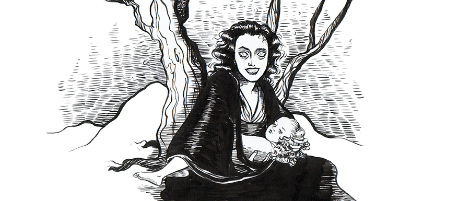
Hester, now an old nurse, tells the tale to the two young children of Rosamund, for whom Hester also served as a nursemaid many years before. Rosamund was five when her parents died, and Hester devoted herself to caring for the orphan at the girl’s mother’s family’s estate in Northumberland. The mansion is enormous and gloomy, the relatives living there are “stony” and unapproachable, the pipe organ plays on its own when a harsh wind howls. On wintry days the ghost of a bruised young girl (“bairn”) is seen outside, either roving about the moor or banging frantically, though soundlessly, at the library’s tall window.
This is a story of cruelty and vulnerability in consequence of pride and vanity. The young Rosamund is lured by the mansion’s spirits, who we learn are her long-dead relatives, bitterly resentful over what transpired in their pasts. Barely watched one day while Hester is in town, Rosamund is beckoned by the specter girl into a blizzard and up to a grove of holly trees. After that, Hester grows determined to save the girl from these vengeful apparitions by taking her away from the house, but she’s vulnerable too in the way she’s shackled to the constraints of a lower class.
Gaskell is masterful in telling the story and has a very distinct and effective style. It’s as if we’re Rosamund’s children sitting with Hester on a cold, damp night by a warm, crackling fire. Her story also conveys the message that the abuses and negligence of the past will echo forward, that their ramifications on the present can be inescapable.