

What do you think?

Jesus the Wicked Priest: How Christianity Was Born of an Essene Schism
Decodes the Dead Sea Scrolls to reveal Christianity's hidden Essene origins
-- Reveals the Essenes as key figures behind Jesus's trial, torture, and crucifixion
-- Shows how Jesus, a former Essene himself, was deemed "the Wicked Priest" for his liberationist politics and humanist bent
-- Examines the lost Christian doctrine of reincarnation and the secret role of Gabriel in the Virgin Birth
The Dead Sea Scrolls, discovered in 1947 at Qumran, are generally believed to have been written by a Jewish sect known as the Essenes between 350 BCE and 70 CE--but until now no convincing methodology has linked the Scrolls to the actual life and teachings of Jesus. Marvin Vining builds from the controversial work of Barbara Thiering to demonstrate that the Scrolls do speak directly to the origins of Christianity and even reflect a mirror image of the Gospels from the perspective of Jesus's enemies.
Christianity arose out of a schism between the exclusivist, rigid, and militant views of the Essenes and the inclusivist, tolerant, and nonviolent views of Jesus. Jesus was raised an Essene, but he refused to follow their orthodoxy. Vining shows that the Dead Sea Scrolls are written in a secret coded language called pesher in which Jesus emerges as the Wicked Priest, the antagonist to the Teacher of Righteousness who was the leader of the Essenes. Jesus the Wicked Priest revitalizes the Gospel message by revealing Jesus's true role as a tireless social reformer and revolutionary teacher. Vining's study reopens Christian doctrinal questions supposedly long settled, such as reincarnation and the Virgin birth--even demonstrating that these two issues are related. He discloses that the angel Gabriel was incarnate in a living human being and transmitted the seed of a holy bloodline to the Virgin Mary.
-- Reveals the Essenes as key figures behind Jesus's trial, torture, and crucifixion
-- Shows how Jesus, a former Essene himself, was deemed "the Wicked Priest" for his liberationist politics and humanist bent
-- Examines the lost Christian doctrine of reincarnation and the secret role of Gabriel in the Virgin Birth
The Dead Sea Scrolls, discovered in 1947 at Qumran, are generally believed to have been written by a Jewish sect known as the Essenes between 350 BCE and 70 CE--but until now no convincing methodology has linked the Scrolls to the actual life and teachings of Jesus. Marvin Vining builds from the controversial work of Barbara Thiering to demonstrate that the Scrolls do speak directly to the origins of Christianity and even reflect a mirror image of the Gospels from the perspective of Jesus's enemies.
Christianity arose out of a schism between the exclusivist, rigid, and militant views of the Essenes and the inclusivist, tolerant, and nonviolent views of Jesus. Jesus was raised an Essene, but he refused to follow their orthodoxy. Vining shows that the Dead Sea Scrolls are written in a secret coded language called pesher in which Jesus emerges as the Wicked Priest, the antagonist to the Teacher of Righteousness who was the leader of the Essenes. Jesus the Wicked Priest revitalizes the Gospel message by revealing Jesus's true role as a tireless social reformer and revolutionary teacher. Vining's study reopens Christian doctrinal questions supposedly long settled, such as reincarnation and the Virgin birth--even demonstrating that these two issues are related. He discloses that the angel Gabriel was incarnate in a living human being and transmitted the seed of a holy bloodline to the Virgin Mary.
- GenresReligionSpirituality
256 pages, Paperback
First published March 27, 2008
Ratings & Reviews
Friends & Following
Create a free account to discover what your friends think of this book!
Community Reviews
Displaying 1 - 4 of 4 reviews

won-t-even-start-it
April 20, 2019The title's so horrible. If the author can't distinguish between a 'wicked priest' (such as ones who would play unfortunate games with altar boys) and a religious leader (not always a priest) who would participate (or lead) a religious schism which is a normal trend in any developing religion.... than one would be too gullible to believe that the only thingy the author got wrong in this book, is its title.
The Judaism-Christianity schism was always on the plate, did anyone think Christianity isn't a schism from the Judaic religion? If so, said people need to learn their history, pronto. (Yep, I've always been extra leery of Christians and Jews openly dismissing each other religions. It's eyeball-roll inducing, since both have a lot more in common than otherwise.)
A very early DNF.
The Judaism-Christianity schism was always on the plate, did anyone think Christianity isn't a schism from the Judaic religion? If so, said people need to learn their history, pronto. (Yep, I've always been extra leery of Christians and Jews openly dismissing each other religions. It's eyeball-roll inducing, since both have a lot more in common than otherwise.)
A very early DNF.

April 14, 2019
"The Essenes were to Jesus as the Sophists were to Socrates, ...as the medieval Catholics were to Luther. They were his dialectical baptism by fire"
"Although Thiering and I differ on lot of details such as the identification of the Righteous Teacher or the extent of Jesus's break with the Essenes, I am much in agreement with her overall views".
Marvin Vining
"Dr. Thiering is an intelligent and persuasive lady, but her theories about the Scrolls lead her into absurdities. In fact the New Testament says nothing direct at all about the Essene movement, and the Dead Sea Scrolls tell us nothing direct at all about Christianity."
Dr. C.B. Forbes, Department of Ancient History, Macquarie University.
This is certainly a book with hard questions, both for Christians and Jews. It traces the emergence of Christianity back to a unique sect of believers: the Essenes. Thus, one first question to start with: Did Jesus himself lead an Essenian schism?
Vining's search and argumentation are based mainly on the Dead Sea Scrolls (but not exclusively, of course). He believes in a "complex relationship " between Jesus and the Essenes. Don't get surprised or alarmed when you read Marvin Vining saying about the "real Jesus": "Unlike the Essenes, Jesus was not an ascetic. Far from it, as Charlesworth puts it: "Jesus loved a good party" (cf Jn 2 1-11). Jesus drank hard wine. He was even called a glutton and a drunkard (Mathew 11:19)".
Vining believes Jesus half-brother James was an Essene, so was John the Baptist. The Dead Sea Scrolls had a Zoroastrian influence. As a teacher, Jesus began with the Essenes. They believed in reincarnation. Therefore, Vining shows his utter surprise as why Christianity is, among the great religions, the single one which doesn't admit the reincarnation idea.
The author is a Christian man, one who hopes for a better understanding between Jews and Christians, despite his daring thesis. One which took him 14 years to write down.
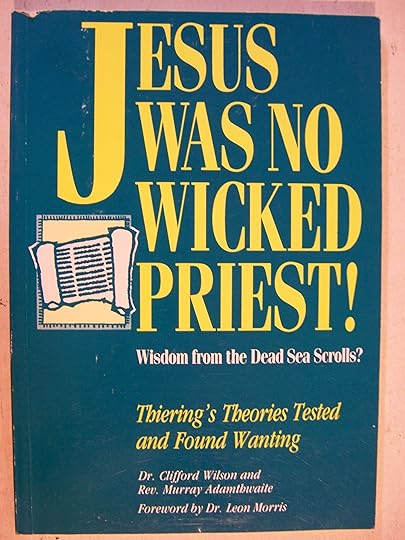
I do not agree with some of the author's assertions. Starting with title of the book which is quite unfortunate. It collides with the hopes of Vining. Then there's the role of (an incarnated) Gabriel in the Virgin birth, just preposterous, to say the least.
Was Jesus an Essene? Some really doubt about that:
If Vining wants to "redefine" the Christian faith (as he wrote), he's got into trouble.
On September 14th, 1992, Time magazine published an article by Richard N. Ostling titled "Is Jesus in the Dead Sea Scrolls?". In the article Ostling seemed encouraged to affirm the connection between the old texts found in old Qumran and the origins of Christianity. But he also quoted a polemic author, Barbara Thiering, who also got inspiration from the scrolls "...of Australia's University of Sydney [she] tells us of a Jesus who was crucified but secretly revived at the Dea Sea and who wed a woman bishop at midnight on March 17, A.D. 50".
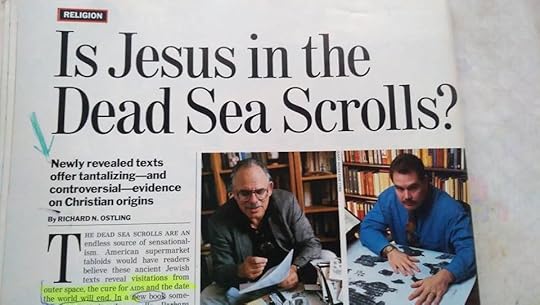

(Barbara Thiering)
In fact, Vining too, often quotes Thiering in his book. But sometimes hypotheses go too far....like imagination itself. I think both Thiering and Vining went too far.
Mind you, I am not discarding the validity of the old texts, rather questioning their interpretation, or as Geza Vermes (in the above article) says: "my concern is simply to find out what this text means". I would add: "what this text REALLY means". Some of the texts are not complete (or, are fragmented) and demand interpolation and extrapolation. And translations sometimes are not consensual. So, aren't interpretations.
Then, who is (was) the Teacher of Righteousness? Vining identifies him with Gabriel incarnate. Yet, there are other views. In the Time article above mentioned, a scholar named Robert Eisenman of the California State-Long Beach shows a different view; he believes the Teacher of Righteousness was James, the New testament "brother of Jesus" and a martyr of the Jerusalem church. Eisenman affirms also that the James' Qumran faction was "aggressive, apocalyptic, nationalist, messianic and violent. Very violent". This faction was opposed by the Apostle Paul and his Hellenized movement, "which rejected Jewish law and was otherworldly, cosmopolitan and forgiving". Another scholar cited in the article is Michael Wise of the University of Chicago. Michael and Eisenman seem to agree on that certain passages [of text 4QS21] of the Dead Sea Scrolls resemble the words of Jesus (in Luke 4). Other texts [4Q28S] seem to announce the coming of a Messiah (from the stump of Jesse the branch of David), just like Isaiah (11:1-4) wrote .
The debate is meant to start, ...even if only in the minds and hearts of the readers.
4 stars for the historical search effort.
"Although Thiering and I differ on lot of details such as the identification of the Righteous Teacher or the extent of Jesus's break with the Essenes, I am much in agreement with her overall views".
Marvin Vining
"Dr. Thiering is an intelligent and persuasive lady, but her theories about the Scrolls lead her into absurdities. In fact the New Testament says nothing direct at all about the Essene movement, and the Dead Sea Scrolls tell us nothing direct at all about Christianity."
Dr. C.B. Forbes, Department of Ancient History, Macquarie University.
This is certainly a book with hard questions, both for Christians and Jews. It traces the emergence of Christianity back to a unique sect of believers: the Essenes. Thus, one first question to start with: Did Jesus himself lead an Essenian schism?
Vining's search and argumentation are based mainly on the Dead Sea Scrolls (but not exclusively, of course). He believes in a "complex relationship " between Jesus and the Essenes. Don't get surprised or alarmed when you read Marvin Vining saying about the "real Jesus": "Unlike the Essenes, Jesus was not an ascetic. Far from it, as Charlesworth puts it: "Jesus loved a good party" (cf Jn 2 1-11). Jesus drank hard wine. He was even called a glutton and a drunkard (Mathew 11:19)".
Vining believes Jesus half-brother James was an Essene, so was John the Baptist. The Dead Sea Scrolls had a Zoroastrian influence. As a teacher, Jesus began with the Essenes. They believed in reincarnation. Therefore, Vining shows his utter surprise as why Christianity is, among the great religions, the single one which doesn't admit the reincarnation idea.
The author is a Christian man, one who hopes for a better understanding between Jews and Christians, despite his daring thesis. One which took him 14 years to write down.
I do not agree with some of the author's assertions. Starting with title of the book which is quite unfortunate. It collides with the hopes of Vining. Then there's the role of (an incarnated) Gabriel in the Virgin birth, just preposterous, to say the least.
Was Jesus an Essene? Some really doubt about that:
"Thus, while Jesus doubtless shared the common Jewish attachment to the Torah, we have no evidence that he cared for the sort of supererogatory piety of the Essenes, nor the application of purity laws to life outside the Temple that appears in varying degrees to have preoccupied the Pharisees. The fact that Jesus preached openly to the Jewish crowds, moreover, is contrary to the Essene secrecy evident in the sectarian DSS and in Josephus. (...) Jesus might just possibly have had an association with the Essenes before he embarked on his ministry, ceasing to be one of their number when he began to preach and heal."
in: Deciphering the Dead Sea Scrolls, by Ariel David
If Vining wants to "redefine" the Christian faith (as he wrote), he's got into trouble.
On September 14th, 1992, Time magazine published an article by Richard N. Ostling titled "Is Jesus in the Dead Sea Scrolls?". In the article Ostling seemed encouraged to affirm the connection between the old texts found in old Qumran and the origins of Christianity. But he also quoted a polemic author, Barbara Thiering, who also got inspiration from the scrolls "...of Australia's University of Sydney [she] tells us of a Jesus who was crucified but secretly revived at the Dea Sea and who wed a woman bishop at midnight on March 17, A.D. 50".
(Barbara Thiering)
In fact, Vining too, often quotes Thiering in his book. But sometimes hypotheses go too far....like imagination itself. I think both Thiering and Vining went too far.
Mind you, I am not discarding the validity of the old texts, rather questioning their interpretation, or as Geza Vermes (in the above article) says: "my concern is simply to find out what this text means". I would add: "what this text REALLY means". Some of the texts are not complete (or, are fragmented) and demand interpolation and extrapolation. And translations sometimes are not consensual. So, aren't interpretations.
Then, who is (was) the Teacher of Righteousness? Vining identifies him with Gabriel incarnate. Yet, there are other views. In the Time article above mentioned, a scholar named Robert Eisenman of the California State-Long Beach shows a different view; he believes the Teacher of Righteousness was James, the New testament "brother of Jesus" and a martyr of the Jerusalem church. Eisenman affirms also that the James' Qumran faction was "aggressive, apocalyptic, nationalist, messianic and violent. Very violent". This faction was opposed by the Apostle Paul and his Hellenized movement, "which rejected Jewish law and was otherworldly, cosmopolitan and forgiving". Another scholar cited in the article is Michael Wise of the University of Chicago. Michael and Eisenman seem to agree on that certain passages [of text 4QS21] of the Dead Sea Scrolls resemble the words of Jesus (in Luke 4). Other texts [4Q28S] seem to announce the coming of a Messiah (from the stump of Jesse the branch of David), just like Isaiah (11:1-4) wrote .
The debate is meant to start, ...even if only in the minds and hearts of the readers.
4 stars for the historical search effort.

July 8, 2013
The title and cover are a bit unfortunate, since they might scare off people who would otherwise find this work inoffensive and enlightening. That aside, "Jesus the Wicked Priest" is a well-documented and generally well-written account of the author's investigations into the Dead Sea Scrolls and what light they might shed on who Jesus was and how Christianity started.
I've read several books on this and related topics recently, including Eisenman's work. JTWP makes some fascinating, even if not altogether convincing, connections that I haven't seen elsewhere. Certainly not without its shortcomings, JTWP is nonetheless a worthwhile read for the layperson interested in the DSS and early Christianity.
I've read several books on this and related topics recently, including Eisenman's work. JTWP makes some fascinating, even if not altogether convincing, connections that I haven't seen elsewhere. Certainly not without its shortcomings, JTWP is nonetheless a worthwhile read for the layperson interested in the DSS and early Christianity.

July 15, 2012
I thought this book was well researched and well written. I was a little afraid of the title at first i was not sure what he meant by it. But once i started reading it i understood. It made complete sence to me, his thesis was well researched and he presented it in a scientific yet easy way to understand. I certainly recommend JESUS THE WICKED PREIST by Marvin Vining.
Displaying 1 - 4 of 4 reviews