The Tooth-Ache, Imagined by Horace Mayhew, and Realized by George Cruikshank. Rear panel priced "1/6 Plain, 3/-Colored" and this being the colored 24 panel, fan-page edition. Description: small, 24mo format, heavy tan paper boards. One of 5,000 Facsimile copies of Horace Mayhew's uncommon 1849 1st edition, (43 panels).
Horace Mayhew was a playwright, journalist, and writer for Punch, for which he also occasionally served as subeditor to Mark Lemon. He was the younger brother of Henry Mayhew and a friend of Charles Dickens.
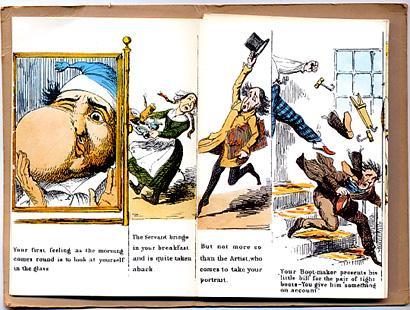
The Tooth-Ache is a tiny little book, which was first published in 1849. It consists of a series of forty five comic cartoons which open out into a concertina, relating the story of one Victorian gentleman’s experience of toothache. The illustrations are hand-coloured, wood engravings with humorous captions, as imagined by Horace Mayhew and realised, in wonderful caricature, by George Cruikshank.
We follow the story as first of all the gentleman is in torment, tossing and turning with the pain of his tooth:
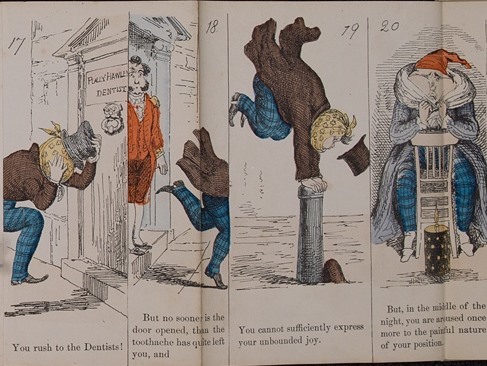
All round him feel his wrath, and he tries various popular remedies such as creosote, and a poultice - in fact “240 infallible cures” in all. But all to no avail. Unbearably miserable at being unable to eat the walnuts and filberts brought by a kind friend, he rushes to the dentist:
As the door opens, the pain magically disappears! He is cured, and “cannot sufficiently express [his] unbounded joy”, leapfrogging a post in delight.
However, this is premature, as the toothache returns in the night.
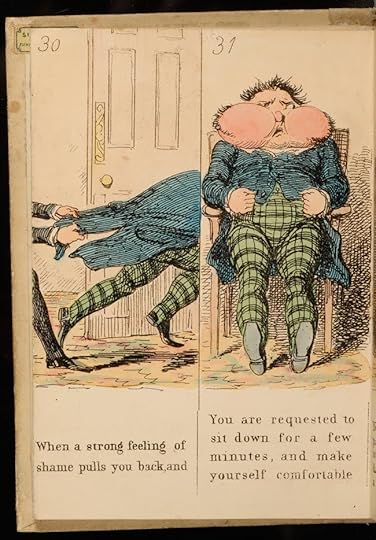
Next morning the gentleman tries more extreme remedies but still his toothache rages on. Finally he decides he must return to the dentist, and sits in the waiting room surrounded by what appear to be strange instruments of torture … and interesting reading material such as “Paine on Man”. A scream from the next room sends him hurtling through the door again, but “A strong feeling of shame pulls [him] back”. (This “strong feeling of shame" seems to be a pair of strong hands, clad in jacket and shirt-cuffs, and we have just a glimpse of a trousered leg too.)
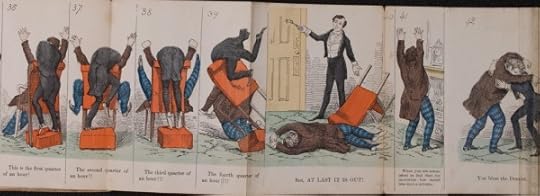
Once in the dentist’s chair, the two of them go through a series of contortions:
But finally all is well. With an enormous wrench, the tooth is pulled out, and in his relief the gentleman hugs and blesses the dentist.
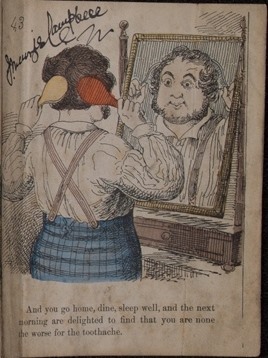
You can feel his relief that the torment is over, and the final caricature shows him the next morning, none the worse for war and feeling quite himself again:
Having toothache must have been an excruciating business in those days. When this book was created, there was still only one treatment for toothache: yank the tooth out, as quickly as you could. Modern painkillers were yet to be discovered.
This book is a rare gem. It takes only minutes to read, but if you enjoy these types of cartoons, they will have you chuckling in no time. George Cruikshank was an artist, caricaturist and illustrator who began his career with satirical political cartoons. During his lifetime he made almost 10,000 prints and illustrations, and he was praised as the “modern Hogarth”. He illustrated the works of many authors, perhaps most famously for his friend Charles Dickens.
However, as with many of Dickens’s friendships, it all began to go wrong. George Cruikshank attempted to take the credit for “Oliver Twist”. There was a public dispute as to who was the true creator, and sadly their friendship began to deteriorate. It soured even further when George Cruikshank spurned drink, and became a fanatical teetotaller, whereas Dickens’s own views were those of moderation. Perhaps the final nail in the coffin came over a year after Dickens’s death. On 30th December 1871, “The Times” newspaper published a letter by George Cruikshank, in which he claimed that he had thought of much of the plot of “Oliver Twist”, fuelling a public controversy once again.
Horace Mayhew was a 19th century London journalist for a satirical magazine. He also was a friend of Charles Dickens. His older brother was Henry Mayhew, the English social reformer, and a co-founder of the satirical and humorous magazine “Punch” in 1841.
If you have ever enjoyed the caricatures of the 19th century, you will have little need of the new-fangled “laughing gas”, to find this pocket-sized little book extremely amusing.
(Note: Joseph Priestley had discovered nitrous oxide in 1772 and Sir Humphry Davy had started experimenting with it as early as 1800, understanding that an anaesthetic gas would be perfect for short dental procedures.)