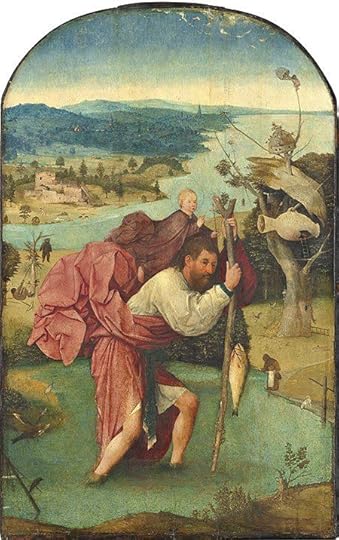
Recently got the video "Bosch: The Garden of Dreams" from our library, which focused on Bosch's most famous (and history's weirdest) painting, "The Garden of Earthly Delights." Fascinating enough to make me want to learn more about Bosch and his other works, so got this book (also from the library, and their only book on the topic)…and it turns out the whole thing is only 6" x 6"!!
So sure, interesting analysis of his various works - but consistently juxtaposes statements like "a dragon rises behind a ruined wall on the far shore" against reproductions actually smaller than this...
…so I could barely find the wall, much less any damned dragon. Like, page after page...nnaaAARRGHH!
That said, the text itself was fairly interesting - as long as I had the painting opened up on my laptop so I could zoom in on whatever the hell Campbell was talking about at any given moment. However, as an actual stand-alone book, this is HIGHLY not recommended.
So...4 stars for Campbell's contribution, but then just 1 to publisher "Harry N. Abrams, Inc." for this totally messed up production concept; and then rounded down for overall putting me in such a foul mood - never really the hoped-for response when studying famous paintings.
FINAL OBSERVATION: More from the video than this stupid book, I was struck by the similarities between "The Garden of Earthly Delights" and Singapore's famous "Tiger Balm Gardens," much of which is devoted to Buddhist representations of hell and contains many similar mutant-human-animal-hybrid demons such as those found in Bosch's work. Weird that such similar imagery could arise in two places separated by such time and distance…Google it, if you're unfamiliar.
After seeing "The Temptations of Saint Anthony" displayed in Brussels, I had an interest in learning more about Bosch. From this book I learned that he wasn't just a tripped out religious nut but "a conservative public figure whose art represented religious and social ideas current among his peers." According to this book he was into the themes of sin and punishment, but he invented various symbols to convey his ideas, rather than using the "fixed and static language of symbols on which the Middle Ages had relied." Though I was surprised to learn that owls at this time were symbols of foolishness. Mostly I enjoyed seeing all his paintings in this book and wished there was more information about his early life and training. I'm not sure I totally agree with the author's interpretations of the art. I guess I'll have to find another book about him now.
Unlike several other of The Essential... series, very little is actually known about Bosch - he lived and died in his hometown and didn't travel anywhere. He was incredibly religious, married a woman in the same town, but they don't know her name or how she came by her wealth.
Because of this lack, the book mainly focuses on deciphering some of the imagery in the paintings, but even that is slightly stunted because many of the symbols related to guilds and other very very local incidences. Bosch in his place and time was really quite well removed from the world and art world at large and this insularity (is that even a word?) keeps his work mysterious.