A hefty and rather thorough volume on Hieronymus Bosch, probably one of the most famous and fascinating painter in the history of the arts. His Garden of Earthly Delights has been reproduced countless times on posters and T-shirts, probably even more than Mickey Mouse. However, the meaning of these fantastical images might well elude us today. This book by Larry Silver, a revered professor of Northern Renaissance art at the University of Pennsylvania, provides a straightforward yet detailed analysis of most of Bosh’s paintings, putting them into perspective against the pictorial traditions and religious views (holy scriptures, sacred history) of the late Middle Ages in Northern Europe.
Bosh’s paintings take their roots in the illuminations of medieval books of hours, especially the hellish pictures in the Visio Tnugdali, and in the early 15th century altarpieces by artists such as Rogier van der Weyden and Hans Memling.
L. Silver goes over most of Bosh’s great paintings with a fine-tooth comb, covering a vast theological programme — I will only mention a couple of great triptychs here:
1) Humanity’s fall, sinful condition and probable eternal punishment are depicted in feverish details in masterpieces such as the Haywain and the Garden of Earthly Delights:
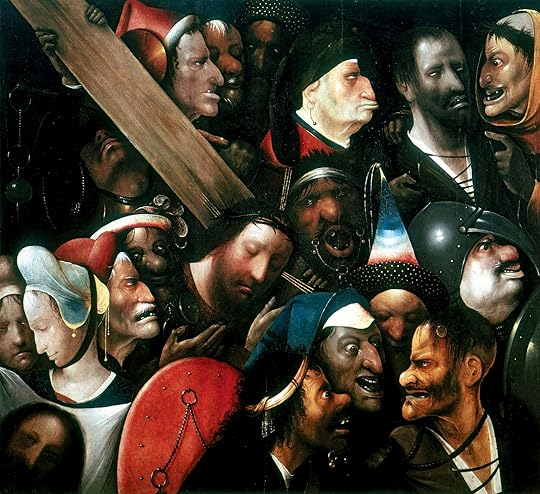
2) The Adoration of the Magi covers Christ’s infancy, while Christ Carrying the Cross shows the passion of the saviour of humanity, smothered by a crowd of grotesque faces:
3) The St. Anthony and a few other holy figures show man’s struggle against sin, chiefly lust and greed:
4) Finally, the Last Jugement displays the horrors that await humanity, led astray by an army of demons:
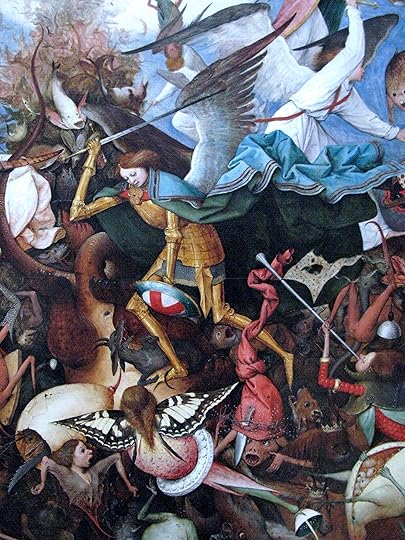
These eschatological visions and all the nightmarish bestiary invented by Bosch have had, as demonstrated in this book, a strong influence on Netherlandish painters of the 16th century, chiefly Pieter Brueghel the Elder, in such masterpieces as the Fall of the Rebel Angels (Silver has also published a thick book on Pieter Bruegel):
His influence could even be traced further to contemporary art, say onto Picasso or Francis Bacon. But I’d add that Bosch’s paintings, redolent of Dante’s Divine Comedy, might also have been a significant influence on literary works such as Milton’s Paradise Lost, Swedenborg’s Heaven and Hell, Flaubert’s Temptation of St. Antony and romanticism in general, and even in some way on Tolkien’s Lord of the Rings.
Part of my book-a-licious birthday gifts. Who knew that watching In Bruges was going to kick off an interest in Hieronymous Bosch that would lead to this gigantic book being one of the prize gifts I received? I tore open the paper and saw half of the back cover ... squealed "Hieronymous Bosch!" like a Twilight fan seeing Edward Cullen saunter by twinkling in the sunlight. This is a big brute of an art book but well worth it so far as Silver delves into Bosch's paintings and provides me with much food for thought and an education into looking at art.
FINAL
I loved this book. I must have, because I read the whole darned thing. Am I any smarter? Probably not. But I know a lot more paintings that I love and it really came in handy when we watched The Mill and The Cross last weekend because the Breugel painting was right there to look at while we watched. Highly recommended.
We had this book in the home library when I was a little kid. It was apparently my dad's book; my mom wouldn't let me look at it. A couple of years ago I opened it and looked at all his paintings and I understood why. Hieronymus Bosch was one sick fuck! He was truly the original Surrealist, and he's better than Salvador Dali any day. He basically was very religious and expressed complex medieval theological ideas in his paintings but he got to draw pictures of hell with whatever images popped into his crazy brain, like helmets stuck on top of feet and a guy getting raped by a fish. He is an absolute master of grotesque facial expressions. I got to see one of his smaller paintings at the National Gallery: http://www.nationalgallery.org.uk/pai...
I skipped a lot of the text in this one because it was bone dry, but the art is nice, even the stuff that's not by our main man Bosch (and there's a lot of it - how else are you going to fill a 400+ page book about an artist with only 25 confirmed paintings?).
The Garden of Earthly Delights invokes awestruck wonder in me with its beautiful and unprecedented weirdness every time I behold it. Where did his ideas come from?
In keeping with the strange, after picking this book up from the library three weeks ago (which nearly required a wheelbarrow to transport home), Hieronymus Bosch has popped up unexpectedly in the two books I've read since. Granted, three appearances in a row (one intentional, two unforeseeable) is not the most profound of coincidences, but why do these invisible threads occur between books as often as they do?
Magnificent overview of Bosch' works replete with fastidious detail and many rich plates. Completely psyched to see many of these works at The Prado in a few short days!