Jump to ratings and reviews
Rate this book

Tarzan #1

Tarzan of the Apes

Rate this book
1888 W Africa. Newlyweds Lord and Lady Greystoke are marooned by mutineers. He builds a snug cabin for their growing family.

But disaster falls. Great Apes raise the small son, destined to be Lord of the Jungle.

342 pages, ebook

First published October 1, 1912

Loading...
Loading...

About the author

Edgar Rice Burroughs

3,536 books2,820 followers
Edgar Rice Burroughs was an American author, best known for his creation of the jungle hero Tarzan and the heroic John Carter, although he produced works in many genres.

Ratings & Reviews

What do you think?
Rate this book

Friends & Following

Create a free account to discover what your friends think of this book!

Community Reviews

5 stars
15,743 (32%)
4 stars
17,627 (35%)
3 stars
11,917 (24%)
2 stars
2,927 (5%)
1 star
913 (1%)
Displaying 1 - 30 of 3,668 reviews
Profile Image for Will Byrnes.
1,373 reviews122k followers
April 11, 2015
Viscount Greystoke will see you now.
One of the advantages of riding the subway to work is getting extra reading time. Coming home, though, I often have to stand for a good while before I can get a seat. As it is not comfortable wrangling the actual book I am reading at a given time while standing, I lift my trusty iTouch and am able to read a bit until the crowd thins. I save my hardcore reading for when I am sitting and can take notes. iTouch reading is of a different sort, at least it has been to date. Nothing too challenging. Tarzan of the Apes was a free download from somewhere I cannot recall. I had first read this, of course, back in my wastrel youth, in the early 60s most likely. While I am a fan of ERB's Barsoom series, I was never all that taken with jungle boy. Maybe it was not sci-fi enough for my pre-adolescent self.

description
Tarzan is introduced to the world in October 1912 - from erbzine.com

In looking at it anew with a bit more lifetime and some extra inches under my belt, a few things stand out. At first blush it appears incredibly dated, awash in the racism of its era. It was published in 1912, not all that long after the Bronx Zoo displayed a pygmy in the monkey house. We have come a long way, hopefully. Not nearly far enough, but some distance nonetheless. Burroughs was a product of and reflects his time. Black Africans were regarded by the ignorant as barely human, cannibalistic, and of inferior moral substance (unlike King Leopold). The stuff of cartoons, hurtful cartoons.

description
ERB with Maureen O’Sullivan and Johnny Weismuller - from classiccinemagold.com

The Tarzan of the title is the son of privilege, his English upper crust parents done in by dark forces while in Africa. Coincident with the downfall of mom and dad Greystoke, aka Alice and John Clayton, a mother gorilla, mourning the recent death of her baby, hears the baby crying, takes him in as a substitute and raises him as her own. The boy's human ingenuity (and mom's fierce protection) gives him the equalizer he needs against the larger and much stronger apes in his tribe, and he thrives. As he grows, Tarzan is intrigued by the unoccupied house in which he was orphaned. He begins to explore, and discovers books. Of course, being an Englishman of gentle birth he has the cranial capacity to figure out the alphabet, language, the whole megilla. Who needs teachers when you have such high-end genes?

description
The 1st Edition cover - from erbzine.com

Tarzan of the Apes (BTW - Just so's ya know, Tarzan was not the first name Burroughs had in mind for his hero. That would be Zantar. And Greystoke was also a revision, of Bloomstoke.) was first published in All-Story Magazine, in October 1912. The text included errors such as the existence of tigers in Africa. Those were removed for the book version. Note the sub-title, A Romance of the Jungle. Jane, in the introductory episode, serves as the damsel in distress, with her black maid shrieking in eye-roll-worthy comedic panic. At least some clueless white guys are served up for comic relief as well. There are dastardly mutineers, a bit of buried treasure, and Tarzan, the original swinger, hoists not only Jane through the jungle with one arm, but also a young man who would love to have Jane for his own. (Maybe he swings both ways?) If it sounds to you like something Team Edward might have purloined for their guy, I think so too. But after the real Mister T has flexed his pecks, hand-killed a lion in front of his European visitors, and slaughtered a few other menacing jungle residents, really, Jane is smitten. Now if he could only learn to translate the English he has come to know so well in print into speech. Not that it matters, Jane is ready to rip bodice.

description
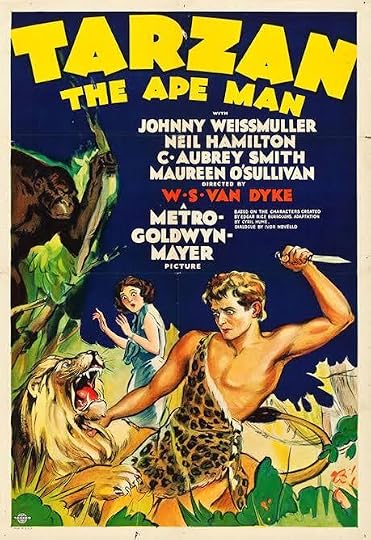
Film poster of the first Weismuller Tarzan - from Daily motion.com

Still, a simple boy-meets-girl, boy-drags-willing-girl-into-the-jungle for some monkey business would not do. Gotta make it a challenge for the big guy, so stars are crossed and the young thing is whisked across the ocean to darkest America, pursued by a suitor no more appealing than the ill-tempered gorilla who had abducted Jane in Africa. Can Tarzan find a way to his lady love (he was of course smitten with her on first sight). Can he learn to speak English? Why stop there? Peut-être un peu le français? Vielleicht ein wenig Deutsch? I mean he already speaks elephant, and a smattering of beastial languages, so clearly has a head for it.

description
Christopher Lambert in Greystoke: The Legend of Tarzan - from The Telegraph

Despite the veneer, a very heavy, very thick veneer of low entertainment, racist humor and stereotyping, and bodice-ripping romance, there is more going on in this book. First, having humans raised by non-humans is as old as Romulus and Remus, and probably even older. But ERB put the notion into the more accessible present for his readers, ("My mother was an Ape…I never knew who my father was," - Maybe not up there with your mother was a hamster, but not bad) albeit a fantasized present. Also, while his racial portrayals are coarse, he does not leave them there. It is not merely the black natives and silly servants who merit disdain. There are very dark-hearted whites as well. Skin of diverse color sheaths hearts both generous and unkind. And such diversity is offered the animals of the jungle as well. There is no kinder mother in literature than the bereft mother gorilla who takes in the infant Tarzan. And no darker foes than the silverbacks of her pack whose hatred of her adopted son is palpable. Beneath the surface of this pulpiest of pulp fiction there resides a theme about universality. This is something that arises again in his Barsoom series. Race plays a large role there as well. And the theme of commonality under the skin, of honor being something available to anyone, is repeated. There is also a nifty consideration of religion and superstition that enlivens the goings on. In another vein, Tarzan is a fine representative of the literary trope of the noble savage, a notion that man is essentially good, but that his better nature is corrupted by civilization. Of course ERB was not so naive as to treat this idea with clear delineations. People are complicated, whatever their moral leanings.

description
T and J in the 1999 Disney animated musical - from fanpop.com

The first volume of the Tarzan series was clearly meant to be just that. The story leaves off with much yet to be resolved, much to be discovered. And Burroughs milked that notion for twenty four Tarzan novels he wrote alone and a few more that were co-written.

There are characters from literature that seem to require a new introduction every generation or so. Greek and Roman mythology and Shakespeare's works have been at this for centuries. More recently, our recurring characters seem to be of the pulp variety. Batman, Superman and Spider Man stand out as examples. I am not sure if James Bond qualifies, as the series has been more or less continuous since Bond, James Bond first found its way to the silver screen in the 1960s. Tarzan first graced cinemas, in silent films and serials, from 1918 through 1929, including one silent film to which sound was added after filming was completed as talkies stormed the world. For folks of my generation, boomers, our introduction to Tarzan in film was most likely Johnny Weismuller, Olympic swimmer turned action movie star, an earlier version, maybe, of Ah-nold. He appeared in twelve Tarzan films from 1932 to 1948. I expect that most of my crowd first saw these on TV instead of theaters. Of course the bod on display way back then was a far cry from what Hollywood presents as the sculpted masculine ideal these days, And of course, Weismuller's Tarzan spoke with an American accent, as did his lady friend. 2016 saw yet another re-introduction of Tarzan to a new generation.

description
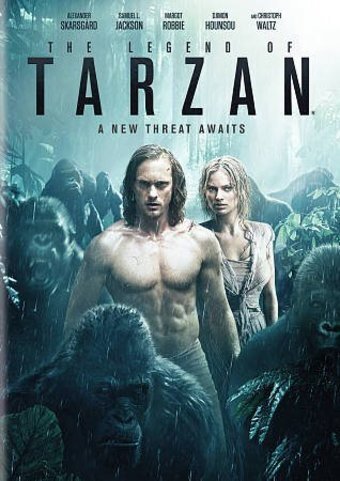
Alexander Skarsgård in The Legend of Tarzan - 2016

There have been more than a few comic books (450) and newspaper comic strips (250) featuring Tarzan. Tarzan books have appeared in pulp, hardcover, and paperback, illustrated and not, selling 100 million copies globally. There have been many adaptations of the source material, 50 for the big screen, 65 episodes for live action TV, and 32 cartoons. The story has been told in theaters and on the radio. Disney's 1999 animation was the most recent feature length version, and the company fed this musical interpretation into a long-running stage production. There is even a Vegas Tarzan-themed slot machine.

Some of these various productions and products have attempted to hew closely to the original story. (My personal fave is Greystoke) Most have taken liberties. Sadly, the presentation of a mono-syllabic Tarzan mirrors the misfortune of presenting Frankenstein's monster as inarticulate. Neither is true. Both Frankie and the Ape-Man were intelligent and, after some learning time, quite articulate. But there is clearly something compelling in a story about a man raised by animals, something that speaks to questions about human nature. How much of how we behave, what we value, is inherent, and how much is the result of nurture, of the specific family upbringing we receive, and of the cultures in which we are raised? Tarzan may have been written as popular pulp entertainment, but the questions raised as he copes with the clash between civilization and the wild, between doing what is right and doing what sates a need, between honor and dishonor, are eternal. Also, ERB showed a very early concern for the environment, as the baddies in the series tend towards the environment-killer sort. You may or may not go ape for it, but whichever way you swing it is definitely worth checking out the original source material for what has become a regular part of Western culture.

And it also goes to show that it is a useful thing to have some classics sitting around on one’s electronic devices. You never know when one might transport you from the concrete jungle to one of a very different sort.

Review first posted in 2015


=============================EXTRA STUFF

The home page for Edgar Rice Burroughs, the corporation.

Home site for the latest (July 2016) film The Legend of Tarzan

4/23/17 - I finally got around to seeing this, at home. Beautiful to watch, of course, wonderful special effects, and impressive bod on Mister T. This one takes a shot at King Leopold's rape of Congo, in the form of Christoph Waltz as his representative. This is certainly a worthy object for our scorn, even with leaving out some of Leopold's more gruesome outrages. I suppose it is meant to echo with latter day exploitation of indigenous peoples by first-world exploiters, but I thought it fell flat in that. Too Dudley Do-Right vs the equivalent of a moustache-twirling Snidely Whiplash. On the other hand, this sort of evil-doer material might have been right at home in ERB's pulp-fest. T's affection for his gorilla mom was nicely presented. Still, it felt like a miss to me. Not close to Greystoke. Ah, well. Maybe in a generation or so, another film-maker (or who knows, maybe a VR or holo-maker?) will have another go at this material. There is certainly franchise potential there, and plenty of serious material to lend substance in supporting an overlay of good-guy-vs-bad-guy conflict and wowzer visuals.

There is a nice brief history of Tarzan the character and product at Wild Stars, including images of what seems a gazillion Tarzan book covers.

A piece from Licensing Works about a centennial celebration of Tarzan in Tarzana, CA. It was the source for the numbers of sundry publications that have been made of T-product.

The entire text of Tarzan of the Apes is available on the Gutenberg Project

The song You'll Be In My Heart from Disney's animated Tarzan film

For a real scientific look at commonalities between apes and people, you should check out the 2019 book, Mama's Last Hug by Frans de Waal
Profile Image for Anne.
4,992 reviews71.8k followers
May 23, 2021
I don't know about you, but when I think of Tarzan, I see that classic image of him swinging through the trees and hear that crazy yodel-scream thing he did.
I've seen multiple movies, but I've never read the real stories, so I thought it was high time to remedy that.

description

Truthfully, Burroughs' classic didn't age particularly well, but it was still an interesting read.
The idea of Tarzan is just so cool!

description

You just have to be prepared to cringe because there's a lot of just insultingly weird portrayals of anyone who isn't white. It's...bad.
And then you have to try not to laugh too hard at the batshit reasons Burroughs gives to explain how Tarzan survived this wildman experience, without becoming either instantly dead or completely feral.

description

And not only survived but thrived!
He becomes the alpha predator of the jungle, easily killing lions and apes with his superman muscles and aristocratic reasoning.
Why? Because aristocrats make the smartest babies.
In fact, he has so much of that amazing bloodline running through his veins that he teaches himself to read and write with the leftover books he found in his parents' treehouse.

description

Annnnnd to top it all off, he's the most handsome guy on the planet -not some scarred-up bitch with cracked teeth and lice.

description

It was cute that he fell in love with Jane instantaneously. But a tad unrealistic that once he saw her, he simultaneously felt something stirring for the first time within him. And I know this is so wrong, but my immediate thought was that there was no way he hadn't fucked a monkey before he met her. I mean, all things considered? Yeah. Probably not a virgin.
Ewww.

description

Oh, and did you know that Tarzan has something like 24 books in his series? I didn't! I thought it was one book with a couple of spin-off tales.

description

Turns out, there were a lot of things I didn't know about this story.
1) Tarzan doesn't actually like to hang out with the apes. From the different media representations I'd seen, I was under the impression he was chummy with his jungle pals well into adulthood. Not so. He's bored with their shit and wants to find some white dudes to hang out with. So they're not friends, he was just the badass who killed the last leader of the apes and earned their respect.

description

2) He doesn't kill predators with his hands alone. He relies on a rope to choke those bitches out, a knife he found, so he can stab them, and poison arrows that he steals from a village. I don't know why, but I always thought he just wrestled them to death. <--completely stupid on my part, but I know I can't be the only one!

description

3) Clayton isn't a bad guy. He is, unbeknownst to both of them, Tarzan's cousin and rival for Jane's affections, and he does say a few shitty things one time when he gets jealous. BUT. Overall, he's a decent fellow.

description

4) He doesn't get the girl! Not right away and not in this book. Turns out, once Jane thinks about it, she's not entirely convinced that the long-term ramifications of marrying a guy who eats raw meat with his hands will be bliss. Ah, some days I wish I'd had her foresight...

description

5) Jane doesn't teach Tarzan to speak, either. That's some French army dude that I had no idea even existed, but these two become the best of friends and travel around together for a chunk of the book. French is, therefore, Zan's first (human) language.

description

6) Jane's father isn't as nice as I thought. He was neglectful, and also pretty much selling Jane off to this asshole guy he owed money to after his treasure hunt went tits up. <--yes, that's why they were in the jungle to start with - pirate treasure!
Oh, Disney, how you lied to me!

description

This whole book shocked me, to be quite honest. But even with all the problems, I regret nothing. The pacing was great for an older book, and even if not one bit of the story was remotely plausible, it was a wacky ride in the best way possible. I can definitely see why these were such beloved books.

I couldn't find the edition that I listened to, but it was produced by Dreamscape Media, LLC, and read by Jeff Harding. I thought he did a good job.
Profile Image for Lyn.
2,049 reviews18k followers
April 9, 2012
Tarzan of the Apes was a pulp classic that spawned a slew of sequels, movies, radio and television shows and a community in California.

I was surprised, pleasantly by the style of writing, Edgar Rice Burroughs was a talented craftsman, and I am amazed at his ability to again and again draw the reader into a cliffhanger situation.

A good read.

description
Profile Image for Whitaker.
311 reviews601 followers
February 12, 2009
Pulp fiction at its best.

I went in with low expectations and enjoyed it more than I thought I would. It's pulp fiction, but it's good pulp: a fun romp and so very very silly. Burroughs buys into all the prejudices of his time, but it's tough to blame him for being merely mortal. Ignore it. He's no worse than JM Barrie or Kipling.

I've shelved it under Fantasy, and that's what it is. There may be no Middle Earth or magic, but a novel where a child brought up among apes learns to read without human aid, and who, as an adult learns to speak fluent French and English in a matter of months...well, if that's not a fantasy, then I'm Galadriel.
Profile Image for Game0ftomes.
179 reviews67 followers
November 8, 2023
Tarzan is an exciting and timeless adventure that blends action, romance, and deep themes of identity and civilization. The story of Tarzan, a man raised by apes in the wild jungle, is captivating from start to finish. Burroughs' vivid descriptions bring the jungle to life, while his exploration of Tarzan's struggle between his wild nature and human society is thought-provoking. The characters are well-developed, and the plot is filled with suspense and unexpected twists. A thrilling and thought-provoking read that continues to resonate with readers today!
Profile Image for J.G. Keely.
546 reviews13.4k followers
January 13, 2009
I must say, I was expecting more from this book. It takes inspiration from a wide array of very good adventure novels, but manages to be more bigoted than the colonial literature that inspired it and less factual and forward-looking than books written thirty years before.

One of the major inspirations is H. Rider Haggard's early pulp adventure stories, including the tales of Allan Quatermain. Like Tarzan, these stories take place in the depths of colonial Africa, but the attitudes and portrayal of other races are far more insulting in Tarzan than in Haggard's books, despite the fact that Haggard was writing three decades before.

Of course, having actually visited Africa numerous times during the Colonial period, Haggard had a much better idea of what was going on there. African tribes are portrayed as noble savages in Haggard, which is a rather silly portrayal, but Tarzan's tribes are made up of ignorant, warlike, half-human cannibals.

Throughout Tarzan, one consistent theme is the popular colonial concept from the previous century that 'Blood Will Out'. This was a theory that genetic traits were responsible for social classes, and that if a prince were raised by pig farmers, he would instinctively know how to bow and pick out a salad fork.

Some stories even indicated that a nobleman could defeat any commoner in a sword duel, even if the commoner were a soldier and the noble had never held a sword before. While Tarzan does not stretch credulity quite that much, it does state that Tarzan naturally understands the concepts of honor, bowing, marriage, and social class.

This explanation is also meant to underscore how Tarzan could learn to read simply by looking at books. Though he might come to recognize some of the symbolism, Burroughs takes for granted that he could understand not only that the pictures represented people, but other complexities such as 'lights' and 'clothes'.

Even if he could decipher the pictures, coming to understand the text without a key is a nearly insurmountable task, as Burroughs should have known from the Rosetta Stone of popular Egyptology. Even if he could see that the symbols for 'Man' coincided with pictures of human beings, coming to understand the use of articles and copulas would be many degrees more difficult. Without training in linguistics or the scientific method, solving such problems is unlikely, especially alone.

Even if we take for granted that Tarzan could decipher the pictures and intuit the meaning of things he'd never seen before and break down the code of letters, words, sentences, tone, and symbolism (which his he does, in the letters he writes). Even so, there is no explanation how he could have known how to pronounce words, as he had no phonetic understanding of how English actually sounds. Yet he signs his letters 'Tarzan', his ape name.

There are also some errors in the portrayal of animal behaviors. For example, lions are depicted as solitary, and jaguars are unable to climb trees. While Natural History was still in its early stages at this point, there were plenty of accurate accounts (including Haggard's) from which to draw inspiration. Likely, Burroughs was more influenced by the sensationalist tales of 'Darkest Africa' than the experiences of actual travelers and experts, such as Haggard and Conrad.

The 'apes' in the series are particularly interesting, as they share little resemblance to any great ape, descending instead from evolutionary ideas about early humans. It is unsurprising that Burroughs would pick up on this popular contemporary idea. His 'apes' use tools, make music, communicate by spoken language, eat meat, perform social rituals, and commit war on one another.

Of course, any ape with these traits would have been driven to extinction by competition with humans. This helps to explain why Gorillas survived, since they are herbivores, and hence do not compete with humans for resources. Even then, the only remaining gorillas live in mountainous, jungle regions too remote for humans to settle.

If a warlike and omnivorous species of protohumans were to survive, they would have to be in an isolated pocket of jungle or perhaps an island, an idea which Burroughs later explored in 'The Land That Time Forgot'.

Verne portrays a similar group of proto-humans in 'The Village in the Treetops', but he actually refers to them as a species of homo sapiens, not as super-apes. Verne's depiction is a more thoughtful expansion of Darwin's ideas, showcasing his talent for extrapolating new ideas into interesting, forward-looking books.

If Burroughs had created some bridge between Verne and Haggard, then Tarzan would have been a book worthy of its reputation. Instead, it is a silly and naive adventure that fails to explore the most fertile ideas and instead relies on the least likely ones.

Burroughs is a creative and ingenious author, combining concepts from natural history with sci fi and adventure stories. However, his plots are often unfocused, simply leaping from one moment to the next without build or connection. He will sometimes squander good opportunities for plot or characterization, instead focusing on fragmentary bits of adventure. For example, the romance between Tarzan and Jane goes off without a hitch. This is despite an inability to communicate and the fact that Tarzan is a frighteningly powerful and alien figure. Pride and Prejudice creates an entire plot three times the length of Tarzan based on the fact that it's hard for two people to get along, even if they are both well-off, attractive nobles from the same culture.

Burroughs overrides the development of a romance by the constant insistence that Tarzan's nobility is evident to Jane, mitigating any frightening elements of her animal attraction to him. Despite immediately recognizing his nobility in his every thought, step, word, and deed, she is unable to recognize that he actually is a noble, even when he gives her a picture of his father, Lord Greystoke. She responds how he looks exactly like Tarzan, but Burroughs tells us through third person narration that she never even imagines that they might be related.

So, Burroughs invents an implausible and difficult reason to maintain conflict by doubt of Tarzan's birthright, but squelches the opportunity to present a troubled love story, even though it would be the most likely result of the situation. It is almost as if he cannot bear to provide more than a moment of fleeting hardship to his characters, and when he needs a man's life threatened by the natives, instead of using an established character, he creates a new one on the spur of the moment.

Burroughs combines many sources of inspiration in his books, and creates vivid, fast-paced adventures. However, his brand of wild, free-wheeling adventure seems to work better on Mars, where there is no fact-checking or colonial philosophizing to strain his credibility. The romanticized idealism in Burroughs' high adventures cannot be sustained on a world as small and mean as Earth.

Perhaps Burroughs was simply more enamored of the John Carter series, since they are more imaginative and more well-written. In any case, Tarzan was his money-maker, so it's no wonder that he returned to it so often, but Tarzan lacks Carter's charm, and a nonsensical Martian world is more plausible than a nonsensical African one.

No doubt I'll pick up more of the Tarzan books in time, and will have to suspend my credulity about ant men, immortality, mad scientists, and talking gorillas. But really, as long as it's written well, I'm willing to extend my disbelief. Perhaps the problem with this book isn't that it's too strange, but that it's not strange enough. Burroughs tries to realize his world with facts, but only shows that he is not familiar enough to write about them.
Profile Image for Scott Rhee.
2,505 reviews213 followers
June 15, 2019
It’s a travesty that Edgar Rice Burroughs’s classic novel “Tarzan of the Apes” had slipped under my radar for so long, but I am overjoyed that I have finally discovered it. The best part? Burroughs wrote 24 sequels. I know what I’ll be requesting from my library in the next several months...

Published in 1914, “Tarzan of the Apes” has, amazingly, never been out of print, and there’s a very good reason for it. Despite the fact that it was a pulpy action/adventure novel written primarily for young boys, despite its purple prose, and despite some of the ridiculous aspects of its plot, it’s wonderfully fun and exciting. I can understand why it has captivated reading audiences for an entire century.


The 1932 film adaptation starring Johnny Weissmuller

Everyone (kind of) knows the story of Lord Greystoke (spoilers ahead!): shipwrecked on a deserted island as an infant, raised by a compassionate ape after his human parents are killed, learns to read English from the plethora of primers and books left by his human father, battles gorillas and lions for supremacy of the jungle, meets Lady Jane and falls in love with her (the feeling’s mutual, of course), becomes (somewhat) civilized with the tutelage of a French gentleman, arrives in America to find Jane, only to see her married off to an English nobleman, the end.

Wait, what?


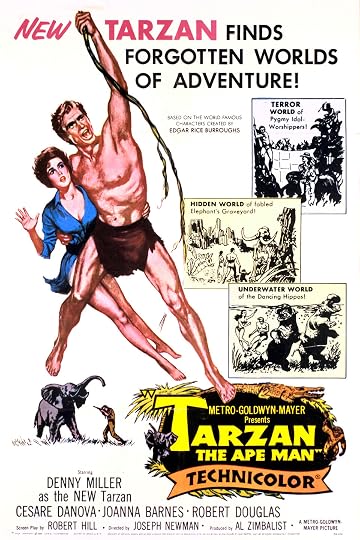
The 1959 adaptation starring Denny Miller, not one of the better adaptations

I know what you’re thinking: that’s not how the Disney cartoon version went at all! Truth be told, the Disney version wasn’t that bad of an adaptation. (Plus, it had a killer Phil Collins soundtrack.)

I have never seen the literally dozens of film versions made throughout the years (with the exception of the 2017 “The Legend of Tarzan”, starring Alexander Skarsgard, a man so ridiculously gorgeous as to make the straightest man in the world entertain the occasional gay thought) other than the Disney cartoon, and yet I felt like I knew the story going into it, which I didn’t.

The 2017 adaptation starring Alexander Skarsgard and Margot Robbie was probably my favorite version

Burroughs can so easily be accused of being racist, classist, and sexist based on some of the politically incorrect material in the book, but something tells me that its popularity wouldn’t have survived if a majority of readers throughout the years found the books to be egregiously distasteful and horrendously offensive. Just remember going into these books: they were written in the early 1900s, which was a very different time---with very different attitudes about race, gender, and class---than today.

In 2012, the Library of America published a beautiful hardcover edition, based on the original text as it appeared in the first edition published by A.C McClurg & Co. in 1914. The novel (in a slightly truncated form) had actually first appeared in print in the October 1912 issue of All-Story magazine.

Along with the full novel, the LOA edition also includes an introduction written by Thomas Mallon, a historical and biographical afterword, and a lengthy timeline of the numerous publications, film versions, television appearances, and comic book adaptations of “Tarzan” throughout the century. A definite must-own for any bibliophile and/or Tarzan-phile.
Profile Image for Kenny.
645 reviews1,534 followers
March 9, 2021
For myself, I always assume that a lion is ferocious, and so I am never caught off my guard.
Tarzan of the Apes ~~~ Edgar Rice Burroughs


1

My introduction to Tarzan was as a young boy. My brothers and I would watch Tarzan religiously on Saturday afternoons. It didn't matter if it was the old movies, or the updated TV show, we loved cheering Tarzan on. It also didn't matter to us that the actor portraying Tarzan changed several times in one afternoon, we loved our Tarzan. I do remember that we cheered a little harder for Mike Henry, Gordon Scott, & especially Buster Crabbe. I guess we went for more of the beef cake Tarzan.

I also remember that we had a couple of copies of Tarzan as part of a set of books for boys that my mother bought us. I'm not even certain we could read when we first got the books, but I know we could tell the story of Tarzan just from looking at the illustrations. I wish now, after reading Tarzan of the Apes , I had read the books during my boyhood.

After finishing 1Q84 last night I decided I wanted to read an old pulp novel. I settled on Tarzan of the Apes for no particular reason other than I saw it on my shelf waiting to be read, and I started thinking about my early memories of my boyhood friend, Tarzan.

1

Tarzan of the Apes is unquestionably pulp fiction, but it is pulp fiction at its best; it is also great fun, if you can set aside your feelings towards colonialist attitudes. Tarzan has become one of those amazing characters from fiction ~~ Dracula, Frankenstein, Sherlock Holmes ~~ with a life far beyond the confines of their original story. Rice Burroughs went on to wring the most from the original success of his story of the ape-man, with 24 sequels written by him, as well as two children's books, with titles including Tarzan and the Foreign Legion and Tarzan at the Earth’s Core ~~ okay, Rice Burroughs really knew how to milk Tarzan. His estate has continued to keep the gravy train going by authorizing several sequels over the years.

By now, we all know the origins of the Tarzan story. Newly-wed Lord Greystoke, an English aristocrat and his young wife are marooned on a deserted African shoreline following a mutiny by the crew. Here they create a mini-Eden, building a thatched hut with locking doors, drapes and bookcases. Lady Greystoke gives birth to an heir, only to succumb to a fit of the vapors following a lion attack. Lord Greystoke quickly follows his wife, leaving young Tarzan to be adopted and brought up by the apes of the jungle. Interestingly these are not gorillas – Rice Burroughs is very specific on that point. This species of ape bears many similarities to the gorilla, but can speak a primitive language. Tarzan grows up among them, acquiring his physical prowess. He also discovers his parents’ hut, and his father’s knife, which allows him to win a series of battles with the alpha-males in his troupe, as well as other beasts, finally becoming king of the jungle.

During this time, Tarzan teaches himself to read and write, and discovers more about his ancestry and the world beyond his jungle. Yes, Tarzan is a genius. Rice Burroughs was obviously taken with the idea of white people being marooned on the coast of Africa by mutinous sailors, because he re-uses this plot-device to introduce Jane Porter, lovely young American heiress, her eccentric father Professor Porter ~~ both from WISCONSIN, by-the-way, and her suitor Clayton, Lord Greystoke. Yes, another Lord Greystoke, Tarzan’s cousin, has pitched up on the same shore in the same manner, twenty years on. Yes, Rice Burroughs is a lazy writer. Why bother inventing a new plot device when there’s a perfectly good one available that is only 15 chapters old? But who cares; this was picked up solely for a fun read. I wasn't expecting Virginia Woolf.

To tell you more of the plot, would rob you of the enjoyment of reading Tarzan of the Apes .

1

My favorite part of Tarzan of the Apes is the first section when the young Greystroke is adopted as an infant by the she-ape Kala and is renamed Tarzan which means white skin in the ape language. He is raised as an ape. These apes have a complex culture and language of their own. Tarzan feels alienated from the other apes due to his physical differences. It is in this section that Rice Burroughs really grabs grabs the reader and sucks them into Tarzan's world.

Tarzan of the Apes is written simply, obviously for a youth audience, but it is engaging enough for an adult audience. If it lacks the depth and nuance of great literature, it still has literary merit. That Tarzan of the Apes is still in print and still being read after a hundred years says a lot.

1
Profile Image for Vanessa J..
347 reviews634 followers
August 27, 2014


Remember this?


I liked that movie when I was younger. Being the bookworm I am, as soon as I found out it was based in a book, I wanted to read it, thinking what I'm sure most of us think when a book has movies: "Surely it is better". And since the movie I knew is Disney's, then my second thought was: "It's gonna be hella different to the movie, and maybe even a childhood ruiner".

Only the second of my thoughts was right. Because Tarzan of the Apes is almost like an ode to insta-love and, above all things, stalking.

We all know the story, don't we? A couple gets lost somewhere in Africa, they have a son there, but they die before him growing up. After that, some apes come into their cabin, and one of them - Kala - decides to take the child as her own and raise him as if he were an ape.

The problems started as soon as the animals appeared. And I'll explain why with a question I'm sure you've heard before: "Is a lion cruel because he hunts?". The answer is always "no", but here, it's stated several times that Sabor the lioness is cruel because she kills and eats.

Oh, but that isn't so bad as this: Tarzan, our handsome and mighty hero, kills too, and he does it for food, vengeance and pleasure, yet... he is justified. His murdering for pleasure is justified because "he is M-A-N and not A-P-E".

Actually, everything for Tarzan has an explanation because he is super special and we have to love him. For example, at one point he almost strangles a man because Jane (the love if his life *rolls eyes*) was going to marry him and he has to force his mate upon him. Not so sweet as Disney told is, right?

Besides, he's a victim of insta-love, and before you say "Jane was the first female of his species he ever saw", let me correct you: She is not the first woman he saw - she is the first white woman he saw, because he also saw women with dark skin, but all were ugly to his eyes.

So when our hero meets beautiful and - let's not forget it - white Jane, he immediately falls in obsession love and starts observing and stalking her, à la Joe from You.

This is what Tarzan wrote to Jane after he stood over her room for hours and stole the letter she had been writing to a friend of hers:

I am Tarzan of the Apes. I want you. I am yours. You are mine.


It doesn't end there, though, because some days after he saves her from danger, and he starts kissing her even when he knows she's repulsed by him. This repulsion, by the way, does not last long. As soon as she examines him, she realises he's the most good-looking man she has ever seen, and so she returns his love, forgets she already wanted another man, and then starts moaning that she doesn't feel safe if he's not with her.

As if that weren't enough, we then have another of my bookish pet peeves: Love triangle. and a very annoying one, for that matter, with lots of whining and an obvious answer.

And the last ingredient of all: Sexism. Oh God, I know this was written in a sexist era, but that doesn't mean I'm going to accept it. Quotes like this:

“Ah, John, I wish that I might be a man with a man's philosophy, but I am but a woman, seeing with my heart rather than my head, and all that I can see is too horrible, too unthinkable to put into words.”


... are enough to make me hate a book, especially if there are lots of them.

So you see? Nothing like the Disney version. And I'm not surprised - that's how it always is. The difference this time is that I prefer that movie than this sorry excuse of a book, especially with its last line, which basically says "for more of Lord Greystoke's adventures, read The Return of Tarzan". Yeah, like I'm going to do that.
Profile Image for Melindam.
919 reviews448 followers
March 23, 2023
I first read Tarzan of the Apes in my early teens and was thoroughly captivated—both by this book and the rest of the series that had been translated into Hungarian at the time. Back then, my undifferentiating teenage self would have rated it at least 4 stars. I found the books entertaining and genuinely fascinating.

Fast-forward some 30 years (yikes!) of reading experience and literary insight (courtesy of a university degree), and here I am again, this time listening to an audiobook version included in my Audible subscription. It was narrated—rather woodenly, though not unbearably—by James Slattery.

So, my current impressions: this is a prime example of successful escapist, superhero-style pulp fiction. It’s very entertaining and absolutely brimming with the false glories of colonialism, racism, white supremacy, and condescension toward anyone who isn’t white and male.

Although, on reflection, most white men are also excluded from Edgar Rice Burroughs’ exclusive Boys Club. The only truly positive characters are either British aristocrats or French officers and gentlemen (singular, really). That must have made an unconscious impression on my teenage self, because until I started re-reading the novel two days ago—and looked him up—I had assumed ERB was British. (Given the composition of his elite club, it's an easy mistake to make.)

Jane Porter—white, beautiful, blonde, and American—is intended as a positive character and Tarzan’s love interest, but her story arc leans heavily on fainting spells, hysteria, and damsel-in-distress rescues. To be fair, I do recall that in at least one later novel (Tarzan the Terrible, I think), ERB lets her grow into a pretty kickass, mature woman with real survival skills, thanks to her time with Tarzan. But not in this first installment.


Most of the white men are portrayed as greedy, murderous, and revolting by default. But the one I found most repugnant this time around was Jane’s father—disguised as a harmless, absentminded professor.


The novel does touch on some interesting themes—nature vs. nurture, or heredity vs. upbringing, if you prefer—but thanks to ERB’s unshakable belief in white supremacy, the outcomes are as predictable as they are implausible.

(Apparently, aristocratic blood will always triumph over a life spent as a wild beast in the jungle.

description

Yeah, yeah, sure!)

Written and published in 1912, the book is very much a product of its time.

All things considered—and despite all the problematic elements—I still found it readable and engaging. I’m even open to revisiting a few more books in the series.
Profile Image for Fabian.
1,023 reviews2,202 followers
January 20, 2014
Here: the fountainhead & the story buried below a myriad adaptations.

E. R. Burroughs's dream did come true after all: his Tarzan spun off into countless later tales & films-- heck, even Broadway musicals. Read this scant but brutal adventure tale with its due respect, for it includes: examples of poetic and natural justice; often tableaux with two male warrior bodies battling it out--always a spectacle to behold; cannibalism; animal eroticism; killer! savage! hot!ness; plot twists and many examples of schizophrenic scope (the world becomes incredibly large and then ridiculously small). It is the story of kingdoms regained--surely my favorite amongst a dozen Disney conventions is, like the Sleeping Beauty, that which dabbles in the innerworkings of a regal fate, the inheritance of some forgotten nobility. It is cinematic--the imagination probably behind countless Hollywood blockbusters can be found here--a champion of good fun. There are climaxes which occur merely paragraphs from each other. The effervescent prose is vicious, savage, alive; the actions depicted all merciless and gory, R-Rated before that very classification came into existence. Tarzan's mother turns mad--the jungle environment is enough to drive ANYONE insane. Ends in optimistic Shawvian mode. Sufficient amounts of comedy via wacky characters, like Esmeralda or Professor Porter. And Lord and Lady Greystone's (and Kala's child's) bones all give off a rather mystical and effortless poetry to the whole fantasia.
Profile Image for John Conrad.
47 reviews17 followers
February 23, 2008
Ah, how to begin... Tarzan raised me from a little boy and helped me become a man. After the Bobsey Twins, Hardy Boys, and, yes, Nancy Drew, I admit, came Tarzan, Return of Tarzan, Beasts of Tarzan, Son of Tarzan, Tarzan and the Jewels of Opar,... yes 24 in all, and then the Mars series, and Moon, and Venus, and Pellucidar, I own over 65 Edgar Rice Burroughs books, but Tarzan was an inspriation to me, so I have to give the credit to this book, despite its flaws, for many happy hours of reading. Tarzan is essentially a romance novel, so be prepared for a lot of mooning in between fierce battles and heroic feats of strength and agility.

Burroughs has only a half dozen characters in his repertoire, and most of them appear in every book he writes, but you learn to like them even though their names keep changing. His hero overcomes any obstacle or adversity. He will take any risk without fear. He cannot even comprehend anything but truth, justice, and fair play. The heroine is someone out of a Bronte or Austen novel who is ultimately beautiful, constantly in need of rescue, and always puts duty ahead of herself, even if it means marrying someone she doesn't love. Burroughs villians are known mostly for craftiness, greed, and obsessive revenge. These guys never forget being thwarted, even if they started the whole thing. Don't try to read any racism into Burroughs treatment of Blacks and Africans. He was a man of a different century, and times were different. For his day he was a very liberal thinker, and I'm convinced that he never intended any offense.

I highly recommend the first four or five Tarzan books, but for heaven's sakes, quit there. Burrough's sci-fi is great for someone wants to read one of the true pioneers of the genre. It over-explains scientific detail and gets way too technical, but writers like Heinlein were heavily influenced by it. Mars was the best and Venus was okay, but the Moon series was crap.

Actually, Burroughs western novels the Bandit at Hells Bend and the Mucker were not bad either.
Profile Image for Tharindu Dissanayake.
309 reviews1,067 followers
April 25, 2020
"But love is a strange master, and human nature is still stranger"

Decided to give a re-read to the Tarzan series. Still love every bit of it this first books of the famous series. Guess it'll be some time before I'm through with the remaining 23.

"This was life! Ah, how he loved it! Civilization held nothing like this in its narrow and circumscribed sphere, hemmed in by restrictions and conventionalities. Even clothes were a hindrance and a nuisance."

"At heart he was an arrant coward, which is the way with bullies among apes as well as among men;"

Profile Image for Calista.
5,451 reviews31.3k followers
March 4, 2020
Okay. That old world British attitude is on display in this story. I learned he's a Mary Sue character.

I grew up watching re-runs of the old Tarzan TV show at my grandparents house. I have watched the many various movies that have come along, and I must say, I think my favorite is the Disney version. So, I like the story of Tarzan and the archetype. I have never read the origin and original and I did enjoy it, but there are many problems with it.

Tarzan is a Mary Sue character. I mean, everything he tries, he's good at the first time. There is no character growth.

He grew up in the jungle and then later, in a matter of days, a Frenchman teaches him to speak French. He teaches himself to read and write English from a dictionary. He learns about money and people over a weeks time. He learns to drive and who knows what else he can just do.

The worst part of the story is how racist the story is. Because Tarzen comes from a royal line with a title, of course he can do everything. It's in his DNA. There are black tribes around him and they are horrible and he kills them and fights with them. They are barely human. He doesn't even consider himself one of them and he grew up with Apes. Strange right.

Things I didn't know in the 1st book: Jane goes back to Baltimore and she is about to marry someone for money. Tarzan gets on a back and comes to America where he learns to drive and the modern world isn't that weird to him. He saves her from a fire. I've never seen any of that in a movie or TV show.

Edgar had a grand idea, an idea that lasted more than a century. Still, the story plotting is a mess. I don't know why Tarzan didn't save Jane in Africa.

This is adventure literature to bring the jungles to people who would never see them. It's action packed and written in it's time. I'm glad this story has been remade and upgraded. The stories are now better. I still enjoyed reading it and seeing Tarzan once again. It has major issue, but I have to put it in it's historical place too and see those attitudes as how the people of the day operated, bad or good.

I don't know if I will read more Tarzan, but I'm glad I read this. I do think Edgar Burroughs wrote a racist story, but I do want to read his Mars stories. I'm interested in that.
Profile Image for zainab .
121 reviews77 followers
Read
July 8, 2021
Tarzan, Lord of the Jungle. Some know him. The young lord was raised by Kala, a mother ape. He grew up in the jungle, but the house and the books, he cannot understand, fascinate him and so he spends many days and nights in this strange tree house. One day, he meets other creatures, that look like him and that's how he meets Jane. The two fall in love with each other. In return, he tries to live like a civilised human, but in the end, the jungle is stronger. It was interesting to read and get to know the real story of him. The book is amusing and adventurous. Sometimes there are inconsistencies that you can't quite understand - learn the language. But on the whole, Tarzan is a legend.
Profile Image for Celise.
644 reviews318 followers
August 21, 2015
I feel like I've been waiting for a book like this my entire life, and here it was all this time, published long before I was even born.

Is the light cast upon race and gender in this novel wrong and inappropriate? Most definitely. However, I read this book ignoring these things, not out of ignorance as the word would imply, but with an acceptance of the flaws, and deciding instead to fall in love with the adventure and the horrible violence of Tarzan's growing up in the jungle. I didn't read this looking for a realistic survival study on apes and men either.

I was not expecting the gritty and gruesome nature of the story, as my only experience of Tarzan prior to reading this novel is with the Disney animated movie version. There is no child-friendly telling of Tarzan winning the love of the great ape Kerchak and Jane teaching him how to read, or Tarzan gallivanting around with his ape buddy Terk and the elephant Tantor. This adventure is much more primal than that, and so fucking beautiful I couldn't finish it without crying. Others will find this much more flawed than I have, I'm sure, but it's been a long time since I've loved reading and this book has brought me out of that slump.

Sidenote: Margot Robbie and Alexander Skarsdård will be starring in next year's Tarzan adaptation, based off of one of the sequels in this book series. That's my dream cast for any movie so I'm super excited, and hoping that they keep to the darker nature of the novels.
Profile Image for Jon Nakapalau.
6,902 reviews1,087 followers
March 22, 2017
I have seen so many versions of Tarzan over my lifetime...cartoons, TV shows, commercials - I decided to read the foundational story of the extensive series. My only problem with the work is that it has a very negative perspective on Africans; I understand that it was a different time and place, but I still found it disturbing. My rating is based on the fact that this character has truly become a global icon of fantasy fiction.
Profile Image for Werner.
Author 4 books750 followers
February 13, 2008
This is the one Burroughs book virtually everyone in the world has heard of, and it embodies many of the characteristics (positive and negative) of his style. Like the (sometimes almost interchangeable) heroes of his science fiction novels, the title character here --a scion of the English aristocracy born to parents marooned in coastal Africa, orphaned as an infant and then raised by apes-- is strong, tough, and brave, instinctively honorable and moral, and exemplifies the theme of feralism or primitivism: a representative of modern technological civilization is forced to adapt to a primitive milieu that strips away the artificial and repressive constraints of modern life, and forces him to develop all of his latent heroic qualities in order to survive.

While this novel isn't set on another planet, or in an imaginary world in the interior of the earth, it might as well be; Burroughs had a disdain for research and no first-hand knowledge of Africa, so his ultra-primitive portrayal of the Dark Continent has little basis in reality. (One of his more glaring errors was the assumption that "apes" are a separate primate species resembling gorillas; the word is actually just the general term for gorillas, chimps and orangutans.) His "apes" are anthropomorphic to a very improbable degree; and like the bulk of his work, this novel, for the most part, isn't very deep. But the worldwide popularity that led to numerous sequels and movie/TV adaptations is no anomaly. The book delivers an appealing tale of exotic adventure, effectively told; Tarzan and Jane Porter are the ultimate unlikely romantic couple whose love for each other has to transcend considerable odds, and whom readers naturally want to root for; and Tarzan's solid moral clarity is profoundly refreshing and edifying. In that respect, the ending here presents, and resolves, a moral conflict which, if it were developed more through the book, would brook comparison of this novel with stories of moral choice like James' The American and Howell's The Rise of Silas Lapham.
Profile Image for Sasha.
Author 12 books5,230 followers
August 22, 2016
The problem with Tarzan is that it sucks. It's deeply silly, of course, adolescent wish fulfillment stuff, the plot makes no sense. But more than that, it's suuuuuper racist. Full of comments about values intrinsic to white people and black savages, and (somehow worse) the fat comic relief mammy Esmeralda, always rolling her big eyes and misusing words. It's way more racist than, for example, King Solomon's Mines, another book about white people in Africa, written 30 years previous in 1885.

But the problem with Tarzan is that it's a great story. If it wasn't a great story we could just throw it out as silly, racist trash, and move on. But Tarzan stays with us because the boy raised by apes to be the king of the jungle is fun, and everybody likes swinging on vines and yelling. So a hundred years later we're still dealing with Tarzan.

So what do you do with the shitty source material for a great story? With Lovecraft you can just sortof not read the most racist stories, but you don't have that luxury with Tarzan. I think you have to treat it like Faust. The original chapbook is not that great, but it spawned great retellings by Marlowe and Goethe and so now you just pick one of those and ignore the original. Others have fixed it.

What I'm saying here is that you should watch the Disney movie and not read this book. It sucks.
Profile Image for RJ - Slayer of Trolls.
1,038 reviews188 followers
January 10, 2017
Tarzan has become a larger-than-life myth that supersedes his own literary footprint; signature traits like his yodeling yell and broken English "me Tarzan, you Jane" greeting are actually a Hollywood variation from the original story. Burroughs' tale of an Englishman raised by apes in the unexplored jungles of Africa was written and published in pulp magazine installments over 100 years ago, and many parts haven't aged particularly well. Burroughs' characterizations of both the natives and the servant Esmeralda are offensive for a modern audience and was probably in poor taste even at the time of publication (the Dover edition, published in 1997, contains a Publisher's Note deploring the stereotypes). The storyline meanders at times and often grinds to a halt altogether during lengthy expository ramblings. The prose often feels stuffy and over-explanatory, not to mention chock-full of early 20th Century English-centricism. The story's saving grace is found in the moments of pure pulp joy during fight/action scenes or as Tarzan moves quickly through the jungle (vine-swinging is not played up quite as much as it was in the movies), where you find yourself riveted to the page wondering how our hero will escape his latest peril and what will become of him in the next installment. But the fleeting moments of fun may not be enough to persuade you to continue on with the 24 sequels, many of which are of dubious quality by most accounts.
Profile Image for Craig.
7,538 reviews228 followers
November 8, 2026
This first Tarzan novel was first published in All-Story magazine in 1912, and I'm bemused to see that Goodreads lists 1945 different editions of the book. Wow, that's a lot! I wonder what ERB would have thought if someone would have told him that he was creating one of the most-recognized characters in the history of literature and media entertainment? I read a kids' edition from Whitman over sixty years ago that says "Authorized Unabridged Edition prepared especially for young readers" on the cover, and I'm not sure what that means exactly. ERB's Tarzan isn't as uneducated or as monosyllabic as Hollywood's version, nor is he as flawless and things don't work out quite as smoothly in his pursuit of Jane, and his Africa doesn't reflect the actual continent any more reliably than his Mars reflected the one we've learned about. On the other hand, it's a very exciting and entertaining book with action and thought-provoking challenges on almost every page; he was a consummate storyteller. (Plus, my Whitman edition has an Ape-English dictionary appendix you can use when your Klingon friends become annoying.) Vando rep!
Profile Image for Giulio Ciacchini.
438 reviews16 followers
June 14, 2025
This novel took me by surprise.
Going into Tarzan of the Apes, I expected a light jungle adventure the kind softened by animated movies and pop culture references
Despite its reputation as a pulp adventure or even a “kids’ story” (thanks to decades of cartoons and sanitized adaptations), it is actually quite raw, violent, and psychologically intense. Edgar Rice Burroughs didn’t write it for children—he wrote it for magazine audiences hungry for thrilling, sensational fiction.
The original novel includes brutal fights with wild animals, the death of Tarzan’s ape mother at the hands of a savage leader, and even moments of moral ambiguity. Tarzan himself is no innocent jungle boy—he’s a survivalist with a complex identity, torn between the wild instincts of his ape upbringing and the heritage of a cultured Englishman. There’s blood, revenge, tribal warfare, cannibalism, and a deep undercurrent of existential struggle.
The scenes are very touching.
An example above all, the moment when Kala takes Tarzan as her child, and his dad is brutally killed by apes is so colourful and dramatic, such a great piece of art.
Clayton is then named "Tarzan" ("White Skin" in the ape language) and raised in ignorance of his human heritage.
When the king ape released the limp form which had been John Clayton, Lord Greystoke, he turned his attention toward the little cradle; but Kala was there before him, and when he would have grasped the child she snatched it herself, and before he could intercept her she had bolted through the door and taken refuge in a high tree.
As she took up the little live baby of Alice Clayton she dropped the dead body of her own into the empty cradle; for the wail of the living had answered the call of universal motherhood within her wild breast which the dead could not still.
High up among the branches of a mighty tree she hugged the shrieking infant to her bosom, and soon the instinct that was as dominant in this fierce female as it had been in the breast of his tender and beautiful mother-the instinct of mother love- reached out to the tiny man-child's half-formed understanding, and he became quiet.
Then hunger closed the gap between them, and the son of an English lord and an English lady nursed at the breast of Kala, the great ape.

Just by chance I was reading also "Sapiens" and the similarities are aplenty.
The scientific rigour of Burroughs is really strong, if we think that the book is 100 years old.
What really surprised me was the semi-scientific mindset behind the novel. Burroughs builds the story around evolutionary ideas — nature vs nurture, survival of the fittest, and inherited instinct. His fictional Mangani apes are even given a quasi-anthropological structure. Reading it while also working through Sapiens made me notice just how interested Burroughs was in humanity’s primal roots, our myths of superiority, and the illusion of “civilization.” Tarzan is depicted as a noble savage not because he's untainted, but because he has mastered both the natural and the cultural world.
For instance the way in which he describes Tarzan learning is amazing.
The story of his own connection with the cabin had never been told him. The language of the apes had so few words that they could talk but little of what they had seen in the cabin, having no words to accurately describe either the strange people or their belongings, and so, long before Tarzan was old enough to understand, the subject had been forgotten by the tribe.

At its core, this is the story of a human raised by apes — but Burroughs doesn’t take the premise lightly or comically. He leans fully into the implications: what would it mean for language, for self-awareness, for instinct, if a man grew up outside of civilization? Tarzan doesn’t just swing through trees — he learns to read and write before he can speak, he battles for dominance, and he experiences a deeply conflicted identity, torn between two worlds. The narrative is unflinching in showing violence, both animal and human, and doesn’t shy away from the cruel realities of jungle life or colonial attitudes of the time.
As a boy, feeling alienated from his peers due to their physical differences, he discovers his true parents' cabin, where he first learns of others like himself in their books. Using basic primers with pictures, over many years he teaches himself to read English, but having "never heard it, cannot speak it."
His strange life had left him neither morose nor bloodthirsty. That he joyed in killing, and that he killed with a joyous laugh upon his handsome lips betokened no innate cruelty. He killed for food most often, but, being a man, he sometimes killed for pleasure, a thing which no other animal does; for it has remained for man alone among all creatures to kill senselessly and wantonly for the mere pleasure of inflicting suffering and death.

This following passage is a clear example of how Burroughs frames Tarzan not merely as a brute force of nature, but as a superior being because of his intelligence and strategic thinking — a recurring theme throughout the novel.
According to his biographer, John Taliaferro, he claimed in a Writer’s Digest, "I was mainly interested in playing with the idea of a contest between heredity and environment. For this purpose I selected an infant child of a race strongly marked by hereditary characteristics of the finer and nobler sort, and at an age at which he could not have been influenced by association with creatures of his own kind I threw him into an environment as diametrically opposite that to which he had been born as I might well conceive".
Even in a life-or-death struggle against a vastly more powerful predator, Tarzan doesn’t triumph through raw strength alone. The lion, Numa, is described as physically superior — “mighty as were his muscles, they were as nothing by comparison with Numa's” — yet it is Tarzan’s agility, intellect, and tool use (the knife) that give him the upper hand.
This juxtaposition of man vs. beast reinforces the idea that human dominance in the natural world doesn’t come from physicality, but from cognitive ability and problem-solving — a theme that echoes Enlightenment humanism as well as early 20th-century evolutionary thinking. In essence, Burroughs uses moments like this to elevate Tarzan above the animals not just in hierarchy, but in existential uniqueness: he is part of the jungle, but not entirely of it.
It also shows how Tarzan, while raised by apes, is essentially human — his superiority is not instinctive but rational, deliberate, and learned. The way he manipulates the lion’s body posture and uses leverage is almost symbolic of humanity’s mastery over nature through understanding and innovation.
The man before him was the embodiment of physical perfection and giant strength; yet it was not upon these he depended in his battle with the great cat, for mighty as were his muscles, they were as nothing by comparison with Numa's. To his agility, to his brain and to his long keen knife he owed his supremacy.
His right arm encircled the lion's neck, while the left hand plunged the knife time and again into the unprotected side behind the left shoulder. The infuriated beast, pulled up and backwards until he stood upon his hind legs, struggled impotently in this unnatural position.

Finally the "White Ape" meets humans.
Tarzan’s confusion and scorn for human customs, particularly their cowardice and rituals around death, underscore a critique of modernity. The fact that he finds Manu, the monkey, more intelligent than human men is deeply ironic: this “wild man” sees supposedly evolved people as detached from common sense and instinct. There’s almost a Rousseau-like thread here—civilization, rather than elevating people, seems to have made them dull and weak.
But then, when it comes to Jane, logic collapses. Tarzan doesn’t analyze her behavior, doesn’t question her in the same way he does the men. Instead, his response is deeply instinctual and protective, revealing both a primal attraction and the beginning of his own emotional evolution. This marks a turning point: Tarzan is beginning to bridge the two worlds—the animalistic and the human—guided not by philosophy, but by love.
Surely the men were stupid and ridiculous and cowardly. Even Manu, the monkey, was more intelligent than they. If these were creatures of his own kind he was doubtful if his past pride in blood was warranted.
But the girl, ah-that was a different matter. He did not reason here. He knew that she was created to be protected, and that he was created to protect her.
He wondered why they had dug a great hole in the ground merely to bury dry bones. Surely there was no sense in that; no one wanted to steal dry bones.
Had there been meat upon them he could have understood, for thus alone might one keep his meat from Dango, the hyena, and the other robbers of the Jungle


A final Note.
Yes the book is sexist and racist, so what? I see plenty of reviews complaining about this fact, but what do you expect from a book that is 100 years hold? Do we like it? No, but still we must accept that the world was different at that time, and not mix the bad stuff with the good one.
Ah, John, I wish that I might be a man with a man's philosophy, but I am but a woman, seeing with my heart rather than my head, and all that I can see is too horrible, too unthinkable to put into words.
"I only hope you are right, John. I will do my best to be a brave primeval woman, a fit mate for the primeval man."
Profile Image for Wanda Pedersen.
2,413 reviews401 followers
July 4, 2021
2.5 stars?

Tarzan has become an iconic figure in our popular culture, but how many of us have read the original story? Until now I sure hadn't. My exposure to the ape man was through comic books and television. I have hazy memories of going to the cinema to see the movie Greystoke back in the 80s when I was in university. Burroughs created a story that we can pick and choose from to explore whatever issue we're currently worried about.

Now, I have attended lectures by one of heroes, Jane Goodall, who likes to share her relationship to Tarzan. She was quite adamant that she was far superior to Burroughs’ Jane! I was quite surprised in the first chapter when the author introduces us to the apes. Footnotes inform me that Burroughs invented this particular species, but they display some very authentic chimpanzee behaviours. The power structure of the group, survival of the toughest, for example. The way they travel through their territory depending on where food is accessible. The scattering of the group as they forage. Their search for ants and opportunistic consumption of flesh when available, though it is rare, just as Burroughs depicts it. And all this before Jane Goodall’s research began! Mind you, he also makes them monogamous (can't offend the readers' mothers after all) and gives them rudimentary language, so it's not a perfect thing.

I can't say strongly enough, if you have African heritage you should leave this book on the shelf. You will find it really offensive. It was a colonial viewpoint of the time to see Africans as superstitious cannibals, so that is what we get here. Contrasts are made between the “civilized” and the “primitive" through telling what Tarzan's cousin in the House of Lords is doing while he brawls and eats raw meat. (As if there isn't plenty of chimp-like poo flinging that happens in the House!) When Jane arrives on the scene, his aristocratic heritage, however, surges within him, and he behaves like a perfect gentleman.

I also see why Jane Goodall was scornful of Jane Porter! JP is a fluttering female with zero survival skills. She is completely ruled by convention, so despite her insta-love for her jungle rescuer, she can't imagine introducing him to polite society. She would rather be given out as a prize by her useless father. I don't think you'll find many 21st century women who want to be Jane Porter.

In the end, Tarzan gives us an interesting window into the mindset of 1912. Burroughs was an American and seems to have had a rather romantic view of European aristocracy, a paternalistic attitude toward women, and an interest in denigrating those of African heritage (as it seems too many still do).

Cross posted at my blog:

https://wanda-thenextfifty.blogspot.c...
Profile Image for David.
372 reviews13 followers
February 14, 2011
Things I love:

1. Tarzan puts both a lion and a gorilla in a full-nelson.
2. Tarzan taught himself to read. From a dictionary.
3. He dug up pirates' treasure even though he didn't see any purpose for it, just because he didn't like them.
4. Tarzan learned French in about two weeks from a wounded French soldier.

Things I don't love:

1. Tarzan grew up shaving with a knife. Even though he had never seen a human until grown, he knew it was unseemly to have hair on one's face like an ape.
2. When he comes upon African villagers, he regularly (without moral qualms) kills them for their stuff. By hanging. Not joking. Yikes.
3. The European family's black servant is portrayed as so incompetent and ridiculous that Al Jolson would cringe.

-------------------------------------------------------------------------------------------------------

Upon finishing, there were several other things that happened that I didn't love, and few that I did. Overall the book was pretty enjoyable if you view it as a period piece. There was too much racism, sexism, and pro-colonial hogwash to really take it seriously.

Even the good parts were ridiculous, but it was a rather quick read and mostly enjoyable. So if you like... Tarzan... worth a read. If not... meh.
Profile Image for Nandakishore Mridula.
1,388 reviews2,818 followers
October 12, 2011
Silly to the point of being nonsensical: unabashedly and un-self-consciously racist - still, I enjoyed it when I first read it as a teen. Tarzan is a member of the British aristocracy who is raised by the great apes. Being an English aristocrat, he's much superior to all the animals of the jungle (of course!) and soon becomes the Lord of All He Surveys. This superman learns to read English without the help of anybody from childhood picture-books and soon learns to speak it also in record time. (However, I was unable to understand how he wrote "Tarzan" without ever learning the sounds of the letter.) Also, I was a bit confused about how his aristocratic ancestry was confirmed in the days when DNA testing was science fiction.


If you can get beyond these issues, it is an enjoyable pulp-read.
Profile Image for BAM IS BACK!.
2,064 reviews449 followers
February 12, 2017
I've actually started with no preconceived notions. I know nothing about this story.


Finished with a great respect for this underrated novel. I think it's been relegated to pulp status due to those cheesy movies from the 50s. This was actually a potent love story. Speaking of which, if you saw me on the car as I was listening to the ending, you would have seen me bellowing "NO" and shaking my fist in the air. I may have to read the next novel in the series to see how this turns out.


2017 Reading Challenge: eccentric character
Profile Image for Julie  G.
1,093 reviews4,229 followers
January 26, 2012
Hand me a vine right now and I'll swing on it, find a shady spot under a tree, and crack this book open and read it all over again. I loved it! I don't think I can give it a 5 for two reasons: the very ignorant racial stereotypes throughout the novel and the rushed ending. Yet, I have already ordered the first sequel, The Return of Tarzan to remedy that! Forget the cheesy movies that have been made and pick up the book if you are at all interested in the ultimate jungle adventure, a passionate romance, or the philosophy of man.
Profile Image for Jason Koivu.
Author 7 books1,448 followers
May 4, 2019
Tarzan of the Apes certainly has its issues, but I was pleasantly surprised at how much I enjoyed this. Looking at it from a pure action/adventure point of view, you can see why it captured the minds of boys back in its time. I don't see myself rushing to read more Tarzan books, but I'm glad I read this one.
Profile Image for Thibault Busschots.
Author 6 books231 followers
May 22, 2020
As a huge fan of the Disney movie, I came in expecting a lot. Maybe too much.

There are a lot of things to like in this book, it’s well-written escapism at its best. This is the foundation all those amazing and popular Tarzan adaptations are based upon and all the ingredients everyone loves are there, though maybe not as streamlined as I would have hoped. The story has conquered a place in western culture for a reason but the hints of racism do hurt it. I still prefer the Disney movie to be honest.
Profile Image for Ken.
387 reviews86 followers
October 14, 2020
Tarzan of the Apes Edgar Rice Burroughs ladies don't touch this story with a ten foot barge pole your way to smart and clever and intelligent, leave it, leave it, just don't. Yikes this is so good I told a buddy and he's hooked I got up to book 5 before it wore me down into a pile of dribbling sweat and have now given it a rest probably.....but who cares. The movies were crap, thinking back, Tarzan is so unbelievable beyond fantasy but hang on it's told in a manner that you think wait stop this could actually be true, yeah nah. Such easy mindless fun with a heap of fights, racism, murderous villains, man eating carnivores, killer mutineers, vicious cannibals, theft, Gorillas plenty of gorillas Superman Batman hmm nope...not really but Tarzan is pretty good he's up there and Burroughs the master story teller for blokes, I reckon. Chuckle a minute if you let yourself go.
Displaying 1 - 30 of 3,668 reviews