Succession meets The Family Stone in bestselling author Wade Rouse’s humorous and sharply observant look at a family teetering on the edge of merry mayhem.
The Chapmans do Christmas the way they do everything: impeccably, expensively, and with the unshakable belief that good lighting can conceal bad blood. Their annual Christmas card may look picture-perfect, but behind the polite smiles there’s a storm brewing. This year, at their grand lakefront cottage on Mackinac Island, a snowstorm traps generations of Chapmans—and their schemes—under one roof.
Chris Chapman is on the verge of losing everything: his father’s trust, his role at the helm of the family business, and his wife’s respect. Kat Chapman is already fed up with hosting her critical, stuck-up in-laws and their impossibly inflexible holiday traditions. Her solution? Invite her working-class parents – born and bred Islanders – for Christmas, much to the horror of the Chapmans, whose rule that “We do not share Christmas with other people” is about to be broken.
As the snow piles up, so do the grievances: their children—fiercely liberal Leah and conservative golden-boy Chip—are locked in a battle of wits, Chris’s vaguely corrupt brother Cormac and his calculating trophy wife are stirring the pot, and Kat’s mother is holding onto a secret that could upend the entire game.
Deliciously messy and surprisingly tender, The Bluff is a feisty festive family drama about money, marriage, power, and all the things we bring to the holiday table besides the turkey.
WADE ROUSE is the critically acclaimed author ofthe memoirs America’s Boy, Confessions of a Prep School Mommy Handler, and At Least in the City Someone Would Hear Me Scream and editor of the upcoming humorous dog anthology I’m Not the Biggest Bitch in This Relationship!He is a humor columnist for Metrosource magazine. Rouse lives outside Saugatuck, Michigan, with his partner, Gary, and their mutts, Marge and Mabel.
the setup… Meet the Chapmans who are assembled for Christmas at Brigadoon, their family vacation home on Mackinac Island in Michigan. Charli Chapman, the matriarch, has led the festivities each year, following the same traditions for decades. But this year, her daughter-in-law Kat is presiding and is upsetting things with some radical changes, the first being the inclusion of her parents. Patriarch CS Chapman is ruthless and loves the bloodsport, pitting sons Chris (he leads the family business) and Cormac against each other and trying to shape his nephew Chip into his mirror image and diminish granddaughter Leah. This is not your traditional family or Christmas.
the heart of the story… This was positioned as Succession meets The Family Stone and they weren’t far off. CS most definitely has that ruthless vibe and couldn’t be more unlikable. Charli is the proverbial ice queen and is politely caustic. There’s so much drama and secrets brewing within and without but Kat Chapman developed a spine and was committed to having a much different holiday. There’s so much to dislike about these people but glimmers of humanity do rise.
the narration… The multicast narration was outstanding as each performer seemed to skillfully inhabit their characters and carry their end of the storytelling. They made such a difference in me fully understanding the characters and dynamics.
the bottom line… Every person in the family has a significant role to play in the drama so there’s a lot going on. But amid the bad behavior were moments of humor and poignancy. Rouse weaves it all together masterfully to blend all those elements to make it feel relatable. Holidays don’t always bring out the best in family but it’s certainly the reality and authentically messy. I loved it.
(Thanks to HTB Books, MIRA and NetGalley for the invitation and my complimentary copy. All opinions are my own.)
Families can be messy. Families during the holidays can be even messier. This story is a stereotypical family drama. It is everything BUT your standard type of Hallmark holiday story. It holds a lot of turmoil and secrets, with a sprinkle of love and laughter. Like this author's book from earlier this year, That's What Friends Are For, I enjoyed his serious as well as lighthearted approach to relationships and the struggles that his characters face. [https://www.goodreads.com/review/show...]
When the Chapman family attempt to get together to have a Norman Rockwell type of Christmas on historic Mackinac Island in Michigan, it turns into National Lampoon's Christmas Vacation on steroids. Told in short segments in each chapter from the POV of the twelve individual characters in the story, including the voice of The Grand Hotel and Mackinac Island itself, it becomes one crisis after another. From the matriarch and patriarch of the wealthy Chapman family to their sons and their spouses, and even the two teenage grandchildren, this angry, disgruntled, ungrateful, and greedy family continually demonstrates malice towards each other. The sweetest thing in the story is the fudge that is iconic to Mackinac Island in the summertime.
At halfway through this book, I wasn't sure that I even wanted to finish the story because the characters were mostly so unlikeable. I began to wonder if I was in the right mood to bear witness to the cruelty that this family demonstrated towards one another, with their comments being snarky and hurtful, and culminating in one awful tirade after another. Also, I kept mixing up the characters who are named Charli, Chip, Chase, Chris, Corm, and CS. However, I am a dedicated Wade Rouse fan, and I trust him not to lead me astray, so I hung in there until the end and I'm glad I did.
What happens when holiday traditions take a back seat to large egos and narcissism? Is it possible for these characters to change? Can this family be saved? Do they even want to be? You'll have to read the Epilogue to find out. I think you'll be surprised. Don't miss the beautiful and touching "Personal Letter to Readers" written by the author at the end of the book.
My sincere thanks to NetGalley and MIRA for giving me the opportunity to read a DRC of this book in exchange for an honest review.
Christmas on Mackinac Island!! Having just spent a few days on the island this October, the big question we asked was what it's like living there in the winter after the tourists have left and most of the shops have shut down? Wade Rouse's new book answers that in spades.
For the wealthy Chapman family, it is tradition to spend Christmas with family at their gorgeous vacation home they have named Brigadoon, which is situated on a bluff on Mackinac Island. But this year things are a little different. Their daughter-in-law Kat has taken over the holiday plans and has even invited her own parents to join them. As a blizzard bears down on the island, will it be a perfect storm with two opposing forces colliding--both inside and out?
Wade Rouse has written his story from twelve points of view, including those of the island itself and the Grand Hotel. As we all know, family relationships can be messy and this novel shines a light on several issues that can come up during the holidays, causing conflict between parents, between siblings, between in-laws. Here we see the issues of sibling rivalry, misogyny, homophobia, transactional love, lost love, depression, class/wealth distinction, etc. play out. Why can't people just get along? Is tradition more important than just being together, making memories, sharing time?
This is an enjoyable holiday novel, often quite humorous. Having just been to Mackinac, I especially enjoyed the many references to the history of the island, its fudge shops, the movie filmed at the Grand Hotel--Somewhere in Time. Would you believe it was filmed nearly 50 years ago? In my estimation, the most romantic movie of all time.
Many thanks to the author and publisher for providing me with an arc via NetGalley.
Any fans of The Family Stone? Me! The Bluff is the story of the Chapman family at Christmas. They celebrate the holidays in a big way that for all appearances is perfect, even if they are entirely dysfunctional beneath the surface. They own a cottage on Mackinac Island, where they are trapped together in a snowstorm, so all bets are off in those types of close quarters.
Messy and relatable, with several points-of-view, The Bluff may make you feel seen if you both loathe and love a family-centered Christmas and all the dynamics that entails.
Christmas is my favorite season and the ‘Succession’ x ‘The Family Stone’ pitch reeled me right in.
Premise - multiple generations of the successful, competitive Chapman family are trapped together at their grand lakefront cottage on Mackinac Island by a snowstorm, and they have schemes and grievances aplenty.
While the comps might hit plot, the vibe of this was so 'Dynasty' (CW) x 'Jane the Virgin.' It's melodrama, secret not-babies, stock evil wealthy grandparents, all wrapped up in snark. It's fun, but definitely felt pretty low-stakes throughout, so it's not a stressful read in any way. Some of the Christmas scene descriptions were really lovely!
In some places, the writing over-explains (example: "something something agreeable" I agreed, nodding my head in agreement.) This one's an extreme example and I think it may just be a case of the ARC coming pre-copy edits, so it could be resolved in the final version. Overall, I prefer to keep more subtext between the lines rather than overt, but I know (from my own edits and what I see in books) that the industry overall is moving away from too much subtlety, to accommodate the literacy crisis, so it's entirely possible Rouse had to hammer their points and didn't have much choice.
Overall, a cute and cozy read!
I listened to the audiobook, a full cast read narrated by Andrew Eiden; Cassandra Campbell; Dan John Miller; Andrew Gibson; Alexandra Hunter; Dawn Harvey; Arthur Morey; Kate Marcin; Petrea Burchard; Michael Crouch; and Kristen Sieh. The full cast read was fun, it's definitely an audiobook experience (but no side effects, which I'm very grateful for, as those pull me out of a story so fast).
Thanks, NetGalley and Harlequin Audio, for the audio ARC in exchange for an honest review.
Ahh, nothing like a dysfunctional family Christmas!! This book is described as a blend of Succession and The Family Stone, and while there are elements of both, it’s definitely not that sad. I’d like to thank Wade Rouse and Thunder Road Books for the advance copy!
The Chapman family believes in traditions, especially around Christmas. The holiday is always spent at the family’s lakefront mansion on Mackinac Island, with the same food and celebrations year after year. And it’s just the Chapmans and their spouses—the family doesn’t “share” the holiday.
But this year, Kat, the wife of oldest son Chris, has organized Christmas—and she’s shaking everything up, much to the dismay and anger of her mother-in-law, Charli. Not only is the Christmas tree in a different place, but Kat has invited her parents to join them, and they’re not at the same level as the Chapmans.
So while Charli rages at everything Kat does, there’s plenty of other drama. Her two sons, Chris and Cormac, are trading barbs about Chris’ handling of the family business. Cormac’s wife, Brie, isn’t above a little scheming to get her and her husband a leg up. Kat’s son Chip is ultra-conservative and motivated solely by money, and her daughter, Leah, is all too willing to question the status quo. And Kat’s mother has some secrets of her own.
As if there wasn’t already enough tension, a big snowstorm is headed for Mackinac Island, and it will trap them together. Resentments, secrets, lies, and manipulations will fill the home as much as the smell of Christmas cookies does. Will the family be speaking by the time they thaw out?
Wade Rouse’s books always have so much heart. I was completely hooked on this family’s story, even though many of them weren’t particularly likable! There’s lots of emotional depth, bad behavior, and even some name-calling…we’ve probably all experienced a bit of this drama! It definitely put me in a holiday mood.
12 points of view, 3 days of Christmas together, and all the messy toxic drama that comes with as the hosting torch is passed down to the younger members. It was a humorous ride that felt real in it's chaos.
This book is a love letter to everyone who's family has a bit of trauma. It really showed the love hate relationship with spending any amount of time with everyone in your family. I hated quite a few of the family members. It was quite reminiscent of my own family holidays. I particularly had to laugh at the lasagna, because my family did that one year, even though several of us really wondered why my non-Italian family was doing so.
I really loved that there were so many points of view. Typically we only get a couple, but we get all the generations with this story to get a full and complete view of the chaos that family holidays can be. For as much dysfunction as this family has there were also moments that touched the heart.
Having been there before (during summer! sorry) I really enjoyed being able to visit Mackinac Island in winter. The fudge is not an over-exaggeration at all, they take it very seriously.
I was hesitant doing just Audio with so many different characters, but with the multi-cast narrators and how wonderfully each narrator brought their character to life I had no problem keeping track of all of them. I would highly recommend giving the audio a listen with or without the book.
Thanks to Harlequin Audio/MIRA, Wade Rouse, and NetGalley for sending for me an Arc to review. Narrated by Andrew Eiden, Cassandra Campbell, Dan John Miller, Andrew Gibson, Alexandra Hunter, Dawn Harvey, Arther Morey, Kate Marcin, Petrea Burchard, Michael Crouch, and Kristen Sieh.
Please Stand Still While We Pretend This Family Is Fine In “The Bluff,” Wade Rouse uses Christmas portraits, giant checks, fake pregnancies, red sweaters, corporate succession, and one relocated tree to expose the amount of labor required to keep a perfect family picture looking perfect. By Demetris Papadimitropoulos | October 2nd, 2026
Doubt arrives in Wade Rouse’s “The Bluff” through interior decorating. Kat Chapman does not declare war on her rich in-laws or expose a family secret. She moves the Christmas tree. At Brigadoon, the Chapman cottage on Mackinac Island, the tree has always stood in the foyer because that is where it photographs best beside the staircase lined with family portraits. Kat wants it near the fireplace and lake windows, where people might actually sit beside it. The gesture is tiny, domestic, faintly ridiculous, and therefore exact. Is Christmas meant to be lived or staged? Rouse spends the rest of the novel asking how many people have been arranged inside a Chapman picture, and what happens when they start moving themselves.
Everyone arrives with a preferred arrangement. Patriarch CS, founder of Chapman Enterprises, treats money, competition, male succession, and pressure as virtues. His wife, Charli, guards holiday customs like evidence. Their son Chris is trying to run the family company without becoming his father; Chris’s wife Kat, an islander who grew up working class, has spent years being made to feel that marrying into money should count as gratitude enough. Cormac wants Chris’s job and the recognition he thinks his surname promises. Cormac’s younger wife, Brie, invents a pregnancy partly to improve their leverage. Teenagers Chip and Leah are already learning which roles the adults reward. Kat’s parents, Bob and Shirley, bring another class history altogether. Then estranged son Chase returns with his husband, Gary, after years of exclusion. Snow closes the exits. Christmas becomes compulsory intimacy with weather.
More useful than the sheer number of narrators is what the twelve points of view do to culpability. Charli can be Kat’s tyrant, Leah’s relic, Chase’s failed mother, Shirley’s unexpected caretaker, Gary’s wary prospective ally, and, in her own chapters, the child of emotionally absent parents. Chip can look like CS’s apprentice until his own sections reveal how frightened he is that the apprenticeship is working. The voices are more distinct by social position than by radically different syntax, but the relay of consciousness keeps revising the reader’s judgments. No one gets final ownership of anybody else. Even Mackinac Island and the Grand Hotel are allowed a say, which makes the human family’s certainty about itself look slightly provincial.
Even the tree changes meaning once the novel keeps looking at it. Its foyer placement belongs to Charli’s annual Christmas photograph, whose promise of continuity begins to resemble domestic propaganda: same staircase, same red clothes, same smiles, same insistence that prosperity and togetherness are interchangeable. Kat’s move alters not only the room but the future image. The center of Christmas slides from display space toward living space. Later, when Chris and Cormac fight on the staircase and send framed family portraits crashing around them, Rouse is hardly whispering the symbolism. Yet the scene works because the archive has already been established as an instrument of control. The brothers are not simply fighting beneath family history. They are breaking the preferred version of it.
Tradition becomes stranger, and better, in Shirley’s ornament-making scene. Charli makes a little figure modeled on Tillie, the nanny who cared for her when her wealthy parents traveled and forgot to leave her a Christmas present. Tillie found Charli a doll, stayed with her instead of her own children, and cooked the stuffing and fruitcake Charli has spent decades guarding as sacred family customs. Suddenly those foods change class. They are not proofs of Chapman refinement but traces of paid care, abandonment, sacrifice, and tenderness. Charli has spent years policing Kat’s working-class traditions while some of her own most cherished rituals were created by a woman whose labor her family could buy and whose loss the Chapman mythology scarcely records.
Rouse’s recurring objects are strongest when they keep changing hands and meanings. Kat’s homemade fudge looks quaint beside Chapman wealth until CS fills the stockings with giant checks and stock, making her handwork disappear beneath capital. The checks look generous until their unequal amounts reveal whom he is cultivating and what he expects in return. Stock, trusts, prenups, promised money for a grandson, corporate titles, and gifts turn affection into financial syntax. Brie learns this family’s operating system with alarming speed: “Everything is contractual. Everything is a bluff. Even love.” She is wrong about love and right about the Chapmans often enough to make the distinction uncomfortable.
If money is one Chapman language, masculinity is another. CS tutors Chip in danger, accumulation, sexual conquest, toughness, and the refusal to show need. Chip sometimes performs the part, but Shirley’s ornament exercise quietly undoes him. He paints a baseball representing a childhood trip with Chris, assuming his father has forgotten it. Chris remembers every detail. The recognition knocks the swagger loose, and Chip finally protests that he is not a man yet, whatever his grandfather says, but a kid who wants someone in his corner. Chris holds him. In a novel crowded with fireworks, schemes, fights, and revelations, the scene is modest enough to land cleanly. Inheritance here is behavioral before it is financial.
Perhaps the sharpest collision between family and business arrives when Chase and CS finally speak alone. CS says he loves his son but cannot promise that such love extends comfortably to Gary, their coming child, and Chase’s full public life. He calls acceptance a “deal.” Chase answers, “It’s not a deal, Dad. I’m your son, not a subsidiary you’re trying to acquire.” The category error is brutal and exact: CS has negotiated belonging for so long that he talks to his child in acquisition language. Chase rejects the metaphor, then still gives him “terms.” Even resistance has to borrow the father’s grammar.
Afterward, the two men shake hands, and Rouse refuses to inflate the gesture. Chase understands it as “either a truce or a goodbye,” specifically not forgiveness or understanding. That leaves an abrasion the Christmas machinery cannot buff away. Chase does not need to stop loving CS in order to deny him unrestricted access, and he does not owe a redemptive meaning to a late, partial gesture. Love remains. So does the boundary.
Part of Shirley’s return to Mackinac is a return to a life she never fully buried. She has Parkinson disease, has become depressed, and has been contemplating suicide rather than letting Bob, Kat, and the grandchildren watch her decline. She also carries the memory of Mitch, a first love tied to the Grand Hotel and “Somewhere in Time,” a romance she never entirely released. Rouse withholds this material in stages: sweet grandmother, then woman strangely overwhelmed by place, then keeper of a ring and a lost romance, then person imagining death as a final act of control. The disclosures do not overturn the character we met. They expose how much work that version of Shirley required.
At the crisis point, the construction is almost suspiciously efficient. Lizzy, Shirley’s dog, gets into the pills Shirley has hidden; Chip realizes from a letter that his grandmother intends to die; and Charli, who trained as a nurse before marriage narrowed her life, is the person who knows what to do. She helps save the dog, then sits with Shirley and hears the story she has concealed. Minutes earlier Charli has stared at the identical staircase portraits and whispered, “Change, Charli.” Now change gets a physical job: kneel, listen, clean up, keep someone alive. The plot gathers an improbable number of threads into one bedroom, but the scene earns its emotion by making care precede explanation.
Directness, however, is also the novel’s most persistent artistic cost. Rouse is better at building images than at leaving them alone. Kat moves a tree whose old placement embodies the family’s obsession with presentation; later Leah tells her, “You moved a mountain.” Mackinac watches winter loosen and then explains that life and family are like the seasons, adding, “We are all islands, but we are all connected to something greater.” Corm, after demonstrating his values for a hundred pages, announces that he is “a wealthy, morally bankrupt man.” The pattern is not fatal, but it is recurrent: scene plus symbol becomes scene plus symbol plus interpretation. Rouse often gives the reader the picture and its caption.
In motion, the prose is much more agile. Rouse favors short-to-medium sentences, fragments, rhetorical questions, quick reversals, pop-cultural shorthand, and punch lines that arrive before a scene can grow solemn about itself. The jokes often work as pressure valves rather than exits: embarrassment and grief are allowed to occupy the same room without requiring a tonal costume change. Gary’s extravagant patter differs from CS’s sports-and-business maxims; Leah filters experience through theater and quotation; Chip through adolescent status and slang; Charli through judgment and social calibration. Yet late in the novel several narrators acquire a suspiciously similar ability to summarize the book’s themes in polished formulations. The structure is polyphonic. The wisdom sometimes sounds like one person passing the microphone around.
Mackinac Island and the Grand Hotel could have become snow-globe gimmicks. Instead they alter the scale of time. The Chapmans treat a few decades of portraits and customs as natural law; an island thinks in seasons, a hotel in generations of arrival and departure. Leah explicitly invokes Thornton Wilder’s “The Long Christmas Dinner,” which the Thornton Wilder estate describes as compressing ninety years and four generations into one holiday meal. Rouse performs something like Wilder’s inverse. Rather than letting ninety years race through Christmas, he lets several Christmas days swell until decades of inheritance occupy the room at once. Repetition is not background decoration here. It is how time becomes visible.
Inside that structure, momentum comes from overlapping clocks. The storm worsens; Christmas rituals keep approaching; Brie’s fake pregnancy edges toward exposure; Shirley approaches a private deadline; Chase remains the family member who may or may not return; Chris is fighting for the company; Charli is fighting for the photograph; everyone is wondering when the island will let them leave. Rouse often exits one conflict just before resolution and reenters through another consciousness. The blackout that coincides with Chase’s arrival is almost comically perfect, but it earns the theatricality: the old family portrait cannot be completed just before the son cropped from that history walks through the door. The mechanism shows. It still works.
The book’s harder wisdom is that recognition does not reliably produce reform. CS can articulate how his own father made insecurity into a parenting method; he can recognize that the system created people starved for love and attention; he can privately admit that he stripped Charli of independence. Yet when she says they need to change, he answers that he cannot and will not. The refusal leaves him less psychologically supple than Charli or Shirley, but it also keeps Christmas from becoming a moral solvent. Knowing why you became cruel is not the same thing as becoming less cruel.
Rouse has said this resistance was deliberate. In an October 2 interview with Jennifer Vido for Fresh Fiction, he explained that CS originally softened more, but after discussions with MIRA editor Susan Swinwood he revised those scenes so the patriarch remained resistant while other characters changed. That revision history is useful precisely because it does not rescue CS from criticism; it tells us the stiffness is chosen, then leaves us to decide what the choice costs. He also said Brie’s ending was reconsidered after Swinwood questioned why the woman was being punished more severely than men behaving just as badly. Intention does not settle execution, but the revision history clarifies the uneven distribution of redemption: some people get insight, some get a second chance, and some keep the habits that have made everyone else miserable.
One revealing counterexample is Corm and Brie, who understand quite a lot and improve almost not at all. Brie’s false pregnancy is exposed; Corm appears ready to leave her; CS then recruits both into a fresh plan against Chris; Corm tries to rewrite the marital financial terms; Brie reveals that she recorded the conspiracy and forces him to retreat. Their marriage survives as mutually assured destruction with champagne. They are not fooled by the Chapman system. They have learned it beautifully. Self-knowledge, the book concedes, can be used to escape a role or to play it more profitably.
Precisely because of that, “The Bluff” never quite collapses into a sermon against tradition. Charli changes, but remains vain, bossy, image-conscious Charli. Chase establishes boundaries without extinguishing love. Shirley relinquishes the fantasy of dying into her past, but the past is not exposed as worthless. Chip learns how dangerous the Chapman model of masculinity and inheritance can be, yet the epilogue finds him hoping that his future children and grandchildren may someday wear red sweaters and pose again on the Brigadoon staircase. The inherited ritual is not automatically the enemy.
Over time, the more exact distinction becomes repetition versus consent. Shirley tells the ornament-makers, “It’s not about being perfect. It’s about creating a memory.” Charli has spent years behaving as though memory requires replication. Kat offers another model. She brings her parents, her fudge, her own rules, Chase and Gary, and eventually another geography into Christmas without demanding that every older thing disappear. A ritual can outlive the authority that once enforced it. It can even become tender again.
Under the comedy, Rouse also understands that affection does not make people less ridiculous. Gary can deliver one of the book’s necessary moral confrontations and still sound as though he has mentally arranged his lighting. Charli can become more humane and immediately worry about her hair in the family photograph. Chip can achieve an insight about Leah and then recommend contact lenses. The humor is broad, occasionally shameless, but rarely cruel toward vulnerability. These people remain embarrassing after their epiphanies. That persistence is funnier, and more convincing, than a wholesale personality renovation.
Like its characters, though, the book can keep talking after the important thing has already happened. Gary’s confrontation with Chase’s parents states nearly every grievance the story has accumulated. Leah eventually inventories everybody’s mask. Chris reflects at length on marriage. Mackinac translates weather into philosophy. Any one of these passages can be moving; together they reveal a novelist anxious that a reader might miss the point. A little more unclaimed space around the objects would let them keep working after the paragraph ends. The tree, the check, the ring, the sweater, the broken frame: these are usually more eloquent than the abstract sentences that follow them.
On the California beach of the epilogue, the argument becomes visual again. The staircase has become sand; snow has become surf; Chase, Gary, and baby Trey are inside the frame; CS is not. The red sweaters survive, altered with sequined Cs for Chapman, Christmas, and California. Charli is still Charli enough to request a touch-up. Shirley is alive and responding to treatment. Nothing about the scene claims that the family has become pure. What has changed is the composition and, more importantly, who gets to enter it.
So “The Bluff” earns 85/100, or 4/5 Goodreads stars. Its pleasures come from a deftly managed ensemble, fast comic timing, genuine emotional force, and a formal design that keeps returning to the same rooms and objects from altered angles. Its weakness is almost the inverse of that gift: Rouse makes the arrangement legible, then too often explains the arrangement after we have already seen it. The best pages trust the furniture.
Down in Michigan, the old staircase still waits. Chip imagines that his own descendants may someday return to Brigadoon, put on red sweaters, and pose beneath the accumulated faces of the dead. After everything the novel has exposed, the wish is not a surrender to the old order. It is the final question the book leaves hanging: can inheritance survive choice? The tree is still a Christmas tree. The sweater is still red. The picture survives. The frame widens.
Wade Rouse is forever an auto-buy author for me, and I throughly enjoyed The Bluff and found it incredibly engaging—the complicated, messy Chapman family and all of their socioeconomic and relationship issues kept me turning the pages. That said, this is a particularly heavy book, and I wouldn’t necessarily call it a Christmas book so much as a book about a deeply complicated family that happens to take place at Christmas. The holiday itself sits second fiddle to the family drama, but between the secrets, resentments, money, marriage, and power struggles, there is more than enough here to keep you invested until the very end. Wade always delivers an emotional tale.
Kat Chapman invites her own parents to Christmas and her in-laws react like she has invited six strangers from the ferry terminal and told them to bring bathing suits. Because the Chapmans have an actual rule that they “do not share Christmas with other people,” and apparently Kat’s parents, the people who MADE KAT, fall under “other people.” I knew immediately that nobody in this family was going to behave normally, and thank God for that.
Christmas is happening at Brigadoon, the Chapman family’s enormous lakefront cottage on Mackinac Island, where everything is beautiful, expensive, traditional, and approximately one wrong facial expression away from an incident. Chris and Kat are hosting his parents, CS and Charli, his brother Cormac and Cormac’s wife Brie, their teenagers Leah and Chip, and now Kat’s parents, the Browns. Then a snowstorm traps everybody together. Perfect. No notes. Take away their phones and let’s see who makes it to dessert.
Chris is already hanging on by his fingernails because CS has handed him the family business but apparently forgot the part where you then stop making your adult son feel like he’s interviewing for the job every morning. Chris is trying to prove himself, Cormac is lurking around with his own agenda, and Kat is standing approximately six feet away thinking, “Hello, remember our marriage?” Sir. Your father has been disappointed in you for years. Perhaps today we could disappoint him efficiently and then go check on your wife.
Kat, meanwhile, has reached the stage with Charli where technically nobody has thrown a drink, but spiritually several drinks have been thrown. Charli has opinions about traditions. Charli has opinions about Kat. Charli has opinions about who belongs at Christmas. I’m pretty sure if someone moved a centerpiece two inches she would feel a disturbance in the force. Kat inviting her parents is basically her finally saying, “Actually, I live here too,” and Charli receives this information with all the warmth of a woman discovering raccoons in the pantry.
And the Browns showing up makes everything SO MUCH WORSE, which naturally means so much better for me. They’re working-class Mackinac Islanders who do not operate according to Chapman Family Protocol, and you can practically hear everyone mentally calculating everyone else’s bank balance across the room. Meanwhile Kat’s mother is carrying around a secret that absolutely does not belong anywhere near this already unstable Christmas. Ma’am. Look around. These people cannot handle a seating-chart adjustment. Whatever you’re hiding needs to remain in your purse until January.
The younger generation is no help because Leah and Chip have apparently decided siblinghood should be conducted like a televised political debate. Leah is fiercely liberal, Chip is Grandpa’s conservative golden boy, and family dinner desperately needs one of those little bells they ring during presidential debates when somebody’s time has expired. Then there’s Cormac, who gives off enough questionable energy that I would inventory the valuables after he used my bathroom, and Brie, his younger wife, whom everyone has decided is basically decorative. I kept watching people underestimate Brie and thinking, oh, absolutely keep doing that. I’m sure this will end beautifully for you.
What got me is how everybody in this family has been assigned a role and nobody seems to realize how much damage they’re doing trying to stay inside it. Chris is supposed to be the worthy son. Cormac is the problem. Chip is the golden child. Brie is the trophy wife. Kat is still somehow being treated like she married into a country club that reserves the right to revoke her membership. And once people start pushing against those roles, all the old family garbage comes spilling out. That part hit. Families can love you deeply and still be weirdly committed to a version of you that stopped existing ten years ago.
Meanwhile Mackinac Island is outside looking like somebody shook a Christmas snow globe while Brigadoon is hosting the emotional equivalent of a congressional hearing. There’s snow, the lake, the Grand Hotel, fudge, all this gorgeous holiday perfection, and inside we’ve got marriages wobbling, business maneuvering, political arguments, class resentment, old secrets, and Charli defending Christmas traditions like someone has threatened the nuclear codes. The Bluff absolutely understands that the prettiest Christmas card usually requires everybody to stop fighting for three seconds while the photo is taken.
And when everything finally starts coming apart, I was READY. Some people surprise you. Some people finally say the thing they should have said years ago. Some people remain exactly the person you suspected they were, which is honestly comforting because at least somebody is consistent. I especially liked that a little snow and holiday sentiment do not magically erase years of people treating each other badly. There are consequences. There are reckonings. There are several moments where I wanted to quietly slide my chair backward from the Chapman table while still remaining close enough to hear everything.
The Bluff gets 4 stars from me because this family gave me the exact Christmas experience I want exclusively in fiction: expensive food, beautiful scenery, buried secrets, terrible boundaries, corporate warfare, teenagers arguing politics, and at least three adults who should absolutely not be seated beside one another. I would read about the Chapmans again in a heartbeat. I would not accept an invitation to Brigadoon unless I had my own transportation and a hotel reservation.
Merry Mayhem Prize: For Inviting Two Extra People to Christmas and Somehow Triggering a Multi-Generational Corporate, Marital, Political, and Class-Warfare Emergency Before Dessert
Huge thanks to Harlequin Trade Publishing and NetGalley for the ARC of The Bluff and for letting me spend Christmas with the Chapmans from the safest possible location, my own home, where Charli cannot see me moving the centerpiece.
A fantastic story on Mackinac Island at Christmas. Discover the magic of Christmas and Mackinac Island. Blending of 2 families in this tender, touching story. Traditions old and new. Sit back and eat some delicious Mackinac Fudge.
Move Over Hallmark: Why "The Bluff" is the Deliciously Dysfunctional Holiday Drama We Needed.
11 Perspectives, 1 Blizzard, Endless Secrets: A Review of Wade Rouse's Latest Masterpiece.
The Bluff by Wade Rouse is an absolute masterpiece. As a devoted fan who has cherished all of his work—both under his own name and his famous pen name Viola Shipman—I can confidently say this is his most deliciously chaotic, fiercely witty, and emotionally resonant novel yet. His summer beach reads and winter holiday treats are not to be missed.
Intro Wade Rouse delivers the ultimate "anti-Hallmark" holiday story that swaps sugary predictability for sharp, laugh-out-loud family dysfunction. It balances the emotional depth we love from his Viola Shipman novels with the hilarious, razor-sharp humor of his memoirs.
The Hook Imagine the high-stakes corporate and psychological warfare of Succession colliding head-on with the holiday disaster-comedy of The Family Stone.
Elevator Pitch: When a massive blizzard traps three generations of the ultra-wealthy, ultra-miserable Chapman family inside their sprawling Mackinac Island estate alongside the host’s traditional, working-class Midwestern parents, decades of buried secrets, political divides, and corporate schemes completely unravel before the turkey is even carved.
Setting: A grand, cantilevered lakeside cottage perched on the scenic bluffs of Mackinac Island, Michigan. The island's cozy, historic charm contrasts beautifully with the claustrophobic fury of a blinding winter storm outside.
Genre: Contemporary Fiction / Holiday Family Drama / Humorous Fiction.
Themes: ~The masks we wear to preserve social status. ~The clash of generational, socioeconomic, and political values. ~The true definition of wealth and family legacy. ~The brevity of time and the heavy weight of long-kept secrets.
Standout Characters: ~Kat Chapman: The former journalist turned reluctant homemaker who is desperately trying to save her marriage, her home, and her identity. ~Shirley Brown: Kat's working-class Midwestern mother who brings down-to-earth island reality—and a massive, game-changing secret—to the pretentious Chapman table.
Author Writing Standout. Rouse masterfully juggles 11 different character points of view across three generations. He manages to give every single voice a distinct personality, allowing readers to view the unfolding family warfare from every dramatic angle in real-time.
Takeaway: True wealth isn’t measured by the perfection of a Christmas card photo or a corporate title; it is found in raw honesty, shared time, and the courage to show your family who you truly are.
Title Significance: "The Bluff" operates on two brilliant levels. It represents the physical, rocky bluffs of Mackinac Island where the family cottage stands, but more importantly, it represents the elaborate psychological "bluff" that every family member is pulling on one another to hide their failures and insecurities.
Metaphor: The cantilevered lake house itself, which is physically crumbling into the waves of Lake Michigan, serves as a flawless metaphor for the Chapman family’s picture-perfect but structurally rotting foundation.
Why You Should Read: If you are tired of overly sweet, formulaic holiday tropes and want a book with sharp teeth, brilliant wit, and a massive heart, this is a must-read. It perfectly validates how wonderfully messy and complicated real families are.
My Thoughts: As someone who has devoured everything Wade Rouse has written, The Bluff feels like the ultimate culmination of his talent and as always full of heart. I love the setting as this was one of my mom's favorite spots to visit! The dialogue is snappy, the pacing never lets up, and the slow-burn explosion of family drama is incredibly satisfying. It features one of the best "heck yeah!" mic-drop moments in recent fiction when the truth finally comes out. THE BLUFF would make a great Hallmark Movie!
Verdict 5/5 Stars "A spectacular, feisty, and fiercely memorable holiday standout that you will want to re-read every winter."
Recs or read alikes: ~The Family Stone (Film) ~The Vacationers by Emma Straub ~The Nest by Cynthia D'Aprix Sweeney ~The Adults by Caroline Hulse
Special thanks to MIRA and NetGalley for sharing an advance reading copy in exchange for my honest thoughts.
Audio: I can't wait to listen to the audiobook narrated by a favorite multi-cast of stars: 🎧Dan John Miller, Andrew Gibson, Alexandra Hunter, Dawn Harvey, Arthur Morey, Kate Marcin, Petrea Burchard, Michael Crouch, Andrew Eiden, and Cassandra Campbell
Blog review posted @ JudithDCollins.com @JudithDCollins | #JDCMustReadBooks My Rating: 5 Stars Pub Date: Oct 13, 2026 Oct Newsletter Oct 2026 Must-Read Books
Thank you to the Publisher for a copy of this book. All thoughts are my own.
This is my first book by this author, so I am unable to comment on their previous works/ literary style outside of these pages.
I will say that the majority of the book is simply : Stereotypes. Whatever that word brings to mind for you, is probably within these pages. You have the bitter, chauvinistic patricarch of the family who doesn't care about anyone but his legacy and how much power he has, trying to make his sons' fight each other for his approval and turning his grandson into his carbon copy. You have the socialite matriarch who cares more about how she is viewed than anything with substance. You have the daughter in law who is trying to push against the norms of the family to make her own well-rounded bubble with her husband and kids. and so on and so on.
The beginning of the story is just plain nasty. I mean that in the way that the characters treat each other. It's just hate filled and despite being centered around Christmas, there isn't much joy within the pages. The middle of the story starts seeing some slight changes and pushing against the established status-quo but the niggling comments are still very much present. Then the end of the story brings about a potential tragedy that ends well and some decent character development for some, and others who refuse to change and grow at all.
It was an easy read, but I do feel like things could have been a bit tighter in editing and a bit nicer in the way the characters actually developed. Some of the plot lines felt like they got lost in-between the insults.
I wouldn't recommend this for a Christmas read, despite the setting, especially not if you are looking for something cozy for the season. I would just recommend this as a book to read when you want something with.... interesting... family dynamics.
I tandem read and listened to Wade Rouse’s The Bluff, bringing the Chapman family’s Christmas chaos along on my commute, and goodness, these people make hosting sound like an endurance sport. Thank you to MIRA and Harlequin Audio for the gifted book and ALC through NetGalley. What is it about the holidays that makes people demand family togetherness and then spend the entire visit testing everyone’s patience?
⭐️⭐️⭐️⭐️⭐️
The Chapmans gather at their lakefront cottage on Mackinac Island, where Christmas comes with money, expectations, and traditions you apparently question at your own risk. This year, Kat is hosting, and she has invited her own working-class parents to join them. Seems reasonable to me. Her in-laws would like to file a complaint.
Then a snowstorm traps everyone together. Just a house full of people with long memories and very little interest in keeping their opinions to themselves.
Kat was the person I wanted to sit beside. She’s trying to create a Christmas that includes something of herself and her parents, instead of forever being a guest in her husband’s family. There’s something so wearing about doing the work of making a holiday lovely while someone stands nearby explaining how you’re doing it wrong. When even moving the Christmas tree becomes an issue, perhaps the tree is not the actual problem.
And Chris? I wanted to have a word. He’s struggling with the family business and his father’s approval, but his wife needs a partner. Watching him get pulled between those loyalties was frustrating in a very believable way. Keeping someone happy can become a habit, even when it costs the people who have been standing beside you all along.
Charli certainly gave me opinions. The criticism, the rules, the importance of how everything looks. I love traditions, but they should make people feel welcome. They should not require a qualifying interview. Still, the glimpses beneath her controlling behavior made her harder to dismiss. Understanding someone’s hurt doesn’t excuse the hurt they cause, but it can change how you see them.
Shirley brought warmth and a quieter sadness that helped give the story its heart. Her worries reminded me that the person trying to make everyone else comfortable may be carrying something nobody has stopped to ask about. Between her and Kat, there were moments that felt much more tender than I expected from all this holiday bickering.
There are plenty of schemes, bruised egos, and people measuring their worth against the family money. Sometimes I wanted everyone to stop talking long enough to actually hear each other. But I appreciated that the story allows some people to reconsider their behavior without handing everyone a sudden personality transplant for Christmas.
The audio deserves its own conversation. The full cast includes Andrew Eiden, Cassandra Campbell, Dan John Miller, Andrew Gibson, Alexandra Hunter, Dawn Harvey, Arthur Morey, Kate Marcin, Petrea Burchard, Michael Crouch, and Kristen Sieh.
With so many perspectives, the different voices help give each person a place in this crowded family. The pointed remarks have extra sting aloud, and the humor benefits from hearing those exchanges unfold. Just as importantly, the performances leave room for vulnerability when the arguments give way to something more personal. Reading alongside the audio lets you linger over those moments, then hear the emotion in them. This is a story that suits the tandem experience beautifully.
I also enjoyed the snowy Mackinac Island atmosphere and the unusual choice to give the island and Grand Hotel their own perspectives. Even the setting gets a say in this family Christmas!
This Christmas has sharp edges, but there’s affection and hope tucked into the mess. It left me thinking about which traditions bring us closer and which we keep simply because nobody wants to be the first to question them.
Which holiday tradition would you protect, and which would you happily retire?
Wade Rouse had me at rich people behaving badly at Christmas on Mackinac Island. 🎄❄️
After having so much fun with That’s What Friends Are For, I was thrilled to receive an advance listening copy of The Bluffs—and this was such a fun, messy, surprisingly tender family drama.
The Chapman family built their fortune through a wildly successful multilevel-marketing cosmetics company, and their sprawling Mackinac Island home, Brigadoon, has long been the setting for their elaborate family Christmases. But this year, things are changing. The younger generation is taking over the holiday, new family members are joining the celebration, and decades of secrets, resentments, expectations, and very strong opinions are all arriving for Christmas too.
Think ** Succession meets The Family Stone**—with fudge, snow, family secrets, and a whole lot of money. Rouse mentions The Family Stone as an inspiration in his lovely author’s note, and truly, I cannot think of a better comparison. The beginning especially is incredibly funny, and somehow even the snobbiest, most elitist characters became people I wanted to keep reading about.
This is an ambitious novel, with 12 different points of view, and that was probably my biggest hesitation. In roughly 300 pages, that’s a lot of people to keep straight, and occasionally I wished we could spend more time with fewer characters. But this is also where the audiobook absolutely shines. 🎧 The multicast narration gives each character such a distinct voice and personality, and the performances helped enormously in keeping everyone straight.
What surprised me most was how tender the story becomes underneath all the family chaos. There are thoughtful themes about loving your children unconditionally, accepting that the people we love may disappoint us, and recognizing that complicated people don’t suddenly transform into entirely different human beings just because it’s Christmas. Some of these characters grow; some reveal softer sides; and some remain frustratingly themselves. That felt refreshingly real.
And I loved seeing Mackinac Island in winter. So many stories focus on the island as a summer tourist destination, while The Bluffs gives us snow, Christmas, fudge shops, island families, and a glimpse of what life there might feel like after the tourists leave.
Funny, messy, Christmasy, heartfelt, and just the right amount of dysfunctional. If you love complicated family dramas, The Family Stone, wealthy families with secrets, or simply want to spend Christmas on Mackinac Island without actually freezing, put this one on your holiday reading list. 🎄🏠❄️
The Bluffs publishes October 13.
Thank you to NetGalley and Harlequin Audio for gifting me the advance listening copy! 🎧
In a recent Substack, author Wade Rouse wrote these words about his upcoming novel The Bluff: “The heart of this book, the heart of our lives, is that our time is short, the people we love mean everything, and the best gifts are those that come from the heart. Even if it’s just time together. Why do we focus on the things that divide us? Why is it so hard to change, forgive, move on?”
This book is a family love story at its core. Inspired by two of the author’s favorite movies, The Family Stone and Somewhere in Time, it looks at love from many points of view. There is family love, which is often disguised as expectations and obligations, as well as the love found within friendship. There is the love of money, and greed masquerading as love, and characters who have had their lives shaped with little love. There are secrets, where love is withheld, and even lost forever, and places where love is reduced to a legal contract.
Told from the viewpoints of many characters, and even the iconic Grand Hotel and the island itself, there will be some characters you love and some you hate. You will laugh and also want to cry as you digest the words of each character. There will be chances for redemption and the hope for change and adaptation, but you won’t always get the happy ending, because this novel keeps it real. Two families with seemingly little in common come together to celebrate a Christmas on Mackinac Island, Michigan that will turn out to be like no other. There will be tension, traditions will be tested, and relationships strained. Even the weather doesn’t cooperate.
Not your typical Hallmark movie holiday novel, The Bluff will hopefully feel like you want to cozy up by the fire and reflect on the holidays you have shared with the significant people in your life. Maybe it IS time to be the change you want to be in your world. If some of the characters in this book can start to change and grow, maybe we can, too. Why is it so hard to change, forgive, and move on? Why indeed? Thank you Wade Rouse for once again masterfully providing a book whose themes will resonate long after the last page is turned, and thank you to NetGalley for the chance to read it early.
The Author marketed this as "Succession meets The Family Stone. Humorous and sharply observant look at a family teetering on the edge of merry mayhem. "
I understood this family drama because it felt SO relatable! This isn’t a happy, cozy Christmas story—it’s messy, complicated, and filled with family drama, secrets, and characters who don’t always treat each other very well. And honestly, that’s the point!
The picture perfect Chapman family gathers for Christmas, but when a snowstorm traps everyone together, the polished holiday façade starts to crack. Behind the forced smiles are marital problems, simmering resentments, family secrets, bickering, and enough drama to ruin Christmas completely. What starts as a festive family gathering quickly turns into a deliciously messy holiday disaster where everyone has something to hide.
With a great cast of characters some likeable, some definitely NOT multiple POVs, plenty of tension, and ALL the messy holiday emotions, I was completely invested. It was well written, gutsy, emotional, and the chapters absolutely flew by. I even found myself laughing at times! Because let’s be honest… most families have SOME kind of DRAMA and somehow the holidays have a way of bringing it all to the surface. This one felt real, chaotic, and completely relatable!
Read & listen on release date 10/13/2026.
Thank you Netgalley and Harlequin Trade Publishing for the Book.
The Bluff is not your typical shiny happy holiday read. This family puts the "F" in dysfunctional with a full cast of unlikeable characters! Speaking of full cast, with so many rapidly shifting POVs, an audiobook recording could have been disastrous and difficult to follow. However, the full cast narration with all distinct voices made the transitions easy to follow and actually added life to the story. Very well done!
I definitely recommend this book for those who want a holiday book that isn't a typical feel good read. There may be some HEAs involved here, but the characters do their best not to earn them on their road to redemption.
Thank you to Harlequin Audio | MIRA and NetGalley for the opportunity to listen to and review this ALC.
I probably wouldn't have loved The Bluff as much as I did if I was not raised in Michigan. The setting in Mackinac Island made me want to read this Christmas story and the "realities" of Michigan made me enjoy the book. What I loved was the different points of view of all the characters, including the island. I loved the setting as Mackinac is a favorite to me and many. I also enjoyed the stereotypes of the family in the story, the Chapmans, as their business is very similar to a famous one in Grand Rapids. Spoiler-I am glad that they gave value to life when a character considered suicide. I also enjoyed the forgiveness and reconciliation of family. It isn't your typical, happy Christmas story, but has great family moments and a humor to it. I could have enjoyed it more without language that wasn't needed, It is not my typical read, but the Native Michigander enjoyed visiting Mackinac. I received a complimentary copy thanks to NetGalley and publisher, but all opinions are my own.
Gay themed, and don’t expect a jolly Christmas read…or even a hopeful resolution to all the mayhem. This book is for politically inclined bah-humbugs who like liberal themes and all things non-traditional. If you are into dysfunction, gay themes, and a not-so-Christmas story at Christmas, then this book is right up your alley. I think it is important to note the heavy gay themes because the book description does not mention this at all, but it is prevalent and will not be enjoyed by all readers.
Don’t let the annual picture-perfect-family Christmas photo fool you. The only perfection in the Chapman family is their opinions of themselves. This family is rich and entitled and they don’t really like each other very much. Then they get stuck in a snowstorm with no electricity and no cell signals. Tempers run beyond high.
At one point I actually re-checked the genre to see if we were going to have a murder mystery on our hands. (Not-a-Spoiler: everyone lives!)
With 12 POVs, the full cast of narrators was perfect for this large family full of drama. They did a great job bringing out the chaos of the holiday.
The Chapmans:
CS: The family patriarch and ruler of the roost. He is stubborn and judgmental. Charli: CS's wife. Incredibly critical of appearances and traditions.
Their son Chris has control of the business and things are not looking good in the numbers department. His wife Kat has had it with her in-laws and has invited her working class parents to the family Christmas, which is strictly taboo. They have a teenage wild child daughter Leah who likes to lock horns with gramps. They also have a teenage son Chip who enjoys being grandpa’s favorite, especially when it comes to his money.
Their son Cormac wants to take over the family empire. His “trophy wife” Brie has her own agenda to achieve wealth.
Cullen is the gay son of CS and Charli. He shows up unannounced with his husband Michael. They announce they are going to have a baby via a surrogate, officially upsetting CS’s uppity apple cart.
The Browns
Kat’s mom Shirley was born and raised on Mackinac Island, she’s down to earth and trying to fit in, while tormenting with her own secret of the past and a secret medical diagnosis.
Kat’s dad Bob is a hard-working outsider and uncomfortable with the wealthy Chapmans.
AND yes, there’s a dog! (And no, Charli isn’t pleased about that either.)
Favorite Quotes:
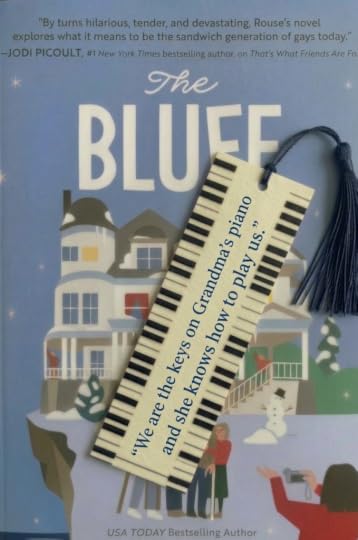
Leah – “We are the keys on Grandma’s piano and she knows how to play us.”
Charli – “Death brings out the worst in people, money brings out the truth.”
Bottom Line – Beneath their cold as ice exteriors, there are heartwarming parts of each of them begging to be seen.
🎧 Narrator: Full Cast: Andrew Eiden, Cassandra Campbell, Dan John Miller, Andrew Gibson, Alexandra Hunter, Dawn Harvey, Arthur Morey, Kate Marcin, Petrea Burchard, Michael Crouch, Kristen Sieh ^ Someone double dipped because 12 POVs, 11 Narrators. Dan John Miller voiced both the elite CS Chapman and his polar opposite, the working-class Bob Brown.
Not yet published. Expected 10-13-2026 Thank you NetGalley and Harlequin Audio for the free *widget* ALC in exchange for my honest review.
^Image - Bookmark I created over book cover on piano key background: "We are the keys on Grandma’s piano and she knows how to play us"
Mackinaw Island in Michigan is a popular tourist spot in the summer months but the location between the upper and lower peninsula where Lakes Michigan and Huron join, is cold and merciless in the winter. The Bluff takes place at Christmas time in a mansion at Mackinaw where there is minimal joy and good will and lots of infighting and just plain dysfunction. A huge blizzard makes travel impossible and shuts off the electricity. Despite all of the anger and angst, there are moments of hilarity that made me laugh out loud.
The Chapman family owns a mansion on the island and spends Christmas there every year. The parents Charli and CS are rich and want to make sure that everyone knows that they can have whatever they want because of their wealth. Charli wants to preserve tradition and replicate everything about Christmas the way things were when she was a child – from where the Christmas tree is placed to the menu for dinner. Her husband is ruthless and cruel – especially to his wife and sons. They have three sons – Chris (married to Kat – an island girl – and two teenage children; Cormac (married to Brie who is a major gold digger) and Chase, the estranged son who is married to Gary and has been kicked out of the family for being gay. Charli gets upset as soon as she arrives and find out that Kat – who is in charge of Christmas this year – has put the tree in a different place than it has traditionally been placed. Then she finds out that Kat’s parents – definitely middle class and teachers – will also be part of the Christmas season. much to the horror of the Chapmans, whose rule that “We do not share Christmas with other people” is about to be broken. To top it all off, a massive storm hits the island and electricity goes out. When the estranged son and his husband show up, things go from bad to worse in Charli and CS’s eyes
This story is messy but tender. It’s a feisty festive family drama about money, marriage, power, and all the things we bring to the holiday table besides the turkey. This book will probably never show up on the Hallmark channel Christmas line up but in many ways it’s more realistic than the happily ever after movies that they show.
The author managed to write this novel from 11 points of view. Every member of the family gets to tell their part of the story including the island of Mackinaw. It is well done and not confusing and helps present a cohesive look at each member of the family and their motivation to act the way they do.
I have enjoyed all of Viola Shipman’s (Wade Rouse’s pen name) books that look at the beauty of Michigan. This is a totally different look at Michigan during the cold dark winter months full of characters who feel like they have reasons to act badly and like it! I found it to be a delightful look at the Christmas that many of us with at least one strange and dysfunctional relative goes through on a day that is supposed to be all about love. Great job Wade!
I won't read a holiday book in October for just anyone, but for Wade Rouse? You betcha!
Rouse penned one of my favorite books of 2026 that I've been shouting about all year -𝘛𝘩𝘢𝘵'𝘴 𝘞𝘩𝘢𝘵 𝘍𝘳𝘪𝘦𝘯𝘥𝘴 𝘈𝘳𝘦 𝘍𝘰𝘳- and now he's back to trade the sunshine of Palm Springs in for the winter wonderland of Mackinac Island.
This year, Christmas with the Chapmans looks a little different. Kat has taken the reigns from snooty mother-in-law Charli and even invited her own parents to the ritzy estate. With a turbulent snowstorm outside and an equally chaotic ensemble under one roof inside, this holiday season is more feisty than festive. Soon long held secrets, ill-conceived schemes, clashing familial traditions and socioeconomic tensions bring everyone to their tipping point.
The Family Stone meets Succession in this spirited dysfunctional family drama. Ever-shifting POVs allow us to see each member for who they truly are, inside and out. You will cheer for some while giving coal to others. What's perhaps most relatable is, as with any family, things are never quite tied up neatly with a bow.
Witty, tender, and downright messy, 𝗧𝗵𝗲 𝗕𝗹𝘂𝗳𝗳 is another triumph from Rouse.
🎙️ With a true full cast narration -Andrew Eiden, Cassandra Campbell, Dan John Miller, Andrew Gibson, Alexandra Hunter, Dawn Harvey, Arthur Morey, Kate Marcin, Petrea Burchard, Michael Crouch, Kristen Sieh- this one's stacked with talented performances and an absolute Christmas gift for the ears.
✨ Thank you to HTP Books and Harlequin Audio for my ARC + ALC! [𝘗𝘶𝘣 𝘥𝘢𝘵𝘦: 10•13•2026]
The author notes the likeness of The Bluff to the Christmas movie The Family Stone and that is exactly the vibe I would use to describe it. With The Bluff, Wade Rouse “finally” sets one of his Michigan based novels on Mackinac Island. Anyone who has visited the island will be familiar with the names and places that are mentioned in the book. In fact, there are chapters told from the Point of View of both The Grand Hotel and the island itself. I especially enjoyed the winter setting of the Mackinac Island setting, as it is one that not many are able to experience first hand. The story is told over the Christmas holiday. The family has gathered on the island to celebrate at their usual location, their ‘cottage’. However, this year, instead of the matriarch running the festivities, the holiday is planned by her daughter-in-law. She tries to modify some of the long held traditions and faces pushback from the establishment. Each chapter is one day or day part and is told from multiple points of view. While there are many points of view, the author does not confuse the reader in the storytelling. In the house we find: a patriarch and matriarch, 2 grandparent-in-laws, 3 sons, 3 in-laws, 2 grandkids, and a dog. What I most liked about this novel is that while there is a redemption arc, there is also an unredemptive arc as well. Things are not wrapped up neatly in a bow at the end, but the reader is okay with that.
I personally would say this is more Succession than Family Stone - but all in all it’s a story full of rich people behaving poorly, dysfunctional family dynamics, and a spotlight on all the work needed to make ‘the perfect family’ actually look good to the public.
This isn’t your average holiday book - yes there is the baking and decorations and bringing family together for the holidays. But instead of a cozy and heartwarming story, it instead delves into family obligations, the pressure, expectations, and weight of it all. All of which I appreciated (with a little cringing at how insane some of the character’s actions are).
There is a lot going on in this ~300 page novel - what with all the lies, secrets, and dysfunctional family. In some ways, the 10+ points of view help build out the story - they let every character show a different version of Charli, ranging from the protagonist of her own story to the antagonist of Kat’s, and every role in between.
That said, as someone listening to the book, while the individual narrators did a lovely job themselves, I often found myself a bit confused on who each chapter was and how that person connected to everyone else in the family. I think this is an example of a fun book, great narrator cast, but the wrong media for my personal ability to process and follow the story.
Thanks to Harlequin Audio, MIRA, and NetGalley for providing me with an advanced listener copy in exchange for an honest review.
This is not a happy book, for all its Hallmark ending. It’s a book about generational trauma, cycles of neglect and abuse, toxic parenting, and whether people can adapt as the world around them changes. It’s family dysfunction played for laughs and giggles, and homages to Christmas movies of the past. If you’re looking for a feel good holiday book, this isn’t it. If you’re looking for something messy and nasty and ridiculous and emotional, this may be right up your alley.
With 10 POV characters — Kat and her husband Chris, her in-laws CS and Charli, her brother-in-law and his wife, her parents, her children — there’s a lot of story to go around, and everyone has one.
Some people love messy drama, and if so, you’ll probably enjoy this book. But if you’re a reader who wants a nice punchy ending or just desserts, that’s not this story. For all that, it’s well written, well paced, and I had a good time reading it.
I had high hopes for this but sadly I'm not a big fan of books about rich people problems. While I enjoyed the Mackinac island setting, there was a lot of dysfunctional family stuff going on and the festive holiday setting wasn't enough to get me invested in these characters or their backstabbing, lying, scheming ways. A miss for me but others might enjoy this light-hearted whackadoodle holiday story more than I did. I will say it wasn’t all bad though. I liked the Somewhere in time movie references and the inner musings from the Grand Hotel, which is sentient being in this book. Many thanks to NetGalley and the publisher for an early audio copy in exchange for my honest feedback.
I really enjoyed the drama this book brought. I could have done with one or two fewer POVs but overall the characters were engaging even if they were mostly caricatures. The Bluff follows a wealthy family over the span of a few days during Christmas. Definitely in the spirit of Succession. Character development was pretty solid for most characters but I really disliked (one of) the antagonist’s endings.