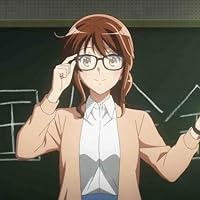
Kumiko Oomae es una joven que se dispone a empezar su primer año en el Instituto Kitauji. Anteriormente había estado en una banda de música tocando el bombardino, aunque me gusta más llamarle eufonio, y pese a que no tenía intención de continuar, acaba en el club de música tocando el mismo instrumento. Aquí conocerá a nuevas amistades y volverá a encontrarse con Reina, ex compañera de banda en el colegio tocando la trompeta. Y comenzará la lucha de la banda por alcanzar los Nacionales.
Novela ligera de la escritora Ayano Takeda, primera de varias, que tuvo su adaptación al anime por parte del estudio Kyoto Animation. Este anime me encanta, y por ello quería acercarme a la historia original. Está bien, y se ve de dónde proviene la semilla de todo, aunque el anime supera a la novela con creces.
Unlike the usual light novels that get licensed Sound! Euphonium is a slice of life story that focuses on band competition and has a female lead.
Please let this be a sign that more female lead light novels will be licensed. Please.
This is the first book of a series, but it ends with enough closure that even if the second book never gets translated it's fine.
I don't really know what to say about this book. Props to Yen On for licensing it, that was a surprise. With all the fantasy killing game harem light novels being brought over this is a breath of fresh air. You just have to be in the right mood to read it or you'll end up like me and not touch it for days.
There's some romance, but it's almost taken for granted. Like, of course, they like each other so no need to focus on it. There was an uncomfortable love triangle introduced, but it gets resolved quickly (thankfully). And while I did like the hints of the couple I wish there had been more development there. Heck, Kumiko and Reina have more development and chemistry. Not that I'm complaining, it's always nice to read stories focusing on friendship, it's just Kumiko was really aware of Reina. Like really. It could be argued she was equally aware of Shuuichi but since he had a lot less page time (it seemed) it just was more noticeable towards Reina. At one point Kumiko wanted to bite Reina's earlobe. Like okay.
I liked how full circle this book was.
But the best part of the book for me was Kumiko. I have never identified so much with a character. She's indecisive and knows it, and there were times when she'd think something I would think, or feel something I would feel. I definitely experienced moments like this:
Kumiko was about the only one still indecisively wandering around the classroom center.
I want to play this. That one looks cool. Kumiko had no such strong preferences. She wished they'd just give her whatever instrument they had to spare. Then she wouldn't have to agonize like this.
I was worried the author would force Kumiko to overcome her indecisiveness in the typical way authors do, but she doesn't (thankfully) and the surprisingly honest conversation that happens between Kumiko and Haruka (?) as a result was really appreciated.
The biggest con for this book (besides having to be in the mood to read about high school students practicing and competing for band competitions) is how hard it was to remember who certain characters were. What made it worse is a character would be referred to by their last(?) name in descriptions, but in dialogue, they'd be referred to by their given (?) name. So sometimes I'd have no idea that Gotou was also Takuya. But that's not a big deal and I feel my constantly taking a break from reading this book had more to do with me not recognizing characters than this.
Final Thoughts: This was a sweet unexpected book. Worth reading to learn about musical instruments and how a band club could be like in a Japanese high school. I'm actually curious about how accurate it is. But mostly I'm glad I read it and met Kumiko.
"There was a moment's stillness - then, as to shatter it, the trumpets' melody. Then, layered above it, the flutes' solo came in. The tubas' thick sound shook the air." I will try not to use too many superlatives, but still - descriptions like that are one of the reasons I like reading. The plot of the book revolves around Kumiko, a high school student from Kyoto, her friends and the whole high school concert band in which they play. In the beginning of the book, the band plays horribly, and its members couldn't care less about it. However, it starts to change with the arrival of a new conductor, which goal is to reach the national concert band competition. The author put an effort in the explanations about the different instruments, the skills needed to play them and the various types of practices (Solfege, Ensemble and so on); it can be easily seen that the writer had some experience in concert band, which makes that book more fun to read. Kumiko's inner struggles are very well-portrayed, and as a high school student, I can really relate to them. The side characters - especially Kumiko's friends - are also well-thought of, unique and realistic, and they are portrayed better than in the anime. From the shy Midori to manipulative Asuka, each character was round and developed and has his own unique style. What I liked the most about the book is the writing style. Takeda knows not only how to write an interesting story, but also how to describe its setting and the elements in it extremely well. It was quite surprising, that the parts in which the band plays were as good as in the anime, in which there was actual music!
All in all, this is one of my favorite books. I expected a novelized version of the anime series by Kyoani but was pleasantly surprised. Whenever you have enjoyed the anime or are searching for a good YA novel, I think you will enjoy this book very much!
As someone who was never in band, I was not expecting a story about the trials and tribulations of a concert high school band to be so utterly suspenseful. A lot of the drama over the mundane and interpersonal that I found so compelling in Naoko Yamada's and Kyoto Animation's Liz and the Blue Bird (a spinoff film based on the books' anime adaptation), I found in full here; nothing more than high school drama and the reputation for some high school's band are ever at stake, but Takeda does a fantastic job showing why these things matter (and why they sometimes don't) to these characters.
It helps that Takeda's prose (and Paul Starr's translation) is as good as it is: intimate in that exact way that brings out tension and beauty in something as unremarkable as eating at a fast food restaurant with a classmate, or waiting at a train stop with friends, or sitting on a bus while headed to a performance. It all makes me wish more of this series 10 volumes were translated and localized here.
As is, though, even with what felt like a somewhat truncated ending, this is a fantastic slice-of-life light novel. This is one of the easiest recommendations I could give to anyone curious about light novels, even if they're not familiar with the anime or with high school concert band.
/edit 9/07/26 I've reread this in Japanese and I stand by my original review
Though the prose is perhaps overly deferential to the original Japanese (the dialogue oddly enough is slightly better localised) the power of the original work comes through keenly, with the author's love of music and Kumiko's own abrasive but genuine personality all coming through quite satisfactorily. There is an odd lack of balance which explains some things in the show though - Shuichi for instance here is better explored but still more of an afterthought, whereas Kumiko's relationship with Reina gets almost no play for half the book and then suddenly leaps to where the anime has sort of primed you to expect it to be. It's a great companion book to the anime, but also leads you to appreciate better how the anime really added to and improved the strong foundations that the novel and its characters laid.
A highly enjoyable read. I hope the sequels and spin off novels get translated by Yen Press soon. I loved the anime and the book did not disappoint at letting me relive the story. Kumiko is an interesting lens to see this world through, as she's a type of main character I have not often seen. She's not strong-willed, independent, passionate, outgoing, brave, or any such thing. She's quiet, lacks self-confidence, afraid to have any real dreams for fear of having them crushed, dislikes conflict and goes out of her way to just go with the flow to avoid conflict, and not all that passionate initially. Because of this initial lack of self confidence, she has a lot of room to grow and I liked her development over the course of the novel. She comes to realize she is passionate about music, really passionate, and finally allows herself to fully embrace a goal even in the face of potential disappointment. But in the end she's still Kumiko and she doesn't change unrecognizably, and still has a lot of room to grow.
I definitely highly recommend the anime if you liked the book. Being able to hear the music performed certainly adds a lot to the story, although I did like the way the music was described in the novel. This novel is the source material for the anime, and they did an amazing job of adapting it. They added a lot to the characterization in the anime and a lot of humor that was not present in the novel.
In regards to the translation, it is mostly well done, with the descriptive passages reading well. Occasionally the characters' lines sound unnatural in English, however, and the translator is inconsistent with the way the characters refer to each other. The translator decided to drop all Japanese words like senpai, kouhai, san, chan, etc., which is fine in general, but this novel is set in a Japanese high school and not a fantasy world, so you lose a lot of cultural and social nuance by dropping these. The characters sometimes use first names and sometimes last names when referring to each other, which is confusing. It just seems like the translator couldn't decide to fully commit to either the Japanese way or the American way in which people refer to each other. For example, Kumiko refers to her euphonium senior, Asuka, just by her first name, even on the day she meets her, which is a bit jarring if you have any knowledge of Japanese culture. However, her other senior and the club president were mostly referred to by their last names (Gotou and Ogasawara). I see a lot of manga keep these titles and just have a little explanation at the end for those unfamiliar with the terms. Overall though, this is a personal preference of mine in translated works and it's not a huge issue.
So, I just finished reading the first and, unfortunately, the only currently localized volume of Sound! Euphonium, which, like the movie, is subtitled Welcome to the Kitauji High School Concert Band. To my surprise, I found out that this book, which is overall less than 200 pages, was actually used as the basis for the entire first anime season with 13 episodes, including an OVA. Because of that, the content is much more concise and condensed, even though the overall plot is the same. Yet, I found it easier to become familiar the characters and their personalities and be sucked into the world. The focus quickly shifts to Kumiko, Midori, and Hazuki as the main trio, with characters like Reina, Asuka, Kaori, and Shuichi appearing in specific scenes. These scenes, thoug, are handled in a way that doesn’t overwhelm you with too many characters at once, which worked well because the book consistently follows Kumiko’s perspective.
One thing that really stood out to me was how skillfully Ayano Takeda structures her writing visually. When it comes to light novels, I often struggle with longer dialogues where it’s unclear which character is supposed to be speaking. Here, though, it was always immediately clear, partly because Takeda breaks up the dialogue with brief comments on the characters’ gestures, facial expressions, or Kumiko’s feelings about the situation, which helps to structure the scene. Additionally, each character has distinctive speech patterns that make them instantly recognizable. This gradual introduction of the characters made it much easier for me to follow along and immerse myself into each character's mindset, without the sensory overload I experienced in the anime, where it could be challenging to focus on the main characters and their interactions amidst the large background cast, especially at the beginning.
However, what the book lacks, due to the limitations of the medium, is the musical accompaniment that enriches the anime’s performances and practice sessions. It made me realize how difficult it is to write a story so focused on music without being able to actually hear the music. Takeda makes a valiant effort, explaining the technical details of the instruments and describing the melodies and ensembles with rich metaphors, but if you don’t have a trained musical ear to mentally translate these descriptions into melodies, it’s hard to achieve the same emotional impact as an audiovisual medium.
One thing that really surprised me was that my most criticized scene from the first anime season—the forced audition orchestrated by Yuuko—was not in the book and seems to have been completely created by Kyoto Animation. The conflict still exists, but here, Kaori simply asks during the dress rehearsal if the audition can be repeated. Both perform without any subsequent vote, and Kaori steps down, realizing that Reina is genuinely better. This effectively addresses all the criticisms I had: Taki doesn’t pass the responsibility to the students, avoiding the problematic notion of making them decide such matters objectively. Reina doesn’t cling to Kumiko in a way that feels inconsistent with her character, and she apologizes directly to Kaori without Yuuko’s involvement, who had instigated the bullying. While Yuuko is still somewhat antagonistic towards Reina here, she isn’t the mastermind behind the bullying, as it’s portrayed more as a group dynamic that develops naturally. I don’t want to outright say that Kyoto Animation "ruined" the series or misunderstood and reinterpreted the characters, as some fans tend to do whenever they dislike something. In fact, I really appreciate many of Kyoto Animation’s changes, especially in season 3, even though this particular alteration didn’t work as well for me. For example, the moment when Taki criticizes her and Kumiko realizes through her subsequent tears that playing music has become so important to her that she finally can cry over it—mirroring Reina and showcasing Kumiko’s character development and the impact Reina has had on her—was missing here. This absence made the relationship between the two feel less significant than it was portrayed in the anime.
However, I did enjoy the stronger emphasis on the connection between Shuichi and Kumiko. Their encounters form a sort of narrative framework: they repeatedly meet on their way home, reflect on the events of the story, share background information about the world, and eventually, Shuichi is the one who helps calm Kumiko’s nerves during the concert when she’s too anxious to play. The frequent act of walking together figuratively shows how they walk side by side, both through the story and through life—starting as childhood friends, playing together in middle school band, and now experiencing together how the Kitauji High School Band transforms from a disaster into an outstanding orchestra, reflecting on this journey during their shared walks home. This connection is much more apparent here than in the anime, which also helps to understand the special role they play in each other’s lives.
Overall, I found the book to be quite good. Even though some aspects in the anime enhance the story, I still felt that the book serves as a great introduction, offering a wonderfully immersive experience in the world and the characters, with a very appealing structure and a clear, easy-to-follow writing style.
This entire review has been hidden because of spoilers.
In this inspiration for Kyoto Animation’s beloved show, Kumiko is a high school freshman at Kitauji High School who’s chosen to go to a school with few of her former middle school classmates so that she can “reinvent” herself. But Kumiko isn’t quite sure what reinventing herself means here, she’s not even sure if she wants to join a new club or continue with the concert band like she did in middle school (although she’s certainly turned off by Kitauji’s horrid performance). Thanks to new friends and new teachers however, Kumiko and the rest of the concert band are in for their most demanding year ever.
Usually when I review a light novel I’ll mention which episodes of the anime it correlates to. Sound! Euphonium, however, is unusual in the fact that this slim book made up the basis for all 13 episodes of the first season of the anime. Reading this book it’s really hard to see how the anime created 13 episodes out of it but I don’t want that to be the focus of the discussion here. I will say however that I was rather struck at how different my interpretation of the main character, Kumiko the euphonium player, was between the anime and this volume.
In the anime Kumiko seems like a snarky teenaged girl who isn’t quite bored and isn’t quite philosophical but who seems to think a little more deeply than you would expect from a 15 year old. I truly saw the young woman she would become; Kumiko too often would let a blunt truth come out of her mouth but it was something her friends, especially trumpet player Reina, valued her for. It was easy to see how Kumiko would learn to become more careful with the wording all while continuing to observe the world raptly and she was a easy to sympathize with main character.
In this volume however Kumiko feels a little more shallow and typical. Her musings are less present and she seems even more pulled along by her friends than in the anime. In short, Kumiko (in this volume at least) feels even less sure of her place in the world and this quite honestly makes her less relatable.
In both versions of the story Kumiko is not the most talented member in the club (or even her brass section), the most dedicated, or even the most experienced member. But in the anime this didn’t conflict with her status as the main character as Kumiko’s past experience in concert band and her status as a freshman member of Kitauji’s band let her stand on both sides of the band’s many underlying tensions, seniority vs talent and drive to win vs urge to enjoy their time. But in this volume this makes her feel even more adrift since she never takes a major role in the conflicts nor do they seem to affect her as much.
Sound! Euphonium is a series so it would make sense to say “well this is only the beginning of the characters’ growth, there’s more coming!” Except that author Ayano Takeda has said that it was after seeing the finished anime that she began to write sequels.. When Kyoto Animation optioned this series it was a one-shot, there was no further promise of growth. So what seemed like foreshadowing with some of the side characters, like Kumiko’s section leader Asuka, was more like coincidence. And so I feel, rather bizarrely, that not only the adaptation surpassed the original but it also inspired the original to create more!
Taken solely on it’s own, this is a perfectly fine slice-of-life light novel about a girl living in contemporary Japan without the slightest trace of fantasy, a rarity in the American light novel market these days! But I cannot help but compare it to the brilliance of the anime and how it used its additional time to flesh out side characters even further. I’m more interested than ever now to read the other volumes in this series (and, if Yen Press would kindly license it, the spin-off about the Rikka High School marching band) to see how Takeda continued to take this work.
So I never participated with the series, but I had seen imagery and heard some things. I anticipated some Yuri vibes, and some of the scenes definitely can be read into that way though there's no definite homosexual character relationships going on yet.
Kumiko is not the most likable of protagonists because she has these glaring flaws, particularly her go with the flow / majority attitude. Kumiko doesn't make choices in her life; she follows the guidance of a sibling to the band, then reenters band in Highschool at the persuasion of friends. Her instrument is not her choice in either band either. She doesn't have that self-confidence, not only in herself but in others to help her succeed. Just a very sad character, but she also remains difficult to empathize with since her go with the flow attitude leads her to doing dubious things, like eavesdropping and talking behind a teacher's back.
The rest of the cast is a hodgepodge of some memorable characters, but a lot of similar physical characteristics and cliched girlish conversationalists. The ones that stand out as significant are Reina (childhood friend female who is a musical prodigy), Shuuichi (fellow childhood friend), Asuka (Kumiko's section leader), along with the two newfound friends, Midori and Hazuki. Outside of them, there are a variety of characters that enter and exit the stage, like Yuuko, Kaori, Ogasawara, Aoi, and Natsuki. Again, most of these characters have black hair as a descriptive element, which doesn't do much for the reader, so you kind of have to imagine what they look like on your own to make them stand out from each other (there's no pictures in this book).
I'll admit I came to this book because I loved the anime and I wanted to relive/compare to that and boy did this book not disappoint. Yes, the anime had amazing animation and music, but this book proves more than anything that the strength of this story comes from its characters.
Its a very simple story, following a high school band that at the beginning is pretty terrible, but with their new director they begin to improve and soon start to think they might have a chance at the big competition at the end. It's a story that has been done plenty of times before, but its the people involved that make it special. The way the characters are written, the way they interact and develop, it's simply wonderful.
Kumiko, our main character, is my favourite because I completely get her. I get her indecisiveness, her desire to not make waves and just go with the flow and it so heart-warming to see her slowly getting sucked into the band and the excitement, all the way until she herself believes that she can actually do this and even admit as much. This is a story about a school band, but its also a story about a young girl finding out what she really wants.
big fan of the anime! The anime follows the plot of this pretty closely, but this reads quite a bit drier than the adaptation which emphasizes the strength of Kyoto Animation's work and ability to improve and expand on source material. I'm not sure if I would really rec this to anyone who isn't already a fan of the anime. It's not bad, I think Kumiko is well-written and the way the band and music stuff is written is interesting and isn't too information-dense, but I do think the story benefits greatly from being able to hear the music and instruments playing so I would probably opt to rec the anime instead.
Also, I genuinely thought the Kumiko/Reina stuff was exaggerated in the anime for fan service so I was surprised about how much of it was in the source material. Same for Asuka/Kaori, I would say that their relationship was more heavily implied in this than in the anime.
I loved the anime so this is not an unbiased review. Reading this bright back many familiar images from what was a gorgeous and high-quality KyoAni show.
I came for the Kumiko/Reina and was delighted that the scenes from the anime did in fact come from the book. The scenes with Shuuichi and the feelings for Taki are still there, but the way Kumiko talks about Reina, the way she feels when she's with Reina, idk I just think it speaks for itself.
Many light novels are about gaming, so reading one about people and their feelings was a very pleasant change. This made me think a lot about my own experiences in middle and high school band, too.
I really hope that the other books by this author get translated into English, too. I would love to read them.
This novel was adapted into an anime series a few years ago that was a favorite of mine, and reading the original work (newly translated into English this year) reveals just how much of the strengths of that series came from the book.
Sound! Euphonium is equally interested in conveying the emotions & experience of being in a high school musical group as it is in the coming-of-age story of its protagonist, Kumiko --- and it's very good at both. The passages that describe performances, in particular, are flowing and lyrical in a way that reveals the strength of this translation.
Basically, reading this book made me nostalgic for high school orchestra in the best way. It's good!
A slice of life book where there's not a satisfying payoff. It also has lesbian baiting. Really there just too much technical infodumps that take up a lot of what this book is and Kumiko is very much not a part of what's going on. Everyone else around her is having the drama play out, but she herself is more of an observer. Also it sexualizes middle school to high school girls and that's gross. Reina has a crush on her teacher as well to add to the grossness. Really Taki, the teacher, is pretty much the male POV character.
Genuinely one of the best books I've ever read, and a translated one no less. I am not good at providing examples, and I don't want to give anything away; I'll just state that this book has one of the best amounts of balance I have seen. Balance as side characters coming in when you expect it but in different and unexpected ways and events happening at a very good pace.
P.S. The descriptions in this book is phenomenal!! You never really realize that they're description and get a very good picture of the emotions and technical details of the surroundings and even the music.
I do know there are fan translations of the next books in the series, but for some reason I’d like to read an official translation. (Mostly to make sure I support the author). I don’t see that happening short of learning a new language. However, this book was decent, but I did catch two errors in the last 10 pages. Otherwise it’s a nice light read.
This took a while to finish because Anime Expo 2017 happened. The anime adaptation is one of my all-time faves and the source material did not disappoint.
Docking off 1 star because of the not so low key queer-baiting.
This is definitely one of the better-written light novels to be released in English, with more focus on character development and less awkward description.
A nice read, overall very well written with vivid characters, but I wish the end wasn't that rushed. And I also wish that the second book was translated already because there is so much more to develop.
Un mondo, bandistico, incantevole (trasposto televisivamente ancora meglio). Anche se con tutte le peculiarità di quelle giapponesi molto fedele e reversibile agli ambiti reali di bande ed orchestre di fiati. Peccato solo che la light novel si trovi solo in inglese.
It was nice to be back in the world of Sound! Euphonium again since I loved the anime so much. I really hope they translate the other light novels someday, since I enjoyed this one so much.
DNF: Page 64 And thus I have discovered a new disinterest in light novels. I did not connect with the characters nor the story and it was like pulling teeth to read it. I'd much rather read the manga, if there is one. (When I initially bought the book I thought it was a manga. When I unwrapped it and discovered it wasn't, I gave it a shot.)