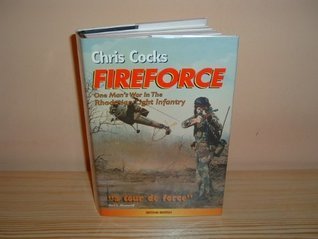
Among the finest war memoirs ever written; from among the most controversial wars ever - "Fireforce: One Man's War in the Rhodesian Light Infantry", Chris Cocks' memoir of his three year enlistment and tour with the Rhodesian Light Infantry (RLI) during the Rhodesian Bush War is among the finest memoirs of war ever written. It has been positively compared to numerous other war classics, both fiction and non-fiction, including "All Quiet on the Western Front" and "The Red Badge of Courage."
This is a "warts and all" memoir of soldiering. Not for the faint of heart.
Cocks is a good writer and captures the sights, smells and experiences of soldiering with a keen wit and a sharp eye. From basic training through the tragedies and triumphs of small unit combat to his final muster out, Cocks gives the reader a near perfect soldier eye view of life in the RLI, Rhodesia's answer to the US Army Rangers, as they fought for the life of their country in a war they could not win.
The Rhodesian Bush War resembled the Vietnam War in that it was unpopular, possibly unwinnable, and for whom the Rhodesians were constantly portrayed as the bad guys -- racist, western colonialists who stole the country from the black African majority and therefore deserved to be hated, ostracized, and embargoed.
The truth, as usual, was more complicated. Rhodesia was never genuinely apartheid like it's neighbor (and ally) South Africa, and the Security Forces were largely made up of black African Rhodesians who hated communism and knew the white minority would protect them from the extreme tribalism that consumed their neighbors. Alas, the combination of sanctions and negative press forced the White majority to cede power. And Robert Mugabe, with assistance from the United States, China, and the Soviets, was pushed forward as the savior of Zimbabwe. Sad.
Cocks largely ignores the politics and leaves the army shortly before the end. Ironically, he did join the Army as a political liberal, from a family that opposed the Ian Smith government, and was disinterested in the larger politics behind the war. He served as a loyal soldier, one who fought for his mates, and fought well. And suffered, as a result, of the PTSD, drug addiction, alcoholism, and relationship dysfunctions that plague soldiers after they come home from war. Especially a war in which they are branded the losers. All this is laid out well and is gut-wrenching to read. But too important a part of the story to ever leave out.
I read this memoir with a heavy melancholy as the world knows how the Rhodesian Bush War ended. Despite their tactical successes, the Rhodesian Security Forces could never keep pace with the manpower and equipment losses the war placed on them. Not with the UN, OAS and the Western Free World all refusing to support them and opening the way for the Communist Chinese and Soviet guerrillas to enter the political system and take over in 1980 with the election of Mugabe. the tragedy of war is much more poignant when the cause is a lost one, as every reader of a Rhodesian Bush War story knows this is how it is going to turn out.
But the best way to memorialize the sacrifice of men who served honorably, for the right reasons, or at least for their mates, is to keep reading these kinds of memoirs. With that in mind, I highly recommend this memoir and encourage you get a copy. It has recently been re-issued by Mr. Cocks with a different cover. You can find it on Amazon by searching for "Fire Force."
This is a must read history from a period most people have no knowledge of.
HIGHLY RECOMMENDED.