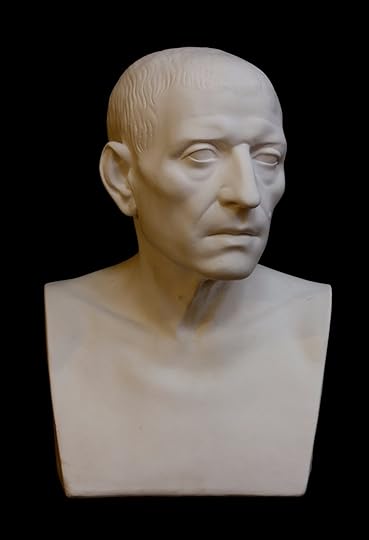
“Always at such moments I think of Scipio’s dream of where dead statesmen dwell in On the Republic*:
‘I gazed in every direction and all appeared wonderfully beautiful. There were stars which we never see from earth, and they were all larger than we have ever imagined. The starry spheres were much greater than the earth; indeed the earth itself seemed to me so small that I was scornful of our empire, which covers only a single point, as it were, upon its surface.
‘If you will only look on high,’ the old statesman tells Scipio, ‘and contemplate this eternal home and resting place, you will no longer bother with the gossip of the common herd or put your trust in human reward for your exploits. Nor will any man’s reputation endure very long, for what men say dies with them and is blotted out with the forgetfulness of posterity.’
All that will remain of us is what is written down.”
*Cicero’s politically and philosophically Romanized redux of Plato’s Republic. The quoted passage here is one of the dialogue’s most famous.
This was a great book, a powerful book, and the last—and best—of Robert Harris’s Cicero trilogy; an epic conclusion befitting the most dramatic and extraordinary epoch in human history. Harris’s three Cicero novels are written from the first person perspective of Tiro, a historical personage who actually did write a biography of Cicero that was later referenced by Plutarch and Suetonius. Alas, Tiro’s biography of Cicero does not survive (for lovers of history and of books, a tragedy nearly on par with the central tragedy of the books’ plot), though Tiro himself lived a life almost as impressive and singular as that of his master. He was born a slave of the wealthy but provincial Cicero family, who hailed from Arpinum, about sixty miles from Rome, and in his late teens or early twenties (Tiro was born in 104 BCE and Cicero in 106, making Tiro about two years Cicero’s junior), was chosen by the young Marcus Tullius to be his secretary and amanuensis—a position which was to give Tiro unparalleled access to the statesman throughout his long political career, as well as a unique vantage point on his work. It was also in his position as amanuensis that Tiro developed a revolutionary system of shorthand for which he became the first, and, I believe, only freedman to ever be officially honored by the Roman Senate (some of the innovations he made in shorthand still survive—e.g. the term “e.g.,” as well as “i.e.” and the ampersand. Maybe not quite on the same level as the Philippics or On the Republic, but truly incredible, nevertheless).
Although Cicero eventually granted Tiro his freedom, Tiro chose to remain at his former master’s side until his (Cicero’s) death, at which point Tiro set about writing the great man’s biography. (I can see the “Gladiator”-like movie trailer now:
“… The man who became a slave. The slave who became a man Friday. The man Friday who became a modestly remunerated personal assistant. The personal assistant who chose to remain at his master’s side after being freed so he could write his biography…
Only in theaters this summer… ” (cue dramatic music))
If you’ve ever read history, chances are it’s either been about World War II or the late Roman Republic. The story of Cicero, Caesar, Pompey, Cato, Brutus, Antony, Cleopatra, Crassus, Catilina, et al. has been told so many times by so many of our greatest historians, biographers, historiographers, philosophers, ethnographers, sociologists, novelists, and poets (Shakespeare’s Julius Caesar and Antony and Cleopatra are perhaps the best known renderings of the period, but it’s endlessly debatable), that I won’t recapitulate it here. Suffice it to say that Harris could have taken ten books to tell the story of Cicero’s life—his rise and fall, and rise… and fall—or even twenty, thirty, fifty books to tell it, and reading them would still be worth it. That’s how good the story is—the “real” story, I mean. Harris’s riff on the history, though, is both original and historically accurate—quite a difficult feat to pull off. And, of course, it’s desperately, thrillingly, compulsively readable.
While even a passing familiarity with the history behind the story is enough to feverishly enjoy these books, the more you know about the time period, the more enjoyment you’ll derive from it. So if you’re a little hazy on the history of the late Republic, brushing up a bit first would not be a bad idea. I loaned my copy of “Imperium” (book one in the series) to my dad as soon as I finished, but then took it back and gave him my copy of “Rubicon” by Tom Holland to read first instead. It’s a short history of Caesar’s astronomic rise and meteoric fall, centering on that most famous of river crossings, and is a perfect way for anyone who’s a bit rusty on Roman history to quickly reengage with all the relevant political machinations and melodramas of the late Republic before diving into the “Cicero” trilogy.
Hannah Arendt once said—only half-jokingly—that the worst kind of fame to have is posthumous fame. I tend to agree; after all, it ain’t exactly like you’ll be reaping the rewards at that point, is it? But if you’re to have it, why not have it like Cicero or Caesar or Cleopatra, and take it in spades? Two-thousand years on from their deaths, and we’re still telling and retelling their stories, and still interested in reading them.