
What do you think?
Rate this book


314 pages, Hardcover
First published January 12, 2016


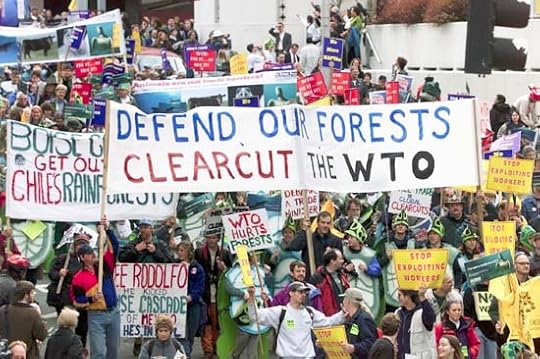
...the days of community policing were over. The world was a bottleful of sparkling darkness and the cops were charged with keeping the cork in it while the rich shook and shook.The contradiction inherent in the title is realized in Your Heart is a Muscle the Size of a Fist as Sunil Yapa, in his remarkable first novel, brings us inside the 1999 anti-WTO protests that rocked Seattle. Over the course of a single day the seven main characters struggle with rage and love, alienation and connection, honor and shame, sacrifice and safety.
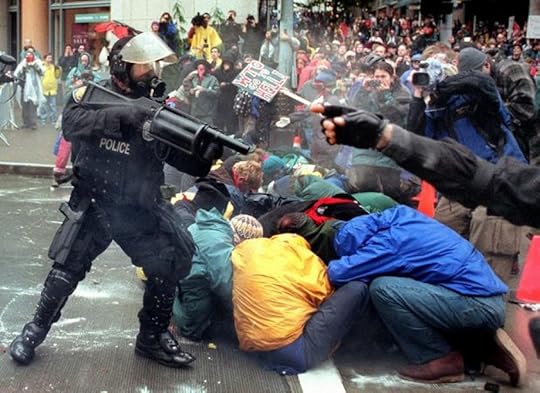
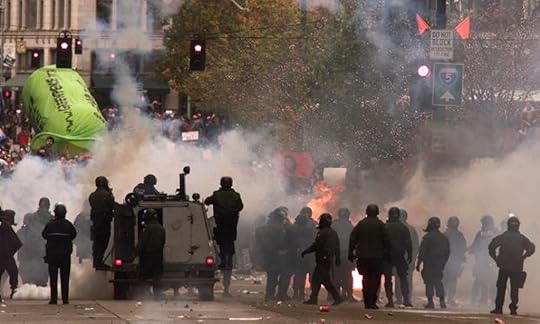
Some say the heart is just like a wheel, when you bend it, you can’t mend it. - from a well known song by Anna McGarrigleSeveral of the seven main characters are trying to fix that dented rim. Bishop has suffered the heartbreak of loss, and wants his son to learn that attachment, that caring leads to crushing disappointment. Victor is trying to fill the void left by the loss of his mother and his falling out with Bishop. King, who has become a cop-whisperer at such gatherings, who sees herself as someone “with only love in her heart,” has blackened that heart with a terrible act, and carries the guilt with her every day. And what if the goodness of the human heart was not assured?
King knew she would remember, drifting toward sleep some day far removed, the solid thump the wood made falling upon him. It was the sound of the true heartbeat of the world, and once it had been heard, there was no way to stop hearing it. Thump-thump. Thump-thump. And what was it in that long and prolonged instant—what was it that told her this pain would go on forever? What was happening there was no erasing. There would be no apologies, no forgetting, no reconciliations. Just the opening to the pain that is your friend dead or shot or starved or beaten. Disappeared into the place where the disappeared die. She saw six cops standing over him and there was something in the way their fists rose and fell that made her heart want to stop. Like a clock that had run out of time.John Henry leads and endures in the turmoil of the protest - they would not stop until they had accomplished what their hearts had demanded they do. Wikramsinghe’s heart is with his countrymen, but he must guard it in the rough and tumble of negotiations.
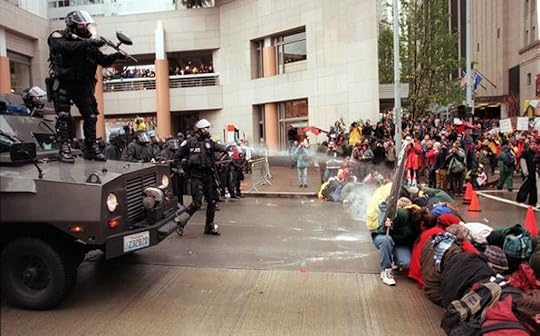

1999 WTO protests.
People around the world live in abject poverty. The mentally ill are out on the streets. Children are starving. Big Pharma is creating monopolies of health. American corn subsidies are impoverishing agricultural nations. The US is shoving hormone treated beef down the throats of unwilling Europeans, under the guise of 'free trade'. Workers are being exploited. Terrible injustice permeates human existence.
But, there is hope: "He heard them saying in the streets, 'Another world is possible,' and beneath his ribs broken and healed and twice broken and healed and thrice broken and healed, he shuddered and thought, God help us. We are mad with hope. Here we come." And, for those who come together in such displays of hopeful protest, their collective action and standing together is how "they hold the fear in their mouths and transform it into gold"...
"The man who took her hand in his, not an effort of restraint, but holding her hand and looking into her face, and in his eyes she saw not the state, not institutionalized evil, not modern medicine and all its chemical compromises, not the death of human connection, not a servant of the state which built prisons for you at every turn, no, what she saw in his eyes, in his face, was nothing more than simple human concern, the sudden affection of one human being for another."
The necessary numbness, the cold core of watchfulness, and the problem of remaining a person yourself, a person who cares. A person who feels. A person who does not hate.
"American bodies no longer on the line. No longer employed in the so-called manufacturing sector. American bodies too expensive for work so they find cheaper bodies to feed the machine."and
"What a violence of the spirit to not know the world."But when he's off…oh boy
"And yet there he was, his son, looking and smiling through his half-opened eyes, not a look of concern, but as if he understood in some way, the sometime knowledge of what this is, the knowledge of the whole ugly beautiful thing, the knowledge of the courage it takes to move into fear and to fuck up and to go on living, knowing that sometimes it is two people alone and some small kindness between them that is not even called family, or forgiveness, but might be what some, on the good days, call love."That ladies and gentlemen was a single sentence. No, I'm not a grammar cop. To me it demonstrates Yapa's desire to be profound and insightful and (in my view) it falls short.
She fought the urge to just turn and run. There were bodies laying [sic] everywhere, the police wading through the pile up, three or four cops walking with spray bottles that looked like small fire extinguishers, the spray looping over them in an arc. King kept her head down. She kept her hands clean as she tried to remember what John Henry had taught her.
The best protection is a gas mask. However, we can no longer recommend the Israeli gas mask as the lenses have been known to shatter on impact.
King saw a woman on her knees in the middle of the intersection. Her hands clasped in prayer, her face a mask of running blood.
Of course the locals thought they were crazy. But on their hill they had no neighbors. On a clear day, a hundred, two hundred miles of vision. Sight lines in every direction. No neighbors who could see like this.
God help us, we are mad with hope. Here we come.This novel walks a fine line between eye-rolling earnestness and conscience-shaking indictment. It worked for me, it will not work for some. A dozen themes and portraits of inequality presented within: I highly recommend reading.
But he knew It was only human nature to believe it best to ignore suffering. To focus on your own good fortune. The human survival mechanism. To say your prayers, thank your gods, and hold your breath when you pass the slums. The sweet poison of privilege wasn’t it? To think blindness a preferable condition.Alongside this:
And yet, there they were, whether you wanted to see it or not. The unwanted of the world. People begging on the street. People without enough to eat. People without the medicine and doctors to make them well. People without proper clothes or homes, without clean water to bathe or drink.
Did these self-congratulatory club members think their inherited wealth came from nowhere save their miraculous good luck? Did they not find a connection between their obscene wealth and the obscene poverty all around them? Perhaps it was too much to suggest the fault was theirs alone. The upper class was too god-damned stupid to be blamed, frankly. But how could they do nothing? How could they look upon their fellow creatures suffering and do absolutely nothing? He didn’t have an answer for that.
What preceded success was not moral courage, but moral compromise.
Doing something, he had discovered, anything, however small, that contributed to your meaningfulness of self and surroundings—well, that was the trick. That was the trick to not feel like shit.
–and–
What is the function of the heart, if not to convince the blood to stay moving with the limits where it belongs, to stay at home.
Stay at home, stay at home, stay at home.
But restless thing that it is, your blood, it leaps into the world.
–and–
...{T}hey learned that courage is not the ability to face your fear, heroically, once, but is the strength to do it day after day. Night after night. Faith without end. Love without border.
They wanted to tear down the borders, to make a leap into a kind of love that would be like living inside a new human skin, wanted to dream themselves into a life they did not yet know. He heard them in the streets saying, “Another world is possible,” and beneath his ribs broken and healed and twice broken and healed and thrice broken and healed, he shuddered and thought, God help us. We are mad with hope. Here we come.
–and–
Tiresome people, but he knew it was only human nature to believe it best to ignore suffering, to focus on your own good fortune. The human survival mechanism: to say your prayers, thank your gods, and hold your breath when you passed the slums. The sweet poison of privelege, wasn't it? To think blindness a preferable condition.
“What we require of others so that we may live our lives of easy convenience. Dad, there are people who work all day every day for thirty years assembling the three wires that make a microwave timer beep. What are we supposed to think of this? How do they survive it? Why do we ask them to?”
–and–
“Son, how easily an open heart can be poisoned, how quickly love becomes the seeds of rage. Life wrecks the living.”
It was 1999 in America, he had traveled the world for three years, looking for what he didn’t know, and now here he found himself: absolutely allergic to belief, nineteen years old, and totally alone.
–and–
And yet there he was, his son, looking and smiling through his half-opened eyes, not a look of concern, but as if he understood in some way, the sometime knowledge of what this is, the knowledge of the whole ugly beautiful thing, the knowledge of the courage it takes to move into fear and to fuck up and to go on living, knowing that sometimes it is two people alone and some small kindness between them that is not even called family, or forgiveness, but might be what some, on the good days, call love.


