Burrowing through the goldsmiths' quarters and hidden archives of London, Tokyo, and Istanbul, Katharine Sterne is on the trail of a ruby, diamond, and pearl brooch once worn by Queen Elizabeth I. Interwoven with the tale of her hunt is that of a pair of Iraqi Jewish brothers who traveled to London two hundred years earlier with fortunes made from an unearthed jar of priceless stones. Spanning two continents and six centuries, The Love of Stones follows three very different people, each consumed by the same desire-possession of the legendary jewel-which binds their stories together in an irresistible quest.
Tobias Hill was an award-winning English poet, essayist, writer of short stories and novelist.
He was born in Kentish Town, north London, to parents of German Jewish and English extraction: his maternal grandfather was the brother of Gottfried Bermann, confidant of Thomas Mann and, as owner of S. Fischer Verlag, German literature's leading publisher-in-exile during the Second World War. Hill was educated at Hampstead School, a comprehensive institution, and Sussex University.
Hill first came to attention in the 1990s as a poet and author of short stories, with early work appearing in magazines such as The Frogmore Papers: he later became established as a novelist. As a poet Hill published four collections, Year of the Dog (1995), Midnight in the City of Clocks (1996), influenced by his experience of life in Japan, Zoo (1998) and Nocturne in Chrome & Sunset Yellow (2006): the last of these was described by The Guardian as "A vital, luminous collection...it is rare to come across a collection of poetry that you know with certainty you will still be reading years from now, but for me, this is such a book."
Hill's only collection of short stories, Skin (1997), was serialized on BBC Radio 4, was shortlisted for the 1998 John Llewellyn Rhys/Mail on Sunday Prize, and won the International PEN/Macmillan Silver Pen Award.
Pilnīgi godīgi - es mēdzu izvēlēties grāmtas pēc vāka un spriest par tām preikšlaicīgi pēc izdevniecības vien. Šai grāmatai tāda taktika noteikti nav vēlam,a jo šis noteikti nav tipisks "Kontinenta" romāns. Nebrīnos, ka autors pirmsākumos bijis dzejnieks, nevis prozaiķis, jo te nu uzsvars ir uz tekstu un domu, nevis uz sižetu, Jā, burtiski atstāstot, tas izklausās tipiski - mūsdienu sieviete meklē leģendāru dārgumu, seko tā pēdām un šķiet, viņai seko grupa augstāk organizētu spoēku, kas grib iegūt to pašu dārgumu. Bet te arī visa līdzība ar a la Davinči Koda grāmatām beidzas. Mēs iepazīstam tēlu, kurš patieši iemīlas dārgakmeņos kā ideālā, kas dodas to meklēt, lai galā izvērtētu sava ideāla vērtību. Tieši šāda pozēija, kas nav pozēzija, bet proza ar sižetu, man patīk.
One of my very favorite novels. Different characters intertwined in the story of a broach, being sought by an obsessed woman who serves as the center of the novel.Historical and psychological. An intricate page turner.
A challenging and difficult read that was also compelling and wonderful. Often, somehow, simultaneously?! Not, in any sense whatsoever, a 'historical thriller' (oh blurbs, what are you), but certainly a timeslip novel in my eyes.
I take issue with reviews which brand the female narrator badly written or an obvious stand-in for a male, just because she's not performatively feminine. She is certainly a flawed and interesting person, both obsessive and capable of change, competent and dogged and strong, while at the same time vulnerable and often frightened. I liked Katharine, in so far as such a character can *be* liked. As far as I can tell, such reviewers are annoyed that she doesn't spend enough time worrying about her hair/make-up/clothes and what other people think of her and her appearance. I found this a refreshing change, honestly; just because oppressive insecurity about body image is embedded in most female presenting people, does this mean that all authors must inflict it on their readers through every female presenting character?
Anyway, this is brilliantly and starkly written and was definitely a must-read for my PhD research. Will certainly repay rereading in the future.
haunting, obsessive, and suspense like a tide! as someone who adores a storyline where two separate characters from different timelines have entwined destinies, the love of stones is the perfect example of the beauty of this trope! also love a woman who is devoted to her special interest. the way the author writes is now part of my inner monologue as i go through daily life, it’s so good!!
p.s. katharine sterne, they could never make me hate you
This book has stood unread on my bookshelf for years. I am astonished I never opened it before. And now I have read it -and I absolutely loved it. While I agree with many other reviewers here that the story is overlong and the detail bordering on excessive; the characters are rarely sympathetic; the narrative is labyrinthine and complex. Yet for all that, it is a wonderfully exotic story of tales within tales haunting the reader even after the final page.
It is full of almost magical happenstance where one continually needs to suspend disbelief as characters meet exactly who they need to meet, exactly when they need to- out of the blue in a huge city in which they have arrived with no money or contacts. But this element of magical realism only adds to the sense that this is more like modern epic, an Odyssey or the legend of Gilgamesh for a modern world, the jewels the holy grail on which so many lives have been shattered over the ages.
This haunting magical tale is worth more than minor quibbles. The arcane world of ancient jewels and their journey through history is fascinating; the strange and wandering Odyssey Katherine makes in her search takes us to places off the beaten track, opening up worlds unknown. Even the underbelly of Victorian London is revealed from a very different angle.
It was to the author’s credit and genius that when the story finally reached its denouement, all the disparate ends were neatly sewn up. I never quite expected such a satisfactory resolution. The Love of Stones is also beautifully written as one would expect from a poet. The language is exquisite. Best book I have read this year!
A wonderful read (from 2001) over several weeks: many of the books I read don't fall into the category of 'un-putable-downess'. I regularly laid aside this 465-page quest for some legendary, but real and royal, jewels (The Three Brethren), to enjoy the poetic & literary & narrative afterglow of some stunning writing by Tobias Hill, a writer of real quality, encapsulating Katharine Sterne, the main misfit protagonist, & jewel-hound, an exiled German octogenarian, Eva Glott, & the Jewish Levy brothers, Daniel & Salman, of Baghdad who emigrate to mid-19th century London (& meet the uncrowned Queen Victoria!), before the climax in contemporary (the cusp of the milennia!) coastal Japan! This full-value tale is full of colourful & exotic scenes; the characters are almost all eccentric with the feel of obsessive madness lurking close to their human surfaces; and the pace is perfect for a satisfying 'long read'. How often great books seem to engulf us as readers in a world we never imagined happening all around us...a world stretching back hundreds, thousands...& in the case of rubies, diamonds & emeralds...millions of years!. The human passion for beautiful things...animal, vegetable or mineral...will never disappear...as priceless objects often do!...
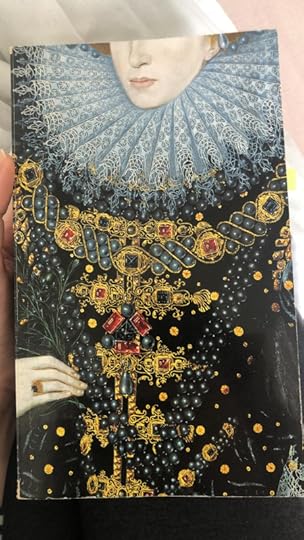
I very much liked the starting point, eloquently displayed on the cover of the book. I had seen the Ermine Portrait of Elizabeth I a few times, observed the rich decoration but not untangled it - Tobias Hill did this for me. I am very grateful to him for pointing out the Three Brethren, a large brooch in fact. But I do wish that Hill had chosen a different character for carry out his quest, possibly male, instead of Katharine. I had a hard time with her but she had all these adventures, this travel and this thirst, obsession almost, to find the jewels. I did not warm to her at all. And the Jewish brothers ditto. I think that Hill wanted to tell an epic story but I would have been happier with fewer pages and a less ambitious plot.
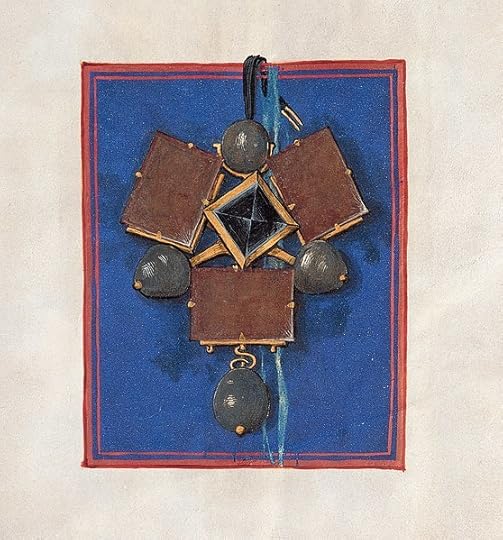
2.6 stars Katherine Sterne is obsessed with finding Thd Bretheren, a cloak clasp created for Philip of Burgundy, worn by Elizabeth the I, sold to pay for armies and missing for hundreds of years. 3 rubies, a large diamond and pearls. She follows a cold trail from Turkey to England to Japan. At the same time, the story follows two brothers, Jews from Baghdad who journey to England to make their fortunes, and help fashionable new crown for young Queen Victoria.
The premise was good, but I had a hard time liking the characters. I ended up skimming the portions about the 2 brothers living in the Victorian slums.
Received as a mystery book - Don't give up after 100 pages, because the first part of the book felt like a dump of knowledge name-dropping obscure names. Once all the history of the stone was regurgitated, the imagery of the story really drew me in. I could so vividly picture Turkey and Baghdad, but the execution of that imagery was very choppy. The author frequently used short bursts of descriptive words rather than sentences. After researching the author and finding out he is a poet, it made me understand the stylistic choice, but I still didn't really like it.
The transitions between the brothers' story and Katherines felt very disjointed, and halfway through the book I was confused as to why I had so much background on the brothers but none on Katherine. As the book came to a close however, I understood the reasoning behind it and finally felt like I knew the character really well but I felt like it took too long to get to that point. Overall I liked the book more than I thought I would, but the execution of it really took away some of my enjoyment.
I expected more, lyrically, from an established poet...what I got was an excellent sense of place from the descriptive settings, a choppy plot that doesn't quite knit together fluidly and characters about whom I remain lukewarm. Some of the situations seem a bit contrived, as well...but the story, rather the themes, have stuck with me after two years, so I can't complain that it was an overall bad book. Definately not good, though.
A 14th century jewel, second to none, whose whereabouts are unknown for some four hundred years? Great potential for a story, to my liking somewhat wasted in this book that I purchased only for its cover, hah. ↓
This being the jewel called The Three Brethren/The Three Brothers: "a triangle of gold. A medieval design, from Burgundy. A knot as big as the palm of my hand. Gold set with eight stones. One diamond, three rubies, four pearls."
I only really enjoyed a few moments in this book. Main's character (Katharine) hunt for the jewel in Istanbul and later in Diyarbakır, Turkey. On the very last 10 pages of the book, the main's character search after the Three Brethren was compared to that of Gilgamesh after immortality. Katharine is being read a passage from the Epic of Gilgamesh "After two leagues the darkness was thick and there was no light, he could see nothing ahead and nothing behind him. After three leagues the darkness was thick and there was no light, he could see nothing ahead and nothing behind him" and so on until after the end of twelve leagues the sun streamed out. She later ponders Gilgamesh's pursuit of eternal life and asks the man that had read it to her whether or not he found it. He answers: "No. There is no point to it. It isn't that kind of story."
It is then a little disappointing that at the very end when she finds/is handed the jewel, she voluntarily leaves it behind and sets out to look for the man, the reader of Gilgamesh, the lover.
There's a scene with two siblings who had to kill their pet dog in self defense. The boy digs out a grave and the girl climbs down to it to test the size. Extremely powerful image.
"There was a term in Japanese. 𝐸𝓃𝑔. It was both a concept and a word of advice. It meant that anyone you meet may be the most important person in your life. Therefore, that every stranger should be treated as a friend. Loved before it is too late. You never know in which night your ship is passing."
"Extinction is all...Extinction makes a necropolis of the earth. These impressions of lost creatures are the proofs and epitaphs of a scientific truth. Christians, Mohammedans or Hindoos, we stand on the bones of more lost species than will ever walk the earth again-"
Both Gilgamesh and Katharine give way to inevitability of life (destiny?) and perhaps even blissfully yield to it.
This entire review has been hidden because of spoilers.
this could have been a 4 star book except for two major flaws. The first being that the author flipped between modern day and several centuries giving the history of the gems and two story lines. I'll say clearly that the history was very interesting and well written. And the story line of the two Jewish brother from the 19th century was good too. Howeverver, the transition from one time to another were clumsy and poorly introduced. I find little need to switch scenes so often.
Secondly, the main protagonist was awful. She was not a person who was fleshed out enough for the reader to get to know her. I don't need to like her but I do need to know her. the author might learn something about writing good female characters from Wally Lamb.
Totally random Oxfam Books find that I absolutely loved. The book loosely follows the misadventures of Katharine Sterne as she searches for a lost jewel known as the Three Brethren. Katharine is an obsessive and rather paranoid narrator, but I really warmed to her as the book progressed. It’s clear that the quest consumes her but it also gives her a sense of meaning, something which is so elusive for many.
I don’t usually love two historically distant - yet intertwined - narratives as they can feel a little contrived, but I thought this worked quite well. It really reminded me of There Are Rivers in the Sky, especially the Mesopotamian/Iraqi angle and the descriptions of Victorian London. Recommended.
This book was actually very good but it did take quite a bit of effort to read. I was almost ready to give up when I hit page 100 but I thought I may as well stick with it as I had got that far and it proved to be worth the effort. The parallel stories are excellent, the prose is beautifully simple and the characters very real in a nasty way - I found at times that I really didn't like the main character but at the same time she kept me enthralled. If you pick up this book then trust me it is worth sticking with!
A difficult book to read, interesting yet not. Time lines were muddled, story itself was disjointed. Not really historic fiction although there were some references to Queen Victoria and her famous crown. The main character Katherine was interesting, obsessed with her search for The Three Brethren jewel. The brothers Daniel and Salman Levy and the young orphan street girl Martha were all likeable as was Hikori, and although the story eventually comes together it took too long for that to happen. Not the most favourite book I have read.
A strange a fascinating story of obsession. In her search for the Three Brethren, Katharine Sterne will stop at nothing, setting aside family, relationships and even her own health. A century earlier two brothers, Iraqi Jews, acquire it without knowing what it is. Their journey and lives intertwine with Sterne's as she scours the globe and discovers that she is not alone.
I found this book thoroughly engaging from start to finish, and was deeply impressed with Hill's storytelling skill.
This book is well-written, let me start with this. But the premise is too high to its contents. I like the many historical facts shared, I really enjoyed Daniel and Salman's parts more than Katharine. And with the book ending on her POV? Meh. Idk but I didn't like the ending, years wasted only to have it like that. This book is longer than it should have been. 3 stars still because I truly enjoyed some parts despite skipping some.
3.5 Complex, haunting, understated epic of one woman's obsession.I need to think more about this novel and may upgrade my rating. The prose and plotting are so dense and multi-layered that it is a book that requires enormous attention and reflection in order to properly absorb.
The kind of fiction I quite love - there is history, travel, mystery and parallel stories set in different centuries that finally intersect in surprising ways. Add to it very poetic language, and you have a narrative that keeps you engaged through all 400 pages of it. An absorbing read.
A smart friend recommended that I would love The Love of Stones, and he was very right. It's full of just the right amount of obsessive history, and romance, and does a swimming turn between the past and present.
I struggled with this one. The author really labours the point about human greed and the dehumanising impact of jewels with uninteresting characters and an off-puttingly choppy prose style. Persevered in the hope that it would get better but it really didn’t.
What a beautiful story (or rather, stories)! But why does the author use so many words to tell it? Not my kind of a book... But great if you like poetic ways of describing the reality.