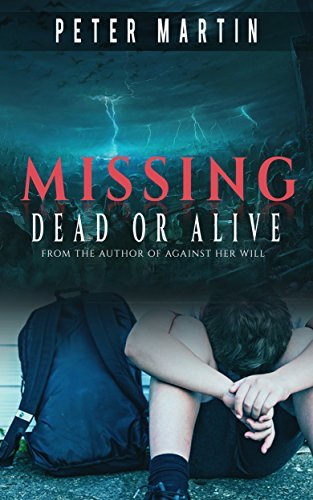
When Tim, Maria and Bob’s fourteen year old apparently model son goes missing, they are baffled and distraught. A police investigation reveals Tim wasn’t quite the son they thought he was. Frantic attempts to find him fail, and when their quest becomes an obsession this causes problems between them. But they never give up, and are determined to find him DEAD OR ALIVE, even though it may cost them dear.
“Will there still be a chance for new beginnings?”
First off, I should say that I really enjoyed this psychological thriller. It had a strong beginning which really set the scene; a good storyline which might have been a little too detailed for some, but which I liked for its descriptive narrative and dialogue; and an ending which held some hope and promise for a better future, but only given time!
This must be the scenario every parent dreads the most. Your teenage child goes missing with no word or trace, leaving you helpless, lost and bereft. But that’s only the outer layer in this multi-faceted storyline, which is well constructed, slowly evolving and very compelling. Peel back the layers of this middle-class suburban family and it doesn’t take long before reality takes hold, the stress cracks begin to show, and eventually life as Bob and Maria know it has crumbled away and is lost forever.
Very character driven, the first half of the book deals exclusively with Tim’s sudden disappearance and Bob and Maria’s desperate search for answers as to why. The story evolves slowly and deliberately, taking in all the nuances of the emotional angst and distress this potentially life-changing event brings with it. Two lives put on hold, a marriage fractured and broken by the continual disappointments of false sightings and the longing for answers to all to all those endless ‘why’ questions. The seemingly endless tunnel of despair, with no light at the end. No arms to hold and comfort during those long dark days and nights, as the couple grow ever further apart. The unspoken guilt and blame of things left unsaid and actions never taken. The eventual realisation that somehow life has to go on, but not really wanting it to. The reality of togetherness, yet feeling so alone and abandoned. No fast-paced action, just a slow dawning that their son has gone from, or been taken from them and that if and when he chooses, or is able to find his way back home to them, it will be at a time of his own choosing – or maybe never at all!
Almost every thought and word from those days, weeks and months after Tim’s disappearance is recorded in detail and I enjoyed the slow unravelling of this relationship and the ensuing aftermath of devastation, guilt, anger and recrimination. However, as visually descriptive and observational as it was, I did find the style of narrative and dialogue quite ‘clunky’ and perhaps a little formulaic. I would have liked a little more fluidity and smooth flowing passion, at what would have been a very emotional time for everyone. I tried to take myself back in time to 2011, when this book was first published, however on careful reflection, I still also felt that a little more in depth research about police procedures in the early days after a child is reported missing, might have made events a little more credible.
The second half of the book really ramps up the pace of the plot building and events begin to take a very disturbing and sinister turn. Peter ratchets up the air of suspense and tension quite nicely and although I worked out where things were eventually leading, there were plenty of twists and turns along the way. It seems as though everyone is out to get Bob and Maria one way or another and the plots and schemes flow thick and fast, although in all fairness neither of them are really much good at helping themselves out of a situation. Will the dread and menace in these sudden turns of events draw them together, or push them ever further apart. Or is there even going to be a future for either of them? Author Peter Martin has very specifically not included any ‘spoilers’ in that concise premise, so I’ll leave it for you to discover for yourself!
Peter did amass a good cast of characters, who kept true to their roles right to the end. They were well defined and developed, although none of them were easy to connect with or invest in. They were all rather shallow, selfish and self-centred, emotionally weak and complex, and almost masters of their own demise, making this on the whole, an entire cast I really loved to hate, exactly as Peter had intended I’m sure.
The writing style and technique of delivery may not always have been to my personal taste, however I am not here to critique the author, so for personal enjoyment, intrigue and the ‘edge of the seat’ ending, it is a definite 4 stars!
This is terribly written. It's like a teenager writing just as he talks. I managed 13% but that was more than enough. Not a hope I was going to wade through more than 300 pages. We had "Time to see what Tim was up," then "As she peered at him feeling a little sick." Tim mentioned he had some revision to do and his mum says "Oh-you should have said, we might have been able to help".....for real ?? There were lots and LOTS of misplaced commas. He uses a lot but not where they should be. For example "You sure you're alright love", "Well if you're sure" "...he stepped inside glad to be home" "The meat pie had started to brown, she saw opening the oven door" "On returning from the kitchen, Bob looking up from his armchair" He mentions a house bathroom, an odd turn of phrase, I thought. He sometimes added a question mark for no reason, again just how people speak. Sorry, but it's just unreadable.
The story opens with every parent’s worst nightmare: their son fails to come home from school, and makes no contact. They wait… and wait… as the hours tick past, and finally dial 999. The police offer no help: children much younger than fourteen go missing often, but they usually come back. Forty-eight hours later, when no friends or relations the couple contact have news of the boy, the police do start an investigation, and discover nothing.
A television appeal is set up. We’ve all seen them… the much-loved son or daughter… a good student… friendly and thoughtful… It’s always someone else’s child, except this time it’s the only son of Maria and Bob Shepherd. Slowly, as the cracks begin to show in Maria and Bob’s marriage, facts come out that don’t add up with “the perfect son”. Evidence, some faked, some perhaps true, reveal a Tim his parents don’t recognise.
Maria, who almost lost her life giving birth to Tim, idolises him and refuses to accept that she will never see him again.. Bob doesn’t want to admit the boy with whom he shared football, and so much more, would stay away if he was free to return. Forced, if Bob is to stay in work, to move, they relocate but lack of trust between the couple sees Maria return to live with her parents, still hoping Tim will reappear even though the police investigation is abandoned. Dead or Alive? Which is it, what happened to Tim, and why? This is a compelling story of a couple ripped apart by tragedy in mysterious circumstances and the suspense is maintained to the end.
I found this story to be a cross between contemporary and thrilling mystery. Mystery isn’t always my favorite but this one is unique to me. It reads like a Lifetime drama but I mean that in a good way! I love Lifetime so this was something I took an instant liking to.
We essentially have two plots tied into the story, the main being the disappearance of Tim—a fourteen year old boy who is normal by all means. He’s at that age where he sleeps in a little too much, he slacks off here and there but at his core he’s a good kid and that’s portrayed very well and very clearly in the short time we have with him as a reader.
Tim’s family, his mother Maria and his father Bob, are also very ‘normal’ parents. Maria is not a nagging mother or wife who bothers her family to no end. She is strong in the sense that she keeps herself together as best she can when her dear son goes missing. A good portion of the emotion in this book is evident all on its own, we are dealing with the case of a missing child, after all, but Maria provides a large chunk of the emotional ride as well. That’s to be expected from the mother but I think it’s unique in this book in that Maria didn’t just curl up and cry the whole time. She actually devotes herself to finding her son even after her husband has begun to accept it. I thought she was a good example of how these situations should be viewed and addressed.
Bob was a good character as well, he wasn’t at the forefront as much as Maria was in my opinion but I really liked his incorporation and his handling of the case. He was the more rational of the two which I appreciated. The author split the story into two different reactions. We have the more logical thinker represented by Bob and the emotional thinker portrayed by Maria. It was interesting to pick up the little hints of this underlying message within the story. How to handle a loss, how to deal with a missing child.
I’ve never thought of this kind of situation, who wants to imagine that? But I think this book shines a light on a very dark, and a little bit depressing, area. I’m not sure if that was the actual intention of the author but I’d say this is a good fictional way to raise awareness of the struggles faced by victims of sudden disappearances.
The second storyline in the book is Bob and Maria’s marriage. You should expect it to crumble, as it does, with the situation the characters find themselves in. But I thought the story of their marriage helped to provide more insight on this kind of event and even progressed the story. Without the inclusion of this detail in their lives, the story would have felt empty and even unrealistic so I thought it was a great addition.
This is a unique mystery thriller, it comes so close to reality as it tugs at your heart strings and challenges your emotional hold. It is a strong story with strong characters and even more powerful message. I have high hopes for this book in the near future.
A boy of fourteen goes missing and his parents, the central characters, are naturally distraught. The tale follows them as they seek police help, hunt for their son and gradually draw apart under the stress. As their lives have to move on, they each find other partners and the stress of the son's disappearance continues to be a major factor, although it is some time before the concept that they have been manipulated really sinks in with them.
Seen as a psychological study, we have to admire the author's look under the surface of suburban life and the tensions on a family struck by an open-ended tragedy.
Some aspects of this story are well done and characters well drawn. I found however that other aspects needed a lot more research and police procedures in particular. The formatting is peculiar in that the paragraphs do not start on indents - it is so easy to set each paragraph automatically starting on an indent that the lack appears amateurish. Spelling is occasionally faulty - as a chest of 'draws' which should be drawers; there are apostrophe confusions which could be sorted out by an editor. On the other hand, nice local phrases are used and we get a real feel for the situation.
Looking at the missing persons enquiry: when a person under age has gone missing, the police take immediate steps. They do not wait for forty-eight hours before getting concerned, especially as the child has no prior record of absence. An adult is allowed to go somewhere without telling anyone, but a child of fourteen is assumed to be at risk. The police would immediately ask for a photograph and within a short time would send an officer to check all through the house and especially the child's own room, with the parents' co-operation. They would form an impression of the home life and family tensions while doing this, would seek clues as to the disappearance and would ascertain that the child was not hiding or hidden on the premises. All the more so since in one real case, a small girl's body turned out to be wrapped in plastic and hidden in the attic. The police would also on the first day ask about any relatives the child has that he might have gone to visit. We do not know of any relatives until halfway through the book when the mother goes to stay with her own parents, who live in the same town. The mother never even contacted them earlier in the story (that we know of), which is just unreal.
A police officer can ask someone to come to the station for questioning, then either let them go, or arrest them. A police officer cannot 'throw them in a cell overnight' without arresting them. If a witness or suspect is not under arrest they are free to go. If they are under arrest this will be said aloud and they will be read their rights, mainly that they have the right to remain silent but it may harm their defence in court. They will have the right to a solicitor and if they cannot afford one the state will appoint one. The parents in this case would certainly have demanded a solicitor (but probably paid for one) as soon as it became clear that they were under suspicion of causing their son's disappearance. The police in this story do not comply with the Police And Criminal Evidence Act (PACE) so would rightly lose their jobs.
A credit card statement is said to contain purchases the parents did not know about, at the time of this teen's disappearance. The parents would have a) told the police and b) been onto their card company at once. No credit card owner wants uncontrolled purchases made on their card and would suspect a teenager, or a foreign phisher, equally but would get it stopped. They would cancel the card and get the money refunded immediately. The police would not just dismiss this without even asking to see the statement or what was purchased. If a train ticket or plane fare was purchased, that would tell them one thing; if a camera or such was purchased, they would want to know if it was bought on line, in a foreign country or in a nearby shop in person; if goods were purchased which did not show up, it would be assumed that they were sold to fund drug purchases. More so as the teen was clearly unreliable by this point. Nobody even mentions drugs as a cause for unreliable behaviour which would be the first assumption these days.
No CCTV is ever mentioned. Ever. A witness places the boy on a bus; the police would take the CCTV from the bus and check for him. Footage from near his school and transport links would be checked. Sightings are confirmed or dismissed by street cameras, shop cameras, public transport cameras these days. Britain is the country with the most CCTV cameras in the world. A home video is produced but that is a different issue. No journalists turn up on the doorstep asking family or neighbours for stories. After a new development some years later, the police are not informed and play no part, nor do the press. You think?
I'm sorry to sound negative, but on top of the great work done on the human side, the author seems to be letting down both himself and his story by not getting basic and important facts right. I have to take it that the author is himself under age and doesn't have a credit card or read police procedural books. I'll be very interested to see what he can turn out in a few years when he's got on top of that end of matters. In the meantime take this story Missing as a psychological chiller.
I was expecting a gripping psychological suspense thriller, but I was disappointed. A teenage boy goes missing for no apparent reason. This is the story of how it affects the parents left behind. I thought this would be an interesting take on the disappearance. I just found it so hard to read. The language used wasn't gripping at all. The characters were not believable and all spoke with the same 'voice'. There were moments where I thought it would pick up, hence the 2 stars.
When a talented and promising young boy goes missing, Maria and Bob Shepherd seemingly ordinary lives came tumbling down or so it seems. But in the quiet town of Dexford, a disturbing mystery is about to unfold. Missing: Dead or Alive is a tragic tale of a missing child. The book is suspenseful and moves at a brisk pace. It will hold the reader’s attention till the very end.
A classic psychological whodunnit. We start with the worst nightmare for parents - their only child goes missing, and from then on we follow the disintegration of their marriage as the worry bites into their relationship and they separate to make other relationships. Then after five years, the son reappears inexplicably and proceeds to wreak havoc with their new relationships. This is a recipe for high drama in what is a very dozy middle-class world where nothing much ever happens, and the author handles the development of the story well. There is a tendency to state the obvious when the story has just made the point, and the characters are not delved into deeply enough for my liking - for instance, I was slightly disappointed that the character of the son was only hinted at and not explored. However, the author may have wanted to keep him as a shadowy figure and concentrate on the suffering of the parents. I was also left with a feeling that there was no 'redemption'at the end of the book. Somehow I feel there should have been after such a harrowing tale - but again, the author may have wanted to leave the protagonists and the situation unredeemed. It was a thrilling story, nicely underplayed, and one constantly wanted to turn the page to find out the next development. That, together with the clarity of the writing, made it a good read.
Bob and Maria Shepherd face the ultimate horror, when their fourteen-year-old son, Tim, heads off to school one day and disappears. While trying to find out what happened to Tim, they must face dastardly false accusations, employment alterations, and new friend manipulations, which put a major strain on their own relationship. However, years later, after facing the worst of dealing with their son’s disappearance, a sudden turn in the mystery brings a new disruption to Bob and Maria. Facing the unknown horror of the disappearance of one’s only child is a base fear that will draw many psychological drama fans into the initial heart of the story; however, the main characters soon face a lot of plot devices that attempt to hype up the tension without much foundation under these plot actions. Manipulations are applied for the minimal motivations, which does not provide a solid base of reality. This seemingly constant flow of plot changes have no direct connections between them, making the main couple the unlucky recipient of a string of “snake eye” consequences. Without these solid connections, strong motivations, or base foundations to drive the story, it becomes difficult for the reader to build empathy with the main characters, including the one who has disappeared. The basic premise was promising, but the lack of depth was disappointing.
Tim, Maria and Bob's, fourteen year old son goes missing. Tim is by all accounts a wonderful kid albeit a teenager so who really knows. Tim leaves for school one day and then never returns, a parent's worst nightmare.
Maria and Bob take the disappearance very hard although Bob seems to accept it after some time passes. Maria on the other hand devotes her life to the disappearance of her son.
Several months after the disappearance Maria and Bob are forced to make a decision regarding their future, which ultimately leads to heartache for them both. Can they move forward and still hold onto the memory of their missing child. It is a question they both are forced to answer and they do so in very different ways.
The story moves at a decent pace in the beginning but lags a little towards the middle before picking up the pace at the end. It felt to me like the story could have used a little less dialog, which in turn would have picked up the pace. The characters are well developed and very interesting. The plot twists were thrilling. Overall, it was a good book.
Missing - Dead or Alive is a story about a 14 year old boy who one day mysteriously disappears without a trace. His parents search in vain for him but police are unable to come up with any clues to his whereabouts.
The premise of the story is very strong and the first act does well to draw the reader into a nightmare situation. One certainly gets the sense of dread parents would feel if their child had gone missing. There is a plot point in Part I where the cops begin to suspect that the parents had something to do with their sons disappearance. The writing is very effective during this section and does well to raise the tension and drama.
The length of the book caused the story to lag at times. The motivations of the characters at certain points felt contrived, as if they were simply acting in a way to move the plot forward and some of the dialogue between the husband and wife in the aftermath of the disappearance sounded forced and didn't ring true. All in all a good read for someone looking for an interesting take on the missing person genre.
'Missing' - Dead or Alive' transports the reader into the minds of a troubled couple as they struggle to come to terms with the mysterious disappearance of their teenage son. Experience their their inner most thoughts, their hopes and fears and then the anguish as neighbours spread malicious rumours. An inevitable strain on the family develops, the underlying question of why has he gone is unanswered until the last few chapters. This creates a new series of problems. 'Missing' is written in an easy read style. Perhaps the story becomes slightly tedious in the opening chapters as the couples' obsession with the disappearance is explored in detail. The pace quickens as the story progresses and climaxes in the final chapters as the mystery unravels. I found 'Missing' to be an enjoyable read. An everyday couple coping with a series of devastating events. I was given a copy in return for a honest review.
This book really intrigued me. I was thinking it was just a cut and dry missing child book but it had a deeper influence. It really focused more on the decline of a marriage as a result of the loss of a child. I found that aspect of the book very interesting. The book was more of an examination of the reaction of the parents to the missing child than a mystery as the boy's disappearance takes second stage to the decline of the parent's marriage. I will not tell more or it would give away plot points and that would ruin the book for you. Some parts were difficult for me to understand but I think that was more of an issue with the author writing in a different style of language then I am used to. Sorry Midwestern gal here more proper British writing will cause me to have to adjust. Overall it was an easy read with some interesting twists and turns. Lovers of mystery novels will enjoy this book.
I must say that I did not think this book was a bad book or that I did not enjoy it, but it felt long. However it was not actually long at only 320 pages...The writing and the extra details made me feel as though the ending was no where near.
This book was more about the missing boy's parents and their relationship rather than the actual missing son. It definitely had some twists and turns, but the synopsis of the novel and other reviews had me expecting the son to not turn out to be the "model" that his parents believe him to be. I also found a few detail to be hard to believe and left with a few questions. I will not write more on that as I do not want to spoil it for anyone planning to read this book.
I haven't looked into whether or not this author has written other stories, but I'm not sure at this point I will be checking them out. Maybe one day!
When a young boy of fourteen goes missing, an only child, his parents are devastated. Eventually the police start investigating, but then strange evidence is presented to the grieving parents about their son forging sick notes and staying off school. This was the boy they thought a high achiever bound to go far in life who had never taken a day off for illness.
Circumstances force the couple to move to a new location, although the nastiness of some neighbors is something they are relieved to leave behind. While Bob forces himself to move on with his life, Maria is stuck in the nightmare of her only son missing. What happens next isn't fair to either of them, but very understandable given the stress of the situation.
What happened to their son, Tim? I didn't guess. It was a magnificent twist to a thrilling book. Loved it.
I found this story to be quite a compelling read. Here we have a nice suburban family. The young son is only fourteen, never really been a problem to his parents and a promising student. One day he just goes through his usual routine of going to school but then is never heard of again. What a nightmare to begin with, your son missing but when a video shows the father and the mother digging out in in the backyard and then putting a bundle into the hole, this can only be perceived as macabre.
Through their anguish for their missing son their lives change considerably and not all for the better.You will enjoy the twist and turns, the ending is to be believed. Peter Martin has you second guessing yourself.
Grim subject matter, a missing child and the parents left to despair as his absence creeps ever longer. Add in a touch of hopelessness (things go wrong at every turn), then start mixing it up as the twists start coming.
Was their son really the model son they were so sure he was?
Quite to my liking, with excellent plotting, the story reminded me of an episode of CSI with the way the it kept getting pulled in unexpected directions as developments... well, developed.
As the surprises mount to keep you turning the pages as quick as you can, Missing - Dead or Alive is at times almost a horror tale: part adrenaline pumper and part psychological thriller, I enjoyed it and will definitely read more from this author.
Missing, Dead or Alive, is a novel based in England. It could best be described as a mystery, but has the added bonus of a surprise twist. The two main characters are Maria and Bob and the story is largely centred around their relationship. When their teenage son goes missing their lives takes a turn for the worse and the plot follows a course not too dissimilar to what you would find in the popular British soap, Coronation Street.
I am not a fan of Coronation Street, but I did appreciate how Peter Martin (the author) explored the effects of loss and how this affects us all differently. He does this very well and his characters are realistic even though the turns and tumbles in their lives tend to be overdone. Overall I thought this book justified a 4 star rating.
I gave it a lot of thought before giving this 1 star to this book. I even went back to the GR stars scale meaning, but that's it, I didn't like it. I give it the credit that it managed to keep me from leaving it aside, it kept me reading it. The author has a good technique to make this happen. I think it's too "flat", many chapters went by without major interesting things. Some loose ends and some interesting things that could have been exploited but weren't. Some natural reactions for a parent were not seen in the missing boy parents. The idea is good and can be capitalized with an editor. I'm glad there are other reviews with good grades.
This book gripped me from the start, Missing, Dead or Alive is a psychological thriller and every parent's worst nightmare. When Tim disappears his parents are devasted. The story takes you on an emotional roller coaster as his they struggles to understand why. Bob and Maria thought their world was perfect but with Tim gone the cracks slowly start to appear. The tension builds as the story unfolds. I found myself racing through the book to find out what happens. There are lots of twists and turns that keep your reading until the end.
'MISSING - DEAD OR ALIVE' is a fast paced psychological mystery novel. The story starts with a young teenager, Tim, who does not come home from school. The police are soon involved in the search of the missing child, but things are not what they seem to be and for the teenager's parents, Maria and Bob, a real life nightmare begins. This is a fast paced gripping story and I really found it difficult to put the book down. The characters are well developed and the suspense is intense. I recommend this book to anyone who loves a gripping mystery novel.
I am having such a hard time reading this book. It has lots of promise but I just can't get thru the typos, misplaced punctuation marks and mistakes: Maria is glad it's Friday because they're off weekends from work but then he has to call their jobs the next morning to let them know they can't work due to their missing son, and she works part-time as a cashier at a grocery store but he has a powerful Audi and they have an upscale home? It seems like a teenager wrote it. I hate to write bad reviews but I simply can't give a good one.
I appreciate that the author took the time to write and share this story, but this tale frustrated me. It could have been a great book, but a) it seemed a book that didn't know what it wanted to be: a mystery about a missing son or the decline of a marriage? Being both made it long and tedious, and I was impatient, and b) it could have used a lot more editing before publication. Overall, it's right there between "it was okay" and "I didn't like it."
Gripping physiological thriller which is all the more intense due to it's grounded nature. The set up, the characters and the relationships all give the impression that these are real people dealing with a parent's worst nightmare and you won't want to put it down without finding out if they get a happy ending.
The writing is smooth, the characters have depth and the dialogue is crisp. Looking forward to reading more from the author.
The writing I have to say seemed somewhat amateur, but the story had me wanting to read on to find out what had happened to Tim, however only in the closing chapter did it seem like we might finally get some answers, on the contrary it explained nothing and left me feeling frustrated and bitterly disappointed!
When a talented and promising young boy goes missing, Maria and Bob Shepherd seemingly ordinary lives came tumbling down or so it seems. But in the quiet town of Dexford, a disturbing mystery is about to unfold. Missing: Dead or Alive is a tragic tale of a missing child. The book is suspenseful and moves at a brisk pace. It will hold the reader’s attention till the very end.
2.5* rounded up. I'm so sorry but I only managed around 30% of this book. The premise, the storyline line kept me going BUT, it's just so wooden. No real feeling, emotion or reality about anything. He said, she said kind of story. Unlike me to give up, but I did try. I'm sure there is a good book in there somewhere.
This was a very good mystery. The suspense held you till the very end . I read till early in the morning just to find how this would end . It really is worth reading . I recommend this book.
This book was so easy to read. It kept me turning pages rapidly. So glad I found it . Keep producing thrillers like these. So very enjoyable. You think as a parent you have all the answers, don't put all your money on it.