Jump to ratings and reviews
Rate this book

All The Wild That Remains: Edward Abbey, Wallace Stegner, and the American West

Rate this book
Archetypal wild man Edward Abbey and proper, dedicated Wallace Stegner left their footprints all over the western landscape. Now, award-winning nature writer David Gessner follows the ghosts of these two remarkable writer-environmentalists from Stegner's birthplace in Saskatchewan to the site of Abbey's pilgrimages to Arches National Park in Utah, braiding their stories and asking how they speak to the lives of all those who care about the West.

These two great westerners had very different ideas about what it meant to love the land and try to care for it, and they did so in distinctly different styles. Boozy, lustful, and irascible, Abbey was best known as the author of the novel The Monkey Wrench Gang (and also of the classic nature memoir Desert Solitaire), famous for spawning the idea of guerrilla actions—known to admirers as "monkeywrenching" and to law enforcement as domestic terrorism—to disrupt commercial exploitation of western lands. By contrast, Stegner, a buttoned-down, disciplined, faithful family man and devoted professor of creative writing, dedicated himself to working through the system to protect western sites such as Dinosaur National Monument in Colorado.

In a region beset by droughts and fires, by fracking and drilling, and by an ever-growing population that seems to be in the process of loving the West to death, Gessner asks: how might these two farseeing environmental thinkers have responded to the crisis?

Gessner takes us on an inspiring, entertaining journey as he renews his own commitment to cultivating a meaningful relationship with the wild, confronting American overconsumption, and fighting environmental injustice—all while reawakening the thrill of the words of his two great heroes.

368 pages, Paperback

First published April 20, 2015

135 people are currently reading
3278 people want to read

About the author

David Gessner

39 books121 followers
David Gessner is the author of fourteen books that blend a love of nature, humor, memoir, and environmentalism, including the New York Times bestselling, All the Wild That Remains, Return of the Osprey, Sick of Nature and Leave It As It Is: A Journey Through Theodore Roosevelt’s American Wilderness.

Gessner is the Thomas S. Kenan III Distinguished Professor at the University of North Carolina Wilmington, where he is also the founder and Editor-in-Chief of the literary magazine, Ecotone. His own magazine publications include pieces in the New York Times Magazine, Outside, Sierra, Audubon, Orion, and many other magazines, and his prizes include a Pushcart Prize and the John Burroughs Award for Best Nature Essay for his essay “Learning to Surf.” He has also won the Association for Study of Literature and the Environment’s award for best book of creative writing, and the Reed Award for Best Book on the Southern Environment. In 2017 he hosted the National Geographic Explorer show, "The Call of the Wild."

He is married to the novelist Nina de Gramont, whose latest book is The Christie Affair.

“A master essayist.” –Booklist

“For nature-writing enthusiasts, Gessner needs no introduction. His books and essays have in many ways redefined what it means to write about the natural world, coaxing the genre from a staid, sometimes wonky practice to one that is lively and often raucous.”—Washington Post.

“David Gessner has been a font of creativity ever since the 1980s, when he published provocative political cartoons in that famous campus magazine, the Harvard Crimson. These days he’s a naturalist, a professor and a master of the art of telling humorous and thought-provoking narratives about unusual people in out-of-the way-places."
--The San Francisco Chronicle

Ratings & Reviews

What do you think?
Rate this book

Friends & Following

Create a free account to discover what your friends think of this book!

Community Reviews

5 stars
344 (23%)
4 stars
630 (43%)
3 stars
387 (26%)
2 stars
68 (4%)
1 star
20 (1%)
Displaying 1 - 30 of 223 reviews
Profile Image for Howard.
440 reviews381 followers
January 19, 2021


HEADLINE, January 18, 2021:
President-elect Biden to end Keystone XL pipeline in fight on climate change


Biden is expected to soon reverse the efforts of the Trump administration and end a project proposed more than a decade ago.

******

“We simply need that wild country available to us, even if we never do more than drive to its edge and look in. For it can be a means of reassuring ourselves of our sanity as creatures, a part of the geography of hope.” – Wallace Stegner, Wilderness Letter

******

David Gessner calls his book “part dueling biography, part travel narrative, part meditation, part criticism, part nature writing.” I would add that it is also an environmental manifesto.

In the book, Gessner writes about two Western writers who were deeply committed to protecting the Western environment, whose personalities occupied opposite ends of the spectrum, mixing like a classic case of oil and water. It is true that they used different methods, but it is also true that they pursued common goals.

Probably most people who know of Wallace Stegner (1909-93) or who have read his work think of him as a critically-acclaimed novelist. He was that, of course, and he was awarded a Pulitzer Prize (Angle of Repose) and a National Book Award (The Spectator Bird), but he also wrote a number of books and essays in which he championed the cause of wilderness preservation. His writing was instrumental in the creation of the Canyonlands National Park in Utah and also the prevention of a dam that would have flooded the Dinosaur National Monument in Colorado.

While Stegner worked inside the system and relied on reason to accomplish his objectives, Edward Abbey (1927-89) was a social nonconformist who was often driven by instinct.

Stegner married only one time, a marriage that lasted sixty years, and only ended when he died in an auto accident in Santa Fe, New Mexico in 1993. Abbey, on the other hand, struggled to commit himself to being a husband or a father. Married five times, he was a failure as a husband, but as somebody wrote, he was even a bigger failure as a father. But he wrote two books that exerted a tremendous impact on the wilderness preservation cause.

Desert Solitaire is a memoir about the two years he spent as a fire spotter in the Arches National Park in Utah. The book brought recognition to the park and America’s arid wilderness much in the same fashion as what Henry David Thoreau did for Walden Pond. The other book, The Monkey Wrench Gang, is a novel that advocated sabotage as a means of hindering development in the West, such as roads and, especially, dams, that were destroying the environment.

Both Stegner and Abbey were environmental activists, but while Stegner’s method was the written word Abbey was willing to resort to whatever was necessary. Gessner writes that “While Stegner’s political thinking was more sophisticated and restrained, Abbey’s words had a rare attribute: They made people act.” Abbey’s words made people use unlawful means such as blowing up bridges, sawing down billboards, or pouring sugar into the gas tanks of bulldozers, actions that came to be called “eco-espionage” or “eco-terrorism.”

The differences between the two men could be summed up this way: Stegner thought moderation was a virtue; Abbey thought moderation was a vice. In fact, Abbey once criticized Stegner for his “excess of moderation.” Nevertheless, Stegner’s methods were effective in salvaging wilderness areas in the arid West.

Gessner does a masterful job of interweaving “Abbey’s unrepentant wildness and Stegner’s brainy restraint” while at the same time presenting his own views about the current vulnerable status of the region that both men fought to preserve. The result is that Gessner is inspired by both Abbey, the renegade, who favored direct action as a way to disturb the system, and by Stegner, the staid professor, who was willing to work within it. He writes:

“It may be an overstatement, but let’s try this one on: We read Stegner for his virtues, but we read Edward Abbey for his flaws. Stegner, the sheriff, Abbey, the outlaw."

Gessner tells us that scientists believe that the West is experiencing the worst dry period in over 800 years. The result is that drought caused by climate change “has helped aid massive fires and bark-beetle infestations that have already destroyed close to twenty percent of the region’s trees. As for the boom in fracking and other mining, it would not have surprised [Stegner and Abbey] one whit. The West had always been a resource colony, there to be exploited.”

Gessner summarizes:

Why should anyone actually stop coring out the last of our lands, sucking up the last of the gas, damming the rivers? It’s what we have always done. We came upon this country of plenty and took everything we could get our hands on. We didn’t care what got in our way: native people, geography, climate, logic, whatever. We rationalized this as a kind of brave, bold, can-do way of being, and in some cases it really was. But in many cases it was, and remains, about greed. In many cases as raiders, pure and simple, we remain.

******

Thank you, Bill, for recommending the book.
Profile Image for Quo.
343 reviews
September 30, 2025
Alas, I am tempted to relabel All The Wild That Remains: Edward Abbey, Wallace Stegner & the American West by David Gessner, something along the lines of Travels Without Charley In Search of Edward Abbey, Wallace Stegner & David Gessner, borrowing just a bit from the travel narrative by John Steinbeck.

This book is not without interest to those keen on savoring the ghosts of Abbey & Stegner but especially the process of unraveling their connection to each other. Just what commonality they shared as authors with a vested interest in preserving the natural beauty of the American West becomes participatory for the reader, with David Gessner very much in the thrall of both.

For starters, it might be said that Wallace Stegner, briefly Edward Abbey's mentor as head of the Creative Writing program at Stanford, is yin to Abbey's yang. Whereas Stegner believed in the supremacy of culture, Abbey was consistently counter-cultural. Stegner believed in permanence, married to the same woman for 60 years & a professor for his entire academic career at Stanford, while Abbey was a "cowboy bohemian", an anarchist at heart, had 5 wives & a belief in free love.

To some degree, the two were polar opposites but when viewed from another angle, some of the differences were more obvious than they were important. This may be because Edward Abbey seemed a radical with a countering conservative disposition or soul. The literary fixative that bound the pair was their abiding interest in being a part of the western landscape of America & keeping it intact.

The author of this book acts as a sort of tour guide through the landscapes that were essential to both Abbey & Stegner, knocking a bit of dust off his own past while en route. We learn that Wallace Stegner, author of Pulitzer Prize winning Angle of Repose & so many other revered books was indebted to fellow western writer Bernard DeVoto, who Stegner declared "marshaled facts with great swiftness & made them into generalizations, while discriminating among ideas with the positiveness of one discriminating between sound & rotten oranges." Stegner was always "driven & his life was a long upward march." He very consistently seemed to have a natural poise & a kind of grace, whether within his office at Stanford or camping at a site far from civilization.


Meanwhile, Edward Abbey, raised in Hoboken, far from the west he came to love, while a reader of Proust, a lover of Mozart & Mahler and a guy who majored in philosophy as an undergraduate, was constantly against the grain, describing himself this way:
Cocky as a rooster. I told myself--you are an artist. An adventurer. A human man. Not some shoe store clerk, kneejerk liberal or kneepad Tory, insurance adjuster or group-encounter therapist or assistant professor of data processing at a vocational tech school. No androgyne with retracted balls & frightened pizzle. So I told myself: Arise, piss, pull on pants & boots. Build a fire.
But with all of that, after drifting away from graduate school at Stanford, Abbey spent years "frittering away, playing the flute, reading Dreiser in the Utah desert, serving as a menial fire-lookout in Arizona, thinking of himself as the next Thoreau, drinking & wenching". Always, in the back & occasionally at the forefront of his mind was a desire to become a writer. Even when he begins to develop the craft of a writer, it is said that "he makes no distinction between the serious & the comic, the temporal & the eternal--mixing puns & meditations, ontology & fart jokes."


While Gessner, the author of All the Wild That Remains finds that Wallace Stegner is not without occasional contradictions, Edward Abbey is a sea of irreconcilable opinions, always ready to contradict himself & thus an exceedingly complex voice, with his books "more dialogue than monologue", sometimes sensual & reminiscent of Whitman, while in the next instant blunt as a truck driver.

It is said that Abbey dramatizes thought, turning it into action & recalls an Emerson quote that states that "our moods do not believe in each other." While it was DeVoto who first dragged Wallace Stegner into the so-called "eco-wars", the latter's approach was to fly to the nation's capital to present his views on the need for conservation & western land preservation before the American Congress, rather than to stage a fictional insurrection as Abbey did in The Monkey Wrench Gang.

Throughout the extended road trip researching the two authors for All The Wild That Remains, Gessner finds their footprints all over the western territory they both grew to love. While Stegner & Abbey led extremely different lives, "taken together, theirs is a chorus that creates a counter-narrative for the west. If Abbey was always Mr. Outside against the world, Stegner was Mr. Inside fighting through proper channels."

Gessner tells the reader that we read Wallace Stegner for his virtues but Edward Abbey for his flaws. Stegner seems to play the part of the sheriff to Abbey's outlaw. However, in my view, the search seems to end somewhat inconclusively & it isn't entirely clear to what degree David Gessner was also in search of his own identity.

In reading All The Wild That Remains, I was taken back to an influential Jesuit who once talked about the juxtaposition of some classic Greek & Roman statuary, with one being Apollonian, marked by a sense of calm, graceful balance, while another was visceral, characterized by a Dionysian feeling of forceful motion. For me, that is ultimately how I view these two very gifted American writers, with Stegner as Apollo & Abbey as Dionysus but with the end result that I very much enjoy reading both of them.

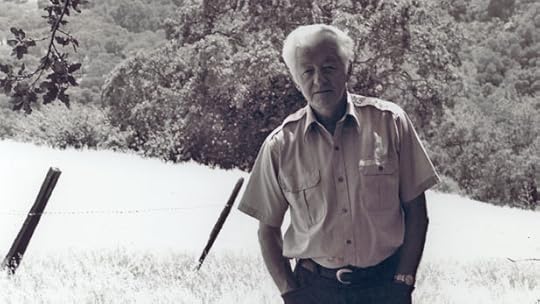
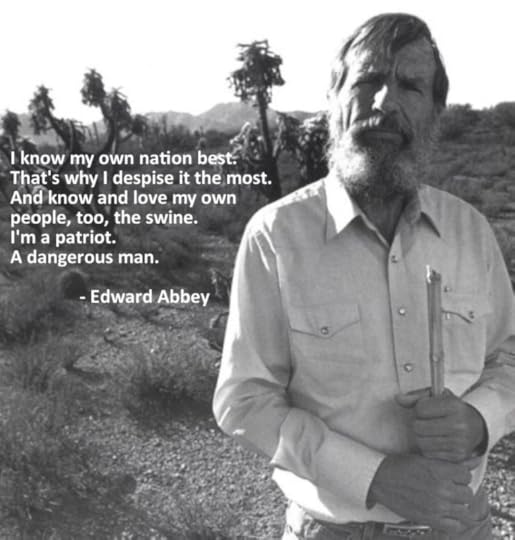
*Within my review, the 1st photo image of Wallace Stegner, while the 2nd (with quote) is of Edward Abbey.
Profile Image for William.
13 reviews9 followers
June 27, 2015
I really wanted to give this book 3.5 stars. I enjoyed it, but I never quite figured out the author's purpose in writing it or the audience he thought he was writing to. Part travel narrative, part biography (or biographies, really), part environmental screed, the book sort of meanders around a lot of different ideas, which maybe--given the fact that the book was written as the product of a long roadtrip around the West--is the author's intention. But as a result, none of the author's topics are ever addressed very fully. I'm also not sure who Gessner thinks he's writing to here. Readers who are unfamiliar with Abbey and Stegner would likely be lost; serious fans will probably be a little bored at times. I've read a lot of Abbey and a little of Stegner (just Angle of Repose, really), so I was interested much of the time, but I still don't feel that I know either of those men fully after reading the book. But on the other hand, it did whet my interest in reading more Stegner (and reminded me why I enjoy reading Abbey), so maybe it's a win in the end.
Profile Image for Angela.
7 reviews2 followers
January 27, 2019
As confusing of a title it may be (in my opinion), I am beginning to think it is because the wild that remains lives on only through books; in particular, those written by Wallace Stegner and Edward Abbey. Those 2 authors lives are detailed in this book as Gessner takes a trip through the not so wild west, to research their lives. I expected more nature, mostly because I found the book at the National Park gift shop in Zion. I did not get that. That being stated, what I did inherit was a worm hole of books to read which detail the history of the west and its former state of wildness. I recommend this book because of the way Gessner has brought together so many various authors along with the main 2, that can teach us about how the west should be...wild and nothing more. I am excited for the books newly placed on my list of those to read.
Profile Image for Ms.pegasus.
815 reviews179 followers
June 17, 2020
A roadtrip is always an uncertain undertaking, even if your companions are two dead authors. The two are Edward Abbey and Wallace Stegner. They were instrumental in shaping author David Gesssner's early interest in environmental writing. Now, decades later, he is returning with the goal of re-assessing their relevance. He is not disappointed. “It was thrilling, really, if you are allowed to use that word for reading. To see that as far back as fifty years ago Stegner and Abbey were predicting, facing, digesting and wrestling with the problems that we now think uniquely our own.” (p.3)

It is also a sobering reminder of how little their warnings have been heeded. Gessner's trip begins in the summer of 2012, the hottest then on record. It is a summer of extreme drought. The Yarnell Mountain Fire that claimed the lives of 19 elite wilderness firefighters would occur a year later. (That event is detailed by Fernanda Santos in her book The Fire Line: The Story of the Granite Mountain Hot Shots and One of the Deadliest Days in American Firefighting).

Gessner opens his book with the desolate scene of fracking and drillingg in Vernal, Utah. He adds graphic detail in a later chapter in which he cautiously interviews the residents, a majority of whom applaud the economic benefits while dismissing the long-term environmental damage.

Gessner has not only read all the writings of Abbey and Stegner, but has explored archives and interviews relatives, friends, and even a few contemporaries of the two authors. His inquiry invites psychological speculation about their contrasting personalities and literary goals.

Prospective readers might fear that this book would be of interest to a limited audience – readers already familiar with Abbey and Stegner. I do not feel this is the case. My own experience was twofold. I had read Abbey's Desert Solitaire, published in 1968, a decade after the events of his memoir. Gessner's book motivated me to re-read it. I came away with deeper insights into his contradictory pronouncements. I had heard of Stegner indirectly. He very generously offered writing guidance to Ranger Randy Morgenson, the subject of Eric Blehm's chronicle, The Last Season. Gessner's book finally converted my curiosity into action. I tackled Stegner's semi-autobiographical novel, The Big Rock Candy Mountain. Reading Gessner's musings helped me appreciate Stegner's careful craftsmanship.

Like all roadtrips, this book meanders. Gessner describes a camping trip in Havasu Canyon, tours the homestead of Abbey's youth in Home, Pennsylvania, interviews Stegner's son Page in Greensboro, Vermont, accompanies a rafting crew down the San Juan River (a tributary of the Colorado River), and hikes numerous trails seeking to recapture what Stegner and Abbey might have experienced and written about. These parts will appeal most to readers already familiar with the terrain. Likewise, Gessner's narrative meanders among unstructured insights about the two authors and their long list of writings.

I'm glad I read this book. It was an engaging introduction to two of the most significant thinkers about the American West.

NOTES:
https://www.nytimes.com/2020/06/01/bo...?
Profile Image for Bob Schnell.
650 reviews14 followers
February 11, 2015
Advanced reading copy review Due for publication April 20, 2015

In "All the Wild That Remains" author David Gessner takes us on a road trip of self-reflection, eco-tourism and literary criticism. He is following in the footsteps of the two authors who jump-started the American eco-activism of the 1970's, Edward Abbey and Wallace Stegner (neither of whom were previously familiar to me). Abbey (best known for "The Monkey Wrench Gang") was the gonzo wild man of the West, advocating direct action, while Stegner (best known for "Big Rock Candy Mountain") was more of a quiet conservationist who helped to write legislation preserving the fragile ecosystem of Anerica's deserts and prairies. Both loved the great outdoors and inspired many readers to visit and advocate for the environment. Both also helped to ruin what they loved most. Mr. Gessner covers a lot of ground, literally and figuratively, and raises more questions than he answers. Readers will have to make up their own minds about what form environmentalism should take for future generations to be able to benefit from what the West has to offer. The end result is that I now have a few books by each author on my "want to read" list. I think Mr. Gessner would call that mission accomplished.
Profile Image for Dan.
1,249 reviews52 followers
March 5, 2021
4 stars

The book is a must read for Stegner or Abbey fans. Part travelogue and part twin biography. The story faded a little at the end but some good writing and solid advice for the environmentalist in all of us.

Profile Image for Chris.
409 reviews190 followers
November 18, 2015
If you're curious about the life and writings of Edward Abbey and Wallace Stegner, maybe prior to reading their works, or even after gaining a substantial familiarity with them, All the Wild that Remains might be what you're looking for. But too often, Gessner's book limits the lives and experiences of these authors by awkwardly comparing them to his own and those of his family.

Even though one of Gessner's stated goals for the book is to place Abbey and Stegner in the modern era, to find the relevance of each to today's environmental issues, he does little more than put a neat wrapper around them.

Abbey created works that screamed for intense personal interpretation and involvement by the reader. Stegner's works require careful reading and deep thought. Neither are served by Gessner's journalistic, non-expert treatment. Forget his second-hand interpretations and read Desert Solitaire or The Sound of Mountain Water for yourself! You can read both in less time than this book, and come away a changed person for life.
Profile Image for Tuck.
2,264 reviews252 followers
July 29, 2015
a bit of a hard slog reading this (for me anyway) as in some ways this is 4 books in one, if not 5 , dual biograpy, environmentalism/land use of western usa, author gessner's road trip visiting stegner and abbey's important places, lit crit, possible trail markers for us or us of the future and what should we do now/then (umm 6?)
i really like this review of book: https://www.goodreads.com/review/show...

so to reiterate, if one is well read in stegner and abbey, this may be too slow and unenlightening, if reader knows nothing of these two giant writers this might be too 'insider', and if one is passionate about western usa land use, conservationism, long term sustainability of land water plants animals human population explosion and explosive exploitation of west usa this is interesting read, but not super helpful, to me.
but i encourage all to 'get into' abbey and stegner if you haven't, and this book is good for that ...
Profile Image for Jeff.
121 reviews59 followers
April 23, 2015
I have so much to say about this book and perhaps I'll wrote a longer review at some point. There are important environmental aspects of this book and the comparison of Abbey and Stegner is interesting. Other parts read like my high school notes from a road trip I took with my "buddies". Rarely have I read a book that I absolutely loved in places and absolutely detested in others, "A;ll the Wild That Remains" is one.
Profile Image for Thomas.
Author 1 book36 followers
June 7, 2022
Not bad.

The twin biographies were by no means comprehensive but they helped me get to know these guys better.

I read Desert Solitaire a few years ago but didn’t get the full sense of what a wild man Ed Abbey was from it. It was a good book though.

Years ago I visited Wallace Stegner’s favourite childhood home, Eastend Saskatchewan. We were camping in the Cypress Hills and decided the visit the T.rex Discovery Centre where Scotty, one of the most complete Tyrannosaurus rex skeletons ever found is housed. Hadn’t heard of Stegner then or I suppose I might have tried finding the house.

This was a fun read.
Profile Image for jeremy.
1,202 reviews309 followers
August 6, 2015
"part dueling biography, part travel narrative, part meditation, part criticism, part nature writing" -- as summed up by the author himself in his "notes on sources."

david gessner's all the wild that remains uses the lives of edward abbey and wallace stegner as a framework around which to build not only a study of their disparate writing careers, but also environmentalism in the west and the accelerating effects of climate change on the region. never dull, gessner's book wends a circuitous route, moving forward and backward in time, to explore the legacy of the american west's twin deans of environmental writing. musing upon their respective literary bequests (and his own admiration of their individual works), gessner considers the relevancy and importance of these towering titans not only in american letters, but on the attitudes and policies that have shaped the west. all the wild that remains will surely appeal to fans of both cactus ed and wally stegner (abbey's one-time professor), but also stands sturdily on its own as homage to the celebrated writers within and the landscapes they both fought so hard to preserve.
it may be an overstatement, but let's try this one on: we read wallace stegner for his virtues, but we read edward abbey for his flaws. stegner the sheriff, abbey the outlaw.
102 reviews2 followers
September 25, 2015
Both Edward Abbey and Wallace Stegner were powerful environmental writers who shared a passion for the western wilderness and fought to preserve it. In All the Wild that Remains nature writer David Gessner has created a fascinated dueling biography of Abbey and Stegner, part literary criticism, part travel narrative, part nature writing.

Desert Solitaire, a journal of Abbey's time as a ranger in Arches National Monument, has been a favorite book of mine since first reading it the seventies. I love his passion for wilderness and his ability to inspire readers to continue his fight to preserve it. This book gave me a better understanding of Abbey (his childhood, his struggles with depression and why his love for wilderness often manifested itself in lashing out at those he believed were destroying it). Wallace Stagner, who taught and worked with Abbey, provided a quote that describes Abbey's appeal so well: "His books were burrs under the saddle blanket of complacency. He had the zeal of a true believer and a stinger like a scorpion when defending the natural, free, unmanaged, unmanhandled wilderness of his chosen country." I will definitely be reading more books by both of these amazing authors.


Profile Image for Linda.
630 reviews36 followers
December 11, 2021
This is one of those things where I just can't say exactly anything because it is all so close to me and so personal; it is all my landscapes and it is all my travels; it is all my writers and all my thoughts about movement and place; it is all my personal developments when I became an adult and all my reckonings while trying to continue to be one.

While these are not more than tiny bits of the book, I'd like to offer my three cheers for the bookstore owner who makes people headed to Moab buy Abbey's Desert Solitaire (promising them double their money back if they don't like it) and I'd like to offer a huge boo! hiss! to The New York Times' refusal to review Stegner's Angle of Repose and petulant opinion piece upon its Pulitzer win.

As a bonus we get thoughts of Terry Tempest Williams 💕, Wendell Berry and Luis Alberto Urrea.

But this whole thing is one writer's reckoning with The West and with other writers, specifically two of the most vital. IT'S FCKNG GREAT.

The chapter about Vernal called Oil and Water and the Saskatchewan chapter should break your heart. Other chapters are what keep our hearts pumping to begin with: home, family, work, education, wilderness.

Humans, goddamn it.
8 reviews2 followers
September 27, 2019
I picked this up as it was recommended as an introduction to writing about the American West. It was however a deep dive into the lives of two writers, Stegner and Abbey. I found the view into these men's lives interesting, but I think I would have preferred reading their books. The story around the authors travels didn't really add much and the transitions between past stories and present were jarring.  But it did extend my to read list quite a bit as it referenced many other writers and books.
Profile Image for Clayton Chase.
445 reviews
December 18, 2022
I enjoyed the juxtaposition of Wallace Stegner and Edward Abbey throughout David Gessner’s own exploration of the west and the lore that surrounds this land which I have the great fortune to call home. As their life stories and literary works unfold, it becomes clear that the fascination with the west by these two great writers springs from the little known fact that they both actually started out in the east. This almost mythic attraction of the west by outsiders may seem like a prophet pointing out water to a fish for those in ignorant bliss. But what Gessner’s writing did for me was to further deepen my appreciation of the American West and evoked many long hidden and wonderful personal memories of growing up in Utah.
Profile Image for Ken Hunt.
167 reviews4 followers
November 13, 2018
I may be the most appreciative of this book than most on the planet, which may mean that not everyone will relate to this book anywhere near as much as I did. This book is a perfect storm of connections in my life in terms of authors, literature, western environmentalism, and ultimate frisbee, making it fascinating to me.

I live in the Pacific Northwest and grew up on the West Coast, a “city” west coast person, but not a “hardy” westerner. I am a Wallace Stegner follower (having read: “Beyond the Hundredth Meridian: John Wesley Powell and The Second Opening of the American West,” “Angle of Repose,” “Crossing to Safety,” “Big Rock Candy Mountain” (really about his Dad), and his biography “Wallace Stegner and The American West” by Philip Fradkin. I grew up in Los Altos, California, unaware of Wallace Stegner, but having lived a couple of miles from him when he taught the likes of Ken Kesey at Stanford. I am also a follower of Ken Kesey, and have read “One Flew Over The Cuckoos Nest” and “Sometimes a Great Notion” by him and “The Electric Kool Aid Acid Test (about him and his Merry Pranksters and by Tom Wolfe). Further Kesey at my daughters college , University of Oregon (where she plays ultimate frisbee) and our family consumes Darigold Dairy products, a co-p founded by Kesey’s father.

Not only did I grow up near Stegner, but my son attends The Villa School in Seattle which during The Great Depression was used to be a Catholic orphanage where Stegner and his brother lived for a time

Individually, David Gessner has some further overlap for me. I have read another of David Gessner’s books “Ultimage Glory,” where Gessner chronicles his early years playing competitive Ultimate Frisbee, a sport near and dear to my family’s hearts. He also seems to have done business with former work acquaintances of mine years ago on the Juiceman Juicer. His daughter’s name is Hadley, I read a lot of literature form the “Lost Generation” and wonder if he named her after Hemingway’s wife.

Lastly-his journey through western environmentalism rings with overlap to one of my favorite authors, Timothy Egan, in his books, “The Big Burn” and “Lasso The Wind, Away to The New West. Many of Gessner’s stories paralleled Egan’s and further validated humanity’s environmental mistakes in the West.

I have not yet ever read Edward Abbey, but am now intrigued to read “The Monkey Wrench Gang” given it is purported to be the catalyst for the more militant environmental activism such as the Earth Liberation Front (ELF) burning down of the UW Center for Urban Horticulture in May 2001, one year before I moved to Seattle.

The passage that struck me the most in this book was:

“the economy of liquidation” that had prevailed in the West since it was first settled, a philosophy that applied to aquifers and farms as well as mines. In the West “the miner’s right to exploit transcends all other rights whatsoever.” As for agriculture, it soon became clear that it was impossible without irrigation, and that irrigation itself was impossible without the massive dams that only the federal government could build. Which, combined with the fact that much grazing and mining occurred on public land, made westerners chronically dependent on government help. In fact, contrary to the image of rugged individualism, westerners were more dependent on help and community than any other region. Dams, irrigation, free private use of public land. It all amounted to a rugged, beautiful, and wild welfare state.”

An amazing read for me.
Profile Image for Joyce.
448 reviews
February 5, 2016
I am not a big " non-fiction " reader, but I picked this one simply because I am an Edward Abbey fan and a lover of the southwest. I know a little about Wallace Stegner, so I thought this would be interesting. I thoroughly enjoyed it and didn't want it to end ! David Gessner was pretty creative with the storyline, intertwining a travel diary with interviews, historical information, present and past comparisons and quotes from numerous " western" writers. I loved meeting the crazy friends of Abbey through Gessner's interviews and seeing the places That were important to both writers, through Gessner's eyes. The comparison of Abbey and Stegner was mostly one- sided for me since I have only read one book by Stegner, but I plan to read more of his. On the other hand, I've read a lot of Abbey's and still have many more I want to read. During a road trip with my husband in the southwest, I read almost an entire book of Abbey's out loud to my husband in the car and we laughed till we cried ! That book was "The Journey Home" .
This was the first book I read by David Gessner and I will definitely keep him on my list of authors I enjoy.
Profile Image for Hancock.
205 reviews3 followers
March 28, 2016
This is an excellent comparative biography of the writers Edward Abbey and Wallace Stegner. When the author discusses these subjects the book is wonderful. When he views the West from his academic ivory tower he is a bit annoying. At time he strays into his personal politics and the book gets icky. He clearly disdains white men in pick-up trucks, religion, perhaps, especially Christians, and nearly all organizations trying to make a buck in the American West. When he remains faithful to the cover's promise of a discussion of "Edward Abbey, Wallace Stegner, and the American West" he excels. His young daughter joins him on his research late in the book. His time with her is sweetly portrayed.

The excellence of this book far exceeds those icky moments.
Profile Image for Laura Hoffman Brauman.
3,118 reviews46 followers
February 15, 2022
“We are a short term people, hungry for now. But the west is a long term place.” In All the Wild That Remains, Gessner sets out to look at the life and works of Edward Abbey and Wallace Stegner and their love of the west. Both authors wrote passionately about the value of wilderness, but their style, approach, and life choices were widely different. Abbey was the radical - both in his approach to protecting the wilderness as well as in how he lived his daily life. Stegner lived a very traditional life - long marriage, career as a college professor, etc - but his writings and work on behalf of the environment have had at least as big of an impact as Abbey’s. I found it fascinating to look at how two people could care so deeply about the west and the need to protect wild spaces and have that care center their life’s work - but go about it so completely differently. The structure for Gessner’s exploration of these writers and their impact was through a series of road trips that he did through the west - alone, with friends, and with his family. Throughout the trips, he was often meeting with people who knew one of the authors (or both) - and these conversations were really a beautiful testament to the messy way we live our lives and values and the impact we have on others. A quote to end “What we do know is that both men had golden moments, and it was out of those moments, and more specifically out of the sentence es they created from them, that their books were built. Which leads to the most amazing thing of all, something that to me seems not far short of miraculous. That through the simple act of reading, those moments can be resurrected. That we can suddenly be back in the desert or at the pond. That those moments, long dead to the authors, are still fully alive and available to us.
Profile Image for Chris.
2,079 reviews29 followers
January 3, 2022
A road-trip, biography, and literary critique of two authors who knew each other and loved the American West but were very different- Wallace Stegner and Edward Abbey. One was culture, the other counter culture. One grew up in the East and never returned, the other grew up in the West as a nomad and retired to the East. Roots versus roaming. No hagiography here but an objective look at two great writers.

David Gessner, the author, loves the West too but currently teaches in North Carolina as far East as you can go-Wilmington. He really misses it too. So this book is about the West as well. Discussions on tourism (the amenities economy), extraction, agriculture are all here as well as cooperation versus competition in an arid environment. The irony of the individual and self reliant West being more dependent on the Federal Government than any other region of the country. It comes down to water.

We visit Wendell Berry in Kentucky who knew both authors. Thoreau and Montaigne are compared to our Western duo.

Some nice takeaways. Here’s one Utah Tourism should use- Utah is transcendence. Going West is like being born again. The West is the geography of hope. John Wesley Powell and his declaration of interdependence.

Ready to roll on Gessner’s next book following Teddy Roosevelt in the West.
Profile Image for Emily.
109 reviews17 followers
June 18, 2022
I land with most other reviewers about this book: good ideas, never got off the ground.

In this book, Gessner travels across the American West (sort of), trying to puzzle out the meaning of the West by following in the footsteps, real and literary (I think? sort of?), of Wallace Stegner and Edward Abbey. He tries to be Anthony Horowitz or John Steinbeck, but his stories are all just meh; he never seems to commit to a travelogue. Somehow, with travelogues, you've got to really commit to a story, and play it out with all its character and suspense - but he doesn't do that. He mentions friends and people, but there's not much story. He also tries to philosophize, but his conclusions aren't really there or fleshed out - they're just kind of floating ideas, and he jumps from one airy conclusion to the next. He also tries to compare and contrast Abbey and Stegner. This also does not really work. They're different people and they both lose out a little by the comparison, especially, to my mind, Stegner. At one point he shares a quote by Terry Tempest Williams, which he then attempts to puzzle out -and he never really lands the plane, just chases his confusion and lets it fizzle out. He talks about his biking a lot, and tries to make fun of himself, but there seems to be little point of this. In short, he tries to do too much, but never really does any of them too well, and he doesn't bring them together.

This isn't a bad book: I learned a lot about the two men's lives and their intersection points. He's clearly learned on both Abbey and Stegner. He's also well-studied on Wendell Berry, who was a strong point of this book. I appreciated a couple of his fleshed-out ideas: the fragility of the West, the disappearance of the West and its natural wonders. But even these felt disconnected. At the end of it I was left feeling like I was grasping disparate wisps of nothingness.
Profile Image for Benjamin Cossel.
29 reviews2 followers
May 6, 2022
A massive fan of Abbey but never having read Stegner, I found this one an enlightening look at the two famous western writers. Equal parts examination of the men's life and personal journey, the writer weaves a wonderful narrative questioning all we think we know of the two men, their roles in the development of environmental activism and the American west. Highly recommend. After a little more thought, for me the take away here is to live as one's authentic self - whichever or whatever that may be - the wild, iconoclast or the rooted, upright activist, in an age that would have us all conform, be your true self.
Profile Image for Kimbolimbo.
1,289 reviews16 followers
November 27, 2022
I kept putting off reading this book. I just knew it needed my undivided attention rather than being a multi-tasking book. I'm so glad I waited until I had time to listen. This book is glorious. I love these authors.
Profile Image for James Biser.
3,766 reviews20 followers
August 12, 2023
This is a great book about Edward Abbey and Wallace Stegner. It is an excellent reminder and review of these two great naturalists and fine writers. The book is amazing.
Profile Image for James.
373 reviews27 followers
July 27, 2017
Integrates the biographies of two patriarchs of the environmental movement Edward Abbey (Desert Solitaire) and Wallace Stegner (Angle of Repose).

We share the sense of awe for the wild things, a profound appreciation of western literature, and dispute with the desecration of the American west.
Profile Image for George.
Author 23 books76 followers
October 1, 2019
A compelling comparison of two vitally important western voices. Not a lot of reflection here about gender but I nevertheless appreciated the full humanity of both writers that Gessner makes visible.
Profile Image for Brooke Rose.
13 reviews1 follower
January 25, 2023
Enjoyable to listen to but the writer ended up convincing me that I would not like Edward Abbey or Wallace Stegner with this defense of all of their misogynistic and racist shortcomings...
Profile Image for Jaime.
6 reviews3 followers
June 27, 2022
Solid book. David Gestner hits the road and interviews some of the most interesting people in todays nature/ecology writing. If you like Edward Abbey or Wallace Stegner, I think this is a good one for you to pick up. If you haven’t heard or read either of them, it’s still a good one to read.
I’m interested in both writers and enjoy reading books about the West. From western expansion, to the gold rush era, etc.
I was born in the desert and grew up in the West. I’ve hiked, biked, & road tripped throughout the region. I love it here but hot damn, it’s increasingly hard to live here.
It’s dry. The drought is very real. The constant threat of fire. The smoke filled sky. Evacuations. Woof.
Anyway, this book covers all of it. From the beauty of the landscape, to the authors who cared about its preservation and what is currently going on and how to address it and think about it.
The only reason I took one star off is that if you haven’t read some of the aforementioned authors books, you’re gonna want to be aware…there are spoilers. David Gessner references many of their books and in doing so also talks about the way that they end. I was pretty disappointed and at points, I had to skim or skip entire paragraphs to avoid the spoilers. There goes Big Rock Candy Mountain! I’m still going to read it but that was a bit of a bummer, as I had been holding out on reading it.
Other than that, I’m glad I read it. It made me want to dig deeper into other books, but even better, it made me want to know David Gessner. Good stuff!
Displaying 1 - 30 of 223 reviews

Can't find what you're looking for?

Get help and learn more about the design.